

SIST EN 13238:2026
(Main)Reaction to fire tests for building products - Conditioning procedures and general rules for selection of substrates
- Abstract
This document establishes the general principles for the conditioning procedures for test specimens tested according to the European standards for reaction to fire.
The rules for the selection of substrates for construction products when carrying out reaction to fire tests are also detailed in this document. In order to use the extension rules set in this document, no modification of the standard substrate is allowed.
This document does not contain requirements for:
— the pre-drying of test specimens for the non-combustibility test according to EN ISO 1182;
— methods of cleaning (e.g. washing) and other methods for the assessment of durability aspects, which are dealt with in the relevant product standards.
- Status
- Published
- Public Enquiry End Date
- 29-Jun-2025
- Publication Date
- 25-Aug-2026
- Technical Committee
- POZ - Požarna varnost
- Current Stage
- 6060 - National Implementation/Publication (Adopted Project)
- Start Date
- 14-Aug-2026
- Due Date
- 19-Oct-2026
- Completion Date
- 26-Aug-2026

SIST EN 13238:2026 is the Slovenian adoption of EN 13238:2026 from CEN, published by SIST, for reaction to fire tests for building products. It specifies how test specimens are conditioned and how standard substrates are selected for reaction-to-fire testing. Engineers, laboratories, manufacturers and certification users apply it when they need test results that reflect end use conditions.
What does SIST EN 13238:2026 specify?
SIST EN 13238:2026 sets the general principles for conditioning test specimens before reaction-to-fire tests and the rules for choosing substrates for construction products. It is intended for use together with the European test standards for reaction to fire, so the specimen preparation matches the test method and the intended application.
The document is organized into five clauses plus a bibliography:
- Clause 1 Scope
- Clause 2 Normative references
- Clause 3 Terms and definitions
- Clause 4 Conditioning procedures
- Clause 5 General rules for selection of substrates
It excludes pre-drying for the non-combustibility test according to EN ISO 1182 and methods such as cleaning or washing used to assess durability, which are handled in the relevant product standards.
What are the key requirements of SIST EN 13238:2026?
Conditioning procedures
SIST EN 13238:2026 requires test specimens for the listed reaction-to-fire methods to be conditioned at 23 ± 2 °C and 50 ± 5 % relative humidity. The specimens must be arranged so that air can circulate around each one. In practice, this gives a controlled starting condition before testing and reduces variation between laboratories.
Clause 4 allows two conditioning routes: conditioning to constant mass or conditioning for a fixed period. Constant mass means two weighings 24 hours apart that differ by no more than 0,1 % of the specimen mass or 0,1 g, whichever is greater, after at least 48 h in the conditioning atmosphere. For fixed-period conditioning, the specimens must first be properly cured, contain no excess water above the stated limit, and then stay in the conditioning atmosphere for the relevant minimum period.
The fixed periods depend on the product type:
- 8 weeks for fire retardant-treated wood and wood-based products, and for cement-based products
- 4 weeks for calcium silicate products, gypsum and gypsum-based products, and other hygroscopic materials
- 2 weeks for all other products
Selection of substrates
Clause 5 ties the substrate choice to the field of application of the test result. For floorings, the end use substrate must meet the density and thickness rules, and the method of attachment, such as adhesive type, quantity, order of application, curing and drying time, must reflect end use practice. If different adhesives are used in practice, separate specimens are needed.
For construction products excluding floorings, Table 1 defines the standard substrates and their representative use. The rules link end use substrates to standard substrates by density, thickness and reaction-to-fire class. For example, A1 substrates represent only A1, A2-s1, d0 substrates represent A2-s1, d0 and A1, and wood-based standard substrates cover wood-based end use substrates with the same or better class.
Clause 5 also says that surface products may need a reproduced air gap up to 40 mm, unless another value is specified, and that layers behind the immediate substrate must be included when they affect performance. If the end use substrate is not represented by a standard substrate, the product is tested in end use condition.
Substrate checking
Clause 5.1 requires one indicative test on each batch of standard substrates used for EN ISO 9239-1, EN ISO 11925-2, EN 13823, EN 14390 and CEN/TS 1187, when appropriate. That means laboratories need to verify the substrate batch before relying on it for classification work.
What terms does SIST EN 13238:2026 define?
- Material - a single basic substance or a uniformly dispersed mixture of substances.
- Product - a material, element or component about which information is required.
- Substrate - the product beneath the system or product being assessed.
- Standard substrate - a product that represents the substrate used in end use applications.
- Test specimen - the piece of product tested, with or without substrate or treatment.
- Conditioning - exposure to a controlled atmosphere.
Who uses SIST EN 13238:2026?
SIST EN 13238:2026 is used by laboratories running reaction-to-fire tests, because it tells them how to prepare specimens and choose substrates consistently. It is also used by manufacturers and product developers who need their test samples to reflect the intended installation.
Quality managers, specifiers and certification bodies use it when they need test results that can be linked to end use conditions and to fire classification work under EN 13501-1. It is especially relevant for flooring products and other construction products tested under the EN reaction-to-fire test family.
What changed in SIST EN 13238:2026 from the previous edition?
SIST EN 13238:2026 supersedes SIST EN 13238:2010.
The European foreword states two significant technical changes:
- adjustments to the requirements for the current available quality of substrates
- re-evaluation of the conditioning periods
Which standards are used with SIST EN 13238:2026?
- EN 13501-1 - used for fire classification based on reaction-to-fire test data.
- EN 13823, EN 14390, EN 16733, CEN/TS 1187, EN ISO 1182, EN ISO 1716, EN ISO 9239-1, EN ISO 11925-2 - the reaction-to-fire test methods to which the conditioning and substrate rules apply.
- EN 312, EN 520, EN 636, EN 12467, EN 13820 - product and material standards used to define standard substrates and related properties.
- EN ISO 13943 - the vocabulary source for the terms and definitions in clause 3.
What does the SIST EN 13238:2026 document contain?
The document contains the conditioning procedure for test specimens, including the controlled atmosphere, constant-mass method and fixed-period method. It also contains the substrate-selection rules for floorings and for construction products excluding floorings.
Table 1 lists the standard substrates and shows their nature, density, thickness, class and the selection rules they support. Clause 5 also describes when to reproduce air gaps, attachments and additional layers, which makes the test specimen closer to the real installation.
A bibliography gives related references used for context.
Relations
- Effective Date
- 01-Oct-2026
- Effective Date
- 16-Sep-2026
- Effective Date
- 02-Sep-2026
- Effective Date
- 05-Aug-2026
- Effective Date
- 05-Aug-2026
- Effective Date
- 05-Aug-2026
- Effective Date
- 05-Aug-2026
- Effective Date
- 05-Aug-2026
- Effective Date
- 05-Aug-2026
- Effective Date
- 05-Aug-2026
- Effective Date
- 05-Aug-2026
- Effective Date
- 05-Aug-2026
- Effective Date
- 05-Aug-2026
- Effective Date
- 05-Aug-2026
- Effective Date
- 05-Aug-2026
Get Certified
Connect with accredited certification bodies for this standard

CIS Institut d.o.o.
Personal Protective Equipment (PPE) certification body. Notified Body NB-2890 for EU Regulation 2016/425 PPE.

Kiwa BDA Testing
Building and construction product certification.
Kmetijski inštitut Slovenije
Agricultural Institute of Slovenia. Soil testing, plant health, agricultural product analysis.
Sponsored listings
Frequently Asked Questions
SIST EN 13238:2026 is a standard published by the Slovenian Institute for Standardization (SIST). Its full title is "Reaction to fire tests for building products - Conditioning procedures and general rules for selection of substrates". This standard covers: This document establishes the general principles for the conditioning procedures for test specimens tested according to the European standards for reaction to fire. The rules for the selection of substrates for construction products when carrying out reaction to fire tests are also detailed in this document. In order to use the extension rules set in this document, no modification of the standard substrate is allowed. This document does not contain requirements for: — the pre-drying of test specimens for the non-combustibility test according to EN ISO 1182; — methods of cleaning (e.g. washing) and other methods for the assessment of durability aspects, which are dealt with in the relevant product standards.
This document establishes the general principles for the conditioning procedures for test specimens tested according to the European standards for reaction to fire. The rules for the selection of substrates for construction products when carrying out reaction to fire tests are also detailed in this document. In order to use the extension rules set in this document, no modification of the standard substrate is allowed. This document does not contain requirements for: — the pre-drying of test specimens for the non-combustibility test according to EN ISO 1182; — methods of cleaning (e.g. washing) and other methods for the assessment of durability aspects, which are dealt with in the relevant product standards.
SIST EN 13238:2026 is classified under the following ICS (International Classification for Standards) categories: 13.220.50 - Fire-resistance of building materials and elements. The ICS classification helps identify the subject area and facilitates finding related standards.
SIST EN 13238:2026 has the following relationships with other standards: It is inter standard links to SIST EN 13238:2010, SIST EN 13820:2004, SIST EN 636:2013+A1:2015, SIST EN ISO 1182:2020, SIST EN ISO 9239-1:2025, SIST EN 15651-2:2013, SIST EN 13830:2015+A1:2020, SIST EN 14319-1:2013, SIST EN 16351:2021, SIST EN 14081-1:2016+A1:2019, SIST EN 14320-1:2013, SIST EN 15651-1:2013, SIST EN 13823:2020+A1:2022, SIST EN 490:2012, SIST EN 12004:2007+A1:2012. Understanding these relationships helps ensure you are using the most current and applicable version of the standard.
SIST EN 13238:2026 is associated with the following European legislation: EU Directives/Regulations: 305/2011; Standardization Mandates: M/088, M/117. When a standard is cited in the Official Journal of the European Union, products manufactured in conformity with it benefit from a presumption of conformity with the essential requirements of the corresponding EU directive or regulation.
SIST EN 13238:2026 is available in PDF format for immediate download after purchase. The document can be added to your cart and obtained through the secure checkout process. Digital delivery ensures instant access to the complete standard document.
Standards Content (Sample)
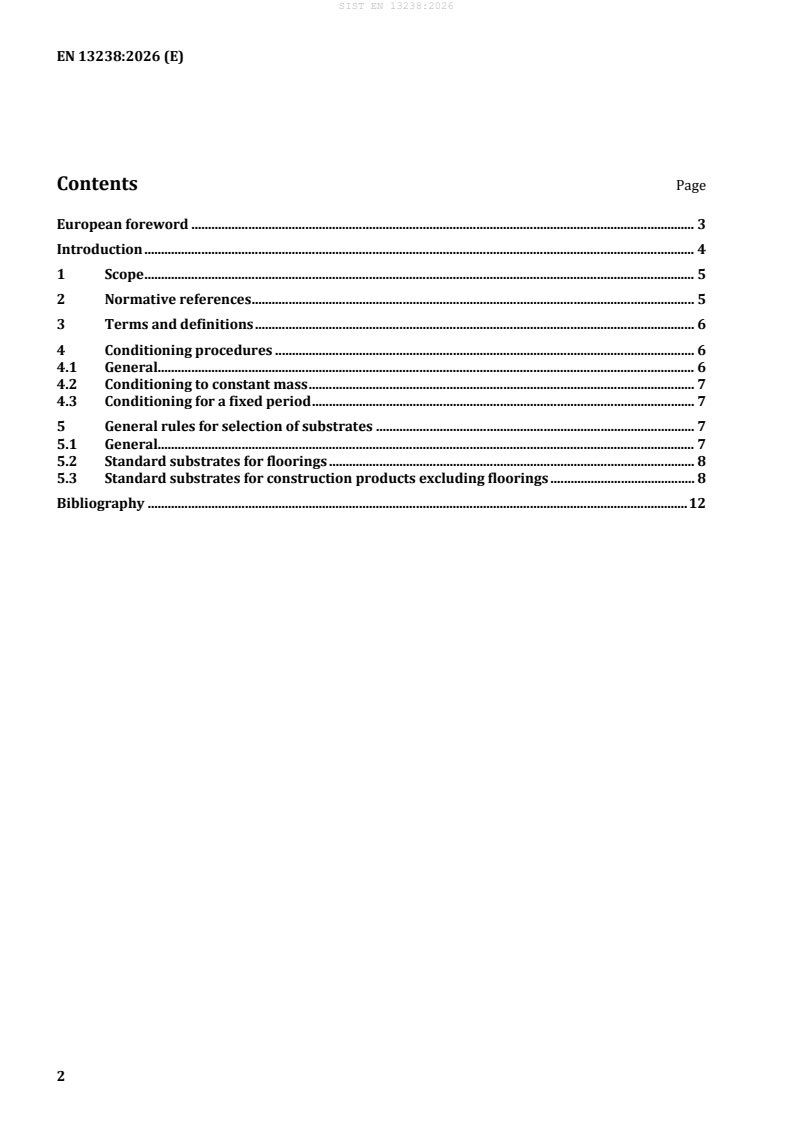
Contents
- Introduction
- 1 Scope
- 2 Normative references
- 3 Terms and definitions
- 3.1 material
- 3.2 product
- 3.3 substrate
- 3.4 standard substrate
- 3.5 test specimen
- 3.6 conditioning
- 4 Conditioning procedures
- 4.1 General
- 4.2 Conditioning to constant mass
- 4.3 Conditioning for a fixed period
- 5 General rules for selection of substrates
- 5.1 General
- 5.2 Standard substrates for floorings
- 5.3 Standard substrates for construction products excluding floorings
- Bibliography
Introduction
The Construction Products Regulation (CPR) requires products to be tested in their end use condition which, for the purpose of substrates, could lead to an economically unrealistic large variety of tests to be carried out. This large spectrum has been reduced to a practical number of standard substrates that enables the majority of end use conditions to be represented. Rules for the selection of such substrates are given in this document.
This document is intended for use in conjunction with European Standards covering the reaction to fire test methods for the relevant construction products.
SIST EN 13238:2026 EN 13238:2026 (E)
1 Scope
This document establishes the general principles for the conditioning procedures for test specimens tested according to the European standards for reaction to fire. The rules for the selection of substrates for construction products when carrying out reaction to fire tests are also detailed in this document. In order to use the extension rules set in this document, no modification of the standard substrate is allowed.
This document does not contain requirements for:
- the pre-drying of test specimens for the non-combustibility test according to EN ISO 1182;
- methods of cleaning (e.g. washing) and other methods for the assessment of durability aspects, which are dealt with in the relevant product standards.
2 Normative references
The following documents are referred to in the text in such a way that some or all of their content constitutes requirements of this document. For dated references, only the edition cited applies. For undated references, the latest edition of the referenced document (including any amendments) applies. EN 312, Particleboards — Specifications EN 520, Gypsum plasterboards — Definitions, requirements and test methods EN 636, Plywood — Specifications EN 12467, Fibre-cement flat sheets — Product specification and test methods EN 13501-1, Fire classification of construction products and building elements — Part 1: Classification using data from reaction to fire tests EN 13820, Thermal insulating materials for building applications — Determination of organic content EN 13823, Reaction to fire tests for building products — Building products excluding floorings exposed to the thermal attack by a single burning item EN 14390, Fire test — Large-scale room reference test for surface products EN 16733, Reaction to fire tests for building products — Determination of a building product’s propensity to undergo continuous smouldering CEN/TS 1187, Test methods for external fire exposure to roofs EN ISO 1182, Reaction to fire tests for products — Non-combustibility test (ISO 1182) EN ISO 1716, Reaction to fire tests for products — Determination of the gross heat of combustion (calorific value) (ISO 1716) EN ISO 9239-1, Reaction to fire tests for floorings — Part 1: Determination of the burning behaviour using a radiant heat source (ISO 9239-1) EN ISO 11925-2, Reaction to fire tests — Ignitability of products subjected to direct impingement of flame — Part 2: Single-flame source test (ISO 1192-2)
SIST EN 13238:2026 EN 13238:2026 (E) EN ISO 13943, Fire safety — Vocabulary (ISO 13943)
3 Terms and definitions
For the purposes of this document, the terms and definitions given in EN ISO 13943 and the following apply.
ISO and IEC maintain terminology databases for use in standardization at the following addresses:
- ISO Online browsing platform: available at https://www.iso.org/obp/
- IEC Electropedia: available at https://www.electropedia.org/
3.1 material
single basic substance or uniformly dispersed mixture of substances EXAMPLE Metal, stone, timber, concrete, mineral wool with uniformly dispersed binder or polymers.
3.2 product
material, element or component about which information is required
3.3 substrate
product which is used beneath the system or the product about which information is required Note 1 to entry: For a flooring, it is the floor on which the flooring is mounted or the material which represents this floor.
3.4 standard substrate
product which is representative of the substrate used in end use applications
3.5 test specimen
piece of the product which is to be tested together with or without any substrate or treatment Note 1 to entry: The test specimen may include an air gap.
3.6 conditioning
exposure to a controlled atmosphere
4 Conditioning procedures
4.1 General
Test specimens used by the laboratory to conduct tests according to EN ISO 1182, EN ISO 1716, EN ISO 9239-1, EN ISO 11925-2, EN 13823, EN 14390, EN 16733 and CEN/TS 1187 T2 and T4 shall be conditioned at a temperature of (23 ± 2) °C and a relative humidity of (50 ± 5) %. NOTE This corresponds to the recommended atmosphere and normal tolerances given in ISO 554. The tolerances stated are on the actual measured values and should not include the uncertainty of measurement of the instruments themselves.
SIST EN 13238:2026 EN 13238:2026 (E) Test specimens shall be arranged within the conditioning environment in such a way that air can circulate around each individual test specimen.
Test specimens shall be conditioned either until constant mass is achieved (see 4.2) or for a fixed period (see 4.3).
...