

EN ISO 21469:2006
(Main)Safety of machinery - Lubricants with incidental product contact - Hygiene requirements (ISO 21469:2006)
- Abstract
ISO 21469:2006 specifies hygiene requirements for the formulation, manufacture, use and handling of lubricants which, during manufacture and processing, can come into incidental contact (e.g. through heat transfer, load transmission, lubrication or the corrosion protection of machinery) with products and packaging used in the food, food-processing, cosmetics, pharmaceutical, tobacco or animal-feeding-stuffs industries. It is not applicable to substances used as product additives or to those in direct product contact, but confines itself to hygiene without addressing occupational health and safety matters.
- Status
- Published
- Publication Date
- 14-Feb-2006
- Withdrawal Date
- 30-Aug-2006
- Technical Committee
- CEN/TC 114 - Safety of machinery
- Drafting Committee
- CEN/TC 114 - Safety of machinery
- Current Stage
- 6060 - Definitive text made available (DAV) - Publishing
- Start Date
- 15-Feb-2006
- Completion Date
- 15-Feb-2006


Overview
EN ISO 21469:2006 / ISO 21469:2006 - “Safety of machinery - Lubricants with incidental product contact - Hygiene requirements” specifies hygiene requirements for the formulation, manufacture, use and handling of lubricants that may have incidental contact with products or packaging in the food, food‑processing, cosmetics, pharmaceutical, tobacco and animal‑feeding‑stuffs industries. It addresses hygiene only (not occupational health and safety) and is intended for lubricants that might contaminate products unintentionally, not for direct product additives or deliberately contacting substances.
Key topics and requirements
- Scope & definitions: clarifies terms such as lubricant, product, incidental product contact and intended use.
- List of hygiene hazards: biological (pathogens), chemical (toxic, carcinogenic, mutagenic substances), physical (wear metals).
- Risk assessment elements: contamination sources, water ingress, service life, thermal/mechanical/oxidative changes, foreseeable misuse.
- Hygienic design & composition:
- Selection from ISO 6743‑99 classification and relevant ISO lubricant specifications.
- Formulations must be composed so that any residues from incidental contact are harmless to consumer health and do not adversely affect taste, odour or intended use.
- Use of substances listed/authorized by recognized bodies (see Annex A: JECFA, EC directives, CFR references).
- Good manufacturing practice (GMP): procedures to avoid cross‑contamination during production and packaging.
- Manufacturer’s compliance verification: examine formulation, manufacturing procedures, independent inspection, laboratory testing and registration criteria (Annex B).
- Information for use: clear labelling indicating suitability for incidental food contact, shelf life, storage and packaging protection.
Applications
- Ensures hygienic selection and control of incidental contact lubricants on food‑processing lines, packaging machinery, conveyors, bearings, gearboxes, hydraulic and pneumatic systems in regulated industries.
- Supports supplier declarations and lubricant registration for use where cross‑contamination cannot be fully prevented.
- Used during procurement, supplier audits, HACCP planning and machine design reviews to reduce product contamination risk.
Who should use this standard
- Lubricant manufacturers and formulators preparing products for incidental product contact.
- Machinery designers and maintenance engineers specifying lubricants for food and pharmaceutical equipment.
- Quality, regulatory and HACCP teams in food, cosmetics and pharma companies.
- Third‑party inspectors and laboratories verifying compliance.
Related standards
- ISO 6743 series (lubricant classification)
- ISO 12100‑1 (safety of machinery - basic concepts)
- ISO 14159 (guidance on hygienic design)
EN ISO 21469:2006 provides a practical hygiene framework for lubricant selection, manufacturing controls and labelling to reduce contamination risk where incidental product contact may occur.
Relations
- Effective Date
- 25-Aug-2026
- Effective Date
- 25-Aug-2026
- Effective Date
- 25-Aug-2026
- Effective Date
- 25-Aug-2026
- Effective Date
- 25-Aug-2026
- Effective Date
- 25-Aug-2026
- Effective Date
- 25-Aug-2026
- Effective Date
- 25-Aug-2026
- Effective Date
- 25-Aug-2026
- Effective Date
- 25-Aug-2026
- Effective Date
- 25-Aug-2026
- Effective Date
- 25-Aug-2026
- Effective Date
- 25-Aug-2026
- Effective Date
- 25-Aug-2026
- Effective Date
- 25-Aug-2026
Get Certified
Connect with accredited certification bodies for this standard

BSI Group
BSI (British Standards Institution) is the business standards company that helps organizations make excellence a habit.

Bureau Veritas
Bureau Veritas is a world leader in laboratory testing, inspection and certification services.

DNV
DNV is an independent assurance and risk management provider.
Sponsored listings
Frequently Asked Questions
EN ISO 21469:2006 is a standard published by the European Committee for Standardization (CEN). Its full title is "Safety of machinery - Lubricants with incidental product contact - Hygiene requirements (ISO 21469:2006)". This standard covers: ISO 21469:2006 specifies hygiene requirements for the formulation, manufacture, use and handling of lubricants which, during manufacture and processing, can come into incidental contact (e.g. through heat transfer, load transmission, lubrication or the corrosion protection of machinery) with products and packaging used in the food, food-processing, cosmetics, pharmaceutical, tobacco or animal-feeding-stuffs industries. It is not applicable to substances used as product additives or to those in direct product contact, but confines itself to hygiene without addressing occupational health and safety matters.
ISO 21469:2006 specifies hygiene requirements for the formulation, manufacture, use and handling of lubricants which, during manufacture and processing, can come into incidental contact (e.g. through heat transfer, load transmission, lubrication or the corrosion protection of machinery) with products and packaging used in the food, food-processing, cosmetics, pharmaceutical, tobacco or animal-feeding-stuffs industries. It is not applicable to substances used as product additives or to those in direct product contact, but confines itself to hygiene without addressing occupational health and safety matters.
EN ISO 21469:2006 is classified under the following ICS (International Classification for Standards) categories: 13.110 - Safety of machinery; 67.020 - Processes in the food industry. The ICS classification helps identify the subject area and facilitates finding related standards.
EN ISO 21469:2006 has the following relationships with other standards: It is inter standard links to ISO 6743-15:2000, ISO 6743-4:1999, ISO 6743-3:2003, ISO 6743-8:1987, ISO 6743-13:2002, ISO 6743-2:1981, ISO 6743-9:2003, ISO 6743-14:1994, ISO 6743-6:1990, ISO 6743-11:1990, ISO 6743-5:1988, ISO 12100-1:2003, ISO 6743-1:2002, ISO 6743-7:1986, ISO 6743-10:1989. Understanding these relationships helps ensure you are using the most current and applicable version of the standard.
EN ISO 21469:2006 is available in PDF format for immediate download after purchase. The document can be added to your cart and obtained through the secure checkout process. Digital delivery ensures instant access to the complete standard document.
Standards Content (Sample)
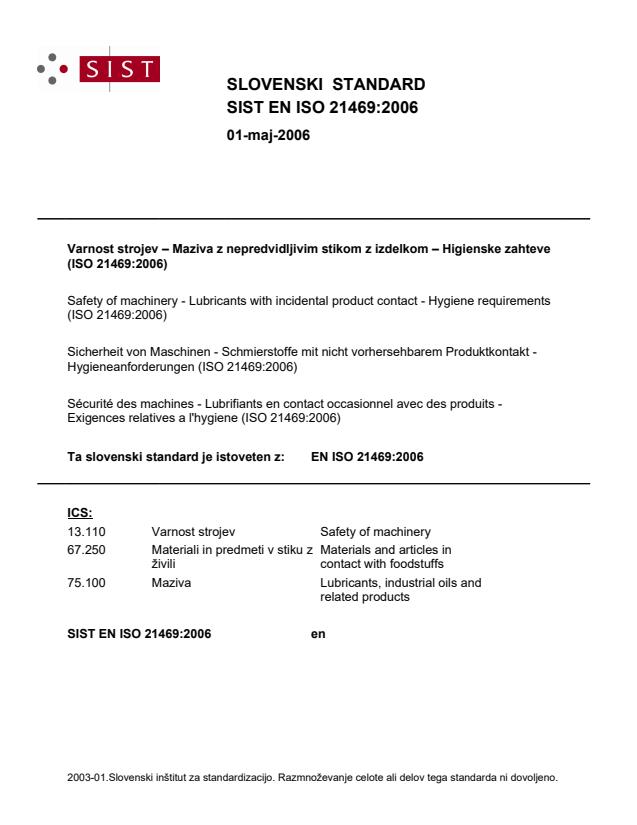
SLOVENSKI STANDARD
01-maj-2006
Varnost strojev – Maziva z nepredvidljivim stikom z izdelkom – Higienske zahteve
(ISO 21469:2006)
Safety of machinery - Lubricants with incidental product contact - Hygiene requirements
(ISO 21469:2006)
Sicherheit von Maschinen - Schmierstoffe mit nicht vorhersehbarem Produktkontakt -
Hygieneanforderungen (ISO 21469:2006)
Sécurité des machines - Lubrifiants en contact occasionnel avec des produits -
Exigences relatives a l'hygiene (ISO 21469:2006)
Ta slovenski standard je istoveten z: EN ISO 21469:2006
ICS:
13.110 Varnost strojev Safety of machinery
67.250 Materiali in predmeti v stiku z Materials and articles in
živili contact with foodstuffs
75.100 Maziva Lubricants, industrial oils and
related products
2003-01.Slovenski inštitut za standardizacijo. Razmnoževanje celote ali delov tega standarda ni dovoljeno.
EUROPEAN STANDARD
EN ISO 21469
NORME EUROPÉENNE
EUROPÄISCHE NORM
February 2006
ICS 67.020; 13.110
English Version
Safety of machinery - Lubricants with incidental product contact -
Hygiene requirements (ISO 21469:2006)
Sécurité des machines - Lubrifiants en contact occasionnel Sicherheit von Maschinen - Schmierstoffe mit nicht
avec des produits - Exigences relatives à l'hygiène (ISO vorhersehbarem Produktkontakt - Hygieneanforderungen
21469:2006) (ISO 21469:2006)
This European Standard was approved by CEN on 6 February 2006.
CEN members are bound to comply with the CEN/CENELEC Internal Regulations which stipulate the conditions for giving this European
Standard the status of a national standard without any alteration. Up-to-date lists and bibliographical references concerning such national
standards may be obtained on application to the Central Secretariat or to any CEN member.
This European Standard exists in three official versions (English, French, German). A version in any other language made by translation
under the responsibility of a CEN member into its own language and notified to the Central Secretariat has the same status as the official
versions.
CEN members are the national standards bodies of Austria, Belgium, Cyprus, Czech Republic, Denmark, Estonia, Finland, France,
Germany, Greece, Hungary, Iceland, Ireland, Italy, Latvia, Lithuania, Luxembourg, Malta, Netherlands, Norway, Poland, Portugal, Romania,
Slovakia, Slovenia, Spain, Sweden, Switzerland and United Kingdom.
EUROPEAN COMMITTEE FOR STANDARDIZATION
COMITÉ EUROPÉEN DE NORMALISATION
EUROPÄISCHES KOMITEE FÜR NORMUNG
Management Centre: rue de Stassart, 36 B-1050 Brussels
© 2006 CEN All rights of exploitation in any form and by any means reserved Ref. No. EN ISO 21469:2006: E
worldwide for CEN national Members.
Foreword
This document (EN ISO 21469:2006) has been prepared by Technical Committee ISO/TC 199
"Safety of machinery" in collaboration with Technical Committee CEN/TC 114 "Safety of
machinery", the secretariat of which is held by DIN.
This European Standard shall be given the status of a national standard, either by publication of
an identical text or by endorsement, at the latest by August 2006, and conflicting national
standards shall be withdrawn at the latest by August 2006.
According to the CEN/CENELEC Internal Regulations, the national standards organizations of
the following countries are bound to implement this European Standard: Austria, Belgium,
Cyprus, Czech Republic, Denmark, Estonia, Finland, France, Germany, Greece, Hungary,
Iceland, Ireland, Italy, Latvia, Lithuania, Luxembourg, Malta, Netherlands, Norway, Poland,
Portugal, Romania, Slovakia, Slovenia, Spain, Sweden, Switzerland and United Kingdom.
Endorsement notice
The text of ISO 21469:2006 has been approved by CEN as EN ISO 21469:2006 without any
modifications.
INTERNATIONAL ISO
STANDARD 21469
First edition
2006-02-15
Safety of machinery — Lubricants with
incidental product contact — Hygiene
requirements
Sécurité des machines — Lubrifiants en contact occasionnel avec des
produits — Exigences relatives à l'hygiène
Reference number
ISO 21469:2006(E)
©
ISO 2006
ISO 21469:2006(E)
PDF disclaimer
This PDF file may contain embedded typefaces. In accordance with Adobe's licensing policy, this file may be printed or viewed but
shall not be edited unless the typefaces which are embedded are licensed to and installed on the computer performing the editing. In
downloading this file, parties accept therein the responsibility of not infringing Adobe's licensing policy. The ISO Central Secretariat
accepts no liability in this area.
Adobe is a trademark of Adobe Systems Incorporated.
Details of the software products used to create this PDF file can be found in the General Info relative to the file; the PDF-creation
parameters were optimized for printing. Every care has been taken to ensure that the file is suitable for use by ISO member bodies. In
the unlikely event that a problem relating to it is found, please inform the Central Secretariat at the address given below.
© ISO 2006
All rights reserved. Unless otherwise specified, no part of this publication may be reproduced or utilized in any form or by any means,
electronic or mechanical, including photocopying and microfilm, without permission in writing from either ISO at the address below or
ISO's member body in the country of the requester.
ISO copyright office
Case postale 56 • CH-1211 Geneva 20
Tel. + 41 22 749 01 11
Fax + 41 22 749 09 47
E-mail copyright@iso.org
Web www.iso.org
Published in Switzerland
ii © ISO 2006 – All rights reserved
ISO 21469:2006(E)
Foreword
ISO (the International Organization for Standardization) is a worldwide federation of national standards bodies
(ISO member bodies). The work of preparing International Standards is normally carried out through ISO
technical committees. Each member body interested in a subject for which a technical committee has been
established has the right to be represented on that committee. International organizations, governmental and
non-governmental, in liaison with ISO, also take part in the work. ISO collaborates closely with the
International Electrotechnical Commission (IEC) on all matters of electrotechnical standardization.
International Standards are drafted in accordance with the rules given in the ISO/IEC Directives, Part 2.
The main task of technical committees is to prepare International Standards. Draft International Standards
adopted by the technical committees are circulated to the member bodies for voting. Publication as an
International Standard requires approval by at least 75 % of the member bodies casting a vote.
Attention is drawn to the possibility that some of the elements of this document may be the subject of patent
rights. ISO shall not be held responsible for identifying any or all such patent rights.
ISO 21469 was prepared by Technical Committee ISO/TC 199, Safety of machinery.
ISO 21469:2006(E)
Introduction
During the production of foodstuffs, cosmetics, pharmaceutical, tobacco and animal feeding products —
including packaging in direct contact with the product — it is essential to avoid contamination with lubricants
from machine elements such as gears, bearings, hydraulics, pneumatics, compressors, slideways and chains.
In all cases where product and lubricant contact cannot be fully prevented, lubricants have to be used which
are acceptable for use should cross-contamination occur.
Up until 1998, the United States Department of Agriculture (USDA) issued the USDA H1 authorization for
lubricants, which met these requirements. Use of such lubricants gave users confidence that they were
complying with best practice in relation to their duty of care to the consumer. Following the end of the USDA
scheme, the need was recognized for an International Standard to be developed in this area.
The structure of safety standards in the field of machinery is as follows.
a) Type-A standards (basis standards) give basic concepts, principle for design, and general aspects that
can be applied to machinery.
b) Type-B standards (generic safety standards) deal with one or more safety aspect(s) or one or more
type(s) of safeguards that can be used across a wide range of machinery:
⎯ type-B1 standards on particular safety aspects (e.g. safety distances, surface temperature, noise);
⎯ type-B2 standards on safeguards (e.g. two-hands controls, interlocking devices, pressure-sensitive
devices, guards).
c) Type-C standards (machinery safety standards) deal with detailed safety requirements for a particular
machine or group of machines.
This International Standard is a type-B standard as stated in ISO 12100-1.
When provisions of a type-C standard are different from those which are stated in type-A or type-B standards,
the provisions of the type-C standard take precedence over the provisions of the other standards for machines
that have been designed and built according to the provisions of the type-C standard.
iv © ISO 2006 – All rights reserved
INTERNATIONAL STANDARD ISO 21469:2006(E)
Safety of machinery — Lubricants with incidental product
contact — Hygiene requirements
1 Scope
This International Standard specifies hygiene requirements for the formulation, manufacture, use and handling
of lubricants which, during manufacture and processing, can come into incidental contact (e.g. through heat
transfer, load transmission, lubrication or the corrosion protection of machinery) with products and packaging
used in the food, food-processing, cosmetics, pharmaceutical, tobacco or animal-feeding-stuffs industries.
Included in this document are registration criteria that can be used to assess conformance with this
International standard for lubricants with incidental product contact (see Annex B). It is not applicable to
substances used as product additives or to those in direct product contact (see Annex A), but confines itself to
hygiene without addressing occupational health and safety matters. Nevertheless, it is considered essential
that where occupational hea
...