


EN 1369:2012
(Main)Founding - Magnetic particle testing
Founding - Magnetic particle testing
This European Standard specifies a magnetic particle testing method for ferro-magnetic iron and steel castings.
NOTE An iron or steel casting is considered to be ferro-magnetic if the magnetic induction is greater than 1 T (Tesla) for a magnetic field strength of 2,4 kA/m.
Gießereiwesen - Magnetpulverprüfung
Diese Europäische Norm legt die Magnetpulverprüfung an ferromagnetischen Eisen- und Stahlgussstücken fest.
ANMERKUNG Ein Gussstück aus Gusseisen oder Stahl wird als ferromagnetisch betrachtet, wenn die magnetische Induktion bei einer magnetischen Feldstärke von 2,4 kA/m größer als 1 T (Tesla) ist.
Fonderie - Contrôle par magnétoscopie
La présente Norme européenne spécifie une méthode de contrôle par magnétoscopie des pièces moulées en fonte et en acier ferromagnétiques.
NOTE Une pièce moulée en fonte ou en acier est considérée comme étant ferromagnétique si son induction magnétique est supérieure à 1 T (Tesla) pour un champ magnétique de 2,4 kA/m.
Livarstvo - Preskušanje z magnetnim prahom
Ta evropski standard določa metodo preskušanja z magnetnim prahom za feromagnetne železne in jeklene ulitke.
General Information
- Status
- Published
- Publication Date
- 16-Oct-2012
- Withdrawal Date
- 29-Apr-2013
- Technical Committee
- CEN/TC 190 - Foundry technology
- Drafting Committee
- CEN/TC 190/WG 11 - Surface inspection
- Current Stage
- 9093 - Decision to confirm - Review Enquiry
- Start Date
- 10-Nov-2022
- Completion Date
- 14-Apr-2025
Relations
- Effective Date
- 24-Oct-2012
Overview
EN 1369:2012 (CEN) - "Founding - Magnetic particle testing" - is a European standard that specifies magnetic particle testing (MPT) methods for ferro‑magnetic iron and steel castings. It complements EN ISO 9934‑1 (general MPT principles) by giving casting‑specific requirements, acceptance criteria and classification rules. A casting is considered ferro‑magnetic in this standard if the magnetic induction exceeds 1 T at a magnetic field strength of 2,4 kA/m.
Key topics and technical requirements
- Scope and application
- Applies to inspection of agreed casting surfaces and agreed sampling/percentage of castings.
- Testing stages and inspected areas must be defined in the order between manufacturer and purchaser.
- Testing method
- Follow operating modes in EN ISO 9934‑1; detection media per EN ISO 9934‑2.
- Unless otherwise specified, magnetize sequentially in two perpendicular directions so each discontinuity is checked against flux in at least one direction.
- Indication classification
- Three indication types: SM (non‑linear), LM (linear) and AM (aligned).
- Definitions use the length (L) to width (W) ratio and rules for grouping aligned indications.
- Use a 105 mm × 148 mm reference frame to evaluate the worst‑case area.
- Severity levels and acceptance
- Severity levels (tables for SM/LM/AM) define minimum detectable sizes, maximum cumulative length/area and allowable counts.
- A casting conforms if the observed severity level is equal to or better than that specified in the order.
- Surface preparation & viewing
- Surfaces must be clean and free of contaminants; gentle blasting if needed.
- Viewing conditions per EN ISO 3059 (naked eye or up to ×3 magnification).
- Personnel & reporting
- Operators should be qualified to EN ISO 9712 (or equivalent).
- Test report format follows EN ISO 9934‑1; model report provided in annex.
- Post‑test
- Cleaning and demagnetization practices are specified; avoid magnetic handling after demagnetization.
Applications and users
EN 1369 is intended for:
- Foundry engineers and quality managers specifying acceptance criteria for castings
- NDT technicians performing magnetic particle testing on iron and steel castings
- Purchasers and inspectors agreeing inspection requirements at order placement
- Fabricators, OEMs and maintenance teams that need reliable MPT procedures for casting quality control
Practical uses include in‑process inspection of castings, final quality acceptance, and defining contractual NDT requirements for cast components.
Related standards
- EN ISO 9934‑1: Magnetic particle testing - General principles
- EN ISO 9934‑2: Detection media
- EN ISO 9712: Qualification and certification of NDT personnel
- EN ISO 3059: Viewing conditions for penetrant and magnetic particle testing
Keywords: EN 1369, magnetic particle testing, foundry, castings, ferro‑magnetic, NDT, severity levels, acceptance criteria, demagnetization, surface preparation.



Frequently Asked Questions
EN 1369:2012 is a standard published by the European Committee for Standardization (CEN). Its full title is "Founding - Magnetic particle testing". This standard covers: This European Standard specifies a magnetic particle testing method for ferro-magnetic iron and steel castings. NOTE An iron or steel casting is considered to be ferro-magnetic if the magnetic induction is greater than 1 T (Tesla) for a magnetic field strength of 2,4 kA/m.
This European Standard specifies a magnetic particle testing method for ferro-magnetic iron and steel castings. NOTE An iron or steel casting is considered to be ferro-magnetic if the magnetic induction is greater than 1 T (Tesla) for a magnetic field strength of 2,4 kA/m.
EN 1369:2012 is classified under the following ICS (International Classification for Standards) categories: 19.100 - Non-destructive testing; 25.120.30 - Moulding equipment; 77.160 - Powder metallurgy; 77.180 - Equipment for the metallurgical industry. The ICS classification helps identify the subject area and facilitates finding related standards.
EN 1369:2012 has the following relationships with other standards: It is inter standard links to EN 1369:1996. Understanding these relationships helps ensure you are using the most current and applicable version of the standard.
You can purchase EN 1369:2012 directly from iTeh Standards. The document is available in PDF format and is delivered instantly after payment. Add the standard to your cart and complete the secure checkout process. iTeh Standards is an authorized distributor of CEN standards.
Standards Content (Sample)
2003-01.Slovenski inštitut za standardizacijo. Razmnoževanje celote ali delov tega standarda ni dovoljeno.Livarstvo - Preskušanje z magnetnim prahomGießereiwesen - MagnetpulverprüfungFonderie - Contrôle par magnétoscopieFounding - Magnetic particle testing77.160Metalurgija prahovPowder metallurgy25.120.30Livarska opremaMoulding equipmentICS:Ta slovenski standard je istoveten z:EN 1369:2012SIST EN 1369:2013en,fr,de01-junij-2013SIST EN 1369:2013SLOVENSKI
STANDARDSIST EN 1369:19971DGRPHãþD
EUROPEAN STANDARD NORME EUROPÉENNE EUROPÄISCHE NORM
EN 1369
October 2012 ICS 19.100; 77.180 Supersedes EN 1369:1996English Version
Founding - Magnetic particle testing
Fonderie - Contrôle par magnétoscopie
Gießereiwesen - Magnetpulverprüfung This European Standard was approved by CEN on 1 September 2012.
CEN members are bound to comply with the CEN/CENELEC Internal Regulations which stipulate the conditions for giving this European Standard the status of a national standard without any alteration. Up-to-date lists and bibliographical references concerning such national standards may be obtained on application to the CEN-CENELEC Management Centre or to any CEN member.
This European Standard exists in three official versions (English, French, German). A version in any other language made by translation under the responsibility of a CEN member into its own language and notified to the CEN-CENELEC Management Centre has the same status as the official versions.
CEN members are the national standards bodies of Austria, Belgium, Bulgaria, Croatia, Cyprus, Czech Republic, Denmark, Estonia, Finland, Former Yugoslav Republic of Macedonia, France, Germany, Greece, Hungary, Iceland, Ireland, Italy, Latvia, Lithuania, Luxembourg, Malta, Netherlands, Norway, Poland, Portugal, Romania, Slovakia, Slovenia, Spain, Sweden, Switzerland, Turkey and United Kingdom.
EUROPEAN COMMITTEE FOR STANDARDIZATION
COMITÉ EUROPÉEN DE NORMALISATION EUROPÄISCHES KOMITEE FÜR NORMUNG
Management Centre:
Avenue Marnix 17,
B-1000 Brussels © 2012 CEN All rights of exploitation in any form and by any means reserved worldwide for CEN national Members. Ref. No. EN 1369:2012: ESIST EN 1369:2013
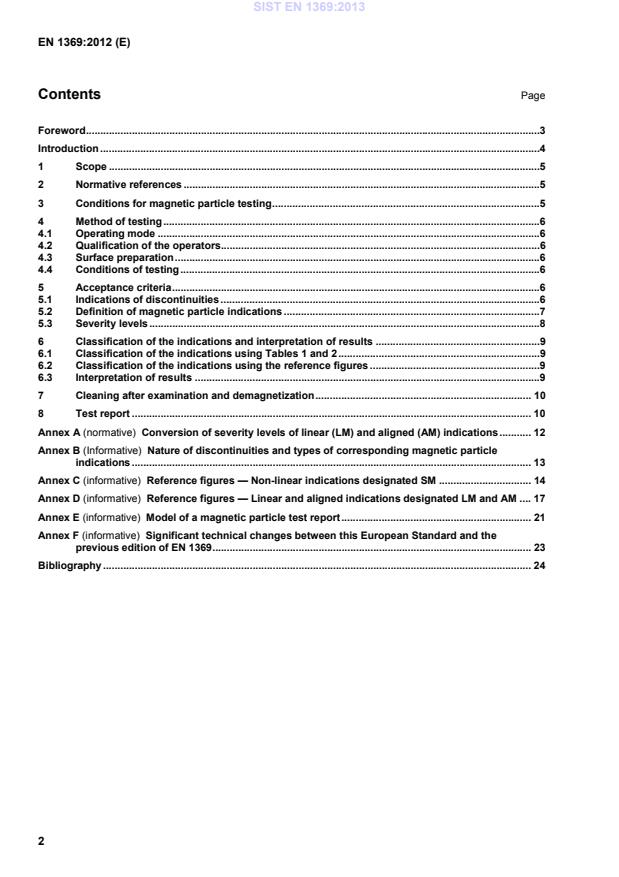
Conversion of severity levels of linear (LM) and aligned (AM) indications . 12Annex B (Informative)
Nature of discontinuities and types of corresponding magnetic particle indications . 13Annex C (informative)
Reference figures — Non-linear indications designated SM . 14Annex D (informative)
Reference figures — Linear and aligned indications designated LM and AM . 17Annex E (informative)
Model of a magnetic particle test report . 21Annex F (informative)
Significant technical changes between this European Standard and the previous edition of EN 1369 . 23Bibliography . 24 SIST EN 1369:2013
The surface to be tested may be painted to provide a contrast before testing (see EN ISO 9934-1). To detect the smallest indication to be considered, the surface finish shall be in accordance with Table 3, unless otherwise specified at the time of ordering. It is recommended that the assessment of surface finish be carried out using a visual tactile surface roughness comparator rather than an instrumental method (see EN 1370 [2]). 4.4 Conditions of testing The testing shall be carried out with the naked eye or at a maximum magnification of three and viewing conditions in conformity with EN ISO 3059. 5 Acceptance criteria 5.1 Indications of discontinuities The discontinuities that are usually seen on a casting are given in Annex B in the nomenclature (A, B, C, D, E, F, H or K). These discontinuities can give indications, magnetic diagrams and groups of indications on any given surface. These indications can all be of different types. SIST EN 1369:2013
L = l1+l2+l3+l4+l5 (see Figure 1).
Figure 1 — Example for L The symbol for aligned indications is AM (A for aligned and M for magnetic particle). SIST EN 1369:2013
...
Questions, Comments and Discussion
Ask us and Technical Secretary will try to provide an answer. You can facilitate discussion about the standard in here.
Loading comments...