


EN 1393:1996
(Main)Plastics piping systems - Glass-reinforced thermosetting plastics (GRP) pipes - Determination of initial longitudinal tensile properties
Plastics piping systems - Glass-reinforced thermosetting plastics (GRP) pipes - Determination of initial longitudinal tensile properties
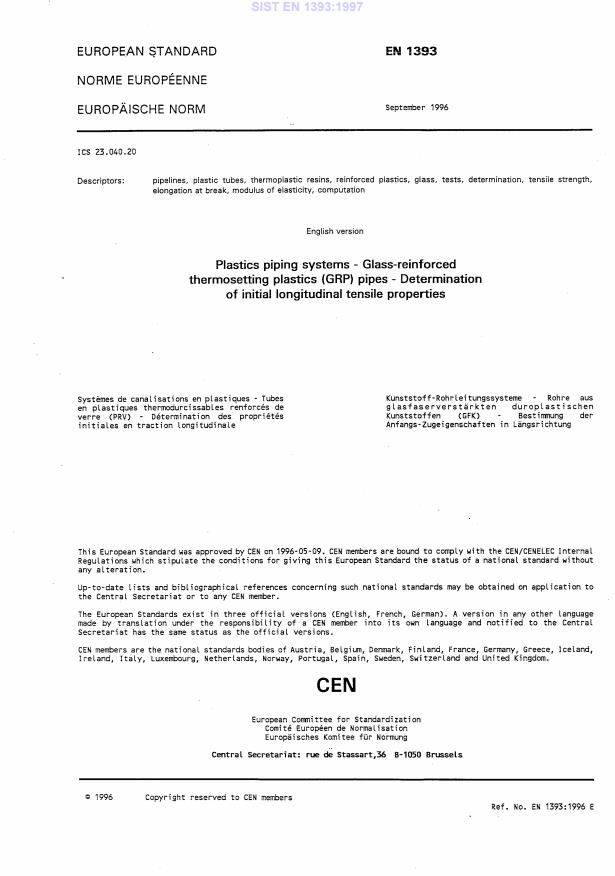
This standard specifies three test methods for determining the longitudinal tensile properties of pipes of glass-reinforced thermosetting plastics (GRP). The properties which can be determined are: - the longitudinal tensile strength; - the percentage ultimate elongation; - the longitudinal modulus of elasticity. Method A uses for the test piece(s) a longitudinal strip cut from a pipe. Method B uses a specified length of the full cross section of the pipe. Method C uses a notched plate cut from a pipe wall section.
Kunststoff-Rohrleitungssysteme - Rohre aus glasfaserverstärkten duroplastischen Kunststoffen (GFK) - Bestimmung der Anfangs-Zugeigenschaften in Längsrichtung
Diese Norm legt drei Prüfverfahren zur Bestimmung der Zugeigenschaften in Längseinrichtung von Rohren aus glasfaserverstärkten duroplastischen Kunststoffen fest, nämlich im einzelnen: - die Längßug-Festigkeit; - die prozentuale Bruchdehnung; - den Elastizitätsmodul in Längsrichtung. Bei Verfahren A wird als Probekörper ein Streifen verwendet, der in Längsrichtung aus einem Rohr entnommen wird. Bei Verfahren B wird eine festgelegete Länge des vollständigen Rohr-Querschnittes benutzt. Bei Verfahren C wird eine eingeschnürte Platte verwendet, die aus der Rohrwand entnommen wird.
Systèmes de canalisations en plastiques - Tubes en plastiques thermodurcissables renforcés de verre (PRV) - Détermination des propriétés initiales en traction longitudinale
Cette norme spécifie trois méthodes d'essai pour la détermination des propriétés en traction longitudinale de tubes en plastique thermodurcissable renforcé de verre (PRV), en particulier. Les propriétés pouvant être déterminées sont: - la résistance à la traction longitudinale; - le pourcentage d'allongement ultime; - le module d'élasticité longitudinal. La méthode A utilise comme éprouvette une bande longitudinale découpée dans la paroi d'un tube. La méthode B utilise une section de tube complet et de longueur spécifiée. La méthode C utilise une plaque entaillée découpée dans la paroi d'un tube.
Cevni sistemi iz polimernih materialov - Cevi iz duromernih materialov, ojačenih s steklenimi vlakni (GRP) - Določanje začetnih nateznih lastnosti v vzdolžni smeri
General Information
- Status
- Published
- Publication Date
- 17-Sep-1996
- Withdrawal Date
- 30-Mar-1997
- Technical Committee
- CEN/TC 155 - Plastics piping systems and ducting systems
- Current Stage
- 9093 - Decision to confirm - Review Enquiry
- Start Date
- 24-Nov-2011
- Completion Date
- 24-Nov-2011
Relations
- Effective Date
- 22-Dec-2008
Overview
EN 1393:1996 is a CEN standard for plastics piping systems made from glass‑reinforced thermosetting plastics (GRP). It specifies three standardized test methods for the determination of the initial longitudinal tensile properties of GRP pipes. The standard defines how to measure the longitudinal tensile strength, percentage ultimate elongation, and longitudinal modulus of elasticity for pipe specimens.
Key Topics
- Scope
- Applies to GRP (glass‑reinforced thermosetting plastics) pipes and sets out procedures to determine initial tensile behaviour in the pipe’s longitudinal direction.
- Measured properties
- Longitudinal tensile strength
- Percentage ultimate elongation
- Longitudinal modulus of elasticity
- Test methods
- Method A: Test pieces are longitudinal strips cut from the pipe wall.
- Method B: Uses a specified length of the pipe’s full cross section as the test specimen.
- Method C: Uses a notched plate cut from a pipe wall section to assess tensile response.
- Standardization context
- Published by the European Committee for Standardization (CEN) as EN 1393:1996; intended for consistent, comparable test results across laboratories and manufacturers.
Applications
EN 1393:1996 is practical for:
- Manufacturers of GRP pipes for product development, production control and batch verification.
- Testing laboratories performing mechanical characterization and certification testing.
- Design engineers assessing material behaviour for structural or pressure-bearing applications.
- Quality assurance and compliance teams ensuring products meet specifications and regulatory requirements.
- Procurement and specification writers creating tender documents or technical specifications that require standardized tensile data.
Typical uses include material selection, comparative performance evaluation of GRP pipe constructions, validation of production processes, and R&D into laminate configurations and resin/fibre combinations.
Related standards
- EN 1393:1996 should be used alongside other CEN plastics piping system standards and GRP product standards that cover dimensional, structural and pressure testing. Consult current CEN listings for the latest related standards and any superseding revisions.
Keywords: EN 1393:1996, GRP pipes, glass‑reinforced thermosetting plastics, longitudinal tensile properties, tensile strength, elongation, modulus of elasticity, test methods.


Frequently Asked Questions
EN 1393:1996 is a standard published by the European Committee for Standardization (CEN). Its full title is "Plastics piping systems - Glass-reinforced thermosetting plastics (GRP) pipes - Determination of initial longitudinal tensile properties". This standard covers: This standard specifies three test methods for determining the longitudinal tensile properties of pipes of glass-reinforced thermosetting plastics (GRP). The properties which can be determined are: - the longitudinal tensile strength; - the percentage ultimate elongation; - the longitudinal modulus of elasticity. Method A uses for the test piece(s) a longitudinal strip cut from a pipe. Method B uses a specified length of the full cross section of the pipe. Method C uses a notched plate cut from a pipe wall section.
This standard specifies three test methods for determining the longitudinal tensile properties of pipes of glass-reinforced thermosetting plastics (GRP). The properties which can be determined are: - the longitudinal tensile strength; - the percentage ultimate elongation; - the longitudinal modulus of elasticity. Method A uses for the test piece(s) a longitudinal strip cut from a pipe. Method B uses a specified length of the full cross section of the pipe. Method C uses a notched plate cut from a pipe wall section.
EN 1393:1996 is classified under the following ICS (International Classification for Standards) categories: 23.040.20 - Plastics pipes; 83.140.30 - Plastics pipes and fittings for non fluid use. The ICS classification helps identify the subject area and facilitates finding related standards.
EN 1393:1996 has the following relationships with other standards: It is inter standard links to EN 1393:1996/AC:1997. Understanding these relationships helps ensure you are using the most current and applicable version of the standard.
EN 1393:1996 is associated with the following European legislation: EU Directives/Regulations: 93/38/EEC; Standardization Mandates: M/BC/CEN/88/15. When a standard is cited in the Official Journal of the European Union, products manufactured in conformity with it benefit from a presumption of conformity with the essential requirements of the corresponding EU directive or regulation.
You can purchase EN 1393:1996 directly from iTeh Standards. The document is available in PDF format and is delivered instantly after payment. Add the standard to your cart and complete the secure checkout process. iTeh Standards is an authorized distributor of CEN standards.
Standards Content (Sample)
2003-01.Slovenski inštitut za standardizacijo. Razmnoževanje celote ali delov tega standarda ni dovoljeno.Kunststoff-Rohrleitungssysteme - Rohre aus glasfaserverstärkten duroplastischen Kunststoffen (GFK) - Bestimmung der Anfangs-Zugeigenschaften in LängsrichtungSystemes de canalisations en plastiques - Tubes en plastiques thermodurcissables renforcés de verre (PRV) - Détermination des propriétés initiales en traction longitudinalePlastics piping systems - Glass-reinforced thermosetting plastics (GRP) pipes - Determination of initial longitudinal tensile properties83
...
記事タイトル:EN 1393:1996-プラスチック配管システム-ガラス繊維強化熱硬化性プラスチック(GRP)パイプ-初期の軸方向引張特性の測定 記事の内容:この規格は、ガラス繊維強化熱硬化性プラスチック(GRP)パイプの初期の軸方向引張特性を測定するための3つの試験方法を規定しています。測定可能な特性は次のとおりです: - 軸方向引張強さ-最終引延率のパーセンテージ-軸方向弾性率。方法Aでは、パイプから切り出した長手方向のストリップを試験片として使用します。方法Bは、パイプの断面の特定の長さを使用します。方法Cは、パイプ壁の一部から切り出した切り欠きのあるプレートを使用します。
기사 제목: EN 1393:1996 - 플라스틱 파이프 시스템 - 유리 강화 열경화 플라스틱(GRP) 파이프 - 초기 종방향 인장 특성 측정 기사 내용: 이 표준은 유리 강화 열경화 플라스틱(GRP) 파이프의 초기 종방향 인장 특성을 결정하기 위한 세 가지 시험 방법을 명시합니다. 측정할 수 있는 특성은 다음과 같습니다: - 종방향 인장 강도, - 최종 연신율 백분율, - 종방향 탄성률. A 방법은 파이프에서 종횡단면 방향의 길이로 제작된 시험 조각을 사용합니다. B 방법은 파이프의 특정 길이를 사용합니다. C 방법은 파이프 벽의 일부를 잘라 만든 갈림턱이 있는 플레이트를 사용합니다.
The article discusses the EN 1393:1996 standard, which outlines three test methods for determining the initial longitudinal tensile properties of glass-reinforced thermosetting plastics (GRP) pipes. These properties include longitudinal tensile strength, percentage ultimate elongation, and longitudinal modulus of elasticity. Method A involves using a longitudinal strip cut from a pipe as the test piece, Method B utilizes a specified length of the full cross section of the pipe, and Method C involves using a notched plate cut from a section of the pipe wall.
Questions, Comments and Discussion
Ask us and Technical Secretary will try to provide an answer. You can facilitate discussion about the standard in here.
Loading comments...