

EN 12753:2005+A1:2010
(Main + Amendment)Thermal cleaning systems for exhaust gas from surface treatment equipment - Safety requirements
General Information
- Abstract
This European Standard is applicable to thermal cleaning systems for exhaust gas from surface treatment equipment/systems as given below in which the concentration of exhaust gas to be cleaned (for the purpose of this European Standard, named "process gas") at the inlet to the thermal cleaning system is safely limited within the concentration ranges given in 5.2.2.2.
Surface treatment equipment includes:
- dryers according to EN 1539, curing equipment;
- flash-off areas;
- coating plants (e.g. closed spray booths, open fronted spray booths);
- machines using flammable solvents for the pre-treatment and cleaning of products or equipment (e.g. barrels, tins, cans or containers);
- related solvent handling equipment.
This European Standard deals only with the significant hazards from fire and explosion and hazards generated by residual process gases as listed in Clause 4, when used as intended and under the conditions foreseen by the manufacturer.
The types of thermal cleaning systems covered in this European Standard are
- direct combustion, and
- catalytic combustion
(see definitions in 3.1.1 and 3.1.2).
This European Standard applies in conjunction with the relevant requirements of EN 746-1 and EN 746-2.
For the purpose of this European Standard a thermal cleaning system for process gas contains the following components: fan(s), heat exchanger, process space, main and supporting burner, injection system, power driven dampers, control and power circuits joined together for the processing of flammable substances, predominantly volatile organic compounds, by effecting oxidation.
NOTE Thermal cleaning equipment is usually integrated with systems as covered by e.g. EN 1010-1, EN 1539, EN 12215, EN 12921-1 or EN 12921-3.
1.2 This European Standard is not applicable to:
- thermal paint removal systems;
- pyrolytic systems.
- Status
- Published
- Publication Date
- 25-May-2010
- Withdrawal Date
- 29-Nov-2010
- Technical Committee
- CEN/TC 271 - Surface treatment equipment - Safety
- Drafting Committee
- CEN/TC 271/WG 4 - Dryers, ovens and evaporating equipment
- Current Stage
- 6060 - Definitive text made available (DAV) - Publishing
- Start Date
- 26-May-2010
- Completion Date
- 26-May-2010
- Directive
- 2006/42/EC - Directive 2006/42/EC of the European Parliament and of the Council of 17 May 2006 on machinery, and amending Directive 95/16/EC (recast)OJ Ref: C, C 284 OJ Date: 20-Oct-2010

Overview
EN 12753:2005+A1:2010 is the CEN European standard that specifies safety requirements for thermal cleaning systems used to treat exhaust gas (process gas) from surface treatment equipment. It covers systems that oxidise volatile organic compounds (VOCs) by direct combustion or catalytic combustion and applies when inlet process-gas concentrations are safely limited to the ranges defined in the standard. Typical covered equipment includes dryers (EN 1539), curing equipment, flash‑off areas, coating plants (spray booths), solvent‑using machines and related solvent handling equipment. The standard addresses significant hazards from fire, explosion and residual process gases and is intended to be used alongside EN 746‑1 and EN 746‑2.
Key topics and technical requirements
- Scope and definitions: terms such as process gas, process space, direct/catalytic combustion, LEL and recirculation.
- Hazard identification: fire, explosion and hazards from residual process gases (Clause 4).
- Safety requirements / protective measures: design, construction and controls to prevent ignition, overconcentration and unsafe conditions (Clause 5).
- System components: requirements for fans, heat exchangers, burners, injection systems, power‑driven dampers, control and power circuits.
- Verification and testing: procedures for verifying safety measures and operational limits.
- Information for use: instruction handbook, marking and operational documentation.
- Annexes and guidance: schematic system views, temperature dependency of LEL, operating parameters and measurement methods, guidelines for increased concentrations, zone/category relation and national references.
- Exclusions: not applicable to thermal paint‑removal or pyrolytic systems.
Practical applications
- Ensures safe design and integration of thermal cleaning units in coating plants, spray booths, dryers and solvent handling systems.
- Guides manufacturers and system integrators on compliant component selection (fans, burners, heat exchangers, controls).
- Directs safety engineers, plant managers and maintenance teams on risk mitigation for fire/explosion and safe operation, verification and documentation.
- Supports third‑party assessors and certification bodies when checking conformity with EU directives (relation to machinery and explosive‑atmosphere requirements is addressed in the standard’s annexes).
Who should use EN 12753
- Equipment manufacturers and OEMs of thermal cleaning systems
- Plant designers and integrators for surface treatment lines
- Safety and process engineers responsible for VOC abatement
- Maintenance personnel and commissioning engineers
- Regulatory and certification bodies verifying compliance
Related standards & keywords
- Applied with EN 746‑1 / EN 746‑2; references include EN 1127‑1, EN 13463 series and EN 1539.
- SEO keywords: EN 12753, thermal cleaning systems, exhaust gas, surface treatment equipment, safety requirements, VOC oxidation, direct combustion, catalytic combustion, LEL, fire and explosion safety, solvent handling.
Relations
- Effective Date
- 18-Jan-2023
- Refers
EN IEC 60079-11:2024 - Explosive atmospheres - Part 11: Equipment protection by intrinsic safety "i" - Effective Date
- 09-Feb-2026
- Effective Date
- 09-Feb-2026
- Refers
EN 60079-2:2014 - Explosive atmospheres - Part 2: Equipment protection by pressurized enclosure "p" - Effective Date
- 09-Feb-2026
- Effective Date
- 09-Feb-2026
- Refers
EN 60079-7:2015 - Explosive atmospheres - Part 7: Equipment protection by increased safety "e" - Effective Date
- 09-Feb-2026
- Effective Date
- 09-Feb-2026
- Refers
EN 60079-6:2015 - Explosive atmospheres - Part 6: Equipment protection by liquid immersion "o" - Effective Date
- 09-Feb-2026
- Refers
EN IEC 60079-18:2025 - Explosive atmospheres - Part 18: Equipment protection by encapsulation "m" - Effective Date
- 09-Feb-2026
- Effective Date
- 09-Feb-2026
- Effective Date
- 09-Feb-2026
- Refers
EN 60079-0:2004 - Electrical apparatus for explosive gas atmospheres - Part 0: General requirements - Effective Date
- 09-Feb-2026
- Effective Date
- 09-Feb-2026
- Effective Date
- 28-Jan-2026
- Effective Date
- 28-Jan-2026
Get Certified
Connect with accredited certification bodies for this standard

DVS-ZERT GmbH
German welding certification society.
CARES (UK Certification Authority for Reinforcing Steels)
UK certification for reinforcing steels and construction.
CIS Institut d.o.o.
Personal Protective Equipment (PPE) certification body. Notified Body NB-2890 for EU Regulation 2016/425 PPE.
Sponsored listings
Frequently Asked Questions
EN 12753:2005+A1:2010 is a standard published by the European Committee for Standardization (CEN). Its full title is "Thermal cleaning systems for exhaust gas from surface treatment equipment - Safety requirements". This standard covers: This European Standard is applicable to thermal cleaning systems for exhaust gas from surface treatment equipment/systems as given below in which the concentration of exhaust gas to be cleaned (for the purpose of this European Standard, named "process gas") at the inlet to the thermal cleaning system is safely limited within the concentration ranges given in 5.2.2.2. Surface treatment equipment includes: - dryers according to EN 1539, curing equipment; - flash-off areas; - coating plants (e.g. closed spray booths, open fronted spray booths); - machines using flammable solvents for the pre-treatment and cleaning of products or equipment (e.g. barrels, tins, cans or containers); - related solvent handling equipment. This European Standard deals only with the significant hazards from fire and explosion and hazards generated by residual process gases as listed in Clause 4, when used as intended and under the conditions foreseen by the manufacturer. The types of thermal cleaning systems covered in this European Standard are - direct combustion, and - catalytic combustion (see definitions in 3.1.1 and 3.1.2). This European Standard applies in conjunction with the relevant requirements of EN 746-1 and EN 746-2. For the purpose of this European Standard a thermal cleaning system for process gas contains the following components: fan(s), heat exchanger, process space, main and supporting burner, injection system, power driven dampers, control and power circuits joined together for the processing of flammable substances, predominantly volatile organic compounds, by effecting oxidation. NOTE Thermal cleaning equipment is usually integrated with systems as covered by e.g. EN 1010-1, EN 1539, EN 12215, EN 12921-1 or EN 12921-3. 1.2 This European Standard is not applicable to: - thermal paint removal systems; - pyrolytic systems.
This European Standard is applicable to thermal cleaning systems for exhaust gas from surface treatment equipment/systems as given below in which the concentration of exhaust gas to be cleaned (for the purpose of this European Standard, named "process gas") at the inlet to the thermal cleaning system is safely limited within the concentration ranges given in 5.2.2.2. Surface treatment equipment includes: - dryers according to EN 1539, curing equipment; - flash-off areas; - coating plants (e.g. closed spray booths, open fronted spray booths); - machines using flammable solvents for the pre-treatment and cleaning of products or equipment (e.g. barrels, tins, cans or containers); - related solvent handling equipment. This European Standard deals only with the significant hazards from fire and explosion and hazards generated by residual process gases as listed in Clause 4, when used as intended and under the conditions foreseen by the manufacturer. The types of thermal cleaning systems covered in this European Standard are - direct combustion, and - catalytic combustion (see definitions in 3.1.1 and 3.1.2). This European Standard applies in conjunction with the relevant requirements of EN 746-1 and EN 746-2. For the purpose of this European Standard a thermal cleaning system for process gas contains the following components: fan(s), heat exchanger, process space, main and supporting burner, injection system, power driven dampers, control and power circuits joined together for the processing of flammable substances, predominantly volatile organic compounds, by effecting oxidation. NOTE Thermal cleaning equipment is usually integrated with systems as covered by e.g. EN 1010-1, EN 1539, EN 12215, EN 12921-1 or EN 12921-3. 1.2 This European Standard is not applicable to: - thermal paint removal systems; - pyrolytic systems.
EN 12753:2005+A1:2010 is classified under the following ICS (International Classification for Standards) categories: 13.040.40 - Stationary source emissions; 25.220.01 - Surface treatment and coating in general. The ICS classification helps identify the subject area and facilitates finding related standards.
EN 12753:2005+A1:2010 has the following relationships with other standards: It is inter standard links to EN 12753:2005, EN IEC 60079-11:2024, EN IEC 60519-1:2020, EN 60079-2:2014, EN IEC 60079-15:2019, EN 60079-7:2015, EN 60079-25:2004, EN 60079-6:2015, EN IEC 60079-18:2025, EN 60204-1:1997, EN 60079-5:2015, EN 60079-0:2004, EN 60079-1:2004, EN ISO 12100-1:2003, EN ISO 13577-2:2023. Understanding these relationships helps ensure you are using the most current and applicable version of the standard.
EN 12753:2005+A1:2010 is associated with the following European legislation: EU Directives/Regulations: 2006/42/EC, 98/37/EC; Standardization Mandates: M/079, M/396. When a standard is cited in the Official Journal of the European Union, products manufactured in conformity with it benefit from a presumption of conformity with the essential requirements of the corresponding EU directive or regulation.
EN 12753:2005+A1:2010 is available in PDF format for immediate download after purchase. The document can be added to your cart and obtained through the secure checkout process. Digital delivery ensures instant access to the complete standard document.
Standards Content (Sample)
2003-01.Slovenski inštitut za standardizacijo. Razmnoževanje celote ali delov tega standarda ni dovoljeno.Thermische Reinigungssysteme für Abluft aus Anlagen zur Oberflächenbehandlung - SicherheitsanforderungenSystèmes d'épuration thermique de l'air extrait des installations de traitement de surface - Prescriptions de sécuritéThermal cleaning systems for exhaust gas from surface treatment equipment - Safety requirements25.220.01Površinska obdelava in prevleke na splošnoSurface treatment and coating in general13.040.40Stationary source emissionsICS:Ta slovenski standard je istoveten z:EN 12753:2005+A1:2010SIST EN 12753:2005+A1:2010en,fr,de01-oktober-2010SIST EN 12753:2005+A1:2010SLOVENSKI
STANDARDSIST EN 12753:20051DGRPHãþD
EUROPEAN STANDARD NORME EUROPÉENNE EUROPÄISCHE NORM
EN 12753:2005+A1
May 2010 ICS 13.040.40; 25.220.01 Supersedes EN 12753:2005English Version
Thermal cleaning systems for exhaust gas from surface treatment equipment - Safety requirements
Systèmes d'épuration thermique de l'air extrait des installations de traitement de surface - Prescriptions de sécurité
Thermische Reinigungssysteme für Abluft aus Anlagen zur Oberflächenbehandlung - Sicherheitsanforderungen This European Standard was approved by CEN on 21 March 2005 and includes Amendment 1 approved by CEN on 23 April 2010.
CEN members are bound to comply with the CEN/CENELEC Internal Regulations which stipulate the conditions for giving this European Standard the status of a national standard without any alteration. Up-to-date lists and bibliographical references concerning such national standards may be obtained on application to the CEN Management Centre or to any CEN member.
This European Standard exists in three official versions (English, French, German). A version in any other language made by translation under the responsibility of a CEN member into its own language and notified to the CEN Management Centre has the same status as the official versions.
CEN members are the national standards bodies of Austria, Belgium, Bulgaria, Croatia, Cyprus, Czech Republic, Denmark, Estonia, Finland, France, Germany, Greece, Hungary, Iceland, Ireland, Italy, Latvia, Lithuania, Luxembourg, Malta, Netherlands, Norway, Poland, Portugal, Romania, Slovakia, Slovenia, Spain, Sweden, Switzerland and United Kingdom.
EUROPEAN COMMITTEE FOR STANDARDIZATION
COMITÉ EUROPÉEN DE NORMALISATION EUROPÄISCHES KOMITEE FÜR NORMUNG
Management Centre:
Avenue Marnix 17,
B-1000 Brussels © 2010 CEN All rights of exploitation in any form and by any means reserved worldwide for CEN national Members. Ref. No. EN 12753:2005+A1:2010: ESIST EN 12753:2005+A1:2010
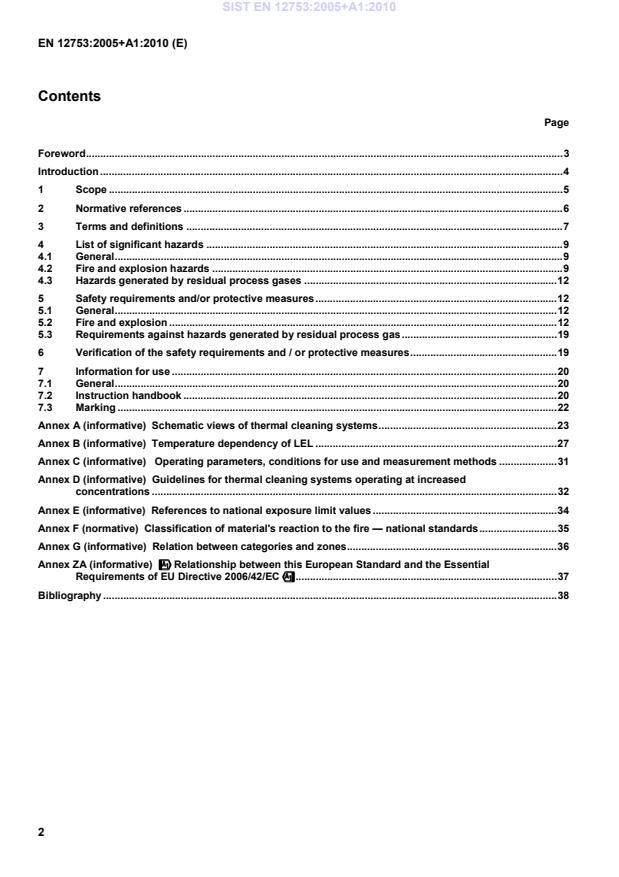
Schematic views of thermal cleaning systems . 23Annex B (informative)
Temperature dependency of LEL . 27Annex C (informative)
Operating parameters, conditions for use and measurement methods . 31Annex D (informative)
Guidelines for thermal cleaning systems operating at increased concentrations . 32Annex E (informative)
References to national exposure limit values . 34Annex F (normative)
Classification of material's reaction to the fire — national standards . 35Annex G (informative)
Relation between categories and zones . 36Annex ZA (informative)
!!!!Relationship between this European Standard and the Essential Requirements of EU Directive 2006/42/EC"""" . 37Bibliography . 38 SIST EN 12753:2005+A1:2010
Thermal cleaning equipment is usually integrated with systems as covered by e.g. EN 1010-1, EN 1539, EN 12215, EN 12921-1 or EN 12921-3. 1.2 This European Standard is not applicable to: thermal paint removal systems; pyrolytic systems. 1.3 This European Standard is not applicable to thermal cleaning systems which are manufactured before the date of publication of this document by CEN.
Examples of downstream equipment are: heat recovery systems, recirculation systems.
Examples of flammable substances are: solvent vapours; fuel gases; condensates; deposits; gases released from condensates and/or deposits.
Examples of ignition sources are: hot surfaces (e.g. of heating systems, of electrical equipment); heating systems, burners, combustion products; sparks created by mechanically induced energy (e.g. by fans wheel, bearing); electrostatic discharges; electrical sparks; hot gases or chemical reactions within the system/equipment itself and/or in upstream and downstream equipment components or duct systems due to back-firing. SIST EN 12753:2005+A1:2010
Maximum temperature in the heat exchanger Mass content of aromatic hydrocarbons Admissible concentration given in % of LEL Reference temperature a) Independent < 25 % 25 % 20 °C b) Independent > 25 % 20 % 20 °C c) 450 °C Independent 50 % Theat exchanger
NOTE 1 The indicated limit values represent the proven findings of scientific studies (see Bibliography) and experiences in the operation of thermal cleaning systems. These findings show that mixtures corresponding to the values indicated in subclauses a), b) and c) do not result in explosive reactions of the flammable substances but an accelerated combustion takes place at temperatures in the region 600 °C. For further information see Bibliography. NOTE 2 For temperature dependence of the LEL, see Annex B. For information about types of thermal cleaning systems, properties of volatile flammable substances and process design see Annex D. There are ways to operate thermal cleaning systems safely at higher concentrations than those given by a), b) and c). These types of thermal cleaning systems are not covered by this European Standard. This is due to the fact that these conditions for a safe operation depend on the specific design of the thermal cleaning system and cannot be determined in a generally applicable way. The risk assessment and the design of such thermal cleaning systems is covered by EN 1127-1. For further information see Annex D. If the limitation of the inlet concentration as given in Table 1 cannot be ensured, the inlet concentration shall be monitored (e.g. by FID, FTA or IR-gas detectors) and interlocked with at least one of the following measures: damper for diluting of the process gas (e.g. by fresh air); damper cutting off the process gas; damper bypassing the system. NOTE 3 Bypassing may need to apply to additional national environmental regulations. The interlocking shall ensure the operation of the system within the limits given in Table 1. SIST EN 12753:2005+A1:2010
...