

prEN 15269-2
(Main)Extended application of test results for fire resistance and/or smoke control for door, shutter and openable window assemblies, including their elements of building hardware - Part 2: Steel hinged and pivoted doorsets
General Information
- Abstract
prEN 15269-2 covers single leaf, hinged or pivoted, steel based doorsets which incorporate a rebated steel door frame. It prescribes the methodology for extending the application of test results obtained from test(s) conducted in accordance with EN 1634-1.
NOTE this draft was created as a first 'model' proposal intended to seek CEN enquiry related to single leaf, hinged or pivoted steel based doorsets into rebated frames only. It is intended to expand the scope at a later date to cover all steel hinged and pivoted doorset types (e.g double leaf doorsets and flush door frames).
Subject to the completion of the appropriate test or tests selected from those identified in Clause 5 the extended application may cover all or some of the following:
- integrity only (E), radiation (EW) or insulated (EI1 or EI2) classifications;
- glazed elements, louvres and/or vents;
- side, transom or overpanels;
- items of building hardware;
- decorative finishes;
- intumescent, smoke, draught or acoustic seals;
alternative supporting construction(s).
- Status
- Not Published
- Technical Committee
- CEN/TC 127 - Fire safety in buildings
- Drafting Committee
- CEN/TC 127/WG 3 - Fire Doors
- Current Stage
- 4098 - Decision to abandon - Enquiry
- Start Date
- 02-Jul-2008
- Completion Date
- 02-Jul-2008

Overview
prEN 15269-2 (CEN) defines a methodology for the extended application of fire resistance test results for single‑leaf, hinged or pivoted steel doorsets installed into rebated steel frames. Intended as a model proposal (draft, 2005), the document explains how to extrapolate results obtained from fire resistance tests performed to EN 1634-1 so manufacturers and competent bodies can demonstrate wider product ranges without repeating every full-scale test.
Key topics and technical requirements
- Scope and limitations
- Applies to single leaf, hinged or pivoted steel‑based doorsets with rebated steel frames (planned future expansion to other steel doorset types).
- Extended application must retain the original classification obtained from EN 1634-1; higher or lower re‑classification is not permitted.
- Mandatory starting point
- Doorsets must be tested and classified per EN 1634-1 and EN 13501-2 before any extension is considered.
- Extension targets
- Extension may cover integrity only (E), radiation control (EW), and insulated classifications (EI1, EI2), plus:
- glazed elements, louvres, vents
- side, transom or overpanels
- building hardware variations
- decorative finishes and seals (intumescent, smoke, draught, acoustic)
- alternative supporting constructions
- Extension may cover integrity only (E), radiation control (EW), and insulated classifications (EI1, EI2), plus:
- Test protocols and annexes
- Annex A: Testing protocol for uninsulated doorsets (E tests, test specimens E.1–E.4)
- Annex B: Testing protocol for insulated/radiation control doorsets
- Annex C: Normative construction parameter variations and how to assess them
- Annex D: Protocols for side, transom and flush overpanels
- Annex E: Informative figures related to Annex C
- Reporting
- Prepare an Extended Application Report (EXAP) in accordance with prEN 15269‑1 and produce a classification report per EN 13501‑2. Evaluation is to be performed by fire experts or competent bodies.
Practical applications and who uses it
- Manufacturers of steel fire doorsets use prEN 15269-2 to plan test programs that maximise the field of direct and extended application, reducing the need for repetitive full-scale testing.
- Test laboratories and notified/certification bodies apply the methodology when assessing whether variations are covered by existing test data.
- Specifiers, architects and fire safety engineers rely on EXAPs and classification reports to select compliant doorsets for building projects.
- Useful for quality managers aiming to validate ranges with different hardware, glazing, seals or finishes while maintaining certified fire performance.
Related standards
- EN 1634-1 - Fire resistance tests for doors and shutters (required test standard)
- EN 13501-2 - Fire classification using resistance test data
- EN 1363-1, EN ISO 13943, prEN 15269-1, prEN 1634-2 (referenced normative documents)
Keywords: prEN 15269-2, fire resistance, steel hinged doorsets, EN 1634-1, extended application, EXAP, fire doors, rebated frame, EW, EI, classification.
Frequently Asked Questions
prEN 15269-2 is a draft published by the European Committee for Standardization (CEN). Its full title is "Extended application of test results for fire resistance and/or smoke control for door, shutter and openable window assemblies, including their elements of building hardware - Part 2: Steel hinged and pivoted doorsets". This standard covers: prEN 15269-2 covers single leaf, hinged or pivoted, steel based doorsets which incorporate a rebated steel door frame. It prescribes the methodology for extending the application of test results obtained from test(s) conducted in accordance with EN 1634-1. NOTE this draft was created as a first 'model' proposal intended to seek CEN enquiry related to single leaf, hinged or pivoted steel based doorsets into rebated frames only. It is intended to expand the scope at a later date to cover all steel hinged and pivoted doorset types (e.g double leaf doorsets and flush door frames). Subject to the completion of the appropriate test or tests selected from those identified in Clause 5 the extended application may cover all or some of the following: - integrity only (E), radiation (EW) or insulated (EI1 or EI2) classifications; - glazed elements, louvres and/or vents; - side, transom or overpanels; - items of building hardware; - decorative finishes; - intumescent, smoke, draught or acoustic seals; alternative supporting construction(s).
prEN 15269-2 covers single leaf, hinged or pivoted, steel based doorsets which incorporate a rebated steel door frame. It prescribes the methodology for extending the application of test results obtained from test(s) conducted in accordance with EN 1634-1. NOTE this draft was created as a first 'model' proposal intended to seek CEN enquiry related to single leaf, hinged or pivoted steel based doorsets into rebated frames only. It is intended to expand the scope at a later date to cover all steel hinged and pivoted doorset types (e.g double leaf doorsets and flush door frames). Subject to the completion of the appropriate test or tests selected from those identified in Clause 5 the extended application may cover all or some of the following: - integrity only (E), radiation (EW) or insulated (EI1 or EI2) classifications; - glazed elements, louvres and/or vents; - side, transom or overpanels; - items of building hardware; - decorative finishes; - intumescent, smoke, draught or acoustic seals; alternative supporting construction(s).
prEN 15269-2 is associated with the following European legislation: EU Directives/Regulations: 305/2011, 89/106/EEC; Standardization Mandates: M/117. When a standard is cited in the Official Journal of the European Union, products manufactured in conformity with it benefit from a presumption of conformity with the essential requirements of the corresponding EU directive or regulation.
prEN 15269-2 is available in PDF format for immediate download after purchase. The document can be added to your cart and obtained through the secure checkout process. Digital delivery ensures instant access to the complete standard document.
Standards Content (Sample)
SLOVENSKI oSIST prEN 15269-2:2005
PREDSTANDARD
oct 2005
Razširjena uporaba rezultatov preskusov požarne odpornosti za vrata in
zaporne elemente - Za vrata in lopute - 2. del: Jeklena vrata z vrtljivim krilom
Extended application of test results for fire resistance for doorsets and shutter
assemblies - For doors and shutters - Part 2: Steel hinged and pivoted doorsets
ICS 13.220.50; 91.060.50 Referenčna številka
© Standard je založil in izdal Slovenski inštitut za standardizacijo. Razmnoževanje ali kopiranje celote ali delov tega dokumenta ni dovoljeno
EUROPEAN STANDARD
DRAFT
NORME EUROPÉENNE
EUROPÄISCHE NORM
August 2005
ICS
English Version
Extended application of test results for fire resistance for
doorsets and shutter assemblies - For doors and shutters - Part
2: Steel hinged and pivoted doorsets
Application élargie des résultats d'essais de résistance au Erweiterter Anwendungsbereich von Prüfergebnissen zur
feu des blocs-portes et blocs-fermetures - Pour portes et Feuerwiderstandsfähigkeit von Türen, Toren und Klappen -
fermetures - Partie 2: Blocs-portes et blocs-fermetures en Teil 2: Drehflügeltüreinrichtungen aus Stahl
acier, pivotants ou battants
This draft European Standard is submitted to CEN members for enquiry. It has been drawn up by the Technical Committee CEN/TC 127.
If this draft becomes a European Standard, CEN members are bound to comply with the CEN/CENELEC Internal Regulations which
stipulate the conditions for giving this European Standard the status of a national standard without any alteration.
This draft European Standard was established by CEN in three official versions (English, French, German). A version in any other language
made by translation under the responsibility of a CEN member into its own language and notified to the Management Centre has the same
status as the official versions.
CEN members are the national standards bodies of Austria, Belgium, Cyprus, Czech Republic, Denmark, Estonia, Finland, France,
Germany, Greece, Hungary, Iceland, Ireland, Italy, Latvia, Lithuania, Luxembourg, Malta, Netherlands, Norway, Poland, Portugal, Slovakia,
Slovenia, Spain, Sweden, Switzerland and United Kingdom.
Recipients of this draft are invited to submit, with their comments, notification of any relevant patent rights of which they are aware and to
provide supporting documentation.
Warning : This document is not a European Standard. It is distributed for review and comments. It is subject to change without notice and
shall not be referred to as a European Standard.
EUROPEAN COMMITTEE FOR STANDARDIZATION
COMITÉ EUROPÉEN DE NORMALISATION
EUROPÄISCHES KOMITEE FÜR NORMUNG
Management Centre: rue de Stassart, 36 B-1050 Brussels
© 2005 CEN All rights of exploitation in any form and by any means reserved Ref. No. prEN 15269-2:2005: E
worldwide for CEN national Members.
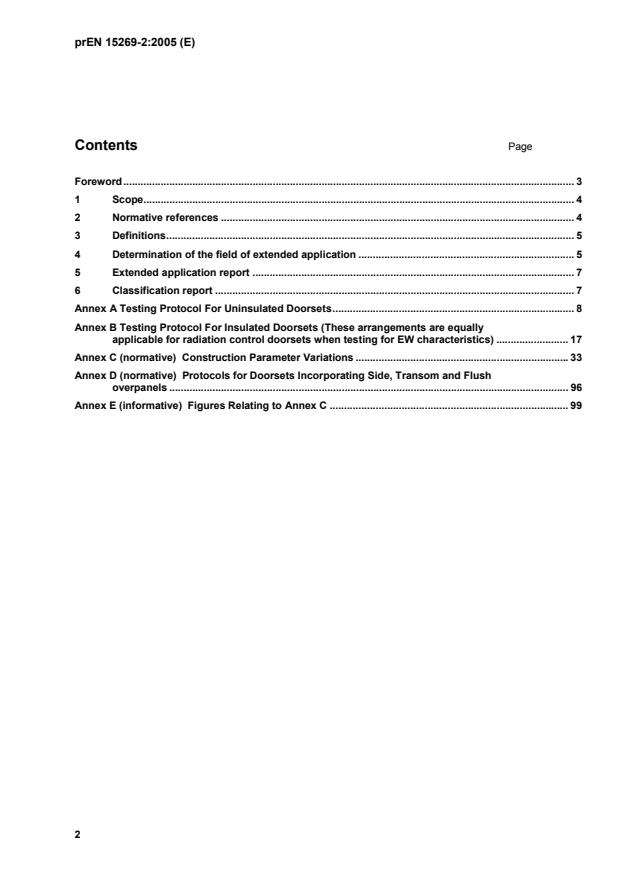
Contents Page
Foreword. 3
1 Scope. 4
2 Normative references . 4
3 Definitions. 5
4 Determination of the field of extended application . 5
5 Extended application report . 7
6 Classification report . 7
Annex A Testing Protocol For Uninsulated Doorsets. 8
Annex B Testing Protocol For Insulated Doorsets (These arrangements are equally
applicable for radiation control doorsets when testing for EW characteristics) . 17
Annex C (normative) Construction Parameter Variations .33
Annex D (normative) Protocols for Doorsets Incorporating Side, Transom and Flush
overpanels . 96
Annex E (informative) Figures Relating to Annex C . 99
Foreword
This document (prEN 15269-2:2005) has been prepared by Technical Committee CEN/TC 127 “Fire
safety in buildings”, the secretariat of which is held by BSI.
This document is currently submitted to the CEN Enquiry.
This document is one of a series of Standards intended to be used by experts or competent bodies for
the purpose of producing an extended application report (EXAP). It is not intended to be used for the
interpretation of test results by non-fire experts.
Editorial note: Clarification is needed to establish if such experts are Bodies Notified for either testing
and/or Certification
prEN 15269 ‘Extended application of test results for fire resistance for doorsets and shutter
assemblies – For doors and shutters’ consists of the following:
Part 1 General requirements
2 Steel hinged and pivoted doorsets
3 Timber hinged and pivoted doorsets
4 Glass hinged and pivoted doorsets
5 Aluminium hinged and pivoted doorsets
6 Timber sliding doorsets
7 Steel sliding doorsets
8 Timber horizontally folding doorsets
9 Steel horizontally folding doorsets
10 Steel rolling shutters
1 Scope
steel door frame. It prescribes the methodology for extending the application of test results obtained
from test(s) conducted in accordance with EN 1634-1.
NOTE this draft was created as a first ‘model’ proposal intended to seek CEN enquiry related to single leaf,
hinged or pivoted steel based doorsets into rebated frames only. It is intended to expand the scope at a later date
to cover all steel hinged and pivoted doorset types (e.g double leaf doorsets and flush door frames).
Subject to the completion of the appropriate test or tests selected from those identified in Clause 5 the
extended application may cover all or some of the following:
integrity only (E), radiation (EW) or insulated (EI or EI ) classifications;
1 2
glazed elements, louvres and/or vents;
side, transom or overpanels;
items of building hardware;
decorative finishes;
intumescent, smoke, draught or acoustic seals;
alternative supporting construction(s).
2 Normative references
The following referenced documents are indispensable for the application of this document. For dated
references, only the edition cited applies. For undated references, the latest edition of the referenced
document (including any amendments) applies.
EN 1363-1, Fire resistance tests — Part 1: General requirements
EN 1634-1, Fire resistance tests for door and shutter assemblies — Part 1: Fire doors and shutters
prEN 1634-2, Fire resistance tests for door and shutter assemblies — Part 2: Fire door hardware
EN 13501-2, Fire classification of construction products and building elements — Part 2: Classification
using test data from fire resistance tests excluding ventilation services
EN ISO, 13943, Fire safety — Vocabulary
prEN 15269, Extended application of test results for fire resisting and smoke control doorsets and
shutter assemblies — Part 1 — General requirements for fire resistance
3 Definitions
For the purposes of this part, the definitions given in EN1363-1, EN ISO 13943, EN 1634-1 and
EXAP prEN 15269-1 together with the following apply:
3.1
full scale test
a test of a full size door element in accordance with EN 1634-1
3.2
small scale test
a test on elements of Building Hardware in accordance with prEN 1634-2 and where the decision
process, given in prEN 1634-2, permits its use. This is abbreviated as SS in annex C
3.3
effective rebate depth
the dimension of the overlapping adjacent parts of door leaf edge relative to the door frame, transom
or side panel or flush overpanel
4 Determination of the field of extended application
4.1 General
4.1.1 Before there can be any consideration for extended application the doorset must have been
tested and classified in accordance with EN1634-1 and EN 13501-2 respectively in order to establish
a classification for the doorset.
4.1.2 Evaluation to a higher classification is not possible.
4.1.3 All evaluations shall be made on the basis of retaining the classification obtained from testing
to EN1634-1.
4.1.4 There is no procedure for evaluation of a lower classification. If, by following the ensuing
procedure, any part of the classification cannot be achieved by extended application theory, that
element of classification shall be omitted from the subsequent extended application report and
classification report.
4.2 Procedure for Evaluation
4.2.1 Identify the variations from the original test specimen(s) which are required to be covered by
an extended application report.
4.2.2 Locate the variations in the appropriate parameter variation by reference to columns (1) and
(2) of annex A.
4.2.3 Review the type of classification to be retained from column (3) and establish from the
contents of column (5) whether any extended application is available beyond the direct application
rules in EN 1634-1 without the need for further testing.
4.2.4 Where this is deemed to be possible this can be recorded in the extended application report
together with any appropriate restrictions and the stated rules from column (5).
4.2.5 Where the variations required can only be achieved from additional testing, the additional test
can be made on a similar specimen type (i.e. single-leaf doorset) to the original test against which the
extended application is sought. Alternatively, column (6) identifies an alternative weakest option for
alternative testing and relevant specimen types are proposed in column (7). These types are identified
by code numbers which can be interpreted from annex B or Annex C. These are generally specimen
types which can present additional options for the product manufacturer.
4.3 Procedure for maximum field of extended application
Where a manufacturer envisages to manufacture a range of doors incorporating single doors and also
double doors with or without side, transom or over panels, with or without glazing, louvres or
ventilation grilles, with alternative element of builders hardware, etc., it is recommended that the test
protocols provided in Annex A and Annex B for integrity only doors or insulated (including radiation
control doors), respectively, be given careful consideration before testing commences.
Establish all the parameter variations which are required to be part of the product range, and in
particular for single leaf hinged or pivoted steel based doorsets into rebated frames.
Determine which are the most important specification requirements and incorporate as many as
possible into the specimen(s) for the E1 (annex A) or I1 (annex B) test.
Complete the E1 or I1 test(s) and prepare a field of direct application and a classification report from
the results of the test.
Establish which of the original desired parameter variations have not been covered by the direct
application classification report.
Identify these parameter variations in Annex C and establish if any extended application is possible
without further testing.
Record this for the extended application report together with any restrictions and rules given in
column (5).
Evaluate which, if any, of the desired parameter variations have not been covered by the field of direct
application or the initial field of extended application derived from 4.3.6. above.
Determine if the product range is to include only single test doorsets or if the range is to also include
double leaf configurations. Where only single doorsets are to be part of the product range then the
outstanding construction parameter variations shall only be incorporated into specimens for the single
leaf doorset tests indicated in the test protocols in Annex A or Annex B. Where single leaf and double
leaf doorsets are to be included in the product range, the outstanding construction parameter
variations for the extended application of single leaf doorsets may be incorporated into either repeated
single leaf doorset tests or in the weakest option double leaf doorset configurations indicated in test
protocols in Annex A and/or Annex B.
Select the required outstanding parameter variations from column (1) and column (2) of Annex C and
observe from column (7) which are the most appropriate weakest specimen options for further testing.
If the complete selection of required parameter variations have not been covered by the tests
completed in accordance with 4.3.9 and 4.3.10 above, then an appropriate test or tests may be
repeated with the additional product variations incorporated.
4.4 Interpretation of Test Results
4.4.1 In order to maximise the field of extended application, it is important that the test reports shall
record details of any premature integrity and/or insulation failure.
4.4.2 Where a series of tests have been conducted, the field of extended application shall be based
on the lowest performance achieved from the complete series of tests unless premature failure has
been attributed to one or more specific construction parameter variation.
4.4.3 Where it has been possible, to identify specific parameter failures, the extended application
for all other construction parameter variations can be based on the performance achieved after
isolating the premature failure(s).
5 Extended application report
5.1 Prepare an extended application report in accordance with the requirements of Clause 5 of
EXAP prEN 15269-1, based on the results of evaluations in accordance with the above.
6 Classification report
The classification report shall be determined from the results of the extended application report and
presented in accordance with annex A of EN 13501-2.
Annex A
Testing Protocol For Uninsulated Doorsets
RIGID CONSTRUCTION
Test E.1 largest single open outwards (worst
case as prEN 1634-1)
Test E.2 largest pair open outwards
Test E.3 largest single open inwards with
largest side panel on latch side and
transom over panel(s)
Test E.4 widest pair open inwards with full
width flush over panel
NOTE In the following list of test specification, the reference to “standard” means the manufacturer’s normal
product parameter e.g. “standard thickness” relates to the manufacturers normally used material.
TEST E.1 SPECIFICATION FOR TEST SPECIMEN
Door Panel
To open outwards
Largest single door panel
Thinnest door panel construction
No cut outs for glazing/louvres
Standard material thickness in mild steel
Standard lipping/rebate edge detail
Standard core/stiffener detail
Standard adhesive/stiffener fixing technique
Smallest intumescent seals (if applicable)
Without smoke/draught seals
Standard paint or galvanised finish
Without kick plates or mouldings
Door Frame
Standard cross section
Three sided frame
Standard panel to frame gap detail
Thinnest material thickness in mild steel
Smallest intumescent seals (if applicable)
Without smoke/draught seals
Standard infill to supporting construction
Standard paint or galvanised finish
Hardware
Standard latch fitted (may be held unlatched if required)
Standard hinge/dog bolt arrangement
Standard separating distances
Standard fixings to door panel and frame
Door closer in standard position
Supporting Construction
Rigid
Frame sunk into floor
Minimum number of fixings
Smallest size fixings at maximum centres
Maximum envisaged gap under doors
Side Panels
None
Over Panels
None
Leaf to open away from the furnace.
Figure A.1 — Test specimen E1
TEST E.2 – SPECIFICATION FOR TEST SPECIMEN
Door Panel
To open outwards
Largest pair
Thickest door panel construction
Cut out in one leaf for largest louvre
Thickest material envisaged in mild steel
Standard lipping/rebate edge detail
Standard/alternative core material/stiffening construction
Standard/alternative adhesive/stiffener fixing technique
Standard/alternative intumescent seals (if applicable)
With smoke/draught seals fitted
Standard/alternative painted/unpainted finish
With kick plates of largest size
without mouldings
Frame
Standard/alternative cross section
Three sided frame
Standard panel to frame gap details
Thickest material thickness in mild steel
Alternative intumescent seals (if applicable)
With smoke/draught seals fitted
With standard/alternative infill to supporting construction
Standard/alternative painted/unpainted finish
Hardware
Standard/alternative latch (may be held unlatched if required)
Standard/alternative hinges/dog bolts
Standard/alternative positioning of hinges/dog bolts
Standard/alternative fixings to door panel and/or frame
Standard/alternative door closer/positioning
Supporting Construction
Rigid
Frame not sunk into floor
Minimum standard/alternative fixings and/or centres
Maximum gap envisaged under door
Side Panels
None
Over Panels
None
Leaves to open away from the furnace.
Figure A.2 — Test specimen E2
TEST E.3 – SPECIFICATION FOR TEST SPECIMEN
Door Panel
To open inwards
Largest single door panel which can be incorporated into widest side panel and tallest transom
panel
Standard panel thickness construction
No cut outs for glazing or louvres
Standard material/alternative thickness in mild steel
Standard/alternative lipping/rebate edge detail
Standard/alternative core material/stiffening details
Standard/alternative adhesive/stiffener fixing details
Standard/alternative intumescent seals (if applicable)
Standard/alternative smoke/draught seals
Standard/alternative painted/unpainted finish
Alternative thickness of decorative laminate
With or without mouldings
Door Frame
Standard/alternative cross section/without rebate option
Three sided frame
Standard panel to frame gap details
Standard/alternative material thickness in mild steel
Standard/alternative intumescent seal (if applicable)
With/without standard/alternative smoke/draught seals
Standard infill for flexible supporting construction
Standard/alternative painted/unpainted finish
Hardware
Standard/alternative latch (may be held unlatched)
Standard/alternative hinges/dog bolts
Standard/alternative separating distances
Standard/alternative fixings to door panel/frame
Standard/alternative door closer/positioning
Supporting Construction
Rigid
Frame not sunk into floor
Minimum number of straps/fixings
Smallest size/maximum centres
Maximum envisaged gap under door
Side Panels
Maximum width side panel
Fitted to latch side of door panel
No cut outs/glazing
Over Panels
Tallest transom panel fitted full width over door and side panel
No cut outs/glazing
Leaf to open away from the furnace.
Figure A.3 — Test specimen E3
TEST E.4 – SPECIFICATION FOR TEST SPECIMEN
Door Panel
To open inwards
Widest pair of doors with tallest flush over panel fitted
Standard thickness door panel construction
Cut out in one leaf for maximum number of pieces of thinnest glass with minimum separation
between glazing and minimum distance from edge of glazing to edge of door
Cut out in other leaf for maximum size of single glass panel fitted as high as envisaged
Possible alternative glass retention detail for each leaf
Standard material thickness in mild steel
Standard lipping/rebate edge detail
Standard construction for glazed panels
Standard intumescent seals (if applicable)
With/without smoke/draught seals
Standard or alternative painted/unpainted finish
With or without mouldings
Door Frame
Standard/alternative cross section
Three sided frame
Standard panel to frame gap detail
Standard/alternative thickness of material in mild steel
Standard intumescent seals (if applicable)
With/without smoke/draught seals
Standard/alternative infill to supporting construction
Standard or alternative painted/unpainted finish
Hardware
Standard/alternative latch (may be held unlatched)
Standard/alternative hinges/dog bolts
Standard/alternative positioning/separating distances
Standard/alternative fixings to door panel and/or frame
Standard/alternative door closer/positioning
Supporting Construction
Rigid
Frame not sunk into floor
Standard/alternative number of fixings
Standard/alternative size/centres of fixings
Maximum envisaged gap under door
Side Panels
None
Over Panels
Flush over panel full width of doors
No cut outs/glazing
Leaf to open away from the furnace.
Figure A.4 — Test specimen E4
Annex B
Testing Protocol For Insulated Doorsets
(These arrangements are equally applicable for radiation control doorsets when testing for EW
characteristics)
RIGID CONSTRUCTION FLEXIBLE CONSTRUCTION
Test I.1(a) largest single open outwards Test I.6 largest single open inwards
Test I.1(b)
smallest single open outwards
(? At hatch height)
Test I.7
(optional)
Repeat of test 2 if fixing to flexible
construction is different from test 6
Test I.2 widest single open inwards fitted
into widest side panel on latch
side, with transom panel
Test I.3
largest pair open outwards, equal
leaf sizes
(permits reduction of either leaf to
50% width)
Test I.4 Test I.4
(optional) (optional)
Smallest pair if sizes less than Smallest pair if sizes less than direct
direct application from test 1(b) application from test 1(b) and 3 are
and 3 are required required
Test I.5 Test I.8
widest pair with full width flush (optional)
over panel open inwards Repeat of test 5 if fixing to flexible
construction is different from test 6
NOTE In the following list of test specification, the reference to “standard” means the manufacturer’s normal
product parameter e.g. “standard thickness” relates to the manufacturers
TEST I.1(a) – SPECIFICATION FOR TEST SPECIMEN
Door Panel
To open outwards
Largest single door panel
Thinnest door panel construction
No cut outs for glazing/louvres
Standard material thickness in mild steel
Standard lipping/rebate edge detail
Thinnest least dense core and/or least stiffening arrangements
Normal adhesive and amount
Smallest intumescent seals
Without smoke/draught seals
Standard paint or galvanised finish
Without kick plates or mouldings
Door Frame
Smallest standard cross section
Three sided frame
Standard panel to frame gap details
Thinnest material thickness in mild steel
Smallest intumescent seals
Without smoke/draught seal
With standard infill to supporting construction
Standard paint or galvanised finish
Hardware
Standard latch (may be held unlatched if required)
Standard hinges/dog bolt combination
Standard separating distances
Standard fixings to door panel and frame
Door closer in standard position
Supporting Construction
Rigid
Cleated to floor
Minimum number of fixings
Smallest size fixings at maximum centres
Maximum envisaged gap under door
Side Panels
None
Over Panels
None
TEST i.1(b) – SPECIFICATION FOR TEST SPECIMEN
Door Panel
To open outwards
Smallest single
Thinnest door panel construction
No cut outs for glazing/louvres
Standard material thickness in mild steel
Standard lipping/rebate edge detail
Standard core/stiffening detail
Normal adhesive/amount
Standard intumescent seals
Without smoke/draught seals
Laminated finish
Without kick plates or mouldings
Door Frame
Minimum section/lipping/rebate detail
Four sided frame (Note: test at hatch height, say 1.5m above floor)
Standard panel to frame gap details
Standard material thickness in mild steel
Standard intumescent
Without smoke/draught seal
Standard infill to supporting construction
Standard paint/unpainted finish or laminated if applicable
Hardware
Standard latch (may be held unlatched if required)
Standard hinge/dog bolt combination
Standard separating distances for size of specimen
Alternative fixing to door panel and/or frame
Standard/alternative door closer position
Supporting Construction
Rigid
Hatch arrangement
Standard fixings around all four sides
Normal gaps all round
Side Panels
None
Over Panels
None
Each leaf to open away from the furnace
Figure B.1 — Test Specimen 11
TEST I.2 – SPECIFICATION FOR DOOR SPECIMEN
Door Panel
To open inwards
Widest single door incorporated into widest side panel with widest hinged transom panel
Standard door panel construction
Cut out in door panel for largest area of glass in most numbers of pieces, using thinnest glass,
minimum distances between glass panels and minimum distance between glass panels and
edges of door
Standard material thickness in mild steel
Standard lipping/rebate edge detail
Standard core infill
Standard adhesive
Standard intumescent seals
With/without smoke/draught seals
Standard or alternative painted/unpainted finish
Without kick plates
With or without mouldings
Door Frame
Standard cross section with or without rebate option
Three sided frame
Standard panel to frame gap details
Standard material thickness in mild steel
Standard intumescent
With/without smoke/draught seal
Standard infill to supporting construction
Standard or alternative painted/unpainted finish
Hardware
Standard latch (may be held unlatched if required)
Standard hinges/dog bolt detail
Standard separating distances
Standard fixings to door panel and frame
Standard door closer and position
Supporting Construction
Rigid
Frame not sunk into floor
Normal fixings/centres
Maximum envisaged gap under door
Side Panels
Widest side panel
To be at latched side
No cut outs/glazing
Over Panels
Full width transom panel
No cut outs/glazing
Leaf to open towards the furnace
Figure B.2 — Test Specimen 12
TEST I.3 – SPECIFICATION FOR TEST SPECIMEN
Door Panel
To open outwards
Largest pair
Normal panel thickness
Cut out for largest louvre in one leaf
Thinnest material thickness envisaged in mild steel
Standard/alternative lipping/rebate edge detail
Core material in one leaf to be in maximum number of pieces, other leaf can be alternative
composition
Alternative adhesive/amount of adhesive
Standard/alternative intumescent seals
With/without smoke/draught seals
Standard or alternative painted/unpainted finish
Without kick plates
With or without mouldings
Door Frame
Alternative section
Three sided frame
Standard panel to frame gap detail
Thickest material in mild steel
Standard intumescent or alternative
With/without smoke/draught seals
Standard/alternative infill to supporting construction
Standard or alternative painted/unpainted finish
Hardware
Louvre panel
Standard/alternative latch (may be left unlatched)
Standard/alternative hinges/dog bolt
Standard/alternative separating distances
Standard/alternative fixing technique to door panel and/or frame
Standard/alternative door closer/positioning
Supporting Construction
Rigid
Frame not sunk into floor
Minimum number of fixings
Smallest size fixings at maximum centres
Maximum envisaged gap under door
Side Panels
None
Over Panels
None
Leaves to open away from the furnace
Figure B.3 — Test Specimen 13
TEST I.4 (OPTIONAL) – SPECIFICATION FOR THE TEST SPECIMEN
Door Panel
To open outwards
Smallest size pair
Standard panel thickness
No cut outs for glazing/louvres
Standard material thickness in mild steel
Standard lipping/rebate edge detail
Standard core material
Standard adhesive/amount
Standard intumescent seals
With/without smoke/draught seals
Thickest intended decorative laminate
Without kick plate
With or without mouldings
Door Frame
Standard/alternative cross section
Three or four sided frame (dependent on size and whether hatch or not)
Standard panel to frame gap detail
Standard/alternative material thickness in mild steel
Standard intumescent seal
With/without smoke/draught seals
Standard/alternative infill to supporting construction
Standard or alternative painted/unpainted finish or laminated if applicable
Hardware
Standard/alternative latch (may be held unlatched)
Standard/alternative hinges/dog bolt combination
Standard separating distances
Standard fixings to door panel and/or frame
No door closers unless required for unlatched condition
Supporting Construction
Rigid or flexible (if flexible, can be done with test 6)
Three sided if to floor, four sided if to hatch position
Standard fixing arrangement/sizes
Normal gaps dependent on three or four sided option
Side Panels
None
Over Panels
None
Leaves to open away from the furnace
Figure B.4 — Test Specimens 14
TEST I.5 – SPECIFICATION FOR TEST SPECIMEN
Door Panel
To open inwards
Largest width pair with flush over panel for full width
Thickest panel construction envisaged
No cut outs for glazing or louvres
Thickest material thickness in mild steel
Standard/alternative lipping/rebate edge detail
Standard/alternative core/maximum stiffening construction
Standard/alternative adhesive and amount
Standard/alternative intumescent seals
With/without smoke/draught seals
One leaf finished with thinnest coat of intumescent paint (if applicable), other leaf with thickest
coat of intumescent paint (if applicable)
Fitted with kick plates
Without mouldings
Door Frame
Standard or alternative cross section
Three sided
Standard panel to frame gap details
Thickest material gauge in mild steel
Standard/alternative intumescent seals
Standard/alternative infill to supporting construction
Standard/painted/unpainted finish or intumescent paint finish if applicable
Hardware
Standard/alternative latch (may be held unlatched)
Standard/alternative hinges/dog bolts
Standard/alternative distance top hinge to top of door
Standard/alternative distance bottom hinge to bottom of door
Standard/alternative fixings to door panel and/or frame
Standard/alternative door closer/positioning
Supporting Construction
Rigid
Frame not sunk into floor
Minimum number of fixings
Smallest size of fixings
Maximum gap under door
Side Panels
None
Over Panels
Full width flush over panel
No cut out/glazing
Leaves to open away from the furnace
Figure B.5 — Test Specimen 15
TEST I.6 – SPECIFICATION FOR TEST SPECIMEN
Door Panel
To open inwards
Largest single door
Standard door panel thickness
Cut out for largest single glass panel in thinnest glass in top half of door
Thickest material thickness envisaged
Standard lipping/rebate edge detail
Standard core material/structure
Standard adhesive/amount
Standard/alternative intumescent seals
With/without standard or alternative smoke/draught seals
Standard painted/unpainted finish
Without kick plates
With or without mouldings
Door Frame
Standard cross section for flexible construction
Three sided
Standard panel to frame gap detail
Standard material thickness in mild steel
Standard intumescent seals
With/without smoke/draught seals
Standard infill to flexible construction
Standard painted/unpainted finish
Hardware
Standard/alternative latch (may be held unlatched)
Standard hinges/dog bolts combination
Standard separating distances
Standard fixings to door panel and/or frame
Door closer in standard position
Supporting Construction
Flexible construction
Frame not sunk into floor
Minimum number of straps/fixings
Smallest fixings at maximum centres
Maximum envisaged gap under door
Side Panels
None
Over Panels
None
Leaf to open towards the furnace
Figure B.6 — Test Specimen 16
TEST I.7 (OPTIONAL)
Test 7 is to be a repeat of test 2 without the hinged transom panel but carried out in flexible
construction. This test is only required if there are to be alternative frame details and/or fixing details
than those tested in test 6.
TEST I.8 (OPTIONAL)
Test 8 is to be a repeat of test 5 but carried out in flexible construction. This test is only required if
there are to be alternative frame details and/or fixing details than those tested in tests 6 or 7.
Leaf to open towards the furnace
Figure B.7 — Test Specimen 17
Leaves to open towards the furnace Flexible supporting construction
Figure B.8 — Test Specimen 18
Annex C
(normative)
Construction Parameter Variations
This table is designed to be used by competent experts in the field of fire resistance testing of hinged steel
doorsets.
The table shall only be used to evaluate a field of extended application when at least one positive fire resistance
test to EN 1634-1 has resulted in a classification according to prEN 13501-2.
The first two columns identify possible variations to the construction details of the specimen tested.
The type of classification achieved from the test can be identified as the ‘Type’ section of column 3 as insulated,
radiation control or integrity only. For some parameters, it is necessary to evaluate whether the specimen
displayed a high, medium or low level of distortion during the test. Where this is the case the following levels
should be used to provide high, medium and low distortion doorsets:
low <40 % of effective rebate depth
medium >40 % and <85 % of effective rebate depth
high >85 % of effective rebate depth
The effect of the change in each parameter is evaluated for each characteristic in column 3 under E for effects on
integrity, I for effects on insulation (whether an I or I class) and W for the effects on radiation control for EW
1 2
doors.
These evaluations lead to the judgement of the possibility of the extension of the field of application the results of
which are given in column 4.
Where additional tests are deemed to be necessary the type of specimen approved for incorporation of the
changed parameter is defined in column 5. Although this standard is specifically for single doorsets, where it is
possible to use information from tests performed on double doorsets, this allowance has been made in order to
reduce the overall number of tests required for single and double doorset field of extended application evaluation.
In order to maximise the possible field of extended application from a minimum number of tests the parameter
changes have been spread over a series of test specimens defined in Annex A and Annex B. The recommended
tests for each parameter are dependants on the classification required and the preferred options are shown
under the appropriate classification in column 6.
Each construction parameter variation may only be applied in isolation from other variations. If after
consideration of a specific variation, additional changes are required to be made to the specimen, these
may be made providing the implications on other variations are also taken into account.
Construction Parameter Variation Influence of variation on Possibility of extension (Definite yes / Additional Evidence Test Reference
performance characteristic Conditional yes / no) Required
(1) (2) (3) (4) (5) (6)
E I W E EI EW
A Door leaf
A.1 General
A.1.1 number of leaves - See single leaf from ≤ ≥ ≥ possible up to a maximum size of single leaf equal
Figure E.1 double door test to the tested dimension of the active leaf and
providing the absolute deflection at any of the
measuring points on the leading edge of the active
leaf is not greater than 25 % of the thickness of the
door leaf otherwise not possible without an additional test single leaf E1 I1a I1a
additional test doorset (open outwards)
A.1.2 number of panels per leaf - add = = = possible if tested at least one leaf with the minimum - - -
See Figure E.2 (one panel) of two panels and the intended jointing technique
centrally located in the door leaf
A.1.3 number of panels per leaf - reduce = = = possible providing the tested width of the panel is - - -
See Figure E.3 (one panel) not increased
A.1.4 intumescent seals - See Location towards ≥ ≥ = possible providing positioning deeper into frame - - -
Figure E.4 the frame rebate rebate - face fixed only
A.1.5 intumescent seals - See location away from ≤ ≤ = not possible without an additional test additional test single leaf E2,3 I3,5,6 I3,5,6
Figure E.5 the frame rebate or double leaf doorset
(open outwards)
A.1.6 non intumescent seals location = = = any movement possible providing no modifications - - -
(draught / smoke / acoustic etc.) - of the construction are required
inorganic, e.g. ceramic products -
See Figure E6
Construction Parameter Variation Influence of variation on Possibility of extension (Definite yes / Additional Evidence Test Reference
performance characteristic Conditional yes / no) Required
(1) (2) (3) (4) (5) (6)
E I W E EI EW
A.1.7 non intumescent seals location >/=/< >/=/< >/=/< no movement possible without an additional test additional test can be E2,3 I3,5,6 I3,5,6
(draught /smoke / acoustic etc.) – single or double leaf
organic - See Figure E7 doorset
A.1.8 non intumescent seals add = = = possible without altering the construction - - -
(draught / smoke / acoustic etc.) -
inorganic, e.g. ceramic products -
See Figure E8
A.1.9 non intumescent seals remove ≤ ≤ ≤ not possible without an additional test additional test can be E2,3 I3,5,6 I3,5,6
(draught / smoke / acoustic etc.) - single or double leaf
inorganic, e.g. ceramic products - doorset
See Figure E9
A.1.10 non intumescent seals add ≤ ≤ ≤ not possible without an additional test additional test can be E2,3 I3,5,6 I3,5,6
(draught / smoke / acoustic etc.) – single or double leaf
organic - See Figure E10 doorset
A.1.11 non intumescent seals remove >/=/< >/=/< = not possible without an additional test additional test can be E2,3 I3,5,6 I3,5,6
(draught / smoke / acoustic etc. – single or double leaf
organic - See Figure E11 doorset
A.1.12 Louvres in door leaf tested add ≤ ≤ ≤ not possible without an additional test additional test can be E2 I3 I3
without louvre - See Figure E12 single or double leaf
doorset
A.1.13 Louvres in door leaf remove >/=/< ≥ ≥ possible providing the cut out is less than 25 % of
the door leaf area otherwise not possible without an
additional test additional test can be E1 I1a I1a
single or double leaf
doorset
Construction Parameter Variation Influence of variation on Possibility of extension (Definite yes / Additional Evidence Test Reference
performance characteristic Conditional yes / no) Required
(1) (2) (3) (4) (5) (6)
E I W E EI EW
A.1.14 Louvres in door leaf tested location in vertical ≤ ≤ ≤ not possible without an additional test additional test can be E2 I3 I3
with louvre direction single or double leaf
doorset
A.1.15 Louvres in door leaf tested location in = = = possible providing the distance between the edge
with louvre - See Figure E.13 horizontal direction of the louvre and the perimeter of the door leaf is
not decreased and providing any internal stiffening
elements are not affected otherwise additional test can be E2 I3 I3
not possible without an additional test single or double leaf
doorset
A.1.16 Louvres in door leaf tested smaller size ≥ ≥ ≥ possible for one or more smaller than tested
with louvre - See Figure E.14a specimen providing the location is inside the
perimeter of the tested louvre and minimum
spacing between cut outs is not less than 100 mm
otherwise
not possible without an additional test additional test can be E2 I3 I3
single or double leaf
doorset
- See Figure E.14b larger size ≤ ≤ ≤ not possible without an additional test additional test can be E2 I3 I3
single or double leaf
doorset
A.1.17 rebate - See Figure E.15 add ≥ ≤ ≥ EI
not possible without an additional test unless the additional test single or - I1a,3 -
original test had additional thermocouples double leaf doorset (open
positioned 100mm and / or 25mm from the edge of outwards)
the notional rebate (i.e. 100-x) and dimension y
shall not be reduced
Construction Parameter Variation Influence of variation on Possibility of extension (Definite yes / Additional Evidence Test Reference
performance characteristic Conditional yes / no) Required
(1) (2) (3) (4) (5) (6)
E I W E EI EW
E, EW
possible providing no reduction of frame rebate or
leaf edge thickness
otherwise
not possible without an additional test additional test single or E1,2 - I1a,3
double leaf doorset (open
outwards)
A.1.18 rebate - See Figure E.16 remove ≤ ≤ ≤ not po
...