

EN 1591-4:2013
(Main)Flanges and their joints - Part 4: Qualification of personnel competency in the assembly of the bolted connections of critical service pressurized systems
- Abstract
This European Standard is applicable to the bolting technicians, and their supervisors, the responsible engineers, who disassemble, assemble and tighten the bolted connections of whatever shape of critical service pressurised systems. A failure of a connection in such a system would endanger personnel, plant or the environment. A route for achieving competency in the skills required to safely and successfully disassemble, assemble and tighten pressurised bolted joints of any shape to a design bolt load using documented work instructions is given in this document. The aim is the establishment of a joint capable of maintaining a leak-free status throughout its’ service life.
This European Standard provides a modular training syllabus and an assessment process that can be used to determine the competency of personnel who disassemble, assemble and tighten bolted connections, whatever their shape, fitted to pressurised equipment containing a medium at any combination of temperature and pressure.
Bolting technicians have to assemble bolted connections of different levels of complexity. For this reason, training matrices dealing with bolted connections of various levels of complexity and for different types of pressurised bolted connections are given in this document. The modular structure created allows a bolting technician, once competency in the foundation level has been achieved, to obtain competency in higher levels as required.
Certification to this European Standard provides an attestation of general competency in accordance with the stated syllabi and assessments.
Certification to this European Standard does not represent an authorisation to operate, since this remains the responsibility of the employer, and the certified person may require additional specialised knowledge of employer-specific procedures, processes and equipment.
- Status
- Published
- Publication Date
- 13-Aug-2013
- Withdrawal Date
- 27-Feb-2014
- Technical Committee
- CEN/TC 74 - Flanges and their joints
- Drafting Committee
- CEN/TC 74/WG 8 - Gaskets
- Current Stage
- 9060 - Closure of 2 Year Review Enquiry - Review Enquiry
- Start Date
- 04-Jun-2025
- Completion Date
- 04-Jun-2025
- Directive
- 97/23/EC - Pressure equipment
Buy Documents





Overview
EN 1591-4:2013 - "Flanges and their joints - Part 4" is a CEN European Standard that defines a route to qualify personnel competency for assembling, disassembling and tightening bolted connections used in critical service pressurized systems. The standard sets out a modular training syllabus, assessment methods and certification principles for bolting technicians, their supervisors and responsible engineers. Its primary aim is to ensure bolted joints are assembled to a design bolt load and remain leak‑free throughout service.
Key topics and requirements
- Scope and purpose
- Applies to bolting technicians, supervisors and responsible engineers working on any shaped bolted connection in pressurized systems where failure endangers people, plant or environment.
- Modular training syllabus
- Foundation level training plus progressive modules for higher complexity bolted connections.
- Training content covers both awareness topics (broad understanding) and core topics (in-depth theoretical and practical skills).
- Assessment and certification
- Defined competence assessment process; certification provides attestation of competency to the syllabus and assessments.
- Certification does not replace employer authorization or require employer‑specific procedure knowledge.
- Trainer and assessor qualifications
- Trainers must demonstrate technical and practical competence; assessors must be qualified in pressurised bolted connection vocational assessment.
- Training delivery
- Training may be classroom/workshop based at a training center, as part of apprenticeship programs, or on‑site with practical exercises representative of workplace connections.
- Competence management
- Record keeping and certification validity rules, with provisions for prolongation and reassessment.
Practical applications and who uses this standard
- Primary users
- Bolting technicians, flange assemblers, maintenance crews, site supervisors, responsible engineers, training providers and assessment bodies.
- Sectors
- Oil & gas, chemical processing, power generation, water treatment and any industry operating pressurized piping and equipment.
- Use cases
- Designing training programs, qualifying contractor technicians, establishing competency matrices for site personnel, and creating assessment frameworks to reduce joint failures and leaks.
Practical benefits
- Reduces risk of leak and catastrophic failure by ensuring consistent, documented assembly practices.
- Provides a recognized competency framework for hiring, training and certifying bolting personnel.
- Enables modular upskilling-from foundation level to more complex bolting operations-matching on‑site needs.
Related standards
- EN 1591 series (design rules for gasketed circular flange connections) - see EN 1591‑1, EN 1591‑2 and related parts for joint design and gasket parameters.
Relations
- Effective Date
- 08-Jun-2022
- Effective Date
- 28-Jan-2026
- Effective Date
- 28-Jan-2026
- Effective Date
- 28-Jan-2026
- Effective Date
- 28-Jan-2026
Buy Documents
Get Certified
Connect with accredited certification bodies for this standard

BSI Group
BSI (British Standards Institution) is the business standards company that helps organizations make excellence a habit.

Bureau Veritas
Bureau Veritas is a world leader in laboratory testing, inspection and certification services.

DNV
DNV is an independent assurance and risk management provider.
Sponsored listings
Frequently Asked Questions
EN 1591-4:2013 is a standard published by the European Committee for Standardization (CEN). Its full title is "Flanges and their joints - Part 4: Qualification of personnel competency in the assembly of the bolted connections of critical service pressurized systems". This standard covers: This European Standard is applicable to the bolting technicians, and their supervisors, the responsible engineers, who disassemble, assemble and tighten the bolted connections of whatever shape of critical service pressurised systems. A failure of a connection in such a system would endanger personnel, plant or the environment. A route for achieving competency in the skills required to safely and successfully disassemble, assemble and tighten pressurised bolted joints of any shape to a design bolt load using documented work instructions is given in this document. The aim is the establishment of a joint capable of maintaining a leak-free status throughout its’ service life. This European Standard provides a modular training syllabus and an assessment process that can be used to determine the competency of personnel who disassemble, assemble and tighten bolted connections, whatever their shape, fitted to pressurised equipment containing a medium at any combination of temperature and pressure. Bolting technicians have to assemble bolted connections of different levels of complexity. For this reason, training matrices dealing with bolted connections of various levels of complexity and for different types of pressurised bolted connections are given in this document. The modular structure created allows a bolting technician, once competency in the foundation level has been achieved, to obtain competency in higher levels as required. Certification to this European Standard provides an attestation of general competency in accordance with the stated syllabi and assessments. Certification to this European Standard does not represent an authorisation to operate, since this remains the responsibility of the employer, and the certified person may require additional specialised knowledge of employer-specific procedures, processes and equipment.
This European Standard is applicable to the bolting technicians, and their supervisors, the responsible engineers, who disassemble, assemble and tighten the bolted connections of whatever shape of critical service pressurised systems. A failure of a connection in such a system would endanger personnel, plant or the environment. A route for achieving competency in the skills required to safely and successfully disassemble, assemble and tighten pressurised bolted joints of any shape to a design bolt load using documented work instructions is given in this document. The aim is the establishment of a joint capable of maintaining a leak-free status throughout its’ service life. This European Standard provides a modular training syllabus and an assessment process that can be used to determine the competency of personnel who disassemble, assemble and tighten bolted connections, whatever their shape, fitted to pressurised equipment containing a medium at any combination of temperature and pressure. Bolting technicians have to assemble bolted connections of different levels of complexity. For this reason, training matrices dealing with bolted connections of various levels of complexity and for different types of pressurised bolted connections are given in this document. The modular structure created allows a bolting technician, once competency in the foundation level has been achieved, to obtain competency in higher levels as required. Certification to this European Standard provides an attestation of general competency in accordance with the stated syllabi and assessments. Certification to this European Standard does not represent an authorisation to operate, since this remains the responsibility of the employer, and the certified person may require additional specialised knowledge of employer-specific procedures, processes and equipment.
EN 1591-4:2013 is classified under the following ICS (International Classification for Standards) categories: 03.100.30 - Management of human resources; 23.040.60 - Flanges, couplings and joints. The ICS classification helps identify the subject area and facilitates finding related standards.
EN 1591-4:2013 has the following relationships with other standards: It is inter standard links to CEN/TS 1591-4:2007, EN 13480-2:2017, EN 1473:2016, EN ISO 27509:2020, EN 1473:2021. Understanding these relationships helps ensure you are using the most current and applicable version of the standard.
EN 1591-4:2013 is associated with the following European legislation: EU Directives/Regulations: 97/23/EC; Standardization Mandates: M/071. When a standard is cited in the Official Journal of the European Union, products manufactured in conformity with it benefit from a presumption of conformity with the essential requirements of the corresponding EU directive or regulation.
EN 1591-4:2013 is available in PDF format for immediate download after purchase. The document can be added to your cart and obtained through the secure checkout process. Digital delivery ensures instant access to the complete standard document.
Standards Content (Sample)
2003-01.Slovenski inštitut za standardizacijo. Razmnoževanje celote ali delov tega standarda ni dovoljeno.Flansche und ihre Verbindungen - Teil 4: Qualifizierung der Befähigung von Personal zur Montage von Schraubverbindungen in druckbeaufschlagten Systemen im kritischen EinsatzBrides et leurs assemblages - Partie 4: Qualification des compétences du personnel en charge du montage des assemblages boulonnés sur des systèmes sous pression en service critiqueFlanges and their joints - Part 4: Qualification of personnel competency in the assembly of the bolted connections of critical service pressurized systems23.040.60Prirobnice, oglavki in spojni elementiFlanges, couplings and joints03.100.30Vodenje ljudiManagement of human resourcesICS:Ta slovenski standard je istoveten z:EN 1591-4:2013SIST EN 1591-4:2013en,fr,de01-december-2013SIST EN 1591-4:2013SLOVENSKI
STANDARDSIST-TS CEN/TS 1591-4:20071DGRPHãþD
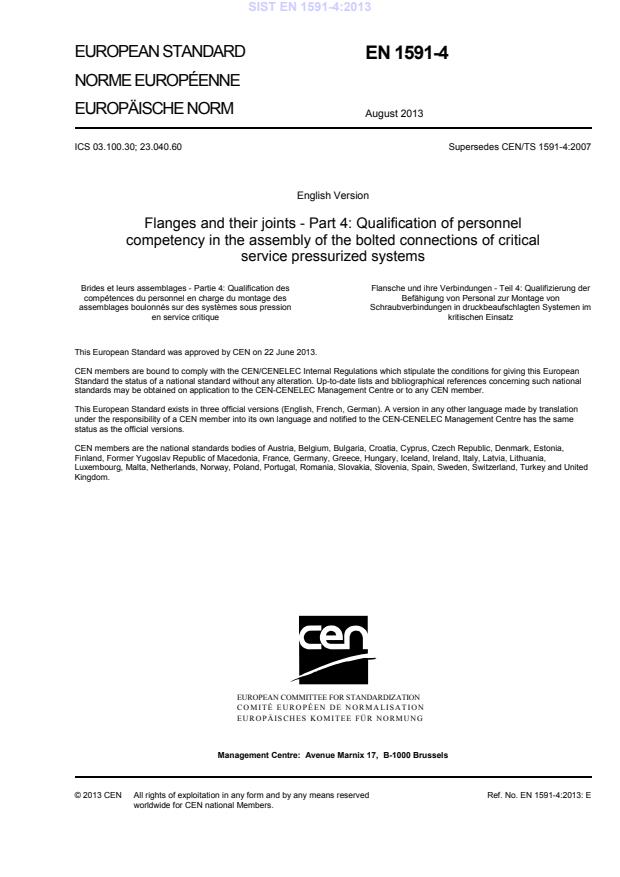
EUROPEAN STANDARD NORME EUROPÉENNE EUROPÄISCHE NORM
EN 1591-4
August 2013 ICS 03.100.30; 23.040.60 Supersedes CEN/TS 1591-4:2007English Version
Flanges and their joints - Part 4: Qualification of personnel competency in the assembly of the bolted connections of critical service pressurized systems
Brides et leurs assemblages - Partie 4: Qualification des compétences du personnel en charge du montage des assemblages boulonnés sur des systèmes sous pression en service critique
Flansche und ihre Verbindungen - Teil 4: Qualifizierung der Befähigung von Personal zur Montage von Schraubverbindungen in druckbeaufschlagten Systemen im kritischen Einsatz This European Standard was approved by CEN on 22 June 2013.
CEN members are bound to comply with the CEN/CENELEC Internal Regulations which stipulate the conditions for giving this European Standard the status of a national standard without any alteration. Up-to-date lists and bibliographical references concerning such national standards may be obtained on application to the CEN-CENELEC Management Centre or to any CEN member.
This European Standard exists in three official versions (English, French, German). A version in any other language made by translation under the responsibility of a CEN member into its own language and notified to the CEN-CENELEC Management Centre has the same status as the official versions.
CEN members are the national standards bodies of Austria, Belgium, Bulgaria, Croatia, Cyprus, Czech Republic, Denmark, Estonia, Finland, Former Yugoslav Republic of Macedonia, France, Germany, Greece, Hungary, Iceland, Ireland, Italy, Latvia, Lithuania, Luxembourg, Malta, Netherlands, Norway, Poland, Portugal, Romania, Slovakia, Slovenia, Spain, Sweden, Switzerland, Turkey and United Kingdom.
EUROPEAN COMMITTEE FOR STANDARDIZATION
COMITÉ EUROPÉEN DE NORMALISATION EUROPÄISCHES KOMITEE FÜR NORMUNG
Management Centre:
Avenue Marnix 17,
B-1000 Brussels © 2013 CEN All rights of exploitation in any form and by any means reserved worldwide for CEN national Members. Ref. No. EN 1591-4:2013: ESIST EN 1591-4:2013
CEN/TS 1591-3, Flanges and their joints — Design rules for gasketed circular flange connections — Part 3: Calculation method for metal to metal contact type flanged joint EN 1591-4, Flanges and their joints — Part 4: Qualification of personnel competency in the assembly of the bolted connections of critical service pressurized systems (the present document) CEN/TR 1591-5, Flanges and their joints — Design rules for gasketed circular flange connections — Part 5: Calculation method for full face gasketed joints According to the CEN-CENELEC Internal Regulations, the national standards organisations of the following countries are bound to implement this European Standard: Austria, Belgium, Bulgaria, Croatia, Cyprus, Czech Republic, Denmark, Estonia, Finland, Former Yugoslav Republic of Macedonia, France, Germany, Greece, Hungary, Iceland, Ireland, Italy, Latvia, Lithuania, Luxembourg, Malta, Netherlands, Norway, Poland, Portugal, Romania, Slovakia, Slovenia, Spain, Sweden, Switzerland, Turkey and the United Kingdom. SIST EN 1591-4:2013
A correctly assembled and tightened pressurised bolted connection that fails in service requires specialist knowledge to understand why the failure occurred and is outside the scope of this European Standard. SIST EN 1591-4:2013
3.11 foundation level level of training required, subject to assessment that the content has been assimilated, to ensure competency in the assembly of bolted connections whose bolts are capable of being tightened with hand operate torque wrenches Note 1 to entry: Once competency at the foundation level has been achieved, further training and assessment for larger bolts and in specialist areas is possible. 3.12 critical service any pressurised system where failure of the connection would result in danger to personnel or the environment 4 Qualification of trainer The trainer shall be able to demonstrate a thorough understanding of the technical and practical aspects of the syllabus. For many institutions providing training, such as vocational technical schools, this shall be mandated in the school’s quality plan. SIST EN 1591-4:2013
...
2003-01.Slovenski inštitut za standardizacijo. Razmnoževanje celote ali delov tega standarda ni dovoljeno.Flansche und ihre Verbindungen - Teil 4: Qualifizierung der Befähigung von Personal zur Montage von Schraubverbindungen in druckbeaufschlagten Systemen im kritischen EinsatzBrides et leurs assemblages - Partie 4: Qualification des compétences du personnel en charge du montage des assemblages boulonnés sur des systèmes sous pression en service critiqueFlanges and their joints - Part 4: Qualification of personnel competency in the assembly of the bolted connections of critical service pressurized systems23.040.60Prirobnice, oglavki in spojni elementiFlanges, couplings and joints03.100.30Vodenje ljudiManagement of human resourcesICS:Ta slovenski standard je istoveten z:EN 1591-4:2013SIST EN 1591-4:2013en,fr,de01-december-2013SIST EN 1591-4:2013SLOVENSKI
STANDARDSIST-TS CEN/TS 1591-4:20071DGRPHãþD
EUROPÄISCHE NORM EUROPEAN STANDARD NORME EUROPÉENNE
EN 1591-4
August 2013 ICS 03.100.30; 23.040.60 Ersatz für CEN/TS 1591-4:2007Deutsche Fassung
Flansche und ihre Verbindungen - Teil 4: Qualifizierung der Befähigung von Personal zur Montage von Schraubverbindungen in druckbeaufschlagten Systemen im kritischen Einsatz
Flanges and their joints - Part 4: Qualification of personnel competency in the assembly of the bolted connections of critical service pressurized systems
Brides et leurs assemblages - Partie 4: Qualification des compétences du personnel en charge du montage des assemblages boulonnés sur des systèmes sous pression en service critique Diese Europäische Norm wurde vom CEN am 22. Juni 2013 angenommen.
Die CEN-Mitglieder sind gehalten, die CEN/CENELEC-Geschäftsordnung zu erfüllen, in der die Bedingungen festgelegt sind, unter denen dieser Europäischen Norm ohne jede Änderung der Status einer nationalen Norm zu geben ist. Auf dem letzten Stand befindliche Listen dieser nationalen Normen mit ihren bibliographischen Angaben sind beim Management-Zentrum des CEN-CENELEC oder bei jedem CEN-Mitglied auf Anfrage erhältlich.
Diese Europäische Norm besteht in drei offiziellen Fassungen (Deutsch, Englisch, Französisch). Eine Fassung in einer anderen Sprache, die von einem CEN-Mitglied in eigener Verantwortung durch Übersetzung in seine Landessprache gemacht und dem Management-Zentrum mitgeteilt worden ist, hat den gleichen Status wie die offiziellen Fassungen.
CEN-Mitglieder sind die nationalen Normungsinstitute von Belgien, Bulgarien, Dänemark, Deutschland, der ehemaligen jugoslawischen Republik Mazedonien, Estland, Finnland, Frankreich, Griechenland, Irland, Island, Italien, Kroatien, Lettland, Litauen, Luxemburg, Malta, den Niederlanden, Norwegen, Österreich, Polen, Portugal, Rumänien, Schweden, der Schweiz, der Slowakei, Slowenien, Spanien, der Tschechischen Republik, der Türkei, Ungarn, dem Vereinigten Königreich und Zypern.
EUROPÄISCHES KOMITEE FÜR NORMUNG EUROPEAN COMMITTEE FOR STANDARDIZATION
COMITÉ EUROPÉEN DE NORMALISATION
Management-Zentrum:
Avenue Marnix 17,
B-1000 Brüssel © 2013 CEN Alle Rechte der Verwertung, gleich in welcher Form und in welchem Verfahren, sind weltweit den nationalen Mitgliedern von CEN vorbehalten.Ref. Nr. EN 1591-4:2013 DSIST EN 1591-4:2013
...