

EN 17077:2018
(Main)Determination of burning behaviour of dust layers
- Abstract
This European Standard describes a test method for the determination of the burning behaviour of dust layers under defined initial conditions of air flow, temperature and ignition.
A test result of burning class 1 with the described method does not mean that a dust cannot be ignited when dispersed in a cloud.
This method is not suitable for use with recognized explosives, like gunpowder and dynamite, explosives which do not require atmospheric oxygen for combustion, pyrophoric substances, or substances or mixtures of substances which may under some circumstances behave in a similar manner. Expert advice should be called in, when any doubt exists about the existence of hazard due to explosive properties.
- Status
- Published
- Publication Date
- 15-May-2018
- Withdrawal Date
- 29-Nov-2018
- Current Stage
- 9093 - Decision to confirm - Review Enquiry
- Start Date
- 19-Feb-2024
- Completion Date
- 14-Oct-2026
- Directive
- 2014/34/EU - Directive 2014/34/EU Of The European Parliament And Of The Council of 26 February 2014 on the harmonisation of the laws of the Member States relating to equipment and protective systems intended for use in potentially explosive atmospheres (recast)OJ Ref: C, C/371 OJ Date: 12-Oct-2018



Overview
EN 17077:2018 - "Determination of burning behaviour of dust layers" (CEN) defines a standardized laboratory method to screen the burning behaviour of dust layers under controlled air flow, temperature and ignition conditions. The standard classifies dust layer reactions (ignition, glowing, smouldering, propagation) into burning classes that help assess fire risk and inform prevention/protection measures. It is a screening method and does not guarantee safety when dust is dispersed as a cloud. The method is not suitable for recognized explosives, pyrophoric substances or materials that do not require atmospheric oxygen.
Key topics and technical requirements
- Test purpose: Experimental determination of dust layer burning behaviour and assignment of a burning class.
- Test environment: Tests are performed in a laboratory fume cupboard with a defined air flow along the dust train (approximately 0.2–0.4 m/s).
- Sample characterization: Representative sampling plus documented particle size distribution and moisture content; sample preparation (drying, sieving, grinding) must be recorded.
- Test apparatus: Two common set-ups:
- Board method - non‑combustible insulating board and mould to form a triangular powder train (mould ~ 20 ± 2 mm width, 10 ± 1 mm height, min. 40 mm length).
- Lütolf apparatus - glass tube and stainless steel sample holder for dust trains.
- Ignition source: Electrically heated glowing platinum wire (~1 000 °C, typical dimensions given) or an open blue flame whose tip temperature is ~1 000 °C.
- Procedure & evaluation: Apply ignition for ~5–10 s (repeat if necessary), visually observe ignition, glowing, smouldering, propagation; special rules for melting substances and elevated initial temperatures (Annex A).
- Limits: A result of burning class 1 does not rule out ignition in a dispersed dust cloud. Not applicable to explosives or pyrophoric materials.
- Related requirements: If class 4 or 5 is obtained and CLP labelling is required, further UN Test N.1 may be necessary.
Applications and who uses it
- Industrial users & safety engineers: screening dusts from food, chemical, wood, metal, mineral and polymer processing to evaluate layer fire risk.
- Testing laboratories: standardized assessment for client reports and regulatory compliance.
- Process designers / operators: inform decisions on fire prevention, filter and dryer design, hot-spot control, and housekeeping.
- Regulatory compliance: supports essential requirements of Directive 2014/34/EU (ATEX) and informs hazard classification under CLP where applicable.
Related standards
- EN 1127-1:2011 - Explosive atmospheres: basic concepts and methodology
- EN 13237:2012 - Terms and definitions for equipment and protective systems for potentially explosive atmospheres
- UN Manual of Tests and Criteria - Test N.1 (readily combustible solids) for additional testing when required
Keywords: EN 17077:2018, burning behaviour of dust layers, dust layer burning test, dust ignition, burning class, Lütolf apparatus, board method, potentially explosive atmospheres, dust explosion prevention.
Relations
- Effective Date
- 28-Jan-2026
- Effective Date
- 28-Jan-2026
Get Certified
Connect with accredited certification bodies for this standard

CIS Institut d.o.o.
Personal Protective Equipment (PPE) certification body. Notified Body NB-2890 for EU Regulation 2016/425 PPE.

Kiwa BDA Testing
Building and construction product certification.
Kmetijski inštitut Slovenije
Agricultural Institute of Slovenia. Soil testing, plant health, agricultural product analysis.
Sponsored listings
Frequently Asked Questions
EN 17077:2018 is a standard published by the European Committee for Standardization (CEN). Its full title is "Determination of burning behaviour of dust layers". This standard covers: This European Standard describes a test method for the determination of the burning behaviour of dust layers under defined initial conditions of air flow, temperature and ignition. A test result of burning class 1 with the described method does not mean that a dust cannot be ignited when dispersed in a cloud. This method is not suitable for use with recognized explosives, like gunpowder and dynamite, explosives which do not require atmospheric oxygen for combustion, pyrophoric substances, or substances or mixtures of substances which may under some circumstances behave in a similar manner. Expert advice should be called in, when any doubt exists about the existence of hazard due to explosive properties.
This European Standard describes a test method for the determination of the burning behaviour of dust layers under defined initial conditions of air flow, temperature and ignition. A test result of burning class 1 with the described method does not mean that a dust cannot be ignited when dispersed in a cloud. This method is not suitable for use with recognized explosives, like gunpowder and dynamite, explosives which do not require atmospheric oxygen for combustion, pyrophoric substances, or substances or mixtures of substances which may under some circumstances behave in a similar manner. Expert advice should be called in, when any doubt exists about the existence of hazard due to explosive properties.
EN 17077:2018 is classified under the following ICS (International Classification for Standards) categories: 13.220.40 - Ignitability and burning behaviour of materials and products. The ICS classification helps identify the subject area and facilitates finding related standards.
EN 17077:2018 has the following relationships with other standards: It is inter standard links to EN 1127-1:2011, EN 13237:2012. Understanding these relationships helps ensure you are using the most current and applicable version of the standard.
EN 17077:2018 is associated with the following European legislation: EU Directives/Regulations: 2014/34/EU, 94/9/EC; Standardization Mandates: M/BC/CEN/92/46. When a standard is cited in the Official Journal of the European Union, products manufactured in conformity with it benefit from a presumption of conformity with the essential requirements of the corresponding EU directive or regulation.
EN 17077:2018 is available in PDF format for immediate download after purchase. The document can be added to your cart and obtained through the secure checkout process. Digital delivery ensures instant access to the complete standard document.
Standards Content (Sample)
2003-01.Slovenski inštitut za standardizacijo. Razmnoževanje celote ali delov tega standarda ni dovoljeno.Ugotavljanje obnašanja pri gorenju prahu v plastehBrandverhalten von Staubschichten durch Klassifizierung in BrennklassenDétermination du comportement lors de la combustion des couches de poussièresDetermination of burning behaviour of dust layers13.220.40Sposobnost vžiga in obnašanje materialov in proizvodov pri gorenjuIgnitability and burning behaviour of materials and productsICS:Ta slovenski standard je istoveten z:EN 17077:2018SIST EN 17077:2018en,fr,de01-julij-2018SIST EN 17077:2018SLOVENSKI
STANDARD
EUROPEAN STANDARD NORME EUROPÉENNE EUROPÄISCHE NORM
EN 17077
May
t r s z ICS
s uä t t rä v r English Version
Determination of burning behaviour of dust layers Détermination du comportement lors de la combustion des couches de poussières
Bestimmung des Brandverhaltens von StaubschichtenThis European Standard was approved by CEN on
{ March
t r s zä
egulations which stipulate the conditions for giving this European Standard the status of a national standard without any alterationä Upætoædate lists and bibliographical references concerning such national standards may be obtained on application to the CENæCENELEC Management Centre or to any CEN memberä
translation under the responsibility of a CEN member into its own language and notified to the CENæCENELEC Management Centre has the same status as the official versionsä
CEN members are the national standards bodies of Austriaá Belgiumá Bulgariaá Croatiaá Cyprusá Czech Republicá Denmarká Estoniaá Finlandá Former Yugoslav Republic of Macedoniaá Franceá Germanyá Greeceá Hungaryá Icelandá Irelandá Italyá Latviaá Lithuaniaá Luxembourgá Maltaá Netherlandsá Norwayá Polandá Portugalá Romaniaá Serbiaá Slovakiaá Sloveniaá Spainá Swedená Switzerlandá Turkey and United Kingdomä
EUROPEAN COMMITTEE FOR STANDARDIZATION COMITÉ EUROPÉEN DE NORMALISATION EUROPÄISCHES KOMITEE FÜR NORMUNG
CEN-CENELEC Management Centre:
Rue de la Science 23,
B-1040 Brussels
t r s z CEN All rights of exploitation in any form and by any means reserved worldwide for CEN national Membersä Refä Noä EN
s y r y yã t r s z ESIST EN 17077:2018
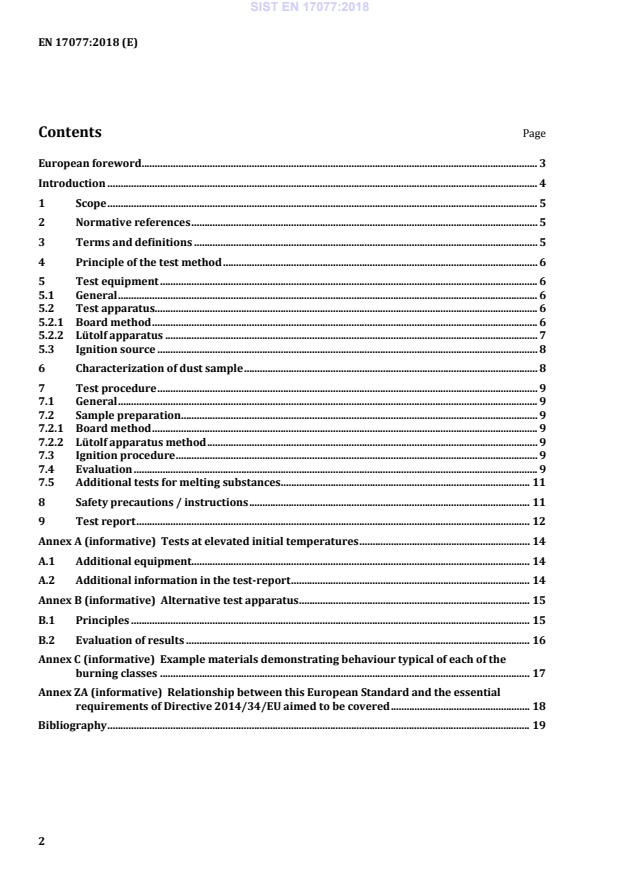
Tests at elevated initial temperatures . 14 A.1 Additional equipment. 14 A.2 Additional information in the test-report . 14 Annex B (informative)
Alternative test apparatus . 15 B.1 Principles . 15 B.2 Evaluation of results . 16 Annex C (informative)
Example materials demonstrating behaviour typical of each of the burning classes . 17 Annex ZA (informative)
Relationship between this European Standard and the essential requirements of Directive 2014/34/EU aimed to be covered . 18 Bibliography . 19
IEC Electropedia: available at http://www.electropedia.org/
ISO Online browsing platform: available at http://www.iso.org/obp 3.1 air flow velocity volume of air [m3] which flows through a defined surface [m2] per unit time [s] 3.2 combustion exothermic reaction with either flames, glowing or smouldering when ignited Note to entry: For the purpose of this standard “combustion” includes decomposition 3.3 ignition initiation of combustion 3.4 initial temperature temperature of the dust train at the moment of ignition SIST EN 17077:2018
...