

EN 15936:2022
(Main)Soil, waste, treated biowaste and sludge - Determination of total organic carbon (TOC) by dry combustion
- Abstract
This document specifies two methods for the determination of total organic carbon (TOC) in sludge, treated biowaste, soil and waste samples containing more than 0,1 % carbon in relation to the dry mass (dm).
NOTE This method can also be applied to other environmental solid matrices, provided the user has verified the applicability.
- Status
- Published
- Publication Date
- 22-Feb-2022
- Withdrawal Date
- 30-Aug-2022
- Technical Committee
- CEN/TC 444 - Environmental characterization
- Drafting Committee
- CEN/TC 444/WG 3 - Inorganic analysis
- Current Stage
- 6060 - Definitive text made available (DAV) - Publishing
- Start Date
- 23-Feb-2022
- Due Date
- 18-Jan-2022
- Completion Date
- 23-Feb-2022


Overview
EN 15936:2022 (CEN) specifies two validated dry-combustion methods for determining total organic carbon (TOC) in solid environmental matrices - notably soil, waste, treated biowaste and sludge - for samples containing more than 0.1% carbon (dry mass). Results are expressed as % C (dm). The standard supersedes EN 15936:2012, incorporates material from EN 13137:2001, and was approved by CEN in December 2021.
Key topics and technical requirements
- Two methods
- Method A (indirect): Measure Total Carbon (TC) by combustion and Total Inorganic Carbon (TIC) by acidification/purging; TOC = TC − TIC.
- Method B (direct): Remove inorganic carbon by acid treatment, then combust and measure the CO2 released to obtain TOC directly.
- Validated matrices include municipal sludge, compost (fresh and treated), sludge-amended and agricultural soils, and various wastes (filter cake, bottom ash, electro-plating and dredged sludges, rubble).
- Sample pre-treatment: Follow EN 16179 or EN 15002 where applicable; particle size < 250 µm; record and remove non-comminutable material.
- Reagents & controls: Specifies analytical-grade reagents and two control mixtures (A and B) formulated from components such as sodium carbonate, Na‑EDTA·4H2O and aluminium oxide to verify method performance.
- Apparatus & detection: Dry-combustion analyzers with CO2 detection (e.g., IR, thermal conductivity, coulometry) and acid-purging equipment for Method A.
- Interferences & limitations: High TIC:TOC ratios (≈ ≥10) can affect accuracy; volatile organics, halogenated compounds, cyanides and certain refractory inorganic carbonates can interfere and may require separate assessment or modifier use.
- Quality & performance: Calibration, control measurements, repeatability/reproducibility data and an informative annex on factors influencing dry-combustion methods are included.
Applications and who uses it
EN 15936:2022 is used by:
- Environmental and analytical laboratories performing routine TOC analyses for compliance, monitoring and reporting.
- Waste management and composting operators measuring organic content of treated biowaste and sludge for process control and certification.
- Soil and remediation specialists assessing organic carbon in amended soil or contaminated sites.
- Regulators and consultants requiring standardized TOC data for permitting, land application criteria and environmental impact assessments.
Practical uses: quality control of composts and biosolids, landfill and incineration feedstock characterization, soil organic matter assessment, and verification of treatment processes.
Related standards
- EN 15936:2012 (superseded)
- EN 13137:2001 (methods combined into this edition)
- Sample pre-treatment references: EN 16179, EN 15002
Keywords: EN 15936:2022, TOC determination, total organic carbon, dry combustion, soil testing, sludge analysis, treated biowaste, waste characterization, CEN standard.
Relations
- Effective Date
- 07-Aug-2019
- Effective Date
- 28-Jan-2026
- Effective Date
- 28-Jan-2026
- Referred By
EN 16907-6:2018 - Earthworks - Part 6: Land reclamation earthworks using dredged hydraulic fill - Effective Date
- 28-Jan-2026
- Effective Date
- 28-Jan-2026
- Effective Date
- 28-Jan-2026
- Effective Date
- 28-Jan-2026
- Effective Date
- 28-Jan-2026
- Effective Date
- 20-Aug-2025
Get Certified
Connect with accredited certification bodies for this standard

CIS Institut d.o.o.
Personal Protective Equipment (PPE) certification body. Notified Body NB-2890 for EU Regulation 2016/425 PPE.

Kiwa BDA Testing
Building and construction product certification.
Kmetijski inštitut Slovenije
Agricultural Institute of Slovenia. Soil testing, plant health, agricultural product analysis.
Sponsored listings
Frequently Asked Questions
EN 15936:2022 is a standard published by the European Committee for Standardization (CEN). Its full title is "Soil, waste, treated biowaste and sludge - Determination of total organic carbon (TOC) by dry combustion". This standard covers: This document specifies two methods for the determination of total organic carbon (TOC) in sludge, treated biowaste, soil and waste samples containing more than 0,1 % carbon in relation to the dry mass (dm). NOTE This method can also be applied to other environmental solid matrices, provided the user has verified the applicability.
This document specifies two methods for the determination of total organic carbon (TOC) in sludge, treated biowaste, soil and waste samples containing more than 0,1 % carbon in relation to the dry mass (dm). NOTE This method can also be applied to other environmental solid matrices, provided the user has verified the applicability.
EN 15936:2022 is classified under the following ICS (International Classification for Standards) categories: 13.030.01 - Wastes in general; 13.080.10 - Chemical characteristics of soils. The ICS classification helps identify the subject area and facilitates finding related standards.
EN 15936:2022 has the following relationships with other standards: It is inter standard links to EN 15936:2012, EN 17196:2023, EN 16174:2012, EN 16907-6:2018, CEN/TS 16675:2018, EN 16457:2014, CEN/TS 17196:2018, CEN/TS 16675:2014, FprEN ISO 15936. Understanding these relationships helps ensure you are using the most current and applicable version of the standard.
EN 15936:2022 is associated with the following European legislation: EU Directives/Regulations: 86/278/EEC; Standardization Mandates: M/330. When a standard is cited in the Official Journal of the European Union, products manufactured in conformity with it benefit from a presumption of conformity with the essential requirements of the corresponding EU directive or regulation.
EN 15936:2022 is available in PDF format for immediate download after purchase. The document can be added to your cart and obtained through the secure checkout process. Digital delivery ensures instant access to the complete standard document.
Standards Content (Sample)
SLOVENSKI STANDARD
01-julij-2022
Nadomešča:
SIST EN 15936:2012
Tla, odpadki, obdelani biološki odpadki in blato - Določevanje celotnega
organskega ogljika (TOC) s suhim sežigom
Soil, waste, treated biowaste and sludge - Determination of total organic carbon (TOC)
by dry combustion
Boden, Abfall, behandelter Bioabfall und Schlamm - Bestimmung des gesamten
organischen Kohlenstoffs (TOC) mittels trockener Verbrennung
Sols, déchets, biodéchets traités et boues - Dosage du carbone organique total (COT)
par combustion sèche
Ta slovenski standard je istoveten z: EN 15936:2022
ICS:
13.030.20 Tekoči odpadki. Blato Liquid wastes. Sludge
13.080.10 Kemijske značilnosti tal Chemical characteristics of
soils
2003-01.Slovenski inštitut za standardizacijo. Razmnoževanje celote ali delov tega standarda ni dovoljeno.
EN 15936
EUROPEAN STANDARD
NORME EUROPÉENNE
February 2022
EUROPÄISCHE NORM
ICS 13.030.01; 13.080.10 Supersedes EN 15936:2012
English Version
Soil, waste, treated biowaste and sludge - Determination of
total organic carbon (TOC) by dry combustion
Sols, déchets, biodéchets traités et boues - Dosage du Boden, Abfall, behandelter Bioabfall und Schlamm -
carbone organique total (COT) par combustion sèche Bestimmung des gesamten organischen Kohlenstoffs
(TOC) mittels trockener Verbrennung
This European Standard was approved by CEN on 19 December 2021.
CEN members are bound to comply with the CEN/CENELEC Internal Regulations which stipulate the conditions for giving this
European Standard the status of a national standard without any alteration. Up-to-date lists and bibliographical references
concerning such national standards may be obtained on application to the CEN-CENELEC Management Centre or to any CEN
member.
This European Standard exists in three official versions (English, French, German). A version in any other language made by
translation under the responsibility of a CEN member into its own language and notified to the CEN-CENELEC Management
Centre has the same status as the official versions.
CEN members are the national standards bodies of Austria, Belgium, Bulgaria, Croatia, Cyprus, Czech Republic, Denmark, Estonia,
Finland, France, Germany, Greece, Hungary, Iceland, Ireland, Italy, Latvia, Lithuania, Luxembourg, Malta, Netherlands, Norway,
Poland, Portugal, Republic of North Macedonia, Romania, Serbia, Slovakia, Slovenia, Spain, Sweden, Switzerland, Turkey and
United Kingdom.
EUROPEAN COMMITTEE FOR STANDARDIZATION
COMITÉ EUROPÉEN DE NORMALISATION
EUROPÄISCHES KOMITEE FÜR NORMUNG
CEN-CENELEC Management Centre: Rue de la Science 23, B-1040 Brussels
© 2022 CEN All rights of exploitation in any form and by any means reserved Ref. No. EN 15936:2022 E
worldwide for CEN national Members.
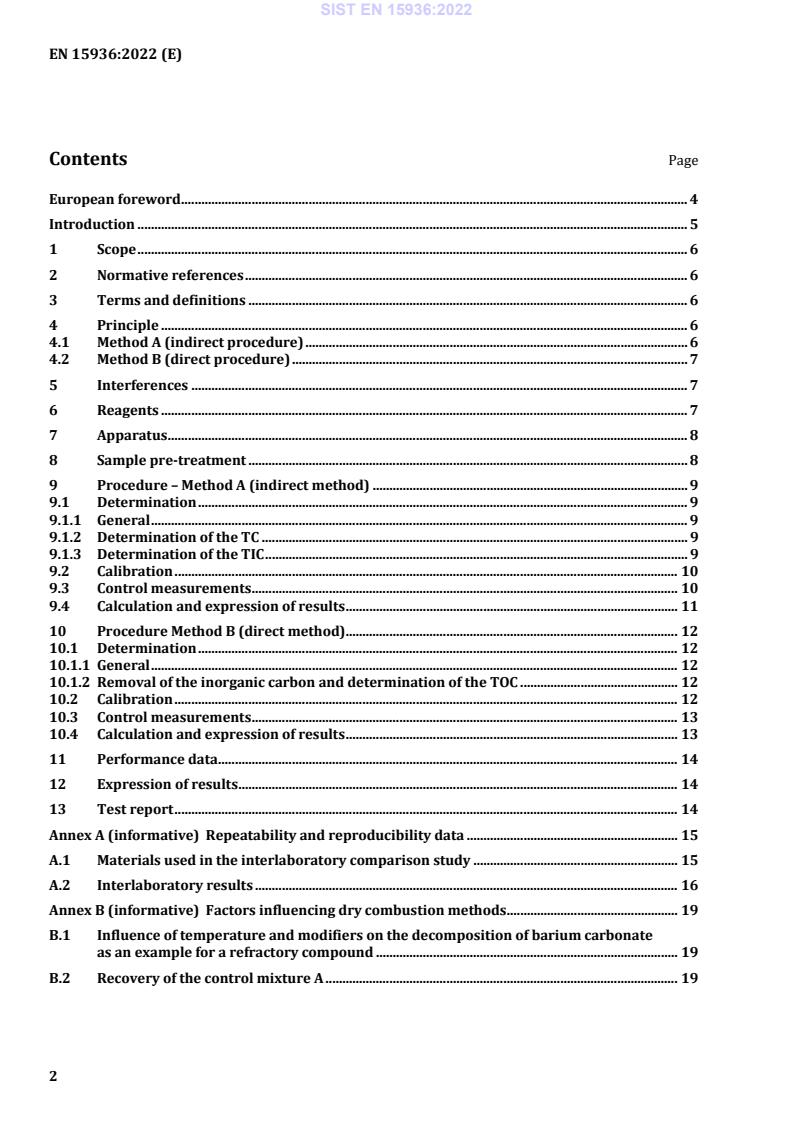
Contents Page
European foreword . 4
Introduction . 5
1 Scope . 6
2 Normative references . 6
3 Terms and definitions . 6
4 Principle . 6
4.1 Method A (indirect procedure) . 6
4.2 Method B (direct procedure) . 7
5 Interferences . 7
6 Reagents . 7
7 Apparatus . 8
8 Sample pre-treatment . 8
9 Procedure – Method A (indirect method) . 9
9.1 Determination . 9
9.1.1 General . 9
9.1.2 Determination of the TC . 9
9.1.3 Determination of the TIC . 9
9.2 Calibration . 10
9.3 Control measurements . 10
9.4 Calculation and expression of results . 11
10 Procedure Method B (direct method) . 12
10.1 Determination . 12
10.1.1 General . 12
10.1.2 Removal of the inorganic carbon and determination of the TOC . 12
10.2 Calibration . 12
10.3 Control measurements . 13
10.4 Calculation and expression of results . 13
11 Performance data . 14
12 Expression of results . 14
13 Test report . 14
Annex A (informative) Repeatability and reproducibility data . 15
A.1 Materials used in the interlaboratory comparison study . 15
A.2 Interlaboratory results . 16
Annex B (informative) Factors influencing dry combustion methods . 19
B.1 Influence of temperature and modifiers on the decomposition of barium carbonate
as an example for a refractory compound . 19
B.2 Recovery of the control mixture A . 19
B.3 Influence of aluminium oxide or sodium sulfate used for sample preparation for the
recovery of TOC . 20
B.4 Influence of TIC:TOC ratio on the recovery and the coefficient of variation . 21
B.5 Method B: Influence of the temperature during the removal of inorganic carbon on
the recovery of TOC . 22
Bibliography . 23
European foreword
This document (EN 15936:2022) has been prepared by Technical Committee CEN/TC 444
“Environmental characterization of solid matrices”, the secretariat of which is held by NEN.
This European Standard shall be given the status of a national standard, either by publication of an
identical text or by endorsement, at the latest by August 2022, and conflicting national standards shall be
withdrawn at the latest by month August 2022.
Attention is drawn to the possibility that some of the elements of this document may be the subject of
patent rights. CEN shall not be held responsible for identifying any or all such patent rights.
This document supersedes EN 15936:2012.
This document combines methods from EN 15936:2012 and EN 13137:2001.
The main changes compared to the previous edition are as follows:
— New composition of the substances in control mixture A (6.10) was defined and the recovery
requirement (9.3) was adapted to the results of a lab trial;
— Annex C – “Determination of total organic carbon (TOC) in solid samples using the suspension
method” was skipped;
— The text was editorially revised.
Any feedback and questions on this document should be directed to the users’ national standards body.
A complete listing of these bodies can be found on the CEN website.
According to the CEN-CENELEC Internal Regulations, the national standards organisations of the
following countries are bound to implement this European Standard: Austria, Belgium, Bulgaria, Croatia,
Cyprus, Czech Republic, Denmark, Estonia, Finland, France, Germany, Greece, Hungary, Iceland, Ireland,
Italy, Latvia, Lithuania, Luxembourg, Malta, Netherlands, Norway, Poland, Portugal, Republic of North
Macedonia, Romania, Serbia, Slovakia, Slovenia, Spain, Sweden, Switzerland, Turkey and the United
Kingdom.
Introduction
This document is applicable and validated for several types of matrices as indicated in Table 1 (see also
Annex A for the results of the validation). The results in this document are expressed in % C in relation
to the dry mass (dm).
Table 1 — Matrices for which this document is applicable and validated
Matrix Materials used for validation
Sludge Municipal sludge
Biowaste Compost,
Fresh Compost
Soil Sludge amended soil,
Agricultural soil
Waste Filter cake,
Bottom ash,
Electro-plating sludge,
Dredged sludge,
Rubble
WARNING — Persons using this document should be familiar with usual laboratory practice. This
document does not purport to address all of the safety problems, if any, associated with its use. It is the
responsibility of the user to establish appropriate safety and health practices.
IMPORTANT — It is absolutely essential that tests conducted according to this document be carried out
by suitably trained staff.
1 Scope
This document specifies two methods for the determination of total organic carbon (TOC) in sludge,
treated biowaste, soil and waste samples containing more than 0,1 % carbon in relation to the dry mass
(dm).
NOTE This method can also be applied to other environmental solid matrices, provided the user has verified
the applicability.
2 Normative references
There are no normative references in this document.
3 Terms and definitions
For the purposes of this document, the following terms and definitions apply.
ISO and IEC maintain terminological databases for use in standardization at the following addresses:
— ISO Online browsing platform: available at https://www.iso.org/obp/
— IEC Electropedia: available at https://www.electropedia.org/
3.1
total carbon
TC
quantity of carbon present in the sample in the form of organic, inorganic and elemental carbon
3.2
total inorganic carbon
TIC
quantity of carbon that is liberated as carbon dioxide by acid treatment
Note 1 to entry: Typically, the TIC represents the carbonates present in a sample.
3.3
total organic carbon
TOC
quantity of carbon that is converted into carbon dioxide by combustion and which is not liberated as
carbon dioxide by acid treatment
4 Principle
4.1 Method A (indirect procedure)
In this procedure, the TOC is obtained by the difference between the results of the measurements of TC
and TIC.
The total carbon (TC) present in the sample is converted into carbon dioxide by combustion in an oxygen-
containing gas flow free of carbon dioxide. To ensure complete combustion, catalysts and/or modifiers
can be used. The released amount of carbon dioxide is measured e.g. by infrared spectrometry, thermal
conductivity detection, or other suitable techniques.
The TIC is determined separately from another sub-sample by means of acidification and purging of the
released carbon dioxide. The carbon dioxide shall be measured by one of the techniques mentioned
above.
4.2 Method B (direct procedure)
In this procedure, the TIC present in the sample are previously removed by treating the sample with acid.
The carbon dioxide released by the following combustion step is measured by one of the techniques
mentioned in 4.1 and indicates the TOC directly.
NOTE The quality of results of Method B is dependent on experience and practice, especially regarding the
steps before the determination of TOC. Use of automatic dispensing units regarding removal of TIC prior to
determination of TOC can improve the performance of Method B.
5 Interferences
Depending on the laboratory experience with samples containing high amounts of TIC, the procedures
can lead to unreliable TOC results if the TIC to TOC ratio is very high (e.g. ≥ 10).
Depending on the detection method used, different interferences can occur, for instance:
— the presence of cyanide can interfere with the coulometric detection of TIC by modifying the pH value
(dissolution of HCN);
— high content of halogenated compounds can lead to an overestimation of TOC when coulometric
detection is used; in some cases the classical silver or copper trap can be insufficient to absorb all
halides.
Method B can lead to incorrect results in the following cases:
— Volatile organic substances (e.g. volatile hydrocarbons from sludge of oil separators) can be lost
during sample preparation especially during the acidification. If necessary, the carbon content
resulting from volatile organic substances shall be determined separately.
— side reactions between the sample and the acid take place (e.g. decarboxylation, volatile reaction
products).
When present, elemental carbon, carbides, cyanides, cyanates, isocyanates, isothiocyanates and
thiocyanates are determined as organic carbon using the methods described in this document. An
interpretation of the measured value can therefore be problematic in cases where the sample contains
relevant levels of the above-mentioned components. If needed, these components shall be determined
separately by means of a suitable validated method and be recorded in the test report.
6 Reagents
Use only reagents of recognized analytical grade, unless otherwise specified.
Hygroscopic substances shall be stored in a desiccator.
6.1 Calcium carbonate, CaCO .
6.2 Sodium carbonate, Na CO , anhydrous.
2 3
6.3 Tetrasodium ethylenediamine tetraacetate-tetra-hydrate, Na -EDTA ∙ 4 H O
4 2
(C H N O Na ∙ 4 H O), heated at 80 °C for 2 h.
10 12 2 8 4 2
Other forms of Na -EDTA hydrates may be used if the water content is exactly known. In these cases, the
composition of the control mixtures shall be recalculated accordingly (see also 6.10 and 6.11).
6.4 Potassium hydrogen phthalate, C H O K.
8 5 4
6.5 Acetanilide, C H NO.
8 9
6.6 Atropine, C H NO .
17 23 3
6.7 Spectrographic graphite powder, C.
6.8 Sodium salicylate, C H O Na.
7 5 3
6.9 Aluminium oxide, Al O , neutral, granular size < 200 µm, annealed at 600 °C.
2 3
6.10 Control mixture A, prepared from sodium carbonate (6.2), Na -EDTA ∙ 4 H O (6.3) and aluminium
4 2
oxide (6.9) in a mass ratio of 2,34 : 1,00 : 7,28.
The mixture shall be homogenized. It shall contain 2,5 % TIC and 2,5 % TOC (e.g. 22,06 g of sodium
carbonate, 9,41 g Na -EDTA ∙ 4 H O, 68,53 g of aluminium oxide).
4 2
6.11 Control mixture B, prepared from sodium salicylate (6.8), calcium carbonate (6.1), Na -EDTA ·
4 H O (6.3) and aluminium oxide (6.9) in a mass ratio of 1,00 : 4,36 : 1,97 : 8,39.
The mixture shall be homogenized. It shall contain 3,3 % TIC and 6,6 % TOC (e.g. 6,36 g of sodium
salicylate, 27,78 g of calcium carbonate, 12,50 g of Na -EDTA · 4 H O, 53,36 g of aluminium oxide).
4 2
6.12 Non-oxidizing mineral acid, used for carbon dioxide expulsion, e.g. phosphoric acid H PO
3 4
(w = 85 %).
NOTE Due to potential corrosion by hydrochloric acid, phosphoric acid is preferred for TIC determination in
Method A (9.1.3). Due to potential formation of P O during combustion, hydrochloric acid is preferred for removal
4 10
of inorganic carbon in Method B (10.1.2).
6.13 Carrier gas, e.g. synthetic air, nitrogen, oxygen or argon, free of carbon dioxide and organic
impurities in accordance with the manufacturer's instructions.
7 Apparatus
7.1 Precision balance, accurate to at least 0,5 % of test portion weight.
7.2 Equipment for determination of carbon in solids, with relevant accessories.
7.3 Purging unit for TIC determination, for Method A only.
7.4 Vessels, made of e.g. ceramic, silica, quartz, silver or platinum.
NOTE Tin and nickel vessels are not acid-resistant. Tin vessels are suitable only for Method A.
8 Sample pre-treatment
The sample should be pre-treated according to EN 16179 or EN 15002, if not otherwise specified. The
particle size shall be < 250 μm. Foreign bodies or non-comminutable material should be separated from
the sample and the weight and nature of the material should be recorded.
For solid materials, dried samples shall be used.
NOTE 1 The drying method can affect the result.
Moist or paste-like waste samples may be mixed with aluminium oxide (6.9) until granular material is
obtained and then be comminuted to a particle size < 250 μm. In this case, the ratio of aluminium oxide
to sample shall be considered in the calculation of TOC (according to 9.4 or 10.4).
If samples contain – depending on the accuracy requested for the method – negligible amounts of volatile
compounds except water, the samples shall be dried.
NOTE 2 For waste samples, the homogeneity is important and often the aluminium oxide step is helpful. More
information is given in Annex B.
9 Procedure – Method A (indirect method)
9.1 Determination
9.1.1 General
The mass of the test portion shall be as large as possible and shall be chosen so that the liberated quantity
of carbon dioxide lies within the working range of the equipment/calibration.
9.1.2 Determination of the TC
To minimize carbon blank values the vessel may be pre-treated by heating (in a muffle furnace or the TC
apparatus itself). The sample prepared according to Clause 8 is weighed into a suitable vessel (7.4).
The sample is combusted or decomposed in a flow of carrier gas containing oxygen (6.13).
The combustion temperature shall be high enough to convert all carbon completely to carbon dioxide.
NOTE For samples containing carbonates, which are difficult to decompose, e.g. barium carbonate, the release
of the carbon dioxide can be improved by increasing the temperature or by the use of modifiers, e.g. tin, copper (see
B.1).
The temperature range of commercially available instruments is between 900 °C and 1 500 °C.
During the combustion of reactive samples, explosion or fuming can be prevented by covering the sample
with inert material e.g. silica sand.
The amount of carbon dioxide released during the combustion is measured e.g. by infrared spectrometry,
thermal conductivity detection, or other suitable techniques, and is expressed as total carbon (TC).
9.1.3 Determination of the TIC
The sample prepared according to Clause 8 is weighed into the purging unit (7.3) or in the sample vessel
(7.4).
The system is closed gas-tight and flushed with carrier gas until no more carbon dioxide from ambient
air is present. Then acid (6.12) is added and the carbon dioxide is stripped by purging or stirring and/or
heating. The released carbon dioxide is transferred to the detector by the carrier gas.
The addition of wetting agents, e.g. surfactants, can improve wetting of the surface of the sample.
The addition of anti-foaming agents, e.g. silicone oil, can be helpful in the case of strongly foaming
samples.
The amount of carbon dioxide released during the gas evolution is mea
...