

EN 15998:2020
(Main)Glass in building - Safety in case of fire, fire resistance - Glass testing methodology for the purpose of classification
- Abstract
This document specifies the testing methodology to be used for glass products that are claiming fire resistance. The methodology covers type testing as defined in the relevant glass product standard.
NOTE This document provides guidance with the declaration of the characteristic, Safety in case of fire − Resistance to fire (for glass for use in a glazed assembly intended specifically for fire resistance) for the CE marking.
The same methodology can also be used to determine the performance classification for market applications (see Annex B).
The methodology covers all glass product types that may require testing and classification for fire resistance.
Fire resistance testing covers end use applications, for example:
- doors;
- partitions, walls (including curtain walling);
- floors, roofs;
- ceilings.
- Status
- Published
- Publication Date
- 29-Sep-2020
- Withdrawal Date
- 30-Mar-2021
- Technical Committee
- CEN/TC 129 - Glass in building
- Drafting Committee
- CEN/TC 129/WG 11 - Fire resistant glazed assemblies
- Current Stage
- 9060 - Closure of 2 Year Review Enquiry - Review Enquiry
- Start Date
- 04-Mar-2026
- Completion Date
- 04-Mar-2026



Overview
EN 15998:2020 - Glass in building - Safety in case of fire, fire resistance - Glass testing methodology for the purpose of classification (CEN) - specifies the testing methodology to be used when glass products claim fire resistance. The standard defines how type testing is carried out for glass as a product characteristic (for CE marking) and provides an approach that can also be applied to market-specific performance classification (see Annex B). It covers all glass product types (monolithic, thermally toughened, laminated, insulating glass units, coated glass) and end‑use glazed assemblies such as doors, partitions and curtain walls, floors, roofs and ceilings.
Key topics and technical requirements
- Testing methodology: Defines procedures for type testing of glass used in fire-resistant glazed assemblies. Testing is performed on a complete glazed assembly - not on glass alone.
- Virtual assembly concept: The tested glazed assembly is often a “virtual assembly” specified by the glass manufacturer (glass + framing system + glazing materials).
- Classification linkage: Fire performance is classified in accordance with EN 13501-2 (E, EW, EI, RE, REI) and relates to the complete glazed assembly.
- Sampling and test data: Rules for sampling, use of pre-existing test data, non-sampled test results and preparation of test reports and manufacturer technical files.
- Extended Field of Application (EXAP): Rules and processes to extend test results to variations in product properties or end uses based on defined calculation or extrapolation procedures.
- Scope of product families: Annex A lists typical glass product families (monolithic, laminated, IGUs, coated, etc.) for which the methodology applies.
- Market application testing: Annex B gives guidance on determining performance classification for real-world market applications.
- Referenced fire test standards: Methodology integrates with fire test standards such as EN 1364 series, EN 1365 series, EN 1634-1 and classification standard EN 13501-2.
Practical applications
- Establishing the essential characteristic “Safety in case of fire − Resistance to fire” for CE marking of glass products.
- Providing manufacturers and test laboratories a harmonized method to obtain fire-resistance classifications for glazed elements.
- Supporting designers, architects and fire engineers in specifying glazing systems for fire-rated doors, partitions, curtain walling, floors, roofs and ceilings.
- Enabling product ranges to be validated for multiple applications via EXAP and documented classification reports.
Who should use this standard
- Glass manufacturers and product development teams
- Accredited fire test laboratories and certification bodies
- Façade, door and curtain-wall system manufacturers
- Fire safety engineers, architects and building specifiers
- Regulatory authorities responsible for CE marking and product compliance
Related standards
- EN 13501-2 (fire classification)
- EN 1364-1/2/3/4, EN 1365-1/2 (fire resistance tests for elements)
- EN 1634-1 (door and shutter assemblies)
- Relevant product standards referenced in Annex A (EN 1279, EN 12150, EN 14449, etc.)
Keywords: EN 15998:2020, fire resistant glass, glass testing methodology, fire resistance classification, glazed assembly, CE marking, EXAP, virtual assembly.
Relations
- Effective Date
- 07-Oct-2020
- Effective Date
- 28-Jan-2026
- Effective Date
- 28-Jan-2026
- Effective Date
- 28-Jan-2026
- Effective Date
- 28-Jan-2026
- Effective Date
- 28-Jan-2026
- Effective Date
- 28-Jan-2026
- Effective Date
- 28-Jan-2026
- Effective Date
- 28-Jan-2026
- Effective Date
- 28-Jan-2026
- Effective Date
- 28-Jan-2026
- Effective Date
- 28-Jan-2026
Get Certified
Connect with accredited certification bodies for this standard

CIS Institut d.o.o.
Personal Protective Equipment (PPE) certification body. Notified Body NB-2890 for EU Regulation 2016/425 PPE.

Kiwa BDA Testing
Building and construction product certification.
Kmetijski inštitut Slovenije
Agricultural Institute of Slovenia. Soil testing, plant health, agricultural product analysis.
Sponsored listings
Frequently Asked Questions
EN 15998:2020 is a standard published by the European Committee for Standardization (CEN). Its full title is "Glass in building - Safety in case of fire, fire resistance - Glass testing methodology for the purpose of classification". This standard covers: This document specifies the testing methodology to be used for glass products that are claiming fire resistance. The methodology covers type testing as defined in the relevant glass product standard. NOTE This document provides guidance with the declaration of the characteristic, Safety in case of fire − Resistance to fire (for glass for use in a glazed assembly intended specifically for fire resistance) for the CE marking. The same methodology can also be used to determine the performance classification for market applications (see Annex B). The methodology covers all glass product types that may require testing and classification for fire resistance. Fire resistance testing covers end use applications, for example: - doors; - partitions, walls (including curtain walling); - floors, roofs; - ceilings.
This document specifies the testing methodology to be used for glass products that are claiming fire resistance. The methodology covers type testing as defined in the relevant glass product standard. NOTE This document provides guidance with the declaration of the characteristic, Safety in case of fire − Resistance to fire (for glass for use in a glazed assembly intended specifically for fire resistance) for the CE marking. The same methodology can also be used to determine the performance classification for market applications (see Annex B). The methodology covers all glass product types that may require testing and classification for fire resistance. Fire resistance testing covers end use applications, for example: - doors; - partitions, walls (including curtain walling); - floors, roofs; - ceilings.
EN 15998:2020 is classified under the following ICS (International Classification for Standards) categories: 13.220.50 - Fire-resistance of building materials and elements; 81.040.20 - Glass in building. The ICS classification helps identify the subject area and facilitates finding related standards.
EN 15998:2020 has the following relationships with other standards: It is inter standard links to EN 15998:2010, EN 1365-1:2012, EN 1364-3:2014, EN 1364-4:2014, EN 1364-1:2015, EN 1364-2:2018, EN 1365-2:2014, EN 13501-2:2023, EN 1634-1:2014+A1:2018, EN 15681-2:2017, EN 1096-4:2018, EN 1279-5:2018. Understanding these relationships helps ensure you are using the most current and applicable version of the standard.
EN 15998:2020 is associated with the following European legislation: EU Directives/Regulations: 305/2011; Standardization Mandates: M/135. When a standard is cited in the Official Journal of the European Union, products manufactured in conformity with it benefit from a presumption of conformity with the essential requirements of the corresponding EU directive or regulation.
EN 15998:2020 is available in PDF format for immediate download after purchase. The document can be added to your cart and obtained through the secure checkout process. Digital delivery ensures instant access to the complete standard document.
Standards Content (Sample)
SLOVENSKI STANDARD
01-december-2020
Nadomešča:
SIST EN 15998:2011
Steklo v gradbeništvu - Varnost v primeru požara, požarna odpornost -
Metodologija preskušanja stekla za namene klasificiranja
Glass in building - Safety in case of fire, fire resistance - Glass testing methodology for
the purpose of classification
Glas im Bauwesen - Brandsicherheit, Feuerwiderstandsfähigkeit - Verfahrensweise von
Glasprüfungen zur Klassifizierung
Verre dans la construction - Sécurité en cas d'incendie, résistance au feu - Méthodologie
d'essai du verre à des fins de classification
Ta slovenski standard je istoveten z: EN 15998:2020
ICS:
13.220.50 Požarna odpornost Fire-resistance of building
gradbenih materialov in materials and elements
elementov
81.040.20 Steklo v gradbeništvu Glass in building
2003-01.Slovenski inštitut za standardizacijo. Razmnoževanje celote ali delov tega standarda ni dovoljeno.
EN 15998
EUROPEAN STANDARD
NORME EUROPÉENNE
September 2020
EUROPÄISCHE NORM
ICS 13.220.50; 81.040.20 Supersedes EN 15998:2010
English Version
Glass in building - Safety in case of fire, fire resistance -
Glass testing methodology for the purpose of classification
Verre dans la construction - Sécurité en cas d'incendie, Glas im Bauwesen - Brandsicherheit,
résistance au feu - Méthodologie d'essai du verre à des Feuerwiderstandsfähigkeit - Verfahrensweise von
fins de classification Glasprüfungen zur Klassifizierung
This European Standard was approved by CEN on 9 January 2020.
CEN members are bound to comply with the CEN/CENELEC Internal Regulations which stipulate the conditions for giving this
European Standard the status of a national standard without any alteration. Up-to-date lists and bibliographical references
concerning such national standards may be obtained on application to the CEN-CENELEC Management Centre or to any CEN
member.
This European Standard exists in three official versions (English, French, German). A version in any other language made by
translation under the responsibility of a CEN member into its own language and notified to the CEN-CENELEC Management
Centre has the same status as the official versions.
CEN members are the national standards bodies of Austria, Belgium, Bulgaria, Croatia, Cyprus, Czech Republic, Denmark, Estonia,
Finland, France, Germany, Greece, Hungary, Iceland, Ireland, Italy, Latvia, Lithuania, Luxembourg, Malta, Netherlands, Norway,
Poland, Portugal, Republic of North Macedonia, Romania, Serbia, Slovakia, Slovenia, Spain, Sweden, Switzerland, Turkey and
United Kingdom.
EUROPEAN COMMITTEE FOR STANDARDIZATION
COMITÉ EUROPÉEN DE NORMALISATION
EUROPÄISCHES KOMITEE FÜR NORMUNG
CEN-CENELEC Management Centre: Rue de la Science 23, B-1040 Brussels
© 2020 CEN All rights of exploitation in any form and by any means reserved Ref. No. EN 15998:2020 E
worldwide for CEN national Members.
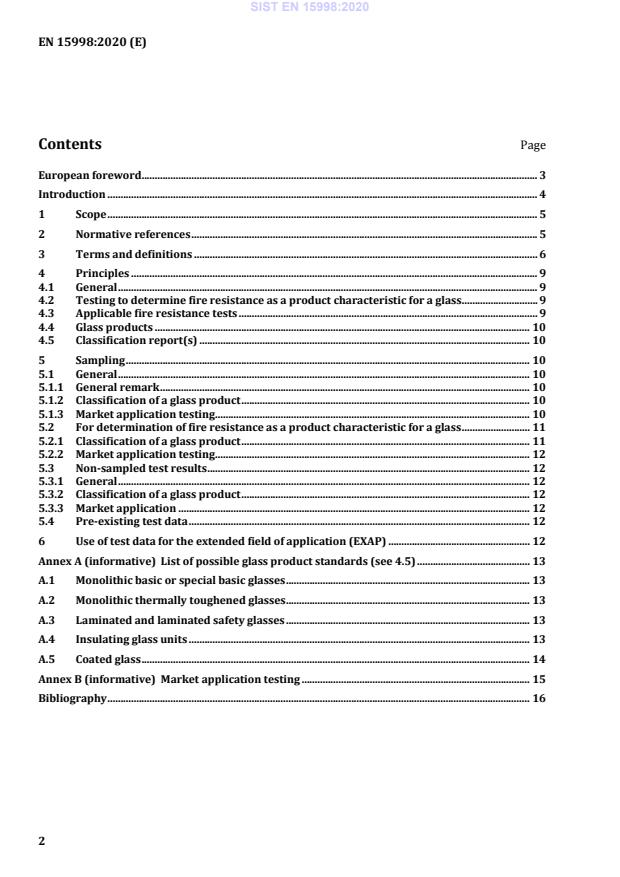
Contents Page
European foreword . 3
Introduction . 4
1 Scope . 5
2 Normative references . 5
3 Terms and definitions . 6
4 Principles . 9
4.1 General . 9
4.2 Testing to determine fire resistance as a product characteristic for a glass . 9
4.3 Applicable fire resistance tests . 9
4.4 Glass products . 10
4.5 Classification report(s) . 10
5 Sampling . 10
5.1 General . 10
5.1.1 General remark . 10
5.1.2 Classification of a glass product . 10
5.1.3 Market application testing . 10
5.2 For determination of fire resistance as a product characteristic for a glass . 11
5.2.1 Classification of a glass product . 11
5.2.2 Market application testing . 12
5.3 Non-sampled test results . 12
5.3.1 General . 12
5.3.2 Classification of a glass product . 12
5.3.3 Market application . 12
5.4 Pre-existing test data . 12
6 Use of test data for the extended field of application (EXAP) . 12
Annex A (informative) List of possible glass product standards (see 4.5) . 13
A.1 Monolithic basic or special basic glasses . 13
A.2 Monolithic thermally toughened glasses . 13
A.3 Laminated and laminated safety glasses . 13
A.4 Insulating glass units . 13
A.5 Coated glass . 14
Annex B (informative) Market application testing . 15
Bibliography . 16
European foreword
This document (EN 15998:2020) has been prepared by Technical Committee CEN/TC 129 “Glass in
building”, the secretariat of which is held by NBN.
This European Standard shall be given the status of a national standard, either by publication of an
identical text or by endorsement, at the latest by March 2021, and conflicting national standards shall
be withdrawn at the latest by March 2021.
Attention is drawn to the possibility that some of the elements of this document may be the subject of
patent rights. CEN shall not be held responsible for identifying any or all such patent rights.
This document supersedes EN 15998:2010.
The following main changes have been made in EN 15998:2020 compared with edition EN 15998:2010:
— update of terms and definitions to be in line with the relevant standards in the area of fire safety in
buildings;
— editorial updates.
According to the CEN-CENELEC Internal Regulations, the national standards organisations of the
following countries are bound to implement this European Standard: Austria, Belgium, Bulgaria,
Croatia, Cyprus, Czech Republic, Denmark, Estonia, Finland, France, Germany, Greece, Hungary, Iceland,
Ireland, Italy, Latvia, Lithuania, Luxembourg, Malta, Netherlands, Norway, Poland, Portugal, Republic of
North Macedonia, Romania, Serbia, Slovakia, Slovenia, Spain, Sweden, Switzerland, Turkey and the
United Kingdom.
Introduction
According to mandate M/135 “Glass in building”, one of the essential characteristics that may be
claimed is Safety in case of fire − Resistance to fire (for glass for use in a glazed assembly intended
specifically for fire resistance). However, glass products cannot be tested and classified for fire
resistance without being incorporated into a fire resistant glazed assembly.
1 Scope
This document specifies the testing methodology to be used for glass products that are claiming fire
resistance. The methodology covers type testing as defined in the relevant glass product standard.
NOTE This document provides guidance with the declaration of the characteristic, Safety in case of fire −
Resistance to fire (for glass for use in a glazed assembly intended specifically for fire resistance) for the CE
marking.
The same methodology can also be used to determine the performance classification for market
applications (see Annex B).
The methodology covers all glass product types that may require testing and classification for fire
resistance.
Fire resistance testing covers end use applications, for example:
— doors;
— partitions, walls (including curtain walling);
— floors, roofs;
— ceilings.
2 Normative references
The following documents are referred to in the text in such a way that some or all of their content
constitutes requirements of this document. For dated references, only the edition cited applies. For
undated references, the latest edition of the referenced document (including any amendments) applies.
EN 1364-1, Fire resistance tests for non-loadbearing elements — Part 1: Walls
EN 1364-2, Fire resistance tests for non-loadbearing elements — Part 2: Ceilings
EN 1364-3, Fire resistance tests for non-loadbearing elements — Part 3: Curtain walling — Full
configuration (complete assembly)
EN 1364-4, Fire resistance tests for non-loadbearing elements — Part 4: Curtain walling — Part
configuration
EN 1365-1, Fire resistance tests for loadbearing elements — Part 1: Walls
EN 1365-2, Fire resistance tests for loadbearing elements — Part 2: Floors and roofs
EN 1634-1, Fire resistance and smoke control tests for door and shutter assemblies, openable windows and
elements of building hardware — Part 1: Fire resistance test for door and shutter assemblies and openable
windows
EN 13501-2, Fire classification of construction products and building elements — Part 2: Classification
using data from fire resistance tests, excluding ventilation services
3 Terms and definitions
For the purposes of this document, the following terms and definitions apply.
ISO and IEC maintain terminological databases for use in standardization at the following addresses:
— IEC Electropedia: available at http://www.electropedia.org/
— ISO Online browsing platform: available at https://www.iso.org/obp
3.1
extended field of application
EXAP
outcome of a process (involving the application of defined rules that can incorporate calculation
procedures) that predicts, for a variation of a product property and/or its intended end use
application(s), a test result on the basis of one or more test results to the same test standard
[SOURCE: EN 13501-2:2016, 3.29]
3.2
fire resistant glass
glass
glass product, (i.e. monolithic glass, laminated glass, insulating glass units), that when used in a glazed
assembly, can have its performance determined and classified in accordance with EN 13501-2
Note 1 to entry: The term “insulating” when used as an insulating glass unit according to EN 1279-1, should not
be confused with the term “insulation” used in EN 13501-2 classification standard for fire resistant glazed
elements.
3.3
fire performance classification
result of (a) fire resistance test(s) expressed as required in EN 13501-2
Note 1 to entry: The classification is reported with respect to integrity (E), integrity and radiation (EW),
integrity and insulation (EI), and loadbearing capacity and integrity (RE) and loadbearing capacity, integrity and
insulation (REI).
Note 2 to entry: The classification of a specific glass product will be one or more of E, EW, EI, RE, REI.
Note 3 to entry: The time obtained for different classifications may be different, e.g. EW 30, EI 20.
3.4
framing system
frame profile and fixing to the supporting construction
Note 1 to entry: See Figure 1, B.
Key
A glazing system
B framing system
1 frame
2 metal anchor, screwed or bolted to the supporting construction (4) by a fixing anchor (3)
3 screw and fixing anchor
4 supporting construction
5 bead, screwed or clipped or clamped
6 bead fixing
7 glazing strip
8 glass
9 sealing or gasket
10 setting block
Figure 1 — Fire resistant framing and glazing system
3.5
glass product range
group of fire resistant glass (see 3.2) products, including products from one or more glass product
families, e.g. monolithic glass, laminated glass, insulating glass units, defined and produced by one
manufacturer for which the characteristic resistance to fire from any one product within the range is
valid for all other products within this range
Note 1 to entry: The glass product families are defined in the relevant product standards.
3.6
glazed assembly
fire-resistant glass to
...