

FprEN 50209:2026
(Main)Test of insulation of bars and coils of high-voltage machines
- Abstract
This document applies to rotating electrical machines with rated voltages (UN) from 5 kV to 27 kV inclusive and with rated output from 5 MVA upwards for generators and from 5 MW upwards for motors. This document is also applicable to machines with rated outputs between 1 MVA (1 MW) and 5 MVA (5 MW) and with rated voltages of 5 kV and above, provided its use has been agreed beforehand. Requirements for machines with a rated voltage above 27 kV are the subject of individual agreement. In the case of machines whose windings are cured in the stator, tests on the separate winding elements are not possible; for these machines the requirements in Clause 6 apply. Converter fed machines are excluded from the scope of this standard. The described tests can be used for this type of machines however the criteria are mutually agreed upon between user and manufacturer.
- Status
- Not Published
- Publication Date
- 14-Jan-2027
- Technical Committee
- CLC/TC 2 - Rotating machinery
- Current Stage
- 5020 - Vote circulated - Formal Approval
- Start Date
- 25-Sep-2026
- Due Date
- 21-Jan-2026
- Completion Date
- 25-Sep-2026

FprEN 50209:2026 is a CENELEC draft European Standard for testing the insulation of bars and coils in high-voltage rotating electrical machines. It specifies routine tests, random sample tests and special provisions for globally impregnated windings, so manufacturers, test houses and buyers can assess insulation quality and dielectric behaviour in a defined way.
What does FprEN 50209:2026 specify?
FprEN 50209:2026 applies to rotating electrical machines with rated voltages from 5 kV to 27 kV, with output ranges set separately for generators and motors. It is organized into Scope, Normative references, Terms and definitions, Routine tests, Random sample test, and Globally impregnated windings, followed by a bibliography.
The document focuses on stator bars and stator coils. It excludes converter fed machines from the main scope, but the described tests may still be used for them when user and manufacturer agree on the criteria. For windings cured in the stator, the document directs the reader to Clause 6, because separate winding elements cannot be tested in the usual way.
What are the key requirements of FprEN 50209:2026?
FprEN 50209:2026 defines a staged test scheme for insulation acceptance. The main idea is to check manufacturing quality on routine tests, then use sample tests when agreed, and adapt the sequence for globally impregnated windings.
Routine tests
Clause 4 requires routine testing on a defined number of bars or coil sides, with sample size tied to rated output and pole number in Table 1. The parallel conductor insulation test is an exception: it is performed on all elements. In practice, this means the manufacturer must plan test coverage before production starts.
Clause 4.2.1 checks the parallel conductor insulation before the main wall insulation is applied. Clause 4.2.2 adds an interturn test for multiturn coils, using a steep-front impulse test by default or an agreed AC withstand test in suitable designs. These tests matter because early defects in conductor-to-conductor insulation can later become winding failures.
Clause 4.2.3 measures the surface resistance of the conductive slot coating (OCP) at multiple positions, and Clause 4.2.4 measures dissipation factor and capacitance at room temperature over stepped voltage levels. The manufacturer must state the measurement method and acceptance criteria for OCP, while Table 2 sets the dissipation factor limits. In practice, the results help detect uneven insulation quality and outliers.
Clause 4.2.5 applies an AC voltage withstand test to the main wall insulation, and Clause 4.2.6 requires partial discharge (PD) measurement at specified voltage levels according to EN IEC 60034-27-1. Clause 4.2.7 allows an optional black out test for corona performance or for investigating anomalies. These tests are the main dielectric checks for service readiness.
Clause 4.3 requires the routine test results to be included in an EN 10204:2004, 3.1 certificate. The report also records temperature, humidity, capacitance and tanδ values, so the customer can trace how the insulation behaved during testing.
Random sample tests
Clause 5 provides an agreed destructive sample test on two randomly chosen elements, with an extra coil for multiturn coils. The sequence includes insulation resistance, thermal stability, PD measurement, AC voltage tests on end winding and main wall insulation, and a steep-front impulse test. If one part fails, the failed part is repeated on further samples, and the result must still meet the requirements.
Globally impregnated windings
Clause 6 adapts the testing approach for windings that reach final insulation properties only after complete stator impregnation and curing. It uses additional sample coils or bars in slot models, tested before insertion, after insertion, and after curing. For these windings, the document also asks for reference measurements on the completed stator winding.
What terms does FprEN 50209:2026 define?
- Winding set - the collection of winding elements needed to produce a complete stator, including extra elements for destructive quality assessment and spares.
- Coil side - one of the two normally straight parts of a coil that run essentially in the axial direction of the machine.
- Multiturn coil - a coil assembly made of one or more sections, usually with common insulation, forming two or more conducting loops.
- Conductive slot coating (OCP) - a conductive paint or tape layer in contact with the main wall insulation in the slot portion, used to help prevent partial discharge between the coil/bar and the stator core.
Who uses FprEN 50209:2026?
FprEN 50209:2026 is used by manufacturers of rotating electrical machines, winding suppliers, test laboratories and quality departments that need to qualify stator bars and coils. It is also used by customers and buyers who want agreed acceptance tests for generator and motor windings, especially when inspecting insulation behaviour before delivery.
What changed in FprEN 50209:2026 from the previous edition?
FprEN 50209:2026 supersedes EN 50209:1998 and its amendments and corrigenda. The draft states these significant technical changes:
- expanded voltage range up to 27 kV
- added routine tests for interturn insulation, surface resistance, voltage withstand and partial discharge
- revised dissipation factor criteria
- added a requirement to record capacitance during dissipation factor measurement
Which standards are used with FprEN 50209:2026?
| Standard | What it contributes |
|---|---|
| EN 10204:2004 | Inspection documents and the 3.1 certificate used for reporting |
| EN 60034-1:2010 | Rating and performance, including the prescribed AC test voltage for main wall insulation in one sample test |
| EN IEC 60034-15:2025 | Steep-front impulse test provisions for form-wound stator coils |
| EN IEC 60034-27-1:2018 | Off-line PD measurement method and test details |
| EN 60034-27-3:2016 | Dissipation factor measurement method and guarding technique |
| EN IEC 60034-27-4:2018 | Insulation resistance measurement and polarization index |
The body also cites IEEE 286 for driven guard technique and IEEE 1799 for external discharge test configuration.
What does the FprEN 50209:2026 document contain?
FprEN 50209:2026 contains sample-size rules, test sequences, acceptance criteria and reporting requirements for insulation testing. Table 1 sets the routine-test sampling plan, Table 2 sets dissipation factor limits, and Table 3 maps which tests apply in routine, random sample and GVPI cases.
The document also gives the voltage steps, conditioning periods, test durations and breakdown checks used in the procedures. Figure 1 shows the tanδ curve against voltage ratio, and Figure 2 gives an example of a cumulative distribution graph used to examine production smoothness and outliers.
Relations
- Effective Date
- 21-Nov-2023
Get Certified
Connect with accredited certification bodies for this standard

IMQ S.p.A. (Certification)
Italian electrical product certification.

SLG Prüf- und Zertifizierungs GmbH
German testing and certification body.

UL Solutions
Global safety science company with testing, inspection and certification.
Sponsored listings
Frequently Asked Questions
FprEN 50209:2026 is a draft published by CLC. Its full title is "Test of insulation of bars and coils of high-voltage machines". This standard covers: This document applies to rotating electrical machines with rated voltages (UN) from 5 kV to 27 kV inclusive and with rated output from 5 MVA upwards for generators and from 5 MW upwards for motors. This document is also applicable to machines with rated outputs between 1 MVA (1 MW) and 5 MVA (5 MW) and with rated voltages of 5 kV and above, provided its use has been agreed beforehand. Requirements for machines with a rated voltage above 27 kV are the subject of individual agreement. In the case of machines whose windings are cured in the stator, tests on the separate winding elements are not possible; for these machines the requirements in Clause 6 apply. Converter fed machines are excluded from the scope of this standard. The described tests can be used for this type of machines however the criteria are mutually agreed upon between user and manufacturer.
This document applies to rotating electrical machines with rated voltages (UN) from 5 kV to 27 kV inclusive and with rated output from 5 MVA upwards for generators and from 5 MW upwards for motors. This document is also applicable to machines with rated outputs between 1 MVA (1 MW) and 5 MVA (5 MW) and with rated voltages of 5 kV and above, provided its use has been agreed beforehand. Requirements for machines with a rated voltage above 27 kV are the subject of individual agreement. In the case of machines whose windings are cured in the stator, tests on the separate winding elements are not possible; for these machines the requirements in Clause 6 apply. Converter fed machines are excluded from the scope of this standard. The described tests can be used for this type of machines however the criteria are mutually agreed upon between user and manufacturer.
FprEN 50209:2026 is classified under the following ICS (International Classification for Standards) categories: 29.080 - Insulation; 29.160.10 - Components for rotating machines. The ICS classification helps identify the subject area and facilitates finding related standards.
FprEN 50209:2026 has the following relationships with other standards: It is inter standard links to EN 50209:1998. Understanding these relationships helps ensure you are using the most current and applicable version of the standard.
FprEN 50209:2026 is available in PDF format for immediate download after purchase. The document can be added to your cart and obtained through the secure checkout process. Digital delivery ensures instant access to the complete standard document.
Standards Content (Sample)
SLOVENSKI STANDARD
oSIST prEN 50209:2026
01-februar-2026
Preskus izolacije palic in tuljav visokonapetostnih strojev
Test of insulation of bars and coils of high-voltage machines
Prüfung der Isolierung von Stäben und Spulen von Hochspannungsmaschinen
Essai de l’isolation des barres et des bobines des machines à haute tension
Ta slovenski standard je istoveten z: prEN 50209:2026
ICS:
29.080.01 Električna izolacija na Electrical insulation in
splošno general
oSIST prEN 50209:2026 en
2003-01.Slovenski inštitut za standardizacijo. Razmnoževanje celote ali delov tega standarda ni dovoljeno.
oSIST prEN 50209:2026
oSIST prEN 50209:2026
EUROPEAN STANDARD DRAFT
prEN 50209
NORME EUROPÉENNE
EUROPÄISCHE NORM
January 2026
ICS 29.080; 29.160.10 Will supersede EN 50209:1998
English Version
Test of insulation of bars and coils of high-voltage machines
Essai de l'isolation des barres et des bobines des machines Prüfung der Isolierung von Stäben und Spulen von
à haute tension Hochspannungsmaschinen
This draft European Standard is submitted to CENELEC members for enquiry.
Deadline for CENELEC: 2026-04-17.
It has been drawn up by CLC/TC 2.
If this draft becomes a European Standard, CENELEC members are bound to comply with the CEN/CENELEC Internal Regulations which
stipulate the conditions for giving this European Standard the status of a national standard without any alteration.
This draft European Standard was established by CENELEC in three official versions (English, French, German).
A version in any other language made by translation under the responsibility of a CENELEC member into its own language and notified to
the CEN-CENELEC Management Centre has the same status as the official versions.
CENELEC members are the national electrotechnical committees of Austria, Belgium, Bulgaria, Croatia, Cyprus, the Czech Republic,
Denmark, Estonia, Finland, France, Germany, Greece, Hungary, Iceland, Ireland, Italy, Latvia, Lithuania, Luxembourg, Malta, the
Netherlands, Norway, Poland, Portugal, Republic of North Macedonia, Romania, Serbia, Slovakia, Slovenia, Spain, Sweden, Switzerland,
Türkiye and the United Kingdom.
Recipients of this draft are invited to submit, with their comments, notification of any relevant patent rights of which they are aware and to
provide supporting documentation.
Warning : This document is not a European Standard. It is distributed for review and comments. It is subject to change without notice and
shall not be referred to as a European Standard.
European Committee for Electrotechnical Standardization
Comité Européen de Normalisation Electrotechnique
Europäisches Komitee für Elektrotechnische Normung
CEN-CENELEC Management Centre: Rue de la Science 23, B-1040 Brussels
© 2026 CENELEC All rights of exploitation in any form and by any means reserved worldwide for CENELEC Members.
Project: 79007 Ref. No. prEN 50209:2026 E
oSIST prEN 50209:2026
prEN 50209:2026 (E)
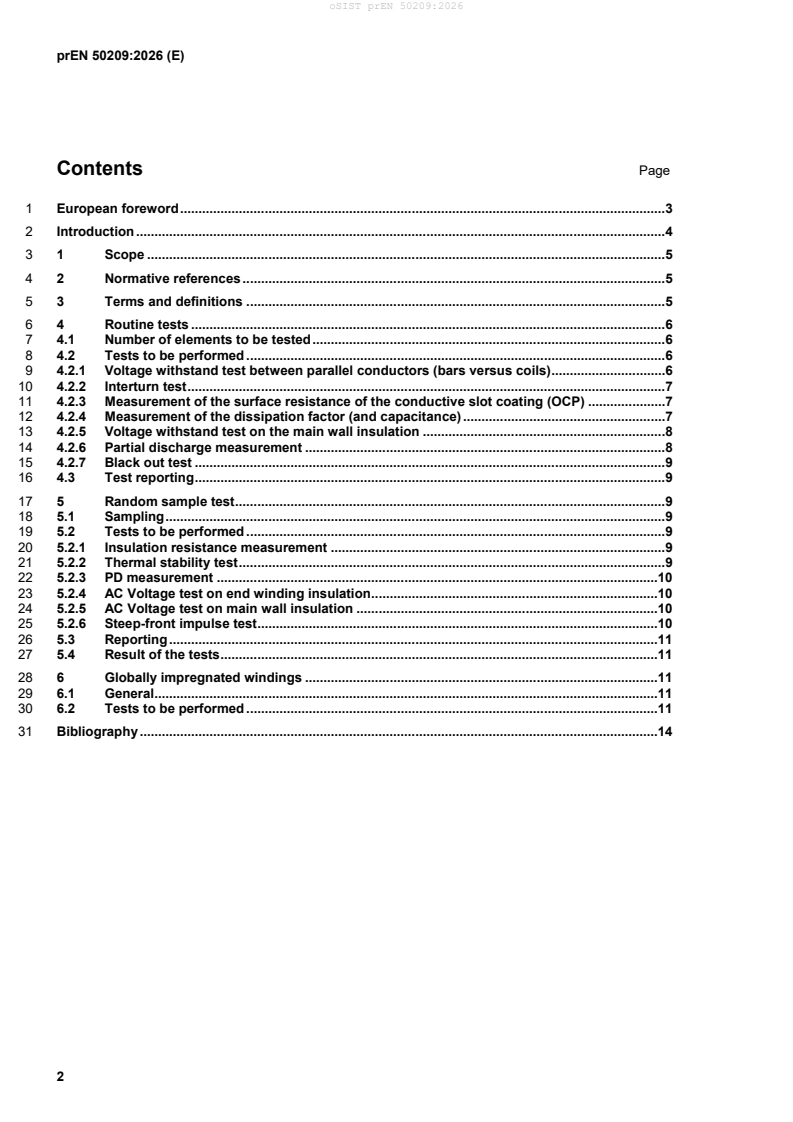
Contents Page
1 European foreword . 3
2 Introduction . 4
3 1 Scope . 5
4 2 Normative references . 5
5 3 Terms and definitions . 5
6 4 Routine tests . 6
7 4.1 Number of elements to be tested . 6
8 4.2 Tests to be performed . 6
9 4.2.1 Voltage withstand test between parallel conductors (bars versus coils) . 6
10 4.2.2 Interturn test . 7
11 4.2.3 Measurement of the surface resistance of the conductive slot coating (OCP) . 7
12 4.2.4 Measurement of the dissipation factor (and capacitance) . 7
13 4.2.5 Voltage withstand test on the main wall insulation . 8
14 4.2.6 Partial discharge measurement . 8
15 4.2.7 Black out test . 9
16 4.3 Test reporting . 9
17 5 Random sample test . 9
18 5.1 Sampling . 9
19 5.2 Tests to be performed . 9
20 5.2.1 Insulation resistance measurement . 9
21 5.2.2 Thermal stability test . 9
22 5.2.3 PD measurement .10
23 5.2.4 AC Voltage test on end winding insulation .10
24 5.2.5 AC Voltage test on main wall insulation .10
25 5.2.6 Steep-front impulse test .10
26 5.3 Reporting .11
27 5.4 Result of the tests .11
28 6 Globally impregnated windings .11
29 6.1 General .11
30 6.2 Tests to be performed .11
31 Bibliography .14
oSIST prEN 50209:2026
prEN 50209:2026 (E)
32 European foreword
33 This document (prEN 50209:2026) has been prepared by CLC/TC 2 “Rotating Machinery”.
34 This document is currently submitted to the Enquiry.
35 The following dates are proposed:
• latest date by which the existence of this (doa) dav + 6 months
document has to be announced at national
level
• latest date by which this document has to be (dop) dav + 12 months
implemented at national level by publication of
an identical national standard or by
endorsement
• latest date by which the national standards (dow) dav + 36 months
conflicting with this document have to be (to be confirmed or
withdrawn modified when voting)
36 This document will supersede EN 50209:1998 and all of its amendments and corrigenda (if any).
37 prEN 50209:2026 includes the following significant technical changes with respect to EN 50209:1998:
38 — expanding the voltage range up to 27 kV;
39 — addition of some tests as routine tests (interturn test, surface resistance, voltage withstand test and partial
40 discharge measurement);
41 — modification of the criteria for the dissipation factor measurement;
42 — included the requirement to record the capacitance during the dissipation factor measurement.
oSIST prEN 50209:2026
prEN 50209:2026 (E)
43 Introduction
44 The purpose of this document is to assess the uniform quality of manufacturing and determine the dielectric
45 behaviour of the insulation of rotating electrical machines having rated voltages from 5 kV to 27 kV. It applies to
46 stator bars and stator coils.
oSIST prEN 50209:2026
prEN 50209:2026 (E)
47 1 Scope
48 This document applies to rotating electrical machines with rated voltages (U ) from 5 kV to 27 kV inclusive and
N
49 with rated output from 5 MVA upwards for generators and from 5 MW upwards for motors.
50 This document is also applicable to machines with rated outputs between 1 MVA (1 MW) and 5 MVA (5 MW)
51 and with rated voltages of 5 kV and above, provided its use has been agreed beforehand.
52 Requirements for machines with a rated voltage above 27 kV are the subject of individual agreement.
53 In the case of machines whose windings are cured in the stator, tests on the separate winding elements are not
54 possible; for these machines the requirements in Clause 6 apply.
55 Converter fed machines are excluded from the scope of this standard. The described tests can be used for this
56 type of machines however the criteria are mutually agreed upon between user and manufacturer.
57 2 Normative references
58 The following documents are referred to in the text in such a way that some or all of their content constitutes
59 requirements of this document. For dated references, only the edition cited applies. For undated references, the
60 latest edition of the referenced document (including any amendments) applies.
61 EN 10204:2004, Metallic products - Types of inspection documents
62 EN 60034-1:2010, Rotating electrical machines - Part 1: Rating and performance (IEC 60034-1:2010)
63 EN IEC 60034-15:2025, Rotating electrical machines - Part 15: Impulse voltage withstand levels of form-wound
64 stator coils for rotating a.c. machines (IEC 60034-15:2025)
65 EN IEC 60034-27-1:2018, Rotating electrical machines - Part 27-1: Off-line partial discharge measurements on
66 the winding insulation (IEC 60034-27-1:2017)
67 EN 60034-27-3:2016, Rotating electrical machines - Part 27-3: Dielectric dissipation factor measurement on
68 stator winding insulation of rotating electrical machines (IEC 60034-27-3:2015)
69 EN IEC 60034-27-4:2018, Rotating electrical machines - Part 27-4: Measurement of insulation resistance and
70 polarization index on winding insulation of rotating electrical machines (IEC 60034-27-4:2018)
71 3 Terms and definitions
72 For the purposes of this document, the following terms and definitions apply.
73 ISO and IEC maintain terminology databases for use in standardization at the following addresses:
74 — ISO Online browsing platform: available at https://www.iso.org/obp/
75 — IEC Electropedia: available at https://www.electropedia.org/
76 3.1
77 winding set
78 collection of winding elements needed to produce a complete stator including additional elements intended for
79 (destructive) quality assessment and spares
80 3.2
81 coil side
82 either of the two, normally straight, parts of a coil which lie essentially in the axial direction of the machine
83 [SOURCE: IEV 411-38-06]
oSIST prEN 50209:2026
prEN 50209:2026 (E)
84 3.3
85 multiturn coil
86 physical assembly of one or more electrical coil sections generally surrounded by common insulation comprising
87 a conductor or group of conductors formed into two or more conducting loops
88 [SOURCE: IEV 411-38-01, 411-38-03, modified]
89 3.4
90 conductive slot coating
91 OCP
92 conductive paint or tape layer in intimate contact with mainwall insulation in the slot portion of the coil/bar side,
93 often called semi-conductive coating
94 Note 1 to entry: The purpose is to prevent partial discharge from occurring between the coil/bar and the stator core.
95 4 Routine tests
96 4.1 Number of elements to be tested
97 The routine test shall be carried out on the number of bars or coil sides, including any spare bars or coils, as
98 shown in Table 1. Exception is the test on the parallel conductor insulation; this test shall be performed on all
99 elements.
100 Table 1 — Number of elements to be tested
Rated output
Number of poles Number of test elements
MVA (MW)
10 % of bars or coil sides
All pole numbers < 5
with a minimum of 20
All bars or coil sides
Two (2) and four (4) ≥ 50
(100 %)
At least 60 bars or coil
sides and, in addition,
Two (2) and four (4) < 50, ≥ 5
10 % of all bars or coil
sides
At least 60 bars or coil
sides and, in addition,
Six (6) and more ≥ 5
10 % of all bars or coil
sides
101 4.2 Tests to be performed
102 4.2.1 Voltage withstand test between parallel conductors (bars versus coils)
103 The parallel conductor insulation of Roebel bars shall be tested using an AC voltage of minimum 110 V, 50 Hz
104 before applying the main wall insulation. Alternatively, a DC voltage of 250 V may be used, particularly in case
105 the conductors are interconnected to the inner corona protection (when present). In that case a minimum
106 insulation resistance of 200 Ω is required.
107 In case of multiturn stator coils, the parallel conductor insulation shall be tested using an AC voltage sufficiently
108 high enough in relation with the nature of the single conductor insulation. The minimum level is 400 V, 50/60 Hz.
109 NOTE For half-coils without Roebel transpositions reference is made to the procedure for multiturn coils.
oSIST prEN 50209:2026
prEN 50209:2026 (E)
110 4.2.2 Interturn test
111 This test is only performed on multiturn coils. As a default the test is carried out as a steep-front impulse test
112 according to the provisions set in EN IEC 60034-15:2025, Clause 6 and Annex D. In case the coil is built up
113 from turns with parallel conductors stacked in the height and no dedicated turn insulation is present, an AC
114 voltage withstand test is preferably used as an alternative.
115 NOTE A multiturn coil can be built from parallel conductors positioned in the width of the stack and/or in the height of
116 the stack. Only in the latter case the AC test can be used to assess the interturn insulation capability.
117 The steep-front impulse test level is depending on whether the coil end winding insulation is in its final state or
118 not. When the coil insulation is in its final state the default test levels as given by EN IEC 60034-15:2025,
119 Table 1, shall be used for the steep-front test. For more details, see EN IEC 60034-15:2025, Annex D. In case
120 of an AC voltage withstand test the levels shall be agreed upon, recommended is a level of 0,3 × U for 1 min
N
121 between turns.
122 4.2.3 Measurement of the surface resistance of the conductive slot coating (OCP)
123 The surface resistance of the OCP shall be measured and recorded at a minimum of two positions along the
124 straight portion of the bar or coil and at least at every meter for long bars/coils over 2 m length. The manufacturer
125 shall state the criteria and measurement method beforehand.
126 4.2.4 Measurement of the dissipation factor (and capacitance)
127 The dissipation factor (tanδ) and capacitance shall be measured on the elements at room temperature in relation
128 to voltage (see Figure 1) over the range of 0,2 × U at least up to 1,0 × U at intervals of 0,2 × U with increasing
N N N
129 voltage.
131 Figure 1 — Curve of tanδ against the ratio U/U
N
132 In case of coils, both coil sides shall be measured separately.
133 The measurements shall be carried out by means of a dedicated instrument, using a guard ring arrangement to
134 exclude the influence of the end winding (for instance due to the stress grading) and thus only determining the
135 dielectric losses of the main wall insulation.
136 The outer surface of the straight part of the element shall be properly connected to the earth (or the sensing
137 terminal of the test equipment) over a length equal to that of the stator core. The guard ring arrangement shall
138 lie outside this zone. Refer to EN 60034-27-3 (grounding: 5.2.1, guard rings: 5.2.2) as well as IEEE 286 (driven
139 guard technique) for further details.
140 The initial value of tanδ , the tip-up (tanδ - tanδ ) and the increment Δtanδ per measuring step of 0,2 × U
0,2 0,6 0,2 N
141 shall not exceed the values in Table 2 for rated voltages up to 27 kV irrespective whether the voltage is
142 increased or decreased during the measurement.
143 If more than 5 % of the samples
...