

ISO/IEC 80079-38:2026
(Main)Explosive atmospheres - Part 38: Equipment and components in explosive atmospheres in underground mines
- Abstract
This document is published as a dual logo standard and is applicable for the explosion protection requirements for the construction, testing and marking for Group I Ex Equipment that can be an individual item, or be an assembly of multiple items of Ex Equipment and Ex Components forming mining machinery. The standard atmospheric conditions (relating to the explosion characteristics of the atmosphere) under which it can be assumed that Ex Equipment can be operated are: - temperature −20 °C to +60 °C; - pressure 80 kPa (0,8 bar) to 110 kPa (1,1 bar); and - air with normal oxygen content, typically a volume fraction of 21 %. This part of ISO/IEC 80079 applies for Ex Equipment and Ex Components with Explosion Protection Levels (EPLs) Ma and Mb. This document supplements and modifies the general requirements of IEC 60079‑0. Where a requirement of this document conflicts with a requirement of IEC 60079-0, the requirement of this document takes precedence. This document can be used for guidance on underground applications where firedamp or coal dust can be present, but which are not Group I mines, for example tunnels. This second edition cancels and replaces the first edition, published in 2016. This edition constitutes a technical revision. Refer to the Foreword of the document for a complete listing of the technical changes between edition 2.0 and the previous edition of the document.
- Status
- Published
- Publication Date
- 01-Oct-2026
- Technical Committee
- SC 31M - Non-electrical equipment and protective systems for explosive atmospheres
- Drafting Committee
- MT 80079-38 - TC 31/SC 31M/MT 80079-38
- Current Stage
- PPUB - Publication issued
- Start Date
- 25-Sep-2026
- Completion Date
- 18-Sep-2026
ISO/IEC 80079-38:2026 is a dual-logo International Standard published by IEC and ISO for explosive atmospheres in underground mines. It specifies explosion protection requirements for the construction, testing and marking of Group I Ex Equipment and Ex Components, including mining machinery made from multiple Ex items, for use at Explosion Protection Levels (EPLs) Ma and Mb.
In practice, ISO/IEC 80079-38:2026 is the document to use when a mining machine or a component assembly needs mine-specific explosion protection rules, especially where firedamp and coal dust can be present. It also gives guidance for some underground applications such as tunnels where similar hazards exist.
What does ISO/IEC 80079-38:2026 specify?
ISO/IEC 80079-38:2026 specifies the explosion protection requirements for Group I Ex Equipment that may be a single item or an assembly of Ex Equipment and Ex Components forming mining machinery. It also sets the marking rules for those assemblies and explains how the document modifies the general requirements of IEC 60079-0.
The document applies to Ex Equipment and Ex Components with EPL Ma and Mb. It is written for underground mine use, but it can also guide other underground applications where firedamp or coal dust may be present.
The structure is straightforward: clauses 1 to 9 cover scope, references, terms, requirements, special equipment cases, EPL Ma with a second independent means, fire protection, information for use, and marking. Two informative annexes add an example assessment and extra guidance.
| Annex | What it covers |
|---|---|
| Annex A | Example ignition hazard assessment for a shearer used in a coal mine atmosphere |
| Annex B | Additional guidance on temperature, dust deposits, protection, cables, cutting equipment and cable reels |
What are the key requirements of ISO/IEC 80079-38:2026?
General conformity and ignition hazard assessment
ISO/IEC 80079-38:2026 requires Ex Equipment and Ex Components to meet the applicable EPL Ma or Mb requirements for Group I, depending on the intended use. When equipment is installed on a mining machine, any certificate limitations or specific conditions of use must be carried through to the assembly.
Clause 4.2 requires an ignition hazard assessment using ISO 80079-36. The assessment has to cover hazards controlled within the machine and hazards that are left to the site installation to control. If some hazards depend on end-user conditions, the certificate uses the “X” suffix and the instructions have to explain the remaining conditions. This matters because mine operators need to know what the machine itself protects against and what still depends on site controls.
Non-electrical and electrical protection
Clause 4.3 sends non-electrical Ex Equipment and Ex Components to ISO 80079-36 and, where needed, to the relevant non-electrical protection concept in ISO 80079-37. Clause 4.4 requires electrical Ex Equipment and Ex Components to comply with IEC 60079-0 and at least one Group I Type of Protection.
For electrical parts, the document focuses on practical mine hazards such as overload, short-circuit, earth fault, live parts, batteries and cable damage. It requires protective measures that stop overheating, prevent ignition from faults, and keep cables and live parts protected against impact, rubbing and crushing. In practice, that means the manufacturer has to show how the circuit is protected, not just that the components are rated for Ex use.
Equipment-specific requirements
Clause 5 adds special rules for equipment that commonly creates ignition risk in mines. The most important cases are cutting and stripping equipment, rope haulages, fans, internal combustion engines, air compressors, drilling equipment, brakes, traction and starter batteries, optical systems, electromagnetic and ultrasonic sources, and gas monitoring systems.
Several of these are safety-critical in daily use:
- Cutting and stripping equipment must minimize frictional heat and sparks, and may need water spray or air dilution with interlocks.
- Rope haulages have to avoid friction heating and include operating and inspection information.
- Fans need rigid casings, controlled clearances and dust control so that rotating parts do not rub or overheat.
- Drilling equipment needs positive drive engagement and, where necessary, flushing and blocked-drill monitoring.
- Batteries and gas monitoring systems have their own connection and monitoring rules because they often support power isolation and atmosphere monitoring.
EPL Ma with a second independent means
Clause 6 covers EPL Ma equipment that achieves the required level of protection using two independent means. ISO/IEC 80079-38:2026 allows this only when both protection concepts fully comply with their own concept standards and can be checked individually.
The clause sets rules for the outer enclosure, the permitted combinations of inner and outer protection concepts, and additional type testing. This matters for design because the enclosure and the inner protection concept have to work together without one reducing the other’s protection level.
Fire protection, use information and marking
Clause 7 deals with fire protection. It requires the ignition hazard assessment to include components that can ignite lubricants or other flammable substances, and it sets rules for non-metallic materials, hydraulic and pneumatic systems, fire-resistant fluids, cable-reeling equipment and cable sheaths. Clauses 8 and 9 then turn those technical decisions into user information and marking, including warnings, maintenance instructions and the marking format for mining machines and EPL Ma or Mb equipment.
What terms does ISO/IEC 80079-38:2026 define?
- flammable substance - A substance that is itself flammable, or that can produce a flammable gas, vapour or mist.
- mining machinery / mining machine - An assembly with linked moving parts or components, intended for use in mines.
- non-electrical equipment - Equipment that performs its intended function mechanically.
- hydraulic fluid - Any fluid or concentrate used for hydraulic transmission and monitoring, except water.
- safety device - A device used inside or outside an explosive atmosphere that contributes to safe functioning with respect to explosion risk.
- EPL Ma - An Explosion Protection Level for equipment intended to remain protected in a constantly present explosive atmosphere.
- EPL Mb - An Explosion Protection Level for equipment intended for use in explosive atmospheres where the risk level is lower than for EPL Ma.
Who uses ISO/IEC 80079-38:2026?
ISO/IEC 80079-38:2026 is used by manufacturers of mining machinery, Ex Equipment suppliers, and designers of electrical and non-electrical systems for underground mines. Certification bodies and test laboratories use it to verify construction, testing, marking and certificate conditions.
Mine operators, buyers and maintenance teams use it to understand what an approved machine should include in its instructions, marking and residual-risk controls. It is most relevant in underground coal mining and other underground mining environments where firedamp or coal dust can be present, and it also helps with some tunnel applications.
What changed in ISO/IEC 80079-38:2026 from the previous edition?
ISO/IEC 80079-38:2026 is the second edition and replaces the first edition published in 2016. The revision is technical, and the foreword lists the main changes.
Key changes named in the document include:
- the scope was clarified to cover construction, testing and marking for Group I use
- EPL Ma was added alongside EPL Mb
- hand tools were removed from the scope
- the body text was adjusted to emphasize mandatory requirements and move much of the former guidance to Annex B
- the ignition hazard assessment was aligned with ISO 80079-36
- a new clause was added for EPL Ma equipment using a second independent means
- fire protection and hydraulic/pneumatic requirements were reorganized and linked to ISO 4413 and ISO 4414
- marking was revised to cover both EPL Ma and EPL Mb situations
- gas monitoring now refers to IEC 60079-29-0
- optical radiation and internal combustion engine requirements were updated by reference to the relevant companion standards
Which standards are used with ISO/IEC 80079-38:2026?
| Standard | What it contributes |
|---|---|
| IEC 60079-0 | General Ex requirements and marking baseline for electrical equipment |
| ISO 80079-36 | Ignition hazard assessment and basic requirements for non-electrical Ex equipment |
| ISO 80079-37 | Non-electrical protection concepts such as constructional safety, liquid immersion and control of ignition sources |
| IEC 60079-5, -7, -11, -18, -25, -28, -29-0, -33 | Specific protection concepts, intrinsically safe systems, optical radiation, gas detection and special protection |
| IEC 60204-1, IEC 60204-11 | Electrical equipment of machines and higher-voltage machine electrical requirements |
| IEC 60332-1, IEC 60529 | Cable fire behaviour and enclosure ingress protection |
| ISO 4413, ISO 4414, ISO 6805 | Hydraulic and pneumatic system design, plus underground hydraulic hose requirements |
| ISO 7010 | Safety signs and warning notices |
| ISO 14935, ISO 15029-1, ISO 15029-2 | Fire-resistant fluid testing and spray ignition characteristics |
| ISO 21840-11 | Rotor balancing for fans |
| ISO/IEC 80079-41 | Reciprocating internal combustion engines for explosive atmospheres |
What does the ISO/IEC 80079-38:2026 document contain?
ISO/IEC 80079-38:2026 contains the requirements that apply to mine equipment assemblies, plus the special rules for cutting systems, fans, compressors, brakes, batteries, drilling equipment, cable reels and fire protection. It also includes marking rules and the user information that has to accompany the equipment.
The document includes a worked example in Annex A, with a shearer layout figure and a table showing how an ignition hazard assessment is recorded. Annex B gathers practical guidance on temperature limits, dust in gaps, short-circuit protection, earth-fault protection, cables, cutting equipment and cable-reeling equipment.
The body of the standard also points to several figures and tables that support design decisions:
- figures showing how EPL Ma equipment can combine two protection concepts
- a material-combination table for fans
- a table for hydraulic fluid fire-resistance categories
- an example marking format for mining machines and EPL Ma equipment
Relations
- Effective Date
- 05-Sep-2023
Get Certified
Connect with accredited certification bodies for this standard

IMQ S.p.A. (Certification)
Italian electrical product certification.

SLG Prüf- und Zertifizierungs GmbH
German testing and certification body.

UL Solutions
Global safety science company with testing, inspection and certification.
Sponsored listings
Frequently Asked Questions
ISO/IEC 80079-38:2026 is a standard published by the International Electrotechnical Commission (IEC). Its full title is "Explosive atmospheres - Part 38: Equipment and components in explosive atmospheres in underground mines". This standard covers: This document is published as a dual logo standard and is applicable for the explosion protection requirements for the construction, testing and marking for Group I Ex Equipment that can be an individual item, or be an assembly of multiple items of Ex Equipment and Ex Components forming mining machinery. The standard atmospheric conditions (relating to the explosion characteristics of the atmosphere) under which it can be assumed that Ex Equipment can be operated are: - temperature −20 °C to +60 °C; - pressure 80 kPa (0,8 bar) to 110 kPa (1,1 bar); and - air with normal oxygen content, typically a volume fraction of 21 %. This part of ISO/IEC 80079 applies for Ex Equipment and Ex Components with Explosion Protection Levels (EPLs) Ma and Mb. This document supplements and modifies the general requirements of IEC 60079‑0. Where a requirement of this document conflicts with a requirement of IEC 60079-0, the requirement of this document takes precedence. This document can be used for guidance on underground applications where firedamp or coal dust can be present, but which are not Group I mines, for example tunnels. This second edition cancels and replaces the first edition, published in 2016. This edition constitutes a technical revision. Refer to the Foreword of the document for a complete listing of the technical changes between edition 2.0 and the previous edition of the document.
This document is published as a dual logo standard and is applicable for the explosion protection requirements for the construction, testing and marking for Group I Ex Equipment that can be an individual item, or be an assembly of multiple items of Ex Equipment and Ex Components forming mining machinery. The standard atmospheric conditions (relating to the explosion characteristics of the atmosphere) under which it can be assumed that Ex Equipment can be operated are: - temperature −20 °C to +60 °C; - pressure 80 kPa (0,8 bar) to 110 kPa (1,1 bar); and - air with normal oxygen content, typically a volume fraction of 21 %. This part of ISO/IEC 80079 applies for Ex Equipment and Ex Components with Explosion Protection Levels (EPLs) Ma and Mb. This document supplements and modifies the general requirements of IEC 60079‑0. Where a requirement of this document conflicts with a requirement of IEC 60079-0, the requirement of this document takes precedence. This document can be used for guidance on underground applications where firedamp or coal dust can be present, but which are not Group I mines, for example tunnels. This second edition cancels and replaces the first edition, published in 2016. This edition constitutes a technical revision. Refer to the Foreword of the document for a complete listing of the technical changes between edition 2.0 and the previous edition of the document.
ISO/IEC 80079-38:2026 is classified under the following ICS (International Classification for Standards) categories: 13.230 - Explosion protection; 29.260.20 - Electrical apparatus for explosive atmospheres; 73.100.30 - Equipment for drilling and mine excavation. The ICS classification helps identify the subject area and facilitates finding related standards.
ISO/IEC 80079-38:2026 has the following relationships with other standards: It is inter standard links to ISO/IEC 80079-38:2016. Understanding these relationships helps ensure you are using the most current and applicable version of the standard.
ISO/IEC 80079-38:2026 is available in PDF format for immediate download after purchase. The document can be added to your cart and obtained through the secure checkout process. Digital delivery ensures instant access to the complete standard document.
Standards Content (Sample)
ISO/IEC 80079-38
Edition 2.0 2026-09
INTERNATIONAL
STANDARD
Explosive atmospheres -
Part 38: Equipment and components in explosive atmospheres in underground
mines
ICS 13.230; 29.260.20 ISBN 978-2-8327-1478-2
ISO/IEC 80079-38: 2026-09(en)
All rights reserved. Unless otherwise specified, no part of this publication may be reproduced or utilized in any form or
by any means, electronic or mechanical, including photocopying and microfilm, without permission in writing from either
IEC or IEC's member National Committee in the country of the requester. If you have any questions about IEC copyright
or have an enquiry about obtaining additional rights to this publication, please contact the address below or your local
IEC member National Committee for further information.
IEC Secretariat Tel.: +41 22 919 02 11
3, rue de Varembé info@iec.ch
CH-1211 Geneva 20 www.iec.ch
Switzerland
About the IEC
The International Electrotechnical Commission (IEC) is the leading global organization that prepares and publishes
International Standards for all electrical, electronic and related technologies.
About IEC publications
The technical content of IEC publications is kept under constant review by the IEC. Please make sure that you have the
latest edition, a corrigendum or an amendment might have been published.
IEC publications search - IEC Products & Services Portal - products.iec.ch
webstore.iec.ch/advsearchform Discover our powerful search engine and read freely all the
The advanced search enables to find IEC publications by a publications previews, graphical symbols and the glossary. With
variety of criteria (reference number, text, technical a subscription you will always have access to up to date content
committee, …). It also gives information on projects, replaced tailored to your needs.
and withdrawn publications.
Electropedia - www.electropedia.org
The world's leading online dictionary on electrotechnology,
IEC Just Published - webstore.iec.ch/justpublished
Stay up to date on all new IEC publications. Just Published containing more than 22 500 terminological entries in English
details all new publications released. Available online and and French, with equivalent terms in 25 additional languages.
once a month by email. Also known as the International Electrotechnical Vocabulary
(IEV) online.
IEC Customer Service Centre - webstore.iec.ch/csc
If you wish to give us your feedback on this publication or need
further assistance, please contact the Customer Service
Centre: sales@iec.ch.
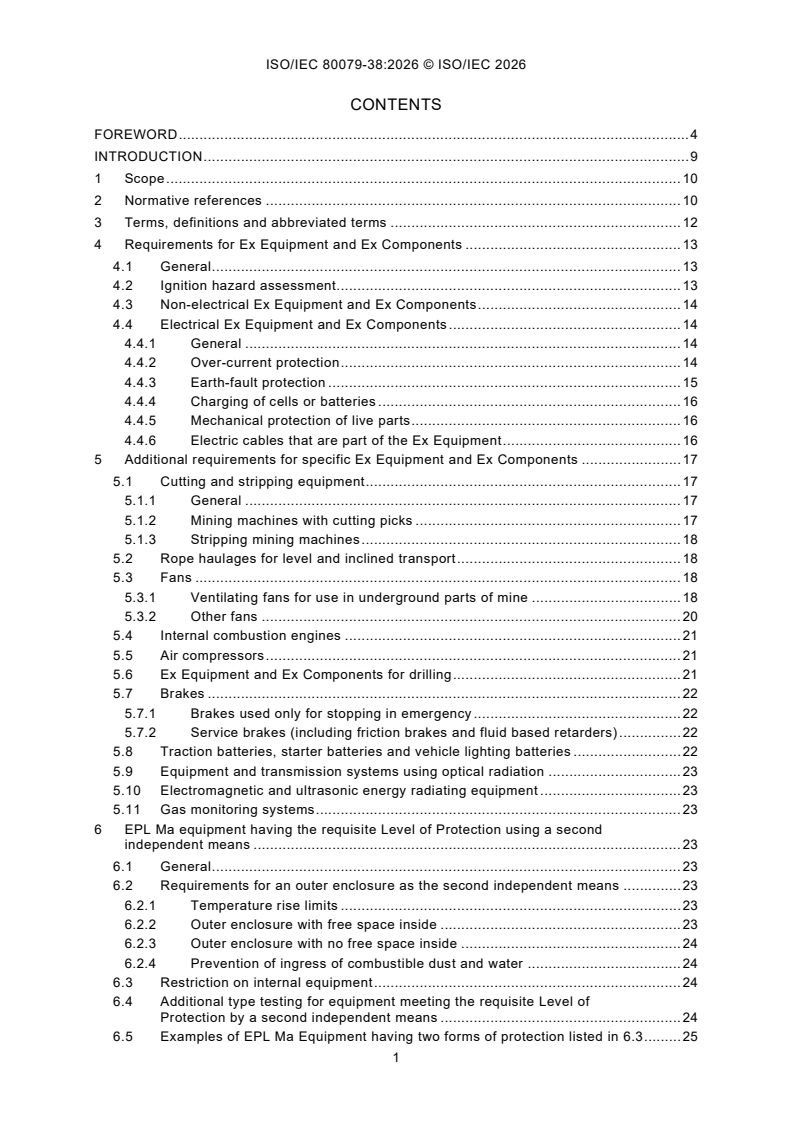
CONTENTS
FOREWORD . 4
INTRODUCTION . 9
1 Scope . 10
2 Normative references . 10
3 Terms, definitions and abbreviated terms . 12
4 Requirements for Ex Equipment and Ex Components . 13
4.1 General . 13
4.2 Ignition hazard assessment. 13
4.3 Non-electrical Ex Equipment and Ex Components . 14
4.4 Electrical Ex Equipment and Ex Components . 14
4.4.1 General . 14
4.4.2 Over-current protection . 14
4.4.3 Earth-fault protection . 15
4.4.4 Charging of cells or batteries . 16
4.4.5 Mechanical protection of live parts . 16
4.4.6 Electric cables that are part of the Ex Equipment . 16
5 Additional requirements for specific Ex Equipment and Ex Components . 17
5.1 Cutting and stripping equipment . 17
5.1.1 General . 17
5.1.2 Mining machines with cutting picks . 17
5.1.3 Stripping mining machines . 18
5.2 Rope haulages for level and inclined transport . 18
5.3 Fans . 18
5.3.1 Ventilating fans for use in underground parts of mine . 18
5.3.2 Other fans . 20
5.4 Internal combustion engines . 21
5.5 Air compressors . 21
5.6 Ex Equipment and Ex Components for drilling . 21
5.7 Brakes . 22
5.7.1 Brakes used only for stopping in emergency . 22
5.7.2 Service brakes (including friction brakes and fluid based retarders) . 22
5.8 Traction batteries, starter batteries and vehicle lighting batteries . 22
5.9 Equipment and transmission systems using optical radiation . 23
5.10 Electromagnetic and ultrasonic energy radiating equipment . 23
5.11 Gas monitoring systems . 23
6 EPL Ma equipment having the requisite Level of Protection using a second
independent means . 23
6.1 General . 23
6.2 Requirements for an outer enclosure as the second independent means . 23
6.2.1 Temperature rise limits . 23
6.2.2 Outer enclosure with free space inside . 23
6.2.3 Outer enclosure with no free space inside . 24
6.2.4 Prevention of ingress of combustible dust and water . 24
6.3 Restriction on internal equipment . 24
6.4 Additional type testing for equipment meeting the requisite Level of
Protection by a second independent means . 24
6.5 Examples of EPL Ma Equipment having two forms of protection listed in 6.3 . 25
7 Fire protection . 26
7.1 General . 26
7.2 Non-metallic materials . 27
7.3 Hydraulic and pneumatic equipment. 27
7.3.1 Hydraulic equipment . 27
7.3.2 Pneumatic equipment . 27
7.4 Fire resistant fluids . 27
7.5 Cable-reeling equipment . 28
7.6 Fire prevention on electric cables that are part of the mining machine . 29
8 Information for use . 29
8.1 Signals and warning notices . 29
8.2 Instructions . 29
8.2.1 Information on use . 29
8.2.2 Information on maintenance and repair . 29
9 Marking . 30
Annex A (informative) Example of an ignition hazard assessment for a shearer
intended for use in an explosive atmosphere of a coal mine . 31
A.1 General . 31
A.2 EPL and intended use of equipment . 31
A.3 Construction/description of the equipment with regard to ignition protection . 31
A.4 Ignition control and monitoring system . 32
A.5 Compliance with the basic methodology and requirements in IEC 60079-0
and ISO 80079-36 . 32
A.6 Ignition hazard assessment of the electrical parts of the equipment . 33
A.7 Ignition hazard assessment of non-electrical ignition sources . 33
A.8 Equipment marking . 36
Annex B (informative) Additional guidance . 37
B.1 Establishing maximum service temperature . 37
B.2 Dust deposits and other material in the gap of moving parts . 37
B.3 Short-circuit protection . 37
B.4 Earth-fault protection . 37
B.5 Electric cables that are part of the equipment . 37
B.6 Cutting and stripping equipment . 38
B.7 Cable-reeled equipment . 38
Bibliography . 39
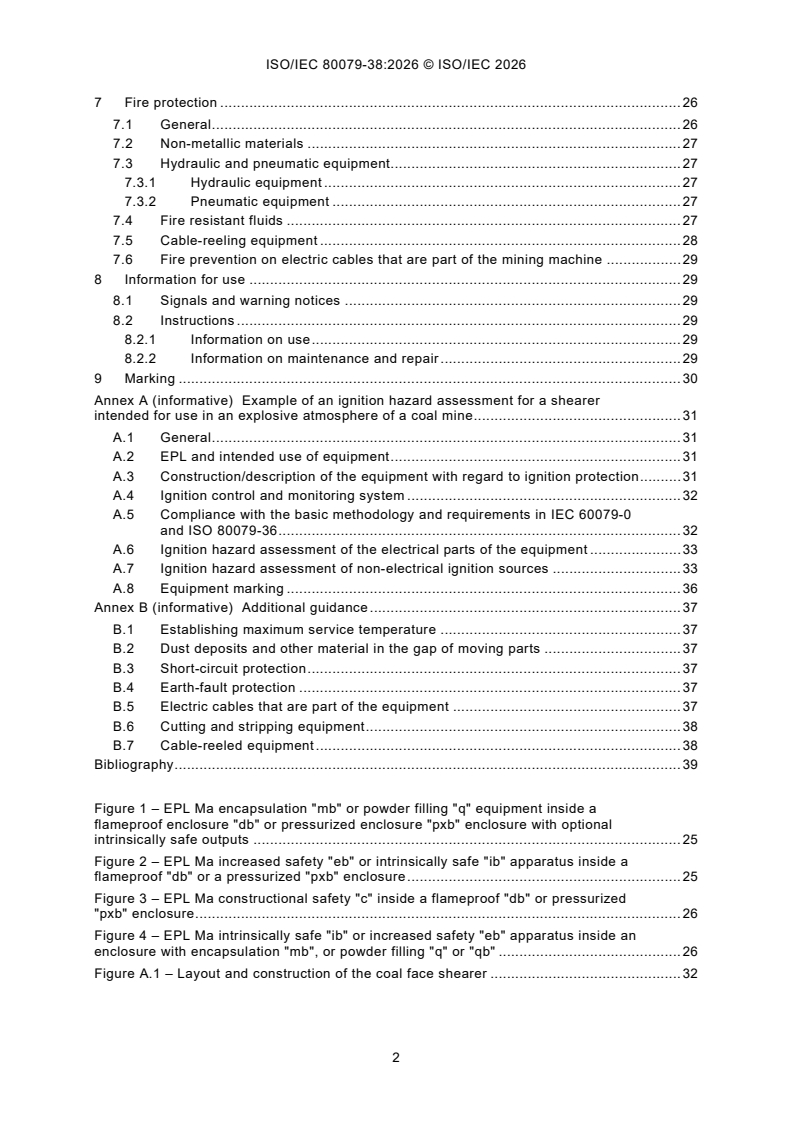
Figure 1 – EPL Ma encapsulation "mb" or powder filling "q" equipment inside a
flameproof enclosure "db" or pressurized enclosure "pxb" enclosure with optional
intrinsically safe outputs . 25
Figure 2 – EPL Ma increased safety "eb" or intrinsically safe "ib" apparatus inside a
flameproof "db" or a pressurized "pxb" enclosure . 25
Figure 3 – EPL Ma constructional safety "c" inside a flameproof "db" or pressurized
"pxb" enclosure . 26
Figure 4 – EPL Ma intrinsically safe "ib" or increased safety "eb" apparatus inside an
enclosure with encapsulation "mb", or powder filling "q" or "qb" . 26
Figure A.1 – Layout and construction of the coal face shearer . 32
Table 1 – Combination of materials . 20
Table 2 – Limit values for hydraulic fluids . 28
Table A.1 – Example of an ignition hazard assessment for a shearer, EPL Mb (1 of 3) . 33
INTERNATIONAL ELECTROTECHNICAL COMMISSION
____________
Explosive atmospheres -
Part 38: Equipment and components in explosive
atmospheres in underground mines
FOREWORD
1) The International Electrotechnical Commission (IEC) is a worldwide organization for standardization comprising
all national electrotechnical committees (IEC National Committees). The object of IEC is to promote international
co-operation on all questions concerning standardization in the electrical and electronic fields. To this end and
in addition to other activities, IEC publishes International Standards, Technical Specifications, Technical Reports,
Publicly Available Specifications (PAS) and Guides (hereafter referred to as "IEC Publication(s)"). Their
preparation is entrusted to technical committees; any IEC National Committee interested in the subject dealt with
may participate in this preparatory work. International, governmental and non-governmental organizations liaising
with the IEC also participate in this preparation. IEC collaborates closely with the International Organization for
Standardization (ISO) in accordance with conditions determined by agreement between the two organizations.
2) The formal decisions or agreements of IEC on technical matters express, as nearly as possible, an international
consensus of opinion on the relevant subjects since each technical committee has representation from all
interested IEC National Committees.
3) IEC Publications have the form of recommendations for international use and are accepted by IEC National
Committees in that sense. While all reasonable efforts are made to ensure that the technical content of IEC
Publications is accurate, IEC cannot be held responsible for the way in which they are used or for any
misinterpretation by any end user.
4) In order to promote international uniformity, IEC National Committees undertake to apply IEC Publications
transparently to the maximum extent possible in their national and regional publications. Any divergence between
any IEC Publication and the corresponding national or regional publication shall be clearly indicated in the latter.
5) IEC itself does not provide any attestation of conformity. Independent certification bodies provide conformity
assessment services and, in some areas, access to IEC marks of conformity. IEC is not responsible for any
services carried out by independent certification bodies.
6) All users should ensure that they have the latest edition of this publication.
7) No liability shall attach to IEC or its directors, employees, servants or agents including individual experts and
members of its technical committees and IEC National Committees for any personal injury, property damage or
other damage of any nature whatsoever, whether direct or indirect, or for costs (including legal fees) and
expenses arising out of the publication, use of, or reliance upon, this IEC Publication or any other IEC
Publications.
8) Attention is drawn to the Normative references cited in this publication. Use of the referenced publications is
indispensable for the correct application of this publication.
9) IEC and ISO draw attention to the possibility that the implementation of this document may involve the use of (a)
patent(s). IEC and ISO take no position concerning the evidence, validity or applicability of any claimed patent
rights in respect thereof. As of the date of publication of this document, IEC and ISO had not received notice of
patents, which may be required to implement this document. However, implementers are cautioned that this may
not represent the latest information, which may be obtained from the patent database available at
https://patents.iec.ch and www.iso.org/patents. IEC and ISO shall not be held responsible for identifying any or
all such patent rights.
ISO/IEC 80079-38 has been prepared by IEC technical committee 31: Equipment for explosive
atmospheres. It is an International Standard.
It is published as a double logo International Standard.
This second edition cancels and replaces the first edition, published in 2016. This edition
constitutes a technical revision.
Users of this document are advised that interpretation sheets clarifying the interpretation of this
document can be published. Interpretation sheets are available from the IEC webstore and can
be found in the "history" tab of the page for each document.
The significance of changes between ISO/IEC 80079-38:2016 (Edition 1) and
ISO/IEC 80079-38: (Edition 2) is as listed below:
Type
Changes Clause Minor and Extension Major
editorial technical
changes changes
Throughout document where appropriate General X
changed "equipment" and "components" to "Ex
Equipment" and "Ex Components"
Throughout the document "machine" changed General X
to "mining machine"
Throughout the body of the document removed General C1
the use of "should" by, in most cases, moving
the clause to Annex B as guidance
References to "standard" changed to X
"document" where appropriate in accordance General
with ISO/IEC Directives
Throughout the document changed "e.g." to General X
"for example" in accordance with TC 31 Good
Working Practice
Scope changed to cover "construction, testing 1 C2
and marking for use in Group I" from "design,
construction, assessment and information for
use (maintenance, repair, marking)". Hand
tools are no longer covered by the standard
Note added to scope to clarify that Group I 1 X
takes account that coal dust can be present
with or without methane
Note added to scope to clarify that Group I also 1 X
covers mines other than coal mines
Note added to scope to clarify that "assembly" 1 X
is not identical to the meaning in IEC 60079-46
Scope expanded to cover EPL Ma as well as 1 C3
EPL Mb
Scope changed to allow this document to be 1 X
used for guidance on underground applications
where firedamp or coal dust can be present but
which are not Group I mines, for example
tunnels
Deletion of definitions in IEC 60079-0 Former 3.1, 3.7, X
3.10, 3.14, 3.15
and 3.16
Deletion of definition "protection against
Former 3.2 X
firedamp explosions"
Change of definition of "flammable substance" 3.1 X
to align with definition in IEC 60079-10-1.
Deletion of definition "component" and Former 3.4 X
introduction of use of term "Ex Component"
from IEC 60079-0
Deletion of definition of "equipment" and Former 3.5 X
introduction of use of term "Ex Equipment from
IEC 60079-0
Deletion of definition "explosion" Former 3.6 X
Deletion of definition "intended use" Former 3.8 X
Change of definition of "machinery" to "mining 3.2 X
machinery" with added admitted term of
"mining machine"
Deletion of definition "minimum ignition energy" Former 3.11 X
Type
Changes Clause Minor and Extension Major
editorial technical
changes changes
Deletion of definition "potentially explosive Former 3.12 X
atmospheres"
Deletion of definition "self-ignition of dust in Former 3.13 X
bulk"
Deletion of definition of mechanical sparks Former 3.19 X
Deletion of definition of incendive sparks Former 3.20 X
Introduction of definition of "safety device"
3.5 X
from IEC TS 60079-42
Introduction of requirements regarding Specific 4.1 X
Conditions of Use
Rewording of requirements for ignition hazard 4.2 X
assessment including reference to
ISO 80079-36
Revision of requirements regarding insulation 4.4.3 X
faults to provide two options.
Introduction of requirements for temperature 4.4.6.1 X
rating of cables
Rewording of requirements for ventilating fans 5.3.1 X
Reference to standard for internal combustion 5.4 X
engines – ISO/IEC 80079-41
Reference to requirements in IEC 60079-0 for 5.8 X
traction batteries, starter batteries and vehicle
lighting batteries
Additional requirement for batteries not 5.8 X
complying with IEC 60079-11 Ex ia Ma to
comply with IEC 60079-33 Ex sa Ma
Optical radiation requirements in standard 5.9 X
replaced with requirement to comply with
IEC 60079-28
Electromagnetic and ultrasonic energy 5.10 X
radiating equipment requirements in standard
replaced with requirement to comply with
IEC 60079-0
Gas monitoring now refers to IEC 60079-29-0 5.11 C4
and does not include any other requirements.
Note added to state that gas detector can be 5.11 X
required on mobile mining machines
New clause "EPL Ma equipment having the 6 C5
requisite Level of Protection using a second
independent means" has been added
Subclause headings added for General and 7.3 X C6
Fire resistant fluids and clause reorganised to
separate requirements for hydraulic and
pneumatic equipment. Compliance with
ISO 4413 and ISO 4413 introduced
Requirements for conveyor belting deleted Former 6.7 C7
Marking requirements revised including for EPL
9 C8
Ma and EPL Mb situations
Example of an ignition hazard assessment for Former Annex A C9
a conveyor belt intended for use in a coal mine
deleted as conveyor belts are no longer part of
the standard
Deletion of Annex on ignition sources as Former Annex C C10
information is in ISO 80079-36
Type
Changes Clause Minor and Extension Major
editorial technical
changes changes
Deletion of Annex on Guidance on potential Former Annex D C11
risks for converter-fed motors
Tests for surface protective coating for Group I Former Annex E C12
hand tools of EPL Mb deleted as hand tools
are not part of this edition
Inclusion of informative guidance material, Annex B C13
most of which was formerly in body of standard
NOTE The technical changes referred to include the significance of technical changes in the revised IEC Standard,
but they do not form an exhaustive list of all modifications from the previous version. More guidance can be found
by referring to the Redline Version of the standard.
Explanations:
a) Definitions
Minor and editorial changes clarification
decrease of technical requirements
minor technical change
editorial corrections
These are changes which modify requirements in an editorial or a minor technical way. They
include changes of the wording to clarify technical requirements without any technical
change, or a reduction in level of existing requirement.
Extension addition of technical options
These are changes which add new or modify existing technical requirements, in a way that
new options are given, but without increasing requirements for equipment that was fully
compliant with the previous standard. Therefore, these will not have to be considered for
products in conformity with the preceding edition.
Major technical changes addition of technical requirements
increase of technical requirements
These are changes to technical requirements (addition, increase of the level or removal)
made in a way that a product in conformity with the preceding edition will not always be able
to fulfil the requirements given in the later edition. These changes have to be considered
for products in conformity with the preceding edition.
NOTE These changes represent current technological knowledge. However, these changes should not normally
have an influence on equipment already placed on the market.
b) Information about the background of changes
C1 The body of the document has been changed to only mandatory text to make it
more suitable to use for conformity assessment.
C2 The scope was made clearer for the application and to remove hand tools from
the scope.
C3 The scope was expanded to include EPL Ma equipment as well as EPL Mb
equipment.
C4 The relevant standard for gas monitoring has changed from IEC 60079-29 to
IEC 60079-29-0 and hence the latest standard is referenced.
C5 The new section now provides requirements relevant to EPL Ma.
C6 Reference to compliance with ISO 4413 and ISO 4414 introduces additional
requirements for hydraulic and pneumatic equipment.
C7 Conveyor belts are no longer part of the scope and so requirements were
deleted.
C8 Marking updated to address both EPL Ma and EPL Mb with the introduction of
EPL Ma in the scope.
C9 See C6 regarding conveyor belts and hence example no longer relevant.
C10 The information on ignition sources is available in ISO 80079-36 and so there is
no need to duplicate the information here.
C11 There is no calling clause to this annex and the information is of a general nature
not specific to mines
C12 With hand tools now longer in the scope, this test is no longer needed.
C13 Most of the guidance material from the body of the previous edition of the
standard is now in this annex.
The text of this International Standard is based on the following documents:
Draft Report on voting
31M/302/FDIS 31M/315/RVD
Full information on the voting for its approval can be found in the report on voting indicated in
the above table.
The language used for the development of this International Standard is English.
This document was drafted in accordance with ISO/IEC Directives, Part 2, and developed in
accordance with ISO/IEC Directives, Part 1 and ISO/IEC Directives, IEC Supplement, available
at www.iec.ch/members_experts/refdocs. The main document types developed by IEC are
described in greater detail at www.iec.ch/publications.
A list of all parts of the IEC 60079 series, under the general title Explosive atmospheres, as
well as the ISO/IEC 80079 series, can be found on the IEC website.
The committee has decided that the contents of this document will remain unchanged until the
stability date indicated on the IEC website under webstore.iec.ch in the data related to the
specific document. At this date, the document will be
– reconfirmed,
– withdrawn, or
– revised.
INTRODUCTION
This part of ISO/IEC 80079 specifies requirements for the constructional features of Ex
Equipment and Ex Components that can be an individual item or form an assembly, to enable
them to be used in mines, or parts of mines, susceptible to explosive atmospheres of firedamp,
combustible dust or a combination of the two.
Most of the Ex Equipment used on mining machinery complies with the Type of Protection
standards as an individual item of equipment, for example motors and switchgear, and they
have their own marking requirements. The Type of Protection standards, however, do not deal
with the interconnection of Ex Equipment and Ex Components.
Both non-electrical Ex Equipment and the interconnection of electrical/non-electrical Ex
Equipment can require an ignition hazard assessment.
The need for this document arises because of major operational differences between
underground mining operations and those in other industries working with, or in, explosive
atmospheres. Examples of these differences are:
– firedamp can be released during the extraction of coal or other mining where firedamp is
trapped;
– the ignitability of the atmosphere around Ex Equipment and Ex Components usually
depends upon the amount of dilution offered by an active ventilating system;
– the atmosphere in the general body of mine air in which machinery is working can change
from one that is not explosive to one that is explosive (for example, during an outburst of
firedamp) and, depending on the likelihood, this can impact on the EPL required
(Ma versus Mb);
– persons working in the mine can be situated in an explosive atmosphere if there is an
increase in the concentration of firedamp; there is a need to monitor constantly the mine
atmosphere at strategic places to ensure that power can be disconnected from all Ex
Equipment except EPL Ma Ex Equipment which is suitable for use in a constantly present
explosive atmosphere;
– in gassy coal mines, an initial explosion of firedamp can raise combustible dust clouds that
when ignited commonly provide a significantly more serious explosion;
– some mining machinery contains cutting devices and drilling devices that can produce an
ignition risk from sparks generated from contact with strata containing high concentrations
of quartz or iron pyrites; and
– long roadways in coal mines are equipped with mineral conveying systems carrying a
product that has a potential for raising a combustible dust cloud and the release of firedamp.
1 Scope
This part of ISO/IEC 80079 is applicable for the explosion protection requirements for the
construction, testing and marking for Group I Ex Equipment that can be an individual item, or
be an assembly of multiple items of Ex Equipment and Ex Components forming mining
machinery.
NOTE 1 The Group I designation takes account of the fact coal dust (which is a combustible dust) is expected to
be present, with or without the presence of firedamp, which is predominately methane.
NOTE 2 The definition of Group I also covers mines other than coal mines that are susceptible to firedamp.
NOTE 3 The term "assembly" as used in this document is not identical in meaning to the term "Equipment Assembly"
as defined in IEC 60079-46.
The standard atmospheric conditions (relating to the explosion characteristics of the
atmosphere) under which it can be assumed that Ex Equipment can be operated are:
– temperature −20 °C to +60 °C;
– pressure 80 kPa (0,8 bar) to 110 kPa (1,1 bar); and
– air with normal oxygen content, typically a volume fraction of 21 %.
This part of ISO/IEC 80079 applies for Ex Equipment and Ex Components with Explosion
Protection Levels (EPLs) Ma and Mb.
This document supplements and modifies the general requirements of IEC 60079-0. Where a
requirement of this document conflicts with a requirement of IEC 60079-0, the requirement of
this document takes precedence.
This document can be used for guidance on underground applications where firedamp or coal
dust can be present, but which are not Group I mines, for example tunnels.
2 Normative references
The following documents are referred to in the text in such a way that some or all of their content
constitutes requirements of this document. For dated references, only the edition cited applies.
For undated references, the latest edition of the referenced document (including any
amendments) applies.
IEC 60079-0, Explosive atmospheres - Part 0: Equipment - General requirements
IEC 60079-5, Explosive atmospheres - Part 5: Equipment protection by powder filling "q"
IEC 60079-7, Explosive atmospheres - Part 7: Equipment protection by increased safety "e"
IEC 60079-11, Explosive atmospheres - Part 11: Equipment protection by intrinsic safety "i"
IEC 60079-18, Explosive atmospheres - Part 18: Equipment protection by encapsulation "m"
IEC 60079-25, Explosive atmospheres - Part 25: Intrinsically safe electrical systems
IEC 60079-28, Explosive atmospheres - Part 28: Protection of equipment and transmission
systems using optical radiation
IEC 60079-29-0, Explosive atmospheres - Part 29-0: Gas detection equipment - General
requirements and test methods
IEC 60079-33, Explosive atmospheres - Part 33: Equipment protection by special protection 's'
IEC 60204-1, Safety of machinery - Electrical equipment of machines - Part 1: General
requirements
IEC 60204-11, Safety of machinery - Electrical equipment of machines - Part 11: Requirements
for equipment for voltages above 1 000 V AC or 1 500 V DC and not exceeding 36 kV
IEC 60332-1 (all parts), Tests on electric and optical fibre cables under fire conditions
IEC 60529, Degrees of protection provided by enclosures (IP Code)
ISO 340, Conveyor belts - Laboratory scale flammability characteristics - Requirements and
test method
ISO 630-5, Structural steels - Part 5: Technical delivery conditions for structural steels with
improved atmospheric corrosion resistance
ISO 4413, Hydraulic Fluid Power - General rules and safety requirements for systems and their
components
ISO 4414, Pneumatic Fluid Power - General rules and safety requirements for systems and
their components
ISO 6805, Rubber hoses and hose assemblies for underground mining - Wire-reinforced
hydraulic types for coal mining - Specification
ISO 7010, Graphical symbols - Safety colours and safety signs - Registered safety signs
ISO 14935, Petroleum and related products - Determination of wick flame persistence of fire-
resistant fluids
ISO 15029-1, Petroleum and related products - Determination of spray ignition characteristics
of fire-resistant fluids - Part 1: Spray flame persistence - Hollow-cone nozzle method
ISO 15029-2, Petroleum and related products - Determination of spray ignition characteristics
of fire-resistant fluids - Part 2: Spray test - Stabilized flame heat release method
ISO 21840-11, Mechanical vibration - Rotor balancing - Part 11: Procedures and tolerances for
rotors with rigid behaviour
ISO 80079-36, Explosive atmospheres - Part 36: Non-electrical equipment for explosive
atmospheres - Basic method and requirements
ISO 80079-37, Explosive atmospheres - Part 37: Non-electrical equipment for explosive
atmospheres - Non-electrical type of protection constructional safety "c", control of ignition
sources "b", liquid immersion "k"
ISO/IEC 80079-41, Explosive atmospheres - Part 41: Reciprocating internal combustion
engines
3 Terms, definitions and abbreviated terms
For the purposes of this document, the terms and definitions given in IEC 60079-0 and the
following apply.
ISO and IEC maintain terminology databases for use in standardization at the following
addresses:
– IEC Electropedia: available at https://www.electropedia.org/
– ISO Online browsing platform: available at https://www.iso.org/obp/ui
NOTE Additional definitions applicable to explosive atmospheres can be found in the International Electrotechnical
Vocabulary (IEV) IEC 60050-426.
3.1
flammable substance
substance which is itself flammable, or is capable of producing a flammable gas, vapour or mist
[SOURCE: IEC 60079-10-1:2020, 3.6.1]
3.2
mining machinery
mining machine
assembly, fitted with or intended to be fitted with a drive system consisting of linked parts or
components, at least one of which moves, and which are joined together for use in mines
Note 1 to entry: The term "machinery" also covers an assembly of machines which, in order to achieve the same
end, are arranged and controlled so that they function as an integral whole.
3.3
non-electrical equipment
equipment which can achieve its intended function mechanically
Note 1 to entry: Equipment addressed in ISO 80079-36 can be powered by any kind of energy including electrical
equipment.
[SOURCE: ISO 80079-36:2016, 3.7]
3.4
hydraulic fluid
any fluid and its concentrate for hydraulic transmission and monitoring with exception of water
3.5
safety device
device intended for use inside or outside explosive atmospheres but required for or contributing
to the safe functioning of Ex Equipment and protective systems with respect to the risks of
explosion
Note 1 to entry: Safety devices differ from the term devices used in the IEC 61508 and IEC 61511 series. Safety
devices can be compared to the terms like "safety-related system (IEC 61508)" or "safety instrumented system
(IEC 61511)".
[SOURCE: IEC TS 60079-42:2019, 3.1]
4 Requirements for Ex Equipment and Ex Components
4.1 General
Ex Equipment and Ex Components shall conform with the applicable requirements for EPL Ma
or Mb according to the IEC 60079 series for electrical equipment and according to the
ISO/IEC 80079 series for non-electrical equipment, for Group I. The requirement for conformity
with EPL Ma or EPL Mb will depend on the intended application.
When Ex Equipment or Ex Components are installed on a mining machine, the Specific
Conditions of Use or the Schedule of Limitations specified in the certificates shall be complied
with as part of the assembly or the mining machine certificate number shall include the "X"
suffix in accordance with the marking requirements of IEC 60079-0 and the remaining Specific
Conditions of Use shall be listed on that certificate.
NOTE Typical conditions for Specific Conditions of Use can, for example, include the minimum flow of cooling water,
temperature protection settings or duty cycle (short time rating).
Guidance relevant to achieving the above requirements is provided in Annex B, in addition to the requirements in the
body of this document.
4.2 Ignition hazard assessment
An assessment of the ignition hazards associated with mining machinery shall be performed
using the methodology in ISO 80079-36.
The documentation shall address the ignition hazards as follows:
a) ignition hazards directly related to the mining machinery, and how they were mitigated in
the equipment assembly; and
b) ignition hazards directly related to the mining machinery, not mitigated in the equipment
assembly, but able to be mitigated in the end-user site installation.
For ignition hazards that are not mitigated in the mining machinery, but that are able to be
mitigated in the end-user site installation, the mining machinery certificate number shall include
the "X" suffix in accordance with the marking requirements of IEC 60079-0 and the Specific
Conditions of Use shall be listed on the certificate and the documentation shall provide guidance
on satisfying those Specific Conditions of Use.
Ignition hazards for each item of Ex Equipment are addressed by the Ex Equipment certificates
and therefore need not be reassessed.
Compliance with this document will require verification that the ignition hazard assessment has
been carried out and documented, along with any control measures and residual hazards as
detailed above.
NOTE Typically the above verification would be done as part of a certification process.
An example of an ignition hazard assessment for a shearer intended for use in an explosive
atmosphere of a coal mine is provided in Annex A.
4.3 Non-electrical Ex Equipment and Ex Components
All non-electrical Ex Equipment and Ex Components (including parts used within the mining
machine in order to connect them), shall comply with the requirements of ISO 80079-36 and,
where necessary, one of the other Types of Protection listed in that document, except where
specific requirements exist in this document, for example the fitting of water spray ignition
protection to cutting picks.
NOTE 1 ISO 80079-36 addresses ignition protection of non-electrical Ex Equipment and Ex Components intended
for use in both explosive gas atmospheres and explosive dust atmospheres.
NOTE 2 Types of ignition protection for non-electrical Ex Equipment are given in ISO 80079-37.
4.4 Electrical Ex Equipment and Ex Components
4.4.1 General
All electrical Ex Equipment and Ex Components shall comply with the requirements of
IEC 60079-0 and at least one of the Types of Protection listed in that document related to
Group I.
NOTE 1 IEC 60079-0 deals with the ignition protection of equipment and components intended for use in explosive
gas atmospheres and explosive dust atmospheres. For gassy mines, equipment tested in an explosive gas
atmosphere and protected against igniting firedamp is also adequately protected against ignition of an explosive coal
dust cloud.
NOTE 2 Examples of Type of Protection documents particularly relevant to mining are:
– IEC 60079-1 (Flameproof enclosure "d");
– IEC 60079-7 (Increased safety "e");
– IEC 60079-11 (Intrinsic safety "i");
– IEC 60079-18 (Encapsulation "m").
NOTE 3 The requirements of this document are in addition to the applicable electrical safety requirements of the
relevant industrial standards. The relevant electrical safety standards typically include IEC 60204-1 and
IEC 60204-11. It is not a requirement of this document that compliance with the relevant industrial standards be
verified.
Where protective measures depend on devices external to the mining machine, the
manufacturer shall specify these in the instructions. For the purposes of this document, the
requirements below commence at the point where the electrical supply is connected to the
mining machine (terminals, plug and socket).
NOTE 4 All terms used to describe electrical devices are as defined in IEC 60050-441.
4.4.2 Over-current protection
4.4.2.1 Overload protection
For the protection of motors and their supply cables against overloading, the requirements of
IEC 60204-1 and IEC 60204-11 shall apply.
NOTE 1 In general, overload causes overheating.
NOTE 2 The objective of the overload protection is to prevent damage to electrical parts by excessive temperature.
The overload protection contributes to reducing the risk of surface temperatures exceeding those specified in
IEC 60079-0. Additionally, possible overloads or temperature rises can be caused by:
– high starting frequency; and
– starting under load.
Protection of motors against overload shall be achieved by the use of fuses, directly-operating
trip relays, current- transformer-operated trip relays or thermal trip devices, or a combination of
these.
Overload protection shall not be provided if:
a) a hazard is caused by its operation, for example the prevention of high voltages on
secondary windings of current transformers, or tripping of exciter windings in generators or
synchronous motors, or electrical braking circuits; and
b) its exclusion is in accordance with the certificate according to IEC 60079–0.
Overload protection devices shall be installed at the beginning of each circuit and at positions
where the current-carrying capacity of a conductor is reduced.
4.4.2.2 Short-circuit protection
Short-circuit protection shall be provided to protect in the event of a short-circuit occurring in
any part of a non-intrinsically safe circuit becoming overheated and creating an ignition
hazard.
Facilities to avoid resetting by unauthorized persons shall be provided.
All external cables installed on a mining machine
...