

ISO 25218:2026
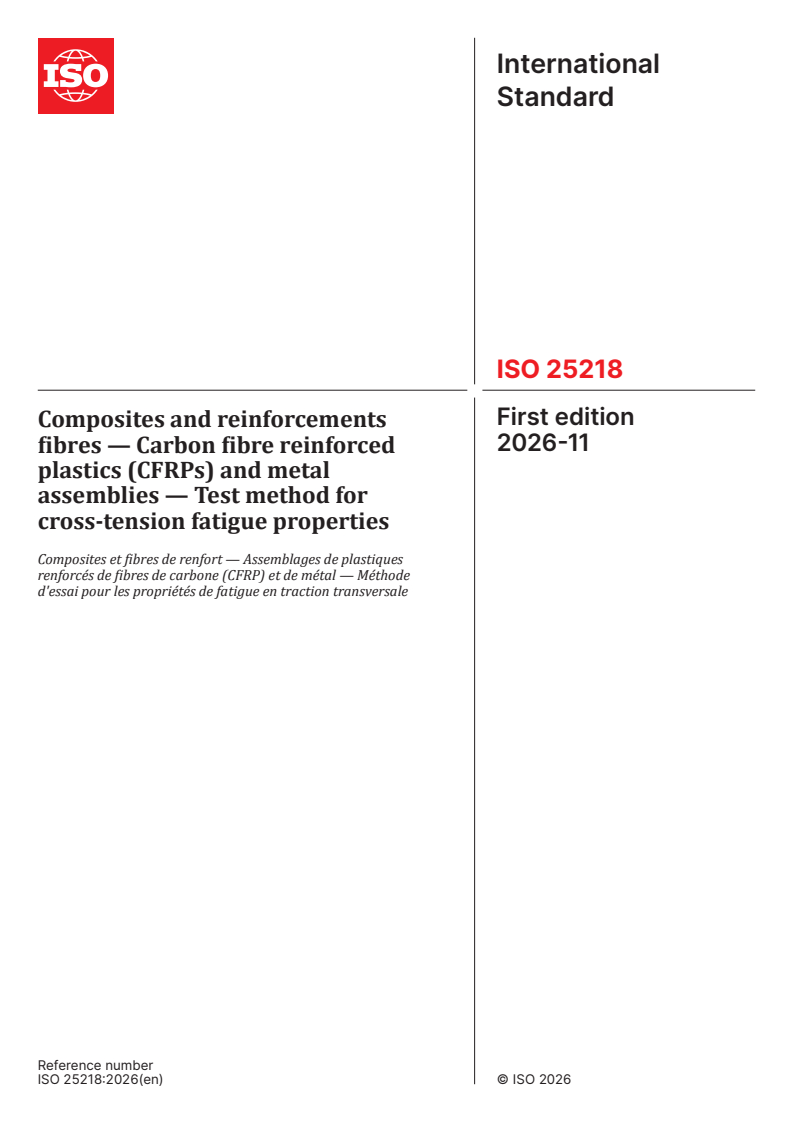
(Main)Composites and reinforcements fibres — Carbon fibre reinforced plastics (CFRPs) and metal assemblies — Test method for cross-tension fatigue properties
- Abstract
This document specifies test specimens and procedures for fatigue testing at ambient conditions, under repeated tensile loading, generating cross-tension loading to the bonded plates of carbon fibre reinforced plastics (CFRPs) to metal assemblies. This document applies to bonded plates used in bonding CFRPs to metal assemblies with adhesive or other specified methods.
- Status
- Published
- Publication Date
- 01-Nov-2026
- Technical Committee
- ISO/TC 61/SC 13 - Composites and reinforcement fibres
- Drafting Committee
- ISO/TC 61/SC 13/WG 7 - Composites and metal assemblies
- Current Stage
- 6060 - International Standard published
- Start Date
- 02-Nov-2026
- Completion Date
- 02-Nov-2026
ISO 25218:2026 is an International Standard from ISO for testing the cross-tension fatigue properties of carbon fibre reinforced plastics (CFRPs) and metal assemblies. It specifies the test specimens, apparatus, and procedures for fatigue testing at ambient conditions under repeated tensile loading on bonded plates used to join CFRPs to metal with adhesive or other specified methods. The method is used to generate S-N curves and to compare the fatigue behaviour of these bonded joints in engineering work.
What does ISO 25218:2026 specify?
ISO 25218:2026 specifies a test method for bonded plates in CFRP-to-metal assemblies, with the load applied so the specimen experiences cross-tension fatigue. The document focuses on standard specimens and controlled test conditions so results from different laboratories can be compared.
The scope covers fatigue testing at ambient conditions under repeated tensile loading. It is intended for bonded plates used in bonding CFRPs to metal assemblies, including adhesive bonding and other specified methods.
The document is organized into clauses on scope, normative references, terms and definitions, test specimen, apparatus, test procedure, and test report, followed by one informative annex.
| Annex | What it covers |
|---|---|
| Annex A | Example of a cross tension fatigue test for an adhesive-bonded CFRP plate to aluminium, including specimen preparation, test conditions, and example S-N curves |
The introduction also explains that the method is for bonded plates in CFRP-metal assemblies and is not meant to replace relevant field tests for specific engineering applications or to extend results beyond the range covered by the method.
What are the key requirements of ISO 25218:2026?
ISO 25218:2026 requires controlled specimen preparation, calibrated test equipment, and a defined fatigue loading sequence so the resulting S-N curve is meaningful for the chosen joint system. In practice, the user needs to control specimen geometry, bonding quality, loading frequency, and reporting of results.
Specimens and joint preparation
Clause 4 says the specimen size and geometry follow ISO 24360. The document gives two specimen types - Type A and Type B - and both use two rectangular coupons with the bonding in the lapped area.
For adhesive-bonded joints, the adhesive layer shall be below 1 mm, and its thickness shall be controlled within the joint and between joints. This matters because uneven adhesive thickness can change the measured fatigue behaviour.
Test machine and measuring system
Clause 5 requires a testing machine with force-measuring systems of Class 1 or higher per ISO 7500-1 and extensometer systems of Class 1 or higher per ISO 9513. The machine must hold the jig securely, measure frequency accurately, and allow visual monitoring of cracking.
The machine shall also record load level and cycle count, and it shall not restart automatically after an interruption. In practice, this protects the validity of the cycle count and prevents uncontrolled continuation of a test.
Test conditions and loading
Clause 6 requires the specimen to be aligned with the loading axis and held firmly in the jig. The test frequency is normally between 10 Hz and 30 Hz, and the specimen should not be heated excessively during testing.
The document also requires the load to be brought first to the mean stress and then to the test amplitude without exceeding the maximum stress. That sequence helps avoid unintended overloads during setup.
S-N curve construction
Clause 6.2 says static cross-tension strength is measured first using at least five specimens and ISO 24360, and the failure mode is recorded using ISO 10365. The fatigue series for the S-N curve uses at least 10 specimens and at least three stress amplitude levels.
The document allows testing at either constant mean stress or constant stress ratio. That choice must be stated in the report, because it affects how the fatigue data are interpreted.
Reporting
Clause 7 lists the minimum report items, including the bonding process, materials and their condition, specimen dimensions, bonded area, static strength results, stress conditions, failure description, and the S-N curve or fatigue limit. This is the information a buyer, lab, or certifier needs to judge whether the test matches the intended joint and application.
What terms does ISO 25218:2026 define?
- cross tension fatigue test - A fatigue test in which a repeated tensile load is applied to the cross-tension specimen in the fatigue-testing machine.
- stress - The tensile force divided by the bonded surface area.
- static cross-tension strength - The average static stress at rupture measured by ISO 24360.
- stress ratio - The ratio of minimum stress to maximum stress in one cycle.
- S-N curve - A curve that plots stress amplitude against fatigue life, usually on logarithmic axes.
- fatigue life - The number of load cycles the specimen withstands before failure.
- fatigue limit - The maximum stress at which the specimen endures a specified number of cycles without failure.
Who uses ISO 25218:2026?
ISO 25218:2026 is used by laboratories, test engineers, quality managers, and buyers who need a repeatable way to compare the fatigue performance of CFRP-to-metal bonded joints. It is also relevant to aerospace engineering work, including type certification, and to maintenance, repair and overhaul (MRO) evaluation.
Adhesive suppliers, substrate manufacturers, and organizations qualifying bonded assemblies can use the method to check how a specific joint design behaves under cyclic loading. It is most useful when the question is not static strength alone, but how the bond performs over time under repeated tension.
Which standards are used with ISO 25218:2026?
ISO 25218:2026 cites these normative references:
- ISO 7500-1 - for calibration and verification of the force-measuring system of the testing machine.
- ISO 9513 - for calibration of extensometer systems used in uniaxial testing.
- ISO 10365 - for naming the main failure patterns in adhesives.
- ISO 24360 - for the static cross-tension strength method and the specimen geometry used here.
The bibliography also points to ISO 13003 for composite fatigue properties under cyclic loading and ISO 9664 for fatigue testing of structural adhesives in tensile shear.
What does the ISO 25218:2026 document contain?
Clause 4 gives the specimen construction, including the two specimen types and the preparation approach for Type B. Clause 5 describes the testing machine, its calibration class requirements, clamping arrangement, and data-recording needs.
Clause 6 provides the test procedure, including alignment, loading frequency, temperature caution, and the steps for building an S-N curve. Clause 7 lists the required test report content.
Annex A is an informative worked example. It shows a CFRTP-to-aluminium adhesive joint, the test jig, the stress cycle used in fatigue loading, and example S-N curves at different frequencies.
Get Certified
Connect with accredited certification bodies for this standard

DIN CERTCO
DIN Group product certification.

Element Materials Technology
Materials testing and product certification.

Inštitut za kovinske materiale in tehnologije
Institute of Metals and Technology. Materials testing, metallurgical analysis, NDT.
Sponsored listings
Frequently Asked Questions
ISO 25218:2026 is a standard published by the International Organization for Standardization (ISO). Its full title is "Composites and reinforcements fibres — Carbon fibre reinforced plastics (CFRPs) and metal assemblies — Test method for cross-tension fatigue properties". This standard covers: This document specifies test specimens and procedures for fatigue testing at ambient conditions, under repeated tensile loading, generating cross-tension loading to the bonded plates of carbon fibre reinforced plastics (CFRPs) to metal assemblies. This document applies to bonded plates used in bonding CFRPs to metal assemblies with adhesive or other specified methods.
This document specifies test specimens and procedures for fatigue testing at ambient conditions, under repeated tensile loading, generating cross-tension loading to the bonded plates of carbon fibre reinforced plastics (CFRPs) to metal assemblies. This document applies to bonded plates used in bonding CFRPs to metal assemblies with adhesive or other specified methods.
ISO 25218:2026 is classified under the following ICS (International Classification for Standards) categories: 77.140.50 - Flat steel products and semi-products; 83.120 - Reinforced plastics. The ICS classification helps identify the subject area and facilitates finding related standards.
ISO 25218:2026 is available in PDF format for immediate download after purchase. The document can be added to your cart and obtained through the secure checkout process. Digital delivery ensures instant access to the complete standard document.
Standards Content (Sample)
International
Standard
ISO 25218
First edition
Composites and reinforcements
2026-11
fibres — Carbon fibre reinforced
plastics (CFRPs) and metal
assemblies — Test method for
cross-tension fatigue properties
Composites et fibres de renfort — Assemblages de plastiques
renforcés de fibres de carbone (CFRP) et de métal — Méthode
d'essai pour les propriétés de fatigue en traction transversale
Reference number
COPYRIGHT PROTECTED DOCUMENT
© ISO 2026
All rights reserved.
This ISO publication is protected by copyright and is owned by ISO and/or its licensors.
The content of this ISO publication is provided under licence, not sold. Use is subject to the applicable licence terms issued by ISO,
an ISO member body, or an authorized third-party distributor.
Except as required for implementation or expressly permitted by a separate licence, no part of this ISO publication may be
reproduced, distributed, modified, used, or made available in any form or by any means – electronic or mechanical, including
photocopying, scanning, recording, or posting on internal or external digital platforms.
Any use beyond the scope of the granted rights is prohibited and may result in legal action.
ISO copyright office
CP 401 • CH-1214 Vernier, Geneva
Phone: +41 22 749 01 11
Email: copyright@iso.org
Website: www.iso.org
Published in Switzerland
ii
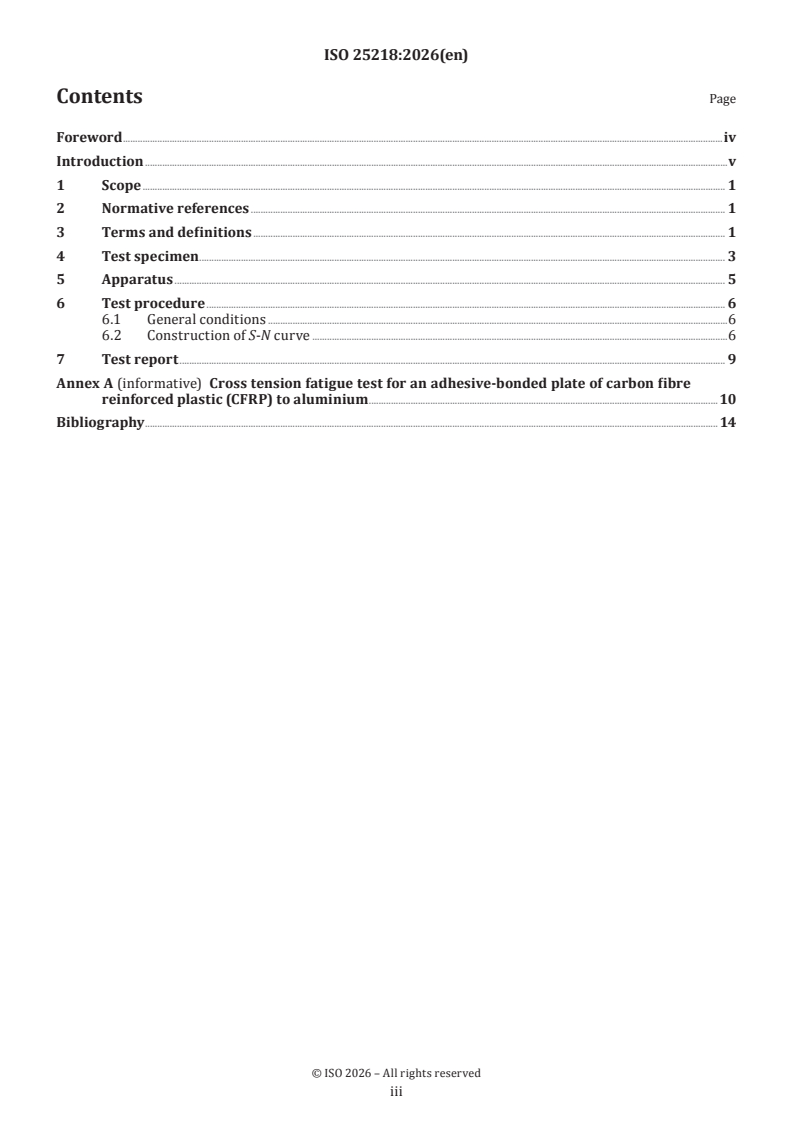
Contents Page
Foreword .iv
Introduction .v
1 Scope . 1
2 Normative references . 1
3 Terms and definitions . 1
4 Test specimen . 3
5 Apparatus . 5
6 Test procedure . 6
6.1 General conditions .6
6.2 Construction of S-N curve .6
7 Test report . 9
Annex A (informative) Cross tension fatigue test for an adhesive-bonded plate of carbon fibre
reinforced plastic (CFRP) to aluminium .10
Bibliography . 14
iii
Foreword
ISO (the International Organization for Standardization) is a worldwide federation of national standards
bodies (ISO member bodies). The work of preparing International Standards is normally carried out through
ISO technical committees. Each member body interested in a subject for which a technical committee
has been established has the right to be represented on that committee. International organizations,
governmental and non-governmental, in liaison with ISO, also take part in the work. ISO collaborates closely
with the International Electrotechnical Commission (IEC) on all matters of electrotechnical standardization.
The procedures used to develop this document and those intended for its further maintenance are described
in the ISO/IEC Directives, Part 1. In particular, the different approval criteria needed for the different types
of ISO document should be noted. This document was drafted in accordance with the editorial rules of the
ISO/IEC Directives, Part 2 (see www.iso.org/directives).
ISO draws attention to the possibility that the implementation of this document may involve the use of (a)
patent(s). ISO takes no position concerning the evidence, validity or applicability of any claimed patent
rights in respect thereof. As of the date of publication of this document, ISO had not received notice of (a)
patent(s) which may be required to implement this document. However, implementers are cautioned that
this may not represent the latest information, which may be obtained from the patent database available at
www.iso.org/patents. ISO shall not be held responsible for identifying any or all such patent rights.
Any trade name used in this document is information given for the convenience of users and does not
constitute an endorsement.
For an explanation of the voluntary nature of standards, the meaning of ISO specific terms and expressions
related to conformity assessment, as well as information about ISO's adherence to the World Trade
Organization (WTO) principles in the Technical Barriers to Trade (TBT), see www.iso.org/iso/foreword.html.
This document was prepared by Technical Committee ISO/TC 61, Plastics, Subcommittee SC 13, Composites
and reinforcement fibres.
Any feedback or questions on this document should be directed to the user’s national standards body. A
complete listing of these bodies can be found at www.iso.org/members.html.
iv
Introduction
This document specifies a method for determining the cross-tensional fatigue properties of the bonded
plates of carbon fibre reinforced plastics (CFRPs) to metal assemblies, with a standard specimen loaded
in cross-tension and under specified conditions of preparation, conditioning and testing. This method is
intended for testing only those bonded plates used in bonding carbon fibre reinforced plastics (CFRPs) to
metal assemblies.
The potential benefits to the users of CFRP-metal assemblies of assessing the cross-tensional fatigue
properties of the bonded plates of carbon fibre reinforced plastics (CFRPs) to metal assemblies based on this
document are:
a) expanding CFRP applications to the fields of the combinations with metallic components;
b) the detection or the prevention of physical properties loss - such as ion migration and time-related
degradation in sealant film, injected calking layer and glass fibre reinforced plastics (GFRPs) layer;
c) demonstrating the conformity to specified conditions for type certification requirements in the
engineering such as aircraft developments;
d) evaluating the procedures for maintenance, repair and overhaul (MRO) in the engineering operation of
CFRP aircraft.
It is not the intent of this document to imply the need for:
— omitting relevant field tests for CFRP related engineering;
— generally specifying the dimensions of test specimen to represent CFRPs related bonded or fastened
structures;
— superimposing test results for specific applications of the parameters that exceed the range of this
document.
v
International Standard ISO 25218:2026(en)
Composites and reinforcements fibres — Carbon fibre
reinforced plastics (CFRPs) and metal assemblies — Test
method for cross-tension fatigue properties
IMPORTANT — Persons using this document should be familiar with normal laboratory practice, if
applicable. This document does not purport to address all of the safety problems, if any, associated
with its use. It is the responsibility of the user to establish appropriate safety and health practices
and to ensure compliance with any regulatory conditions.
SAFETY STATEMENT — It is recognized that some of the materials permitted in this document
might have a negative environmental impact. As technological advances lead to more acceptable
alternatives for such materials, they will be eliminated to the greatest extent possible. At the end of
the test, care should be taken to dispose of all waste in an appropriate manner.
1 Scope
This document specifies test specimens and procedures for fatigue testing at ambient conditions, under
repeated tensile loading, generating cross-tension loading to the bonded plates of carbon fibre reinforced
plastics (CFRPs) to metal assemblies.
This document applies to bonded plates used in bonding CFRPs to metal assemblies with adhesive or other
specified methods.
2 Normative references
The following documents are referred to in the text in such a way that some or all of their content constitutes
requirements of this document. For dated references, only the edition cited applies. For undated references,
the latest edition of the referenced document (including any amendments) applies.
ISO 7500-1, Metallic materials — Calibration and verification of static uniaxial testing machines — Part 1:
Tension/compression testing machines — Calibration and verification of the force-measuring system
ISO 9513, Metallic materials — Calibration of extensometer systems used in uniaxial testing
ISO 10365, Adhesives — Designation of main failure patterns
ISO 24360, Composites and reinforcements fibres — Carbon fibre reinforced plastics (CFRPs) and metal
assemblies — Determination of the cross tension strength
3 Terms and definitions
For the purposes of this document, the terms and definitions given in ISO 10365 and the following apply.
ISO and IEC maintain terminology databases for use in standardization at the following addresses:
— ISO Online browsing platform: available at https:// www .iso .org/ obp
— IEC Electropedia: available at https:// www .electropedia .org/
3.1
cross tension fatigue test
fatigue test that applies a repeated tensile load to the cross-tension test specimen mounted between the
jaws of the fatigue-testing machine
3.2
stress
σ
stress determined by dividing the tensile force by the bonded surface area
Note 1 to entry: Expressed in megapascal (MPa).
3.3
static cross-tension strength
σ
R
average static stress at rupture as determined by ISO 24360
Note 1 to entry: Expressed in megapascal (MPa).
3.4
maximum stress
σ
max
greatest algebraic value reached at regular intervals by the stress
Note 1 to entry: Expressed in megapascal (MPa).
3.5
minimum stress
σ
min
smallest algebraic value reached at regular intervals by the stress
Note 1 to entry: Expressed in megapascal (MPa).
3.6
mean stress
σ
m
algebraic mean of the maximum and minimum stresses, expressed as σ = (σ + σ )/2
m min max
Note 1 to entry: Expressed in megapascal (MPa).
3.7
stress amplitude
σ
a
alternating stress equal to half the algebraic difference between the maximum and minimum stresses
Note 1 to entry: Expressed in megapascal (MPa).
3.8
stress ratio
R
algebraic ratio of the minimum stress to the maximum stress in one cycle
Note 1 to entry: Expressed as R = σ / σ . R shall be positive and 0 < R < 1.
min max
3.9
S-N curve
curve constructed by plotting the stress amplitude (σ ) as ordinated and the fatigue life (N ) as abscissa
a f
Note 1 to entry: It is normal practice to use logarithmic axes.
3.10
fatigue limit
σ
τ
maximum stress at which the test specimen can endure a specific number of test cycles (N) without failure
expressed as σ = σ + σ
τ m a
Note 1 to entry: Expressed in megapascal (MPa).
3.11
fatig
...