

SIST EN 17483-4:2026
(Main)Private security services - Protection of critical infrastructure - Part 4: Energy sector security services
General Information
- Abstract
This document gives the sector specific requirements for the provision of private security services in the energy sector that are additional to the requirements of EN 17483-1.
This document specifies service requirements for quality in organization, processes, personnel and management of a security service provider and/or its independent branches and establishments under commercial law and trade as a provider with regard to security services in the energy sector.
This document defines quality criteria for the delivery of security services in the energy sector requested by public and private clients. This document is suitable for the selection, attribution, awarding and reviewing of the most suitable provider of security services in the energy sector.
NOTE 1 This document is the Part 4 of a series of standards on the provision of private security services for critical infrastructure. See Figure 2.
NOTE 2 It is important that the selection of a private security service provider always represents the best balance between quality and price. This document sets out the minimum requirements that providers are expected to comply with in order for this balance to be struck.
This document is not applicable to private security services in nuclear power plants.
A list of activities for Private Security Companies (PSC) in Critical Infrastructure Protection (CIP) in the energy sector comprises:
1. Perimeter Protection and Surveillance:
- human - reception services, static guarding, patrols, dog-handler;
- technology – CCTV, unmanned vehicles (air/ground/sea); others;
- operation of a control/monitoring room;
- operation of an alarm monitoring centre;
- access Control and Management (turnstiles, barriers, authorization and badges).
2. Human and technology, e.g. use of screening and detection equipment for:
- vehicles;
- goods;
- visitors;
- staff;
- contractors;
3. Site security and mobile patrolling/ Static guarding activities required to secure a specific facility/area and mobile patrolling on-site and in buildings within the site;
4. Emergency response;
- alarm response;
- first aid response.
- Status
- Published
- Public Enquiry End Date
- 26-Feb-2025
- Publication Date
- 11-May-2026
- Technical Committee
- I11 - Imaginarni 11
- Current Stage
- 6060 - National Implementation/Publication (Adopted Project)
- Start Date
- 04-May-2026
- Due Date
- 09-Jul-2026
- Completion Date
- 12-May-2026

Overview
SIST EN 17483-4:2026 sets sector-specific requirements for the provision of private security services in the energy sector. Developed by the Slovenski inštitut za standardizacijo (SIST) and aligned with European Standard EN 17483-4, this document supplements the general standards defined in EN 17483-1 with requirements tailored to the unique operational and risk landscape of energy infrastructure. It aims to define quality criteria for security organization, processes, personnel, and management, supporting both public and private clients in selecting and evaluating private security service providers for the energy sector.
This standard is part of a broader framework for the protection of critical infrastructure and is intended to enhance resilience, operational continuity, and security for entities responsible for vital energy services, excluding nuclear power plants.
Key Topics
1. Sector-Specific Security Services
SIST EN 17483-4:2026 underlines specific activities essential for securing energy infrastructure, including:
- Perimeter protection and surveillance
- Human presence: reception services, static guarding, patrols, dog-handlers
- Technology: CCTV, unmanned vehicles (air/ground/sea), alarm monitoring centre operations
- Access control: turnstiles, barriers, authorization, and badge management
- Screening and detection
- Use of technology and manual checks for vehicles, goods, visitors, staff, and contractors
- Site security and patrols
- Facility-specific static guarding and mobile patrols covering all site areas
- Emergency response services
- Alarm response, first aid response, and preparedness for incidents
2. Service Quality and Competence
- Staff Training: Detailed guidance on training, qualification, refresher courses, and specialized instruction relevant to the energy sector
- Quality Control and Compliance: Requirements for internal monitoring, compliance checks, operational audits, and continuous improvement
3. Selection and Evaluation Criteria
- Establishes the minimum quality benchmarks needed for service provider selection, attribution, and ongoing performance review
- Promotes a structured, balanced approach to weighing quality against cost for clients managing critical energy infrastructure
Applications
Practical Value for the Energy Sector
- Enhanced Security and Resilience: Facilitates standardized, high-quality protection for energy facilities, including power generation, transmission, and distribution
- Risk-Based Security Management: Ensures that private security providers align with the client's risk assessments and resilience planning, covering disaster prevention, physical protection, incident response, business continuity, and insider threat management
- Reliable Outsourcing: Assists public and private sector clients in evaluating and contracting reliable security partners who meet clearly defined, sector-relevant benchmarks
- Quality Assurance: Supports regular auditing, on-site supervision, and continual staff training to maintain high security standards amid evolving threats
Entities Covered
- Electricity producers and network operators
- District heating and cooling operators
- Oil and gas infrastructure operators
- Hydrogen production and storage operators
Related Standards
For a comprehensive approach to critical infrastructure protection, consider these related standards:
- EN 17483-1:2021: General requirements for private security services in critical infrastructure
- EN 15602: Terminology for private security services
- EN 17483-2: Sector-specific requirements for airport and aviation security services
- EN 17483-3: Sector-specific requirements for maritime and port security services
References and Regulatory Alignment
- Directive (EU) 2022/2557 on the resilience of critical entities
- Delegated Regulation (EU) 2023/2450 establishing essential services in critical infrastructure
Keywords: private security services, energy sector security, critical infrastructure protection, security service provider, perimeter protection, site security, energy infrastructure, quality control, staff training, EN 17483-4, resilience, emergency response, compliance, SIST standard.
Relations
- Effective Date
- 06-May-2026
- Effective Date
- 06-May-2026
Get Certified
Connect with accredited certification bodies for this standard

DNV
DNV is an independent assurance and risk management provider.

BSI Group
BSI (British Standards Institution) is the business standards company that helps organizations make excellence a habit.

Bureau Veritas
Bureau Veritas is a world leader in laboratory testing, inspection and certification services.
Sponsored listings
Frequently Asked Questions
SIST EN 17483-4:2026 is a standard published by the Slovenian Institute for Standardization (SIST). Its full title is "Private security services - Protection of critical infrastructure - Part 4: Energy sector security services". This standard covers: This document gives the sector specific requirements for the provision of private security services in the energy sector that are additional to the requirements of EN 17483-1. This document specifies service requirements for quality in organization, processes, personnel and management of a security service provider and/or its independent branches and establishments under commercial law and trade as a provider with regard to security services in the energy sector. This document defines quality criteria for the delivery of security services in the energy sector requested by public and private clients. This document is suitable for the selection, attribution, awarding and reviewing of the most suitable provider of security services in the energy sector. NOTE 1 This document is the Part 4 of a series of standards on the provision of private security services for critical infrastructure. See Figure 2. NOTE 2 It is important that the selection of a private security service provider always represents the best balance between quality and price. This document sets out the minimum requirements that providers are expected to comply with in order for this balance to be struck. This document is not applicable to private security services in nuclear power plants. A list of activities for Private Security Companies (PSC) in Critical Infrastructure Protection (CIP) in the energy sector comprises: 1. Perimeter Protection and Surveillance: - human - reception services, static guarding, patrols, dog-handler; - technology – CCTV, unmanned vehicles (air/ground/sea); others; - operation of a control/monitoring room; - operation of an alarm monitoring centre; - access Control and Management (turnstiles, barriers, authorization and badges). 2. Human and technology, e.g. use of screening and detection equipment for: - vehicles; - goods; - visitors; - staff; - contractors; 3. Site security and mobile patrolling/ Static guarding activities required to secure a specific facility/area and mobile patrolling on-site and in buildings within the site; 4. Emergency response; - alarm response; - first aid response.
This document gives the sector specific requirements for the provision of private security services in the energy sector that are additional to the requirements of EN 17483-1. This document specifies service requirements for quality in organization, processes, personnel and management of a security service provider and/or its independent branches and establishments under commercial law and trade as a provider with regard to security services in the energy sector. This document defines quality criteria for the delivery of security services in the energy sector requested by public and private clients. This document is suitable for the selection, attribution, awarding and reviewing of the most suitable provider of security services in the energy sector. NOTE 1 This document is the Part 4 of a series of standards on the provision of private security services for critical infrastructure. See Figure 2. NOTE 2 It is important that the selection of a private security service provider always represents the best balance between quality and price. This document sets out the minimum requirements that providers are expected to comply with in order for this balance to be struck. This document is not applicable to private security services in nuclear power plants. A list of activities for Private Security Companies (PSC) in Critical Infrastructure Protection (CIP) in the energy sector comprises: 1. Perimeter Protection and Surveillance: - human - reception services, static guarding, patrols, dog-handler; - technology – CCTV, unmanned vehicles (air/ground/sea); others; - operation of a control/monitoring room; - operation of an alarm monitoring centre; - access Control and Management (turnstiles, barriers, authorization and badges). 2. Human and technology, e.g. use of screening and detection equipment for: - vehicles; - goods; - visitors; - staff; - contractors; 3. Site security and mobile patrolling/ Static guarding activities required to secure a specific facility/area and mobile patrolling on-site and in buildings within the site; 4. Emergency response; - alarm response; - first aid response.
SIST EN 17483-4:2026 is classified under the following ICS (International Classification for Standards) categories: 03.080.20 - Services for companies; 13.310 - Protection against crime; 27.010 - Energy and heat transfer engineering in general. The ICS classification helps identify the subject area and facilitates finding related standards.
SIST EN 17483-4:2026 has the following relationships with other standards: It is inter standard links to SIST EN 17483-1:2021, SIST EN 15602:2022. Understanding these relationships helps ensure you are using the most current and applicable version of the standard.
SIST EN 17483-4:2026 is available in PDF format for immediate download after purchase. The document can be added to your cart and obtained through the secure checkout process. Digital delivery ensures instant access to the complete standard document.
Standards Content (Sample)
SLOVENSKI STANDARD
01-junij-2026
Storitve zasebnega varovanja - Zaščita kritične infrastrukture - 4. del: Varnostne
storitve v energetskem sektorju
Private security services - Protection of critical infrastructure - Part 4: Energy sector
security services
Private Sicherheitsdienstleistungen - Schutz kritischer Infrastrukturen - Teil 4:
Sicherheitsdienstleistungen im Energiesektor
Services de sécurité privée - Protection des infrastructures critiques - Partie 4 : Services
de sécurité dans le secteur de l'énergie
Ta slovenski standard je istoveten z: EN 17483-4:2026
ICS:
03.080.20 Storitve za podjetja Services for companies
13.310 Varstvo pred kriminalom Protection against crime
27.010 Prenos energije in toplote na Energy and heat transfer
splošno engineering in general
2003-01.Slovenski inštitut za standardizacijo. Razmnoževanje celote ali delov tega standarda ni dovoljeno.
EN 17483-4
EUROPEAN STANDARD
NORME EUROPÉENNE
April 2026
EUROPÄISCHE NORM
ICS 27.010
English Version
Private security services - Protection of critical
infrastructure - Part 4: Energy sector security services
Services de sécurité privée - Protection des Private Sicherheitsdienstleistungen - Schutz kritischer
infrastructures critiques - Partie 4 : Services de Infrastrukturen - Teil 4: Sicherheitsdienstleistungen im
sécurité dans le secteur de l'énergie Energiesektor
This European Standard was approved by CEN on 13 March 2026.
CEN members are bound to comply with the CEN/CENELEC Internal Regulations which stipulate the conditions for giving this
European Standard the status of a national standard without any alteration. Up-to-date lists and bibliographical references
concerning such national standards may be obtained on application to the CEN-CENELEC Management Centre or to any CEN
member.
This European Standard exists in three official versions (English, French, German). A version in any other language made by
translation under the responsibility of a CEN member into its own language and notified to the CEN-CENELEC Management
Centre has the same status as the official versions.
CEN members are the national standards bodies of Austria, Belgium, Bulgaria, Croatia, Cyprus, Czech Republic, Denmark, Estonia,
Finland, France, Germany, Greece, Hungary, Iceland, Ireland, Italy, Latvia, Lithuania, Luxembourg, Malta, Netherlands, Norway,
Poland, Portugal, Republic of North Macedonia, Romania, Serbia, Slovakia, Slovenia, Spain, Sweden, Switzerland, Türkiye and
United Kingdom.
EUROPEAN COMMITTEE FOR STANDARDIZATION
COMITÉ EUROPÉEN DE NORMALISATION
EUROPÄISCHES KOMITEE FÜR NORMUNG
CEN-CENELEC Management Centre: Rue de la Science 23, B-1040 Brussels
© 2026 CEN All rights of exploitation in any form and by any means reserved Ref. No. EN 17483-4:2026 E
worldwide for CEN national Members.
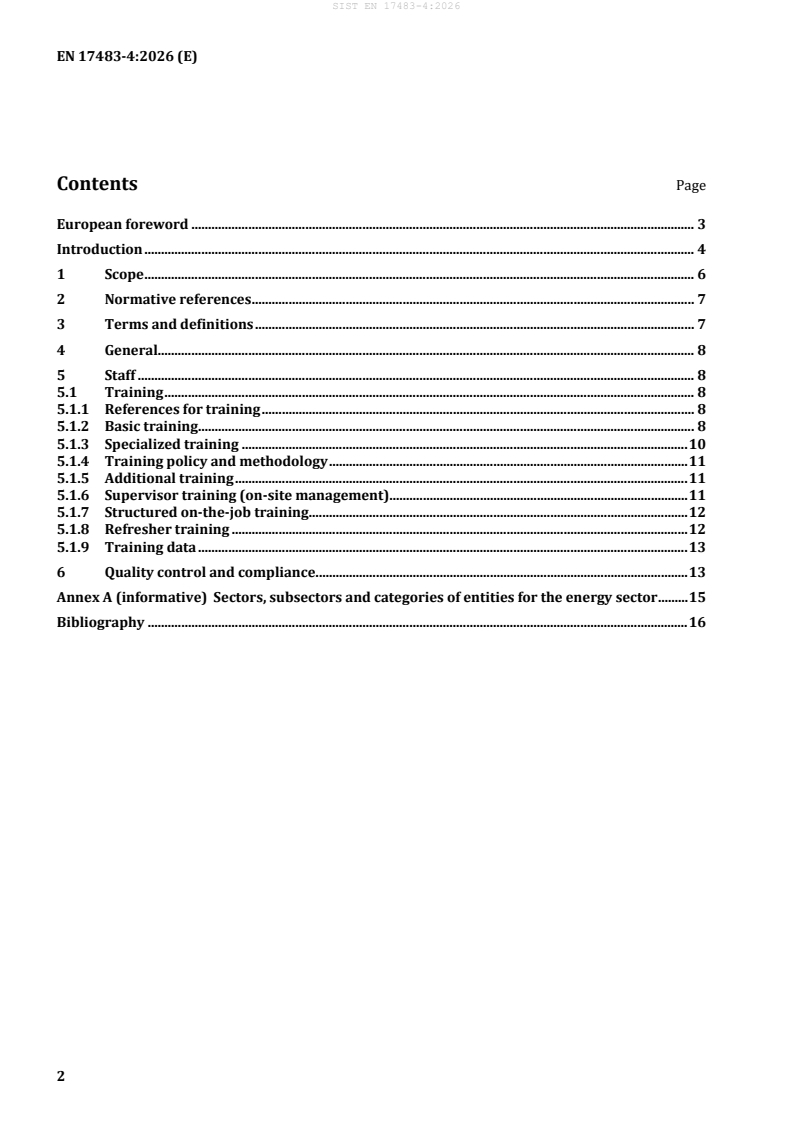
Contents Page
European foreword . 3
Introduction . 4
1 Scope . 6
2 Normative references . 7
3 Terms and definitions . 7
4 General. 8
5 Staff . 8
5.1 Training . 8
5.1.1 References for training . 8
5.1.2 Basic training. 8
5.1.3 Specialized training . 10
5.1.4 Training policy and methodology . 11
5.1.5 Additional training . 11
5.1.6 Supervisor training (on-site management) . 11
5.1.7 Structured on-the-job training . 12
5.1.8 Refresher training . 12
5.1.9 Training data . 13
6 Quality control and compliance . 13
Annex A (informative) Sectors, subsectors and categories of entities for the energy sector . 15
Bibliography . 16
European foreword
This document (EN 17483-4:2026) has been prepared by Technical Committee CEN/TC 439 “Private
security services”, the secretariat of which is held by DIN.
This European Standard shall be given the status of a national standard, either by publication of an
identical text or by endorsement, at the latest by October 2026, and conflicting national standards shall
be withdrawn at the latest by October 2026.
Attention is drawn to the possibility that some of the elements of this document may be the subject of
patent rights. CEN shall not be held responsible for identifying any or all such patent rights.
The EN 17483 series, under the general title Private security services — Protection of Critical
Infrastructure, is composed of the following parts:
— Part 1: General requirements;
— Part 2: Airport and aviation security services;
— Part 3: Maritime and port security services;
— Part 4: Energy sector security services.
Any feedback and questions on this document should be directed to the users’ national standards body.
A complete listing of these bodies can be found on the CEN website.
According to the CEN-CENELEC Internal Regulations, the national standards organisations of the
following countries are bound to implement this European Standard: Austria, Belgium, Bulgaria, Croatia,
Cyprus, Czech Republic, Denmark, Estonia, Finland, France, Germany, Greece, Hungary, Iceland, Ireland,
Italy, Latvia, Lithuania, Luxembourg, Malta, Netherlands, Norway, Poland, Portugal, Republic of North
Macedonia, Romania, Serbia, Slovakia, Slovenia, Spain, Sweden, Switzerland, Türkiye and the United
Kingdom.
Introduction
The objective of this document is to set minimum criteria for the provision of energy sector security
services as part of both national and international critical infrastructure.
This document is built on EN 17483-1, which covers the basic and common requirements for all sectors
of critical infrastructure, which meets the need to aim for high quality and harmonized quality criteria
for private security services providers. This, in turn, contributes to good functioning of society. In
outlining what makes a private security company a worthy provider of such crucial critical infrastructure
as the energy sector, the document aims to contribute to the professionalisation of clients and providers
of private security services.
The series of documents, building on EN 17483-1, which establishes the basic requirements, and all
further upcoming sector specific documents of the EN 17483 series (including this document) follows a
transparent structure as shown below (see Figure 1).
Figure 1 — Structure for sector-specific standards
The final goal is to create the necessary sector specific documents for every suitable and applicable sector
within critical infrastructure according to the outlined sectors as of EN 17483-1:2021, Annex A.
These sector-specific standards are necessary to compensate for the lack of, or gaps in, legislation. They
are meant to help certifiers check the compliance with the provisions of the main requirements standards
and the sector-specific ones.
This document incorporates the broad interdisciplinary expertise of various organisations and
individuals involved in standardization and private security services at both national and international
level.
This document is not limited solely to the protection of critical infrastructures in the energy sector;
rather, it adopts a broader and more strategic security approach. Its objective is to ensure the protection
and operational continuity of these infrastructures and the assets owned or managed by critical entities
responsible for providing essential services.
These essential services are directly related to the sectors and subsectors specified in the annex of
Directive (EU) 2022/2557 [1] of the European Parliament and the Council of 14 December 2022 on the
resilience of critical entities. Furthermore, their non-exhaustive list has been approved by the European
Commission through Delegated Regulation (EU) 2023/2450 [2] of 25 July 2023, supplementing Directive
(EU) 2022/2557.
1 Scope
This document gives the sector specific requirements for the provision of private security services in the
energy sector that are additional to the requirements of EN 17483-1.
This document specifies service requirements for quality in organization, processes, personnel and
management of a security service provider and/or its independent branches and establishments under
commercial law and trade as a provider with regard to security services in the energy sector.
This document defines quality criteria for the delivery of security services in the energy sector requested
by public and private clients. This document is suitable for the selection, attribution, awarding and
reviewing of the most suitable provider of security services in the energy sector.
NOTE 1 This document is the Part 4 of a series of standards on the provision of private security services for
critical infrastructure. See Figure 2.
Figure 2 — Structure for sector-specific standards
NOTE 2 It is important that the selection of a private security service provider always represents the best balance
between quality and price. This document sets out the minimum requirements that providers are expected to
comply with in order for this balance to be struck.
This document is not applicable to private security services in nuclear power plants.
A list of activities for private security companies (PSC) in critical infrastructure protection (CIP) in the
energy sector comprises:
1. perimeter protection and surveillance;
— human – reception services, static guarding, patrols, dog-handler;
EN 17483-x - refers to possible future sector specific standards.
— technology – CCTV, unmanned vehicles (air/ground/sea); others;
— operation of a control/monitoring room;
— operation of an alarm monitoring centre;
— access control and management (turnstiles, barriers, authorization and badges).
2. human and technology, e.g. use of screening and detection equipment for:
— vehicles;
— goods;
— visitors;
— staff;
— contractors;
3. site security and mobile patrolling/ static guarding activities required to secure a specific
facility/area and mobile patrolling on-site and in buildings within the site;
4. emergency response;
— alarm response;
— first aid response.
2 Normative references
The following documents are referred to in the text in such a way that some or all of their content
constitutes requirements of this document. For dated references, only the edition cited applies. For
undated references, the latest edition of the referenced document (including any amendments) applies.
EN 15602, Private security services — Terminology
EN 17483-1:2021, Private security services — Protection of critical infrastructure — Part 1: General
requirements
3 Terms and definitions
For the purposes of this document, the terms and definitions given in EN 15602 apply.
ISO and IEC maintain terminology databases for use in standardization at the following addresses:
— ISO Online browsing platform: available at https://www.iso.org/obp/
— IEC Electropedia: available at https://www.electropedia.org/
4 General
The relevant subsectors within the energy sector are referred to within Annex A.
The provider shall demonstrate their ability to support the client's processes in order to ensure
appropriate and proportionate technical, personnel and organisational measures to ensure the client's
security and resilience by providing adequate proof, e.g. documentation of comparable projects,
operating procedures, training plans.
The client’s processes shall be based on the client's risk assessment, including measures necessary to:
a) prevent incidents from occurring, considering disaster risk reduction and climate adaptation
measures;
b) ensure adequate physical protection of their premises and critical infrastructure, considering, for
example, fencing, barriers, perimeter monitoring tools and routines, detection equipment and access
controls;
c) respond to, resist and mitigate the consequences of incidents, considering the implementation of risk
and crisis management procedures and protocols and alert routines;
d) recover from incidents, considering business continuity measures, in order to resume the provision
of the client's essential service;
e) ensure adequate employee security management, considering measures such as setting out
categories of personnel who exercise critical functions, establishing access rights to
...