

SIST EN 13035-11:2007+A1:2010
(Main)Machines and plants for the manufacture, treatment and processing of flat glass - Safety requirements - Part 11: Drilling machines
General Information
- Abstract
This European Standard contains the requirements for stationary machines for the drilling of flat glass, using a powered rotating tool. Stationary machines are classified into:
a) manual;
b) semi-automatic;
c) automatic single-head or multi-head;
d) fully automatic.
1.2 This European Standard deals with the significant hazards, hazardous situations and events relevant to drilling machines for flat glass when they are used as intended and under the conditions of misuse which are reasonably foreseeable by the manufacturer (see Clause 4). This European Standard specifies the appropriate technical measures to eliminate or reduce risks arising from the significant hazards during commissioning, the operation and maintenance. Safety requirements and/or protective measures are given in Clause 5. When references are made to B level standards such as EN 953, EN 983, EN 999, EN 1037,
EN 1088, EN 60204-1, EN ISO 13850 and EN ISO 13857, the manufacturer should carry out an adequate risk assessment for the requirements thereof where choice is necessary.
1.3 This European Standard does not address the safety requirements for conveyor belts, rollers (see EN 619) or other means of transporting the glass to and from the drilling machine (see e.g. EN 13035-5).
1.4 This European Standard is not applicable to drilling machines which are manufactured before the date of publication of this European Standard by CEN.
- Status
- Published
- Publication Date
- 06-Apr-2010
- Technical Committee
- I13 - Imaginarni 13
- Current Stage
- 6060 - National Implementation/Publication (Adopted Project)
- Start Date
- 15-Mar-2010
- Due Date
- 20-May-2010
- Completion Date
- 07-Apr-2010
- Directive
- 2006/42/EC - Directive 2006/42/EC of the European Parliament and of the Council of 17 May 2006 on machinery, and amending Directive 95/16/EC (recast)OJ Ref: C 136, TIP C,7.9.2026 UMIK 20.1.2027 OJ Date: 26-May-2010 Conflicting Date: 20-Jan-2027

Overview
EN 13035-11:2006+A1:2010 is the CEN Type C European standard specifying safety requirements for stationary drilling machines used on flat glass. It covers machines that drill glass with a powered rotating tool and classifies them as manual, semi‑automatic, automatic (single- or multi‑head) or fully automatic. The standard addresses significant hazards during commissioning, operation and maintenance and defines technical measures to eliminate or reduce risks for intended use and reasonably foreseeable misuse.
Key topics and technical requirements
- Scope and machine types: Applies only to stationary drilling machines for flat glass manufactured after the standard’s publication; excludes conveyors and glass transport (see EN 13035‑5).
- Hazard identification: Lists significant hazards such as crushing, cutting, entanglement, drawing‑in/trapping, impact, ejected objects/fluids, electrical contact, harmful coolants, biological contamination, noise, laser devices and unexpected restarts.
- Safeguarding and guards: Requires fixed and movable guards per EN 953. Transparent panels must be laminated glass, polyacrylic or polycarbonate. Annex A gives an example of a movable interlocking guard.
- Clamping and control: Manual clamping must use a two‑stage operation limiting closing force (first stage ≤ 150 N) and prevent full pressure unless clamp is in contact with glass. Related safety control parts must meet specified performance levels (EN ISO 13849‑1).
- Electrical and IP protection: Electrical equipment to EN 60204‑1; power circuit enclosures minimum IP54, or IP65 where fluids/dust risk exists (EN 60529).
- Emergency stop and control reliability: Emergency‑stop actuators required at operator stations (EN ISO 13850); stop categories and performance levels are specified (see EN 60204‑1, EN ISO 13849‑1).
- Coolants, lasers and noise: Splash guards for coolants; laser centring devices to EN 60825‑1; noise measurement/test provisions included (Annex B) and acoustics standards referenced.
- Information for use and risk assessment: Manufacturers must supply operating information and perform adequate risk assessments, especially where B‑level standards offer options.
Applications and users
- Who uses it: Machine designers, manufacturers, safety engineers, CE conformity assessors, plant managers and installers in the flat glass and glazing industries.
- Practical use: Use EN 13035‑11 to design and verify safe drilling machines, prepare risk assessments, write machine instructions, select guards, specify control systems, and demonstrate conformity with EU machinery directives (see Annexes ZA/ZB).
Related standards (normative/reference)
- EN ISO 12100‑1/2, EN 60204‑1, EN 953, EN 1088, EN ISO 13849‑1, EN ISO 13850, EN ISO 13857, EN 60825‑1, EN ISO 4871 and acoustics standards (EN ISO 3744/3746/11201 etc.).
These referenced standards should be consulted where EN 13035‑11 refers to B‑level requirements or specific measurement/test codes.
Relations
- Effective Date
- 09-Feb-2026
- Effective Date
- 09-Feb-2026
- Effective Date
- 28-Jan-2026
- Effective Date
- 28-Jan-2026
- Effective Date
- 28-Jan-2026
- Effective Date
- 28-Jan-2026
- Effective Date
- 28-Jan-2026
- Effective Date
- 28-Jan-2026
- Effective Date
- 28-Jan-2026
- Effective Date
- 28-Jan-2026
- Effective Date
- 28-Jan-2026
- Effective Date
- 28-Jan-2026
- Effective Date
- 28-Jan-2026
- Effective Date
- 28-Jan-2026
- Effective Date
- 28-Jan-2026
Get Certified
Connect with accredited certification bodies for this standard

DVS-ZERT GmbH
German welding certification society.
CARES (UK Certification Authority for Reinforcing Steels)
UK certification for reinforcing steels and construction.
EWF/IIW (European/International Welding Federation)
International welding personnel certification.
Sponsored listings
Frequently Asked Questions
SIST EN 13035-11:2007+A1:2010 is a standard published by the Slovenian Institute for Standardization (SIST). Its full title is "Machines and plants for the manufacture, treatment and processing of flat glass - Safety requirements - Part 11: Drilling machines". This standard covers: This European Standard contains the requirements for stationary machines for the drilling of flat glass, using a powered rotating tool. Stationary machines are classified into: a) manual; b) semi-automatic; c) automatic single-head or multi-head; d) fully automatic. 1.2 This European Standard deals with the significant hazards, hazardous situations and events relevant to drilling machines for flat glass when they are used as intended and under the conditions of misuse which are reasonably foreseeable by the manufacturer (see Clause 4). This European Standard specifies the appropriate technical measures to eliminate or reduce risks arising from the significant hazards during commissioning, the operation and maintenance. Safety requirements and/or protective measures are given in Clause 5. When references are made to B level standards such as EN 953, EN 983, EN 999, EN 1037, EN 1088, EN 60204-1, EN ISO 13850 and EN ISO 13857, the manufacturer should carry out an adequate risk assessment for the requirements thereof where choice is necessary. 1.3 This European Standard does not address the safety requirements for conveyor belts, rollers (see EN 619) or other means of transporting the glass to and from the drilling machine (see e.g. EN 13035-5). 1.4 This European Standard is not applicable to drilling machines which are manufactured before the date of publication of this European Standard by CEN.
This European Standard contains the requirements for stationary machines for the drilling of flat glass, using a powered rotating tool. Stationary machines are classified into: a) manual; b) semi-automatic; c) automatic single-head or multi-head; d) fully automatic. 1.2 This European Standard deals with the significant hazards, hazardous situations and events relevant to drilling machines for flat glass when they are used as intended and under the conditions of misuse which are reasonably foreseeable by the manufacturer (see Clause 4). This European Standard specifies the appropriate technical measures to eliminate or reduce risks arising from the significant hazards during commissioning, the operation and maintenance. Safety requirements and/or protective measures are given in Clause 5. When references are made to B level standards such as EN 953, EN 983, EN 999, EN 1037, EN 1088, EN 60204-1, EN ISO 13850 and EN ISO 13857, the manufacturer should carry out an adequate risk assessment for the requirements thereof where choice is necessary. 1.3 This European Standard does not address the safety requirements for conveyor belts, rollers (see EN 619) or other means of transporting the glass to and from the drilling machine (see e.g. EN 13035-5). 1.4 This European Standard is not applicable to drilling machines which are manufactured before the date of publication of this European Standard by CEN.
SIST EN 13035-11:2007+A1:2010 is classified under the following ICS (International Classification for Standards) categories: 25.080.40 - Drilling machines; 81.100 - Equipment for the glass and ceramics industries. The ICS classification helps identify the subject area and facilitates finding related standards.
SIST EN 13035-11:2007+A1:2010 has the following relationships with other standards: It is inter standard links to SIST EN 61310-1:2008, SIST EN 60825-1:1999, SIST EN 983:1998, SIST EN ISO 4871:2009, SIST EN 953:2000, SIST EN 1088:2000, SIST EN ISO 3744:2009, SIST EN ISO 11201:2009, SIST EN 2286:2001, SIST EN ISO 3746:2009, SIST EN ISO 11688-1:2009, SIST EN ISO 13850:2008, SIST EN ISO 13849-1:2008, SIST EN ISO 3747:2009, SIST EN ISO 11204:2009. Understanding these relationships helps ensure you are using the most current and applicable version of the standard.
SIST EN 13035-11:2007+A1:2010 is associated with the following European legislation: EU Directives/Regulations: 2006/42/EC, 98/37/EC, EUR-PUB; Standardization Mandates: M/396. When a standard is cited in the Official Journal of the European Union, products manufactured in conformity with it benefit from a presumption of conformity with the essential requirements of the corresponding EU directive or regulation.
SIST EN 13035-11:2007+A1:2010 is available in PDF format for immediate download after purchase. The document can be added to your cart and obtained through the secure checkout process. Digital delivery ensures instant access to the complete standard document.
Standards Content (Sample)
2003-01.Slovenski inštitut za standardizacijo. Razmnoževanje celote ali delov tega standarda ni dovoljeno.Stroji in obrati za proizvodnjo, obdelavo in predelavo ravnega stekla - Varnostne zahteve - 11. del: Vrtalni strojiMaschinen und Anlagen zur Herstellung, Be- und Verarbeitung von Flachglas - Sicherheitsanforderungen - Teil 11: BohrmaschinenMachines et installations pour la production, le façonnage et la transformation du verre plat - Exigences de sécurité - Partie 11 : Machines de perçageMachines and plants for the manufacture, treatment and processing of flat glass - Safety requirements - Part 11: Drilling machines81.100Equipment for the glass and ceramics industries25.080.40VrtalnikiDrilling machinesICS:Ta slovenski standard je istoveten z:EN 13035-11:2006+A1:2010SIST EN 13035-11:2007+A1:2010en,fr01-maj-2010SIST EN 13035-11:2007+A1:2010SLOVENSKI
STANDARD
EUROPEAN STANDARD NORME EUROPÉENNE EUROPÄISCHE NORM
EN 13035-11:2006+A1
March 2010 ICS 81.100 Supersedes EN 13035-11:2006English Version
Machines and plants for the manufacture, treatment and processing of flat glass - Safety requirements - Part 11: Drilling machines
Machines et installations pour la production, le façonnage et la transformation du verre plat - Exigences de sécurité - Partie 11: Machines de perçage
Maschinen und Anlagen zur Herstellung, Be- und Verarbeitung von Flachglas - Sicherheitsanforderungen - Teil 11: Bohrmaschinen This European Standard was approved by CEN on 24 May 2006 and includes Amendment 1 approved by CEN on 24 January 2010.
CEN members are bound to comply with the CEN/CENELEC Internal Regulations which stipulate the conditions for giving this European Standard the status of a national standard without any alteration. Up-to-date lists and bibliographical references concerning such national standards may be obtained on application to the CEN Management Centre or to any CEN member.
This European Standard exists in three official versions (English, French, German). A version in any other language made by translation under the responsibility of a CEN member into its own language and notified to the CEN Management Centre has the same status as the official versions.
CEN members are the national standards bodies of Austria, Belgium, Bulgaria, Croatia, Cyprus, Czech Republic, Denmark, Estonia, Finland, France, Germany, Greece, Hungary, Iceland, Ireland, Italy, Latvia, Lithuania, Luxembourg, Malta, Netherlands, Norway, Poland, Portugal, Romania, Slovakia, Slovenia, Spain, Sweden, Switzerland and United Kingdom.
EUROPEAN COMMITTEE FOR STANDARDIZATION
COMITÉ EUROPÉEN DE NORMALISATION EUROPÄISCHES KOMITEE FÜR NORMUNG
Management Centre:
Avenue Marnix 17,
B-1000 Brussels © 2010 CEN All rights of exploitation in any form and by any means reserved worldwide for CEN national Members. Ref. No. EN 13035-11:2006+A1:2010: ESIST EN 13035-11:2007+A1:2010
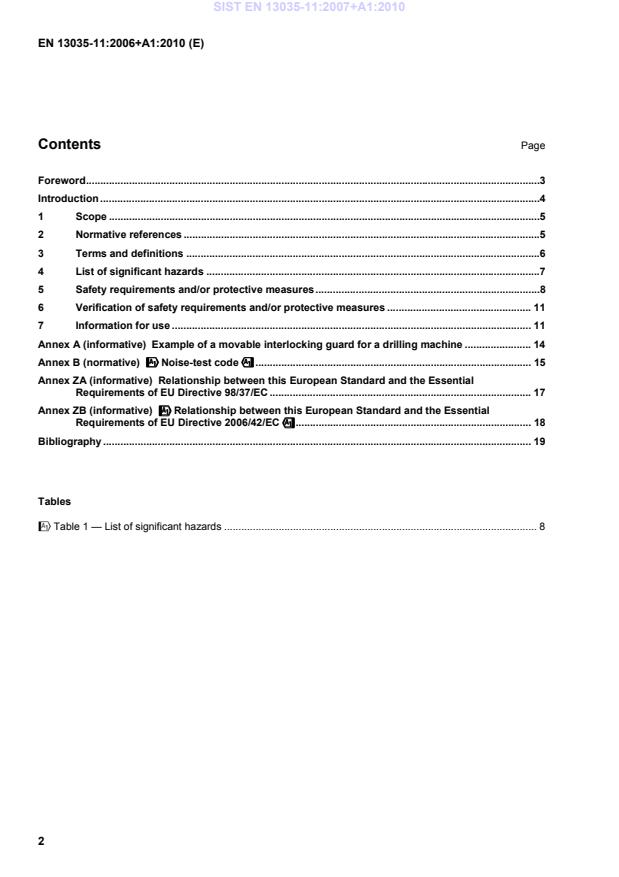
Example of a movable interlocking guard for a drilling machine . 14Annex B (normative)
!!!!Noise-test code"""" . 15Annex ZA (informative)
Relationship between this European Standard and the Essential Requirements of EU Directive 98/37/EC . 17Annex ZB (informative)
!!!!Relationship between this European Standard and the Essential
Requirements of EU Directive 2006/42/EC"""" . 18Bibliography . 19
Tables !Table 1 — List of significant hazards . 8 SIST EN 13035-11:2007+A1:2010
1 Scope 1.1 This European Standard contains the requirements for stationary machines for the drilling of flat glass, using a powered rotating tool. Stationary machines are classified into: a) manual; b) semi-automatic; c) automatic single-head or multi-head; d) fully automatic. 1.2 !This European Standard deals with the significant hazards, hazardous situations and events rele-vant to drilling machines for flat glass when they are used as intended and under the conditions of misuse which are reasonably foreseeable by the manufacturer (see Clause 4)." This European Standard specifies the appropriate technical measures to eliminate or reduce risks arising from the significant hazards during commissioning, the operation and maintenance. !Safety requirements and/or protective measures are given in Clause 5. When references are made to B level standards such as EN 953, EN 983, EN 999, EN 1037,
EN 1088, EN 60204-1, EN ISO 13850 and EN ISO 13857, the manufacturer should carry out an adequate risk assessment for the requirements thereof where choice is necessary." 1.3 This European Standard does not address the safety requirements for conveyor belts, rollers (see EN 619) or other means of transporting the glass to and from the drilling machine (see e.g. EN 13035-5). 1.4 This European Standard is not applicable to drilling machines which are manufactured before the date of publication of this European Standard by CEN. 2 Normative references The following referenced documents are indispensable for the application of this document. For dated refer-ences, only the edition cited applies. For undated references, the latest edition of the referenced document (including any amendments) applies. !deleted text" EN 953:1997, Safety of machinery — Guards — General requirements for the design and construction of fixed and movable guards !deleted text" EN 983:1996, Safety of machinery — Safety requirements for fluid power systems and their components — Pneumatics !deleted text" EN 1088:1995, Safety of machinery — Interlocking devices associated with guards — Principles for design and selection !EN 60204-1:2006, Safety of machinery — Electrical equipment of machines — Part 1: General require-ments (IEC 60204-1:2005, modified)" EN 60825-1:1994, Safety of laser products — Part 1: Equipment classification, requirements and user's guide (IEC 60825-1:1993) SIST EN 13035-11:2007+A1:2010
machining operations are under the control and guidance of the operator.
NOTE During the machining operations, the operator does not come into contact with the workpiece 3.3 automatic machine machine where the workpiece is loaded and unloaded by the operator, but all the intermediate machining
operations are carried out without operator intervention 3.4 fully automatic machine machine where the workpiece is presented to and removed from the tools automatically and all the intermedi-ate machining operations are carried out without intervention of the operator 4 List of significant hazards This clause contains the significant hazards, hazardous situations and events, as far as they are dealt with in this European Standard, identified by risk assessment as significant for drilling machines and which require action to eliminate or reduce the risk. !deleted text" SIST EN 13035-11:2007+A1:2010
Danger zone/dangerous items Preventive
measures: see clause 4.1 crushing during down stroke of the clamp 5.4; 5.7; 7.3.8 4.2 cutting or severing during drilling operation 5.4; 5.7 4.3 entanglement during drilling and glass positioning opera-tions 5.4; 5.7 4.4 drawing-in or trapping during drilling and glass positioning opera-tions 5.4; 5.7 4.5 impact during down stroke of the clamp 5.4; 5.7; 7.3.8 4.6 friction or abrasion during drilling operation 5.4; 5.7 4.7 electrical direct or indirect contact 5.5; 5.8; 5.9; 7.3.5 4.8 resulting from contact with or inha-lation of harmful fluids, gases, mists, fumes and dusts coolants 5.2; 7.3.6 4.9 biological and micro-biological (vi-ral or bacterial) coolants 5.2; 7.3.6 4.10 neglected use of personal protec-tion equipment all operational phases of the machine 5.8; 7.3.3 4.11 impossibility of stopping in the best possible conditions during operation of the machine 5.6 4.12 ejected objects or fluids during drilling operation 5.2; 5.4 4.13 unexpected start-up by restoration of energy supply after interruption, errors made by the operator all dangerous movements 5.8; 5.9 4.14 hazards by noise may result in hearing damage, tinnitus, stress, in accidents due to interference with speech communication and with the perception of acoustic signals during drilling operation 5.10; 7.3.2 4.15 lasers laser centring device 5.3; 7.2.1; 7.3.7" 5 Safety requirements and/or protective measures 5.1 General Machinery shall comply with the safety requirements and/or protective measures of this clause. In addition, the machine shall be designed according to the principles of EN ISO 12100 for hazards relevant but not significant which are not dealt with by European Standard (e.g. sharp edges). !deleted text" Where the means of reducing the risk is by the arrangement of the installed machine or by a safe system of work, the manufacturer shall include in the information for use a reference to the reduction means to be
provided, and to any limiting value of the requirement and, if appropriate, to the means of verification. SIST EN 13035-11:2007+A1:2010
...