


SIST EN 14932:2025
(Main)Plastics - Thermoplastic stretch films for wrapping silage bales
Plastics - Thermoplastic stretch films for wrapping silage bales
This document specifies the requirements for dimensional, mechanical, oxygen transmission rate and optical characteristics of thermoplastic stretch films for wrapping bales used for ensiling of forage. It specifies a measurement for solar reflectance of the films.
This document specifies also test methods to check these requirements.
This document is applicable to white, black, or coloured films based on polyethylene materials. It covers the width range from 250 mm up to 1 500 mm.
The performances of the stretch films in conformance with this document are based on the use of at least six layers of films, pre-stretched at a ratio between 60 % and 70 % for round bales and a ratio of 55 % and 65 % for wrapping square bales.
This document also gives guidance for design for recycling.
Kunststoffe - Thermoplastische Stretchfolien zum Umwickeln von Silage-Ballen
Dieses Dokument legt die Anforderungen an Maße, mechanische Eigenschaften, Sauerstoffdurchlässigkeitsrate und optische Eigenschaften von thermoplastischen Stretchfolien zum Umwickeln von Ballen, in denen Futtermittel siliert wird, fest. Es legt eine Messung für den Solarreflexionsgrad der Folien fest.
Dieses Dokument legt außerdem Prüfverfahren zur Überprüfung dieser Anforderungen fest.
Dieses Dokument ist für weiße, schwarze und farbige Folien, die aus Polyethylenwerkstoffen bestehen, anwendbar. Es umfasst den Breitenbereich von 250 mm bis zu 1 500 mm.
Die Funktionen von Stretchfolien in Übereinstimmung mit diesem Dokument basieren auf der Nutzung von mindestens sechs Folienlagen, vorgedehnt auf ein Verhältnis von 60 % bis 70 % für Rundballen sowie 55 % bis 65 % zum Umwickeln von Quaderballen.
Zudem enthält dieses Dokument eine Anleitung zur recyclinggerechten Gestaltung.
Plastiques - Films thermoplastiques étirables pour l'enrubannage de balles d'ensilage
Le présent document spécifie les exigences relatives aux caractéristiques dimensionnelles, mécaniques, au coefficient de transmission de l’oxygène et aux caractéristiques optiques des films thermoplastiques étirables utilisés pour enrubanner les balles pour l’ensilage du fourrage. Il spécifie un mesurage du facteur de réflexion solaire des films.
Le présent document spécifie également des méthodes d’essai permettant de vérifier ces exigences.
Le présent document est applicable aux films blancs, noirs ou colorés, à base de polyéthylène. Il couvre une plage de largeur allant de 250 mm à 1 500 mm.
Les performances des films étirables en conformité avec le présent document reposent sur l’utilisation d’au moins six couches de film, pré-étiré à un taux d’étirage compris entre 60 % et 70 % pour les balles rondes et entre 55 % et 65 % pour les balles carrées.
Le présent document donne également des recommandations pour la conception en vue du recyclage.
Polimerni materiali - Raztegljive plastomerne folije za zavijanje v bale
Ta dokument določa zahteve za dimenzijske, mehanske in optične lastnosti ter zahteve glede stopnje prenosa kisika raztegljivih plastomernih folij za zavijanje v bale, ki se uporabljajo za silažo ali krmo. Določa merjenje folij na podlagi njihove solarne odsevnosti. Ta dokument določa tudi preskusne metode za preverjanje teh zahtev. Ta dokument se uporablja za bele, črne ali barvne folije na osnovi polietilenskih materialov. Zajema širine v razponu od 250 mm do 1500 mm. Učinkovitost raztegljivih folij, skladna s tem dokumentom, temelji na uporabi najmanj šest plasti folij, ki so predhodno raztegnjene med 60 % in 70 % za okrogle bale ter med 55 % in 65 % za ovijanje kvadratnih bal. Ta dokument podaja tudi smernice glede zasnove za recikliranje.
General Information
- Status
- Published
- Public Enquiry End Date
- 15-Oct-2024
- Publication Date
- 19-Aug-2025
- Technical Committee
- IPMA - Polimer materials and products
- Current Stage
- 6060 - National Implementation/Publication (Adopted Project)
- Start Date
- 31-Jul-2025
- Due Date
- 05-Oct-2025
- Completion Date
- 20-Aug-2025
Relations
- Effective Date
- 24-Jan-2023
Overview
EN 14932:2025 - Plastics: Thermoplastic stretch films for wrapping silage bales - specifies the performance and test requirements for silage stretch films used in forage ensiling. The standard covers dimensional, mechanical, oxygen transmission and optical characteristics, including a defined measurement method for solar reflectance. It applies to white, black or coloured polyethylene-based films with widths from 250 mm to 1 500 mm, and defines performance based on use of at least six layers of film pre-stretched (60–70% for round bales; 55–65% for square bales). EN 14932:2025 also provides guidance on design for recycling and references handling/removal guidance in EN 18109:2025.
Key Topics
- Scope & materials: Applicability to polyethylene thermoplastic stretch films (white/black/coloured) and width range 250–1 500 mm.
- Performance basis: Requirements assume multi-layer wrapping and specified pre-stretch ratios for round and square bales.
- Dimensional & mechanical requirements: Thickness, width, film length, core protrusion, neck‑in, tensile characteristics, tear and impact resistance, and tightening force.
- Barrier & optical properties: Measurement of oxygen transmission rate (OTR) to assess gas-tightness and a normative method for solar reflectance (to evaluate bale temperature effects due to color/pigmentation).
- Durability & weathering: Tests for resistance to artificial weathering and guidance on correlating lab exposure to natural conditions.
- Test methods: Normative test methods for thickness, width, neck-in, tensile tests, impact (dart) tests, Elmendorf tear, luminous transmittance, OTR (equal-pressure), and solar reflectance.
- Design for recycling: Criteria and guidance to support recyclability under current removal, sorting, collection and recycling practices.
- Marking, installation & removal: Requirements for film marking, packaging labels, installation/use instructions and removal/collection recommendations.
Applications and Who Uses It
EN 14932:2025 is intended for:
- Film manufacturers - to design and declare compliant silage stretch films.
- Quality control & test laboratories - to perform standardized tests (thickness, OTR, mechanical, solar reflectance).
- Agricultural machinery producers - to ensure compatibility with wrapping equipment and required pre-stretch ratios.
- Farmers and contractors - to select films that provide airtightness, durability and suitable thermal behavior for silage conservation.
- Recyclers and product designers - to implement design-for-recycling elements and end‑of‑life sorting guidance.
- Specifiers and regulators - for procurement, certification and regulatory compliance.
Related Standards
Key normative references include:
- EN 18109:2025 (agricultural plastic products - installation, use, removal, sorting, collection, recycling)
- EN ISO 527-1 / EN ISO 527-3 (tensile properties)
- ISO 15105-2 (gas transmission - equal-pressure method)
- EN ISO 4892-2 (xenon-arc weathering)
- ISO 9845-1 (solar spectral irradiance)
Keywords: EN 14932:2025, silage stretch films, thermoplastic stretch films, solar reflectance, oxygen transmission rate, polyethylene, design for recycling, silage bale wrapping, test methods.

Frequently Asked Questions
SIST EN 14932:2025 is a standard published by the Slovenian Institute for Standardization (SIST). Its full title is "Plastics - Thermoplastic stretch films for wrapping silage bales". This standard covers: This document specifies the requirements for dimensional, mechanical, oxygen transmission rate and optical characteristics of thermoplastic stretch films for wrapping bales used for ensiling of forage. It specifies a measurement for solar reflectance of the films. This document specifies also test methods to check these requirements. This document is applicable to white, black, or coloured films based on polyethylene materials. It covers the width range from 250 mm up to 1 500 mm. The performances of the stretch films in conformance with this document are based on the use of at least six layers of films, pre-stretched at a ratio between 60 % and 70 % for round bales and a ratio of 55 % and 65 % for wrapping square bales. This document also gives guidance for design for recycling.
This document specifies the requirements for dimensional, mechanical, oxygen transmission rate and optical characteristics of thermoplastic stretch films for wrapping bales used for ensiling of forage. It specifies a measurement for solar reflectance of the films. This document specifies also test methods to check these requirements. This document is applicable to white, black, or coloured films based on polyethylene materials. It covers the width range from 250 mm up to 1 500 mm. The performances of the stretch films in conformance with this document are based on the use of at least six layers of films, pre-stretched at a ratio between 60 % and 70 % for round bales and a ratio of 55 % and 65 % for wrapping square bales. This document also gives guidance for design for recycling.
SIST EN 14932:2025 is classified under the following ICS (International Classification for Standards) categories: 53.040 - Continuous handling equipment; 55.040 - Packaging materials and accessories; 83.140.10 - Films and sheets. The ICS classification helps identify the subject area and facilitates finding related standards.
SIST EN 14932:2025 has the following relationships with other standards: It is inter standard links to SIST EN 14932:2018. Understanding these relationships helps ensure you are using the most current and applicable version of the standard.
SIST EN 14932:2025 is associated with the following European legislation: Standardization Mandates: M/584. When a standard is cited in the Official Journal of the European Union, products manufactured in conformity with it benefit from a presumption of conformity with the essential requirements of the corresponding EU directive or regulation.
SIST EN 14932:2025 is available in PDF format for immediate download after purchase. The document can be added to your cart and obtained through the secure checkout process. Digital delivery ensures instant access to the complete standard document.
Standards Content (Sample)
SLOVENSKI STANDARD
01-september-2025
Polimerni materiali - Raztegljive plastomerne folije za zavijanje v bale
Plastics - Thermoplastic stretch films for wrapping silage bales
Kunststoffe - Thermoplastische Stretchfolien zum Umwickeln von Silage-Ballen
Plastiques - Films thermoplastiques étirables pour l'enrubannage de balles d'ensilage
Ta slovenski standard je istoveten z: EN 14932:2025
ICS:
55.040 Materiali in pripomočki za Packaging materials and
pakiranje accessories
83.140.10 Filmi in folije Films and sheets
2003-01.Slovenski inštitut za standardizacijo. Razmnoževanje celote ali delov tega standarda ni dovoljeno.
EN 14932
EUROPEAN STANDARD
NORME EUROPÉENNE
July 2025
EUROPÄISCHE NORM
ICS 55.040; 83.140.10 Supersedes EN 14932:2018
English Version
Plastics - Thermoplastic stretch films for wrapping silage
bales
Plastiques - Films thermoplastiques étirables pour Kunststoffe - Thermoplastische Stretchfolien zum
l'enrubannage de balles d'ensilage Umwickeln von Silage-Ballen
This European Standard was approved by CEN on 16 June 2025.
CEN members are bound to comply with the CEN/CENELEC Internal Regulations which stipulate the conditions for giving this
European Standard the status of a national standard without any alteration. Up-to-date lists and bibliographical references
concerning such national standards may be obtained on application to the CEN-CENELEC Management Centre or to any CEN
member.
This European Standard exists in three official versions (English, French, German). A version in any other language made by
translation under the responsibility of a CEN member into its own language and notified to the CEN-CENELEC Management
Centre has the same status as the official versions.
CEN members are the national standards bodies of Austria, Belgium, Bulgaria, Croatia, Cyprus, Czech Republic, Denmark, Estonia,
Finland, France, Germany, Greece, Hungary, Iceland, Ireland, Italy, Latvia, Lithuania, Luxembourg, Malta, Netherlands, Norway,
Poland, Portugal, Republic of North Macedonia, Romania, Serbia, Slovakia, Slovenia, Spain, Sweden, Switzerland, Türkiye and
United Kingdom.
EUROPEAN COMMITTEE FOR STANDARDIZATION
COMITÉ EUROPÉEN DE NORMALISATION
EUROPÄISCHES KOMITEE FÜR NORMUNG
CEN-CENELEC Management Centre: Rue de la Science 23, B-1040 Brussels
© 2025 CEN All rights of exploitation in any form and by any means reserved Ref. No. EN 14932:2025 E
worldwide for CEN national Members.
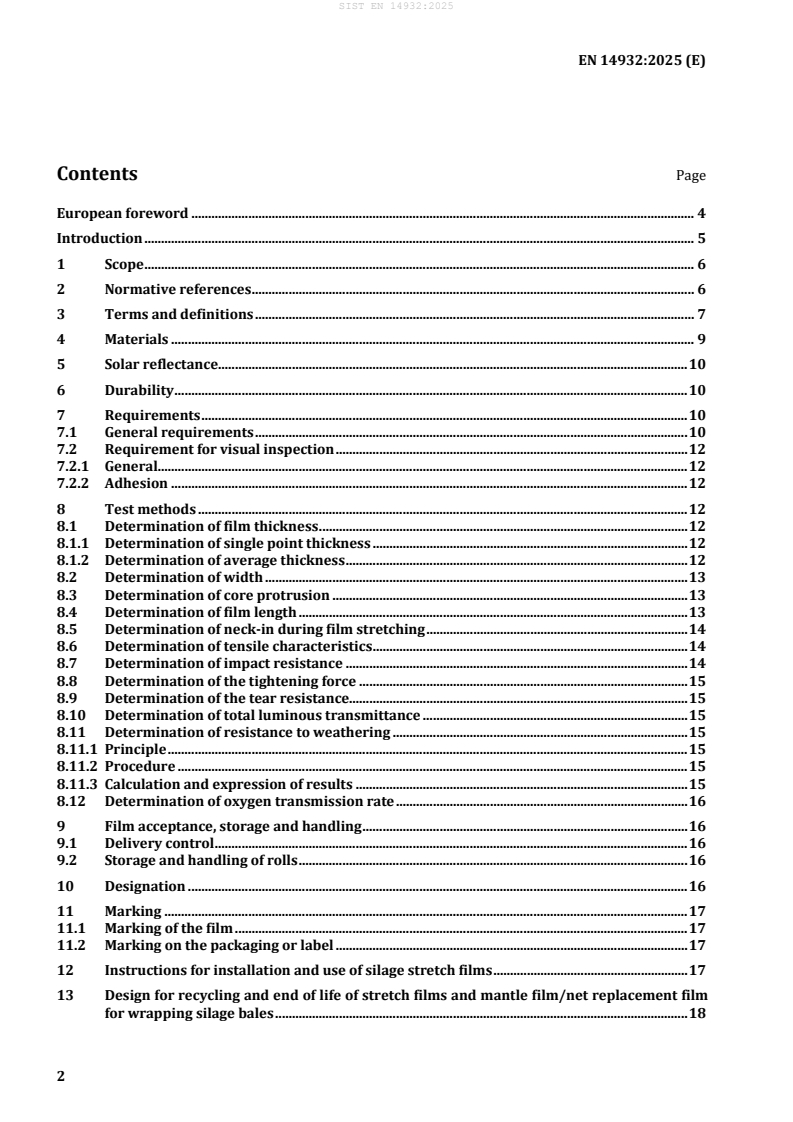
Contents Page
European foreword . 4
Introduction . 5
1 Scope . 6
2 Normative references . 6
3 Terms and definitions . 7
4 Materials . 9
5 Solar reflectance . 10
6 Durability . 10
7 Requirements . 10
7.1 General requirements . 10
7.2 Requirement for visual inspection . 12
7.2.1 General. 12
7.2.2 Adhesion . 12
8 Test methods . 12
8.1 Determination of film thickness . 12
8.1.1 Determination of single point thickness . 12
8.1.2 Determination of average thickness . 12
8.2 Determination of width . 13
8.3 Determination of core protrusion . 13
8.4 Determination of film length . 13
8.5 Determination of neck-in during film stretching . 14
8.6 Determination of tensile characteristics . 14
8.7 Determination of impact resistance . 14
8.8 Determination of the tightening force . 15
8.9 Determination of the tear resistance. 15
8.10 Determination of total luminous transmittance . 15
8.11 Determination of resistance to weathering . 15
8.11.1 Principle . 15
8.11.2 Procedure . 15
8.11.3 Calculation and expression of results . 15
8.12 Determination of oxygen transmission rate . 16
9 Film acceptance, storage and handling . 16
9.1 Delivery control . 16
9.2 Storage and handling of rolls . 16
10 Designation . 16
11 Marking . 17
11.1 Marking of the film . 17
11.2 Marking on the packaging or label . 17
12 Instructions for installation and use of silage stretch films . 17
13 Design for recycling and end of life of stretch films and mantle film/net replacement film
for wrapping silage bales . 18
14 Removal and collection instructions of used silage stretch films . 19
Annex A (informative) Exposure to other light sources . 20
Annex B (informative) Numerical correlation between durations of stretch forage films exposed
to artificial weathering and a natural exposure . 23
Annex C (normative) Determination of solar reflectance . 25
Annex D (normative) Determination of neck-in during stretching . 28
Annex E (normative) Determination of tightening force . 31
Annex F (informative) Determination of adhesion characteristic . 33
Bibliography . 38
European foreword
This document (EN 14932:2025) has been prepared by Technical Committee CEN/TC 249 “Plastics”, the
secretariat of which is held by SIS.
This European Standard shall be given the status of a national standard, either by publication of an
identical text or by endorsement, at the latest by January 2026, and conflicting national standards shall
be withdrawn at the latest by January 2026.
Attention is drawn to the possibility that some of the elements of this document may be the subject of
patent rights. CEN shall not be held responsible for identifying any or all such patent rights.
This document supersedes EN 14932:2018.
— Clause 4 on materials has been extended;
— Clauses 10, 11 and 12 on designation, marking and instructions for installation and use of silage
stretch films, respectively, have been modified;
— Clause 13 on the design-for-recycling and end of life of stretch films for wrapping silage bales has
been added;
— Clause 14 on removal and collection instructions of used silage stretch films has been modified,
referring to EN 18109 for additional information;
— the informative Annex F on the determination of oxygen permeability and airtightness on an artificial
bale, and the informative Annex H on guidance for use and disposal of stretch films, of the previous
edition, have been deleted;
— the informative Annex G on the determination of adhesion characteristic has been modified to
become normative Annex E on the determination of tightening force.
This document has been prepared under a standardization request addressed to CEN by the European
Commission. The Standing Committee of the EFTA States subsequently approves these requests for its
Member States.
Any feedback and questions on this document should be directed to the users’ national standards body.
A complete listing of these bodies can be found on the CEN website.
According to the CEN-CENELEC Internal Regulations, the national standards organisations of the
following countries are bound to implement this European Standard: Austria, Belgium, Bulgaria, Croatia,
Cyprus, Czech Republic, Denmark, Estonia, Finland, France, Germany, Greece, Hungary, Iceland, Ireland,
Italy, Latvia, Lithuania, Luxembourg, Malta, Netherlands, Norway, Poland, Portugal, Republic of North
Macedonia, Romania, Serbia, Slovakia, Slovenia, Spain, Sweden, Switzerland, Türkiye and the United
Kingdom.
Introduction
The biological and practical requirements for silage stretch films and the interactions with the machinery,
used for the wrapping and handling of round bales and square bales, have been considered for the design
of this document. However, it is difficult to simulate in laboratory conditions some parameters like leak
tightness, oxygen permeability, temperature and the manner they interact.
In order to obtain silage of high quality it is essential to reduce unwanted microbiological activities to
very low levels. It is necessary to limit the penetration of oxygen of air inside the bale in order to create
the best conditions for conservation. Consequently, the wrapped bale should be as gas tight as possible.
There are discussions regarding how the temperature inside the bale will influence how different types
of “good” and “bad” microbiological activities will develop in forage. Although the film can be made of any
colour, it is a fact that the pigmentation or colour itself will influence the temperature inside the bale, due
to sun-radiation. Therefore, this document also includes a method for the determination of the solar
reflectance of stretch films [1].
This document defines the criteria for design for recycling of silage stretch films.
End-of-life management is not covered in this document, as it is under the scope of EN 18109:2025 Clause
4 and 5.
1 Scope
This document specifies the requirements for dimensional, mechanical, oxygen transmission rate and
optical characteristics of thermoplastic stretch films for wrapping bales used for ensiling of forage. It
specifies a measurement for solar reflectance of the films.
This document specifies also test methods to check these requirements.
This document is applicable to white, black, or coloured films based on polyethylene materials. It covers
the width range from 250 mm up to 1 500 mm.
The performances of the stretch films in conformance with this document are based on the use of at least
six layers of films, pre-stretched at a ratio between 60 % and 70 % for round bales and a ratio of 55 %
and 65 % for wrapping square bales.
This document also gives guidance for design for recycling.
2 Normative references
The following documents are referred to in the text in such a way that some or all of their content
constitutes requirements of this document. For dated references, only the edition cited applies. For
undated references, the latest edition of the referenced document (including any amendments) applies.
EN 18109:2025, Plastics — Agricultural plastic products — Installation, use, removal, sorting, collection,
preparation for recycling and design for recycling guidelines
EN ISO 527-1, Plastics - Determination of tensile properties - Part 1: General principles (ISO 527-1)
EN ISO 527-3:2018, Plastics - Determination of tensile properties - Part 3: Test conditions for films and
sheets (ISO 527-3:2018)
EN ISO 1133-1, Plastics - Determination of the melt mass-flow rate (MFR) and melt volume-flow rate (MVR)
of thermoplastics - Part 1: Standard method (ISO 1133-1)
EN ISO 4892-2:2013, Plastics - Methods of exposure to laboratory light sources - Part 2: Xenon-arc lamps
(ISO 4892-2)
EN ISO 6383-2, Plastics - Film and sheeting - Determination of tear resistance - Part 2: Elmendorf method
(ISO 6383-2)
EN ISO 7765-1, Plastics film and sheeting - Determination of impact resistance by the free-falling dart
method - Part 1: Staircase methods (ISO 7765-1)
EN ISO 13468-2, Plastics - Determination of the total luminous transmittance of transparent materials -
Part 2: Double-beam instrument (ISO 13468-2)
ISO 4592, Plastics — Film and sheeting — Determination of length and width
ISO 4593, Plastics — Film and sheeting — Determination of thickness by mechanical scanning
ISO 9845-1:2022, Solar energy — Reference solar spectral irradiance at the ground at different receiving
conditions — Part 1: Direct normal and hemispherical solar irradiance for air mass 1,5
ISO 15105-2:2003, Plastics — Film and sheeting — Determination of gas-transmission rate — Part 2:
Equal-pressure method
ISO 22095, Chain of custody — General terminology and models
3 Terms and definitions
For the purposes of this document, the following terms and definitions apply.
ISO and IEC maintain terminology databases for use in standardization at the following addresses:
— ISO Online browsing platform: available at https://www.iso.org/obp/
— IEC Electropedia: available at https://www.electropedia.org/
3.1
width
total film width when laid flat
Note 1 to entry: It is expressed in millimetres, mm.
3.2
nominal width
W
film width, as declared by the manufacturer
Note 1 to entry: It is expressed in millimetres, mm.
3.3
nominal thickness
film thickness, as declared by the manufacturer
Note 1 to entry: It is expressed in micrometres, μm.
3.4
film length
largest dimension of a film corresponding to the length of the unwinded roll (or reel)
Note 1 to entry: It is expressed in metres, m.
3.5
nominal length
length of the film, as declared by the manufacturer
Note 1 to entry: It is expressed in metres, m.
3.6
longitudinal direction
MD
direction parallel to the film length corresponding to the extrusion direction
3.7
transverse direction
TD
direction parallel to the film width, at right angles to the length
3.8
core protrusion
C
p
distance from the edge of a roll to the edge of its core
Note 1 to entry: It is expressed in millimetres, mm.
3.9
neck-in
Ni
shrinkage of a film in the transverse direction (TD) induced by stretching the film in longitudinal direction
(MD)
Note 1 to entry: It is expressed as a percentage, %.
3.10
radiant exposure
H
time integral of irradiance
−2
Note 1 to entry: It is expressed in (J ⋅ m )
[SOURCE: ISO 9370:2017, 3.27]
3.11
mantle film
net replacement film
film which is by materials and process similar to the stretch film for wrapping bales but has the purpose
to hold together the bale instead of a conventional net wrap
3.12
design for recycling
design of product, including the related accessories, in order to ensure its recyclability under the current
practices of removal, sorting, collection and recycling systems
Note 1 to entry: The purpose of the design for recycling criteria is to be able to use the recyclates back in the same
product, independent of producer of material.
[SOURCE: EN 18109:2025, 3.1.13, modified without DFR]
3.13
mechanical recycling
processing of plastic waste into secondary raw materials or products without significantly changing the
chemical structure of the material
Note 1 to entry: Plastic secondary raw material is a synonym of recyclate.
[SOURCE: EN ISO 472:2013, 2.1697, modified — Note 1 to entry changed; “plastics waste” changed to
read “plastic waste”]
3.14
post-consumer plastic
plastic, generated by the end-users of products, that has fulfilled its intended purpose and can no longer
be used for its intended purpose (including plastic returned from within the distribution chain)
Note 1 to entry: The term “post-use” is sometimes used synonymously.
Note 2 to entry: Often abbreviated as PCR.
3.15
pre-consumer plastic
plastic diverted from the manufacturing process stream
Note 1 to entry: Excluded is reutilization of plastic such as rework, regrind or scrap generated in a process and
capable of being reclaimed within the same process that generated it.
3.16
recycled content
proportion, by mass, of recycled plastic in a product or packaging
Note 1 to entry: Only pre-consumer and postconsumer materials shall be considered as recycled content, consistent
with the following usage of terms.
3.17
controlled blending model
chain of custody model in which materials or products with a set of specified characteristics are mixed
according to certain criteria with materials or products without that set of characteristics resulting in a
known proportion of the specified characteristics in the final output
Note 1 to entry: The adhered claim may refer to a certain percentage, at batch-level and /or site-level.
[SOURCE: ISO 22095:2020, 3.3.3]
3.18
national collection scheme
NCS
voluntary or mandatory national collection system of defined plastic fractions used in agriculture or
horticulture applications
3.19
specular
indicates that the flux leaves a surface or medium at an angle that is numerically equal to the angle of
incidence, lies in the same plane as the incident ray and the perpendicular, but is on the opposite side of
the perpendicular to the surface
[SOURCE: ISO 16378:2022, 3.16]
4 Materials
Stretch films for wrapping silage bales and mantle films/net replacement films according to this
document are manufactured from polyethylene, copolymers thereof and additives.
The product shall be suitable for mechanical recycling as a PE fraction, according to the design for
recycling specified in Clause 13.
Recycled content in the film shall be verified with ratio of post-consumer plastic recyclates and/or pre-
consumer plastic recyclates following a controlled blending model according to ISO 22095.
The core, which is a part of the stretch film product, enables winding of the stretch film in production and
wrapping of the bales. The core shall be recyclable and clearly marked for which material fraction to be
sorted.
5 Solar reflectance
The solar reflectance shall be determined according to Annex C by using one layer of unstretched film [2].
The solar reflectance shall be declared by the manufacturer.
6 Durability
The durability of stretch forage films shall be declared by the manufacturer in kLy .
The duration of exposure of the film shall be determined by an artificial weathering using xenon-arc
lamps, conforming to 8.11, which induces a decrease of the value of tensile strain at break equal or less
than 50 % of the initial value.
Other light sources may be used provided that a correlation between the test results obtained with these
light sources and these obtained after a natural exposure can be demonstrated. Details of these methods
are given in Annex A.
NOTE A numerical correlation between durability of stretch films exposed to artificial weathering and natural
exposure is given in Annex B.
7 Requirements
7.1 General requirements
Stretch silage films shall fulfil the requirements given in Table 1. Mantle films/Net replacement films shall
fulfil the requirements given in Table 2.
Table 1 — Requirements for stretch silage films
Test method
Characteristics Unit Requirements
subclause
Shall conform to
Appearance 7.2
7.2
Tolerance of average
% from −8 to 12 8.1
thickness/nominal thickness
Tolerance of single point
a
% from −20 to 28 8.1
thickness/nominal thickness
W0 – 5 ≤ W ≤ W0
Width tolerance mm 8.2
+ 5
Core protrusion mm 3 ≤ C ≤ 10 8.3
p
≥ 99,0 %
Film length m 8.4
of nominal roll
length
1 2
1kLy = 0,04184 GJ/m
Test method
Characteristics Unit Requirements
subclause
Neck in during film stretching % < 25 8.5
Tensile stress at break 8.6
MD MPa ≥ 25
TD MPa ≥ 23
Tensile stress at yield
8.6
MPa ≥ 9
MD
Tensile strain at break 8.6
MD % ≥ 400
TD % ≥ 600
Impact resistance g ≥ 150 8.7
Tightening force N ≥ 8,30 8.8
Tear resistance 8.9
MD cN ≥ 120
TD cN ≥ 600
Total luminous transmittance % < 50 8.10
b
Oxygen transmission rate (expressed
3 2 f
cm /(m⋅24h⋅bar ) 8.12
as for one layer of unstretched film)
c
For film with solar reflectance ≥ 24 % < 10 000
d
For film with solar reflectance ≥ 10 %
< 9 500
and < 24 %
e
For film with solar reflectance < 10 % < 8 500
a
Measurement shall be performed outside of any defects, e.g. gel from recycling material
b 3 2
A commonly used unit for the oxygen gas transmission rate is the cm (STP)/(m ⋅ d) at one atmosphere pressure
3 5
differential, where: 1 cm at standard temperature and pressure (STP = 273,15K; 1,013 × 10 Pa) is 44,62 μmol and one
3 2 3 2
s . The oxygen transmission rate in mol/(m ⋅ s ⋅ Pa) is obtained multiplying the value in cm (STP)/(m
day is 86,4 × 10
−10
⋅ d) by 5,165 × 10 .
c
EXAMPLE: white and light green films
d
EXAMPLE: dark green films
e
EXAMPLE: black films
f 5 2
1 bar = 0,1 MPa = 10 Pa; 1 MPa = 1 N/mm
Table 2 — Requirements for mantle films/Net replacement films
Test
Characteristics Unit Requirements method
subclause
Appearance Shall conform to 7.2 7.2
Tolerance of average thickness/nominal
% from −8 to 12 8.1
thickness
Tolerance of single point thickness/nominal
a
% from −20 to 28 8.1
thickness
Width tolerance mm W - 5 ≤ W ≤ W + 5 8.2
0 0
Core protrusion mm 3 ≤ C ≤ 10 8.3
p
≥ 99,0 %
Film length m 8.4
of nominal roll length
a
Measurement shall be performed outside of any defects, e.g. gel from recycling material.
7.2 Requirement for visual inspection
7.2.1 General
The edges of the reels shall be straight.
Bubbles and wrinkles on the reel and visible defects on the film which affect the proper use of the film
shall be limited.
7.2.2 Adhesion
Adhesion is a major property of stretch films for wrapping silage bales but no specific method has been
developed for this application.
The adhesion may be evaluated by determining the airtightness of a wrapped bale or by expressing the
force needed to separate two film layers. For information, see Annex F and the test methods described in
ASTM D5458 [5].
8 Test methods
8.1 Determination of film thickness
8.1.1 Determination of single point thickness
The film thickness at single point shall be determined in accordance with ISO 4593. The test shall be
performed using one strip of film cut in transverse direction of the roll (TD).
8.1.2 Determination of average thickness
The average film thickness shall be determined by measuring the length and width of the film and by
weighing the roll. The manufacturer shall state the density of the film material. The average film thickness
shall be calculated by using Formula (1).
m
(1)
d= 10
lw××ρ
where
d is the mean thickness of the film, expressed in micrometres (μm);
m is the weight of the film roll, excluding the core, expressed in kilograms (kg) and measured
on a weighing machine with a maximum permissible error of ±0,010 kg or better;
l is the total length of the film (see 8.4), expressed in metres (m);
w is the mean width of the film (see 8.2), measured on the film roll, expressed in metres (m);
ρ is the density of the film as stated by the manufacturer, expressed in kilograms per cubic
metres (kg/m ).
8.2 Determination of width
The width of the film shall be determined in accordance with ISO 4592.
8.3 Determination of core protrusion
The core protrusion of a roll shall be measured on each side of the roll. The two values shall be expressed
in millimetres (mm) recorded and compared with the value in Table 2.
8.4 Determination of film length
The length of the film shall be determined by unwinding the roll by means of a calibrated reel in contact
continuously with its outside surface (see Figure 1). The calibrated reel is connected to a revolution
counter. The diameter of the calibrated reel shall be measured with an accuracy of ±0,2 %. The roll shall
be totally unwound at a speed of 100 m/min ± 10 m/min.
The value of the length of the film is calculated by using Formula (2):
ln=⋅π⋅ d (2)
where
l is the value of the length of the film, expressed in metres (m);
n is the number of revolutions of the calibrated reel during the total unwinding of the roll;
d is the diameter of the calibrated reel, expressed in metres (m).
Key
1 film roll
2 calibrated reel with a revolution counter
3 collection reel
Figure 1 — Apparatus for the determination of the film length
8.5 Determination of neck-in during film stretching
The neck-in during film stretching shall be determined in accordance with Annex D.
The test result, corresponding to the film shrinkage in TD, shall be expressed as a percentage of the
original width by using Formula (3):
WW−
N = 100 (3)
i
W
where
N is the value of neck-in, expressed as a percentage (%);
i
W is the measured width of the unstretched film according to 8.2, expressed in millimetres (mm);
W is the measured width of the stretched film on the bale (D.5.4), expressed in millimetres (mm).
8.6 Determination of tensile characteristics
The tensile characteristics shall be determined according to EN ISO 527-1 and EN ISO 527-3 using five
test specimens type 2, see EN ISO 527-3:2018, Figure 1, 15 mm wide, cut in MD and TD of the film, at a
test speed of 500 mm/min, with an initial grip-to-grip separation of 50 mm.
Calculate the arithmetic average value of the five measurements.
The arithmetic average values shall fulfil the requirements of Table 2, as applicable.
NOTE A possible way to prepare the test specimens is to cut from a stack of 2 or more (max. 10) layers of the
film under investigation and then separate them individually by delaminating in order to limit the risk of creating
micro-fractures in the specimens because stretch films are thin and sticky.
8.7 Determination of impact resistance
The impact resistance shall be determined in accordance with EN ISO 7765-1, Method A. The test shall be
performed in such a manner that the least tacky side of the film is facing up. The value shall fulfil the
requirement of Table 2.
8.8 Determination of the tightening force
The tightening force shall be determined in accordance with Annex E.
8.9 Determination of the tear resistance
The tear resistance shall be determined in accordance with EN ISO 6383-2, on five test specimens cut
from the unstretched film in MD and TD of the film.
Calculate the arithmetic average value of the five measurements, expressed in Newtons (N).
The arithmetic average value shall fulfil the requirements of Table 2, as applicable.
8.10 Determination of total luminous transmittance
The total luminous transmittance shall be determined in accordance with EN ISO 13468-2 by using one
layer of unstretched film. Calculate the arithmetic mean value of five measurements performed on test
specimens cut from the unstretched film.
8.11 Determination of resistance to weathering
8.11.1 Principle
The variation of the tensile strain at break of specimens is determined before and after an exposure to
xenon-arc lamps. Other light sources may be used according to Annex A and Annex B to reduce test time.
NOTE Exposure duration is based on a ring trial on greenhouse films. For more details see EN 13206 [6].
8.11.2 Procedure
Carry out the artificial weathering according to EN ISO 4892-2:2013, Method A, Cycle No.1, using the test
conditions given in Table 3.
Table 3 — Exposure cycles and test conditions
Irradiance
Black-
Chamber Relative
standard
Exposure
Broadband Narrowband
temperature humidity
temperature
conditions
(300 nm to 400 nm) (340 nm)
°C %
°C
2 2
W/m W/(m⋅nm)
102 min dry 60 ± 2 0,51 ± 0,02 65 ± 3 38 ± 3 50 ± 5
18 min water spray 60 ± 2 0,51 ± 0,02 — — —
Expose the specimens according to 8.11.2 for the duration specified by the film manufacturer with a
specimen backing made of preferably not pigmented rigid plastic (e.g. fluorinated polymer) and the tacky
side of the film facing the backing.
After the exposure, determine the tensile strain at break according to EN ISO 527-1 and EN ISO 527-3,
using five type 2 test specimens, see Figure 1 of EN ISO 527-3:2018, 15 mm wide, taken in MD of the film,
at a test speed of 500 mm/min, with an initial grip-to-grip separation of 50 mm.
8.11.3 Calculation and expression of results
Calculate the arithmetic mean value of the five measurements performed on the test specimens cut from
the exposed specimens and the arithmetic mean value of the five measurements performed on the test
specimens cut from the unexposed specimens in MD (see 8.6). Compare these two values.
The test is considered successful when the value calculated for specimens exposed to artificial weathering
is equal or greater than 50 % of the value calculated for unexposed specimens.
8.12 Determination of oxygen transmission rate
The oxygen transmission rate shall be determined in accordance with ISO 15105-2:2003, Annex A.
The test shall be performed by using one layer to a maximum of six layers of unstretched film, at 23 °C ±
2 °C and (from 0 to 5) % RH.
The test result shall be multiplied by the number of film layers used in the test to obtain the oxygen
transmission rate of the film (see Table 2).
9 Film acceptance, storage and handling
9.1 Delivery control
The customer shall carefully examine the rolls at the delivery in order to find any apparent damage or
anomalies. If any defect, it shall take the necessary actions.
Whenever possible, it is recommended to take a photograph of the damage.
9.2 Storage and handling of rolls
The rolls shall be carried, not dragged over the ground or any other surface.
Keep the rolls in their original packaging and store them in a location protected from direct exposure to
sunlight and temperature source and rain.
It is recommended that the rolls be stored in a dry location.
Handling of the rolls should be done carefully so damaging of the film and/or roll edges is avoided.
Damaged film and/or roll edges leads to problems during wrapping such as start-up issues or tearing.
10 Designation
The purpose of designation is to provide the product relevant information for the intended use on the
sales and logistics documents.
The designation shall include the following information:
a) manufacturer's trademark;
b) reference to this document, i.e. EN 14932;
c) nominal width, in millimetres (mm);
d) nominal roll length, in metres (m);
e) nominal thickness, in micrometres (μm);
f) colour;
g) declared value for durability (see Clause 6);
h) declared minimum content of recycled post-consumer plastic (percentage of total mass) when post-
consumer plastic is integrated.
NOTE Content of recycled pre-consumer plastic can also be declared separately
EXAMPLE The designation of a white silage stretch film, in a roll of 750 mm wide, 1 500 m long and 25 µm
thick, with an expected maximum duration of 130 kLy (corresponding to 1 year in south of France) with at least 30
% of post-consumer recycled material (PCR):
TRADEMARK, 750 mm × 25 µm × 1 500 m, white, durability 130 kLy, EN 14932, min. 30 % PCR
External documentary evidence can be requested by the purchaser or interested third parties as
collection schemes for used products.
11 Marking
11.1 Marking of the film
For technical reasons marking on the film is optional.
11.2 Marking on the packaging or label
Marking on the packaging or label shall include at least the following information:
a) manufacturer's trademark;
b) reference to this document, i.e. EN 14932;
c) nominal width, in millimetres (mm);
d) nominal length in metres (m);
e) nominal thickness in micrometres (µm);
f) declared value for durability;
g) declared minimum content of recycled post-consumer plastic (percentage of total mass) when post-
consumer plastic is integrated.
NOTE 1 Content of recycled pre-consumer plastic can also be declared separately
h) manufacturing code, including traceability to define manufacturing date.
Optional information:
i) recovery logo.
NOTE 2 Marking of recyclability is ensured by the reference to this document, i.e. EN 14932.
EXAMPLE The marking of a white silage stretch film, in a roll of 750 mm wide, 1 500 m long and 25 µm thick,
with an expected maximum duration of 130 kLy (corresponding to 1 year in south of France), with at least 30 % of
post-consumer recycled material (PCR) and manufactured by TRADEMARK and manufacturing code:
TRADEMARK, EN 14932 750 mm × 1500 m × 25 µm, white, 130 kLy, min. 30 % PCR, manufacturing code.
12 Instructions for installation and use of silage stretch films
The impact of the installation, removal and preparation for recycling made by the final user on the used
products give to him the specific responsibility to ensure them the most effective end-of-life.
Such responsibility requires appropriate information and training of all the actors of the use of plastic for
agricultural purposes, including manufacturer’s staff, agronomic advisers, retailers and final users is
given in EN 18109 and related certification systems.
For the conditions of installation and use, including durability aspects, the user and distributors shall
follow the instructions of the manufacturer at first. These instructions can be given under paper form
accompanying the film and/or with a QR code or via internet link printed on labels. In the absence of such
instructions, guidance is given in EN 18109:2025, Clause 5.
In order to ensure traceability, the end-user shall keep the labels accompanying films or their packaging
up to end-of-use (silage). Keeping only the pallet label for homogeneous pallet deliveries is acceptable.
13 Design for recycling and end of life of stretch films and mantle film/net
replacement film for wrapping silage bales
The purpose with the design for recycling criteria is to be able to use the recyclates from silage stretch
film and mantle film/net replacement film back in the same product, independent of producer of material.
The design for mechanical recycling criteria for silage stretch film are described in Table 4 below. The
material can be recycled with other processes but criteria’s needs to be specified for e.g. chemical
recycling or physical recycling.
The design for mechanical recycling criteria for related components to silage stretch film is described in
Table 5 below. The material can be recycled with other processes but criteria’s needs to be specified for
e.g. chemical recycling or physical recycling.
It is recommended to use recyclates coming from plastic collected by an NCS dedicated to agriculture.
Table 4 — Guideline design for recycling of stretch films and mantle film/net replacement film
for wrapping silage bales
Full compatibility with PE bale wrap No compatibility with PE bale wrap
recycling recycling
Materials Nonpolar ethylene copolymers and PP, PET; PVC; PS; PA; EVOH; PVA;
homopolymers (PE-LD, PE-LLD, PE-MD, biodegradable, compostable polymers.
PE-HD); polar ethylene copolymers with a
Polar ethylene copolymers with a
comonomer content representing not more
comonomer content representing more
than 5 wt% of comonomer in the structure.
than 5 wt% of comonomer in the structure.
Additives (in Amounts of additives that do not raise the Amounts of additives that raise the density
3 3
film) density of the film to 0,97 g/cm or beyond; of the film to above 0,97 g/cm ;
Functional additives that do not affect the Additives that prevent recyclability, e.g.
recycling of the material; e.g. processing aid pro-degradant additives, vegetable fillers
agents, antioxidants, UV stabilizers or (lignin, starch, cellulose) and inorganic
liquid tackifiers such as PIB materials if load > 10wt%.
(Polyisobutylene).
Uncoated CaCO3.
Pigments (in Colour pigments, carbon black, Titanium Titanium dioxide (Anatase type), metal
film) dioxide (Rutile type only) complex dyes.
Target material A film containing at least 85 wt% PE (sum A film containing less than 85 wt% PE (sum
content of PE-LD, PE-LLD, PE-MD, PE-HD, polar of PE-LD, PE-LLD, PE-MD, PE-HD, polar
ethylene copolymers and the PE-content in ethylene copolymers and the PE-content in
the recycled content, but excluding PIB) the recycled content, but excluding PIB)
and having a melt flow rate (190°C/2,16 and having a melt flow rate (190°C/2,16
a a
kg) below or equal to 2 g/10 min. kg) above 2 g/10 min.
a
This shall be according to EN ISO 1133-1.
As related components the cores of the silage stretch films are seen as parts of the products. In addition,
labels and tapes put on the silage stretch films and/or bales are seen as related components which affect
the recycling stream.
Table 5 — Guideline design for recycling of related components
Allowed Not allowed
Cores Based on materials such as PE, PP, PVC, Non-recyclable materials
a
cardboard
Labels and tapes Labels shall be of the material as the Material different of the product it is
b
– material products (core or silage stretch film) it is attached to.
attached to.
Following the design for recycling
guidelines in Table 4.
Labels and tapes Adhesives that do not unacceptably Any other adhesive
– adhesive influence the recyclates quality
NOTE Regarding specific material composition of the cores, national or regional regulations can apply.
a
Material composition of the cores should be clearly marked on the cores.
b
Labels and tapes attached to the core or silage stretch and/or bale.
Core and packaging shall be collected separately from the silage stretch films and managed according to
the requirements of EN 18109:2025, Clause 4.
NOTE A material is declared “non-recyclable” if there is no collection channel for its recycling in the country
where it is collected after use.
14 Removal and collection instructions of used silage stretch films
Removal and preparation instructions for collection of used thermoplastic stretch films for wrapping
silage bales and guidelines for collections systems are provided by EN 18109:2025, Clause 4 and 5. The
film manufacturer can provide specific instructions for removal after use.
Annex A
(informative)
Exposure to other light sources
A.1 Medium pressure mercury vapour lamps
A.1.1 Exposure method
Carry out the exposure according to EN 16472 [7] using the test conditions given in A.1.2 and A.1.3.
The exposure may be carried out in the presence of moisture in the form of water spray, condensation or
by immersion cycles with or without light. In this case, test parameters shall be agreed between parties
and recorded in the test report.
NOTE Information on the influence of water and additive migration can be found in ISO 10640 [8].
A.1.2 Irradiance
The irradiance at the surface of the test specimens shall be (95 ± 15) W/m in the spectral passband 290
nm to 420 nm.
A.1.3 Temperature
The apparatus can be designed according to different technologies (e.g. type
...
Questions, Comments and Discussion
Ask us and Technical Secretary will try to provide an answer. You can facilitate discussion about the standard in here.
Loading comments...