

SIST EN 18109:2025
(Main)Plastics - Agricultural plastic products - Installation, use, removal, sorting, collection, preparation for recycling and design for recycling guidelines
General Information
- Abstract
This document specifies the integrated management of agricultural plastic products with agronomic performance.
This document gives guidance and requirements for their installation, use, removal, sorting, collection and preparation for recycling as well as general guidelines for design for recycling.
NOTE 1 EN 13206:2025, EN 13207:2025, EN 13655:2025, EN 14932:2025 and EN 17098-1:2025 include a specific clause dedicated to design for recycling.
NOTE 2 Design for recycling for products not covered by a standard is detailed in this document.
This document first aims professional users and can be used also for domestic purposes.
This document is applicable to:
- covering films that comply with EN 13206:2025 or with specifications laid out by the film manufacturer/supplier, used for covering greenhouses, small tunnels or livestock buildings, as well as to direct crop covers used for semi-forcing plants and seed;
- silage films for horizontal silos that comply with EN 13207:2025 or with specifications laid out by the film manufacturer/supplier;
- sheaths for horizontal silos (forage crop and grain storage) that comply with EN 13207:2025 or with specifications laid out by the sheath manufacturer/supplier;
- stretch films for wrapping bales that comply with EN 14932:2025 or with specifications laid out by the film manufacturer/supplier;
- thermoplastic mulching films that comply with EN 13655:2025 or with specifications laid out by the film manufacturer/supplier;
- barrier films for agricultural and horticultural soil disinfection by fumigation that comply with EN 17098-1:2025;
- nets and twines for catling and horticulture that comply with the specifications laid out by EN ISO 4167 or by the manufacturer/supplier;
- flexible ducts, semi-rigid and rigid pipes and fittings for irrigation that comply with ISO 8779, EN ISO 9261, ISO 13460-1, ISO 16438, EN 14267, EN 12324-2, EN 13635, EN 13997, EN 17176-2:2019+A1:2022 or with specifications laid out by the manufacturer/supplier;
- fabrics and non-woven nets and sheets for catling and horticulture that comply with ISO 9073 series or with specifications laid out by the manufacturer/supplier.
This document does not cover construction, packaging and food-contact products.
NOTE 3 For products non-suitable for recycling in the context of this document, specific procedures apply.
- Status
- Published
- Public Enquiry End Date
- 25-Sep-2024
- Publication Date
- 30-Sep-2025
- Technical Committee
- IPMA - Polimer materials and products
- Current Stage
- 6060 - National Implementation/Publication (Adopted Project)
- Start Date
- 29-Sep-2025
- Due Date
- 04-Dec-2025
- Completion Date
- 01-Oct-2025
Buy Documents

Overview
EN 18109:2025 - Plastics - Agricultural plastic products - Installation, use, removal, sorting, collection, preparation for recycling and design for recycling guidelines (CEN) provides integrated management guidance for agricultural plastic products with agronomic performance. The standard addresses the entire lifecycle from installation and use to removal, sorting, collection and preparation for recycling, and gives general design for recycling guidance for products not covered by product-specific standards. It is aimed primarily at professional users but can also be used for domestic purposes.
Key topics and technical requirements
- Scope of covered products: covering films (greenhouses, tunnels, livestock), silage films and sheaths, bale stretch films, thermoplastic mulch and solarisation films, barrier (fumigation) films, nets and twines, fabrics and nonwovens, flexible ducts, semi‑rigid/rigid irrigation pipes and fittings.
- Lifecycle management: instructions for storage, installation, maintenance, removal and packaging of used plastics to retain recyclability and value.
- Preparation for recycling: sorting, characterization of used agricultural plastics and recyclates, cleaning and packaging requirements to reduce contamination (soilage, organic residues) that affect reprocessing cost and quality.
- Design for recycling / eco‑design: criteria to improve recyclability (material selection, thickness, avoidance of incompatible additives, easier separation), plus guidance where product‑specific standards already include design for recycling clauses.
- Extended Producer Responsibility (EPR): roles of producers and users in integrated management, social and environmental responsibilities, and mitigation of environmental impacts.
- Product‑specific guidance: practical handling, durability, removal and end‑of‑life anticipation for films, twines, nets, fabrics, nonwovens and irrigation components.
- Exclusions and special cases: construction, packaging and food‑contact products are excluded; products deemed non‑suitable for recycling are handled by specific procedures.
Practical applications and target users
Who uses EN 18109:2025:
- Farmers, horticulturalists and greenhouse operators (best practice for installation, removal and storage).
- Product manufacturers and designers (eco‑design, material selection to facilitate recycling).
- Waste managers, collection schemes and recyclers (sorting, characterization and preparation protocols).
- Agricultural service providers, cooperatives and policy makers (EPR implementation and integrated management strategies). Practical benefits include improved recycling rates, reduced contamination, lower reprocessing costs and clearer responsibilities across the supply chain.
Related standards
- EN 13206:2025, EN 13207:2025, EN 13655:2025, EN 14932:2025, EN 17098‑1:2025 (product‑specific design for recycling clauses)
- EN ISO 4167 (nets/twines), ISO 8779, ISO 9073 series (fabrics), EN 17176‑2:2019+A1:2022 and other irrigation/pipe standards cited for compatibility and reference.
Keywords: EN 18109:2025, agricultural plastic products, design for recycling, installation, removal, sorting, collection, preparation for recycling, CEN, agricultural films, nets, twines, irrigation pipes.
Relations
- Effective Date
- 28-Jan-2026
- Effective Date
- 28-Jan-2026
- Effective Date
- 28-Jan-2026
- Refers
SIST EN 13206:2025 - Plastics - Thermoplastic covering films for use in agriculture and horticulture - Effective Date
- 28-Jan-2026
- Refers
SIST EN 15344:2025 - Plastics - Recycled plastics - Characterization of Polyethylene (PE) recyclates - Effective Date
- 28-Jan-2026
- Effective Date
- 28-Jan-2026
- Effective Date
- 28-Jan-2026
- Effective Date
- 28-Jan-2026
- Effective Date
- 28-Jan-2026
- Effective Date
- 28-Jan-2026
- Effective Date
- 28-Jan-2026
- Effective Date
- 28-Jan-2026
- Effective Date
- 28-Jan-2026
- Effective Date
- 28-Jan-2026
- Effective Date
- 28-Jan-2026
Buy Documents
Get Certified
Connect with accredited certification bodies for this standard

Control Union Certifications
Global certification for agriculture and sustainability.

DIN CERTCO
DIN Group product certification.

ECOCERT
Organic and sustainability certification.
Sponsored listings
Frequently Asked Questions
SIST EN 18109:2025 is a standard published by the Slovenian Institute for Standardization (SIST). Its full title is "Plastics - Agricultural plastic products - Installation, use, removal, sorting, collection, preparation for recycling and design for recycling guidelines". This standard covers: This document specifies the integrated management of agricultural plastic products with agronomic performance. This document gives guidance and requirements for their installation, use, removal, sorting, collection and preparation for recycling as well as general guidelines for design for recycling. NOTE 1 EN 13206:2025, EN 13207:2025, EN 13655:2025, EN 14932:2025 and EN 17098-1:2025 include a specific clause dedicated to design for recycling. NOTE 2 Design for recycling for products not covered by a standard is detailed in this document. This document first aims professional users and can be used also for domestic purposes. This document is applicable to: - covering films that comply with EN 13206:2025 or with specifications laid out by the film manufacturer/supplier, used for covering greenhouses, small tunnels or livestock buildings, as well as to direct crop covers used for semi-forcing plants and seed; - silage films for horizontal silos that comply with EN 13207:2025 or with specifications laid out by the film manufacturer/supplier; - sheaths for horizontal silos (forage crop and grain storage) that comply with EN 13207:2025 or with specifications laid out by the sheath manufacturer/supplier; - stretch films for wrapping bales that comply with EN 14932:2025 or with specifications laid out by the film manufacturer/supplier; - thermoplastic mulching films that comply with EN 13655:2025 or with specifications laid out by the film manufacturer/supplier; - barrier films for agricultural and horticultural soil disinfection by fumigation that comply with EN 17098-1:2025; - nets and twines for catling and horticulture that comply with the specifications laid out by EN ISO 4167 or by the manufacturer/supplier; - flexible ducts, semi-rigid and rigid pipes and fittings for irrigation that comply with ISO 8779, EN ISO 9261, ISO 13460-1, ISO 16438, EN 14267, EN 12324-2, EN 13635, EN 13997, EN 17176-2:2019+A1:2022 or with specifications laid out by the manufacturer/supplier; - fabrics and non-woven nets and sheets for catling and horticulture that comply with ISO 9073 series or with specifications laid out by the manufacturer/supplier. This document does not cover construction, packaging and food-contact products. NOTE 3 For products non-suitable for recycling in the context of this document, specific procedures apply.
This document specifies the integrated management of agricultural plastic products with agronomic performance. This document gives guidance and requirements for their installation, use, removal, sorting, collection and preparation for recycling as well as general guidelines for design for recycling. NOTE 1 EN 13206:2025, EN 13207:2025, EN 13655:2025, EN 14932:2025 and EN 17098-1:2025 include a specific clause dedicated to design for recycling. NOTE 2 Design for recycling for products not covered by a standard is detailed in this document. This document first aims professional users and can be used also for domestic purposes. This document is applicable to: - covering films that comply with EN 13206:2025 or with specifications laid out by the film manufacturer/supplier, used for covering greenhouses, small tunnels or livestock buildings, as well as to direct crop covers used for semi-forcing plants and seed; - silage films for horizontal silos that comply with EN 13207:2025 or with specifications laid out by the film manufacturer/supplier; - sheaths for horizontal silos (forage crop and grain storage) that comply with EN 13207:2025 or with specifications laid out by the sheath manufacturer/supplier; - stretch films for wrapping bales that comply with EN 14932:2025 or with specifications laid out by the film manufacturer/supplier; - thermoplastic mulching films that comply with EN 13655:2025 or with specifications laid out by the film manufacturer/supplier; - barrier films for agricultural and horticultural soil disinfection by fumigation that comply with EN 17098-1:2025; - nets and twines for catling and horticulture that comply with the specifications laid out by EN ISO 4167 or by the manufacturer/supplier; - flexible ducts, semi-rigid and rigid pipes and fittings for irrigation that comply with ISO 8779, EN ISO 9261, ISO 13460-1, ISO 16438, EN 14267, EN 12324-2, EN 13635, EN 13997, EN 17176-2:2019+A1:2022 or with specifications laid out by the manufacturer/supplier; - fabrics and non-woven nets and sheets for catling and horticulture that comply with ISO 9073 series or with specifications laid out by the manufacturer/supplier. This document does not cover construction, packaging and food-contact products. NOTE 3 For products non-suitable for recycling in the context of this document, specific procedures apply.
SIST EN 18109:2025 is classified under the following ICS (International Classification for Standards) categories: 13.030.50 - Recycling; 65.040.30 - Greenhouses and other installations; 65.060.01 - Agricultural machines and equipment in general; 83.080.01 - Plastics in general; 83.140.10 - Films and sheets. The ICS classification helps identify the subject area and facilitates finding related standards.
SIST EN 18109:2025 has the following relationships with other standards: It is inter standard links to SIST EN 10244-2:2023, SIST EN 15345:2025, SIST EN 12324-2:2000, SIST EN 13206:2025, SIST EN 15344:2025, SIST EN 13655:2025, SIST EN 15347-3:2025, SIST EN 17176-2:2019+A1:2022, SIST EN 15347-1:2024, SIST EN ISO 9261:2011, SIST EN 13997:2004, SIST EN ISO 21306-1:2019, SIST EN 13207:2025, SIST EN 17098-1:2025, SIST EN 15343:2008. Understanding these relationships helps ensure you are using the most current and applicable version of the standard.
SIST EN 18109:2025 is associated with the following European legislation: Standardization Mandates: M/584. When a standard is cited in the Official Journal of the European Union, products manufactured in conformity with it benefit from a presumption of conformity with the essential requirements of the corresponding EU directive or regulation.
SIST EN 18109:2025 is available in PDF format for immediate download after purchase. The document can be added to your cart and obtained through the secure checkout process. Digital delivery ensures instant access to the complete standard document.
Standards Content (Sample)
SLOVENSKI STANDARD
01-november-2025
Polimerni materiali - Kmetijski izdelki iz polimernih materialov - Smernice za
namestitev, uporabo, odstranjevanje, sortiranje, zbiranje, pripravo na recikliranje
in za načrtovanje recikliranja
Plastics - Agricultural plastic products - Installation, use, removal, sorting, collection,
preparation for recycling and design for recycling guidelines
Kunststoffe - Landwirtschaftliche Kunststofferzeugnisse - Installation, Verwendung,
Abbau, Sortierung, Sammlung, Aufbereitung für das Recycling und Richtlinien für
recyclinggerechte Gestaltung
Plastiques - Produits pour l’agriculture en matières plastiques - Installation, utilisation,
dépose, tri, collecte, préparation au recyclage et lignes directrices pour la conception en
vue du recyclage
Ta slovenski standard je istoveten z: EN 18109:2025
ICS:
13.030.50 Recikliranje Recycling
65.060.01 Kmetijski stroji in oprema na Agricultural machines and
splošno equipment in general
83.080.01 Polimerni materiali na Plastics in general
splošno
2003-01.Slovenski inštitut za standardizacijo. Razmnoževanje celote ali delov tega standarda ni dovoljeno.
EN 18109
EUROPEAN STANDARD
NORME EUROPÉENNE
August 2025
EUROPÄISCHE NORM
ICS 13.030.50; 65.040.30; 83.140.10
English Version
Plastics - Agricultural plastic products - Installation, use,
removal, sorting, collection, preparation for recycling and
design for recycling guidelines
Plastiques - Produits pour l'agriculture en matières Kunststoffe - Landwirtschaftliche
plastiques - Installation, utilisation, dépose, tri, collecte, Kunststofferzeugnisse - Installation, Verwendung,
préparation au recyclage et lignes directrices pour la Abbau, Sortierung, Sammlung, Aufbereitung für das
conception en vue du recyclage Recycling und Richtlinien für recyclinggerechte
Gestaltung
This European Standard was approved by CEN on 16 June 2025.
CEN members are bound to comply with the CEN/CENELEC Internal Regulations which stipulate the conditions for giving this
European Standard the status of a national standard without any alteration. Up-to-date lists and bibliographical references
concerning such national standards may be obtained on application to the CEN-CENELEC Management Centre or to any CEN
member.
This European Standard exists in three official versions (English, French, German). A version in any other language made by
translation under the responsibility of a CEN member into its own language and notified to the CEN-CENELEC Management
Centre has the same status as the official versions.
CEN members are the national standards bodies of Austria, Belgium, Bulgaria, Croatia, Cyprus, Czech Republic, Denmark, Estonia,
Finland, France, Germany, Greece, Hungary, Iceland, Ireland, Italy, Latvia, Lithuania, Luxembourg, Malta, Netherlands, Norway,
Poland, Portugal, Republic of North Macedonia, Romania, Serbia, Slovakia, Slovenia, Spain, Sweden, Switzerland, Türkiye and
United Kingdom.
EUROPEAN COMMITTEE FOR STANDARDIZATION
COMITÉ EUROPÉEN DE NORMALISATION
EUROPÄISCHES KOMITEE FÜR NORMUNG
CEN-CENELEC Management Centre: Rue de la Science 23, B-1040 Brussels
© 2025 CEN All rights of exploitation in any form and by any means reserved Ref. No. EN 18109:2025 E
worldwide for CEN national Members.
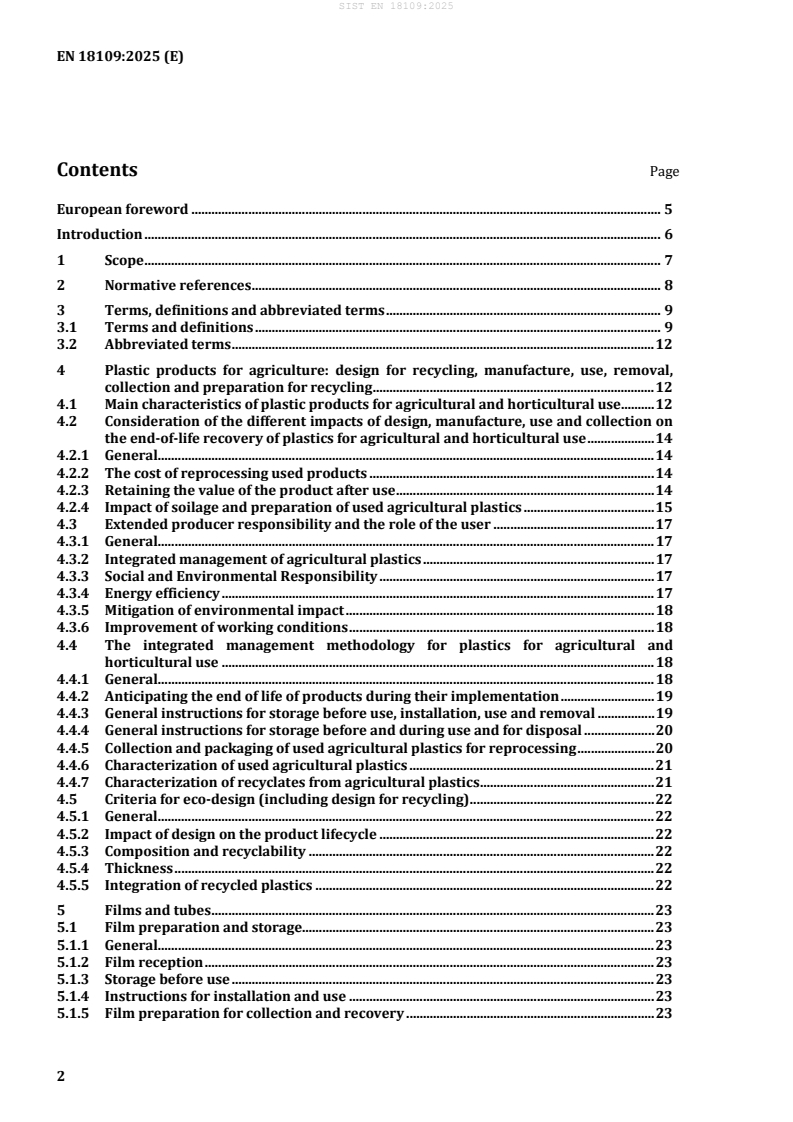
Contents Page
European foreword . 5
Introduction . 6
1 Scope . 7
2 Normative references . 8
3 Terms, definitions and abbreviated terms . 9
3.1 Terms and definitions . 9
3.2 Abbreviated terms . 12
4 Plastic products for agriculture: design for recycling, manufacture, use, removal,
collection and preparation for recycling . 12
4.1 Main characteristics of plastic products for agricultural and horticultural use. 12
4.2 Consideration of the different impacts of design, manufacture, use and collection on
the end-of-life recovery of plastics for agricultural and horticultural use . 14
4.2.1 General. 14
4.2.2 The cost of reprocessing used products . 14
4.2.3 Retaining the value of the product after use . 14
4.2.4 Impact of soilage and preparation of used agricultural plastics . 15
4.3 Extended producer responsibility and the role of the user . 17
4.3.1 General. 17
4.3.2 Integrated management of agricultural plastics . 17
4.3.3 Social and Environmental Responsibility . 17
4.3.4 Energy efficiency . 17
4.3.5 Mitigation of environmental impact . 18
4.3.6 Improvement of working conditions . 18
4.4 The integrated management methodology for plastics for agricultural and
horticultural use . 18
4.4.1 General. 18
4.4.2 Anticipating the end of life of products during their implementation . 19
4.4.3 General instructions for storage before use, installation, use and removal . 19
4.4.4 General instructions for storage before and during use and for disposal . 20
4.4.5 Collection and packaging of used agricultural plastics for reprocessing . 20
4.4.6 Characterization of used agricultural plastics . 21
4.4.7 Characterization of recyclates from agricultural plastics . 21
4.5 Criteria for eco-design (including design for recycling) . 22
4.5.1 General. 22
4.5.2 Impact of design on the product lifecycle . 22
4.5.3 Composition and recyclability . 22
4.5.4 Thickness . 22
4.5.5 Integration of recycled plastics . 22
5 Films and tubes . 23
5.1 Film preparation and storage. 23
5.1.1 General. 23
5.1.2 Film reception . 23
5.1.3 Storage before use . 23
5.1.4 Instructions for installation and use . 23
5.1.5 Film preparation for collection and recovery . 23
5.2 Covering films . 24
5.2.1 Greenhouse cover films . 24
5.2.2 Small tunnel cover films . 31
5.2.3 Films for covering livestock and storage buildings . 33
5.3 Silage films and tubes for horizontal silos . 33
5.3.1 Use . 33
5.3.2 Installation instructions and anticipation of end of life . 33
5.3.3 Conditions of use and maintenance . 35
5.3.4 Durability of silage film . 35
5.4 Stretch film for bale wrapping . 35
5.4.1 Use . 35
5.4.2 Installation instructions and anticipation of end of life . 35
5.4.3 Use, maintenance and instructions for storage of wrapped bales . 36
5.4.4 Durability of silage wrapping film . 37
5.4.5 Specific removal instructions for opening and preparation of wrapped bales . 37
5.5 Mulch films and solarisation films . 37
5.5.1 Use . 37
5.5.2 Installation instructions, conditions of use and anticipation of end of life . 38
5.5.3 Specific removal instructions . 38
5.6 Fumigation films . 39
5.6.1 Use . 39
5.6.2 Installation instructions, conditions of use and anticipation of end of life . 39
5.6.3 Specific removal instructions . 39
6 Twines and nets . 40
6.1 Horticultural twines and accessories . 40
6.1.1 General . 40
6.1.2 Trellising twine . 40
6.1.3 Twines for crops tutoring . 40
6.1.4 Accessories for horticultural twines . 41
6.2 Baler twine for seasonal crops . 41
6.2.1 Use and implementation . 41
6.2.2 Specific removal instructions . 41
6.3 Protective nets . 42
6.3.1 General . 42
6.3.2 Anti-hail and rain nets . 42
6.3.3 Shading nets. 43
6.3.4 Insect proof nets . 43
6.3.5 Harvesting nets . 44
6.3.6 Windbreaks nets . 44
6.4 Design for recycling of twines and nets . 45
6.5 Baling nets for catling . 47
6.5.1 Use . 47
6.5.2 Implementation and anticipation of the end of life . 47
6.5.3 Maintenance during the period of use . 47
6.5.4 Specific removal instructions . 47
7 Fabrics and nonwovens . 47
7.1 Characterization of fabrics and nonwovens . 47
7.2 Receipt and storage of fabrics and nonwovens . 47
7.3 Canvas . 48
7.3.1 General . 48
7.3.2 Hydroponic cultivation canvas . 48
7.3.3 Protective covers . 48
7.4 Nonwoven veils . 49
7.4.1 General. 49
7.4.2 Nonwoven frost protection and insect-proof veils . 49
7.4.3 Nonwoven protective veils for agricultural goods stored temporary at the field . 50
8 Pipes, fittings and accessories, rigid ducts for irrigation . 50
8.1 General. 50
8.2 Characterization of driplines, pipes and ducts . 51
8.2.1 General. 51
8.2.2 Characteristics of products delivered to the farmer . 51
8.2.3 Industry standard formats of products delivered to the farmer . 52
8.2.4 Checking procedures for new products . 54
8.2.5 Labelling of irrigation pipes . 55
8.2.6 Storage and handling of used irrigation pipes and ducts . 55
8.3 Thin wall driplines (TWD) or “Tapes” . 55
8.3.1 Use . 55
8.3.2 Implementation and anticipation of the end of life . 55
8.3.3 Maintenance during the period of use . 55
8.3.4 Specific removal instructions . 56
8.4 Heavy wall driplines (HWD: semi-rigid irrigation pipes) . 56
8.4.1 Use . 56
8.4.2 Implementation and anticipation of the end of life . 56
8.4.3 Maintenance during the period of use . 57
8.4.4 Specific removal instructions . 57
8.5 Irrigation ducts . 57
8.5.1 Use . 57
8.5.2 Implementation and anticipation of the end of life . 57
8.5.3 Maintenance during the period of use . 57
8.5.4 Specific removal instructions . 58
8.6 Irrigation fittings and accessories (connectors, valves, filters, etc.) . 58
8.6.1 General. 58
8.6.2 Use . 58
8.6.3 Implementation and anticipation of the end of life . 58
8.6.4 Maintenance during the period of use . 58
8.6.5 Specific removal and storage instructions . 58
8.7 Rain guns . 58
8.7.1 General. 58
8.7.2 Use . 59
8.7.3 Implementation and anticipation of the end of life . 59
8.7.4 Maintenance during the period of use . 59
8.7.5 Specific removal and collection instructions . 59
Annex A (informative) Classification of used agricultural plastic films in France . 60
Annex B (informative) Example of methods for the establishment of a dedicated collection
scheme . 61
Annex C (informative) Measurement of soilage rate in agricultural plastics . 66
Bibliography . 67
European foreword
This document (EN 18109:2025) has been prepared by Technical Committee CEN/TC 249 “Plastics”, the
secretariat of which is held by SIS.
This European Standard shall be given the status of a national standard, either by publication of an
identical text or by endorsement, at the latest by February 2026, and conflicting national standards shall
be withdrawn at the latest by February 2026.
Attention is drawn to the possibility that some of the elements of this document may be the subject of
patent rights. CEN shall not be held responsible for identifying any or all such patent rights.
This document has been prepared under a standardization request addressed to CEN by the European
Commission. The Standing Committee of the EFTA States subsequently approves these requests for its
Member States.
Any feedback and questions on this document should be directed to the users’ national standards body.
A complete listing of these bodies can be found on the CEN website.
According to the CEN-CENELEC Internal Regulations, the national standards organisations of the
following countries are bound to implement this European Standard: Austria, Belgium, Bulgaria, Croatia,
Cyprus, Czech Republic, Denmark, Estonia, Finland, France, Germany, Greece, Hungary, Iceland, Ireland,
Italy, Latvia, Lithuania, Luxembourg, Malta, Netherlands, Norway, Poland, Portugal, Republic of North
Macedonia, Romania, Serbia, Slovakia, Slovenia, Spain, Sweden, Switzerland, Türkiye and the United
Kingdom.
Introduction
In recent years, the use of plastic products in agriculture has become a subject of concern due to its impact
on the environment. To address this issue, there is a growing need for a European standard that sets
guidelines in agricultural practices.
The European standardization for agricultural products aims to promote sustainable practices, reduce
plastic waste, and protect the environment. It emphasizes the importance of reducing plastic waste,
improving recycling and reuse methods. Also, it takes into account the entire life cycle of plastic products,
from production to end of use, and encourages the adoption of practices that contribute to a circular
economy, primarily recycling.
One of the key aspects is to encourage farmers and producers to opt for the implementation of collection
and recycling systems specifically designed for agricultural plastic waste.
The European standardization emphasizes the importance of proper waste management and disposal. It
encourages the establishment of collection points and recycling facilities for agricultural plastic waste,
ensuring that it is processed and recycled in an environmentally responsible manner. Additionally, it
promotes awareness and education among farmers and producers regarding the proper handling and
disposal of plastic products.
Furthermore, the European standardization encourages research and innovation in the field of
sustainable materials. It calls for the development of new technologies and materials that are recyclable,
reusable. This includes exploring options such as bio-based materials made from renewable resources or
utilizing natural materials that have minimal impact on the environment.
By implementing these guidelines, farmers and producers will contribute to a more sustainable
agricultural industry that balances the need for plastic products with the preservation of our natural
resources.
1 Scope
This document specifies the integrated management of agricultural plastic products with agronomic
performance.
This document gives guidance and requirements for their installation, use, removal, sorting, collection
and preparation for recycling as well as general guidelines for design for recycling.
NOTE 1 EN 13206:2025, EN 13207:2025, EN 13655:2025, EN 14932:2025 and EN 17098-1:2025 include a
specific clause dedicated to design for recycling.
NOTE 2 Design for recycling for products not covered by a standard is detailed in this document.
This document first aims professional users and can be used also for domestic purposes.
This document is applicable to:
— covering films that comply with EN 13206:2025 or with specifications laid out by the film
manufacturer/supplier, used for covering greenhouses, small tunnels or livestock buildings, as well
as to direct crop covers used for semi-forcing plants and seed;
— silage films for horizontal silos that comply with EN 13207:2025 or with specifications laid out by
the film manufacturer/supplier;
— sheaths for horizontal silos (forage crop and grain storage) that comply with EN 13207:2025 or with
specifications laid out by the sheath manufacturer/supplier;
— stretch films for wrapping bales that comply with EN 14932:2025 or with specifications laid out by
the film manufacturer/supplier;
— thermoplastic mulching films that comply with EN 13655:2025 or with specifications laid out by the
film manufacturer/supplier;
— barrier films for agricultural and horticultural soil disinfection by fumigation that comply with
EN 17098-1:2025;
— nets and twines for catling and horticulture that comply with the specifications laid out by
EN ISO 4167 or by the manufacturer/supplier;
— flexible ducts, semi-rigid and rigid pipes and fittings for irrigation that comply with ISO 8779,
EN ISO 9261, ISO 13460-1, ISO 16438, EN 14267, EN 12324-2, EN 13635, EN 13997,
EN 17176-2:2019+A1:2022 or with specifications laid out by the manufacturer/supplier;
— fabrics and non-woven nets and sheets for catling and horticulture that comply with ISO 9073 series
or with specifications laid out by the manufacturer/supplier.
This document does not cover construction, packaging and food-contact products.
NOTE 3 For products non-suitable for recycling in the context of this document, specific procedures apply.
2 Normative references
The following documents are referred to in the text in such a way that some or all of their content
constitutes requirements of this document. For dated references, only the edition cited applies. For
undated references, the latest edition of the referenced document (including any amendments) applies.
EN 10244-2, Steel wire and wire products — Non-ferrous metallic coatings on steel wire — Part 2: Zinc or
zinc alloy coatings
EN 12324-2, Irrigation techniques — Reel machine systems — Part 2: Specifications of polyethylene tubes
for reel machines
EN 13031-1, Greenhouses — Design and construction — Part 1: Commercial production greenhouses
EN 13206, Plastics — Thermoplastic covering films for use in agriculture and horticulture
EN 13207, Plastics — Thermoplastic silage films and tubes for use in agriculture
EN 13635, Irrigation techniques — Localised irrigation systems — Terminology and data to be supplied by
the manufacturer
EN 13655, Plastics — Thermoplastic mulch films recoverable after use, for use in agriculture and
horticulture
EN 13997, Irrigation techniques — Connection and control accessories for use in irrigation systems —
Technical characteristics and testing
EN 14267, Irrigation techniques — Irrigation hydrants
EN 14932, Plastics — Thermoplastic stretch films for wrapping silage bales
EN 15343, Plastics — Recycled Plastics — Plastics recycling traceability and assessment of conformity and
recycled content
EN 15344, Plastics — Recycled plastics — Characterization of Polyethylene (PE) recyclates
EN 15345, Plastics — Recycled plastics — Characterisation of Polypropylene (PP) recyclates
EN 15347-1, Plastics — Sorted plastics wastes — Part 1: General characterization
EN 15347-2, Plastics — Sorted plastics wastes — Part 2: Quality grades of sorted Polyethylene (PE) wastes
and specific test methods
EN 15347-3, Plastics — Sorted plastics wastes — Part 3: Quality grades of sorted Polypropylene (PP) wastes
and specific test methods
EN 17098-1, Plastics — Barrier films for agricultural and horticultural soil disinfection by fumigation —
Part 1: Specifications for barrier films
EN 17176-2:2019+A1:2022, Plastics piping systems for water supply and for buried and above ground
drainage, sewerage and irrigation under pressure — Oriented unplasticized poly(vinyl chloride) (PVC-O) —
Part 2: Pipes
EN 17615, Plastics — Environmental Aspects — Vocabulary
EN ISO 472, Plastics — Vocabulary (ISO 472)
EN ISO 9261, Agricultural irrigation equipment — Emitters and emitting pipe — Specification and test
methods (ISO 9261)
ISO 8779, Plastics piping systems — Polyethylene (PE) pipes for irrigation — Specifications
ISO 9092, Nonwovens — Vocabulary
ISO 13460-1, Agricultural irrigation equipment — Plastics saddles — Part 1: Polyethylene pressure pipes
ISO 15270, Plastics — Guidelines for the recovery and recycling of plastics waste
ISO 16348, Metallic and other inorganic coatings — Definitions and conventions concerning appearance
3 Terms, definitions and abbreviated terms
3.1 Terms and definitions
For the purposes of this document, the terms and definitions given in EN ISO 472, EN 17615, ISO 9092
and the following apply.
ISO and IEC maintain terminology databases for use in standardization at the following addresses:
— IEC Electropedia: available at https://www.electropedia.org/
— ISO Online browsing platform: available at https://www.iso.org/obp
3.1.1
conventional expected lifetime
expected lifetime defined by agreement between the manufacturer/supplier and the customer or, by
default, the minimum use duration that the product needs to satisfy
Note 1 to entry: It is expressed in years, months or seasons.
EXAMPLE Products include e.g. film, sheath, net, twine, canvas, nonwoven, pipe, etc.
3.1.2
actual useful lifetime
time interval defined as starting on the fitting date, or installation date, of a product until its removal or
early failure
Note 1 to entry: It is expressed in months or seasons for greenhouse covering films.
EXAMPLE Products include e.g. film, sheath, net, twine, canvas, nonwoven, pipe, etc.
3.1.3
use ratio
ratio of the actual useful lifetime (3.1.2) of a product to its conventional expected lifetime (3.1.1)
Note 1 to entry: It is expressed as a percentage, %.
EXAMPLE Products include e.g. film, sheath, net, twine, canvas, nonwoven, pipe, etc.
Under revision as a multi-part standard.
3.1.4
remaining use potential
difference between the conventional expected lifetime (3.1.1) of a product and its actual useful
lifetime (3.1.2), determined over the lifespan of the product
Note 1 to entry: It is expressed in months or seasons for greenhouse covering films.
EXAMPLE Products include e.g. film, sheath, net, twine, canvas, nonwoven, pipe, etc.
3.1.5
soilage
S
natural foreign material found in a used product as mineral, water and organic material
Note 1 to entry: It is expressed as a percentage, %.
3.1.6
soilage rate
SR
proportion of foreign material found in a used product calculated relatively to the mass of used product
Note 1 to entry: The formula can be found in 4.2.4.1.
Note 2 to entry: Soilage rate and soilage coefficient can be transposed one into another, using the related
mathematical formulae in 4.2.4.1.
3.1.7
dry soilage rate
proportion of foreign material found in a used product calculated relatively to the mass of used product,
excluding water content
Note 1 to entry: The formula can be found in 4.2.4.1.
3.1.8
soilage coefficient
SC
proportion of foreign material found in a used product calculated relatively to the original product mass,
obtained by a transposition formula from the soilage rate (3.1.6)
Note 1 to entry: The formula can be found in 4.2.4.1.
3.1.9
reprocessor
natural or legal person applying a physical treatment to a collected used plastic modifying its shape or
physical properties
EXAMPLE Grinding, shredding-washing, etc.
3.1.10
recycler
natural or legal person applying a physical treatment to a collected used plastic that transform it in a new
raw material directly usable in a production process
3.1.11
collection operator
natural or legal person ensuring by himself or via a contractor the systematic collection of used plastic
3.1.12
recyclability
ability of a product, including the related accessories, to be sorted and recycled in practice and at scale in
the current recycling technology and infrastructure, and deliver recyclates of suitable quality to be
integrated into new products, respecting product standards and regulations in force
Note 1 to entry: The adjective of “recyclability” is “recyclable”.
[SOURCE: M/584 COMMISSION IMPLEMENTING DECISION of 1.8.2022 on a standardisation request to
the European Committee for Standardisation and the European Committee for Electrotechnical
Standardisation as regards plastics recycling and recycled plastics - modified]
3.1.13
design for recycling
DFR
design of product, including the related accessories, in order to ensure its recyclability (3.1.12) under the
current practices of removal, sorting, collection and recycling systems
Note 1 to entry: The purpose with the design for recycling criteria is to be able to use the recyclates back in the
same product, independent of producer of material.
3.1.14
recycling of plastics
process of recovering plastics waste into products, materials or substances to be used again but excluding
energy recovery and materials intended to be used as fuels
Note 1 to entry: Recycling can be mechanical, chemical, physical or organic.
Note 2 to entry: Recycling is also defined in Directive 2008/98/EC, Article 3 (15a).
[SOURCE: EN 17615:2022, 3.211]
3.1.15
mechanical recycling
processing of plastic waste into secondary raw materials or products without significantly changing the
chemical structure of the material
Note 1 to entry: Plastics secondary raw material is a synonym of recyclate.
[SOURCE: EN ISO 472:2013, 2.1697, modified — Note 1 to entry changed; “plastics waste” changed to
read “plastic waste”.]
3.1.16
chemical recycling
conversion of polymers into chemical substances by changing the chemical structure of plastic waste
through processes such as cracking, pyrolysis, gasification or depolymerization excluding energy
recovery and the production of materials that are to be used as fuels or for backfilling operations
Note 1 to entry: “Feedstock recycling” is widely used as a synonym for “chemical recycling”.
[SOURCE: EN 17615:2022, 3.53]
3.1.17
post-consumer plastics
plastics, generated by the end-users of products, that has fulfilled its intended purpose and can no longer
be used for its intended purpose (including plastics returned from within the distribution chain)
Note 1 to entry: The term “post-use” is sometimes used synonymously.
Note 2 to entry: Often abbreviated as PCR.
3.1.18
pre-consumer plastics
plastics diverted from the waste stream during a manufacturing process
Note 1 to entry: Excluded is reutilization of plastics such as rework, regrind or scrap generated in a process and
capable of being reclaimed within the same process that generated it.
3.1.19
national collection scheme
NCS
voluntary or mandatory national collection system of defined plastic fractions used in agriculture or
horticulture applications
3.2 Abbreviated terms
For the purposes of this document, abbreviated terms related to recyclates given in EN ISO 1043-1 and
the following apply.
DFR Design for recycling
EOR End of row
EPR Extended Producer Responsibility
HWD Heavy wall driplines
NAP New agricultural product
NCS National collection scheme
OTR Over the row
PAR Photosynthetically active radiation
PCR Post-consumer recyclates
PRO Producer Responsibility Organization
RUP Remaining use potential
TWD Thin wall driplines
UAP Used agricultural product
4 Plastic products for agriculture: design for recycling, manufacture, use,
removal, collection and preparation for recycling
4.1 Main characteristics of plastic products for agricultural and horticultural use
Plastics products used for agricultural or horticultural purpose take advantage of their various agronomic
performances obtained by the material properties (light, air, heat, moisture control, etc.).
They are usually made mono-polymeric resins with organic and/or mineral additives, with a thickness in
accordance with the intended condition of use in open air.
Products shall be used according to specifications to ensure full recyclability (as over-used products
might not be suitable for recycling of plastics).
These characteristics make them usually especially suitable for mechanical recycling whenever the
soilage and moisture content after use and sun exposure during use do not hinder excessively the
polymer quality. In a similar way, chemical contamination should be minimized (as it will be released in
a later phase, during collection, cleaning, extrusion or the useful lifetime in new products).
Thermoplastic products are recyclable materials that can be re-processed in a material recovery process
intended to save resources while minimizing harmful emissions into the air, water and soil, as well as
their impacts on human health. As a consequence:
— all products shall be sorted after use and collected for recycling of plastics;
— all products shall contribute for the financing of their end-of-life management;
— all products shall have a designation: the purpose of designation is to provide the product relevant
information for the intended use on the sales and logistics documents. When post-consumer plastics
is integrated, the designation shall include the minimum content of recycled post-consumer plastics
(percentage of total mass);
— all products shall have a marking on the packaging or label: when post-consumer plastics is
integrated, the marking on the packaging or label shall include the minimum content of recycled post-
consumer plastics (percentage of total mass);
— products not complying with DFR requirements described in this document shall be submitted to a
separate handling. In the above mentioned cases, product manufacturers shall provide a certificate
from an official certification body certified by Producer Responsibility Organization (PRO) proving
their compliance with the DFR requirements of this document. This compliance can be shown by the
mention “(DFR compliant)” along with the product’s marking;
— used products not complying with the technical minimum requirements of the collection operators
are considered to be not recyclable and shall be collected separately.
NOTE Content of recycled pre-consumer plastics can also be declared separately.
The following standards shall be followed:
— EN 15347-1, EN 15347-2 and EN 15347-3 provide a framework for characterizing plastic waste.
— EN 15343 provides the procedures necessary for ensuring the traceability of recycled plastics.
— EN 15344 provides data for characterizing polyethylene recyclates.
— EN 15345 provides data for characterizing polypropylene recyclates.
— ISO 15270 provides guidelines for terminology and material recovery, in particular through
mechanical recycling.
Under revision as a multi-part standard.
4.2 Consideration of the different impacts of design, manufacture, use and collection on
the end-of-life recovery of plastics for agricultural and horticultural use
4.2.1 General
The purpose of this subclause is to simplify as much as possible the reverse logistics and cleaning
operations and to preserve the mechanical properties of the collected plastics.
4.2.2 The cost of reprocessing used products
4.2.2.1 General
The reprocessing of used products is split into three main steps:
a) product cleaning, separation and conditioning by the farmer;
b) product collection, sorting and grouping for massification by the collection operator;
c) recycling of plastics itself with grinding, washing and extrusion by the reprocessor.
NOTE An excessive expense in one of those steps can easily make the reprocessing unable to self-sustain
through the value of regenerated material.
4.2.2.2 The impact of design and manufacture
Products design and manufacturi
...