

SIST ISO 8159:1999
(Main)Textiles -- Morphology of fibres and yarns -- Vocabulary
General Information
- Abstract
Defines the principal terms used to described the various forms into which textile fibres can be assembled, up to and including cabled yarns. Only contains terms of general application. Terms and/or definitions which are specific to particular fibres (such as hemp, silk, textile glass, metal fibre, carbon fibre, etc) are excluded.
- Status
- Published
- Publication Date
- 30-Nov-1999
- Technical Committee
- ITEK - Textile and textile products
- Current Stage
- 6060 - National Implementation/Publication (Adopted Project)
- Start Date
- 01-Dec-1999
- Due Date
- 01-Dec-1999
- Completion Date
- 01-Dec-1999


Overview
SIST ISO 8159:1999 is an international standard published by the International Organization for Standardization (ISO) that establishes the principal vocabulary for describing the morphology of textile fibres and yarns. This standard focuses on the terminology used to define the various forms in which textile fibres are assembled, from individual fibres through to cabled yarns. It ensures a common language for industry professionals, researchers, and manufacturers involved in textile production and analysis.
This standard covers general textile fibre and yarn terms only, explicitly excluding terms specific to particular fibre types such as hemp, silk, glass, metal, or carbon fibres. It also does not cover manufacturing methods or quantitative measurement terms related to fibre or yarn properties. A morphological scheme diagram is included to illustrate the relationships between terms from a production perspective.
Key Topics
- Textile Fibre Definition: Fibres characterized by flexibility, fineness, and a high length-to-cross section ratio suitable for textile applications.
- Fibre Types:
- Staple fibre: Short, limited-length fibres.
- Filament: Very long fibres considered continuous.
- Textile film and tape yarn: Film-like or tape-shaped textile elements.
- Fibre Assemblies:
- Tow: Large bundles of man-made staple filaments without twist.
- Sliver or Top: Long assemblies of staple fibres without twist.
- Roving: Similar to sliver but with slight twist.
- Flock: Very short fibres intended to be stuck to a backing.
- Yarn Types:
- Yarn: A long, relatively fine textile product of fibres and/or filaments, with or without twist.
- Spun yarn: Made primarily from staple fibres bound by twist.
- Filament yarn: Made from single or multiple filaments, twisted or untwisted.
- Bulked yarn: Spun yarns treated chemically or thermally to increase volume.
- Singles yarn: Yarn with twist inserted in a single operation.
- Folded (plied) yarn: Two or more singles twisted together.
- Cabled yarn: Yarn formed by twisting together two or more yarns, including at least one folded yarn.
- Textured Filament Yarns: Covered in related ISO 8160, these include yarns with crimp or other stretch and bulk properties developed through twist or after-treatments.
Applications
SIST ISO 8159:1999 is essential for:
- Textile manufacturers and designers who require consistent terminology for fibre and yarn morphology.
- Quality control and laboratory analysts standardizing descriptions of raw materials.
- Researchers and educators developing curriculum or conducting studies related to fibre and yarn structure.
- Documentation and communication within the textile supply chain-ensuring clarity around fibre forms from raw material to complex yarn assemblies.
- Regulatory and standards compliance where precise vocabulary reduces ambiguities.
The vocabulary standard aids in describing structures prior to or during processing and supports improved textile product development, sourcing, and technical communication worldwide.
Related Standards
- ISO 8160: Textiles - Textured filament yarns - Vocabulary. Complements ISO 8159 by defining terminology for yarns with specialized physical properties achieved by texturing processes.
- Other ISO textile standards developed by ISO Technical Committee 38 (Textiles), which cover fibre characteristics, testing methods, and fabric classifications.
- National and regional standards referencing ISO 8159 terms to harmonize terminology in trade and industry documentation.
By adopting SIST ISO 8159:1999, industry professionals align on a globally recognized set of terms, improving efficiency and reducing misinterpretations in describing fibre and yarn morphology.
Relations
- Effective Date
- 25-Aug-2026
Get Certified
Connect with accredited certification bodies for this standard

Control Union Certifications
Global certification for agriculture and sustainability.

Hohenstein Institut
Textile testing and certification.

Bureau Veritas Bangladesh
Bureau Veritas certification services in Bangladesh.
Sponsored listings
Frequently Asked Questions
SIST ISO 8159:1999 is a standard published by the Slovenian Institute for Standardization (SIST). Its full title is "Textiles -- Morphology of fibres and yarns -- Vocabulary". This standard covers: Defines the principal terms used to described the various forms into which textile fibres can be assembled, up to and including cabled yarns. Only contains terms of general application. Terms and/or definitions which are specific to particular fibres (such as hemp, silk, textile glass, metal fibre, carbon fibre, etc) are excluded.
Defines the principal terms used to described the various forms into which textile fibres can be assembled, up to and including cabled yarns. Only contains terms of general application. Terms and/or definitions which are specific to particular fibres (such as hemp, silk, textile glass, metal fibre, carbon fibre, etc) are excluded.
SIST ISO 8159:1999 is classified under the following ICS (International Classification for Standards) categories: 01.040.59 - Textile and leather technology (Vocabularies); 59.060.01 - Textile fibres in general; 59.080.20 - Yarns. The ICS classification helps identify the subject area and facilitates finding related standards.
SIST ISO 8159:1999 has the following relationships with other standards: It is inter standard links to SIST-TP CEN/TR 17603-32-07:2022. Understanding these relationships helps ensure you are using the most current and applicable version of the standard.
SIST ISO 8159:1999 is available in PDF format for immediate download after purchase. The document can be added to your cart and obtained through the secure checkout process. Digital delivery ensures instant access to the complete standard document.
Standards Content (Sample)
ISO
INTERNATIONAL STANDARD
NORME INTERNATIONALE 8159
First edition
Premiere Edition
1987-04-01
INTERNATIONAL ORGANIZATION FOR STANDARDIZATION
ORGANISATION INTERNATIONALE DE NORMALISATION
MEX,!jYHAPOflHAfl OPTAHM3A~Wl I-l0 CTAH~APTM3A~MM
Textiles - Morphology of fibres and yarns -
Vocabulary
- Morphologie des fibres et fils -
Textiles
Vocabulaire
Reference number
Numero de rkfkrence
ISO 8159: 1987 (E/F)
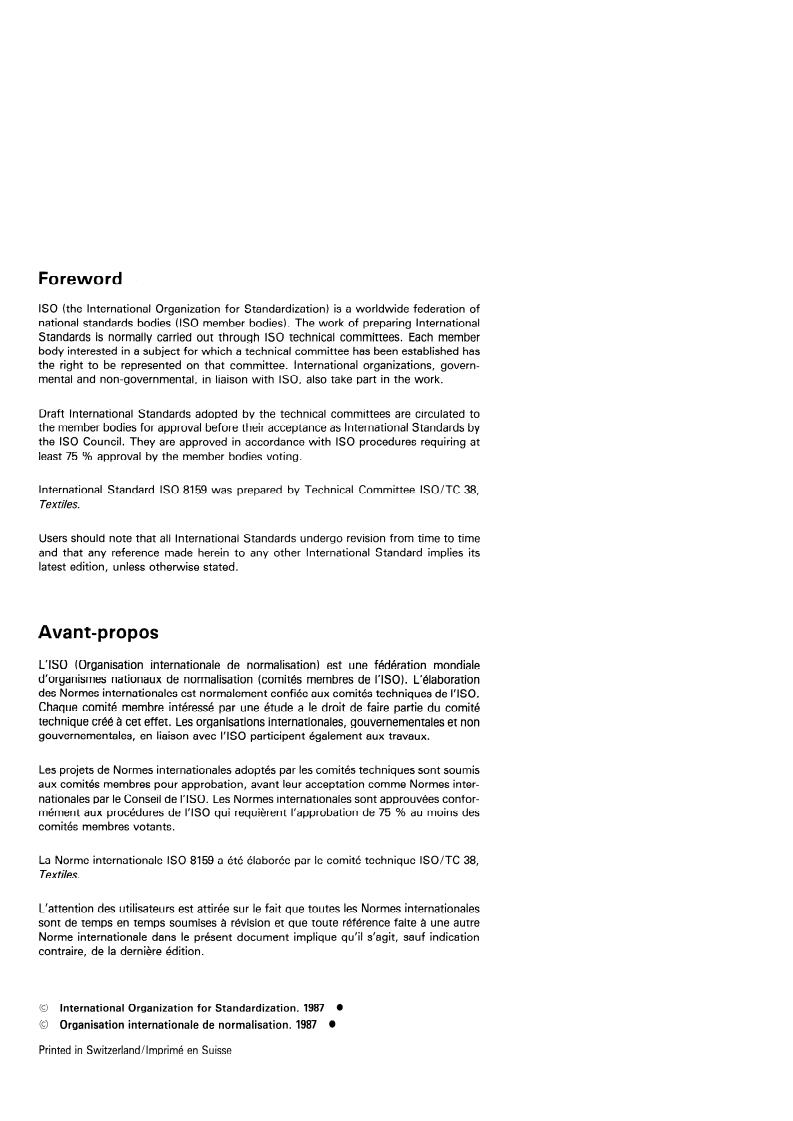
Foreword
ISO (the International Organization for Standardization) is a worldwide federation of
national Standards bodies (ISO member bedies). The work of preparing International
Standards is normally carried out through ISO technical committees. Esch member
body interested in a subject for which a technical committee has been established has
the right to be represented on that committee. International organizations, govern-
mental and non-governmental, in liaison with ISO, also take part in the work.
Draft International Standards adopted by the technical committees are circulated to
the member bodies for approval before their acceptance as International Standards by
the ISO Council. They are approved in accordance with ISO procedures requiring at
least 75 % approval by the member bodies voting.
International Standard ISO 8159 was prepared by Technical Committee ISO/TC 38,
Textiles.
Users should note that all International Standards undergo revision from time to time
and that any reference made herein to any other International Standard implies its
Jatest edition, unless otherwise stated.
Avant-propos
L’ISO (Organisation internationale de normalisation) est une federation mondiale
d’organismes nationaux de normalisation (comites membres de I’ISO). L’elaboration
des Normes internationales est normalement confiee aux comites techniques de I’ISO.
Chaque comite membre interesse par une etude a Ie droit de faire Partie du comite
technique cr& a cet effet. Les organisations internationales, gouvernementales et non
gouvernementales, en liaison avec I’ISO participent egalement aux travaux.
Les projets de Normes internationales adoptes par les comites techniques sont soumis
aux comites membres pour approbation, avant leur acceptation comme Normes inter-
nationales par Ie Conseil de I’ISO. Les Normes internationales sont approuvees confor-
mement aux procedures de I’ISO qui requierent I’approbation de 75 % au moins des
comites membres votants.
La Norme internationale ISO 8159 a etc elaboree par Ie comite technique ISO/TC 38,
Textiles.
L’attention des utilisateurs est attiree sur Ie fait que toutes les Normes internationales
sont de temps en temps soumises a revision et que toute reference faite a une autre
Norme internationale dans Ie present document implique qu’il s’agit, sauf indication
contraire, de Ia derniere Edition.
International Organization for Standardkation, 1987
0 Organisation internationale de normalisation, 1 987
Printed in Switzerland/lmprim6 en Gisse
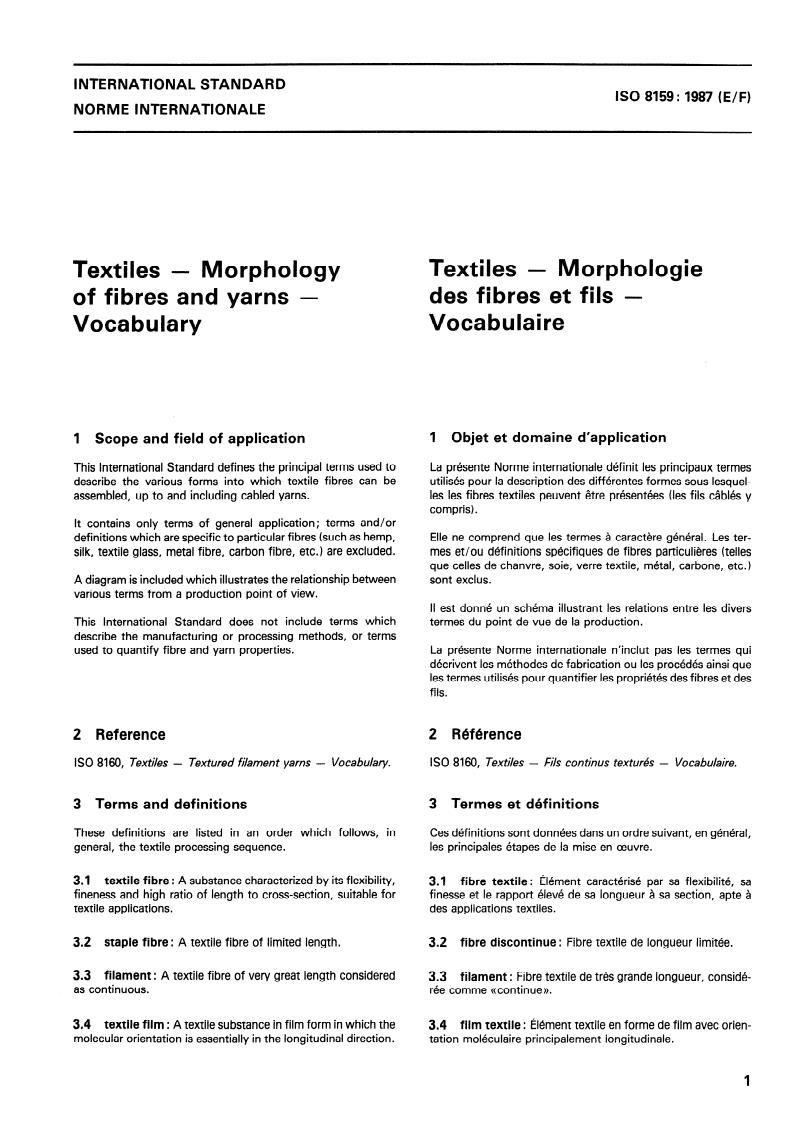
INTERNATIONAL STANDARD
EO 8159: 1987 (E/F)
NORME INTERNATIONALE
- Morphologie
Textiles
Textiles - Morphology
des fibres et fils -
of fibres and yarns -
Vocabulaire
Vocabulary
1 Objet et domaine d’application
1 Scope and field of application
La presente Norme internationale definit Ies principaux termes
This International Standard defines the principal terms used to
utilises pour Ia description des differentes formes sous lesquel-
describe the various forms into which textile fibres tan be
les les fibres textiles peuvent etre presentees (les fils cables y
assembled, up to and including cabled yarns.
compris).
It contains only terms of general application; terms and/or
Elle ne comprend que les termes a caractere general. Les ter-
definitions which are specific to particular fibres (such as hemp,
mes et/ou definitions specifiques de fibres particulieres (telles
silk, textile glass, metal fibre, carbon fibre, etc.) are excluded.
que celles de chanvre, soie, verre textile, metal, carbone, etc.)
sont exclus.
A diagram is included which illustrates the relationship between
various terms from a production Point of view.
ll est donne un Schema illustrant les relations entre les divers
This International Standard does not include terms which termes du Point de vue de Ia production.
describe the manufacturing or processing methods, or terms
La presente Norme internationale n’inclut pas les termes qui
used to quantify fibre and yarn proper-Ges.
decrivent les methodes de fabrication ou les procedes ainsi que
les termes utilises pour quantifier les proprietes des fibres et des
fils.
2 Rhference
2 Reference
ISO 8160, Textiles - Fils continus textUres - Vocabulaire.
ISO 8160, Textiles - Textured filament yarns - Vocabulary.
3 Termes et definitions
3 Terms and definitions
These definitions are listed in an Order which follows, in Ces definitions sont donnees dans un ordre suivant, en general,
les principales etapes de Ia mise en ceuvre.
general, the textile processing sequence.
3.1 textile fibre : A substance characterized by its flexibility, 3.11 fibre textile: Element caracterise par sa flexibilite, sa
finesse et Ie rapport eleve de sa longueur a sa section, apte a
fineness and high ratio of length to Cross-section, suitable for
textile applications. des applications textiles.
3.2 staple fibre: A textile fibre of limited length. 3.2 fibre discontinue: Fibre textile de Iongueur limitee.
filament: A textile fibre of very great length considered
3.3 3.3 filament : Fibre textile de tres grande longueur, conside-
as continuous. res! comme «continue».
3.4 textile film : A textile substance in film form in which the 3.4 film textile : Element textile en forme de film avec orien-
tation moleculaire principalement longitudinale.
molecular orientation is essentially in the longitudinal direction.
ISO 8159: 1987 (E/F)
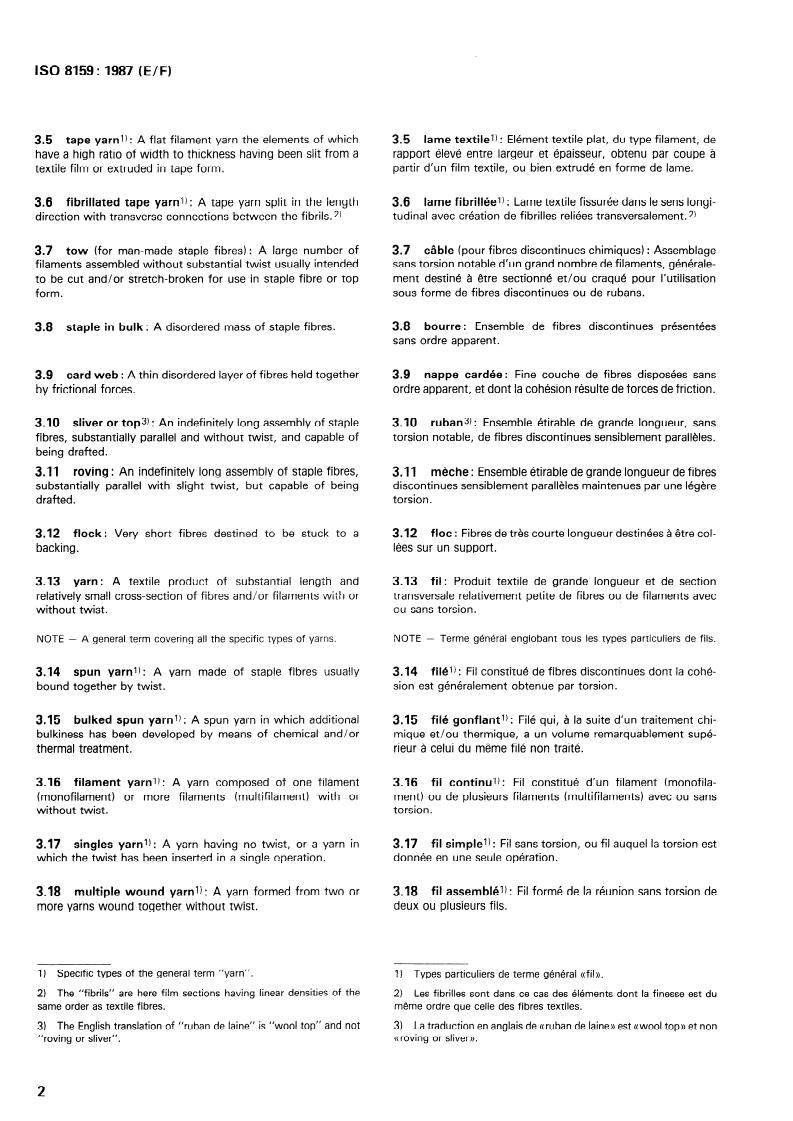
3.5 lame textile? Element textile plat, du type filament, de
rapport eleve entre largeur et epaisseur, obtenu par coupe a
partir d’un film textile, ou bien extrude en forme d
...
S L O V E N S K I SIST ISO 8159
prva izdaja
STANDARD
december 1999
Tekstilije - Oblika vlaken in prej - Slovar
(enakovreden ISO 8159:1987)
Textiles - Morphology of fibres and yarns - Vocabulary
Textiles - Morphologie des fibres et fils - Vocabulaire
Deskriptorji: tekstilije, tekstilna vlakna, preje, slovar
Referenčna številka
ICS 01.040.59, 59.080.20 SIST ISO 8159:1999 (sl)
Nadaljevanje na straneh od 2 do 7
© Standard je založil in izdal Urad Republike Slovenije za standardizacijo in meroslovje pri Ministrstvu za znanost in tehnologijo.
Razmnoževanje ali kopiranje celote ali delov tega standarda ni dovoljeno.
SIST ISO 8159 : 1999
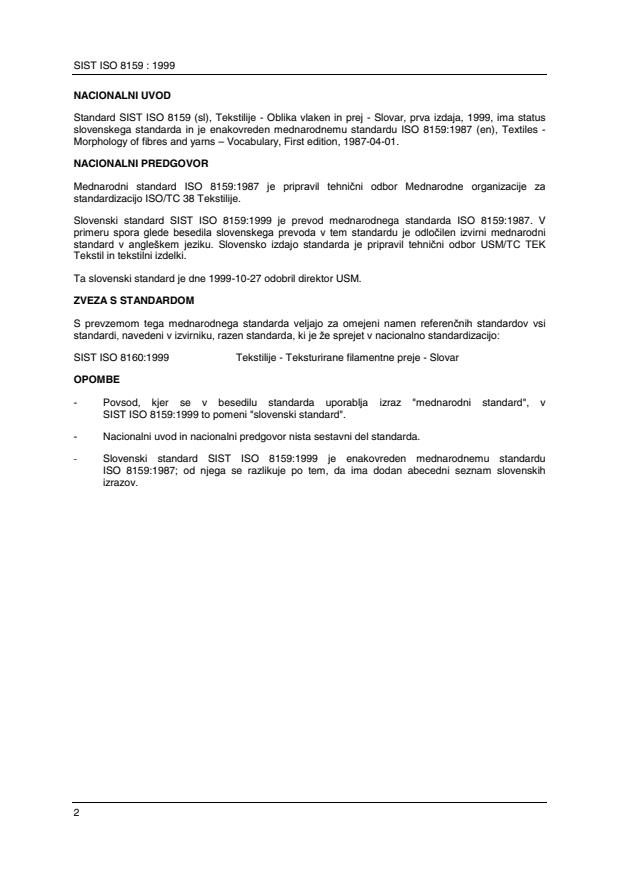
NACIONALNI UVOD
Standard SIST ISO 8159 (sl), Tekstilije - Oblika vlaken in prej - Slovar, prva izdaja, 1999, ima status
slovenskega standarda in je enakovreden mednarodnemu standardu ISO 8159:1987 (en), Textiles -
Morphology of fibres and yarns – Vocabulary, First edition, 1987-04-01.
NACIONALNI PREDGOVOR
Mednarodni standard ISO 8159:1987 je pripravil tehnični odbor Mednarodne organizacije za
standardizacijo ISO/TC 38 Tekstilije.
Slovenski standard SIST ISO 8159:1999 je prevod mednarodnega standarda ISO 8159:1987. V
primeru spora glede besedila slovenskega prevoda v tem standardu je odločilen izvirni mednarodni
standard v angleškem jeziku. Slovensko izdajo standarda je pripravil tehnični odbor USM/TC TEK
Tekstil in tekstilni izdelki.
Ta slovenski standard je dne 1999-10-27 odobril direktor USM.
ZVEZA S STANDARDOM
S prevzemom tega mednarodnega standarda veljajo za omejeni namen referenčnih standardov vsi
standardi, navedeni v izvirniku, razen standarda, ki je že sprejet v nacionalno standardizacijo:
SIST ISO 8160:1999 Tekstilije - Teksturirane filamentne preje - Slovar
OPOMBE
- Povsod, kjer se v besedilu standarda uporablja izraz "mednarodni standard", v
- Nacionalni uvod in nacionalni predgovor nista sestavni del standarda.
- Slovenski standard SIST ISO 8159:1999 je enakovreden mednarodnemu standardu
izrazov.
SIST ISO 8159 :1999
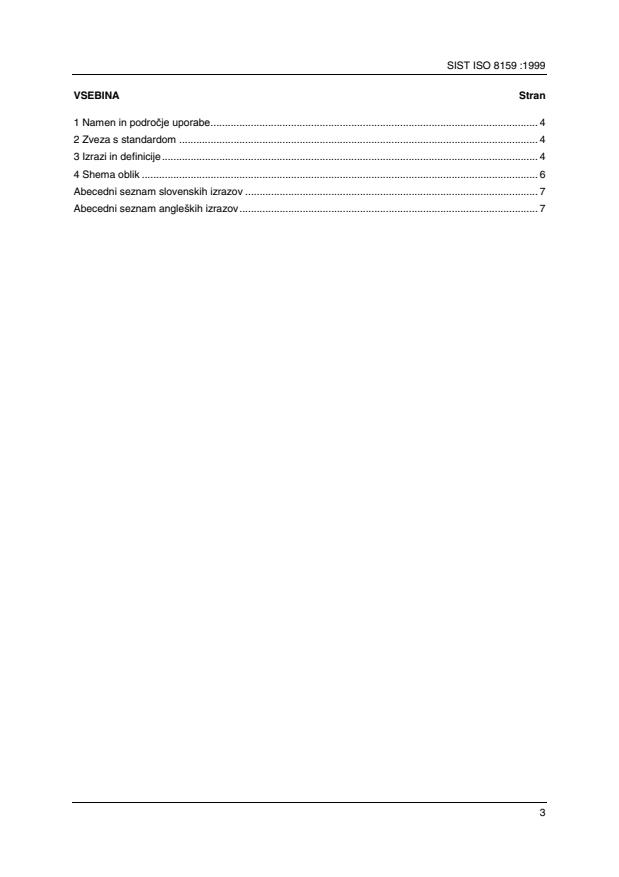
VSEBINA Stran
1 Namen in področje uporabe. 4
2 Zveza s standardom . 4
3 Izrazi in definicije. 4
4 Shema oblik . 6
Abecedni seznam slovenskih izrazov . 7
Abecedni seznam angleških izrazov. 7
SIST ISO 8159 : 1999
Tekstilije - Oblika vlaken in prej - Slovar
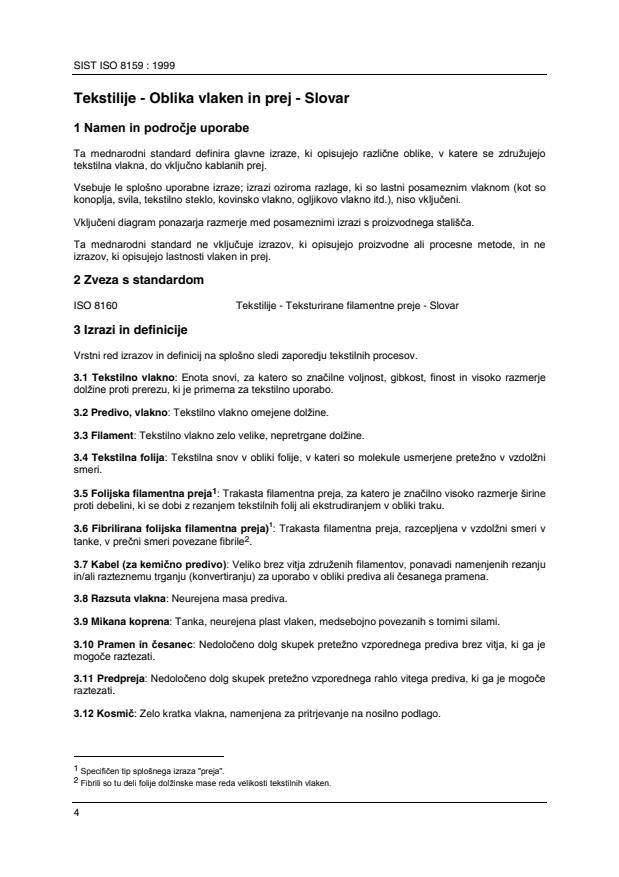
1 Namen in področje uporabe
Ta mednarodni standard definira glavne izraze, ki opisujejo različne oblike, v katere se združujejo
tekstilna vlakna, do vključno kablanih prej.
Vsebuje le splošno uporabne izraze; izrazi oziroma razlage, ki so lastni posameznim vlaknom (kot so
konoplja, svila, tekstilno steklo, kovinsko vlakno, ogljikovo vlakno itd.), niso vključeni.
Vključeni diagram ponazarja razmerje med posameznimi izrazi s proizvodnega stališča.
Ta mednarodni standard ne vključuje izrazov, ki opisujejo proizvodne ali procesne metode, in ne
izrazov, ki opisujejo lastnosti vlaken in prej.
2 Zveza s standardom
ISO 8160 Tekstilije - Teksturirane filamentne preje - Slovar
3 Izrazi in definicije
Vrstni red izrazov in definicij na splošno sledi zaporedju tekstilnih procesov.
3.1 Tekstilno vlakno: Enota snovi, za katero so značilne voljnost, gibkost, finost in visoko razmerje
dolžine proti prerezu, ki je primerna za tekstilno uporabo.
3.2 Predivo, vlakno: Tekstilno vlakno omejene dolžine.
3.3 Filament: Tekstilno vlakno zelo velike, nepretrgane dolžine.
3.4 Tekstilna folija: Tekstilna snov v obliki folije, v kateri so molekule usmerjene pretežno v vzdolžni
smeri.
3.5 Folijska filamentna preja : Trakasta filamentna preja, za katero je značilno visoko razmerje širine
proti debelini, ki se dobi z rezanjem tekstilnih folij ali ekstrudiranjem v obliki traku.
3.6 Fibrilirana folijska filamentna preja) : Trakasta filamentna preja, razcepljena v vzdolžni smeri v
tanke, v prečni smeri povezane fibrile .
3.7 Kabel (za kemično predivo): Veliko brez vitja združenih filamentov, ponavadi namenjenih rezanju
in/ali razteznemu trganju (konvertiranju) za uporabo v obliki prediva ali česanega pramena.
3.8 Razsuta vlakna: Neurejena masa prediva.
3.9 Mikana koprena: Tanka, neurejena plast vlaken, medsebojno povezanih s tornimi silami.
3.10 Pramen in česanec: Nedoločeno dolg skupek pretežno vzporednega prediva b
...