

SIST-TS CEN/TS 17847:2023
(Main)Characterization of waste - Determination of selected low boiling point alcohols using gas chromatography with flame ionization detection after static head-space extraction (HS-GC-FID)
General Information
- Abstract
This document specifies a method for quantitative determination of the concentration of selected alcohols with low boiling point in liquid waste and pasty waste by gas chromatography with flame ionization detection after static headspace extraction.
Under the conditions specified in this document, a limit of application of 20 mg/kg, expressed on dry matter for pasty waste and expressed on raw waste for liquid waste, can be achieved.
- Status
- Published
- Public Enquiry End Date
- 01-Jul-2022
- Publication Date
- 12-Feb-2023
- Technical Committee
- KAT - Soil quality
- Current Stage
- 6060 - National Implementation/Publication (Adopted Project)
- Start Date
- 12-Jan-2023
- Due Date
- 19-Mar-2023
- Completion Date
- 13-Feb-2023



Overview
CEN/TS 17847:2022 specifies a validated laboratory method for the quantitative determination of selected low boiling point alcohols in liquid and pasty waste using static head‑space extraction (HS) followed by gas chromatography with flame ionization detection (HS‑GC‑FID). Under the prescribed conditions the method achieves a practical limit of application of 20 mg/kg (expressed on dry matter for pasty waste or on raw waste for liquid samples).
Key topics and technical requirements
- Analytes covered: methanol, ethanol, iso‑propanol, tert‑butanol, n‑propanol, iso‑butanol and n‑butanol. (Other low‑boiling analytes may be included after in‑house validation.)
- Principle: add a defined extractant solution (containing an internal standard) to a hermetically sealed headspace vial, equilibrate (example conditions: 80 °C until equilibrium), then inject a defined gas‑phase aliquot into the GC‑FID for quantification using external calibration.
- Internal standard: dimethylformamide (DMF) is used for retention time verification; extractant contains NaCl and internal standard at prescribed concentration.
- Instrumentation: headspace autosampler, GC with FID and at least two GC columns with different stationary phases (e.g., DB‑Wax and CP‑SIL8‑CB) to confirm identification and reduce co‑elution interferences.
- Sampling and storage: recommended sampling in vials pre‑filled with extractant to minimize volatilization losses; keep samples dark at 5 °C ± 3 °C and analyze within 8 days. Field blanks and replicate samples are required.
- Quality controls: multi‑point calibration (five or more standards), method blanks, and confirmation on a second column to manage interferences and ensure accuracy.
- Sensitivity: limit of application 20 mg/kg under specified conditions.
Applications and users
- Environmental and analytical laboratories performing waste characterization and regulatory compliance testing.
- Waste treatment, sorting and disposal facilities assessing hazard classification of liquid and pasty wastes (e.g., toxicology and flammability risk).
- Remediation and soil/waste contractors needing fast routine screening of volatile alcohols.
- Regulatory bodies and consultants requiring standardized, reproducible HS‑GC‑FID procedures for reporting and comparison.
Related standards
- EN 15934:2012 - calculation of dry matter fraction
- EN 16179:2012 - guidance for sample pretreatment
- EN 15002:2015 - preparation of test portions from laboratory samples
This concise method description highlights practical steps, instrument needs and quality controls for reliable measurement of low boiling point alcohols in waste using HS‑GC‑FID (CEN/TS 17847:2022). Keywords: HS‑GC‑FID, CEN/TS 17847:2022, low boiling point alcohols, waste characterization, static headspace extraction, gas chromatography flame ionization.
Relations
- Effective Date
- 28-Jan-2026
- Effective Date
- 28-Jan-2026
- Effective Date
- 28-Jan-2026
Get Certified
Connect with accredited certification bodies for this standard

ECOCERT
Organic and sustainability certification.

CIS Institut d.o.o.
Personal Protective Equipment (PPE) certification body. Notified Body NB-2890 for EU Regulation 2016/425 PPE.

Eurofins Food Testing Global
Global leader in food, environment, and pharmaceutical product testing.
Sponsored listings
Frequently Asked Questions
SIST-TS CEN/TS 17847:2023 is a technical specification published by the Slovenian Institute for Standardization (SIST). Its full title is "Characterization of waste - Determination of selected low boiling point alcohols using gas chromatography with flame ionization detection after static head-space extraction (HS-GC-FID)". This standard covers: This document specifies a method for quantitative determination of the concentration of selected alcohols with low boiling point in liquid waste and pasty waste by gas chromatography with flame ionization detection after static headspace extraction. Under the conditions specified in this document, a limit of application of 20 mg/kg, expressed on dry matter for pasty waste and expressed on raw waste for liquid waste, can be achieved.
This document specifies a method for quantitative determination of the concentration of selected alcohols with low boiling point in liquid waste and pasty waste by gas chromatography with flame ionization detection after static headspace extraction. Under the conditions specified in this document, a limit of application of 20 mg/kg, expressed on dry matter for pasty waste and expressed on raw waste for liquid waste, can be achieved.
SIST-TS CEN/TS 17847:2023 is classified under the following ICS (International Classification for Standards) categories: 13.030.01 - Wastes in general; 71.040.50 - Physicochemical methods of analysis. The ICS classification helps identify the subject area and facilitates finding related standards.
SIST-TS CEN/TS 17847:2023 has the following relationships with other standards: It is inter standard links to SIST EN 15934:2012, SIST EN 15002:2015, SIST EN 16179:2013. Understanding these relationships helps ensure you are using the most current and applicable version of the standard.
SIST-TS CEN/TS 17847:2023 is available in PDF format for immediate download after purchase. The document can be added to your cart and obtained through the secure checkout process. Digital delivery ensures instant access to the complete standard document.
Standards Content (Sample)
SLOVENSKI STANDARD
01-marec-2023
Karakterizacija odpadkov - Določevanje izbranih alkoholov z nizkim vreliščem s
plinsko kromatografijo s statično "headspace" tehniko in s plamensko
ionizacijskim detektorjem (HS-GC-FID)
Characterization of waste - Determination of selected low boiling point alcohols using
gas chromatography with flame ionization detection after static head-space extraction
(HS-GC-FID)
Charakterisierung von Abfällen - Bestimmung von ausgewählten, niedrigsiedenden
Alkoholen mittels Gaschromatographie mit Flammenionisationsdetektor nach statischer
Headspace Extraktion (HS-GC-FID)
Caractérisation des déchets - Détermination d'une sélection d'alcools à bas point
d’ébullition par chromatographie en phase gazeuse avec détection par ionisation de
flamme après extraction statique par espace de tête (HS-GC-FID)
Ta slovenski standard je istoveten z: CEN/TS 17847:2022
ICS:
13.030.01 Odpadki na splošno Wastes in general
71.040.50 Fizikalnokemijske analitske Physicochemical methods of
metode analysis
2003-01.Slovenski inštitut za standardizacijo. Razmnoževanje celote ali delov tega standarda ni dovoljeno.
CEN/TS 17847
TECHNICAL SPECIFICATION
SPÉCIFICATION TECHNIQUE
September 2022
TECHNISCHE SPEZIFIKATION
ICS 13.030.01
English Version
Characterization of waste - Determination of selected low
boiling point alcohols using gas chromatography with
flame ionization detection after static head-space
extraction (HS-GC-FID)
Caractérisation des déchets - Détermination d'une Charakterisierung von Abfällen - Bestimmung von
sélection d'alcools à bas point d'ébullition par ausgewählten, niedrigsiedenden Alkoholen mittels
chromatographie en phase gazeuse avec détection par Gaschromatographie mit Flammenionisationsdetektor
ionisation de flamme après extraction statique par nach statischer Headspace Extraktion (HS-GC-FID)
espace de tête (HS-GC-FID)
This Technical Specification (CEN/TS) was approved by CEN on 15 August 2022 for provisional application.
The period of validity of this CEN/TS is limited initially to three years. After two years the members of CEN will be requested to
submit their comments, particularly on the question whether the CEN/TS can be converted into a European Standard.
CEN members are required to announce the existence of this CEN/TS in the same way as for an EN and to make the CEN/TS
available promptly at national level in an appropriate form. It is permissible to keep conflicting national standards in force (in
parallel to the CEN/TS) until the final decision about the possible conversion of the CEN/TS into an EN is reached.
CEN members are the national standards bodies of Austria, Belgium, Bulgaria, Croatia, Cyprus, Czech Republic, Denmark, Estonia,
Finland, France, Germany, Greece, Hungary, Iceland, Ireland, Italy, Latvia, Lithuania, Luxembourg, Malta, Netherlands, Norway,
Poland, Portugal, Republic of North Macedonia, Romania, Serbia, Slovakia, Slovenia, Spain, Sweden, Switzerland, Türkiye and
United Kingdom.
EUROPEAN COMMITTEE FOR STANDARDIZATION
COMITÉ EUROPÉEN DE NORMALISATION
EUROPÄISCHES KOMITEE FÜR NORMUNG
CEN-CENELEC Management Centre: Rue de la Science 23, B-1040 Brussels
© 2022 CEN All rights of exploitation in any form and by any means reserved Ref. No. CEN/TS 17847:2022 E
worldwide for CEN national Members.
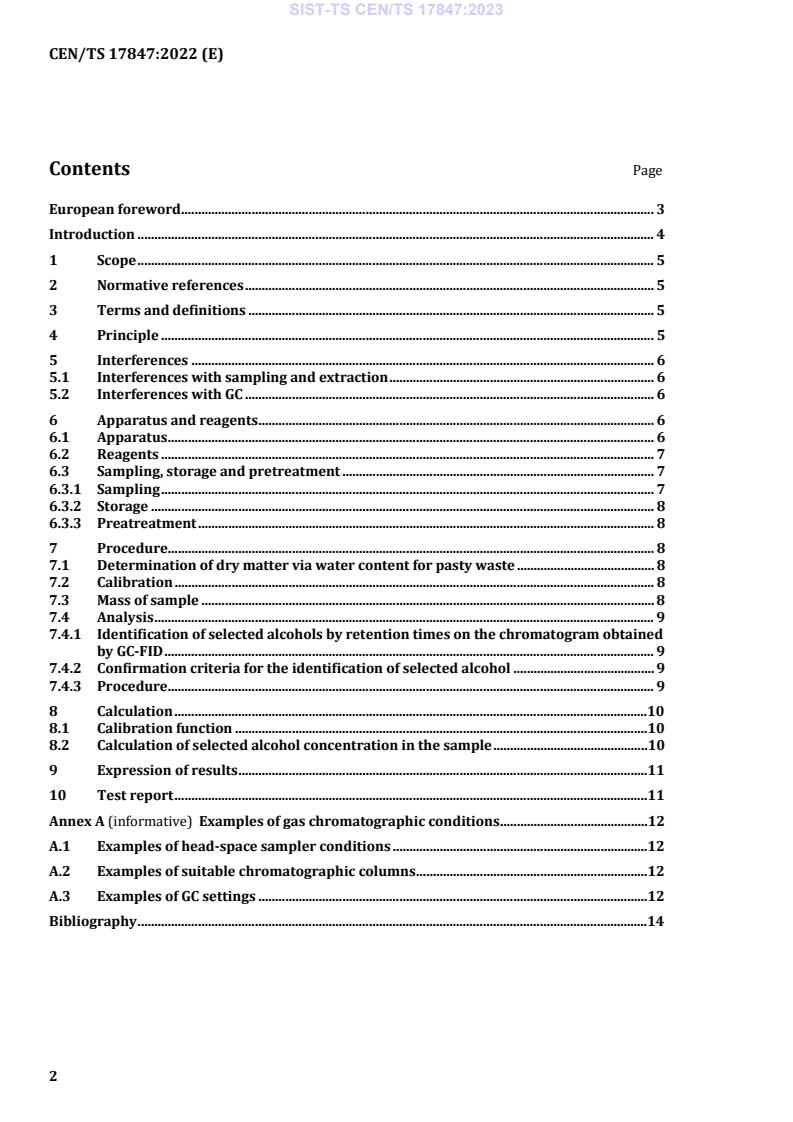
Contents Page
European foreword . 3
Introduction . 4
1 Scope . 5
2 Normative references . 5
3 Terms and definitions . 5
4 Principle . 5
5 Interferences . 6
5.1 Interferences with sampling and extraction . 6
5.2 Interferences with GC . 6
6 Apparatus and reagents . 6
6.1 Apparatus . 6
6.2 Reagents . 7
6.3 Sampling, storage and pretreatment . 7
6.3.1 Sampling . 7
6.3.2 Storage . 8
6.3.3 Preatreatment . 8
7 Procedure. 8
7.1 Determination of dry matter via water content for pasty waste . 8
7.2 Calibration . 8
7.3 Mass of sample . 8
7.4 Analysis . 9
7.4.1 Identification of selected alcohols by retention times on the chromatogram obtained
by GC-FID . 9
7.4.2 Confirmation criteria for the identification of selected alcohol . 9
7.4.3 Procedure. 9
8 Calculation .10
8.1 Calibration function .10
8.2 Calculation of selected alcohol concentration in the sample .10
9 Expression of results .11
10 Test report .11
Annex A (informative) Examples of gas chromatographic conditions .12
A.1 Examples of head-space sampler conditions .12
A.2 Examples of suitable chromatographic columns .12
A.3 Examples of GC settings .12
Bibliography .14
European foreword
This document (CEN/TS 17847:2022) has been prepared by Technical Committee CEN/TC 444
“Environmental characterization of solid matrices”, the secretariat of which is held by NEN.
Attention is drawn to the possibility that some of the elements of this document may be the subject of
patent rights. CEN shall not be held responsible for identifying any or all such patent rights.
Any feedback and questions on this document should be directed to the users’ national standards body.
A complete listing of these bodies can be found on the CEN website.
According to the CEN/CENELEC Internal Regulations, the national standards organisations of the
following countries are bound to announce this Technical Specification: Austria, Belgium, Bulgaria,
Croatia, Cyprus, Czech Republic, Denmark, Estonia, Finland, France, Germany, Greece, Hungary, Iceland,
Ireland, Italy, Latvia, Lithuania, Luxembourg, Malta, Netherlands, Norway, Poland, Portugal, Republic of
North Macedonia, Romania, Serbia, Slovakia, Slovenia, Spain, Sweden, Switzerland, Türkiye and the
United Kingdom.
Introduction
Directive 96/82/EC, as amended, requires transit/sorting/regrouping or waste treatment facilities to
assess the hazardous nature of their waste, in particular, from the point of view of the following categories
of hazards:
— very toxic or toxic to humans if swallowed, if there is contact with the skin or by inhalation, for
example;
— very toxic or toxic to the aquatic environment.
Based on knowledge of the composition of elements and substances of a waste, its hazard potential can
then be determined from the classification rules established for mixtures in waste legislation.
1 Scope
This document specifies a method for quantitative determination of the concentration of selected
alcohols with low boiling point in liquid waste and pasty waste by gas chromatography with flame
ionization detection after static headspace extraction.
Under the conditions specified in this document, a limit of application of 20 mg/kg, expressed on dry
matter for pasty waste and expressed on raw waste for liquid waste, can be achieved.
2 Normative references
The following documents are referred to in the text in such a way that some or all of their content
constitutes requirements of this document. For dated references, only the edition cited applies. For
undated references, the latest edition of the referenced document (including any amendments) applies.
EN 15934:2012, Sludge, treated biowaste, soil and waste - Calculation of dry matter fraction after
determination of dry residue or water content
EN 16179:2012, Sludge, treated biowaste and soil - Guidance for sample pretreatment
EN 15002:2015, Characterization of waste - Preparation of test portions from the laboratory sample
3 Terms and definitions
No terms and definitions are listed in this document.
ISO and IEC maintain terminological databases for use in standardization at the following addresses:
— ISO Online browsing platform: available at https://www.iso.org/obp
— IEC Electropedia: available at https://www.electropedia.org/
4 Principle
This method describes a gas chromatography (GC) method using a flame ionization detection (FID) after
an equilibrium-based static headspace preparation.
A specified quantity of extractant solution is added to a test portion of raw sample before any
pretreatment in a hermetically sealed vial with sufficient space for desorption of analytes into the gas
phase. The vial is heated in a thermostat at 80 °C until desorption equilibrium is reached.
A defined portion of the gas phase is injected into the gas chromatograph using two analytical columns
with different stationary phases, and the analytes are detected by a flame ionization detector. The amount
of each analyte is calculated using a calibration function established with external standards. An internal
standard is added in the extractant solution, for the retention time verification.
The list of analytes is given in Table 1.
Table 1 — Analytes, with CAS RN and boiling point
Substance CAS RN Boiling point
(°C)
Methanol (Me-OH) 67–56–1 64,5
Ethanol (Et-OH) 64–17–5 78,5
iso-Propanol (i-Pr-OH) 67–63–0 82,4
tert-Butanol (t-Bu-OH) 75–65–0 83,0
n-Propanol (Pr-OH) 71–23–8 97,1
iso-Butanol (i-Bu-OH) 78–83–1 108,0
n-Butanol (Bu-OH) 71–36–3 118,0
NOTE The method can be applied to other low boiling point analytes not specified in the scope provided
suitability is proven by proper in-house validation.
5 Interferences
5.1 Interferences with sampling and extraction
Use sampling glass containers. During storage of the samples, losses of alcohols can occur due to
volatilization. Sampling directly in head-space vials minimizes handling of samples and analytes loss.
Samples can be contaminated by diffusion of volatile organic compounds through the septum seal of the
sample vial during shipment and storage. A transport blank, prepared from extractant solution and
sample container and carried through sampling and handling protocols, serves as a check on such
contamination.
5.2 Interferences with GC
Substances that co-elute with analytes can interfere with the determination. These interferences can lead
to insufficient signal resolution and can, depending on their magnitude, affect accuracy and precision of
the analytical results. Two analytical columns with different stationay phases (6.1.5) are used to confirm
the identification of the selected alcohols.
6 Apparatus and reagents
6.1 Apparatus
Usual laboratory glassware.
All glassware and material that come into contact w
...