

SIST EN 16421:2015
(Main)Influence of materials on water for human consumption - Enhancement of microbial growth (EMG)
General Information
- Abstract
This European Standard specifies three methods for determining the ability of non-metallic materials to enhance the growth of micro-organisms.
This European Standard is applicable to those materials destined to be used under various conditions for the transport and storage of water intended for human consumption.
The standard allows for the testing of a single type of material, or a product in which only one material is in contact with water. It is unsuitable for use with assembled products where more than one material is exposed to water.
NOTE The results given by each method are not directly comparable.
- Status
- Published
- Public Enquiry End Date
- 25-Jul-2012
- Publication Date
- 18-Jan-2015
- Technical Committee
- IOVO - Water supply and waste water engineering
- Current Stage
- 6060 - National Implementation/Publication (Adopted Project)
- Start Date
- 06-Jan-2015
- Due Date
- 13-Mar-2015
- Completion Date
- 19-Jan-2015


Overview
SIST EN 16421:2015 - "Influence of materials on water for human consumption - Enhancement of microbial growth (EMG)" - is the European standard that defines laboratory methods to assess how non‑metallic materials influence microbial growth in drinking water. It specifies three independent test methods to determine whether a single material or a product containing only one material in contact with water can stimulate microbial proliferation or biofilm formation during transport and storage of water intended for human consumption. The standard is not suitable for assembled products where more than one material contacts water, and the results from the three methods are not directly comparable.
Key topics and technical requirements
- Scope and applicability
- Applies to non‑metallic materials destined for use in drinking‑water transport and storage.
- Tests single materials or single‑material products only.
- Three EMG test methods
- Method 1 - Biomass Production Potential (BPP) measured by ATP: quantifies microbial biomass generation potential using ATP measurements.
- Method 2 - Biofilm volume: measures the amount of biofilm formed on material surfaces after exposure to test water/flow conditions.
- Method 3 - Mean dissolved oxygen depletion: evaluates microbial activity by measuring oxygen consumption as an indicator of enhancement of microbial growth.
- Test design and controls
- Requires defined test water, inoculum controls and negative/positive controls to validate performance.
- Specifies sample preparation, pre‑treatment (e.g., flushing, stagnation, prewashing), incubation and measurement procedures.
- Includes requirements for test containers, modules (for pipes/hoses), and basic laboratory apparatus.
- Reporting
- Test reports must include material/product identification, test conditions, control performance and quantitative test results.
- Limitations
- Results from different methods are method‑specific and cannot be interchanged.
Applications - who uses this standard
- Manufacturers of pipes, hoses, storage tanks, fittings and polymeric components for drinking‑water systems use SIST EN 16421:2015 to evaluate material suitability and optimize formulations to limit microbial enhancement.
- Independent testing laboratories and accredited conformity assessment bodies apply the defined methods to produce comparable test reports for product claims and certification.
- Water utilities, installers and specifiers use results to select materials that minimise biofilm risk and operational problems (taste, odour, hygiene).
- Regulators and public health authorities reference EMG testing as part of material safety assessment in drinking‑water regulations and guidance.
Related standards
- EN 16421 is a CEN European Standard (also published as national identical versions, e.g., SIST EN 16421:2015). Laboratories often apply it alongside other drinking‑water and material contact standards when assessing overall compliance and safety.
Keywords: SIST EN 16421:2015, EMG, Enhancement of microbial growth, materials in contact with drinking water, biofilm testing, ATP biomass, dissolved oxygen depletion.
Relations
- Effective Date
- 25-Feb-2026
- Effective Date
- 28-Jan-2026
- Effective Date
- 28-Jan-2026
- Effective Date
- 28-Jan-2026
- Effective Date
- 28-Jan-2026
- Effective Date
- 28-Jan-2026
- Effective Date
- 28-Jan-2026
- Effective Date
- 28-Jan-2026
- Effective Date
- 28-Jan-2026
- Effective Date
- 28-Jan-2026
- Effective Date
- 28-Jan-2026
- Effective Date
- 28-Jan-2026
- Effective Date
- 28-Jan-2026
- Effective Date
- 28-Jan-2026
- Effective Date
- 28-Jan-2026
Get Certified
Connect with accredited certification bodies for this standard

BSI Group
BSI (British Standards Institution) is the business standards company that helps organizations make excellence a habit.

Bureau Veritas
Bureau Veritas is a world leader in laboratory testing, inspection and certification services.

DNV
DNV is an independent assurance and risk management provider.
Sponsored listings
Frequently Asked Questions
SIST EN 16421:2015 is a standard published by the Slovenian Institute for Standardization (SIST). Its full title is "Influence of materials on water for human consumption - Enhancement of microbial growth (EMG)". This standard covers: This European Standard specifies three methods for determining the ability of non-metallic materials to enhance the growth of micro-organisms. This European Standard is applicable to those materials destined to be used under various conditions for the transport and storage of water intended for human consumption. The standard allows for the testing of a single type of material, or a product in which only one material is in contact with water. It is unsuitable for use with assembled products where more than one material is exposed to water. NOTE The results given by each method are not directly comparable.
This European Standard specifies three methods for determining the ability of non-metallic materials to enhance the growth of micro-organisms. This European Standard is applicable to those materials destined to be used under various conditions for the transport and storage of water intended for human consumption. The standard allows for the testing of a single type of material, or a product in which only one material is in contact with water. It is unsuitable for use with assembled products where more than one material is exposed to water. NOTE The results given by each method are not directly comparable.
SIST EN 16421:2015 is classified under the following ICS (International Classification for Standards) categories: 07.100.20 - Microbiology of water; 13.060.20 - Drinking water; 67.250 - Materials and articles in contact with foodstuffs. The ICS classification helps identify the subject area and facilitates finding related standards.
SIST EN 16421:2015 has the following relationships with other standards: It is inter standard links to SIST EN ISO 10012:2026, SIST EN ISO 16266:2008, SIST EN 901:2025, oSIST prEN 1254-1:2007, SIST EN 14944-1:2023, SIST EN ISO 12402-6:2006, SIST EN ISO 10012:2003, SIST EN ISO 13385-1:2019, SIST EN 1484:1998, SIST EN ISO 9308-1:2014, SIST EN ISO 5814:2013, SIST EN ISO 13385-2:2020, SIST EN ISO 7393-2:2018, SIST EN ISO 10523:2012, SIST EN ISO 3696:1998. Understanding these relationships helps ensure you are using the most current and applicable version of the standard.
SIST EN 16421:2015 is associated with the following European legislation: EU Directives/Regulations: 88/183/EEC; Standardization Mandates: M/136 rev2. When a standard is cited in the Official Journal of the European Union, products manufactured in conformity with it benefit from a presumption of conformity with the essential requirements of the corresponding EU directive or regulation.
SIST EN 16421:2015 is available in PDF format for immediate download after purchase. The document can be added to your cart and obtained through the secure checkout process. Digital delivery ensures instant access to the complete standard document.
Standards Content (Sample)
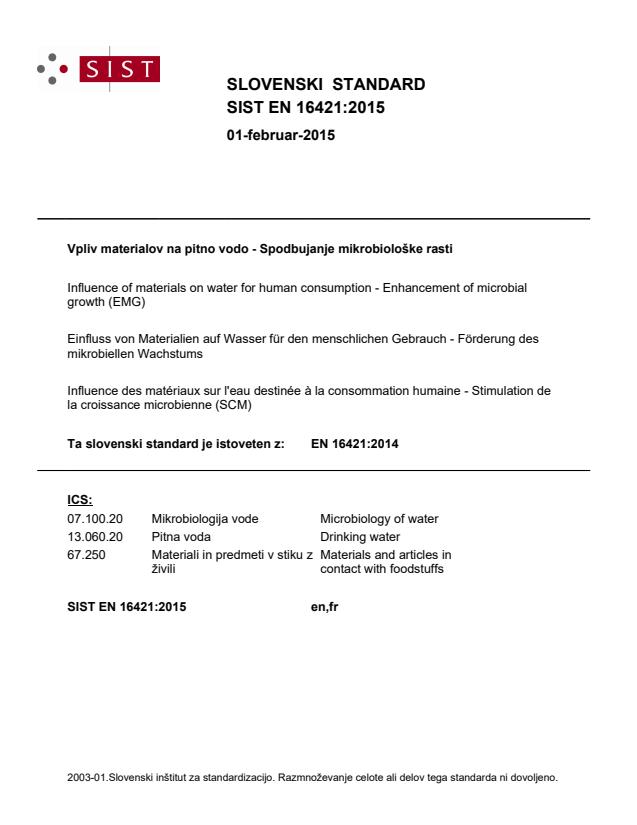
2003-01.Slovenski inštitut za standardizacijo. Razmnoževanje celote ali delov tega standarda ni dovoljeno.Vpliv materialov na pitno vodo - Spodbujanje mikrobiološke rastiEinfluss von Materialien auf Wasser für den menschlichen Gebrauch - Förderung des mikrobiellen WachstumsInfluence des matériaux sur l'eau destinée à la consommation humaine - Stimulation de la croissance microbienne (SCM)Influence of materials on water for human consumption - Enhancement of microbial growth (EMG)67.250Materiali in predmeti v stiku z živiliMaterials and articles in contact with foodstuffs13.060.20Pitna vodaDrinking water07.100.20Mikrobiologija vodeMicrobiology of waterICS:Ta slovenski standard je istoveten z:EN 16421:2014SIST EN 16421:2015en,fr01-februar-2015SIST EN 16421:2015SLOVENSKI
STANDARD
EUROPEAN STANDARD NORME EUROPÉENNE EUROPÄISCHE NORM
EN 16421
December 2014 ICS 07.100.20 English Version
Influence of materials on water for human consumption - Enhancement of microbial growth (EMG)
Influence des matériaux sur l'eau destinée à la consommation humaine - Stimulation de la croissance microbienne (SCM)
Einfluss von Materialien auf Wasser für den menschlichen Gebrauch - Förderung des mikrobiellen Wachstums This European Standard was approved by CEN on 25 October 2014.
CEN members are bound to comply with the CEN/CENELEC Internal Regulations which stipulate the conditions for giving this European Standard the status of a national standard without any alteration. Up-to-date lists and bibliographical references concerning such national standards may be obtained on application to the CEN-CENELEC Management Centre or to any CEN member.
This European Standard exists in three official versions (English, French, German). A version in any other language made by translation under the responsibility of a CEN member into its own language and notified to the CEN-CENELEC Management Centre has the same status as the official versions.
CEN members are the national standards bodies of Austria, Belgium, Bulgaria, Croatia, Cyprus, Czech Republic, Denmark, Estonia, Finland, Former Yugoslav Republic of Macedonia, France, Germany, Greece, Hungary, Iceland, Ireland, Italy, Latvia, Lithuania, Luxembourg, Malta, Netherlands, Norway, Poland, Portugal, Romania, Slovakia, Slovenia, Spain, Sweden, Switzerland, Turkey and United Kingdom.
EUROPEAN COMMITTEE FOR STANDARDIZATION
COMITÉ EUROPÉEN DE NORMALISATION EUROPÄISCHES KOMITEE FÜR NORMUNG
CEN-CENELEC Management Centre:
Avenue Marnix 17,
B-1000 Brussels © 2014 CEN All rights of exploitation in any form and by any means reserved worldwide for CEN national Members. Ref. No. EN 16421:2014 ESIST EN 16421:2015
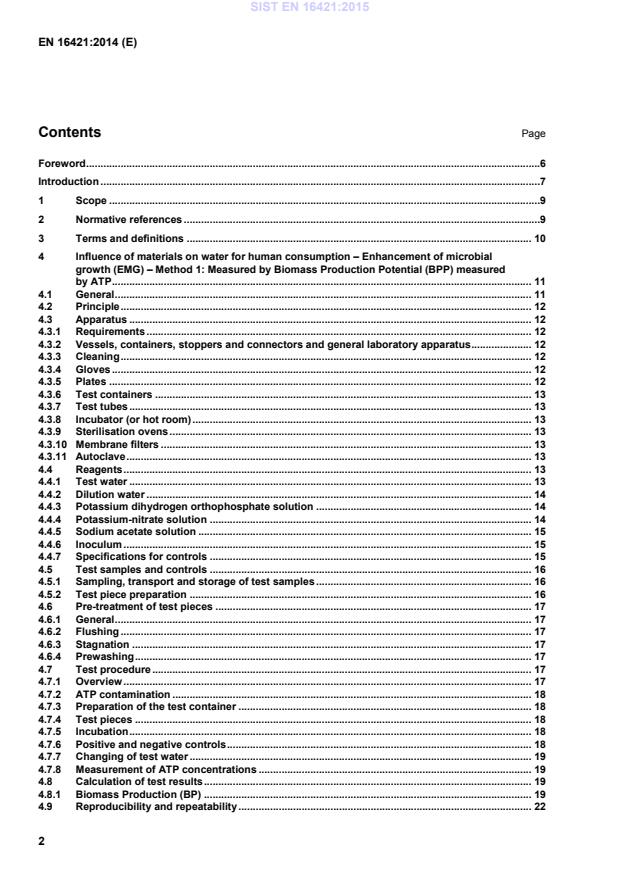
Method 1: Measured by Biomass Production Potential (BPP) measured by ATP – Assessment of the suitability of test water for its use in the BPP test (biological stability and the need for addition of trace elements) . 48 Annex B (normative)
Method 1: Measured by Biomass Production Potential (BPP) measured by ATP – Protocol of ATP analysis . 50 B.1 Introduction . 50 B.2 Apparatus and glassware . 50 B.3 Reagents and auxiliary substances . 50 B.3.1 General . 50 B.3.2 Sterile water . 50 B.3.3 ATP solutions for standard dilutions and calibration curves . 50 B.3.4 Luciferin/luciferase (enzyme) solution . 51 B.3.5 ATP extraction reagent . 52 B.4 Sampling . 52 B.5 Procedure . 52 B.5.1 General . 52 B.5.2 Blank water . 52 B.5.3 Control dilutions . 52 B.5.4 Samples . 52 B.6 Expression of results . 52 B.6.1 Water samples . 52 B.6.2 Material samples . 53 B.7 Test record . 53 SIST EN 16421:2015
Method 1: Measured by Biomass Production Potential (BPP) measured by ATP - ATP and its measurement . 55 Annex D (informative)
Method 1: Measured by Biomass Production Potential (BPP) measured by ATP – Evaluating procedures for removal of attached biomass . 56 D.1 Introduction . 56 D.2 Procedures for removal of Attached Biomass . 56 D.2.1 General . 56 D.2.2 Swabbing . 56 D.2.3 Low energy sonication (LES) . 56 D.2.4 High energy sonication (HES) . 56 D.3 Effectiveness of removal procedure . 57 Annex E (informative) Method 1: Measured by Biomass Production Potential (BPP) measured by ATP . 58 Annex F (informative)
Method 2: Measured by biofilm volume . 59 Annex G (informative)
Method 2: Measured by biofilm volume . 60 Annex H (informative)
Method 3: Measured by mean dissolved oxygen depletion . 63 Bibliography . 65
The results given by each method are not directly comparable. 2 Normative references The following documents, in whole or in part, are normatively referenced in this document and are indispensable for its application. For dated references, only the edition cited applies. For undated references, the latest edition of the referenced document (including any amendments) applies. EN 901, Chemicals used for treatment of water intended for human consumption — Sodium hypochlorite prEN 1254-1:2007, Copper and copper alloys — Plumbing fittings — Part 1: Fittings with ends for capillary soldering or capillary brazing to copper tubes EN 1484, Water analysis — Guidelines for the determination of total organic carbon (TOC) and dissolved organic carbon (DOC) EN 10088-1, Stainless steels — Part 1: List of stainless steels EN 14944-1, Influence of cementitious products on water intended for human consumption — Test methods — Part 1: Influence of factory made cementitious products on organoleptic parameters EN ISO 3696:1995, Water for analytical laboratory use — Specification and test methods (ISO 3696:1987) EN ISO 5814, Water quality — Determination of dissolved oxygen — Electrochemical probe method (ISO 5814) EN ISO 7393-2, Water quality — Determination of free chlorine and total chlorine — Part 2: Colorimetric method using N, N-diethyl-1, 4-phenylenediamine, for routine control purposes (ISO 7393-2) EN ISO 9308-1, Water quality — Enumeration of Escherichia coli and coliform bacteria — Part 1: Membrane filtration method for waters with low bacterial background flora (ISO 9308-1) EN ISO 10012, Measurement management systems — Requirements for measurement processes and measuring equipment (ISO 10012) EN ISO 10523, Water quality — Determination of pH (ISO 10523) EN ISO 13385-1, Geometrical product specifications (GPS) — Dimensional measuring equipment — Part 1: Callipers; Design and metrological characteristics (ISO 13385-1) EN ISO 13385-2, Geometrical product specifications (GPS) — Dimensional measuring equipment — Part 2: Calliper depth gauges; Design and metrological characteristics (ISO 13385-2) EN ISO 16266, Water quality — Detection and enumeration of Pseudomonas aeruginosa — Method by membrane filtration (ISO 16266) SIST EN 16421:2015
...