

SIST EN 16760:2016
(Main)Bio-based products - Life Cycle Assessment
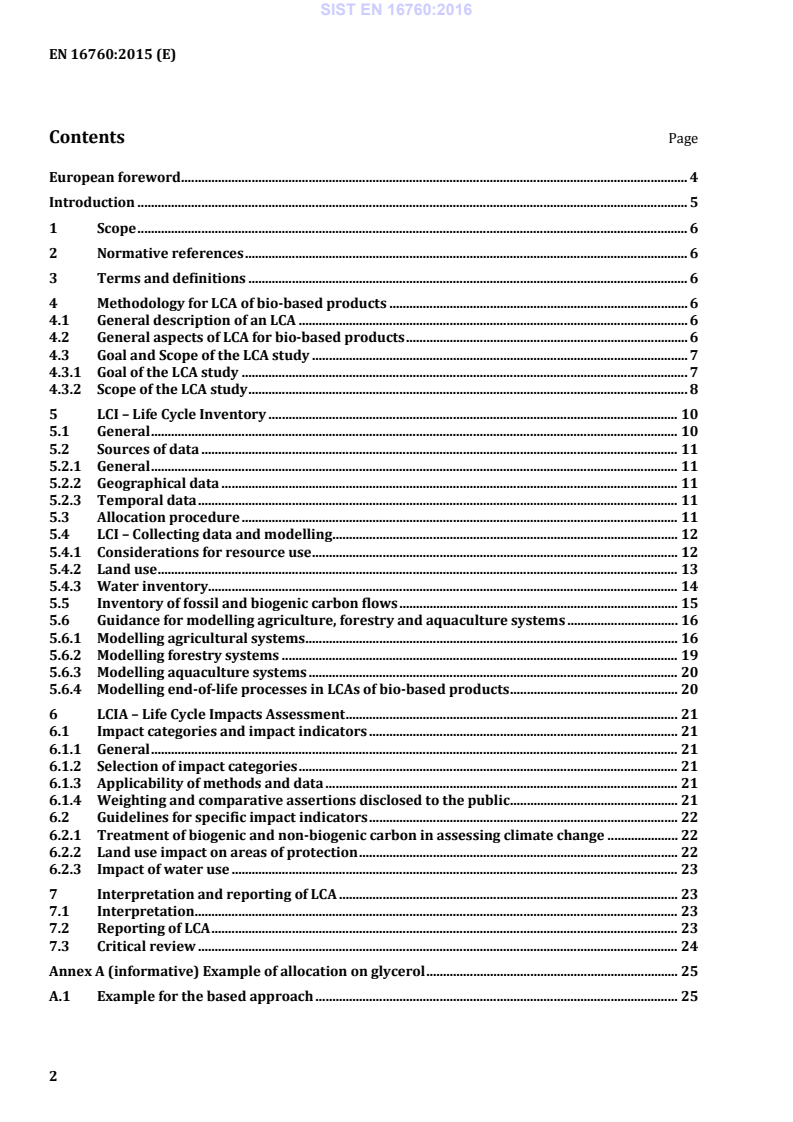
General Information
- Abstract
This European Standard provides specific life cycle assessment (LCA) requirements and guidance for bio-based products, excluding food, feed and energy, based on EN ISO 14040 and EN ISO 14044.
This European Standard covers bio-based products, derived wholly or partly from biomass.
This European Standard provides guidance and requirements to assess impact over the life cycle of bio-based products with the focus on how to handle the specificities of the bio-based part of the product.
The applications of LCA as such are outside the scope of this European Standard. Clarifications, considerations, practices, simplifications and options for the different applications, are also beyond the scope of this European Standard. In addition, this European Standard may be applied in studies that do not cover the whole life cycle, with justification e.g. in the case of business-to-business information, such as cradle-to-gate studies, gate-to-gate studies, and specific parts of the life cycle (e.g. waste management, components of a product).
- Status
- Published
- Public Enquiry End Date
- 14-Oct-2014
- Publication Date
- 13-Dec-2015
- Technical Committee
- I13 - Imaginarni 13
- Current Stage
- 6060 - National Implementation/Publication (Adopted Project)
- Start Date
- 08-Dec-2015
- Due Date
- 12-Feb-2016
- Completion Date
- 14-Dec-2015

Overview
EN 16760:2015 - published by CEN - defines Life Cycle Assessment (LCA) requirements and guidance specifically for bio‑based products (whole or partly derived from biomass). Based on EN ISO 14040 and EN ISO 14044, the standard focuses on how to handle the particularities of the bio‑based part of a product’s life cycle. Food, feed and energy uses are excluded, but the guidance can be applied to cradle‑to‑gate, gate‑to‑gate or other partial studies where justified.
Key SEO terms: EN 16760:2015, bio‑based products, Life Cycle Assessment, LCA, CEN, bio‑based content, biogenic carbon.
Key topics and technical requirements
- Scope and Goal Definition: Requires clear statement of intended application, audience and reasons for the LCA - consistent with ISO 14040/14044 principles.
- Whole‑product approach: LCA shall cover the entire product system (not only the bio‑based fraction), while giving special treatment to biomass‑related flows.
- Life Cycle Inventory (LCI): Guidance on data sources, geographical and temporal representativeness, data collection and modelling for bio‑based feedstocks.
- Allocation procedures: Specific requirements for handling co‑products common in biomass value chains.
- Resource accounting: Treatment of land use, water use, and other elementary flows relevant to biomass.
- Carbon flows: Detailed inventory guidance for fossil and biogenic carbon and how these are reported.
- Sector modelling: Practical modelling advice for agricultural, forestry and aquaculture systems, and for end‑of‑life processes of bio‑based products.
- Life Cycle Impact Assessment (LCIA): Selection of impact categories and indicators, including treatment of biogenic vs non‑biogenic carbon, land‑use impacts and water‑use impacts.
- Interpretation & Reporting: Requirements for transparency, critical review and public disclosure to support credible communication and declarations.
Applications and users
EN 16760:2015 is intended for:
- LCA practitioners and consultants preparing LCAs for bio‑based materials and products
- Product developers and manufacturers seeking consistent environmental assessment for bio‑based products
- Sustainability managers and procurement teams evaluating bio‑based alternatives
- Certification bodies and Product Category Rule (PCR) developers using LCA inputs for environmental declarations
- Policy makers and regulators needing harmonized LCA approaches for bio‑based product claims
Practical uses include cradle‑to‑gate carbon accounting, comparative LCAs, inputs to Type III environmental declarations, and as a harmonized basis for sustainability communication across the EU.
Related standards
- EN ISO 14040 (LCA - Principles and framework)
- EN ISO 14044 (LCA - Requirements and guidelines)
- EN 16575 (Bio‑based products - Vocabulary)
- EN ISO 14025 (Type III environmental declarations)
- prEN 16751 (linked guidance: criteria/uses referenced in EN 16760)
EN 16760:2015 provides targeted LCA rules for bio‑based products to improve consistency, transparency and credibility of environmental assessments and claims.
Relations
- Effective Date
- 15-Jul-2026
- Effective Date
- 28-Jan-2026
- Effective Date
- 28-Jan-2026
- Effective Date
- 28-Jan-2026
- Effective Date
- 28-Jan-2026
- Effective Date
- 28-Jan-2026
- Effective Date
- 28-Jan-2026
- Referred By
SIST EN 16935:2017 - Bio-based products - B2C reporting and communication - Requirements for claims - Effective Date
- 28-Jan-2026
- Effective Date
- 28-Jan-2026
- Effective Date
- 28-Jan-2026
- Referred By
SIST EN 17035:2022 - Surface active agents - Bio-based surfactants - Requirements and test methods - Effective Date
- 28-Jan-2026
- Effective Date
- 28-Jan-2026
- Effective Date
- 28-Jan-2026
- Effective Date
- 28-Jan-2026
Get Certified
Connect with accredited certification bodies for this standard

BSI Group
BSI (British Standards Institution) is the business standards company that helps organizations make excellence a habit.

Bureau Veritas
Bureau Veritas is a world leader in laboratory testing, inspection and certification services.

DNV
DNV is an independent assurance and risk management provider.
Sponsored listings
Frequently Asked Questions
SIST EN 16760:2016 is a standard published by the Slovenian Institute for Standardization (SIST). Its full title is "Bio-based products - Life Cycle Assessment". This standard covers: This European Standard provides specific life cycle assessment (LCA) requirements and guidance for bio-based products, excluding food, feed and energy, based on EN ISO 14040 and EN ISO 14044. This European Standard covers bio-based products, derived wholly or partly from biomass. This European Standard provides guidance and requirements to assess impact over the life cycle of bio-based products with the focus on how to handle the specificities of the bio-based part of the product. The applications of LCA as such are outside the scope of this European Standard. Clarifications, considerations, practices, simplifications and options for the different applications, are also beyond the scope of this European Standard. In addition, this European Standard may be applied in studies that do not cover the whole life cycle, with justification e.g. in the case of business-to-business information, such as cradle-to-gate studies, gate-to-gate studies, and specific parts of the life cycle (e.g. waste management, components of a product).
This European Standard provides specific life cycle assessment (LCA) requirements and guidance for bio-based products, excluding food, feed and energy, based on EN ISO 14040 and EN ISO 14044. This European Standard covers bio-based products, derived wholly or partly from biomass. This European Standard provides guidance and requirements to assess impact over the life cycle of bio-based products with the focus on how to handle the specificities of the bio-based part of the product. The applications of LCA as such are outside the scope of this European Standard. Clarifications, considerations, practices, simplifications and options for the different applications, are also beyond the scope of this European Standard. In addition, this European Standard may be applied in studies that do not cover the whole life cycle, with justification e.g. in the case of business-to-business information, such as cradle-to-gate studies, gate-to-gate studies, and specific parts of the life cycle (e.g. waste management, components of a product).
SIST EN 16760:2016 is classified under the following ICS (International Classification for Standards) categories: 13.020.55 - Biobased products; 13.020.60 - Product life-cycles. The ICS classification helps identify the subject area and facilitates finding related standards.
SIST EN 16760:2016 has the following relationships with other standards: It is inter standard links to SIST EN ISO 14025:2026, SIST EN ISO 14044:2006, SIST EN ISO 14025:2010, SIST EN 16575:2014, SIST EN ISO 14040:2006, SIST-TP CEN/TR 17611:2021, SIST-TS CEN/TS 16766:2015, SIST EN 16935:2017, SIST-TS CEN/TS 17035:2018, SIST-TP CEN/TR 16957:2016, SIST EN 17035:2022, SIST-TP CEN/TR 17612:2021, SIST EN 18027:2025, SIST EN 16766:2018. Understanding these relationships helps ensure you are using the most current and applicable version of the standard.
SIST EN 16760:2016 is associated with the following European legislation: Standardization Mandates: M/492. When a standard is cited in the Official Journal of the European Union, products manufactured in conformity with it benefit from a presumption of conformity with the essential requirements of the corresponding EU directive or regulation.
SIST EN 16760:2016 is available in PDF format for immediate download after purchase. The document can be added to your cart and obtained through the secure checkout process. Digital delivery ensures instant access to the complete standard document.
Standards Content (Sample)
2003-01.Slovenski inštitut za standardizacijo. Razmnoževanje celote ali delov tega standarda ni dovoljeno.Bioizdelki - Ocenjevanje življenjskega ciklaBiobasierte Produkte - ÖkobilanzenProduits biosourcés - Analyse du cycle de vieBio-based products - Life Cycle Assessment13.020.60Življenjski ciklusi izdelkovProduct life-cyclesICS:Ta slovenski standard je istoveten z:EN 16760:2015SIST EN 16760:2016en,fr,de01-januar-2016SIST EN 16760:2016SLOVENSKI
STANDARD
EUROPEAN STANDARD NORME EUROPÉENNE EUROPÄISCHE NORM
EN 16760
November
t r s w ICS
s uä r t rä x r English Version
Bioæbased products æ Life Cycle Assessment Produits biosourcés æ Analyse du cycle de vie
Biobasierte Produkte æ Ökobilanzen This European Standard was approved by CEN on
s y October
t r s wä
egulations which stipulate the conditions for giving this European Standard the status of a national standard without any alterationä Upætoædate lists and bibliographical references concerning such national standards may be obtained on application to the CENæCENELEC Management Centre or to any CEN memberä
translation under the responsibility of a CEN member into its own language and notified to the CENæCENELEC Management Centre has the same status as the official versionsä
CEN members are the national standards bodies of Austriaá Belgiumá Bulgariaá Croatiaá Cyprusá Czech Republicá Denmarká Estoniaá Finlandá Former Yugoslav Republic of Macedoniaá Franceá Germanyá Greeceá Hungaryá Icelandá Irelandá Italyá Latviaá Lithuaniaá Luxembourgá Maltaá Netherlandsá Norwayá Polandá Portugalá Romaniaá Slovakiaá Sloveniaá Spainá Swedená Switzerlandá Turkey and United Kingdomä
EUROPEAN COMMITTEE FOR STANDARDIZATION COMITÉ EUROPÉEN DE NORMALISATION EUROPÄISCHES KOMITEE FÜR NORMUNG
CEN-CENELEC Management Centre:
Avenue Marnix 17,
B-1000 Brussels
t r s w CEN All rights of exploitation in any form and by any means reserved worldwide for CEN national Membersä Refä Noä EN
s x y x rã t r s w ESIST EN 16760:2016
1 A Mandate is a standardization task embedded in European trade laws. M/492 Mandate is addressed to the European Standardization bodies, CEN, CENELEC and ETSI, for the development of horizontal European Standards for bio-based products. SIST EN 16760:2016
Figure 1 — Example of a product system of a bio-based product which includes biomass as well as non-biogenic material feedstocks NOTE 1 The boxes linked with bold arrows in Figure 1 represent the flows of bio-based products (partly or fully derived from biomass) that can be raw materials, intermediary products and final product. NOTE 2 For simplification purposes, transportation steps have not been reported in Figure 1, but transportation can occur between any of the unit processes. This European Standard provides additional requirements and guidelines for bio-based products on: Goal and scope (see 4.3), Life Cycle Inventory - LCI (see Clause 5), Life Cycle Impact Assessment - LCIA (see Clause 6) and Interpretation and reporting (see Clause 7). An LCA for a bio-based product shall include the four phases of LCA. LCA requirements and guidelines are provided in EN ISO 14044:2006, 4.2, 4.3, 4.4 and 4.5. This European Standard provides further guidance on the following, which can be important for bio-based products, due to their biomass origin: — geographical (see 5.2.2) and temporal scope (see 5.2.3) to be representative for the biomass acquisition phase considering agricultural, forest and aquaculture specificities; — allocation procedures (see 5.3) as the production stages typically generates co-products; — consideration for resource elementary flows (see 5.4.1); — data collection and modelling for land use (see 5.4.2), water use (see 5.4.3), and fossil and biogenic carbon flows (see 5.5); — modelling of agriculture, forestry and aquaculture systems (see 5.6); and — inventory and modelling requirements for bio-based products end-of-life (see 5.6.4). This series of European Standards focuses on bio-based products for industrial applications; food, feed and energy are excluded from the scope. However the guidelines and requirements for LCA provided in this standard can be applied to any product derived from biomass, irrespective of the application. 4.3 Goal and Scope of the LCA study 4.3.1 Goal of the LCA study When defining the goal and scope of the LCA study, the requirements of EN ISO 14040:2006, 5.2.1 and EN ISO 14044:2006, 4.2.2 and 4.2.3 shall apply. There is no single solution as to how LCA can best be applied, it will depend on the goal of the LCA and on each organization's size, its products, the strategy, the internal systems, tools and procedures and the external drivers. SIST EN 16760:2016
2 Formally, Step 1 is not part of the allocation procedure. SIST EN 16760:2016
use of fertilizers on the field; — irrigation; — land occupation and transformation; — soil management; and — activities for the production of agricultural inputs such as mineral fertilizers and fuels. It is noted that agricultural field work is complex, and practices vary significantly across farms and regions. Many parameters influence LCA impacts of agriculture, including intensification and optimization of production practices. At the same time (resource-, energy-, emission-) efficiency and thus the resulting environmental interventions mirrored in LCA of agricultural production, vary significantly amongst the (a) type of crop cultivated (b) management regime (fertilizer, pesticide, mechanization, irrigation, tillage practices) (c) soil and climate characteristics (hence location and time), (d) farm practices for (potential) conservation and drying steps of harvest etc. The following guidance is intended for practitioner
...