

oSIST prEN 17093:2026
(Main)Domestic appliances used for drinking water treatment not connected to water supply - Jug water filter systems - Safety and performance requirements, labeling and information to be supplied
General Information
- Abstract
This European Standard describes the specifications and test methods for gravity fed devices for conditioning of drinking water that are not connected to the mains water distribution system in buildings, known as jug water filter systems. It also gives instructions for the user manuals, so that the jug water filter system can be used and maintained properly. Jug water filter systems are intended to modify the properties of drinking water only, and are not designed to make non-potable water safe for drinking. The scope of this document does not extend to combination systems that require an electrical power supply such as water heaters and water coolers systems.
NOTE 1 Although jug water filter systems are covered by the widely harmonized food legislation (EU Regulations 178/2002 and 1935/2004), existing national regulations concerning the use and or the characteristics of these products remain in force
NOTE 2 This standard provides no information as to whether the product is used without restriction in any of the Member States of the EU or EFTA.
- Status
- Not Published
- Public Enquiry End Date
- 24-Nov-2026
- Technical Committee
- I13 - Imaginarni 13
- Current Stage
- 4020 - Public enquire (PE) (Adopted Project)
- Start Date
- 05-Oct-2026
- Due Date
- 22-Feb-2027

Relations
- Effective Date
- 18-Feb-2026
Get Certified
Connect with accredited certification bodies for this standard

CIS Institut d.o.o.
Personal Protective Equipment (PPE) certification body. Notified Body NB-2890 for EU Regulation 2016/425 PPE.

Kiwa BDA Testing
Building and construction product certification.
Kmetijski inštitut Slovenije
Agricultural Institute of Slovenia. Soil testing, plant health, agricultural product analysis.
Sponsored listings
Frequently Asked Questions
oSIST prEN 17093:2026 is a draft published by the Slovenian Institute for Standardization (SIST). Its full title is "Domestic appliances used for drinking water treatment not connected to water supply - Jug water filter systems - Safety and performance requirements, labeling and information to be supplied". This standard covers: This European Standard describes the specifications and test methods for gravity fed devices for conditioning of drinking water that are not connected to the mains water distribution system in buildings, known as jug water filter systems. It also gives instructions for the user manuals, so that the jug water filter system can be used and maintained properly. Jug water filter systems are intended to modify the properties of drinking water only, and are not designed to make non-potable water safe for drinking. The scope of this document does not extend to combination systems that require an electrical power supply such as water heaters and water coolers systems. NOTE 1 Although jug water filter systems are covered by the widely harmonized food legislation (EU Regulations 178/2002 and 1935/2004), existing national regulations concerning the use and or the characteristics of these products remain in force NOTE 2 This standard provides no information as to whether the product is used without restriction in any of the Member States of the EU or EFTA.
This European Standard describes the specifications and test methods for gravity fed devices for conditioning of drinking water that are not connected to the mains water distribution system in buildings, known as jug water filter systems. It also gives instructions for the user manuals, so that the jug water filter system can be used and maintained properly. Jug water filter systems are intended to modify the properties of drinking water only, and are not designed to make non-potable water safe for drinking. The scope of this document does not extend to combination systems that require an electrical power supply such as water heaters and water coolers systems. NOTE 1 Although jug water filter systems are covered by the widely harmonized food legislation (EU Regulations 178/2002 and 1935/2004), existing national regulations concerning the use and or the characteristics of these products remain in force NOTE 2 This standard provides no information as to whether the product is used without restriction in any of the Member States of the EU or EFTA.
oSIST prEN 17093:2026 is classified under the following ICS (International Classification for Standards) categories: 13.060.20 - Drinking water; 97.040.99 - Other kitchen equipment. The ICS classification helps identify the subject area and facilitates finding related standards.
oSIST prEN 17093:2026 has the following relationships with other standards: It is inter standard links to SIST EN 17093:2018. Understanding these relationships helps ensure you are using the most current and applicable version of the standard.
oSIST prEN 17093:2026 is available in PDF format for immediate download after purchase. The document can be added to your cart and obtained through the secure checkout process. Digital delivery ensures instant access to the complete standard document.
Standards Content (Sample)
SLOVENSKI STANDARD
01-november-2026
Gospodinjske naprave, ki se uporabljajo za čiščenje pitne vode in niso priključene
na vodovodno omrežje - Sistemi za filtriranje vode v vrčih - Varnostne zahteve za
delovanje, označevanje in podatki, ki morajo biti navedene
Domestic appliances used for drinking water treatment not connected to water supply -
Jug water filter systems - Safety and performance requirements, labeling and information
to be supplied
Leitungsungebundene Haushaltsgeräte zur Behandlung von Trinkwasser -
Haushaltswasserfiltersysteme - Sicherheits- und Leistungsanforderungen,
Kennzeichnung und mitzuliefernde Informationen
Appareils domestiques de traitement de l'eau non connectés au réseau d'alimentation en
eau - Systèmes de carafes filtrantes d'eau - Exigences de sécurité et de performance,
étiquetage et informations à fournir
Ta slovenski standard je istoveten z: prEN 17093
ICS:
13.060.20 Pitna voda Drinking water
97.040.99 Druga kuhinjska oprema Other kitchen equipment
2003-01.Slovenski inštitut za standardizacijo. Razmnoževanje celote ali delov tega standarda ni dovoljeno.
DRAFT
EUROPEAN STANDARD
NORME EUROPÉENNE
EUROPÄISCHE NORM
September 2026
ICS 97.040.99 Will supersede EN 17093:2018
English Version
Domestic appliances used for drinking water treatment
not connected to water supply - Jug water filter systems -
Safety and performance requirements, labeling and
information to be supplied
Appareils domestiques de traitement de l'eau non Leitungsungebundene Haushaltsgeräte zur
connectés au réseau d'alimentation en eau - Systèmes Behandlung von Trinkwasser -
de carafes filtrantes d'eau - Exigences de sécurité et de Haushaltswasserfiltersysteme - Sicherheits- und
performance, étiquetage et informations à fournir Leistungsanforderungen, Kennzeichnung und
mitzuliefernde Informationen
This draft European Standard is submitted to CEN members for enquiry. It has been drawn up by the Technical Committee
CEN/TC 426.
If this draft becomes a European Standard, CEN members are bound to comply with the CEN/CENELEC Internal Regulations
which stipulate the conditions for giving this European Standard the status of a national standard without any alteration.
This draft European Standard was established by CEN in three official versions (English, French, German). A version in any other
language made by translation under the responsibility of a CEN member into its own language and notified to the CEN-CENELEC
Management Centre has the same status as the official versions.
CEN members are the national standards bodies of Austria, Belgium, Bulgaria, Croatia, Cyprus, Czech Republic, Denmark, Estonia,
Finland, France, Germany, Greece, Hungary, Iceland, Ireland, Italy, Latvia, Lithuania, Luxembourg, Malta, Netherlands, Norway,
Poland, Portugal, Republic of North Macedonia, Romania, Serbia, Slovakia, Slovenia, Spain, Sweden, Switzerland, Türkiye and
United Kingdom.
Recipients of this draft are invited to submit, with their comments, notification of any relevant patent rights of which they are
aware and to provide supporting documentation.
Warning : This document is not a European Standard. It is distributed for review and comments. It is subject to change without
notice and shall not be referred to as a European Standard.
EUROPEAN COMMITTEE FOR STANDARDIZATION
COMITÉ EUROPÉEN DE NORMALISATION
EUROPÄISCHES KOMITEE FÜR NORMUNG
CEN-CENELEC Management Centre: Rue de la Science 23, B-1040 Brussels
© 2026 CEN All rights of exploitation in any form and by any means reserved Ref. No. prEN 17093:2026 E
worldwide for CEN national Members.
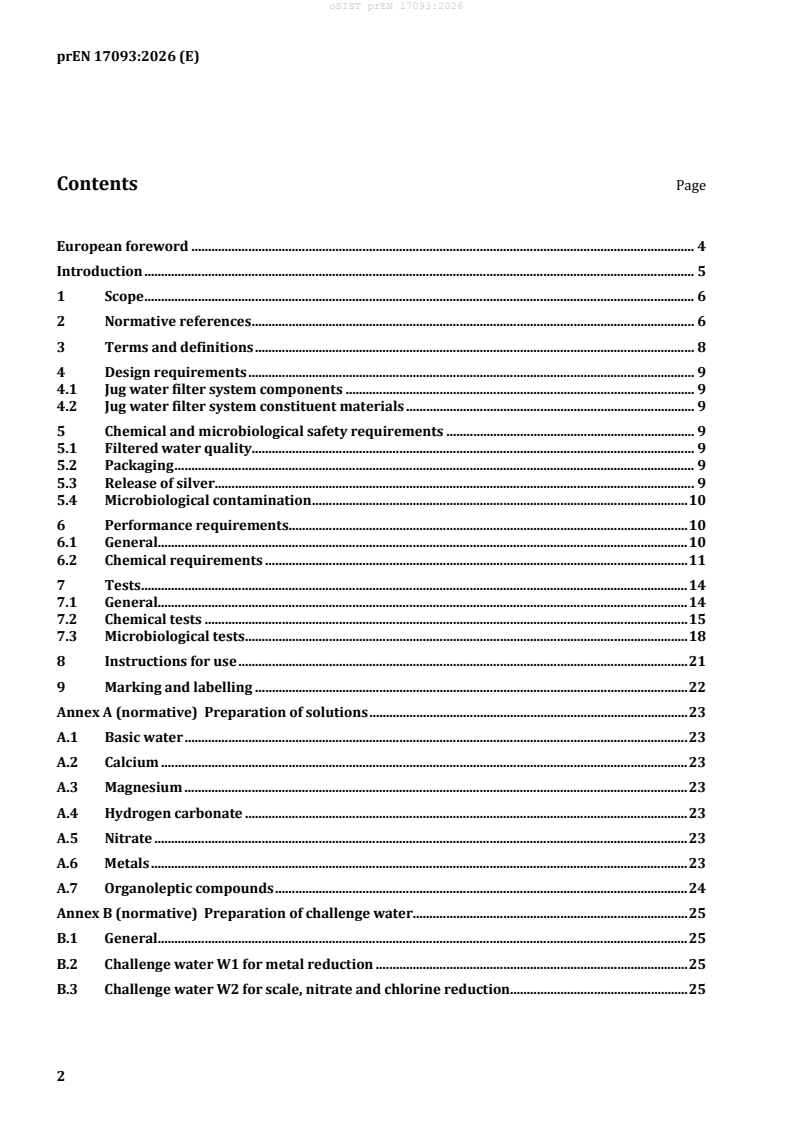
Contents Page
European foreword . 4
Introduction . 5
1 Scope . 6
2 Normative references . 6
3 Terms and definitions . 8
4 Design requirements . 9
4.1 Jug water filter system components . 9
4.2 Jug water filter system constituent materials . 9
5 Chemical and microbiological safety requirements . 9
5.1 Filtered water quality. 9
5.2 Packaging . 9
5.3 Release of silver . 9
5.4 Microbiological contamination . 10
6 Performance requirements . 10
6.1 General. 10
6.2 Chemical requirements . 11
7 Tests . 14
7.1 General. 14
7.2 Chemical tests . 15
7.3 Microbiological tests . 18
8 Instructions for use . 21
9 Marking and labelling . 22
Annex A (normative) Preparation of solutions . 23
A.1 Basic water . 23
A.2 Calcium . 23
A.3 Magnesium . 23
A.4 Hydrogen carbonate . 23
A.5 Nitrate . 23
A.6 Metals . 23
A.7 Organoleptic compounds . 24
Annex B (normative) Preparation of challenge water. 25
B.1 General. 25
B.2 Challenge water W1 for metal reduction . 25
B.3 Challenge water W2 for scale, nitrate and chlorine reduction . 25
B.4 Challenge water W3 for the improvement of organoleptic characteristics and
reduction of PFAS . 26
B.5 Challenge water for microbiological challenge . 27
Annex C (informative) Examples of filtration and sampling schedule for chemical tests . 29
C.1 Example of sampling schedule for a cartridge with a nominal capacity of 100 l. 29
Annex D (informative) Examples of the microbiological test procedure . 30
Annex E (normative) Scale reduction by boiling test . 32
E.1 General . 32
E.2 Test equipment. 32
E.3 Test procedure . 32
E.4 Acceptance criteria . 33
Annex F (normative) Synopsis of test procedures and analytical methods . 34
Annex G (informative) Examples of test report for each jug . 35
Annex H (normative) Substance-specific reduction claims. 36
Annex I (informative) Conversion table . 37
Annex J (normative) Seal verification test . 38
J.1 Mechanical tests . 38
J.2 Method for low cartridge leakage . 38
J.3 Method for the cartridge leakage . 38
J.4 Control flow rate . 39
Bibliography . 40
European foreword
This document (prEN 17093:2026) has been prepared by Technical Committee CEN/TC 426 “Domestic
appliances used for water treatment not connected to water supply”, the secretariat of which is held by
UNI.
This document is currently submitted to the CEN Enquiry.
This document will supersede EN 17093:2018.
This document includes the following significant technical changes with respect to EN 17093:2018:
— addition of reduction of PFAS as chemical requirement;
— addition of free chlorine reduction as chemical requirement.
Introduction
Jug water filter systems are used for the conditioning of drinking water with the objective of optimizing
drinking water for specific applications.
1 Scope
This document describes the specifications and test methods for gravity fed devices for conditioning of
drinking water that are not connected to the mains water distribution system in buildings, known as jug
water filter systems. It also gives instructions for the user manuals, so that the jug water filter system
can be used and maintained properly. Jug water filter systems are intended to modify the properties of
drinking water only and are not designed to make non-potable water safe for drinking. The scope of this
document does not extend to combination systems that require an electrical power supply such as
water heaters and water coolers systems.
NOTE Although jug water filter systems are covered by the widely harmonized food legislation (EU
Regulations 178/2002 and 1935/2004), existing national regulations concerning the use and or the
characteristics of these products remain in force.
2 Normative references
The following documents are referred to in the text in such a way that some or all of their content
constitutes requirements of this document. For dated references, only the edition cited applies. For
undated references, the latest edition of the referenced document (including any amendments) applies.
EN 12673, Water quality - Gas chromatographic determination of some selected chlorophenols in water
EN 12903, Products used for the treatment of water intended for human consumption - Powdered
activated carbon
EN 12904, Products used for treatment of water intended for human consumption - Silica sand and silica
gravel
EN 12905, Products used for treatment of water intended for human consumption - Expanded
aluminosilicate
EN 12906, Products used for treatment of water intended for human consumption - Pumice
EN 12907, Products used for treatment of water intended for human consumption - Pyrolyzed coal
material
EN 12909, Products used for treatment of water intended for human consumption - Anthracite
EN 12910, Products used for treatment of water intended for human consumption - Garnet
EN 12911, Products used for treatment of water intended for human consumption - Manganese greensand
EN 12912, Products used for treatment of water intended for human consumption - Barite
EN 12913, Products used for treatment of water intended for human consumption - Powdered
diatomaceous earth
EN 12914, Products used for treatment of water intended for human consumption - Powdered perlite
EN 12915-1, Products used for the treatment of water intended for human consumption - Granular
activated carbon - Part 1: Virgin granular activated carbon
EN 13752, Products used for treatment of water intended for human consumption - Manganese dioxide
EN 13753, Products used for treatment of water intended for human consumption - Granular activated
alumina
EN 13754, Products used for treatment of water intended for human consumption - Bentonite
EN 14368, Products used for treatment of water intended for human consumption - Manganese dioxide
coated limestone
EN 14369, Products used for treatment of water intended for human consumption - Iron-coated granular
activated alumina
EN 17892, Water quality - Determination of selected per- and polyfluoroalkyl substances in drinking
water - Method using liquid chromatography/tandem-mass spectrometry (LC-MS/MS)
EN 26777, Water quality - Determination of nitrite - Molecular absorption spectrometric method (ISO
6777)
EN ISO 3696, Water for analytical laboratory use - Specification and test methods (ISO 3696)
EN ISO 7393-2, Water quality - Determination of free chlorine and total chlorine - Part 2: Colorimetric
method using N,N-dialkyl-1,4-phenylenediamine, for routine control purposes (ISO 7393-2)
EN ISO 9308-1, Water quality - Enumeration of Escherichia coli and coliform bacteria - Part 1: Membrane
filtration method for waters with low bacterial background flora (ISO 9308-1)
EN ISO 9963-1, Water quality - Determination of alkalinity - Part 1: Determination of total and composite
alkalinity (ISO 9963-1)
EN ISO 10301, Water quality - Determination of highly volatile halogenated hydrocarbons - Gas-
chromatographic methods (ISO 10301)
EN ISO 10304-1, Water quality - Determination of dissolved anions by liquid chromatography of ions -
Part 1: Determination of bromide, chloride, fluoride, nitrate, nitrite, phosphate and sulfate (ISO 10304-1)
EN ISO 10523, Water quality - Determination of pH (ISO 10523)
EN ISO 13395, Water quality - Determination of nitrite nitrogen and nitrate nitrogen and the sum of both
by flow analysis (CFA and FIA) and spectrometric detection (ISO 13395)
EN ISO 11885, Water quality - Determination of selected elements by inductively coupled plasma optical
emission spectrometry (ICP-OES) (ISO 11885)
EN ISO 17294-2, Water quality - Application of inductively coupled plasma mass spectrometry (ICP-MS) -
Part 2: Determination of selected elements including uranium isotopes (ISO 17294-2)
ISO 6059, Water quality — Determination of the sum of calcium and magnesium — EDTA titrimetric
method
ISO 7890-3, Water quality — Determination of nitrate — Part 3: Spectrometric method using
sulfosalicylic acid
3 Terms and definitions
For the purposes of this document, the following terms and definitions apply.
ISO and IEC maintain terminology databases for use in standardization at the following addresses:
— ISO Online browsing platform: available at https://www.iso.org/obp/
— IEC Electropedia: available at https://www.electropedia.org/
3.1
active medium
active material that significantly changes the composition of the water by physical or chemical
processes
3.2
cartridge
replaceable or rechargeable component, which contains the active medium through which the water
passes in order to be treated
3.3
cartridge replacement indicator
device indicating the need to replace a cartridge
3.4
challenge water
water spiked with chemicals or inoculated with bacteria, used for carrying out the tests
3.5
filtrate
water that has passed through the filter active medium
3.6
flow rate
time taken for one litre of water to pass through the cartridge
3.7
hopper
separate, removable or non-removable chamber that contains the water before it passes through the
active medium
3.8
jug
receptacle that collects the filtrate
3.9
jug water filter system
freestanding water filter device, not connected to a water supply system
3.10
maximum usage time
time in weeks specified by the manufacturer up to which hygienic conditions of the filter are
maintained subject to correct operation in accordance with manufacturer’s instructions
3.11
nominal capacity
(NC)
volume in litres of treated water stated by the manufacturer, up to which cartridge performances are
guaranteed
4 Design requirements
4.1 Jug water filter system components
The jug water filter system can comprise some or all of the following components:
a) jug;
b) hopper;
c) cartridge;
d) cartridge replacement indicator;
e) lid.
NOTE The components of a jug water filter system can vary and might include parts other than those listed.
However, this list is representative of most jug water filter systems currently available.
4.2 Jug water filter system constituent materials
All materials used in the jug water filter system coming into contact with inlet water and filtrate shall
meet the regulations for materials in contact with food [11] [12].
The active media shall comply with the requirements relating to the water extractable chemical
parameters in EN 12903, EN 12904, EN 12905, EN 12906, EN 12907, EN 12909, EN 12910, EN 12911,
EN 12912, EN 12913, EN 12914, EN 12915-1, EN 13752, EN 13753, EN 13754, EN 14368, and
EN 14369 as appropriate.
For the use of an ion exchange resin, ResAP (2004) 3 [14] shall be considered.
5 Chemical and microbiological safety requirements
5.1 Filtered water quality
For compliance with this European Standard, instructions on the filtered water quality can be found in
the European drinking water Directive 2020/2184/EU, Annex 1, Part A and B and any subsequent
amendments [1] or appropriate food legislation.
5.2 Packaging
Filter cartridges shall be adequately protected from mechanical damage during shipment and storage.
They shall also be individually, hygienically packed to prevent contamination during shipment and
storage.
5.3 Release of silver
There is no European regulated limit governing the amount of silver in drinking water. Taking into
consideration the information provided in the WHO Guidelines [15], if the cartridge is treated with
silver, the average silver concentration when tested in accordance with 7.2.5.3 shall not exceed 80 µg/l.
When testing for silver leachate in a new cartridge, an initial volume of water specified shall be
discarded before commencement of use and before testing is carried out.
5.4 Microbiological contamination
5.4.1 Condition on the new cartridge
The new cartridge as delivered to the consumer shall not contain numbers or concentrations of micro-
organisms constituting a potential danger to the health of the user.
When tested in accordance with 7.3.2 sterile filtered challenge water after filtration by a new jug water
filter system, shall comply with the microbiological requirements. More instructions can be found in the
Drinking Water Directive 2020/2184/EC, Annex 1, Part A [1], as applicable to tap water.
5.4.2 Potential for colonisation of the jug water filter system
During normal use, the jug water filter system shall not promote microbiological growth, therefore, a
microbiological challenge test according to 7.3.3 shall be carried out.
When tested in accordance with 7.3.3, the sum of the Colony Forming Units (CFU) counts of E.coli for
day 2 to day 4 shall not exceed twice the CFU counts of the challenge water, for each of the two
challenge weeks.
6 Performance requirements
6.1 General
6.1.1 Compliance with this standard may only be claimed if the jug water filter system has been tested
as a complete unit.
The jug water filter system shall only be assessed against the performance claims relevant to the
parameters present in the standard.
At least one parameter shall be identified in those performance claims based on the nominal capacity in
litres.
If more than one performance parameter is declared for the jug water filter system, the performance
parameter with the lowest capacity (in litres) defines the maximum capacity declared.
All claims made to this standard shall be clearly separated from other claims or information.
6.1.2 Any additional substance reduction claims (see Annex H) not specifically mentioned in this
standard but tested according to the procedures specified in Clause 7 shall have a reduction rate of at
least 90 %.
6.1.3 If a filter cartridge, which has been confirmed to comply with this standard in a specific jug
water filter system, is to be used in an alternative system (hopper and jug), compliance of the
alternative system can be assumed if:
a) the cartridge has been tested in the jug water filter system with the highest water level above the
cartridge (the reference system), and
b) a seal verification confirms that the cartridge fits into the alternative jug water filter system(s) with
the same seal tightness as in the reference system (see Annex J);
c) the contact time for the cartridge is not less than 90 % of that for the originally tested system.
6.2 Chemical requirements
6.2.1 Reduction of metal contents
When tested according to 7.2.5.2, the average of all of the daily composite filtered water samples from
each jug water filter system shall meet the minimum average percentage reduction of the concentration
of all of the challenge water according to Table 1 the metal parameters tested.
Table 1 — Metal reduction requirements
Parameter Concentration unit challenge water Minimum average
a
Concentration Ci
for water W1 (Annex B) percentage reduction
+40
Aluminium µg/l Al 60
−20
Copper mg/l Cu +0,6 80
−03,
Lead µg/l Pb +20 90
−10
+16
Nickel µg/l Ni 75
−10
a
The concentration of aluminium in the challenge water W1 is equal to the parametric value laid down in the
Drinking Water Directive; the concentrations of copper, lead and nickel are greater than the corresponding
parametric values laid down in the Drinking Water Directive and represent the transient values that may be
found in the water at the consumers’ tap after a long stagnation time inside premises and establishments.
6.2.2 Reduction of scale, free chlorine and nitrate contents
When chlorine reduction and nitrate reduction are tested according to 7.2.5.3 or the average of all the
daily composite filtered water samples for the respective parameter for each jug water filter system
shall meet the minimum average percentage reduction of the concentration of the challenge water
according to Table 2.
The scale reduction shall be tested by boiling test in accordance with Annex E, the total limescale
deposits from each kettle using filtered water shall be at least 80 % less than total limescale removed
from the kettle supplied with untreated water.
Table 2 — Chemical reduction requirements
Parameter Concentration unit challenge water Minimum Average
Concentration Ci percentage
for water W2 (Annex B)
reduction
b
+40
Scale reduction mg/l 30
−20
(Carbonate hardness
reduction)
b
+40
Scale reduction (Boiling mg/l 80
−20
test)
c
+10
Nitrate mg/l NO 50
a
−5
Free chlorine mg/l Cl +0,2 80
−01,
a The concentration of nitrate in the challenge water W1 is equal to the parametric value laid down in the
Drinking Water Directive.
b It shall be stated which scale reduction test was used to confirm the performance according to carbonate
hardness reduction, boiling test or both whichever is applicable.
c In the case of nitrate, to check that no excessive nitrite formation has occurred, the analysis of filtrate samples
shall include both nitrate and nitrite, and the following condition shall be met:
CC
−−
NO NO
( ) ( )
3 2
+≤ 1
50 3
where
C is the concentration in mg/l
6.2.3 Improvement of organoleptic characteristics
When organoleptic reduction is tested according to 7.2.5.4, the daily average of all the filtered water
samples for the respective parameter for each jug water filter shall meet the minimum average
percentage reduction according to Table 3 or according to Table 4.
Separate claims for odour and flavour reduction are not permitted.
There are two options for organoleptic testing. Either Geosmin and TCP reduction (6.2.3.1) together or
free chlorine reduction (6.2.3.2).
Both Geosmin and 2,4,6-TCP shall be tested together for compliance with this standard.
Table 3 — Organoleptic characteristics reduction test by Geosmin and TCP reduction
Parameter Concentration unit challenge water Minimum average
Concentration Ci percentage reduction
for water W3 (Annex B)
a
2,4,6-TCP µg/l 2,4,6-TCP 5 (+1/-0,5) 50
b
Geosmin µg/l Geosmin 0,05 (+0,01/-0,005) 50
a 2,4,6-trichlorophenol.
b 2,6-dimethylbicyclo[4;4;0]decan-1-ol
Free chlorine reduction can be used as an alternative parameter for organoleptic improvement.
Table 4 — Organoleptic characteristics reduction test by free chlorine reduction
Parameter Concentration unit challenge water Minimum Average
Concentration Ci percentage
for water W2 (Annex B)
reduction
Free chlorine mg/l Cl +0,2 80
−01,
6.2.4 Reduction of PFAS
6.2.4.1 General
Representatives of the PFAS substance class have been included as new chemical parameters in the
European Drinking Water Directive (EC) 2020/2184 (Annex I Part B).
Considering that PFAS reduction is an evolving topic and that in the future more substances would be
needed to be tested for manufacturer’s claims, other PFAS substances than those indicated below
should be tested according to Annex H and in consideration with standards or scientific studies
available published.
This standard is based on a total limit value of 20 ng/l for PFAS-4, which is adopted by some national
and European authorities.
The following representatives of this substance class “PFAS-4” should therefore be tested for reduction
performance:
— Perfluorooctanoic acid (PFOA)
— Perfluorooctane sulfonic acid (PFOS)
— Perfluorononanoic acid (PFNA)
— Perfluorohexane sulfonic acid (PFHxS)
6.2.4.2 Determination of the concentration of PFAS-4 in Challenge Water W3
The tests for substance reduction shall be carried out using test water that contains ten times the value
stipulated (Table 5).
In this case, it would mean a 10 times concentration of the limit value setting, i.e. 20 ng/l of PFAS-4.
Table 5 − PFAS concentration
Parameter for Water W3 concentration in challenge Average minimum reduction in
(Annex B) water W3 [ng/L] %
+10
PFOA 90
−10
+10
PFOS 90
−10
+10
PFNA 90
−10
+10
PFHxS 90
−10
In accordance to these limit values the PFAS-4 concentration of the challenge water is therefore
200 ng/l ± 20 %.
This means, for each single PFAS of PFAS-4 a concentration of 50 ng/l ± 20 % is applicable.
During the test in accordance with 6.2.4, the average value of all daily filter samples from each jug water
filter system shall correspond to the reduction of the individual PFAS concentration in accordance with
Table 5.
6.2.4.3 PFAS removal performance test
PFAS removal performance test shall be done as follows:
Challenge Water Preparation: Challenge water W3 is prepared in accordance with Annex B. A stock
solution containing all of the above PFAS is prepared for PFAS spiking. In order to obtain reproducible
results, it shall be ensured that the target concentration of PFAS in the test water remains constant over
time (if necessary, methanol shall be used as a solubilizer. This shall be noted in the test report). The
test water is freshly spiked with the selected PFAS on a daily basis to minimize the sorption of PFAS on
the walls of the storage vessel. The analysis of PFAS in the filtrate shall be performed according to the
procedure described in EN 17892.
Water Sampling Water: Sampling shall be carried out according to 7.2.5.3.
6.2.5 THMs reduction
Trihalomethanes (THMs) are by-products of disinfection of drinking water by chlorine. Chloroform is
the predominant THM and is used as a surrogate for testing THMs reductions.
When tested according to 7.2.5.4, the average of all of the daily composite filtered water samples for
each jug water filter shall meet the minimum average percentage reduction of the concentration of the
challenge water according to Table 6.
Table 6 — THMs reduction requirements
Parameter Concentration unit challenge water Minimum average
b
Concentration Ci percentage reduction
for water W3 (Annex B)
a
Chloroform µg/l CHCl +20 90
( )
−10
a Used as a representative of all THMs.
b The concentration of chloroform in the challenge water W1 is equal to the parametric value of total THMs
laid down in the Drinking Water Directive.
7 Tests
7.1 General
The jug water filter system shall be commissioned and maintained in accordance with the conditions
specified for use throughout the test.
Two identical jug water filter systems shall be tested in parallel. If one of the two does not give the
required results, a third jug water filter system shall be tested. If the test with the third jug water filter
system gives required results, the test is successful.
The test procedure shall be carried out at room temperature of 22 °C ± 3 °C.
7.2 Chemical tests
7.2.1 Materials
7.2.1.1 Reagents, stock solutions and challenge water
All reagents shall be of recognized analytical grade, and the water used to prepare the reagent solutions
shall be grade 2 according to EN ISO 3696.
Prepare stock solutions according to Annex A.
Prepare challenge water according to Annex B. Store the challenge water in the challenge water storage
tank.
7.2.1.2 Apparatus
a) Challenge water storage tank, opaque jug sealed with a lid, tarpaulin or floating cover and equipped
with a stirrer or recirculating pump;
b) Laboratory balance, with an accuracy of ± 1 mg;
c) Graduated glassware;
d) Plastic or glass sample bottles;
e) Calibrated pipettes or syringes.
7.2.2 Challenge water storage tank and water filter system preparation
Rinse the challenge water storage tank in order to remove any deposit.
Fill the challenge water storage tank with water, add sodium hypochlorite solution to achieve a free
chlorine concentration of at least 10 mg/l.
Stir or start up the recirculating pump for a minimum of 30 min to disinfect. Remove the chlorinated
water and rinse the storage equipment with water.
Assemble and condition the jug water filter system(s) to be tested, in accordance with the specified
conditions of use.
7.2.3 Filtration regime
The filtration regime is based on the nominal capacity in litres and the maximum usage time in weeks
for the jug water filter system. The filter shall be operated for a weekly cycle of 5 days followed by a 2-
day stagnation period.
a) To determine the daily filtration volume, divide the nominal capacity in litres by the maximum
usage time in weeks, and divide the result by 5. The daily filtration volume shall be expressed with
an accuracy of 1 %.
b) To obtain the number of filtrations per day, divide the daily filtration volume by the hopper
capacity. At least five filtrations shall be carried out each day. If the hopper volume is greater than
one fifth of the daily filtration volume, at least 3 of the daily filtrations shall be with a full hopper
volume regardless of the maximum capacity.
The following examples illustrate the sampling schedule for cartridges with different nominal
capacities, maximum usage times and hopper volumes:
EXAMPLE 1 For a cartridge with a nominal capacity of 100 l, a maximum usage time of 4 weeks and a hopper
volume of 1 l, the daily filtration will be 100 l/4 weeks/5 days = 5 l per day or 5 hopper volumes per day.
EXAMPLE 2 For a cartridge with a nominal capacity of 200 l, a maximum usage time of 6 weeks and a hopper
capacity of 1,5 l, the daily filtration volume will be 200 l/6 weeks /5 days = 6,67 l. This requires the hopper to be
filled 3 times during the day plus 2 filtrations of 1,09 l.
7.2.4 Filtration procedure
Taking into account the specified conditions for use, fill the hopper of each jug water filter system with
the challenge water appropriate to the test (see Annex B). For volatile substances, pour the challenge
water into the hopper very slowly avoiding any shaking of the challenge water.
a) Allow the challenge water to pass through the cartridge into the jug
b) Empty the jug by pouring the filtrate into a suitable filtered water storage vessel. If the hopper
volume is larger than the jug, pour the first part of the filtrate in the filtered water storage vessel
immediately after the filtration stops. Then continue the filtration and discard the remaining part;
c) Carry out steps a) and b) n times in a row depending on the calculated volume in accordance with
the filtration volumes calculated in 7.2.3;
d) Repeat steps from a) to c) for further four consecutive days;
e) Stop the filtration for two days and store the jug according to the specified guidelines. In the
absence of guidelines, the jug shall be stored at room temperature (20 °C to 25 °C), in an open
atmosphere;
f) Recondition each jug water filter system according to the specified instructions for resumption
after two days of non-use;
g) Repeat the whole procedure from steps a) to f) until 100 % of the nominal capacity of the jug water
filter system has been filtered (e.g. 100 l of nominal capacity correspond to 20 filtration
procedures).
7.2.5 Sampling plan for each jug water filter system
7.2.5.1 General
During the filtration regime, collect and analyse both challenge water and filtrate samples on the days
(sampling days) when 5 %, 25 %, 50 %, 75, % and 100 % of the nominal capacity of the cartridge are
reached (see Annex C for an example of filtration and sampling schedules). On the remaining days (non-
sampling days), discard the daily filtrates.
On sampling days:
a) filtrate samples shall be taken after filtration of a full hopper volume;
b) for volatile substances, take an aliquot volume, appropriate to the test, of the filtrate immediately
after filtering the first and the last filtration of the day and analyse immediately or store in a sealed
vial according to the specific analytical method;
c) for non-volatile substances, take an aliquot of at least 100 ml from each of the daily filtrations.
Acidify the aliquot immediately if prescribed in the specific test procedure. At the end of the
sampling day prepare a composite sample by mixing together all aliquots taken during the day.
7.2.5.2 Sampling plan for reduction of metal content
7.2.5.2.1 Challenge water sampling and protocol
Take a sample of challenge water W1 (Annex B). Analyse it according to Annex F.
7.2.5.2.2 Sampling of filtrates and preparation of composite samples
On non-sampling days, discard the daily filtrates. On sampling days:
a) Immediately measure the pH of every filtrate and then acidify it, according to the requirements of
the analytical method chosen for metal determination;
NOTE Typically, nitric acid (ρ = 1,42 g/ml) is added in order to obtain an acid concentration of 1 % by
volume.
b) Mix together all of the daily acidified filtrates to form a composite sample for each of the jug water
filter systems;
c) Determine the concentration of metals, appropriate to the test, in the composite sample for each jug
water filter system according to Annex F.
7.2.5.3 Sampling plan for the determination of scale reduction, free chlorine reduction, nitrate
reduction and silver leaching
7.2.5.3.1 Challenge water sampling and protocol
Take sample of the challenge water W2 (Annex B). Analyse it according to Annex F immediately before
starting the filtration. For the determination of scale reduction by boiling test, see Annex E.
7.2.5.3.2 Sampling of filtrates and preparation of composite samples
On non-sampling days, discard the daily filtrates. On sampling days:
a) For free chlorine reduction, determine the concentration directly in an aliquot of the first and the
last filtrate immediately after filtration according to Annex F;
b) For silver leaching measurement, immediately acidify an aliquot of each daily filtrate according to
the requirements of the analytical method chosen for the determination. Mix together all of the
daily acidified filtrates to form a first composite sample and determine the concentration according
to Annex F;
NOTE 1 Typically, nitric acid (ρ = 1,42 g/ml) is added in order to obtain an acid concentration of 1 % by
volume.
c) For scale reduction by carbonate hardness test and/or nitrate reduction, take an aliquot of each
filtrate and mix together the daily filtrates to form a composite sample. Determine the
concentration according to Annex F.
d) For PFAS reduction, take an aliquot of each filtrate and mix together the daily filtrates to form a
composite sample. The test water is freshly spiked each day with the selected PFAS to minimize
adsorption of PFAS onto the surfaces of the storage vessel. Analyse the sampled filtered water
immediately. Determine the concentration according to Annex F.
NOTE 2 If the analysis is not performed immediately, store the sample in a cool, dark place.
7.2.5.4 Sampling plan for the improvement of organoleptic characteristics and THMs reduction
7.2.5.4.1 Challenge water sampling and protocol
Take sample challenge water W3 (Annex B). Analyse it according to Annex F immediately before
starting the filtration. Test reduction of 2,4,6-TCP, Geosmin and Chloroform separately.
7.2.5.4.2 Sampling of filtrates and preparation of composite samples
On non-sampling days, discard the daily filtrates. On sampling days:
a) For odour improvement and THMs reduction, determine the concentration of Geosmin and
Chloroform directly in an aliquot of the first and the last filtrate immediately after filtration
according to Annex F. Pour each aliquot into a vial avoiding any shaking of the water sample and
close it tightly with an inert septum (e.g. PTFE).
b) For taste improvement, take an aliquot of each filtrate and mix together the daily filtrates to form a
composite sample. Determine the concentration of 2,4,6-TCP according to Annex F.
c) As an alternative parameter for taste and odour improvement free chlorine reduction can be tested
according to 6.2.2
7.2.6 Test report
An example of a test report is presented in Annex G.
7.3 Microbiological tests
7.3.1 General
All results shall be expressed as Colony Forming Unit (CFU)/100 ml.
7.3.2 Test procedure to determine the microbiological condition of a new filter cartridge
a) Clean the jug and hopper according to the specified instructions;
b) insert a new cartridge into the jug water filter system. Do not pre-rinse the cartridge;
c) pour one litre of sterile filtered tap water (see B.5.1) into the hopper of the jug water filter system;
d) immediately sample the water from the jug and analyse for the presence of E.coli, coliform bacteria
and Eterococci according to Annex III of Directive 2020/2184/EC [1].
7.3.3 Test for the potential for colonisation of the jug water filter system with bacterial
indicators
7.3.3.1 General
To test for the potential for bacteriological colonisation of the jug water filter system, it is operated for
the nominal capacity and the maximum usage time declared, but, at the start of the second week, it is
subjected to a challenge with E.coli bacteria, and the effluent colony count measured on the following 3
days, to determine potential increase. The challenge is repeated at the end of the maximum usage time
and the E.coli analyses checked in accordance with 7.3.3.5.
All tests shall be carried out by membrane filtration on Chromogenic Coliform Agar (CCA) according to
EN ISO 9308-1.
----------------
...