


EN 16202:2026
(Main)Compost and digestate - Determination of the content of macroscopic impurities and stones
General Information
- Abstract
This document specifies a method to determine the visible macroscopic impurities > 2 mm and stones > 5 mm in compost and digestate. Macroscopic impurities are contaminants that are not naturally occurring in soil such as pieces of glass, metal, plastic. This method is not able to make a distinction between compostable and non-compostable plastics.
Fragments of wood or bark are acceptable constituents of the sample and not classified as macroscopic impurities.
- Status
- Published
- Publication Date
- 28-Jul-2026
- Technical Committee
- CEN/TC 223 - Soil improvers and growing media
- Drafting Committee
- CEN/TC 223/WG 8 - Physical contamination
- Current Stage
- 6060 - Definitive text made available (DAV) - Publishing
- Start Date
- 29-Jul-2026
- Due Date
- 06-Mar-2024
- Completion Date
- 29-Jul-2026

Overview
EN 16202:2026 is a European standard developed by CEN for the determination of visible macroscopic impurities and stones in compost and digestate. It establishes a method for quantifying contaminants such as glass, metal, and plastics (>2 mm) and stones (>5 mm) that are not naturally found in soil. The scope specifically excludes the distinction between compostable and non-compostable plastics; all plastic fragments are considered impurities unless they are wood or bark.
This standard supports environmental safety and product quality, especially in the context of the European Fertilising Product Regulation (FPR), which aims to increase the safe use of recycled nutrients and ensure that composts and digestates are suitable for use as soil improvers or fertilizers.
Key Topics
- Macroscopic Impurities in Compost and Digestate: Focuses on contaminants larger than 2 mm, such as pieces of glass, metals, and plastics, not occurring naturally in soil.
- Stone Content: Specifically measures stones larger than 5 mm. Stones, like expanded clay granules or ceramic shards, are systematically identified and quantified.
- Method Precision: The method involves sieving, sorting, and weighing sample fractions to determine impurity levels with repeatability and reproducibility, validated through interlaboratory studies.
- Sample Preparation: Instructions include sample drying, potential washing steps to prevent sieve clogging, and thorough procedures for accurately capturing impurities.
- Safety Considerations: Sample handling requires protective gloves and masks due to potential hazards like sharp or toxic contaminants.
Applications
EN 16202:2026 offers significant value to stakeholders in the waste management, composting, and fertilizer industries:
- Quality Control for Compost and Digestate Producers: Enables reliable assessment of impurity levels to meet regulatory and customer standards.
- Regulatory Compliance: Supports compliance with the European Fertilising Product Regulation (FPR), facilitating CE marking and the free trade of compost and digestate products within the EU.
- Environmental Protection: Minimizes the risk of soil and crop contamination by ensuring that only materials with low impurity and stone content are applied to agricultural land.
- Market Access: Allows manufacturers and distributors to demonstrate their products' safety and eligibility for use as soil improvers and fertilizers across European markets.
Related Standards
- CEN/TS 17732:2022: Specifies terminology for soil improvers and growing media, providing definitions for terms used in EN 16202:2026.
- prEN 13040-1: Describes preparation methods for laboratory samples of soil improvers and growing media, including determining dry matter and moisture content.
- ISO 5725-2: Outlines the basic method for determining the repeatability and reproducibility of standard measurement methods, as referenced in method validation.
- European Fertilising Product Regulation (EU 2019/1009): The legislative framework underpinning the standard, providing requirements for CE-marked fertilising products.
Keywords: EN 16202:2026, compost impurity determination, digestate impurities, macroscopic impurities, stones in compost, compost quality standard, CEN, fertilizer regulation compliance, waste management standards, soil improvers, EU FPR compliance.
Relations
- Replaces
CEN/TS 16202:2013 - Sludge, treated biowaste and soil - Determination of impurities and stones - Effective Date
- 19-Jan-2023
- Effective Date
- 16-Sep-2026
- Effective Date
- 16-Sep-2026
Get Certified
Connect with accredited certification bodies for this standard

CIS Institut d.o.o.
Personal Protective Equipment (PPE) certification body. Notified Body NB-2890 for EU Regulation 2016/425 PPE.

Kiwa BDA Testing
Building and construction product certification.
Kmetijski inštitut Slovenije
Agricultural Institute of Slovenia. Soil testing, plant health, agricultural product analysis.
Sponsored listings
Frequently Asked Questions
EN 16202:2026 is a standard published by the European Committee for Standardization (CEN). Its full title is "Compost and digestate - Determination of the content of macroscopic impurities and stones". This standard covers: This document specifies a method to determine the visible macroscopic impurities > 2 mm and stones > 5 mm in compost and digestate. Macroscopic impurities are contaminants that are not naturally occurring in soil such as pieces of glass, metal, plastic. This method is not able to make a distinction between compostable and non-compostable plastics. Fragments of wood or bark are acceptable constituents of the sample and not classified as macroscopic impurities.
This document specifies a method to determine the visible macroscopic impurities > 2 mm and stones > 5 mm in compost and digestate. Macroscopic impurities are contaminants that are not naturally occurring in soil such as pieces of glass, metal, plastic. This method is not able to make a distinction between compostable and non-compostable plastics. Fragments of wood or bark are acceptable constituents of the sample and not classified as macroscopic impurities.
EN 16202:2026 is classified under the following ICS (International Classification for Standards) categories: 13.030.20 - Liquid wastes. Sludge; 13.080.30 - Biological properties of soils. The ICS classification helps identify the subject area and facilitates finding related standards.
EN 16202:2026 has the following relationships with other standards: It is inter standard links to CEN/TS 16202:2013, FprEN 17732, FprEN 13040-1. Understanding these relationships helps ensure you are using the most current and applicable version of the standard.
EN 16202:2026 is associated with the following European legislation: EU Directives/Regulations: 2003/2003, 2019/1009; Standardization Mandates: M/564, M/564 Amd 1, M/564 Amd 2, M/XXX. When a standard is cited in the Official Journal of the European Union, products manufactured in conformity with it benefit from a presumption of conformity with the essential requirements of the corresponding EU directive or regulation.
EN 16202:2026 is available in PDF format for immediate download after purchase. The document can be added to your cart and obtained through the secure checkout process. Digital delivery ensures instant access to the complete standard document.
Standards Content (Sample)
SLOVENSKI STANDARD
01-september-2026
Nadomešča:
SIST-TS CEN/TS 16202:2013
Kompost in digestat - Določanje makroskopskih nečistoč in kamnov
Compost and digestate - Determination of the content of macroscopic impurities and
stones
Kompost und Gärreste - Bestimmung des Gehalts an makroskopischen
Verunreinigungen und Steinen
Compost et digestat - Détermination de la teneur en impuretés macroscopiques et en
pierres
Ta slovenski standard je istoveten z: EN 16202:2026
ICS:
13.030.20 Tekoči odpadki. Blato Liquid wastes. Sludge
13.080.30 Biološke lastnosti tal Biological properties of soils
2003-01.Slovenski inštitut za standardizacijo. Razmnoževanje celote ali delov tega standarda ni dovoljeno.
EN 16202
EUROPEAN STANDARD
NORME EUROPÉENNE
July 2026
EUROPÄISCHE NORM
ICS 13.030.20; 13.080.30 Supersedes CEN/TS 16202:2013
English Version
Compost and digestate - Determination of the content of
macroscopic impurities and stones
Compost et digestat - Détermination de la teneur en Kompost und Gärrückstand - Bestimmung des Gehalts
impuretés macroscopiques et en pierres an makroskopischen Verunreinigungen und Steinen
This European Standard was approved by CEN on 15 June 2026.
CEN members are bound to comply with the CEN/CENELEC Internal Regulations which stipulate the conditions for giving this
European Standard the status of a national standard without any alteration. Up-to-date lists and bibliographical references
concerning such national standards may be obtained on application to the CEN-CENELEC Management Centre or to any CEN
member.
This European Standard exists in three official versions (English, French, German). A version in any other language made by
translation under the responsibility of a CEN member into its own language and notified to the CEN-CENELEC Management
Centre has the same status as the official versions.
CEN members are the national standards bodies of Austria, Belgium, Bulgaria, Croatia, Cyprus, Czech Republic, Denmark, Estonia,
Finland, France, Germany, Greece, Hungary, Iceland, Ireland, Italy, Latvia, Lithuania, Luxembourg, Malta, Netherlands, Norway,
Poland, Portugal, Republic of North Macedonia, Romania, Serbia, Slovakia, Slovenia, Spain, Sweden, Switzerland, Türkiye and
United Kingdom.
EUROPEAN COMMITTEE FOR STANDARDIZATION
COMITÉ EUROPÉEN DE NORMALISATION
EUROPÄISCHES KOMITEE FÜR NORMUNG
CEN-CENELEC Management Centre: Rue de la Science 23, B-1040 Brussels
© 2026 CEN All rights of exploitation in any form and by any means reserved Ref. No. EN 16202:2026 E
worldwide for CEN national Members.
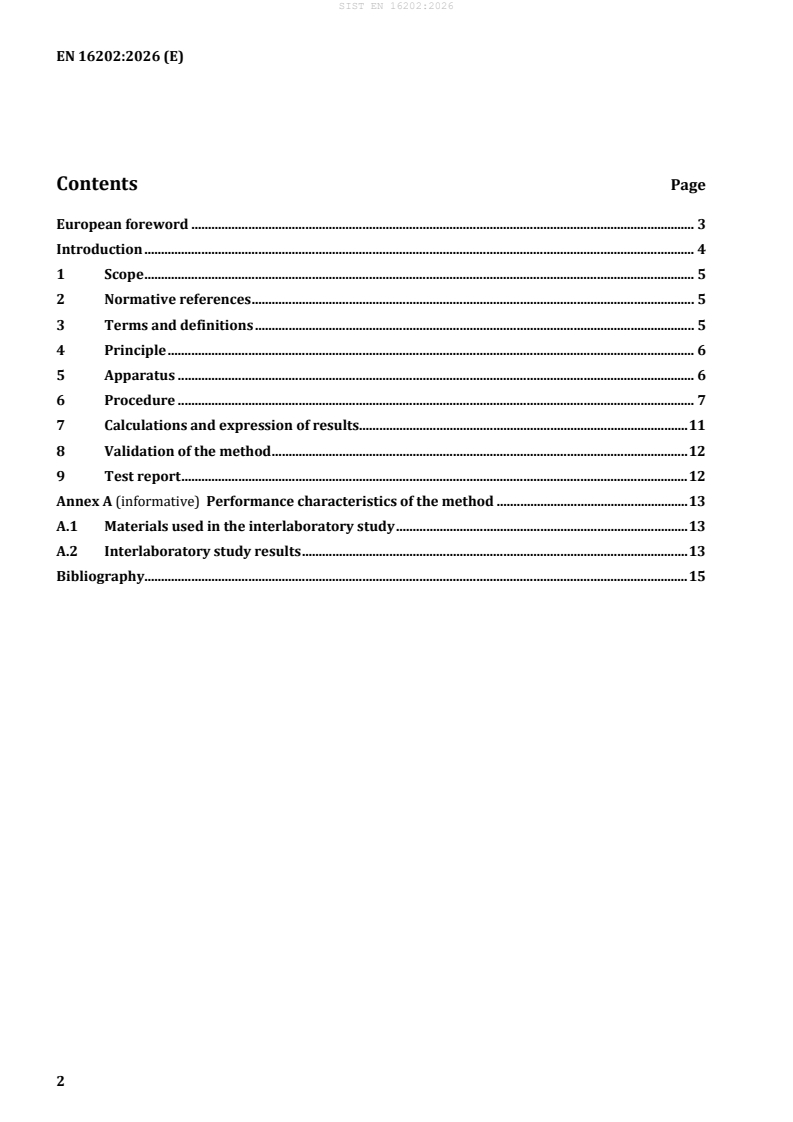
Contents Page
European foreword . 3
Introduction . 4
1 Scope . 5
2 Normative references . 5
3 Terms and definitions . 5
4 Principle . 6
5 Apparatus . 6
6 Procedure . 7
7 Calculations and expression of results. 11
8 Validation of the method . 12
9 Test report . 12
Annex A (informative) Performance characteristics of the method . 13
A.1 Materials used in the interlaboratory study . 13
A.2 Interlaboratory study results . 13
Bibliography. 15
European foreword
This document (EN 16202:2026) has been prepared by Technical Committee CEN/TC 223 “Soil
improvers and growing media”, the secretariat of which is held by NEN.
This European Standard shall be given the status of a national standard, either by publication of an
identical text or by endorsement, at the latest by January 2027, and conflicting national standards shall
be withdrawn at the latest by January 2027.
Attention is drawn to the possibility that some of the elements of this document may be the subject of
patent rights. CEN shall not be held responsible for identifying any or all such patent rights.
This document supersedes CEN/TS 16202:2013.
In comparison with the previous edition, the following technical modifications have been made:
— soil and sludge have been excluded from the scope of the standard;
— the bleaching step has been excluded from the method.
This document has been prepared under a standardization request given to CEN by the European
Commission. The Standing Committee of the EFTA States subsequently approves these requests for its
Member States.
Any feedback and questions on this document should be directed to the users’ national standards body.
A complete listing of these bodies can be found on the CEN website.
According to the CEN-CENELEC Internal Regulations, the national standards organisations of the
following countries are bound to implement this European Standard: Austria, Belgium, Bulgaria, Croatia,
Cyprus, Czech Republic, Denmark, Estonia, Finland, France, Germany, Greece, Hungary, Iceland, Ireland,
Italy, Latvia, Lithuania, Luxembourg, Malta, Netherlands, Norway, Poland, Portugal, Republic of North
Macedonia, Romania, Serbia, Slovakia, Slovenia, Spain, Sweden, Switzerland, Türkiye and the United
Kingdom.
Introduction
The European Committee for Standardization (CEN) has been requested by the European Commission to
draft European standardization deliverables in support of the European Fertilising Product
Regulation (FPR) [1]. The FPR aims to promote an increased use of recycled nutrients to further aid the
development of a circular economy and allow a more resource efficient and general use of nutrients, while
reducing the dependency of nutrients from countries not within the European Union. It lays down rules
on the requirements of different sorts of fertilising products. Fertilising products bearing CE marking
may freely be traded within the European Union.
To enable the market to justify the use of the CE mark, CEN is requested by the European Commission to
develop a series of European Standards described in Standardization Request M/564. These European
Standards will enable the implementation of the FPR; the commercialisation of the soil improvers,
growing media and other fertilising products within the EU Single market; and provide a uniform and
reliable way of assessing the compliance to the requirements laid down in the FPR.
This document provides a method for the determination of macroscopic impurities in compost and
digestate. Compost and digestate have a maximum acceptable limit of macroscopic impurities. This limit
ensures that the products are fit for use and lowers the risk of injuries when using the material. With this
document, products can be assessed on the amount of macroscopic impurities it contains.
WARNING — The use of this document can involve hazardous materials and operations. Samples can
contain sharp fragments, chemical contaminants, pathogenic organisms or be of dusty nature. This
document does not purport to address all the safety problems associated with its use. It is the
responsibility of the user of this document to establish appropriate safety and health practices and
determine the applicability of any other restrictions prior to use.
1 Scope
This document specifies a method to determine the visible macroscopic impurities > 2 mm and
stones > 5 mm in compost and digestate. Macroscopic impurities are contaminants that are not naturally
occurring in soil such as pieces of glass, metal, plastic. This method is not able to make a distinction
between compostable and non-compostable plastics.
Fragments of wood or bark are acceptable constituents of the sample and not classified as macroscopic
impurities.
NOTE This method has been validated in an interlaboratory study with specific products that were present on
the market during the study (as included in Annex A, being biowaste compost, green waste compost, biowaste solid
digestate, biowaste liquid digestate, and kitchen biowaste compost).
2 Normative references
The following documents are referred to in the text in such a way that some or all of their content
constitutes requirements of this document. For dated references, only the edition cited applies. For
undated references, the latest edition of the referenced document (including any amendments) applies.
EN 17732:— , Soil improvers and growing media — Terminology
EN 13040-1:— , Soil improver and growing media — Sample preparation — Part 1: Sample preparation
for chemical and physical tests, determination of dry matter content, moisture content and laboratory bulk
density
EN 12579, Soil improvers and growing media — Sampling
3 Terms and definitions
For the purposes of this document, the terms and definitions given in EN 17732 and the following apply.
3.1
compost
solid particulate material that is the result of a thermophilic aerobic composting of biodegradable matter
by microorganisms, which has been sanitised and stabilised
[SOURCE: EN 17732:—, 3.3.4]
3.2
digestate
solid or liquid product that is the result of anaerobic digestion of biodegradable materials by
microorganisms
[SOURCE: EN 17732:—, 3.3.5]
3.3
glass
usually transparent, lustrous, hard and brittle material, generally composed of a silicate (such as silicon
oxide, or quartz) combined with an alkali and sometimes other substances
[SOURCE: EN 17732:—, 3.7.8.1]
Under preparation. Stage at the time of publication: prEN 17732:2025.
Under preparation. Stage at the time of publication: prEN 13040-1:2025.
3.4
metal
usually crystalline solid of rigid or malleable non-brittle material e.g. steel, iron, copper, lead and tin
Note 1 to entry: Ferrous stones are not considered to be metals and shall be considered as stones.
[SOURCE: EN 17732:—, 3.7.8.2]
3.5
plastic
solid material which is usually man-made, oil-based, mouldable when soft, and light in weight
Note 1 to entry: Plastics include both fossil based and biobased plastics.
[SOURCE: EN 17732:—, 3.7.8.3]
3.6
stone
hard solid non-metallic mineral matter of which rock is made and of a small or moderate size
Note 1 to entry: Expanded clay granules and tableware shards shall be considered as stone.
[SOURCE: EN 17732:—, 3.7.8.5]
3.7
other impurities
impurities that are not made of glass, metal, plastic or stones, or are composites that cannot be separated
and placed in single categories
Note 1 to entry: Cigarette butts can contain plastic. However, as they are composites that cannot be separated, they
are placed in the category of other impurities.
3.8
test sample
sample prepared from the laboratory sample and from which test portions will be taken
[SOURCE: EN 17732:—, 3.5.11]
4 Principle
The particle size of visible macroscopic impurities is determined by their ability to go through the sieve
(mesh size). Macroscopic impurities > 2 mm and stones > 5 mm are determined by mass.
5 Apparatus
5.1 Sample trays, constructed of material thermally stable up to 100 °C, surface approximately
1 250 cm .
5.2 Drying oven, ventilated, fan assisted, capable of holding sample trays at 80 °C ± 5 °C.
5.3 Weighing scale, with a precision of 0,1 g (for test sample weighing).
5.4 Weighing scale, with a precision of 0,01 g (for impurities weighing).
5.5 Sieves (for the determination of the coarseness of the laboratory sample), minimum diameter
size of 200 mm, with 12 mm, 25 mm and 40 mm square apertures.
NOTE To avoid spilling of material, a sieve with sufficient edge height can be chosen.
5.6 Sieves (for liquid digestate and macroscopic impurities other than stones), minimum
diameter size of 200 mm, with 2 mm square apertures.
NOTE To avoid spilling of material, a sieve with s
...