

EN 12266-1:2012
(Main)Industrial valves - Testing of metallic valves - Part 1: Pressure tests, test procedures and acceptance criteria - Mandatory requirements
- Abstract
This European Standard specifies requirements for tests, test procedures and acceptance criteria for production testing of industrial valves made of metallic materials.
The specified tests may also be used as type tests or acceptance tests.
Safety devices are not covered by EN 12266-1.
When specified as a normative reference in a valve product or performance standard, this European Standard is to be considered in conjunction with given specific requirements of the valve product or performance standard. Where requirements in a product or performance standard differ from those given in this European Standard, the requirements of the product or performance standard apply.
NOTE For testing of industrial valves of thermoplastic materials, ISO 9393-1 and ISO 9393-2 apply.
- Status
- Published
- Publication Date
- 03-Apr-2012
- Withdrawal Date
- 30-Oct-2012
- Technical Committee
- CEN/TC 69 - Industrial valves
- Drafting Committee
- CEN/TC 69/WG 1 - Basic standards
- Current Stage
- 9092 - Decision on results of review/2YR ENQ - revise - Review Enquiry
- Start Date
- 30-Jan-2024
- Completion Date
- 07-Oct-2026
- Directive
- 2014/68/EU - Directive 2014/68/EU of the European Parliament and of the Council of 15 May 2014 on the harmonisation of the laws of the Member States relating to the making available on the market of pressure equipmentOJ Ref: C 293/01 OJ Date: 12-Aug-2016
97/23/EC - Pressure equipmentOJ Ref: C, C 233 OJ Date: 03-Aug-2012

Overview
EN 12266-1:2012 - Industrial valves: Testing of metallic valves - Part 1 - specifies mandatory pressure tests, test procedures and acceptance criteria for production testing of industrial valves made of metallic materials. It defines uniform methods for shell strength (P10), shell tightness (P11) and seat tightness (P12) tests, the required test media, temperature ranges and measuring equipment accuracy. Safety devices are excluded; thermoplastic valves are covered by ISO 9393‑1/2.
Key topics and technical requirements
- Scope and purpose: Production testing of metallic industrial valves; tests may also be used as type or acceptance tests. When a product/performance standard differs, that standard takes precedence.
- Mandatory tests:
- P10 Shell strength - validates the pressure‑containing capability of the shell.
- P11 Shell tightness - verifies external shell leak tightness including mechanism seals.
- P12 Seat tightness - confirms seat leakage performance for isolating and check valves (control valves per EN 1349).
- Test media and conditions:
- Test fluid: water (may contain inhibitor) or suitable liquid, or gas (air or other) where agreed. Liquid is required for P10 unless gas agreed with purchaser (gas tests require extra safety).
- Test fluid temperature: 5 °C to 40 °C.
- Test pressure:
- Generally at least 1.5 × allowable pressure at room temperature (PSRT). For valves rated only at elevated temperatures, the higher allowable pressure value is used.
- Test equipment and measurement:
- Test rigs must not introduce external loads affecting results.
- Measuring instruments must measure pressure to an accuracy of ±5% of the required test pressure.
- Test procedures:
- Examples: for P10 the obturator is partially open, end connections blanked, cavities filled, pressure applied and held for the specified duration; liquid tests inspected visually for leakage; gas tests detected by immersion/bubbles or leak detection fluid.
- Designation: Tests are designated by title and test reference, e.g. Shell strength, Test P10 - EN 12266‑1.
Applications and who uses it
- Target users: valve manufacturers, quality control/inspection teams, test houses, engineering procurement departments, compliance officers, and certification bodies operating in process industries (oil & gas, chemical, power, water).
- Practical uses:
- Establishing factory production test routines and acceptance criteria.
- Defining type-test programs for new valve designs.
- Supporting compliance with the EU Pressure Equipment Directive (PED) via Annex ZA references.
- Providing common contractual test language between purchasers and manufacturers.
Related standards
- EN 12266‑2 (supplementary tests and requirements)
- ISO 5208 (basis for EN 12266)
- EN 1349 (control valve seat testing)
- EN 736 series (valve terminology)
- ISO 9393‑1/2 (thermoplastic valve testing)
- EU Directive 97/23/EC (PED) - relationship addressed in Annex ZA
Keywords: EN 12266-1:2012, industrial valves, metallic valves, pressure tests, test procedures, acceptance criteria, shell strength P10, shell tightness P11, seat tightness P12, valve testing, production testing.
Relations
- Effective Date
- 11-Apr-2012
- Effective Date
- 28-Jan-2026
- Effective Date
- 28-Jan-2026
- Effective Date
- 28-Jan-2026
- Effective Date
- 28-Jan-2026
- Effective Date
- 28-Jan-2026
- Effective Date
- 28-Jan-2026
- Effective Date
- 28-Jan-2026
- Referred By
EN ISO 21787:2006 - Industrial valves - Globe valves of thermoplastics materials (ISO 21787:2006) - Effective Date
- 28-Jan-2026
- Effective Date
- 28-Jan-2026
- Effective Date
- 28-Jan-2026
- Effective Date
- 28-Jan-2026
- Effective Date
- 28-Jan-2026
- Effective Date
- 28-Jan-2026
- Effective Date
- 28-Jan-2026
Get Certified
Connect with accredited certification bodies for this standard

BSI Group
BSI (British Standards Institution) is the business standards company that helps organizations make excellence a habit.

TÜV Rheinland
TÜV Rheinland is a leading international provider of technical services.

TÜV SÜD
TÜV SÜD is a trusted partner of choice for safety, security and sustainability solutions.
Sponsored listings
Frequently Asked Questions
EN 12266-1:2012 is a standard published by the European Committee for Standardization (CEN). Its full title is "Industrial valves - Testing of metallic valves - Part 1: Pressure tests, test procedures and acceptance criteria - Mandatory requirements". This standard covers: This European Standard specifies requirements for tests, test procedures and acceptance criteria for production testing of industrial valves made of metallic materials. The specified tests may also be used as type tests or acceptance tests. Safety devices are not covered by EN 12266-1. When specified as a normative reference in a valve product or performance standard, this European Standard is to be considered in conjunction with given specific requirements of the valve product or performance standard. Where requirements in a product or performance standard differ from those given in this European Standard, the requirements of the product or performance standard apply. NOTE For testing of industrial valves of thermoplastic materials, ISO 9393-1 and ISO 9393-2 apply.
This European Standard specifies requirements for tests, test procedures and acceptance criteria for production testing of industrial valves made of metallic materials. The specified tests may also be used as type tests or acceptance tests. Safety devices are not covered by EN 12266-1. When specified as a normative reference in a valve product or performance standard, this European Standard is to be considered in conjunction with given specific requirements of the valve product or performance standard. Where requirements in a product or performance standard differ from those given in this European Standard, the requirements of the product or performance standard apply. NOTE For testing of industrial valves of thermoplastic materials, ISO 9393-1 and ISO 9393-2 apply.
EN 12266-1:2012 is classified under the following ICS (International Classification for Standards) categories: 11.060.20 - Dental equipment; 23.060.01 - Valves in general. The ICS classification helps identify the subject area and facilitates finding related standards.
EN 12266-1:2012 has the following relationships with other standards: It is inter standard links to EN 12266-1:2003, EN 736-3:2008, EN 736-1:1995, EN 1349:2009, EN 736-2:1997, EN 12516-2:2014+A1:2021, EN 16249:2013, EN 14141:2003, EN ISO 21787:2006, EN 1984:2010, EN 1474-1:2008, EN 1983:2006, EN 1626:2008, EN 16767:2020, EN 1983:2013. Understanding these relationships helps ensure you are using the most current and applicable version of the standard.
EN 12266-1:2012 is associated with the following European legislation: EU Directives/Regulations: 2014/68/EU, 97/23/EC; Standardization Mandates: M/071. When a standard is cited in the Official Journal of the European Union, products manufactured in conformity with it benefit from a presumption of conformity with the essential requirements of the corresponding EU directive or regulation.
EN 12266-1:2012 is available in PDF format for immediate download after purchase. The document can be added to your cart and obtained through the secure checkout process. Digital delivery ensures instant access to the complete standard document.
Standards Content (Sample)
2003-01.Slovenski inštitut za standardizacijo. Razmnoževanje celote ali delov tega standarda ni dovoljeno.Industriearmaturen - Prüfung von Armaturen aus Metall - Teil 1: Druckprüfungen, Prüfverfahren und Annahmekriterien - Verbindliche AnforderungenRobinetterie industrielle - Essais des appareils de robinetterie métalliques - Partie 1: Essais sous pression, modes opératoires d'essai et critères d'acceptation - Prescriptions obligatoiresIndustrial valves - Testing of metallic valves - Part 1: Pressure tests, test procedures and acceptance criteria - Mandatory requirements23.060.01Ventili na splošnoValves in generalICS:Ta slovenski standard je istoveten z:EN 12266-1:2012SIST EN 12266-1:2012en,fr,de01-julij-2012SIST EN 12266-1:2012SLOVENSKI
STANDARDSIST EN 12266-1:20031DGRPHãþD
EUROPEAN STANDARD NORME EUROPÉENNE EUROPÄISCHE NORM
EN 12266-1
April 2012 ICS 23.060.01 Supersedes EN 12266-1:2003English Version
Industrial valves - Testing of metallic valves - Part 1: Pressure tests, test procedures and acceptance criteria - Mandatory requirements
Robinetterie industrielle - Essais des appareils de robinetterie métalliques - Partie 1: Essais sous pression, procédures d'essai et critères d'acceptation - Prescriptions obligatoires
Industriearmaturen - Prüfung von Armaturen aus Metall - Teil 1: Druckprüfungen, Prüfverfahren und Annahmekriterien - Verbindliche Anforderungen This European Standard was approved by CEN on 25 February 2012.
CEN members are bound to comply with the CEN/CENELEC Internal Regulations which stipulate the conditions for giving this European Standard the status of a national standard without any alteration. Up-to-date lists and bibliographical references concerning such national standards may be obtained on application to the CEN-CENELEC Management Centre or to any CEN member.
This European Standard exists in three official versions (English, French, German). A version in any other language made by translation under the responsibility of a CEN member into its own language and notified to the CEN-CENELEC Management Centre has the same status as the official versions.
CEN members are the national standards bodies of Austria, Belgium, Bulgaria, Croatia, Cyprus, Czech Republic, Denmark, Estonia, Finland, France, Germany, Greece, Hungary, Iceland, Ireland, Italy, Latvia, Lithuania, Luxembourg, Malta, Netherlands, Norway, Poland, Portugal, Romania, Slovakia, Slovenia, Spain, Sweden, Switzerland, Turkey and United Kingdom.
EUROPEAN COMMITTEE FOR STANDARDIZATION
COMITÉ EUROPÉEN DE NORMALISATION EUROPÄISCHES KOMITEE FÜR NORMUNG
Management Centre:
Avenue Marnix 17,
B-1000 Brussels © 2012 CEN All rights of exploitation in any form and by any means reserved worldwide for CEN national Members. Ref. No. EN 12266-1:2012: ESIST EN 12266-1:2012
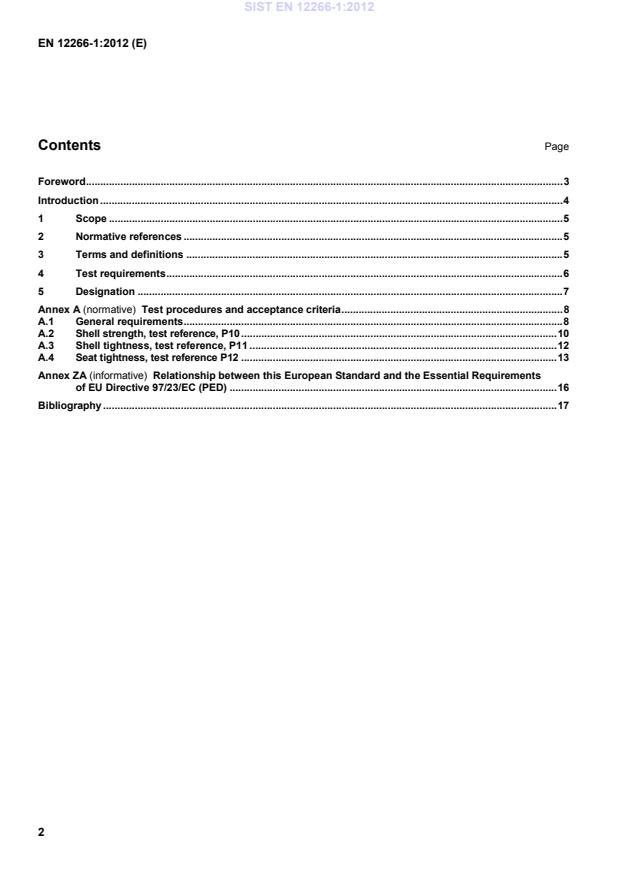
Test procedures and acceptance criteria . 8A.1General requirements . 8A.2Shell strength, test reference, P10 . 10A.3Shell tightness, test reference, P11 . 12A.4Seat tightness, test reference P12 . 13Annex ZA (informative)
Relationship between this European Standard and the Essential Requirements of EU Directive 97/23/EC (PED) . 16Bibliography . 17 SIST EN 12266-1:2012
EN 736-3:2008 and the following apply. 3.1 shell test test at a pressure in excess of the cold working pressure (3.7) rating of a valve for the purpose of validating the soundness and strength of the valve pressure containing and retaining structures Note 1 to entry: These structures include valve-actuating mechanisms that have a direct connection to the valve internals subject to fluid test pressure within the valve proper. 3.2 test pressure internal pressure (gauge), expressed in bar 1) to which the valve under testing is subjected Note 1 to entry: Unless otherwise noted, gauge pressure is used throughout this European Standard. 3.3 test fluid pressurized liquid or gas used to test a valve
1 1 bar = 105 Pa. SIST EN 12266-1:2012
Shell strength a P10 To confirm the pressure containing capability of the shell against internal pressure see
EN 12266-2:2012, A.2 a The shell strength and shell tightness tests may be carried out at the same time. b See Table A.3 for the type of valve. c To check the pressure containing capability of the obturator, if valve is used as the single means of insulation between the content of an item of pressure equipment and the downstream equipment not designed to withstand the upstream pressure.
5 Designation Tests in accordance with this European Standard shall be designated by the following elements: title of test and test reference; EN 12266-1. EXAMPLE Shell strength, Test P10 — EN 12266-1 SIST EN 12266-1:2012
Test procedures and acceptance criteria A.1 General requirements A.1.1 Purpose These general requirements shall be applied to all the test procedures detailed in this annex. Safety aspects of valve testing are not covered in this European Standard. NOTE Users of this European Standard should analyse the hazard resulting from the pressure and take proper safety precautions. A.1.2 Test equipment The test equipment shall be of such a design that it does not subject the valve to externally applied loads which may affect the results of the test. NOTE The test equipment can apply external loads sufficient to react to the forces resulting from the test pressure. When using test equipment and procedures different to that detailed in this European Standard, the manufacturer shall be able to demonstrate the equivalence of such test procedures and acceptance criteria with the requirements of this European Standard. A.1.3 Measuring equipment The measuring equipment shall be capable of measuring fluid pressure with an accuracy of ± 5 % of the required test pressure. A.1.4 Painted, coated or lined valves Before the shell strength test, reference P10, and the shell tightness test, reference P11, valves shall not be painted externally or otherwise coated with materials capable of sealing against leakage from external surfaces of the shell. Valves with liners, internal linings or coatings forming a design feature of the valve may be tested with the liner, after lining or coating. Attention shall be given that the liners, internal linings or coatings are not damaged by the test procedure. NOTE If tests in the presence of a representative of the purchaser are specified, painted or coated valves from stock may be retested without removal of painting or coating. A.1.5 Test fluid The test fluid to be used shall be: either a liquid (water which may contain a corrosion inhibitor, or any other suitable liquid having a viscosity not greater than water); a gas (air or other suitable gas). SIST EN 12266-1:2012
...