

SIST EN 50546:2020
(Main)Railway applications - Rolling Stock - Three phase shore (external) supply system for rail vehicles and its connectors
General Information
- Abstract
This document specifies requirements for the shore supply system for auxiliaries and pre-conditioning and the related intermateable connector pairs. This standard specifies the characteristics of the connectors in order to achieve interoperability at the rolling-stock/shore power supply interface.
This document does not apply to shore supplies to move the rolling stock.
- Status
- Published
- Public Enquiry End Date
- 29-Jun-2019
- Publication Date
- 10-Nov-2020
- Technical Committee
- ŽEN - Electrical applications for railways
- Current Stage
- 6060 - National Implementation/Publication (Adopted Project)
- Start Date
- 09-Nov-2020
- Due Date
- 14-Jan-2021
- Completion Date
- 11-Nov-2020


Overview
EN 50546:2020 - published by CLC/CENELEC - defines a harmonized three‑phase shore (external) supply system for rail vehicles and the intermateable shore power connectors used between rolling stock and shore infrastructure. The standard covers functional and safety requirements for supplying auxiliaries and pre‑conditioning from shore power, connector characteristics to ensure interoperability at the rolling‑stock/shore interface, and associated tests and marking. It explicitly does not apply to shore supplies used to move rolling stock.
Key topics and technical requirements
- System requirements: functional description, supply voltages, power limitation, overload protection, earth‑fault systems and prevention of unintended energization of fixed connectors.
- Operational safety: emergency cut‑off switch, traction and brake interlocks, earthing and protection against electric shock.
- Connector specifications: voltage and current ratings, connector layouts and dimensions, gendering, contact design and resistance, creepage/clearance, IP protection, temperature classes, material and corrosion resistance.
- Mechanical requirements: mounting and installation of fixed connectors, interlocks (mechanical and electrical), contact retention, strain relief, vibration/shock resistance, and single‑person operation.
- Testing and conformity: preconditioning, dielectric strength, temperature rise, contact resistance, mechanical durability, corrosion, drop tests and many tests referenced to EN 60512 series.
- Connector families: normative designs included (e.g., 63 A / 125 A connector design and 600 A connector design) to support typical rolling‑stock shore power needs.
- Marking and identification: clear identification, labelling and coding contacts to ensure safe and interoperable connections.
Applications and who uses it
EN 50546:2020 is used by:
- Rolling‑stock manufacturers and system integrators specifying connector interfaces for trains, trams and other rail vehicles.
- Infrastructure owners and depot designers implementing shore power supply points and fixed connectors.
- Component and connector manufacturers developing compliant shore‑power plugs, sockets and interlocks.
- Test laboratories and certification bodies performing conformity and type tests.
- Operators implementing depot pre‑conditioning and maintenance shore supply systems.
Practical benefits include safer depot operations, reduced vehicle onboard energy consumption during layover, and standardized interfaces that enable cross‑fleet interoperability of shore power connectors.
Related standards
- EN 60512 (connector testing) - referenced for test schedules and procedures.
- Supersedes CLC/TS 50546:2013 (previous technical specification).
Keywords: EN 50546:2020, shore power, three‑phase shore supply, rail vehicles, rolling stock connectors, shore supply system, shore power connector, interoperability.
Relations
- Effective Date
- 13-Oct-2020
- Effective Date
- 09-Feb-2026
- Effective Date
- 09-Feb-2026
- Effective Date
- 03-Feb-2026
- Effective Date
- 03-Feb-2026
- Refers
SIST EN 50160:2023 - Voltage characteristics of electricity supplied by public distribution networks - Effective Date
- 03-Feb-2026
- Effective Date
- 03-Feb-2026
- Effective Date
- 03-Feb-2026
- Effective Date
- 03-Feb-2026
- Effective Date
- 03-Feb-2026
- Effective Date
- 03-Feb-2026
- Effective Date
- 03-Feb-2026
- Effective Date
- 03-Feb-2026
- Effective Date
- 03-Feb-2026
- Effective Date
- 03-Aug-2021
Get Certified
Connect with accredited certification bodies for this standard

IMQ S.p.A. (Certification)
Italian electrical product certification.

IRIS Certification (UNIFE)
International Railway Industry Standard certification.

SLG Prüf- und Zertifizierungs GmbH
German testing and certification body.
Sponsored listings
Frequently Asked Questions
SIST EN 50546:2020 is a standard published by the Slovenian Institute for Standardization (SIST). Its full title is "Railway applications - Rolling Stock - Three phase shore (external) supply system for rail vehicles and its connectors". This standard covers: This document specifies requirements for the shore supply system for auxiliaries and pre-conditioning and the related intermateable connector pairs. This standard specifies the characteristics of the connectors in order to achieve interoperability at the rolling-stock/shore power supply interface. This document does not apply to shore supplies to move the rolling stock.
This document specifies requirements for the shore supply system for auxiliaries and pre-conditioning and the related intermateable connector pairs. This standard specifies the characteristics of the connectors in order to achieve interoperability at the rolling-stock/shore power supply interface. This document does not apply to shore supplies to move the rolling stock.
SIST EN 50546:2020 is classified under the following ICS (International Classification for Standards) categories: 29.120.30 - Plugs, socket-outlets, couplers; 45.060.01 - Railway rolling stock in general. The ICS classification helps identify the subject area and facilitates finding related standards.
SIST EN 50546:2020 has the following relationships with other standards: It is inter standard links to SIST-TS CLC/TS 50546:2013, SIST EN ISO 4892-2:2013, SIST EN 45545-2:2013+A1:2015, SIST EN 50125-1:2014, SIST EN 50264-3-1:2008, SIST EN 50160:2023, SIST EN 50467:2012, SIST EN 50122-1:2011, SIST EN 60512-1-4:2002, SIST EN 61373:2010, SIST EN 50032:1998, SIST EN 50124-1:2017, SIST EN 50153:2014, SIST EN 60529:1997, SIST EN 50546:2020/AC:2021. Understanding these relationships helps ensure you are using the most current and applicable version of the standard.
SIST EN 50546:2020 is associated with the following European legislation: EU Directives/Regulations: 2008/57/EC, 2016/797/EU; Standardization Mandates: M/483. When a standard is cited in the Official Journal of the European Union, products manufactured in conformity with it benefit from a presumption of conformity with the essential requirements of the corresponding EU directive or regulation.
SIST EN 50546:2020 is available in PDF format for immediate download after purchase. The document can be added to your cart and obtained through the secure checkout process. Digital delivery ensures instant access to the complete standard document.
Standards Content (Sample)
SLOVENSKI STANDARD
01-december-2020
Nadomešča:
SIST-TS CLC/TS 50546:2013
Železniške naprave - Vozna sredstva - Trifazni (zunanji) napajalni sistem in
konektorji za železniška vozila
Railway applications - Rolling Stock - Three phase shore (external) supply system for rail
vehicles and its connectors
Bahnanwendungen - Fahrzeuge - Dreiphasige Fremdeinspeisung für
Eisenbahnfahrzeuge
Applications ferroviaires - Matériel roulant - Systèmes d’alimentation triphasée (externe)
de quai pour les véhicules ferroviaires
Ta slovenski standard je istoveten z: EN 50546:2020
ICS:
29.120.30 Vtiči, vtičnice, spojke Plugs, socket-outlets,
couplers
45.060.01 Železniška vozila na splošno Railway rolling stock in
general
2003-01.Slovenski inštitut za standardizacijo. Razmnoževanje celote ali delov tega standarda ni dovoljeno.
EUROPEAN STANDARD EN 50546
NORME EUROPÉENNE
EUROPÄISCHE NORM
October 2020
ICS 29.120.30; 45.060.01 Supersedes CLC/TS 50546:2013 and all of its
amendments and corrigenda (if any)
English Version
Railway applications - Rolling Stock - Three-phase shore
(external) supply system for rail vehicles and its connectors
Applications ferroviaires - Matériel roulant - Système Bahnanwendungen - Fahrzeuge - Dreiphasiges
d'alimentation à quai (externe) triphasée des véhicules Fremdeinspeisungssystem für Schienenfahrzeuge und
ferroviaires par connecteurs zugehörige Steckverbinder
This European Standard was approved by CENELEC on 2020-08-17. CENELEC members are bound to comply with the CEN/CENELEC
Internal Regulations which stipulate the conditions for giving this European Standard the status of a national standard without any alteration.
Up-to-date lists and bibliographical references concerning such national standards may be obtained on application to the CEN-CENELEC
Management Centre or to any CENELEC member.
This European Standard exists in three official versions (English, French, German). A version in any other language made by translation
under the responsibility of a CENELEC member into its own language and notified to the CEN-CENELEC Management Centre has the
same status as the official versions.
CENELEC members are the national electrotechnical committees of Austria, Belgium, Bulgaria, Croatia, Cyprus, the Czech Republic,
Denmark, Estonia, Finland, France, Germany, Greece, Hungary, Iceland, Ireland, Italy, Latvia, Lithuania, Luxembourg, Malta, the
Netherlands, Norway, Poland, Portugal, Republic of North Macedonia, Romania, Serbia, Slovakia, Slovenia, Spain, Sweden, Switzerland,
Turkey and the United Kingdom.
European Committee for Electrotechnical Standardization
Comité Européen de Normalisation Electrotechnique
Europäisches Komitee für Elektrotechnische Normung
CEN-CENELEC Management Centre: Rue de la Science 23, B-1040 Brussels
© 2020 CENELEC All rights of exploitation in any form and by any means reserved worldwide for CENELEC Members.
Ref. No. EN 50546:2020 E
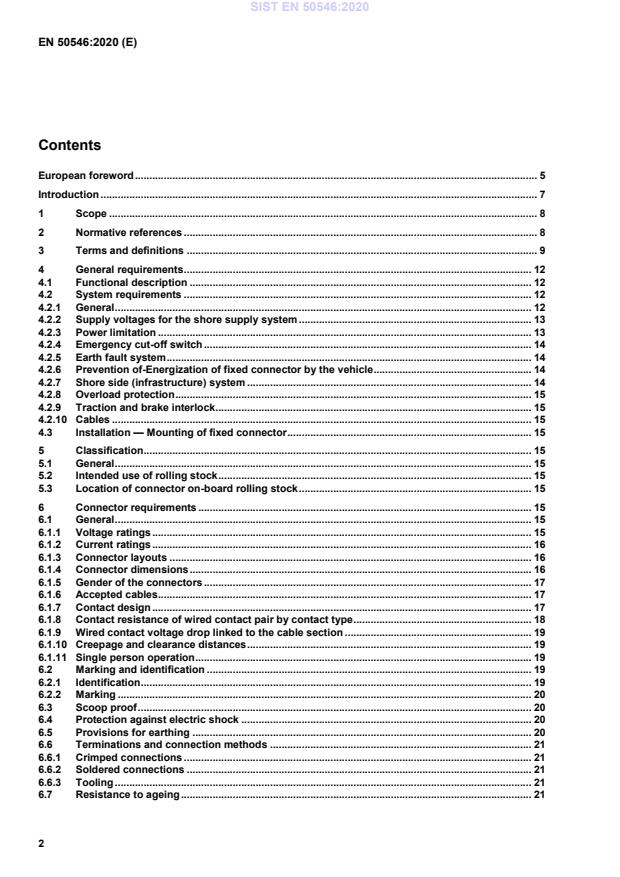
Contents
European foreword . 5
Introduction . 7
1 Scope . 8
2 Normative references . 8
3 Terms and definitions . 9
4 General requirements . 12
4.1 Functional description . 12
4.2 System requirements . 12
4.2.1 General . 12
4.2.2 Supply voltages for the shore supply system . 13
4.2.3 Power limitation . 13
4.2.4 Emergency cut-off switch . 14
4.2.5 Earth fault system . 14
4.2.6 Prevention of-Energization of fixed connector by the vehicle . 14
4.2.7 Shore side (infrastructure) system . 14
4.2.8 Overload protection . 15
4.2.9 Traction and brake interlock . 15
4.2.10 Cables . 15
4.3 Installation — Mounting of fixed connector . 15
5 Classification . 15
5.1 General . 15
5.2 Intended use of rolling stock . 15
5.3 Location of connector on-board rolling stock . 15
6 Connector requirements . 15
6.1 General . 15
6.1.1 Voltage ratings . 15
6.1.2 Current ratings . 16
6.1.3 Connector layouts . 16
6.1.4 Connector dimensions . 16
6.1.5 Gender of the connectors . 17
6.1.6 Accepted cables. 17
6.1.7 Contact design . 17
6.1.8 Contact resistance of wired contact pair by contact type . 18
6.1.9 Wired contact voltage drop linked to the cable section . 19
6.1.10 Creepage and clearance distances . 19
6.1.11 Single person operation . 19
6.2 Marking and identification . 19
6.2.1 Identification . 19
6.2.2 Marking . 20
6.3 Scoop proof . 20
6.4 Protection against electric shock . 20
6.5 Provisions for earthing . 20
6.6 Terminations and connection methods . 21
6.6.1 Crimped connections . 21
6.6.2 Soldered connections . 21
6.6.3 Tooling . 21
6.7 Resistance to ageing . 21
6.8 Interlock . 21
6.8.1 Mechanical . 21
6.8.2 Electrical . 22
6.9 Degree of protection IP . 22
6.10 Dielectric strength . 22
6.11 Mechanical and electrical durability . 22
6.12 Harness or assembly strain relief . 22
6.13 Mechanical strength . 23
6.13.1 Insert retention in the shell . 23
6.13.2 Retention of the contacts within insert . 23
6.13.3 Durability . 23
6.13.4 Bending moment withstand . 23
6.14 Vibration and shock . 23
6.15 Insulation and insulation co-ordination . 23
6.16 Temperature classes . 23
6.17 Temperature rise . 23
6.18 Protection against corrosion . 23
6.19 Fire behaviour of materials and components . 23
6.20 Resistance to chemically active substances and to contaminating fluids . 24
6.21 Resistance to ozone . 24
6.22 Resistance to UV radiation . 24
6.23 Connector material . 24
6.24 Protective cover . 24
7 Tests . 25
7.1 Introduction . 25
7.1.1 General . 25
7.1.2 Preconditioning and preparation . 25
7.1.3 Test conditions . 25
7.2 Test schedule (EN 60512-1-100 – General – Applicable Publications) . 26
7.2.1 Test conditions for Group A . 26
7.2.2 Test conditions for Group B . 27
7.2.3 Test conditions for Group C . 28
7.2.4 Test conditions for Group D . 28
7.2.5 Test conditions for Group E . 29
7.2.6 Test conditions for Group F — Test phase F1 . 30
7.2.7 Test conditions for Group G . 31
7.3 Tests on raw materials . 32
7.4 Protection against electric shock . 32
7.5 Temperature rise . 32
7.6 Mechanical operation . 32
7.6.1 General . 32
7.6.2 Test conditions . 32
7.7 Measurement of contact resistance of wired contact pair . 32
7.8 Drop test for free connector . 33
7.9 Measurement of clearances and creepage . 33
7.10 Dielectric strength . 33
7.11 Resistance between earthing conductor of the free connector and the shell of the fixed
connector . 33
7.12 Corrosion test . 33
7.13 Contact retention . 34
Annex A (normative) 63 A/125 A Connector design . 35
A.1 Fixed connector . 35
A.1.1 Arrangement of contacts . 35
A.1.2 Locking mechanism . 36
A.1.3 Dimensions of male contacts . 37
A.1.4 Dimensions of protective cover . 40
A.2 Free connector . 41
A.2.1 General . 41
A.2.2 Arrangement of contacts and locking pin . 42
A.2.3 Dimensions of power contacts . 44
A.2.4 Dimensions of pilot and coding contacts . 45
Annex B (normative) 600 A connector design . 46
B.1 Fixed connector . 46
B.1.1 General . 46
B.1.2 Arrangement of contacts . 48
B.1.3 Locking mechanism . 50
B.1.4 Dimensions of contacts . 52
B.2 Free connector . 53
B.2.1 General . 53
B.2.2 Dimensions for locking arrangement . 56
B.2.3 Dimensions of power contacts . 58
B.2.4 Dimensions of pilot and coding contacts . 58
Annex ZZ (informative) Relationship between this European Standard and the essential
requirements of EU Directive 2016/797/EU [2016 OJ L138] aimed to be covered . 60
Bibliography . 62
European foreword
This document (EN 50546:2020) has been prepared by CLC/SC 9XB, “Electrical, electronic and
electromechanical material on board rolling stock, including associated software”.
The following dates are fixed:
• latest date by which this document has (dop) 2021-08-17
to be implemented at national level by
publication of an identical national
standard or by endorsement
• latest date by which the national (dow) 2023-08-17
standards conflicting with this document
have to be withdrawn
This document supersedes CLC/TS 50546:2013.
a) Revision of Clause 1, Scope;
b) Revision of Clause 2, Normative references;
c) Revision of Clause 3, Terms and definitions, with reorganization of definitions;
d) Revision of Clause 4, General requirements, to include reference to connectors and associated shore
side requirements;
e) Introduction of new Clause 5, Classification;
f) Introduction of new Clause 6, Connector requirements;
g) Introduction of new Clause 7, Tests;
h) Introduction of the following mandatory Annexes:
1) Annex A, Connector design 63 A/ 125 A;
2) Annex B, Connector design 600 A;
i) Bibliography, revised and corrected.
Attention is drawn to the possibility that some of the elements of this document may be the subject of patent
rights. CENELEC shall not be held responsible for identifying any or all such patent rights.
This document has been prepared under a mandate given to CENELEC by the European Commission and
the European Free Trade Association, and supports essential requirements of EU Directive(s).
For the relationship with EU Directive(s) see informative Annex ZZ, which is an integral part of this document.
This standardization project was derived from the EU-funded Research project MODTRAIN (MODPOWER). It
is part of a series of standards, referring to each other. The hierarchy of the standards is intended to be as set
out in Figure 1:
Figure 1 — Overview on the technical framework CLC/TS 50534 defines the basis for other dependent
standards
Introduction
The shore supply system is used within depots and sidings location for providing power to the auxiliary
electrical supply (which may include battery charging) when the primary power supply is not available, and the
train is static (0 km/h). This document defines connectors that are intermateable to provide interoperability for
rolling stock that is to run across borders and has been equipped with batteries which are be charged in
locations other than their normal depot or sidings location.
The connectors are dimensioned using standard rolling stock cables as set out in EN 50264-3-1:2008.
This document provides the requirements for compatibility of systems defined and good practice 3-phase
AC + N; 400 V, 50 Hz shore (external) supply systems. It focuses on describing the defined interfaces
regarding electrical power supply in stations, depots/workshops and sidings location into the rail vehicle.
This document provides recommended characteristics of power supply and the interface drawings for the
shore supply connectors. The interface drawings are supplied to provide intermateability and interoperability of
connectors. The fixed connector is provided with a protective cover to prevent any ingress when the connector
is not in use.
Two connectors have been specified in this document. The first is suitable for either 63 A or 125 A shore
supplies. The second is suitable for 600 A shore supplies. The 600 A connector is the existing UK standard
three-phase shore supply connector which has a long service history.
1 Scope
This document specifies requirements for the shore supply system for auxiliaries and pre-conditioning and the
related intermateable connector pairs. This standard specifies the characteristics of the connectors in order to
achieve interoperability at the rolling-stock/shore power supply interface.
This document does not apply to shore supplies to move the rolling stock.
2 Normative references
The following documents are referred to in the text in such a way that some or all of their content constitutes
requirements of this document. For dated references, only the edition cited applies. For undated references,
the latest edition of the referenced document (including any amendments) applies.
EN 45545-2:2013+A1:2015, Railway applications – Fire protection on railway vehicles – Part 2: Requirements
for fire behaviour of materials and components
EN 50122-1:2011, Railway applications - Fixed installations - Electrical safety, earthing and the return circuit
Part 1: Protective provisions against electric shock
EN 50124-1:2017, Railway applications – Insulation coordination – Part 1: Basic requirements – Clearances
and creepage distances for all electrical and electronic equipment
EN 50125-1:2014, Railway applications – Environmental conditions for equipment Part 1:Rolling stock and on-
board equipment
EN 50153:2014, Railway applications – Rolling stock – Protective provisions relating to electrical hazards
EN 50160, Voltage characteristics of electricity supplied by public electricity networks
EN 50264-3-1:2008, Railway applications – Railway rolling stock power and control cables having special fire
performance – Part 3-1: Cables with crosslinked elastomeric insulation with reduced dimensions – Single core
cables
EN 50467:2011, Railway applications – Rolling stock – Electrical connectors, requirements and test methods
1)
EN 50533:2011 , Railway applications – Three-phase train line voltage characteristics
EN 60512-1-4:1997, Electromechanical components for electronic equipment - Basic testing procedures and
measuring methods - Part 1: General - Section 4: Test 1d: Contact protection effectiveness (scoop-proof)
(IEC 60512-1-4:1997)
2)
EN 60529:1991 , Degrees of protection provided by enclosures (IP Code) (IEC 60529)
EN 61373:2010, Railway applications - Rolling stock equipment - Shock and vibration tests (IEC 61373:2010)
EN ISO 4892-2:2013, Plastics - Methods of exposure to laboratory light sources - Part 2: Xenon-arc lamps
(ISO 4892-2:2013)
ISO 1431-1:2012, Rubber, vulcanized or thermoplastic – Resistance to ozone cracking – Part 1: Static and
dynamic strain testing
1)
Currently impacted by EN 50533:2011/A1:2016.
2)
Currently impacted by EN 60529:1991/A1:2000, EN 60529:1991/A2:2013 and EN 60529:1991/AC:2016-12.
3 Terms and definitions
For the purposes of this document, the following terms and definitions apply.
ISO and IEC maintain terminological databases for use in standardization at the following addresses:
• IEC Electropedia: available at http://www.electropedia.org/
• ISO Online browsing platform: available at https://www.iso.org/obp
3.1
crimped connection
permanent connection made by the application of pressure inducing the deformation or reshaping of the barrel
around the conductor of a cable
Note 1 to entry: In some cases, the deformation or reshaping of the barrel may affect the form of the conductor.
[SOURCE: IEC 60050-461:2008, 461-19-01]
3.2
connector
electrical device providing connection and disconnection to a suitable mating component
Note 1 to entry: A connector has one or more contact elements.
Note 2 to entry: In this document a connector is a connector without breaking capability.
[SOURCE: IEC 60050-581:2008, 581-26-01, modified –‘device’ was modified to ‘electrical device’ and Note 2
to entry was added.]
3.3
connector without breaking capacity
COC
connector which is not allowed to be engaged or disengaged in normal use when live or under load
[SOURCE: IEC 60050-581:2008, 581-27-73]
3.4
free connector
connector for attachment to a free end of a cable
[SOURCE: IEC 60050-581:2008, 581-26-10, modified – ‘of a cable’ added for clarity]
3.5
fixed connector
connector for attachment to a rigid surface
[SOURCE: IEC 60050-581:2008, 581-26-07]
3.6
shore supply connector
connector dedicated to the shore supply system
3.7
contact,
conductive element in a connector (including means for a cable termination) that mates with a corresponding
element to provide an electric path
[SOURCE: EN 50467:2011, 3.8]
3.8
male contact
pin contact
contact element intended to make electric engagement on its outer surface for mating with the inner surface of
another contact element
Note 1 to entry: Where the term 'contact diameter' is used in this standard for the male contact, it refers to the diameter
of the active part.
[SOURCE: IEC 60050-581:2008, 581-22-08, modified – The preferred term “pin contact” and the admitted
term “male contact” have been inverted. The note has been added. ]
3.9
female contact
socket contact
contact element intended to make electric engagement on its inner surface for mating with the outer surface of
another contact element
Note 1 to entry: In English, the term “socket contact” does not imply that socket contacts are always mounted in a socket
(151–12–20) nor that sockets have only socket contacts.
[SOURCE: IEC 60050-581:2008, 581-22-06, modified – The preferred term “socket contact” and the admitted
term “female contact” have been inverted.]
3.10
interlock
device, which prevents the contacts of a connector from becoming live before it is in proper
engagement with its counterpart, and which either prevents the connector from being disconnected while its
contacts are live or makes the contact dead before separation
[SOURCE: IEC 60050-581:2008, 581–27–48, modified –The specific use “” has been replaced with
“”. “either electrical or mechanical,” has been deleted. The word ‘withdrawn’has been replaced by
‘disconnected’]
3.11
locking device
feature incorporated in certain components to provide mechanical retention of their mating part
[SOURCE: IEC 60050-581:2008, 581-23-22]
3.12
mating cycle
cycle of operation of a connector
one connection and one disconnection of the connector halves
[SOURCE: IEC 60050-581:2008, 581-21-06, modified – The preferred term “cycle of (connector) operation”
has been replaced by “mating cycle” and the admitted term “cycle of operation of a connector” has been
added. The word ‘insertion’ has been replaced with ‘connection’ and the word ‘withdrawal’ has been replaced
by ‘disconnection’]
3.13
clearance
shortest distance in air between two conductive parts
[SOURCE: IEC 60050-581:2008, 581-27-76]
3.14
creepage distance
shortest distance along the surface of a solid insulating material between two conductive parts
[SOURCE: IEC 60050-581:2008, 581-21-23]
3.15
rated voltage
U
value of voltage assigned to the connector and to which operation and performance
characteristics are referred
3.16
rated impulse voltage
U
Ni
impulse voltage value assigned to the connector, characterizing the specified withstand
capability of its insulation against transient overvoltages
Note 1 to entry: U is higher than or equal to the working peak voltage.
Ni
SOURCE: IEC 60050-581:2008, 581-21-18, modified – specific use and Note 1 to entry were added and “by
the manufacturer” was deleted]
3.17
impulse withstand voltage
highest peak value of impulse voltage of prescribed form and polarity which does not cause breakdown of
insulation under specified conditions
[SOURCE: IEC 60050-442:2014, 442-09-18]
3.18
rated (connector) current
value of the electric current in a connector used for specification purposes, established for the operating
condition in which the electric current is present continuously
[SOURCE: IEC 60050-581:2008, 581-21-05, modified – The second part of the definition “and simultaneously
in all contacts of the connector being wired with the largest specified conductor, while the ambient
temperature near the connector is maintained at 40 °C” has been removed. The Note has been omitted]
3.19
shore supply connection system
complete system consisting of the fixed connector, the free connector and the associated cables
3.20
intermateable
pertaining to each of two components when they feature identical dimensions for electrical and dimensional
interfaces
[SOURCE: IEC 60050-581:2008, 581-24-07]
3.21
pilot contact
auxiliary electric contact for use in a control or monitoring or interlock function
[SOURCE: EN 60309-4]
3.22
coding contact
control contact for the system to know which current is available from the shore (external) supply
3.23
order,
ik−1
( )
ϑ − 2π
number k, in the expression for the initial phase of quantity i of the set of m quantities
m
forming a symmetric polyphase system, where υ is the initial phase of one of the quantities which is arbitrarily
chosen out of the set of m quantities, i is one of the integers 1, 2, …, m, and k is a characteristic of the
system, equal to one of the integers 0,1, 2, …, m-1
[SOURCE: IEC 60050-141:2004, 141-01-06]
3.24
last make, first break
contacts that are the last to make a connection when the free connector is connected into the fixed connector
and the first to break the connection when the free connector is disconnected from the fixed connector
3.25
load shed mode
when some of the loads on the rolling stock are shut down to reduce the current drawn by the rolling stock
from the shore (external) supply system
4 General requirements
4.1 Functional description
Shore (external) supply systems have the following main functions:
— feed the auxiliary electrical equipment on board railway vehicles from an external power source;
— ensure safety during operation of shore (external) supply systems and rolling stock;
— ensure that the connecting and disconnecting operations take place under conditions of zero current;
— ensure that movement of the rolling stock is not possible when the shore (external) power supply is
physically connected. This requirement is not applicable for hauled trains.
The phase order shall be 1, 2, 3 using the contacts as set out in 6.1.3.
4.2 System requirements
4.2.1 General
4.2.1.1 Rolling stock side of the system
The rolling stock side of the system consists of the fixed connector and the associated controls and protection
devices.
The functional requirements of the rolling stock are set out in EN 50533:2011, Clause 5.
4.2.1.2 Shore side (Infrastructure) of the system
The shore side of the system consists of the free connector, connector stowage location, cable and power
supply with its associated control and protection devices.
The voltage requirements of the shore (external) supply system are set out in EN 50160.
4.2.2 Supply voltages for the shore supply system
Supply voltage range is:
3-phase AC + N; 400 V, 50 Hz voltage range ± 10 %
Full characteristics of the shore supply are set out in EN 50533:2011, Clause 5, and EN 50160.
NOTE EN 50533:2011, Clause 5 states that the supply is 3 phase AC floating. This means that the Neutral is floating
and so not connected to the earth.
The phases assigned to the contacts in the connectors shall be as set out in Annex A for the 63 A/125 A
connectors and Annex B for the 600 A connectors.
For DC railways, the earthing arrangements as set out in the EN 50122-1:2011 shall be considered.
For AC traction: The installer of the shore side (infrastructure) system shall connect any earths provided on
the free connector to the earth of the shore side (infrastructure) system.
For DC traction: Depending on the earth principle of the DC traction installation and the train signalling the
installer of the shore side (infrastructure) system shall decide how to connect any earths provided on the free
connector to the earth of the shore side (infrastructure) system.
4.2.3 Power limitation
4.2.3.1 Current ratings for the shore supply system
The maximum external supply power for one infeed point shall be limited to the values specified in Table 1.
NOTE The pilot and control contacts are not rated for these currents.
The breaking capacity of the pilot contacts shall be 110 V DC, 2 A minimum.
Table 1 — Shore supply power ratings
Type of socket Rated operating current Remarks
(continuous load at an ambient
temperature of 20 °C)
3-phase AC; 400 V, 50 Hz 600 A per phase 400 kW High power system
3-phase AC + N; 400 V, 50 Hz 125 A per phase 86 kW Medium power system
3-phase AC + N; 400 V, 50H z 63 A per phase 44 kW Low power system
4.2.3.2 Current restriction on the rolling stock system
For the 63 A/125 A connector, the rolling stock shall be able to read the shore supply rated operating current
through the coding contacts, as set out in 6.8.2.2, and control the onboard systems such that only 63 A is
drawn, without damage to the onboard equipment, when only 63 A is available from the shore side
(infrastructure) system.
NOTE This could be done by including a load shed mode for the shore (external) supply system.
For the 600 A connector current restriction is done by the overload protection on the shore side (infrastructure)
by disconnection. No disconnection due to overload has to be ensured by operational routines.
4.2.4 Emergency cut-off switch
All shore (external) supply systems shall be equipped with a clearly visible and readily identifiable emergency
cut-off switch to disconnect the power supply. This emergency cut-off switch shall be coloured red. Once
activated, it is recommended that the emergency cut-off switch requires a key to deactivate the emergency
cut-off and reset the system.
The emergency cut-off switch shall be part of the shore side (infrastructure) system.
4.2.5 Earth fault system
An on-board earth fault system shall be provided to ensure that:
— when an earth fault is detected on the rolling stock, the system prevents energization of the shore supply
by using the pilot contacts;
— if energized the shore supply system shall operate the protection on detection of an earth fault on the
rolling stock.
NOTE An earth fault can be detected in some cases due to leakage currents caused by EMC filters. Therefore, an
adaptive residual current circuit breaker or a short-time suppression of the earth fault detection can be used to avoid this
operational condition.
4.2.6 Prevention of-Energization of fixed connector by the vehicle
The fixed connector mounted on the vehicle shall not be energized from the onboard auxiliary electrical
supply.
The coding contact circuit for the 63 A /125 A fixed connector shall only be energised when the pilot contacts
are proved connected.
4.2.7 Shore side (infrastructure) system
4.2.7.1 Energization conditions
Electrical parts of the free (infrastructure) connector shall be de-energized when the shore (external) supply
system is not in use.
The shore side system shall include a visible indication, which indicates that the system is live.
NOTE The indication does not have to be on the connector.
4.2.7.2 Stowage of connector
It is recommended that the shore side (infrastructure) system shall include a stowage location for the free
connector when not in use. It is recommended that there is both mechanical and electrical connection at the
stowage location. It is recommended that the stowage system shall provide an indicator that shows:
— that the shore supply system is connected and supplies power to the rolling stock;
— that the free connector is not stowed;
— that the free connector is safely stowed.
The indicator that shows that the shore supply system is connected and supplies power to the rolling stock
may be the one that shows that the shore supply system is live. The stowage device should be located such
that the indicator is visible from the rolling stock connector location and the length of cable is minimized.
It is recommended that the stowage device is mounted at an angle to match the connection to the fixed
connector and reduce the risk of water ingress.
4.2.8 Overload protection
Overload protection shall be provided on the shore (external) power supply that considers the inrush current
and starting characteristics of the railway vehicle auxiliary loads, particularly on high power auxiliary systems.
4.2.9 Traction and brake interlock
The train shall include interlocking to ensure that movement of the rolling stock is not possible when the shore
(external) power supply is connected.
4.2.10 Cables
The cables used shall meet the requirements set out in EN 50264-3-1:2008 for cables not only for rolling stock
but also for shore side (infrastructure) systems (connection between supply unit and rolling stock).
This provides performance compatibility and interoperability for the connectors.
NOTE The connectors are dimensioned based on the sizes of the standard railway cables.
4.3 Installation — Mounting of fixed connector
Where the fixed connector is mounted in location 4 as set out in EN 50467:2011, the connector shall be
mounted at an angle to prevent water ingress.
It is recommended that the shore supply connector is accessible from track level to allow for interoperability
with the shore side (infrastructure) system. The shore side (infrastructure) supply is commonly located on a
short post at track level or at the platform level.
5 Classification
5.1 General
The shore supply connector shall comply with EN 50467:2011 unless otherwise specified in this document.
5.2 Intended use of rolling stock
The shore supply connectors can be used on different rolling stock types for example tramways, light rail and
metro systems, commuter trains, regional trains and high-speed trains as well as locomotive hauled
passenger and freight trains.
5.3 Location of connector on-board rolling stock
The permitted installation locations for rolling stock connectors are limited to Locations 1 to 4 as set out in
EN 50467:2011, Figure 3.
NOTE 1 These connectors are not fitted in dynamic locations as they are only used when the rolling stock is static.
NOTE 2 All requirements have been specified for the most severe environment.
6 Connecto
...