


SIST-TP CLC/TR 50619:2014
(Main)Guidance on how to conduct Round Robin Tests
Guidance on how to conduct Round Robin Tests
This document provides guidance for carrying out round robin tests (RRT) and hence for the determination of levels of repeatability (intra-laboratory variability) and reproducibility (inter-lababoratory variability).
Leitfaden zur Durchführung von Ringversuchen
Guide de conduite des essais Round Robin
Navodilo za izvajanje krožnih primerjalnih preskušanj
General Information
- Status
- Published
- Publication Date
- 24-Feb-2014
- Technical Committee
- FGA - Consumer information related to household electrical appliances
- Current Stage
- 6060 - National Implementation/Publication (Adopted Project)
- Start Date
- 12-Feb-2014
- Due Date
- 19-Apr-2014
- Completion Date
- 25-Feb-2014
Overview
SIST-TP CLC/TR 50619:2014 is a technical report published by CLC (European Committee for Electrotechnical Standardization) offering detailed guidance on how to conduct Round Robin Tests (RRT). This document focuses on establishing reliable methodologies to determine repeatability (intra-laboratory variability) and reproducibility (inter-laboratory variability) of measurement procedures used in testing household and similar electrical appliances. Round Robin Testing is critical for ensuring consistency in standards, validating measurement methods, qualifying laboratories, and ultimately supporting regulatory frameworks such as energy labeling and ecodesign.
Key Topics
Scope and Purpose
The guidance targets the execution of Round Robin Tests to measure levels of repeatability and reproducibility. It is not intended for assessing production variation but can be used to verify and improve measurement methods and laboratory qualifications.Testing Process and Responsibilities
Detailed description of the step-by-step process, including:- Selection of representative products that reflect typical performance
- Clear definition of parameters to be tested
- Use of standardized measurement procedures, preferably published EN standards
- Procedures for sample transportation to multiple laboratories, ensuring product integrity
- Description of serial and parallel testing methods to reduce aging or damage effects
- Assignment of roles such as contracting body, neutral coordinator, and subcontractors
- Agreement on financing and logistics arrangements prior to laboratory selection
Laboratory Selection and Qualification
Advice on identifying potential laboratories through public announcements and qualification criteria, including experience, equipment, and certifications. The report emphasizes transparent and open invitations to ensure broad participation and high-quality results.Data Analysis and Reporting
Guidelines on analyzing test results for repeatability and reproducibility, producing draft reports, and finalizing internal and external publications. The statistical evaluation of data aids in setting tolerance levels and uncertainty margins for measurement methods.Normative References
The report references key standards such as EN ISO/IEC 17043:2010 on proficiency testing and IEC/TR 61923 on repeatability and reproducibility assessment.
Applications
Standardization and Regulatory Compliance
Helps technical committees develop robust measurement procedures that underpin energy efficiency and safety regulations in the electrical appliance sector.Laboratory Qualification and Proficiency Testing
Enables accreditation bodies to evaluate laboratory performance, promoting confidence in test results among manufacturers, regulators, and consumers.Measurement Method Validation and Improvement
Facilitates continuous improvement of testing methodologies by identifying inter- and intra-laboratory discrepancies and driving corrective actions.Support for Ecodesign and Labeling Programs
Provides statistical evidence required for setting compliance verification tolerances and ensuring accurate product declarations related to energy and water consumption.
Related Standards
- EN ISO/IEC 17043:2010 – General requirements for proficiency testing, offering foundational principles for inter-laboratory comparisons.
- IEC/TR 61923 – Specific methods for assessing repeatability and reproducibility in household electrical appliance performance measurements.
- ISO 3534-1 – Definitions related to statistical methods, such as repeatability and reproducibility terminology used in this guidance.
Summary
SIST-TP CLC/TR 50619:2014 delivers a comprehensive framework for conducting Round Robin Tests, a critical tool for ensuring measurement consistency and reliability across laboratories. The document supports practical applications in regulatory conformity, laboratory accreditation, and standardization development. By adhering to this guidance, stakeholders can enhance the quality and comparability of test results for electrical appliances, reinforcing confidence in product performance claims and compliance with international standards.

Frequently Asked Questions
SIST-TP CLC/TR 50619:2014 is a technical report published by the Slovenian Institute for Standardization (SIST). Its full title is "Guidance on how to conduct Round Robin Tests". This standard covers: This document provides guidance for carrying out round robin tests (RRT) and hence for the determination of levels of repeatability (intra-laboratory variability) and reproducibility (inter-lababoratory variability).
This document provides guidance for carrying out round robin tests (RRT) and hence for the determination of levels of repeatability (intra-laboratory variability) and reproducibility (inter-lababoratory variability).
SIST-TP CLC/TR 50619:2014 is classified under the following ICS (International Classification for Standards) categories: 19.020 - Test conditions and procedures in general. The ICS classification helps identify the subject area and facilitates finding related standards.
SIST-TP CLC/TR 50619:2014 is available in PDF format for immediate download after purchase. The document can be added to your cart and obtained through the secure checkout process. Digital delivery ensures instant access to the complete standard document.
Standards Content (Sample)
SLOVENSKI STANDARD
01-marec-2014
Navodilo za izvajanje krožnih primerjalnih preskušanj
Guidance on how to conduct Round Robin Tests
Ta slovenski standard je istoveten z: CLC/TR 50619:2014
ICS:
19.020 Preskuševalni pogoji in Test conditions and
postopki na splošno procedures in general
2003-01.Slovenski inštitut za standardizacijo. Razmnoževanje celote ali delov tega standarda ni dovoljeno.
TECHNICAL REPORT
CLC/TR 50619
RAPPORT TECHNIQUE
February 2014
TECHNISCHER BERICHT
ICS 03.120.20; 19.020
English version
Guidance on how to conduct Round Robin Tests
Guide de conduite des essais Round Leitfaden zur Durchführung von
Robin Ringversuchen
This Technical Report was approved by CENELEC on 2014-01-24.
CENELEC members are the national electrotechnical committees of Austria, Belgium, Bulgaria, Croatia, Cyprus,
the Czech Republic, Denmark, Estonia, Finland, Former Yugoslav Republic of Macedonia, France, Germany,
Greece, Hungary, Iceland, Ireland, Italy, Latvia, Lithuania, Luxembourg, Malta, the Netherlands, Norway, Poland,
Portugal, Romania, Slovakia, Slovenia, Spain, Sweden, Switzerland, Turkey and the United Kingdom.
CENELEC
European Committee for Electrotechnical Standardization
Comité Européen de Normalisation Electrotechnique
Europäisches Komitee für Elektrotechnische Normung
CEN-CENELEC Management Centre: Avenue Marnix 17, B - 1000 Brussels
© 2014 CENELEC - All rights of exploitation in any form and by any means reserved worldwide for CENELEC members.
Ref. No. CLC/TR 50619:2014 E
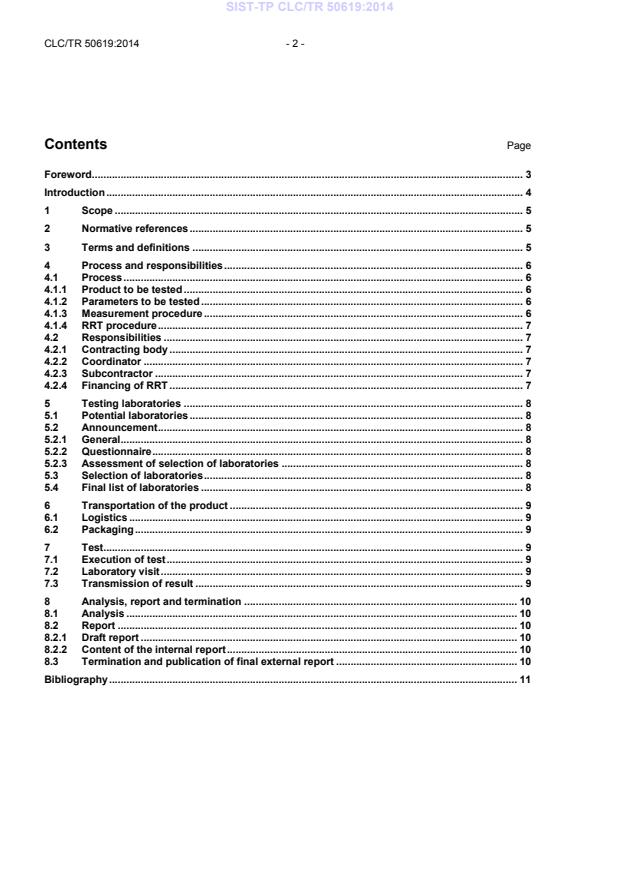
Contents Page
Foreword . 3
Introduction . 4
1 Scope . 5
2 Normative references . 5
3 Terms and definitions . 5
4 Process and responsibilities . 6
4.1 Process . 6
4.1.1 Product to be tested . 6
4.1.2 Parameters to be tested . 6
4.1.3 Measurement procedure . 6
4.1.4 RRT procedure . 7
4.2 Responsibilities . 7
4.2.1 Contracting body . 7
4.2.2 Coordinator . 7
4.2.3 Subcontractor . 7
4.2.4 Financing of RRT . 7
5 Testing laboratories . 8
5.1 Potential laboratories . 8
5.2 Announcement . 8
5.2.1 General . 8
5.2.2 Questionnaire . 8
5.2.3 Assessment of selection of laboratories . 8
5.3 Selection of laboratories . 8
5.4 Final list of laboratories . 8
6 Transportation of the product . 9
6.1 Logistics . 9
6.2 Packaging . 9
7 Test . 9
7.1 Execution of test . 9
7.2 Laboratory visit . 9
7.3 Transmission of result . 9
8 Analysis, report and termination . 10
8.1 Analysis . 10
8.2 Report . 10
8.2.1 Draft report . 10
8.2.2 Content of the internal report . 10
8.3 Termination and publication of final external report . 10
Bibliography . 11
- 3 - CLC/TR 50619:2014
Foreword
This document (CLC/TR 50619:2014) has been prepared by CLC/TC TC59X "Performance of household
and similar electrical appliances".
Attention is drawn to the possibility that some of the elements of this document may be the subject of
patent rights. CENELEC [and/or CEN] shall not be held responsible for identifying any or all such patent
rights.
Introduction
It is the responsibility of each standardisation committee under TC 59X to establish the repeatability and
reproducibility of the measurement standards developed.
Results from inter-laboratory comparisons are important for
a) identification of interlaboratory differences;
b) establishment of the effectiveness and comparability of test or measurement methods;
c) validation of uncertainties;
d) evaluation of the performance of laboratories for specific tests or measurements and monitoring
laboratories' continuing performance;
e) identification of problems in laboratories and initiation of actions for improvement which, for
example, may be related to inadequate test or measurement procedures, effectiveness of staff
training and supervision, or calibration of equipment; and
f) education of participating laboratories based on the outcomes of such comparisons.
The need for ongoing confidence in laboratory performance is not only essential for laboratories and their
contractors but also for other interested parties, such as regulators, laboratory accreditation bodies and
other organisations that specify requirements for laboratories. EN ISO/IEC 17011 requires accreditation
bodies to take account of laboratories' participation and performance in proficiency testing.
With this respect round robin testing was widely made in the past by TC59X for development of
measurement procedures on purpose of EU regulatory measures on Labeling and Ecodesign. Round
robin test results have been widely taken into account in the establishment of regulations, in defining
tolerance levels for verification of declared values and/or limits.
This Technical Report is intended to provide a consistent basis for performing round robin testing. It gives
guidance to all interested parties to determine the competence among each other. It provides common
ground for reliable statistical data (repeatability and reproducibility levels, etc.) as needed for regulation
purposes (like for Labeling and Ecodesign).
- 5 - CLC/TR 50619:2014
1 Scope
This Technical Report provides guidance for carrying out round robin tests (RRT) and hence for the
determination of levels of repeatability (intra-laboratory variability) and reproducibility (inter-laboratory
variability).
This Technical Report can also be used to verify the measurement methods, to improve the
measurement method, and to qualify laboratories.
It is not applicable for the determination of production variation for a particular product.
General advice on proficiency testing of laboratories is given in EN 17043. This Technical Report can be
used in addition to this document.
NOTE The repeatability and reproducibility levels are important factors for the establishment of uncertainty margins
of the measurement methods and for the definition of tolerances levels in verification schemes.
2 Normative references
The following documents, in whole or in part, are normatively referenced in this document and are
indispensable for its application. For dated references, only the edition cited applies. For undated
references, the latest edition of the referenced document (including any amendments) applies.
EN ISO/IEC 17043:2010, Conformity assessment — General requirements for proficiency testing
(ISO/IEC 17043)
IEC/TR 61923, Household electrical appliances — Method of measuring performance — Assessment of
repeatability and reproducibility
3 Terms and definitions
For the purposes of this document, the terms and definitions given in EN ISO/IEC 17043:2010 and the
following apply.
3.1
contracting body
organisation or individual for which a round robin testing is provided through a contractual arrangement
[SOURCE: EN ISO/IEC 17043:2010, definition 3.3, modified]
3.2
repeatability
precision under repeatability conditions
Note1 to entry: Repeatability includes the variability of the appliance under test.
[SOURCE: ISO 3534-1, definition 3.15]
3.3
reproducibility
precision under reproducibility conditions
Note 1 to entry: Reproducibility includes repeatability
[SOURCE: ISO 3534-1, definition 3.20]
3.4
round robin testing
process in which one or more items is tested according to a specific protocol by a number of different
laboratories
Note 1 to entry: It is the intention to derive levels of repeatability and reproducibility and hence making
classifications of laboratories.
Note 2 to entry: An alternative term is “ring testing”. The term “proficiency testing” is more general as covers other
aspects than derivation of repeatability and reproducibility values [SOURCE: EN ISO/IEC 17043:2010, definition 3.7].
Note 3 to entry: It may be used for the evaluation of laboratory performance against pre-established criteria.
4 Process and responsibilities
4.1 Process
4.1.1 Product to be tested
The product category to be tested should be clearly specified and one or more representative products
should be selected. If only one product is selected, it should be representative in the sense that it reflects
the typical behaviour and performance of the defined product category. It is recommended that two or
more products be tested in order to get an indication on the measurement uncertainty across the range of
performance that is likely to be encountered in the market. (For example, one product with high and one
with low energy/water consumption or performance).
The products to be used for the RRT can be selected either by pre-testing, pre-selection or special
production.
Additional sample(s) should be put aside as replacements in case any RRT samples are damaged.
NOTE It may be appropriate to circulate key items of test equipment or other test objects together with the RRT
samples.
4.1.2 Parameters to be tested
...
Questions, Comments and Discussion
Ask us and Technical Secretary will try to provide an answer. You can facilitate discussion about the standard in here.
Loading comments...