


kSIST FprEN IEC 62590-2-2:2026
(Main)Railway applications - Electronic power converters for fixed installations - Part 2-2: DC Applications - Controlled converters
Bahnanwendungen – Leistungselektronische Stromrichter für ortsfeste Anlagen – Teil 2-2: Gleichstrom Anwendungen – Gesteuerte Stromumrichter
Applications ferroviaires - Convertisseurs électroniques de puissance pour installations fixes - Partie 2-2 : Applications de traction en courant continu - Convertisseurs commandés
Železniške naprave - Elektronski močnostni pretvornik za fiksne postroje - 2-2. del: Enosmerno napajanje - Krmiljeni konverter
General Information
- Status
- Not Published
- Public Enquiry End Date
- 31-Oct-2024
- Technical Committee
- ŽEN - Electrical applications for railways
- Current Stage
- 5020 - Formal vote (FV) (Adopted Project)
- Start Date
- 30-Dec-2025
- Due Date
- 17-Feb-2026
- Completion Date
- 29-Jan-2026

Overview
kSIST FprEN IEC 62590-2-2:2026 provides comprehensive requirements and guidelines for electronic power converters utilized in fixed railway installations, specifically focusing on DC applications with controlled converters. Developed by SIST under the IEC framework, this international standard details the functions, working principles, interfaces, and test methods for controlled AC/DC and DC/DC converters used in electric traction power supply systems. The aim is to ensure system safety, interoperability, and efficiency across diverse railway networks, metros, tramways, trolleybuses, and emerging electric transport systems.
This standard addresses a range of semiconductors and converter technologies essential for modern rail infrastructure, promoting consistency and reliability in the integration of rectifiers, inverters, and bidirectional power electronics.
Key Topics
Types of Controlled Converters
- Line-commutated converters: Utilize the properties of the connected network for switching, found commonly in large, centralized systems.
- Self-commutated converters: Employ components like IGBTs or turn-off thyristors with antiparallel free-wheeling diodes, suitable for flexible and decentralized installations.
Power Electronics Functions
- Rectification: Controlled rectifiers direct alternating current (AC) from the three-phase grid to the direct current (DC) traction system.
- Inversion: Inverters return energy from the DC traction system to the grid, enabling regenerative braking and energy efficiency.
- Bidirectional Conversion: Reversible converters facilitate energy flow in both directions between AC supply and DC traction.
System Configurations
- Integration with 3-phase AC networks, energy storage systems, and other DC grids.
- Flexible approaches to transformers, including separate, combined, and tapped transformer arrangements for optimal performance and redundancy.
Performance and Protection
- Definition of rated load, DC power, and operational characteristics.
- Guidance on anti-commutation failure measures and use of voltage/current sensors for system protection.
Testing and Compliance
- Rigorous test methods spanning insulation, functionality, load, temperature rise, EMC compatibility, harmonics, and sound emission.
- Defined requirements for rating plates, marking, and conformity assessment.
Applications
IEC 62590-2-2 is central to the design, integration, and operation of electronic power converters in:
- Mainline Railway Networks: Ensures reliable DC power supply for traction systems, supporting high-capacity and frequent operations.
- Urban and Metropolitan Transport: Facilitates safe and efficient power flow in metros, trams, trolleybuses, and automated transport solutions.
- Electric Road and Maglev Systems: Provides adaptable standards for advanced and emerging transport technologies.
- Energy Storage Integration: Allows seamless connection of stationary energy storage systems (ESS) and supports regenerative energy capture during vehicle braking.
- Inter-system Connectivity: Enables controlled exchange of power between multiple DC networks or between AC and DC systems.
The standard is crucial for manufacturers, system integrators, and operators striving for high safety, energy efficiency, and interoperability in railway electrification projects.
Related Standards
Implementing IEC 62590-2-2 often requires alignment with complementary standards, including:
- IEC 62590-1: General requirements for electronic power converters in railway fixed installations.
- IEC 62590-2-1: Covers uncontrolled rectifiers for DC rail applications.
- IEC 62590-3-1 / 3-2: Standards for AC traction applications, covering compensators and frequency converters.
- IEC 60850: Supply voltages for traction systems.
- IEC 60529: Degrees of protection (IP code), relevant for environmental protection of electronic equipment.
- IEC 62236-5: Electromagnetic compatibility for fixed installations.
- IEC 62924: Stationary energy storage systems for DC traction.
Conclusion:
By following kSIST FprEN IEC 62590-2-2:2026, stakeholders in railway electrification ensure compliance with international best practices, promote safe interoperability, and achieve robust, energy-efficient conversion solutions for fixed rail infrastructure. This standard is essential for advancing the reliability and sustainability of modern rail and electric transport networks.
Get Certified
Connect with accredited certification bodies for this standard

IMQ S.p.A. (Certification)
Italian electrical product certification.

IRIS Certification (UNIFE)
International Railway Industry Standard certification.

SLG Prüf- und Zertifizierungs GmbH
German testing and certification body.
Sponsored listings
Frequently Asked Questions
kSIST FprEN IEC 62590-2-2:2026 is a draft published by the Slovenian Institute for Standardization (SIST). Its full title is "Railway applications - Electronic power converters for fixed installations - Part 2-2: DC Applications - Controlled converters". This standard covers: Railway applications - Electronic power converters for fixed installations - Part 2-2: DC Applications - Controlled converters
Railway applications - Electronic power converters for fixed installations - Part 2-2: DC Applications - Controlled converters
kSIST FprEN IEC 62590-2-2:2026 is classified under the following ICS (International Classification for Standards) categories: 29.200 - Rectifiers. Convertors. Stabilized power supply; 45.040 - Materials and components for railway engineering. The ICS classification helps identify the subject area and facilitates finding related standards.
kSIST FprEN IEC 62590-2-2:2026 is available in PDF format for immediate download after purchase. The document can be added to your cart and obtained through the secure checkout process. Digital delivery ensures instant access to the complete standard document.
Standards Content (Sample)
SLOVENSKI STANDARD
oSIST prEN IEC 62590-2-2:2024
01-oktober-2024
Železniške naprave - Elektronski elektroenergetski pretvornik za fiksne postroje -
2-2. del: Enosmerno napajanje - Krmiljeni konverter
Railway applications - Electronic power converters for fixed installations - Part 2-2: DC
Applications - Controlled converters
Applications ferroviaires - Convertisseurs électroniques de puissance pour installations
fixes - Partie 2-2 : Applications de traction en courant continu - Convertisseurs
commandés
Ta slovenski standard je istoveten z: prEN IEC 62590-2-2:2024
ICS:
29.200 Usmerniki. Pretvorniki. Rectifiers. Convertors.
Stabilizirano električno Stabilized power supply
napajanje
45.040 Materiali in deli za železniško Materials and components
tehniko for railway engineering
oSIST prEN IEC 62590-2-2:2024 en
2003-01.Slovenski inštitut za standardizacijo. Razmnoževanje celote ali delov tega standarda ni dovoljeno.
oSIST prEN IEC 62590-2-2:2024
oSIST prEN IEC 62590-2-2:2024
9/3105/CDV
COMMITTEE DRAFT FOR VOTE (CDV)
PROJECT NUMBER:
IEC 62590-2-2 ED1
DATE OF CIRCULATION: CLOSING DATE FOR VOTING:
2024-08-09 2024-11-01
SUPERSEDES DOCUMENTS:
9/2942/CD, 9/2983A/CC
IEC TC 9 : ELECTRICAL EQUIPMENT AND SYSTEMS FOR RAILWAYS
SECRETARIAT: SECRETARY:
France Mr Denis MIGLIANICO
OF INTEREST TO THE FOLLOWING COMMITTEES: PROPOSED HORIZONTAL STANDARD:
Other TC/SCs are requested to indicate their interest, if
any, in this CDV to the secretary.
FUNCTIONS CONCERNED:
EMC ENVIRONMENT QUALITY ASSURANCE SAFETY
SUBMITTED FOR CENELEC PARALLEL VOTING NOT SUBMITTED FOR CENELEC PARALLEL VOTING
Attention IEC-CENELEC parallel voting
The attention of IEC National Committees, members of
CENELEC, is drawn to the fact that this Committee Draft
for Vote (CDV) is submitted for parallel voting.
The CENELEC members are invited to vote through the
CENELEC online voting system.
This document is still under study and subject to change. It should not be used for reference purposes.
Recipients of this document are invited to submit, with their comments, notification of any relevant patent rights of
which they are aware and to provide supporting documentation.
Recipients of this document are invited to submit, with their comments, notification of any relevant “In Some
Countries” clauses to be included should this proposal proceed. Recipients are reminded that the CDV stage is
the final stage for submitting ISC clauses. (SEE AC/22/2007 OR NEW GUIDANCE DOC).
TITLE:
Railway applications - Electronic power converters for fixed installations - Part 2-2: DC
Applications - Controlled converters
PROPOSED STABILITY DATE: 2027
NOTE FROM TC/SC OFFICERS:
electronic file, to make a copy and to print out the content for the sole purpose of preparing National Committee positions.
You may not copy or "mirror" the file or printed version of the document, or any part of it, for any other purpose without
permission in writing from IEC.
oSIST prEN IEC 62590-2-2:2024
IEC CDV 62590-2-2 IEC 2024 – 2 – 9/3105/CDV
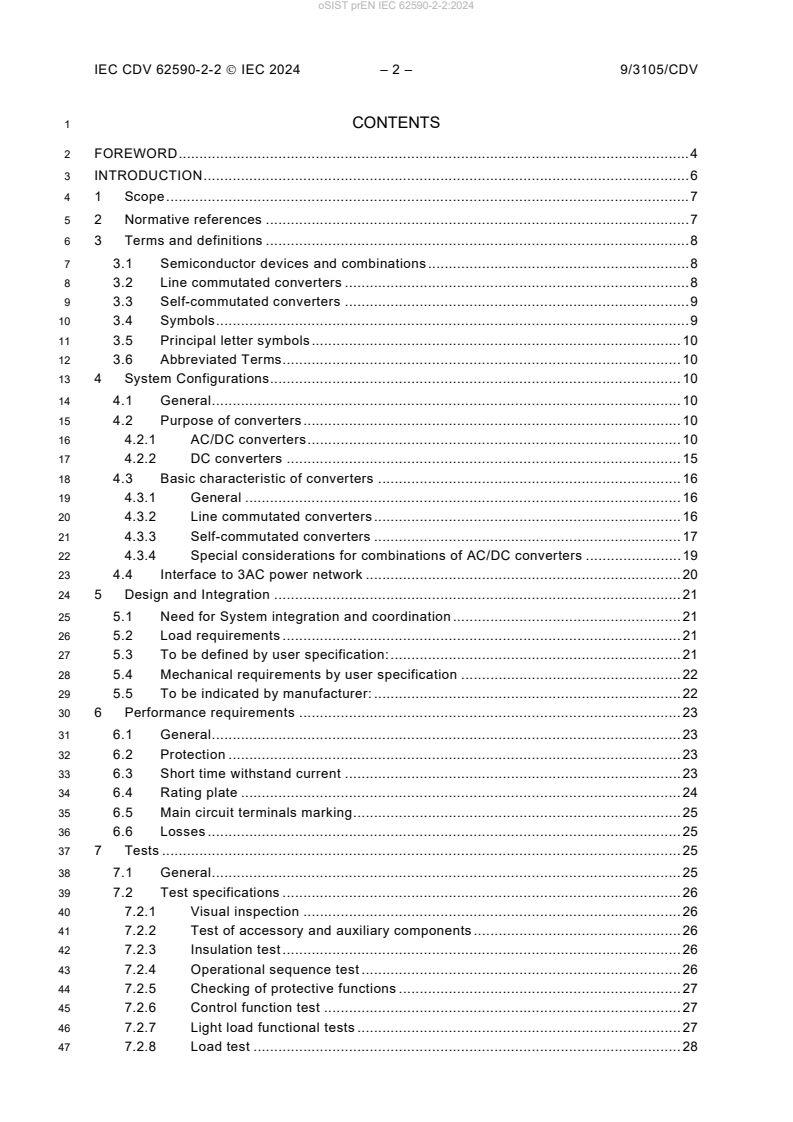
1 CONTENTS
2 FOREWORD . 4
3 INTRODUCTION . 6
4 1 Scope . 7
5 2 Normative references . 7
6 3 Terms and definitions . 8
7 3.1 Semiconductor devices and combinations . 8
8 3.2 Line commutated converters . 8
9 3.3 Self-commutated converters . 9
10 3.4 Symbols . 9
11 3.5 Principal letter symbols . 10
12 3.6 Abbreviated Terms . 10
13 4 System Configurations . 10
14 4.1 General . 10
15 4.2 Purpose of converters . 10
16 4.2.1 AC/DC converters . 10
17 4.2.2 DC converters . 15
18 4.3 Basic characteristic of converters . 16
19 4.3.1 General . 16
20 4.3.2 Line commutated converters . 16
21 4.3.3 Self-commutated converters . 17
22 4.3.4 Special considerations for combinations of AC/DC converters . 19
23 4.4 Interface to 3AC power network . 20
24 5 Design and Integration . 21
25 5.1 Need for System integration and coordination . 21
26 5.2 Load requirements . 21
27 5.3 To be defined by user specification: . 21
28 5.4 Mechanical requirements by user specification . 22
29 5.5 To be indicated by manufacturer: . 22
30 6 Performance requirements . 23
31 6.1 General . 23
32 6.2 Protection . 23
33 6.3 Short time withstand current . 23
34 6.4 Rating plate . 24
35 6.5 Main circuit terminals marking . 25
36 6.6 Losses . 25
37 7 Tests . 25
38 7.1 General . 25
39 7.2 Test specifications . 26
40 7.2.1 Visual inspection . 26
41 7.2.2 Test of accessory and auxiliary components . 26
42 7.2.3 Insulation test . 26
43 7.2.4 Operational sequence test . 26
44 7.2.5 Checking of protective functions . 27
45 7.2.6 Control function test . 27
46 7.2.7 Light load functional tests . 27
47 7.2.8 Load test . 28
oSIST prEN IEC 62590-2-2:2024
IEC CDV 62590-2-2 IEC 2024 – 3 – 9/3105/CDV
48 7.2.9 Temperature rise test . 28
49 7.2.10 Short-time withstand current test . 28
50 7.2.11 Power Loss determination . 30
51 7.2.12 Audible sound . 30
52 7.2.13 EMC . 30
53 7.2.14 Harmonic measurements . 30
54 7.2.15 Power factor . 31
55 7.2.16 Mechanical Tests . 31
56 Annex A (informative) Power flow control strategies . 32
57 A.1 General . 32
58 A.2 Examples for DC side coordination of current versus voltage characteristics: . 32
59 Annex B (informative) Calculation Factors . 37
60 Annex C (informative) Test circuits for load tests . 38
61 C.1 General . 38
62 C.2 Test circuits . 38
63 Bibliography . 40
65 Figure 1 – General arrangement of AC/DC converters . 11
66 Figure 2 – Rectifiers, inverters, and combinations . 12
67 Figure 3 – Connection with separate transformers . 13
68 Figure 4 – Connection with combined transformer . 13
69 Figure 5 – Connection with combined transformer with taps . 14
70 Figure 6 – Converter with reversible valve device assembly . 14
71 Figure 7 – Common system configuration of stationary ESS . 15
72 Figure 8 – configurations of DC converters . 15
73 Figure A.1 – Diode Rectifier + Thyristor Inverter – example (1) . 32
74 Figure A.2 – Diode Rectifier + Thyristor Inverter – example (2) . 33
75 Figure A.3 – Diode Rectifier + Thyristor Inverter – example (3) . 33
76 Figure A.4 – Diode Rectifier + Thyristor Inverter – example (4) . 34
77 Figure A.5 – Thyristor Rectifier + Thyristor Inverter – example (5) . 34
78 Figure A.6 – self-commutated converter/Inverter – example (6) . 35
79 Figure A.7 – self-commutated converter/Inverter – example (7) . 36
80 Figure C.1 – Test of a controlled rectifier or inverter . 38
81 Figure C.2 – Test of a reversible converter . 39
83 Table 1 – Summary of tests . 25
84 Table B.1 – Voltage factors . 37
oSIST prEN IEC 62590-2-2:2024
IEC CDV 62590-2-2 IEC 2024 – 4 – 9/3105/CDV
87 INTERNATIONAL ELECTROTECHNICAL COMMISSION
88 ____________
90 RAILWAY APPLICATIONS –ELECTRONIC POWER CONVERTERS FOR
91 FIXED INSTALLATIONS
92 Part 2-2: DC TRACTION APPLICATIONS – CONTROLLED CONVERTERS
94 FOREWORD
95 1) The International Electrotechnical Commission (IEC) is a worldwide organization for standardization comprising
96 all national electrotechnical committees (IEC National Committees). The object of IEC is to promote international
97 co-operation on all questions concerning standardization in the electrical and electronic fields. To this end and
98 in addition to other activities, IEC publishes International Standards, Technical Specifications, Technical Reports,
99 Publicly Available Specifications (PAS) and Guides (hereafter referred to as “IEC Publication(s)”). Their
100 preparation is entrusted to technical committees; any IEC National Committee interested in the subject dealt with
101 may participate in this preparatory work. International, governmental and non-governmental organizations liaising
102 with the IEC also participate in this preparation. IEC collaborates closely with the International Organization for
103 Standardization (ISO) in accordance with conditions determined by agreement between the two organizations.
104 2) The formal decisions or agreements of IEC on technical matters express, as nearly as possible, an international
105 consensus of opinion on the relevant subjects since each technical committee has representation from all
106 interested IEC National Committees.
107 3) IEC Publications have the form of recommendations for international use and are accepted by IEC National
108 Committees in that sense. While all reasonable efforts are made to ensure that the technical content of IEC
109 Publications is accurate, IEC cannot be held responsible for the way in which they are used or for any
110 misinterpretation by any end user.
111 4) In order to promote international uniformity, IEC National Committees undertake to apply IEC Publications
112 transparently to the maximum extent possible in their national and regional publications. Any divergence between
113 any IEC Publication and the corresponding national or regional publication shall be clearly indicated in the latter.
114 5) IEC itself does not provide any attestation of conformity. Independent certification bodies provide conformity
115 assessment services and, in some areas, access to IEC marks of conformity. IEC is not responsible for any
116 services carried out by independent certification bodies.
117 6) All users should ensure that they have the latest edition of this publication.
118 7) No liability shall attach to IEC or its directors, employees, servants or agents including individual experts and
119 members of its technical committees and IEC National Committees for any personal injury, property damage or
120 other damage of any nature whatsoever, whether direct or indirect, or for costs (including legal fees) and
121 expenses arising out of the publication, use of, or reliance upon, this IEC Publication or any other IEC
122 Publications.
123 8) Attention is drawn to the Normative references cited in this publication. Use of the referenced publications is
124 indispensable for the correct application of this publication.
125 9) Attention is drawn to the possibility that some of the elements of this IEC Publication may be the subject of patent
126 rights. IEC shall not be held responsible for identifying any or all such patent rights.
127 International Standard IEC 62590 has been prepared by IEC technical committee 9: Electrical
128 equipment and systems for railways.
129 The text of this standard is based on the following documents:
FDIS Report on voting
9/1387/FDIS 9/1411/RVD
131 Full information on the voting for the approval of this standard can be found in the report on
132 voting indicated in the above table.
133 This publication has been drafted in accordance with the ISO/IEC Directives, Part 2.
oSIST prEN IEC 62590-2-2:2024
IEC CDV 62590-2-2 IEC 2024 – 5 – 9/3105/CDV
134 The committee has decided that the contents of this publication will remain unchanged until the
135 stability date indicated on the IEC web site under "http://webstore.iec.ch" in the data related to
136 the specific publication. At this date, the publication will be
137 • reconfirmed,
138 • withdrawn,
139 • replaced by a revised edition, or
140 • amended.
oSIST prEN IEC 62590-2-2:2024
IEC CDV 62590-2-2 IEC 2024 – 6 – 9/3105/CDV
143 INTRODUCTION
144 Semiconductor converters for traction power supply differ from other electronic power
145 converters for industrial use due to special electrical service conditions and due to the large
146 range of load variation and the peculiar characteristics of the load.
147 Controlled rectifiers are supplying a DC traction network from a three-phase power network
148 using controllable semiconductor valves. Inverters enable to recuperate power from a DC
149 traction network into a three-phase power network. Reversible converters combine the functions
150 of a rectifier and an inverter.
151 DC converters are self-commutated converters for connecting of the DC traction network with
152 other DC networks or storage devices.
153 The series of IEC 62590 consists of the following parts:
154 IEC 62590-1 Railway applications – Electronic power converters for fixed installations – Part 1:
155 General requirements
156 IEC 62590-2-1 Railway applications – Electronic power converters for fixed installations –
157 Part 2-1: DC traction applications - Uncontrolled rectifiers
158 IEC 62590-2-2 Railway applications – Electronic power converters for fixed installations –
159 Part 2-2: DC traction applications – Controlled converters
160 IEC 62590-3-1 Railway applications – Electronic power converters for fixed installations –
161 Part 3-1: AC traction applications – Electronic power compensators
162 IEC 62590-3-2 Railway applications – Electronic power converters for fixed installations –
163 Part 3-2: AC traction applications – Static frequency converters
oSIST prEN IEC 62590-2-2:2024
IEC CDV 62590-2-2 IEC 2024 – 7 – 9/3105/CDV
166 RAILWAY APPLICATIONS – ELECTRONIC POWER CONVERTERS FOR
167 FIXED INSTALLATIONS
168 PART 2-2: DC TRACTION APPLICATIONS - CONTROLLED CONVERTERS
171 1 Scope
172 This document describes functions and working principles, specifies requirements, interfaces,
173 and test methods for controlled converters for DC electric traction power supply systems:
174 • AC/DC converters
175 – Rectifiers
176 – Inverters
177 – Combinations
178 • DC converters
179 Purpose of the converters can be a power connection to other power networks or energy
180 storages.
181 Common characteristic of this equipment is the possibility to influence the power flow in the DC
182 electric traction power supply system. The converters can be:
183 • Line commutated
184 • Self-commutated
186 This document applies to fixed installations of following electric traction systems:
187 • railway networks,
188 • metropolitan transport networks including metros, tramways, trolleybuses and fully
189 automated transport systems, magnetic levitated transport systems, electric road systems.
191 2 Normative references
192 The following documents are referred to in the text in such a way that some or all of their content
193 constitutes requirements of this document. For dated references, only the edition cited applies.
194 For undated references, the latest edition of the referenced document (including any
195 amendments) applies.
196 IEC 60529, Degrees of protection provided by enclosures (IP code)
197 IEC 62590-1, Railway applications – Fixed installations – Electronic power converters – Part 1:
198 General requirements
199 IEC 62695, Railway applications - Fixed installations - Traction transformers
200 IEC 60850, Railway applications – Supply voltages of traction systems
201 IEC 62236-5, Railway applications - Electromagnetic compatibility - Part 5: Emission and
202 immunity of fixed power supply installations and apparatus / Applies in conjunction with IEC
203 62236-1 (2008-12)
204 IEC 60071-1, Insulation co-ordination - Part 1: Definitions, principles and rules
oSIST prEN IEC 62590-2-2:2024
IEC CDV 62590-2-2 IEC 2024 – 8 – 9/3105/CDV
205 3 Terms and definitions
206 For the purposes of this document, the terms and definitions given in 62590-1 and the following
207 apply.
208 ISO and IEC maintain terminological databases for use in standardization at the following
209 addresses:
210 • ISO Online browsing platform: available at https://www.iso.org/obp
211 • IEC Electropedia: available at https://www.electropedia.org
212 3.1 Semiconductor devices and combinations
213 3.1.1
214 rated current
215 rated load
216 I
Nd
217 value of a DC current a controlled converter is designed for, referring to the DC electric traction
218 power supply system
219 Note 1 to entry: All rated values of the components are derived from this value
220 Note 2 to entry: A converter can have a rated continuous load and rated loads in conjunction with a duty classes.
221 3.1.2
222 rated DC power
223 rated current multiplied with nominal DC voltage
224 Note 1 to entry: This value refers to DC electric traction power supply system side.
225 3.1.3
226 reversible converter
227 converter in which the direction of the power flow is reversible
228 [SOURCE IEC 60050-551:1998, 551-12-37]
230 3.2 Line commutated converters
231 3.2.1
232 trigger delay angle
233 time expressed in angular measure by which the trigger pulse is delayed with respect to the
234 reference instant in the case of phase control
235 Note 1 to entry: With line, machine or load commutated converters the reference instant is the zero crossing instant
236 of the commutating voltage. With AC controllers it is the zero crossing instant of the supply voltage. For AC controllers
237 with inductive loads the trigger delay angle is the sum of the phase shift and the current delay angle.
238 [SOURCE: IEC 60050-551:1998, 551-16-33, modified – “the” removed]
239 3.2.2
240 commutation failure
241 failure to commutate the current from a conducting arm to the succeeding arm
242 [SOURCE: IEC 60050-551:1998, 551-16-59, modified – “a” removed]
oSIST prEN IEC 62590-2-2:2024
IEC CDV 62590-2-2 IEC 2024 – 9 – 9/3105/CDV
244 3.3 Self-commutated converters
245 3.3.1
246 switched valve device
247 controllable valve device which can be turned on and off by a control signal
248 [SOURCE: IEC 60050-551:1998 551-14-08, modified – “a” removed, may replaced with can]
249 3.3.2
250 free-wheeling diode
251 diode parallel to a switched valve device in reverse direction fulfilling the purpose of a free-
252 wheeling arm
253 3.3.3
254 boost converter
255 direct DC converter providing an output voltage which is higher than the input voltage
256 [SOURCE: IEC 60050-551:1998, 551-12-32]
257 3.3.4
258 buck converter
259 direct DC converter providing an output voltage which is lower than the input voltage
260 [SOURCE: IEC 60050-551:1998, 551-12-33]
261 3.4 Symbols
262 The following symbols are used in this document:
263 AC/DC converter with optional indication of power
264 flow direction
DC
DC
265 DC converter
DC
DC
266 DC converter with isolation between 2 electrical circuits
Rec
267 diode rectifier (valve)assembly
268 IGBT converter(valve device) assembly
oSIST prEN IEC 62590-2-2:2024
IEC CDV 62590-2-2 IEC 2024 – 10 – 9/3105/CDV
Rec
269 thyristor converter (valve) assembly
270 NOTE: The symbols for the DC converters are taken from IEC 60617 while the other symbols are adapted to the
271 need of this document.
272 3.5 Principal letter symbols
273 U test voltage for power frequency withstand voltage test
a
274 U no load transformer voltage, valve side
v0
275 UdN nominal DC voltage
276 3.6 Abbreviated Terms
277 ESS energy storage system, system that can take electrical energy from the DC
278 power supply network, store the energy, and supply the energy back to the DC electric power
279 supply network when necessary
280 ESU energy storage unit, device to which electrical energy is charged and from which
281 electrical energy is discharged
282 ACTB apparatus to connect ESU to DC bus
283 IGBT insulated gate bipolar transistor
284 AC alternating current
285 3AC three phase AC
286 DC direct current
287 4 System Configurations
288 4.1 General
289 Main purpose of controlled electronic power converters for DC electric traction power supply
290 systems is to influence the power flow. The power can flow from a 3AC power network to the
291 DC electric traction system or vice versa. This can also be a bidirectional power flow to energy
292 storages or other equipment using regenerated power.
293 This type of equipment has a control including processing of measured values.
295 4.2 Purpose of converters
296 4.2.1 AC/DC converters
297 4.2.1.1 General
298 The AC/DC converters connect a 3AC power network with a DC electric traction power supply
299 system as shown in Figure 1. Requirements from both networks shall be considered.
oSIST prEN IEC 62590-2-2:2024
IEC CDV 62590-2-2 IEC 2024 – 11 – 9/3105/CDV
3AC power network
U
V0
3~
DC
DC traction power supply system
U
dN
301 Figure 1 – General arrangement of AC/DC converters
302 4.2.1.2 Rectifiers
303 The purpose of rectifiers is to have a power flow from the 3AC power network to the DC electric
304 traction power supply system.
305 Controlled rectifiers operate on an adjustable characteristic curve in the voltage versus current area.
306 This characteristic can be adjustable. Examples are given in Annex A. Limits may be included.
307 Controlled rectifiers can be line commutated or self-commutated.
308 A suitable duty class should be chosen from IEC 62590-1 5.7.2 .
310 4.2.1.3 Inverters
311 The purpose of inverters is to enable a power flow from the DC electric traction power supply system
312 to the 3AC power network. The benefit of this power flow direction is based on the possibility of
313 traction vehicles to brake electrically either for reducing the speed or driving downhill.
314 Inverters can be line commutated or self-commutated.
315 The definition of a load cycle is appropriate in most cases, see IEC 62590-1 5.7.3.
317 4.2.1.4 Reversible converters
318 The purpose of a combination of a rectifier and inverter is to enable a bidirectional power exchange
319 between a 3AC power network and the DC electric traction power supply system.
320 There is a broad variety of different combinations using line commutated and self-commutated
321 converters, see Figure 2.
322 Figures 3 to 6 show various possible combinations of rectifiers and inverters to be installed in a
323 reversible substation. They can share the same transformer, same control, or same filter.
325 Commonly used parts of the reversible converter are subject to a combined load requirement.
326 For the rectifier part a suitable duty class should be chosen. For the inverter part a suitable load cycle
327 or a suitable duty class should be chosen according to the application, see Figure 3 to Figure 6. This
328 can result in an asymmetric load for 3 winding transformers in special cases shown in Figure 4 and
329 Figure 5.
oSIST prEN IEC 62590-2-2:2024
IEC CDV 62590-2-2 IEC 2024 – 12 – 9/3105/CDV
Reversible
Rectifier Inverter Converter
3~ 3~ 3~
DC DC DC
Inv
Rec
Inv
Rec
Rec
Rec Inv Inv
Rec Inv
Rec
Inv
REC/Inv
331 Key:
332 Left column controlled rectifiers
333 middle column inverters
334 right column reversible converters
335 Row 1 general symbol
336 Row 2 example of transformer + valve device assembly
337 Row 3 to 6 alternative valve device assemblies
338 NOTE: The symbols represent typical valve devices used in the respective application.
339 Figure 2 – Rectifiers, inverters, and combinations
oSIST prEN IEC 62590-2-2:2024
IEC CDV 62590-2-2 IEC 2024 – 13 – 9/3105/CDV
3AC power network
3~ 3~ 3~
DC DC DC
Electric traction power supply system
343 Figure 3 – Connection with separate transformers
344 A reversible converter configuration may consist of separated rectifier and inverter. Figure 3 shows
345 such a configuration. Both may be connected to the same 3AC power network or to different 3AC
346 power networks. The function and design are as independent as possible.
3AC power network
3~ 3~ 3~ 3~
DC DC DC DC
Electric traction power supply system
350 Figure 4 – Connection with combined transformer
352 A reversible converter configuration may share the same main transformer. Such a configuration is
353 shown in Figure 4. In this case an additional transformer is used to adapt the inverter 3AC voltage to
354 the rectifier 3AC voltage. If a three-winding transformer with two traction side windings is used the
355 inverter can be connected to one side only or one inverter to each winding. The main transformer shall
356 be designed for both power flow directions.
oSIST prEN IEC 62590-2-2:2024
IEC CDV 62590-2-2 IEC 2024 – 14 – 9/3105/CDV
3AC power network
3~ 3~ 3~ 3~
DC DC DC DC
Electric traction power supply system
359 Figure 5 – Connection with combined transformer with taps
361 Figure 5 shows a configuration with a combined transformer with taps. No additional transformer is
362 used for the adaptation of the inverter and rectifier voltage.
3AC power network
3~
DC
Electric traction power supply system
366 Figure 6 – Converter with reversible valve device assembly
368 Figure 6 shows the configuration of a reversible converter using a unique all in one reversible valve
369 device assembly associated with a unique transformer. The control for both flow directions is
370 integrated in this case.
371 More than one traction side transformer winding can be used.
372 Parallel and series connections are possible.
oSIST prEN IEC 62590-2-2:2024
IEC CDV 62590-2-2 IEC 2024 – 15 – 9/3105/CDV
374 4.2.1.5 Reversible AC/DC converters for energy storages
375 The purpose of reversible converter for an energy storage is to connect the DC electric traction power
376 supply system with an energy storage unit.
377 The purpose is described in IEC 62924. The converter is fulfilling the function of the ACTB.
378 The configuration is shown in Figure 7.
379 Load requirements are defined in IEC 62924.
381 Figure 7 – Common system configuration of stationary ESS
383 4.2.2 DC converters
384 A DC converter connects the DC electric traction power supply system to another DC system. This
385 can be for example a capacitor or battery for the purpose of energy storage or a DC distribution
386 system. DC converters can also be used for controlling a wayside braking resistor for consuming
387 power of braking rolling stock.
388 NOTE: A controlled wayside braking resistor is often called AARU, automatic assured receptivity unit, or BRU, braking
389 resistor unit.
Electric traction power supply sytem
Electric traction
DC DC
power supply
DC DC
system
Other system
391 Figure 8 – configurations of DC converters
392 Figure 8 shows the basic configuration of DC converters.
393 Both sides of a non-isolating DC converter are part of the DC electric traction power supply system.
394 An isolating DC converter separates the DC electric traction power supply system from another
395 system with different insulation coordination.
396 The purpose for energy storages is described in IEC 62924. The converter is fulfilling the function of
397 an ACTB. See Figure 7.
398 For energy storage purpose load requirements are defined in IEC 62924.
oSIST prEN IEC 62590-2-2:2024
IEC CDV 62590-2-2 IEC 2024 – 16 – 9/3105/CDV
399 For other purpose a load class should be selected.
401 4.3 Basic characteristic of converters
402 4.3.1 General
403 Controlled converters have different basic working principles. A coordination between the
404 transformer and the valve device assembly is needed. In most cases the transformer is part of
405 a filter circuit. The choice of the transformer main values has a major influence on the power
406 quality of the connected networks.
407 All controlled converters use voltage and current sensors. Their signals are processed and used
408 to create firing signals for the semiconductors. For all converters connected to a 3AC power
409 network, a synchronization with this network is necessary.
410 4.3.2 Line commutated converters
411 4.3.2.1 General
412 The basic behaviour of line commutated converters is broadly described in IEC 60146-1-1.
413 An application guide is IEC/TR 60146-1-2.
414 Basic connection are 6-pulse bridges or their combinations. Most common are 12-pulse connections.
415 The basic connections and calculation factors for uncontrolled operation can be taken from IEC
416 62590-2-1 table 1.
417 NOTE: The ratio between the direct voltage drop and the impedance voltage in IEC 60146-1-1 Table 10 have a
418 slightly different meaning.
419 The DC voltage can be controlled varying the trigger delay angle. A voltage versus current
420 characteristic can be realized.
421 The user shall define the whole intended range of operation in conjunction with the tolerance of the
422 3AC network voltage. This enables the manufacturer to design the transformer and the valve device
423 assembly.
425 4.3.2.2 Line commutated rectifiers
426 The transformer no load voltage shall be chosen according to the required range of operation. The
427 transformer no load voltage for a controlled rectifier is higher than for an uncontrolled diode rectifier.
428 The trigger delay angle reduces the DC voltage as described in IEC TR 60146-1-2.
430 For rectifier purpose the trigger delay angle is in the range clearly below 90°. The trigger delay angle is
431 depending on the point of operation and is usually between 60° and 5°. For practical reasons a trigger
432 delay angle of 0° is not achievable as thyristors can only be switched on with a forward voltage.
434 The no load transformer voltage is higher than for a comparable diode rectifier. With a higher no load
435 voltage
436 • the control range increases
437 • the reactive power at the 3AC side increases
438 • the DC harmonic content increases
oSIST prEN IEC 62590-2-2:2024
IEC CDV 62590-2-2 IEC 2024 – 17 – 9/3105/CDV
439 • the transformer power for the same traction load is higher
440 • the 3AC harmonic content is higher at low current
442 4.3.2.3 Line commutated inverters
443 For inverters the trigger delay angle is higher than 90° and the cathodes are connected to the negative
444 polarity of the supply voltage. A practical range is between 130° and 165° including some reserve.
445 The worst case expected operational situation should not lead to a commutation failure. This worst
446 case consists of the maximum operational DC voltage at the maximum DC current in combination with
447 the minimum expected operational 3AC power network voltage.
448 A commutation failure is a short circuit and leads to an interruption of the inverter operation. Only
449 intended protection devices shall operate.
450 A commutation failure shall not lead to any damage of the inverter by design. Only the foreseen
451 protection devices should be reset. Neighbouring rectifiers should not be affected to guarantee the
452 availability of the power supply function.
453 The maximum allowable trigger delay angle is depending on:
454 • the recovery time of the thyristor
455 • and the overlap angle as a function of the current
456 • commutation inductance provided by the transformer and short circuit impedance
457 • the actual 3AC power network voltage
458 • the transformer no load voltage
459 • the DC operating voltage
460 The choice of a proper traction side no load voltage of the transformer is important for the overall
461 behavior of the inverter. With a higher no load voltage
462 • the probability of a commutation failure decreases
463 • the DC harmonic content is higher
464 • the reactive power increases
465 • the transformer power for the same current is higher
467 In most cases a DC side inductor is recommended to improve the operational behaviour in case of a
468 commutation failure and to reduce the DC harmonic current.
470 4.3.3 Self-commutated converters
471 4.3.3.1 General
472 Self-commutated converters are described in IEC 60146-2.
473 Self-commutated converters are characterized using switched valves that can be switched on and off.
474 Most common is the use of transistors and turn-off thyristors both with an antiparallel free-wheeling
475 diode.
oSIST prEN IEC 62590-2-2:2024
IEC CDV 62590-2-2 IEC 2024 – 18 – 9/3105/CDV
476 Self-commutated converters contain a major capacitor smoothing the DC side voltage. Together
477 with other components it is forming a filter. Precharging can be used in order to avoid current
478 surges.
479 4.3.3.2 AC/DC converters
480 A broad variety of connections is in use.
481 The main common characteristics are:
482 • Use of free-wheeling diodes. The free-wheeling diodes are forming an uncontrolled rectifier.
483 The DC voltage is higher than the amplitude of the 3AC transformer traction side voltage.
484 • There is no fixed ratio between the 3AC transformer traction side voltage and the DC
485 voltage. The ratio is determined by pulse patterns and modulation method. Safety margins
486 are used for the adaption to all points of operation.
487 • The converters can be operated in both directions even if it may be not intended in some
488 applications.
489 • Despite the losses the DC power is equal to the 3AC active power.
490 • The transformer is used for voltage adaption.
491 • The transformer is isolating two networks
492 • The impedance of the transformer is used for power flow control and is part of a filter.
493 • Harmonic orders are specific for every converter type, on the DC side as well as on the AC
494 side.
495 • A major capacitance on the DC side is needed for the function.
496 Pulse frequency, modulation method and number of parallel units are defining the harmonic
497 orders on the 3AC power network side as well as on the DC side. Coordination is recommended
498 to avoid frequencies used by the signalling system as well as resonance frequencies as far as
499 they are identified.
500 A self-commutated AC/DC converter may have additional control functions as providing reactive
501 power for the 3AC power network side or active filtering. These functions shall be properly
502 defined.
503 4.3.3.3 DC converters
504 DC converters are self-commutated.
505 DC converters are mostly reversible.
506 DC converters use a filter on the DC traction side.
507 Applications for energy storages shall be bidirectional. The free-wheeling diodes may carry a current
508 in the case of a DC electric traction power supply system short circuit. A disconnection device can be
509 used for this case.
510 The power flow is controlled in both directions or in one direction only for wayside resistors.
511 A boost converter and/or a buck converter can be used. With a boost converter the non traction side
512 can determine a higher insulation voltage. A third type can be a bidirectional converter.
513 Isolating DC converters consist of an inverter + transformer + rectifier. They can be used to connect
514 the DC electric traction power supply system with other DC power systems. Both DC circuits can have
515 a different insulation level. In the terminology of power electronics this type is an indirect DC converter
516 with an AC intermediate circuit.
518 Both sides of a non-isolating DC converter are part of the DC electric traction power supply system.
oSIST prEN IEC 62590-2-2:2024
IEC CDV 62590-2-2 IEC 2024 – 19 – 9/3105/CDV
520 4.3.4 Special considerations for combinations of AC/DC converters
521 4.3.4.1 General
522 The rectifier and inverter function can be combined in different ways. Both functions can share
523 components.
524 Two separate converter units do not share any component. They can be individually designed
525 delivered and put in operation. They can be connected to different 3AC power networks.
526 A reversible converter is associated to a unique transformer. Power flow requirements of both
527 directions shall be considered.
528 All combinations shall be coordinated for proper operation. The current versus voltage
529 characteristic shall be coordinated in a way that only intended circulating current is flowing.
530 Coordination can mean the exchange of information between combined units. Examples are
531 shown in Annex A.
532 Different types of converters need different 3AC transformer traction side voltages at the valve
533 device assembly for the same DC voltage, see Annex B. This leads to adapt the voltage either
534 by transformers or DC converters.
535 Circulating currents shall be considered. The current versus voltage characteristic is subject to
536 an optimized power flow. This can include a circulation current by intention.
537 4.3.4.2 Diode rectifier combined with thyristor inverter
538 The voltage versus current characteristic of the rectifier is fixed. The characteristic of the
539 inverter can be adjusted.
540 Even if the average inverter voltage is higher than the average rectifier voltage circulating
541 current will occur due to the instantaneous voltages. The circulating current is limited by the
542 inverter inductor and the transformer impedances.
543 Both valve device assemblies need different transformer no load voltages.
544 4.3.4.3 Diode rectifier combined with self-commutated inverter
545 The voltage versus current characteristic of the rectifier is fixed. The characteristic of the
546 inverter can be adjusted.
547 The smoothed DC voltage allows for avoiding circulating current.
548 Both valve device assemblies need different no load voltages.
549 4.3.4.4 Thyristor recti
...