

oSIST prEN IEC 62635:2026
(Main)Assessment of material recoverability rate of products
- Status
- Not Published
- Public Enquiry End Date
- 31-Jul-2026
- Technical Committee
- ITIV - Electronics assembly technology and Environmental standardization
- Current Stage
- 4020 - Public enquire (PE) (Adopted Project)
- Start Date
- 08-Jun-2026
- Due Date
- 26-Oct-2026
- Completion Date
- 03-Aug-2026

oSIST prEN IEC 62635:2026 is the Slovenian standard identical to prEN IEC 62635:2026, published by SIST and based on IEC work. It gives a method for assessing the material recyclability rate and material recoverability rate of products, especially electrical and electronic equipment (EEE), using end-of-life (EoL) treatment scenarios. Manufacturers use it to calculate product-level rates during design, and EoL treatment operators use it to provide the process data those calculations need.
What does oSIST prEN IEC 62635:2026 specify?
oSIST prEN IEC 62635:2026 specifies how to calculate material recyclability and material recoverability for EEE during the design phase. It also sets the rules for describing EoL treatment scenarios, exchanging information between manufacturers and EoL treatment operators, and documenting the assessment.
Clause 1 limits the scope to product material recyclability rate and material recoverability rate, including groups of materials of interest such as critical raw materials (CRM). It excludes recovery of products and parts for reuse and product packaging.
The document is organized around a common method, default scenarios, specific scenarios, information exchange, calculation rules, documentation, and the IEC 62635 SDB.
| Annex | What it covers |
|---|---|
| Annex A | Normative workflow for calculating product material recyclability and/or material recoverability rate |
| Annex B | Normative default EoL treatment scenario for product material recyclability rates |
| Annex C | Normative default EoL treatment scenario for product material recoverability rates |
| Annex D | Informative specific EoL treatment scenarios, including Japan and Korea examples |
| Annex E | Informative prospective European use case for low voltage control and switchgear |
| Annex F | Informative template for EoL treatment information |
| Annex G | Informative framework for information from EoL treatment operators |
What are the key requirements of oSIST prEN IEC 62635:2026?
oSIST prEN IEC 62635:2026 requires the user to choose a suitable EoL treatment scenario, use its material rates, and then calculate product-level recyclability or recoverability from the product’s mass and composition. In practice, the document turns EoL process data into a design-time metric that can be compared across products or scenarios.
EoL treatment scenarios and what they must describe
Clause 4 defines an EoL treatment scenario as the process sequence used for treatment and the corresponding recycling and/or recovery rates. The document says losses outside the scenario, such as collection, storage, and transport, are not considered. That matters because the result is intended to reflect the treatment process itself, not the whole waste chain.
Clause 5 makes the default EoL treatment scenario the baseline when no specific scenario is available, when comparing product designs over time, or when comparing designs against a common baseline. Annex B and Annex C provide the default scenarios for recyclability and recoverability.
Clause 6 requires a specific EoL treatment scenario to be built from a flow chart that shows all relevant treatment steps, outputs, destinations, and losses. The scenario has to be representative in product, technology, time, and geography. In practice, this means the scenario should match the product group and market, use state-of-the-art technology, and rely on data representative of the region.
Information exchange between operators and manufacturers
Clause 7 requires EoL treatment operators to give manufacturers process capability information so manufacturers can support the calculation of product material recyclability and product material recoverability rates. The operator information includes process identification, pollution prevention measures, and rates for recovered or recycled materials.
For mono-material parts and difficult-to-process parts, the operator’s documentation must include the material type or part description, purity or processing constraints, and the relevant rate data. If a product runs in a mixed stream, the operator gives average rates. This matters because the calculation needs realistic rates from actual treatment practice, not just theoretical equipment capability.
Clause 8 gives guidance on the information manufacturers should provide to EoL treatment operators. This includes product identification, material composition, safety risks, and parts that need separate treatment, such as hazardous parts, valuable parts, and parts difficult to process. For design teams, this supports better dismantling, sorting, and safer treatment.
Design-related aspects that affect the result
Clause 9 links the calculation to product design. If parts that need selective treatment cannot be accessed and removed, the material recycling or material recovery rate for that product shall be 0. The clause also treats groups of materials of interest separately, so CRM and other environmentally relevant materials can be assessed even when their mass share is small.
Clause 10 and Clause 11 give the calculation approach. Product material recyclability and material recoverability are calculated in mass percent from the masses of the materials in the product and the material recycling or recovery rates for each material. The document also says unspecified materials go into “other materials” and are assigned 0 in the calculation.
Documentation and the IEC 62635 SDB
Clause 12 requires the assessment to be documented and made available for verification. The report has to state the chosen EoL treatment scenario, the product description, the design-characteristic evaluation, and the quantitative results. If a claim is made, the scenario used must be declared.
Clause 13 defines the IEC 62635 SDB content and maintenance. The SDB contains the default scenarios and may also contain specific scenarios. Each scenario has an authority, identity, and version, with major and minor updates tracked in the version format.
What terms does oSIST prEN IEC 62635:2026 define?
- End-of-life treatment scenario - A defined treatment process for end-of-life products, parts, and materials, together with the material recycling and material recovery rates used in the assessment.
- Default EoL treatment scenario - The baseline scenario used in all cases, regardless of where the product is actually recycled or recovered, mainly for comparison across designs.
- Specific EoL treatment scenario - A scenario developed for a particular country, region, or product group when local or product-specific treatment data are needed.
- Material recyclability rate - The mass ratio of recycled material recovered from end-of-life products or waste, excluding alternate material recovery, products or parts recovery, and energy recovery.
- Material recoverability rate - The mass ratio of useful material recovered from end-of-life products or waste, excluding products or parts recovery and energy recovery.
- Product material recyclability rate - The ratio of the mass of materials in the product that can be recycled to the total mass of the product.
- Product material recoverability rate - The ratio of the mass of materials in the product that can be recovered to the total mass of the product.
- Standard as database (SDB) - A standard whose valid form of publication is a database.
- SDBT - The standard as database team, the expert group responsible for the IEC 62635 SDB.
Who uses oSIST prEN IEC 62635:2026?
oSIST prEN IEC 62635:2026 is used by manufacturers of EEE, product designers, and environmental or quality managers who need to assess design options during development. It is also used by EoL treatment operators, recyclers, and secondary raw material suppliers who provide the process data behind the calculation.
In practice, the document supports these tasks:
- comparing alternative product designs against a common baseline
- documenting recyclability or recoverability claims
- building country- or product-specific EoL treatment scenarios
- exchanging product and process information between manufacturers and operators
- improving dismantling, depollution, sorting, and material separation
- assessing groups of materials of interest, including CRM and other valuable or environmentally relevant materials
What changed in oSIST prEN IEC 62635:2026 from the previous edition?
oSIST prEN IEC 62635:2026 cancels and replaces the technical report published in 2012.
The document states these significant technical changes:
- material recyclability and material recoverability were introduced
- default EoL treatment scenarios were introduced for calculation
- specific EoL treatment scenarios were updated and adapted to the state of the art
- alignment with EN 45555 was added
- material recyclability rate quantification of materials of interest was added
Which standards are used with oSIST prEN IEC 62635:2026?
oSIST prEN IEC 62635:2026 cites several standards and related publications that support its terms, data inputs, and maintenance framework.
- IEC/FDIS 60050-193:2026 - Supplies many of the vocabulary terms used in Clause 3, including recovery, recycling, reuse, waste, and related EoL concepts.
- ISO 11074:2025 - Provides the definition of pollutant used in the document.
- IEC 62430:2019 - Provides the definition and context for environmentally conscious design (ECD).
- IEC 62474 and IEC 82474-1 - Support material declaration and material group information used for product composition data.
- IEC TS 63428 - Is cited for design aspects that influence recyclability and recoverability.
- IEC 63395 - Is referenced for selecting EoL treatment operators representing best available technology in a geographical area.
- EN 45555 - Is named as an alignment reference for the updated technical approach.
- ISO/IEC Directives, Part 1 + IEC Supplement (Annex SK) - Provide the procedure framework used for IEC 62635 SDB maintenance.
What does the oSIST prEN IEC 62635:2026 document contain?
oSIST prEN IEC 62635:2026 contains a calculation method, scenario rules, information templates, formulas, and example datasets. The body includes process-flow figures for recovery activities and the default EoL treatment process, plus tables for representativeness criteria and data reporting.
The annexes add practical content for implementation and comparison. Annex A gives the calculation workflow, Annexes B and C give default rates and process descriptions, Annex D gives country or product examples, Annex E gives a prospective European use case, Annex F gives a template for EoL treatment information, and Annex G gives a framework for operator-supplied scenario data.
For users, the document is especially useful where a product team needs to:
- map treatment steps and losses
- collect material rates from operators
- quantify product-level recyclability or recoverability
- document the basis for a claim or verification file
- maintain comparable scenario data in the IEC 62635 SDB
Relations
- Effective Date
- 02-Jun-2026
Get Certified
Connect with accredited certification bodies for this standard

BSI Group
BSI (British Standards Institution) is the business standards company that helps organizations make excellence a habit.

Bureau Veritas
Bureau Veritas is a world leader in laboratory testing, inspection and certification services.

DNV
DNV is an independent assurance and risk management provider.
Sponsored listings
Frequently Asked Questions
oSIST prEN IEC 62635:2026 is a draft published by the Slovenian Institute for Standardization (SIST). Its full title is "Assessment of material recoverability rate of products". This standard covers: Assessment of material recoverability rate of products
Assessment of material recoverability rate of products
oSIST prEN IEC 62635:2026 is classified under the following ICS (International Classification for Standards) categories: 13.020.60 - Product life-cycles; 13.030.50 - Recycling. The ICS classification helps identify the subject area and facilitates finding related standards.
oSIST prEN IEC 62635:2026 has the following relationships with other standards: It is inter standard links to SIST EN IEC 63341-1:2026. Understanding these relationships helps ensure you are using the most current and applicable version of the standard.
oSIST prEN IEC 62635:2026 is available in PDF format for immediate download after purchase. The document can be added to your cart and obtained through the secure checkout process. Digital delivery ensures instant access to the complete standard document.
Standards Content (Sample)
SLOVENSKI STANDARD
01-julij-2026
Ocena stopnje obnovljivosti materialov izdelkov
Assessment of material recoverability rate of products
Ta slovenski standard je istoveten z: prEN IEC 62635:2026
ICS:
13.020.60 Življenjski ciklusi izdelkov Product life-cycles
13.030.50 Recikliranje Recycling
2003-01.Slovenski inštitut za standardizacijo. Razmnoževanje celote ali delov tega standarda ni dovoljeno.
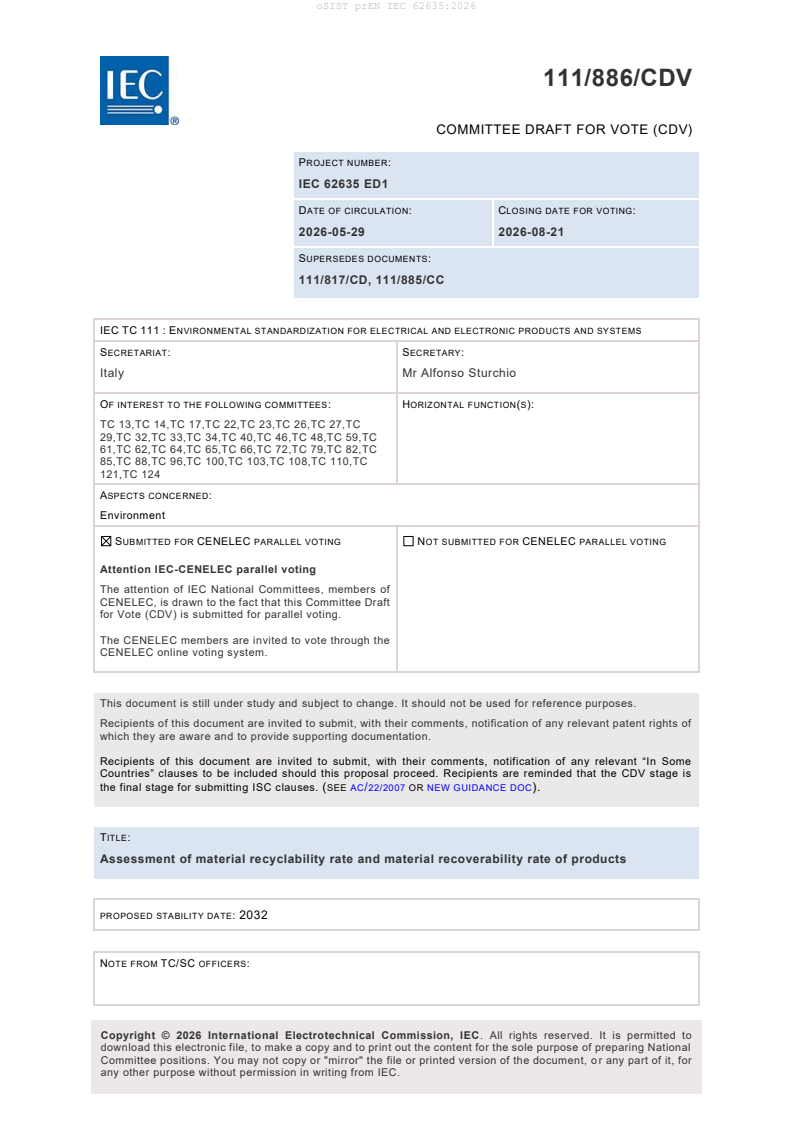
111/886/CDV
COMMITTEE DRAFT FOR VOTE (CDV)
PROJECT NUMBER:
IEC 62635 ED1
DATE OF CIRCULATION: CLOSING DATE FOR VOTING:
2026-05-29 2026-08-21
SUPERSEDES DOCUMENTS:
111/817/CD, 111/885/CC
IEC TC 111 : ENVIRONMENTAL STANDARDIZATION FOR ELECTRICAL AND ELECTRONIC PRODUCTS AND SYSTEMS
SECRETARIAT: SECRETARY:
Italy Mr Alfonso Sturchio
OF INTEREST TO THE FOLLOWING COMMITTEES: HORIZONTAL FUNCTION(S):
TC 13,TC 14,TC 17,TC 22,TC 23,TC 26,TC 27,TC
29,TC 32,TC 33,TC 34,TC 40,TC 46,TC 48,TC 59,TC
61,TC 62,TC 64,TC 65,TC 66,TC 72,TC 79,TC 82,TC
85,TC 88,TC 96,TC 100,TC 103,TC 108,TC 110,TC
121,TC 124
ASPECTS CONCERNED:
Environment
SUBMITTED FOR CENELEC PARALLEL VOTING NOT SUBMITTED FOR CENELEC PARALLEL VOTING
Attention IEC-CENELEC parallel voting
The attention of IEC National Committees, members of
CENELEC, is drawn to the fact that this Committee Draft
for Vote (CDV) is submitted for parallel voting.
The CENELEC members are invited to vote through the
CENELEC online voting system.
This document is still under study and subject to change. It should not be used for reference purposes.
Recipients of this document are invited to submit, with their comments, notification of any relevant patent rights of
which they are aware and to provide supporting documentation.
Recipients of this document are invited to submit, with their comments, notification of any relevant “In Some
Countries” clauses to be included should this proposal proceed. Recipients are reminded that the CDV stage is
the final stage for submitting ISC clauses. (SEE AC/22/2007 OR NEW GUIDANCE DOC).
TITLE:
Assessment of material recyclability rate and material recoverability rate of products
PROPOSED STABILITY DATE: 2032
NOTE FROM TC/SC OFFICERS:
download this electronic file, to make a copy and to print out the content for the sole purpose of preparing National
Committee positions. You may not copy or "mirror" the file or printed version of the document, o r any part of it, for
any other purpose without permission in writing from IEC.
IEC CDV 62635 © IEC 2026
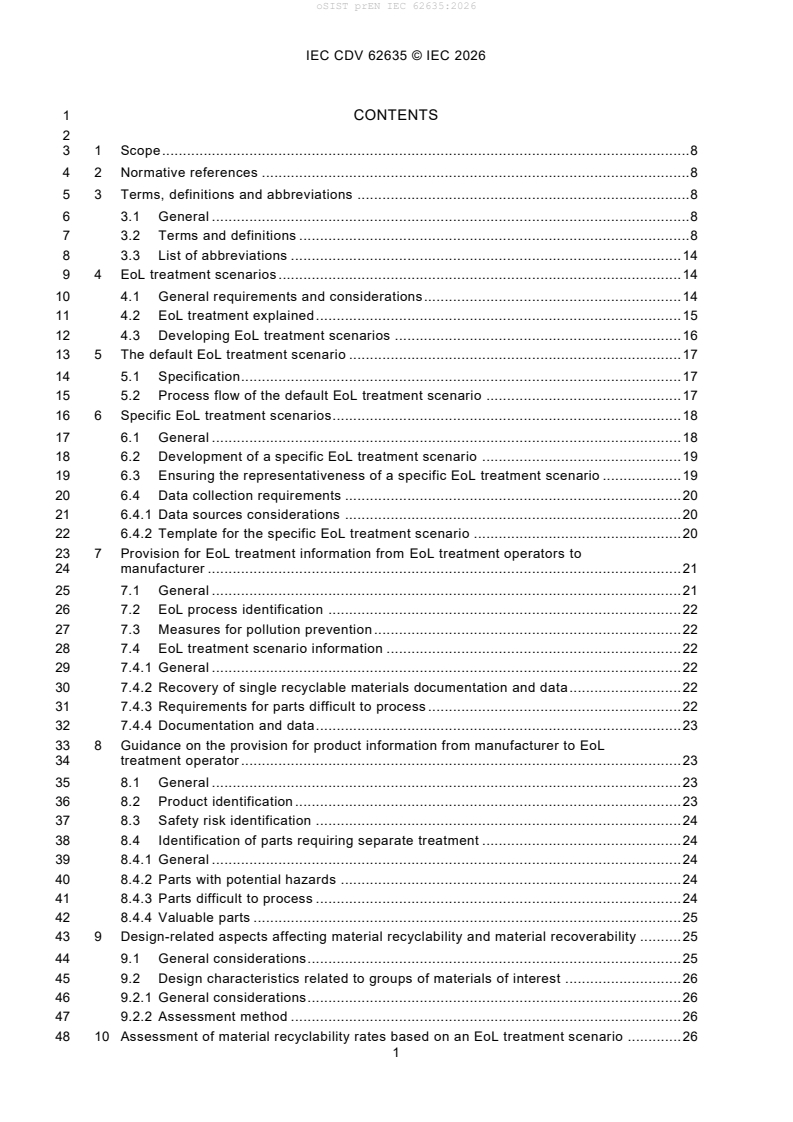
1 CONTENTS
3 1 Scope . 8
4 2 Normative references . 8
5 3 Terms, definitions and abbreviations . 8
6 3.1 General . 8
7 3.2 Terms and definitions . 8
8 3.3 List of abbreviations . 14
9 4 EoL treatment scenarios . 14
10 4.1 General requirements and considerations . 14
11 4.2 EoL treatment explained . 15
12 4.3 Developing EoL treatment scenarios . 16
13 5 The default EoL treatment scenario . 17
14 5.1 Specification. 17
15 5.2 Process flow of the default EoL treatment scenario . 17
16 6 Specific EoL treatment scenarios. 18
17 6.1 General . 18
18 6.2 Development of a specific EoL treatment scenario . 19
19 6.3 Ensuring the representativeness of a specific EoL treatment scenario . 19
20 6.4 Data collection requirements . 20
21 6.4.1 Data sources considerations . 20
22 6.4.2 Template for the specific EoL treatment scenario . 20
23 7 Provision for EoL treatment information from EoL treatment operators to
24 manufacturer . 21
25 7.1 General . 21
26 7.2 EoL process identification . 22
27 7.3 Measures for pollution prevention . 22
28 7.4 EoL treatment scenario information . 22
29 7.4.1 General . 22
30 7.4.2 Recovery of single recyclable materials documentation and data. 22
31 7.4.3 Requirements for parts difficult to process . 22
32 7.4.4 Documentation and data . 23
33 8 Guidance on the provision for product information from manufacturer to EoL
34 treatment operator . 23
35 8.1 General . 23
36 8.2 Product identification . 23
37 8.3 Safety risk identification . 24
38 8.4 Identification of parts requiring separate treatment . 24
39 8.4.1 General . 24
40 8.4.2 Parts with potential hazards . 24
41 8.4.3 Parts difficult to process . 24
42 8.4.4 Valuable parts . 25
43 9 Design-related aspects affecting material recyclability and material recoverability . 25
44 9.1 General considerations . 25
45 9.2 Design characteristics related to groups of materials of interest . 26
46 9.2.1 General considerations . 26
47 9.2.2 Assessment method . 26
48 10 Assessment of material recyclability rates based on an EoL treatment scenario . 26
IEC CDV 62635 © IEC 2026
49 10.1 Material recyclability rates quantification . 26
50 10.2 Material groups and unspecified materials . 27
51 10.3 Material recyclability rate quantification of a single or a group of materials of
52 interest based on an EoL treatment scenario . 27
53 11 Material recoverability rates quantification based on an EoL treatment scenario . 28
54 12 Documenting the assessment of the material recyclability and material
55 recoverability rate . 29
56 12.1 General . 29
57 12.2 Elements of the documentation . 29
58 13 IEC 62635 SDB content and maintenance . 30
59 13.1 General . 30
60 13.2 IEC 62635 SDB update process . 30
61 13.3 Creation and maintenance of EOL treatment scenarios . 31
62 Annex A (normative) Calculating the product material recyclability rate and/or material
63 recoverability rate . 32
64 A.1 Flow chart . 32
65 A.2 Selection on EoL treatment scenario of the product . 33
66 A.3 Description of the specific EoL treatment scenario . 34
67 A.4 Evaluation of the product design characteristics . 34
68 A.5 Calculation of a product material recycling or material recoverability rate . 34
69 A.6 Documentation . 34
70 Annex B (normative) Default EoL treatment scenario for the calculation of product
71 material recyclability rates . 35
72 B.1 Introduction . 35
73 B.2 General information . 35
74 B.3 Process flow and description . 36
75 B.4 Material recycling rates . 37
76 Annex C (normative) Default EoL treatment scenario for the calculation of product
77 material recoverability rates . 39
78 C.1 Introduction . 39
79 C.2 General information . 39
80 C.3 Process flow and description . 39
81 C.4 Material recovery rates . 40
82 Annex D (informative) Specific EoL treatment scenarios . 43
83 D.1 Introduction . 43
84 D.2 Specific EoL treatment scenario for home appliances in Japan . 43
85 D.2.1 General information . 43
86 D.2.2 Process flow and description . 43
87 D.2.3 Material recycling rates. 44
88 D.3 Specific EoL treatment scenario for small household appliances in Korea . 43
89 D.3.1 Introduction . 45
90 D.3.2 General information . 45
91 D.3.3 Process flow and description . 46
92 D.3.4 Material recycling rate and/or material recovery rate. 46
93 Annex E (informative) Use case for a potential EoL treatment scenario: Prospective
94 European scenario for low voltage control and switchgear . 49
95 E.1 Introduction . 49
96 E.2 General information . 49
97 E.3 Process description . 49
IEC CDV 62635 © IEC 2026
98 E.4 Material recycling rates for polymers . 50
99 Annex F (informative) Example of a template for EoL treatment information . 52
100 Annex G (informative) Framework of information from EoL treatment operators on
101 specific EoL treatment scenarios . 53
102 G.1 General . 53
103 G.2 Specific EoL treatment scenarios template . 53
105 Figure 1 – Recovery activities framework . 16
106 Figure 2 – Default EoL treatment process flow . 18
107 Figure A.1 — Process for calculating the material recyclability and/or recoverability
108 rate of a product . 33
109 Figure B.1 – Flow chart of material recycling activities . 36
110 Figure D.1 – Treatment flow of a household appliance EoL treatment facility . 44
111 Figure E.2 – Flow chart of recycling activities for a specific EoL treatment scenario for
112 low voltage control and switchgear . 51
114 Table 1 — Representativeness criteria for developing specific EoL treatment scenarios . 19
115 Table 2 — Material recycling rates and/or material recovery rates . 21
116 Table B.1 – Material recycling rate . 37
117 Table C.1 – Material recovery rates . 40
118 Table D.2 – Product category and corresponding list . 46
119 Table D.3 – Material recycling rates and material recovery rates . 46
120 Table E.1 – Material recycling rates of used polymer as a function of the composition
121 of the input material . 50
IEC CDV 62635 © IEC 2026
124 INTERNATIONAL ELECTROTECHNICAL COMMISSION
125 ____________
126 Assessment of material recyclability rate and material recoverability rate
127 of products
131 FOREWORD
132 1) The International Electrotechnical Commission (IEC) is a worldwide organization for standardization comprising
133 all national electrotechnical committees (IEC National Committees). The object of IEC is to promote international
134 co-operation on all questions concerning standardization in the electrical and electronic fields. To this end and
135 in addition to other activities, IEC publishes International Standards, Technical Specifications, Technical Reports,
136 Publicly Available Specifications (PAS) and Guides (hereafter referred to as "IEC Publication(s)"). Their
137 preparation is entrusted to technical committees; any IEC National Committee interested in the subject dealt with
138 may participate in this preparatory work. International, governmental and non-governmental organizations liaising
139 with the IEC also participate in this preparation. IEC collaborates closely with the International Organization for
140 Standardization (ISO) in accordance with conditions determined by agreement between the two organizations.
141 2) The formal decisions or agreements of IEC on technical matters express, as nearly as possible, an international
142 consensus of opinion on the relevant subjects since each technical committee has representation from all
143 interested IEC National Committees.
144 3) IEC Publications have the form of recommendations for international use and are accepted by IEC National
145 Committees in that sense. While all reasonable efforts are made to ensure that the technical content of IEC
146 Publications is accurate, IEC cannot be held responsible for the way in which they are used or for any
147 misinterpretation by any end user.
148 4) In order to promote international uniformity, IEC National Committees undertake to apply IEC Publications
149 transparently to the maximum extent possible in their national and regional publications. Any divergence between
150 any IEC Publication and the corresponding national or regional publication shall be clearly indicated in the latter.
151 5) IEC itself does not provide any attestation of conformity. Independent certification bodies provide conformity
152 assessment services and, in some areas, access to IEC marks of conformity. IEC is not responsible for any
153 services carried out by independent certification bodies.
154 6) All users should ensure that they have the latest edition of this publication.
155 7) No liability shall attach to IEC or its directors, employees, servants or agents including individual experts and
156 members of its technical committees and IEC National Committees for any personal injury, property damage or
157 other damage of any nature whatsoever, whether direct or indirect, or for costs (including legal fees) and
158 expenses arising out of the publication, use of, or reliance upon, this IEC Publication or any other IEC
159 Publications.
160 8) Attention is drawn to the Normative references cited in this publication. Use of the referenced publications is
161 indispensable for the correct application of this publication.
162 9) Attention is drawn to the possibility that some of the elements of this IEC Publication may be the subject of patent
163 rights. IEC shall not be held responsible for identifying any or all such patent rights.
164 International Standard IEC 62635 has been prepared by IEC technical committee 111:
165 Environmental standardization for electrical and electronic products and systems.
166 This edition cancels and replaces the technical report published in 2012.
167 This edition includes the following significant technical changes with respect to the previous
168 technical specification:
169 – Material recyclability and material recoverability introduced;
170 – Default EoL treatment scenarios for the calculation of product material recyclability and
171 material recoverability introduced;
172 – Specific EoL treatment scenarios updated and adapted to the state of the art;
173 – Alignment with EN 45555 [8];
174 – Material recyclability rate quantification of materials of interest.
IEC CDV 62635 © IEC 2026
176 The text of this International Standard is based on the following documents:
FDIS Report on voting
xxx xxx
178 Full information on the voting for its approval can be found in the report on voting indicated in
179 the above table.
180 The language used for the development of this International Standard is English.
181 This document was drafted in accordance with ISO/IEC Directives, Part 2, and developed in
182 accordance with ISO/IEC Directives, Part 1 and ISO/IEC Directives, IEC Supplement, available
183 at www.iec.ch/members_experts/refdocs. The main document types developed by IEC are
184 described in greater detail at www.iec.ch/standardsdev/publications.
185 The committee has decided that the contents of this document will remain unchanged until the
186 stability date indicated on the IEC website under webstore.iec.ch in the data related to the
187 specific document. At this date, the document will be
188 – reconfirmed,
189 – withdrawn,
190 – replaced by a revised edition, or
191 – amended.
IMPORTANT – The 'colour inside' logo on the cover page of this publication indicates
that it contains colours which are considered to be useful for the correct understanding
of its contents. Users should therefore print this document using a colour printer.
IEC CDV 62635 © IEC 2026
195 Introduction
196 EDITOR”S NOTE TO NCs: The objective is to move (copy) the information contained in each
197 EoL treatment scenarios in the Annexes of this document into the new IEC SDB 62635 once it
198 is created (in reference to standard as database below).
199 Electrical and electronic equipment (EEE) have become a defining and ubiquitous feature of
200 modern life, raising living standards of the global population. As a counter -effect, they are
201 becoming one of the fastest growing waste streams globally.
202 NOTE The amount of e-waste exceeded 57 million tons in 2021 (WEEE Forum [10]).
203 Electrical and electronic equipment waste (e-waste) contains a complex mixture of materials,
204 some of which are hazardous or contain hazardous substances, able to cause major
205 environmental and health problems if the discarded devices are not managed properly. Modern
206 electronics also contain critical and valuable resources, such as critical raw materials (CRMs)
207 and gold. These can be recycled and re-used if the waste is effectively managed. Improving the
208 collection, treatment, recovery (incl. recycling) of electrical and electronic equipment (EEE) at
209 the end of their life can increase resource efficiency and support the shift to a circular economy.
210 To determine the ability to recover the materials contained in a product or its parts and materials
211 at end-of-life, the concepts of “material recyclability rates” and “material recoverability rates”
212 are introduced. In order to effectively improve the ability to recover or recycle materials at their
213 end-of-life, it is important to consider the recoverability and recyclability of the product and its
214 parts already during the design and development phase. In order to ensure that a given material
215 recyclability and material recoverability potential materializes into actual material recycling and
216 material recovery rates it is important to ensure that the actual treatment technologies employed
217 at product EoL are state of the art and capable to recover and/or recycle groups of materials of
218 interest such as critical or environmentally relevant materials.
219 IEC 62635 consists of two parts:
220 – this document, which provides a comprehensive framework for assessing the
221 recyclability and recoverability of materials used in EEE, including groups of materials
222 of interest such as critical or environmentally relevant materials;
223 – a standard as database (IEC 62635 SDB) which is a managed collection of EoL
224 treatment scenarios including recycling and recovery rates.
225 The IEC 62635 SDB is maintained by a database maintenance team (SDBT 62635) which
226 updates information in the IEC 62635 SDB based on requirements specified in the IEC 62635
227 standard.
228 This document provides the calculation rules based on the understanding that the material
229 recovery rate and material recycling rates are defined as the data provided by the EoL treatment
230 operator. The product material recyclability rate and the material recoverability rate are the
231 result of the calculation performed by the manufacturer.
232 The general method presented in this document takes into account the availability and efficiency
233 of state-of the-art recycling and recovery processes to predict the material recyclability or
234 material recoverability rates of products during the design phase. The focus is, therefore, on
235 the ability to recycle or recover the product itself rather than the recycling or recovery
236 processes.
237 This document can be used to assess a products material recyclability and material
238 recoverability independently of where it will be recycled using a default EoL treatment scenario
239 presented in Annex B and Annex C. The option to use a default EoL treatment scenario is
240 intended to assess products material recyclability and material recoverability early in the design
241 process where the final fate of a product is not always known, to compare the evolution of a
242 product design overtime or to compare different product designs against each other based on
243 a common baseline.
IEC CDV 62635 © IEC 2026
244 This document can also be used to assess a product material recyclability and material
245 recoverability in relation to an EoL treatment scenario that is specific for a given country, region
246 or product group.
247 It is assumed that the assessment of the material recyclability and material recoverability of a
248 product as a whole may be valid for a certain period of time in a given geographical
249 area. Therefore, the standard provides organizations with
250 – relevant information to characterize activities at EoL treatment facilities in order to
251 enable them to implement effective environmentally conscious design and,
252 – sufficient information for the product designers (having to ensure the design for
253 recycling) about what will happen later-on, in the recycling process.
254 This document will promote sustainable practices by enabling manufacturers, with the support
255 of EoL operators, to evaluate the potential for material recycling and material recovery at the
256 end of a product’s life cycle. It also allows for meaningful interactions between EoL treatment
257 operators including secondary raw material suppliers with manufacturers that use these
258 secondary materials.
259 By applying this document, organisations can enhance their environmental performance,
260 contribute to waste and pollution reduction and so contribute to a circular economy.
IEC CDV 62635 © IEC 2026
261 1 Scope
262 IEC 62635 provides a method to calculate the material recyclability rate of electr ical and
263 electronic equipment (EEE) during the design phase using material recycling rate data based
264 on EoL treatment scenarios. It also provides a method to calculate material recoverability rate
265 based on material recovery rate data. This document sets up criteria and a format to describe
266 the EoL treatment scenarios. Additionally, the method can be also applied for the calculation of
267 recyclability and recoverability of materials of interest such as CRMs.
268 To achieve the above, this document addresses:
269 – A default EoL treatment scenario for material recycling and for material recovery ,
270 – Examples of EoL treatment scenarios and the corresponding material recovery and
271 material recycling rates,
272 – Provisions for product information from manufacturers to EoL treatment operators to
273 improve material recycling and recovery rates,
274 – Provisions for EoL treatment information from EoL treatment operators to manufacturers
275 to build EoL treatment scenarios.
276 This document does not address the recovery of products and parts for reuse and product
277 packaging.
EDITOR”S NOTE TO NCs: A paragraph on the horizontal function will be added later, when
the horizontal publication is approved (separate Q doc will be circulated for it):
“This document is a basic/generic environment horizontal publication focusing on essential
requirements / data type and is primarily intended for the use by manufacturers and EoL
management operators in accordance with the principles laid down in IEC Guide 123 and IEC
Guide 108 ED3.”
279 2 Normative references
280 There are no normative references in this document.
281 3 Terms, definitions and abbreviations
282 3.1 General
283 For the purposes of this document, the following terms and definitions apply.
284 ISO and IEC maintain terminology databases for use in standardization at the following
285 addresses:
286 – IEC Electropedia: available at https://www.electropedia.org/
287 – ISO Online browsing platform: available at https://www.iso.org/obp
288 3.2 Terms and definitions
289 3.2.1
290 alternate material recovery
291 controlled processing of end-of-life (IEV 193-05-07) products (IEV 193-02-01) or waste (IEV
292 193-04-01) producing useful material (IEV 193-03-03) of a type different from that of the original
293 material
294 EXAMPLE Slag, by-product.
295 [SOURCE: IEC/FDIS 60050-193:2026 [1], 193-04-10.]
IEC CDV 62635 © IEC 2026
296 3.2.2
297 critical raw material
298 CRM
299 material (IEV 193-03-03) which, according to a defined classification methodology, is
300 economically important, and has a high risk associated with its supply
301 Note 1 to entry: As the classification methodology is country- or region-specific, the CRMs list is also country- or
302 region-specific.
303 [SOURCE: IEC/FDIS 60050-193:2026 [1], 193-03-10.]
304 3.2.3
305 depollution
306 process of removing pollutant
307 3.2.4
308 pollutant
309 substance or agent present in an environmental medium, which, due to its properties, amount
310 or concentration causes adverse impacts on the environmental medium
311 [SOURCE: ISO 11074:2025 [6], 3.328]
312 3.2.5
313 disassembly
314 process whereby a product (IEV 193-02-01) is taken apart in such a way that it can subsequently
315 be reassembled and made operational
316 [SOURCE: IEC/FDIS 60050-193:2026 [1], 193-04-26.]
317 3.2.6
318 dismantling
319 process whereby a product (IEV 193-02-01) is taken apart in such a way that it is not intended
320 to be reassembled and made operational
321 Note 1 to entry: After dismantling, some parts (IEV 193-02-02) can be reused.
322 [SOURCE: IEC/FDIS 60050-193:2026 [1], 193-04-27.]
323 3.2.7
324 end-of-life
325 end of life
326 EoL
327 life cycle stage of a product (IEV 193-02-01) starting when it is removed from its use stage until
328 the product has either its life extended or is handed over for recovery (IEV 193 -04-04)
329 SEE: Figure 193-05-03
330 [SOURCE: IEC/FDIS 60050-193:2026 [1], 193-05-07, modified – The Note 1 to entry, related to
331 homographs, was deleted.]
332 3.2.8
333 end-of-life treatment
334 operation covering all activities starting when end-of-life (IEV 193-05-07) products (IEV 193-
335 02-01) are handed over for recovery (IEV 193-04-04) or are discarded and waste (IEV 193-04-
336 01) is handed over for recovery or final disposal (IEV 193-04-28)
337 Note 1 to entry: End-of-life treatment includes collection and logistics.
338 Note 2 to entry: End-of-life products can be handed over for recovery through, for example, a take-back programme
339 on request of or even managed by the manufacturer.
340 [SOURCE: IEC/FDIS 60050-193:2026 [1], 193-04-03, modified – The Figure and related Note
341 3 to entry have been deleted.]
IEC CDV 62635 © IEC 2026
342 3.2.9
343 energy recovery
344 production of useful energy (IEV 193-03-23) through direct and controlled combustion or other
345 processing of waste (IEV 193-04-01)
346 SEE: Figure 193-04-04B
347 EXAMPLE Producing hot water, steam and electricity are common means for energy recovery.
348 [SOURCE: IEC/FDIS 60050-193:2026 [1], 193-04-11.]
349 3.2.10
350 final disposal
351 disposal
352 operation that does not lead to the recovery (IEV 193-04-04) of product (IEV 193-02-01), parts
353 (IEV 193-02-02), materials (IEV 193-03-03) or energy (IEV 193-03-23)
354 [SOURCE: IEC/FDIS 60050-193:2026 [1], 193-04-28, modified – The Figure and related Note
355 3 to entry have been deleted.]
356 3.2.11
357 manufacturer
358 natural or legal entity with responsibility for the design, manufacture, packaging and labelling
359 of a product (IEV 193-02-01) before it is placed on the market under its own name, regardless
360 of whether these operations are carried out by that entity itself or on its behalf by a third party
361 [SOURCE: IEC/FDIS 60050-193:2026 [1], 193-02-10 – modified, Note 1 to entry referring to
362 homographs has been deleted.]
363 3.2.12
364 material recovery
365 controlled processing of end-of-life (IEV 193-05-07) products (IEV 193-02-01) or waste (IEV
366 193-04-01) to produce useful material (IEV 193-03-03)
367 Note 1 to entry: Processes for material recovery can include dismantling, depollution, grinding, shredding, milling,
368 concentration, homogenization, refining, etc.
369 Note 2 to entry: The result of the material recovery is either alternate material or material that will be further processed
370 in material recycling.
371 Note 3 to entry: Material recovery results in circular material, i.e. material that can be recovered again.
372 [SOURCE: IEC/FDIS 60050-193:2026 [1], 193-04-07, modified – The Figure and the related
373 Note 4 to entry have been deleted.]
374 3.2.13
375 material recovery rate
376 mass ratio of any useful material (IEV 193-03-03) recovered from end-of-life (IEV 193-05-07)
377 products (IEV 193-02-01) or waste (IEV 193-04-01) excluding products or parts recovery (IEV
378 193-04-05) and energy recovery (IEV 193-04-11)
𝑚
(𝑟eco)
𝑅(reco) =
𝑚
( )
eol/𝑤
379 where
380 R(reco) is the material recovery rate;
381 m is the mass of the recovered materials;
(reco)
382 m(eol/w) is the total mass of the end-of-life products or waste (inflow in a certain period).
383 Note 1 to entry: When the material recovery rate is calculated, it is important to make clear where the material is
384 recovered from, whether end-of-life products or waste.
385 [SOURCE: IEC/FDIS 60050-193:2026 [1], 193-04-08.]
IEC CDV 62635 © IEC 2026
386 3.2.14
387 material recycling
388 controlled processing of material (IEV 193-03-03) that has been recovered from end-of-life (IEV
389 193-05-07) products (IEV 193-02-01) or waste (IEV 193-04-01) to produce material of the same
390 or similar type as the original material
391 EXAMPLE An ABS compound that is shredded and then recycled as ABS compound; an aluminium alloy that is
392 recycled as an aluminium alloy; a thermoset that is shredded and used as filler in a thermoset material.
393 Note 1 to entry: Polymer materials are of the same type if they have the same base polymer such as PE, PP, ABS.
394 Metal materials of the same type share the same base metal (e.g. aluminium alloy).
395 Note 2 to entry: There can be variation in the performance or characteristics of the recycled material compared to
396 the original one.
397 Note 3 to entry: In some cases, the processes of recovery and recycling cannot be distinguished from each other.
398 Note 4 to entry: If the produced material is of a different type from the original material, it is an alternate material.
399 Note 5 to entry: Material recycling excludes products and parts recovery, alternate material recovery (IEV 193 -04-
400 10) and energy recovery (IEV 193-04-11).
401 [SOURCE: IEC/FDIS 60050-193:2026 [1], 193-04-13, modified – The Figure and related Note
402 6 to entry have been deleted.]
403 3.2.15
404 material recycling rate
405 mass ratio of recycled material (IEV 193-03-12) recovered from end-of-life (IEV 193-05-07)
406 products (IEV 193-02-01) or waste (IEV 193-04-01) excluding alternate material recovery (IEV
407 193-04-10), products or parts recovery (IEV 193-04-05) and energy recovery (IEV 193-04-11)
𝑚
(𝑟𝑚)
𝑅(recy) =
𝑚
(𝑤)
408 where
409 R is the material recycling rate;
(recy)
410 m(rm) is the mass of the recycled materials, excluding alternate materials;
411 m is the total mass of the end-of-life products or waste (inflow in a certain period).
(w)
412 Note 1 to entry: When the material recycling rate is calculated, it is important to make clear where the material is
413 recycled from, whether end-of-life products or waste.
414 [SOURCE: IEC/FDIS 60050-193:2026 [1], 193-04-14.]
415 3.2.16
416 material separation
417 operation to separate materials (IEV 193-03-03), including mechanical, chemical or thermal
418 processes additional to disassembly (193-04-26) and dismantling (IEV 193-04-27)
419 EXAMPLE Smelting, sorting, etc.
420 [SOURCE: IEC/FDIS 60050-193:2026 [1], 193-04-25, modified – The Figure and related Note
421 1 to entry have been deleted.]
422 3.2.17
423 products or parts recovery
424 controlled process whereby functioning products (IEV 193-02-01) or parts (IEV 193-02-02) are
425 recovered from end-of-life (IEV 193-05-07) products or waste (IEV 193-04-01) and are brought
426 back to use for the same or a different purpose
427 Note 1 to entry: Processes for product recovery can include refurbishment (IEV 193-06-03), remanufacture (IEV 193-
428 06-04) and repurpose (IEV 193-06-05).
429 Note 2 to entry: Processes for parts recovery can include disassembly (IEV 193-04-26), cleaning, and testing.
430 [SOURCE: IEC/FDIS 60050-193:2026 [1], 193-04-05.]
IEC CDV 62635 © IEC 2026
431 3.2.18
432 product material recoverability rate
433 ratio of mass of the estimated recoverable material (IEV 193-03-03) to the mass of the complete
434 product (IEV 193-02-01)
𝑚
(𝑟eco)
𝑅(reco,p) =
𝑚
(𝑝)
435 where
436 R is the product material recoverability rate;
(reco,p)
437 m(reco) is the total mass of the materials of the product that can be recovered;
438 m is the total mass of the product.
(p)
439 Note 1 to entry: The amount of materials that can be recovered is estimated based on a specific state -of-the-art end-
440 of-life treatment scenario.
441 Note 2 to entry: Recoverable material excludes material used for energy recovery.
442 [SOURCE: IEC/FDIS 60050-193:2026 [1], 193-04-09.]
443 3.2.19
444 product material recyclability rate
445 ratio of mass of the materials (IEV 193-03-03) that can be recycled to the mass of the complete
446 product (IEV 193-02-01)
𝑚
(𝑟ecy)
𝑅(recy,p) =
𝑚
(𝑝)
447 where
448 R is the product material recyclability rate;
(recy,p)
449 m is the total mass of the materials of the product that can be recycled;
(recy)
450 m(p) is the total mass of the product.
451 Note 1 to entry: Recyclable materials exclude alternate materials and those related to energy recovery.
452 Note 2 to entry: The amount of materials that can be recycled is estimated based on a specific state -of-the-art end-
453 of-life treatment scenario.
454 [SOURCE: IEC/FDIS 60050-193:2026 [1], 193-04-15.]
455 3.2.20
456 recovery
457 controlled process by which products (IEV 193-02-01), parts (IEV 193-02-02) or materials (IEV
458 193-03-03) are recovered from end-of-life (IEV 193-05-07) products or waste (IEV 193-04-01),
459 or by which waste is used to produce energy (IEV 193-03-23)
460 Note 1 to entry: Recovery is an operation by which value is regained from end-of-life products or waste.
461 [SOURCE: IEC/FIDS 60050-193:2026 [1], 193-04-04, modified – The Figures and the related
462 Note 2 entry as well as Note 3 to entry related to homographs have been deleted.]
463 3.2.21
464 recycled material
465 material (IEV 193-03-03) reprocessed from end-of-life (IEV 193-05-07) products (IEV 193-02-
466 01) or waste (IEV 193-04-01) that is of the same or similar type as the original material and that
467 is ready to be used in manufacturing of products
468 SEE: Figure 193-03-11
469 Note 1 to entry: Recycled material can be pre- or post-consumer.
470 Note 2 to entry: Recycled material refers to the sum of the various fractions of materials recycled from end -of-life
471 products or waste like metals, plastics, etc., excluding alternate material and material used to produce energy (IEV
472 193-03-23)
IEC CDV 62635 © IEC 2026
473 [SOURCE: IEC/FDIS 60050-193:2026 [1], 193-03-12.]
474 3.2.22
475 recovered material
476 useful material (IEV 193-03-03) that has been recovered from discarded material generated
477 during a manufacturing process, end-of-life (IEV 193-05-07) products (IEV 193-02-01) or waste
478 (IEV 193-04-01)
479 Note 1 to entry: Recovered material refers to the sum of the various fractions of materials obtained from
480 manufacturing processes, end-of-life products or waste excluding material used to produce energy and excluding
481 material used for backfilling (IEV 193-04-29) purposes.
482 [SOURCE: IEC/FDIS 60050-193:2026 [1], IEV 193-03-11, modified — The Figure and Note 2
483 to entry have been deleted.]
484 3.2.23
485 reuse
486 operation by which a product (IEV 193-02-01) or part (IEV 193-02-02) having reached the end-
487 of-use (IEV 193-05-06) is used again
488 Note 1 to entry: Reuse for another purpose is called repurpose (IEV 193 -06-05).
489 Note 2 to entry: Normal, regular or sporadic use is not considered as reuse.
490 [SOURCE: IEC/FDIS 60050-193:2026 [1], 193-06-01, modified — The Figure and related Note
491 3 to entry have been deleted.]
492 3.2.24
493 waste
494 material (IEV 193-03-03) or object that the holder discards or is required to discard
495 Note 1 to entry: Triggers to discard can include:
496 function no longer available;
497 change in the holder’s needs or desires;
498 interoperability loss;
499 object no longer repairable or serviceable due to loss or unavailability of spare parts, consumables or
500 technical information.
501 Note 2 to entry: Material or object that is lost or abandoned by the holder (litter or rubbish) can also be considered
502 waste.
503 Note 3 to entry: For environmental protection and traceability purposes, waste must be captured by a waste
504 management system.
505 [SOURCE: IEC/FDIS 60050-193:2026 [1], 193-04-01, modified — The Figure and related Note
506 4 t
...