


CEN/TR 18359:2026
(Main)Public transport – Common Glossary
General Information
- Abstract
The scope of this TR is a Public Transport common glossary to harmonise terms and definitions from existing data dictionaries.
The methodology consisting of highlighting the differences between various use contexts arises from a number of factors, many of them practical:
1) The facts of history. Many of the legislations, as noted (especially EU Regulations, EC Delegated Regulations and EC Implementing Decisions), already have mandatory application of varying scope, and the regulatory bodies would be most unlikely to consider it worthwhile to actually modify them in line with some list of precise terms developed after the fact.
2) The diversity of practices and use-cases which have been included in the Public Transport domain. Especially as a result of the need for this domain to cover multi-modality and developing technologies, and the increasing requirement for Public Transport to interact with wider domains such as Road Traffic Management, there are bound to be some deeply embedded terms which have been used in different senses in different domains.
3) The differing nature and working practices involved in the legislative, regulatory and technical standardisation processes, and their relationship both to one another and to real-world implementors of Public Transport services.
4) The prior existence of a well-established and precise set of Conceptual Models, including terms and definitions, in the Transmodel ecosystem. This is self-consistent and clearly defined and is being maintained on a continuous basis. However, its use in a legislative context is by “delegation”, which may do little to decrease the possibility of regulations themselves making use of some terms in a sense not intended by Transmodel itself.
The format of the glossary will be structured around following sections:
- Contexts: Summary of the contexts in which the term or phrase is defined.
- Related terms: Phrases in which the term is used, either as an element in a compound (e.g. the term “access” vs “access right” or where a related term is used which carries a notably different association (e.g. the term “access” vs “accessibility”, where the latter has a precise meaning in some contexts).
- Concept: Where it is possible to identify a unifying concept among the various definitions. An informal or explanatory summary of that concept. Where it is not possible, a note of that fact.
- Harmonisation: Containing references and links to the definitions in their contexts and the suggested conventions for citing them in contexts other than those where they are defined.
- Source references: Links to definitions of the exact term in their contexts.
- Usage recommendations: Recommendations for how the terms should be cited in contexts outside that in which the term is defined.
- Status
- Not Published
- Publication Date
- 18-Aug-2026
- Technical Committee
- CEN/TC 278 - Road transport and traffic telematics
- Drafting Committee
- CEN/TC 278/WG 3 - Public transport (PT)
- Current Stage
- 6055 - CEN Ratification completed (DOR) - Publishing
- Start Date
- 17-Aug-2026
- Due Date
- 11-Jan-2027
- Completion Date
- 17-Aug-2026

Overview
CEN/TR 18359:2026 - Public Transport Common Glossary is a Technical Report developed by the European Committee for Standardization (CEN/TC 278) to harmonize key terms and definitions in the public transport sector. This standard focuses on terminology sourced from existing data dictionaries, predominant EU legislation, and established conceptual models such as Transmodel. By fostering a unified vocabulary, the glossary aims to enhance consistency, legal clarity, and interoperability in mobility data across the European public transport ecosystem.
The document is particularly relevant for professionals involved in legislative drafting, regulatory affairs, transport data management, service provision, network operations, ontology development, and digital public transport solutions. Its unique approach emphasizes highlighting differences in use, context, and meaning, rather than enforcing a new universal lexicon.
Key Topics
- Harmonised Terminology: Consolidates definitions of essential public transport terms used across EU legislation and industry standards.
- Contextual Analysis: Details various application contexts for terms, enabling users to recognize differences and avoid ambiguity.
- Interoperability: Supports seamless data sharing and integration among transport services, digital systems, and cross-border operations.
- Multi-modality: Addresses terms relevant to diverse transport modes and the increasing overlap with Road Traffic Management and Intelligent Transport Systems (ITS).
- Practical Recommendations: Offers usage guidance for terms in contexts outside their original definitions, enhancing real-world applicability.
Applications
CEN/TR 18359:2026 has broad utility across the public transport domain, including but not limited to:
- Legislation Interpretation and Drafting: Legal experts and policymakers can reference harmonised definitions, promoting clarity and compliance in new or revised regulations.
- Data Management and Digital Services: Public transport authorities, data custodians, and developers benefit from a consistent vocabulary for system integration, data exchange, and the deployment of ITS and digital mobility services.
- Ontology and Conceptual Model Development: Organizations developing taxonomies or ontologies for new or emerging transport scenarios can rely on vetted terms and definitions with contextual notes.
- Cross-border and Multi-modal Transport: Operators and service providers involved in European and international public transport can reduce misunderstandings and align operational language, particularly regarding interoperability, "access," "standard," and related terms.
- Training and Knowledge Transfer: The glossary serves as a foundational resource for staff onboarding, training programs, and documentation within transport management organizations.
Related Standards
CEN/TR 18359:2026 is complemented by a range of standards and regulations in the public transport and mobility sectors, including:
- Transmodel (EN 12896 series): The reference conceptual model for public transport data and interoperability.
- ITS Directive (Directive 2010/40/EU, amended by Directive (EU) 2023/2661): Framework for intelligent transport systems in road and intermodal transport.
- INSPIRE Directive (Directive 2007/2/EC): Spatial information infrastructure, relevant for geographic datasets in public transport.
- NACE Classification (Regulation (EC) 1893/2006): Standard economic activity codes impacting transport data taxonomy.
- Additional EU Directives & Regulations: Numerous other legislative sources examine safety, consumer rights, road transport, and multimodal infrastructure, each contributing to the harmonised glossary.
By following the methodology outlined in CEN/TR 18359:2026, organizations can adopt best practices for public transport terminology, supporting sector-wide clarity and improved cooperation in the rapidly evolving landscape of European mobility.
Get Certified
Connect with accredited certification bodies for this standard

Great Wall Tianjin Quality Assurance Center
Established 1993, first batch to receive national accreditation with IAF recognition.
Hong Kong Quality Assurance Agency (HKQAA)
Hong Kong's leading certification body.

Innovative Quality Certifications Pvt. Ltd. (IQCPL)
Known for integrity, providing ethical & impartial Assessment & Certification. CMMI Institute Partner.
Sponsored listings
Frequently Asked Questions
CEN/TR 18359:2026 is a draft published by the European Committee for Standardization (CEN). Its full title is "Public transport – Common Glossary". This standard covers: The scope of this TR is a Public Transport common glossary to harmonise terms and definitions from existing data dictionaries. The methodology consisting of highlighting the differences between various use contexts arises from a number of factors, many of them practical: 1) The facts of history. Many of the legislations, as noted (especially EU Regulations, EC Delegated Regulations and EC Implementing Decisions), already have mandatory application of varying scope, and the regulatory bodies would be most unlikely to consider it worthwhile to actually modify them in line with some list of precise terms developed after the fact. 2) The diversity of practices and use-cases which have been included in the Public Transport domain. Especially as a result of the need for this domain to cover multi-modality and developing technologies, and the increasing requirement for Public Transport to interact with wider domains such as Road Traffic Management, there are bound to be some deeply embedded terms which have been used in different senses in different domains. 3) The differing nature and working practices involved in the legislative, regulatory and technical standardisation processes, and their relationship both to one another and to real-world implementors of Public Transport services. 4) The prior existence of a well-established and precise set of Conceptual Models, including terms and definitions, in the Transmodel ecosystem. This is self-consistent and clearly defined and is being maintained on a continuous basis. However, its use in a legislative context is by “delegation”, which may do little to decrease the possibility of regulations themselves making use of some terms in a sense not intended by Transmodel itself. The format of the glossary will be structured around following sections: - Contexts: Summary of the contexts in which the term or phrase is defined. - Related terms: Phrases in which the term is used, either as an element in a compound (e.g. the term “access” vs “access right” or where a related term is used which carries a notably different association (e.g. the term “access” vs “accessibility”, where the latter has a precise meaning in some contexts). - Concept: Where it is possible to identify a unifying concept among the various definitions. An informal or explanatory summary of that concept. Where it is not possible, a note of that fact. - Harmonisation: Containing references and links to the definitions in their contexts and the suggested conventions for citing them in contexts other than those where they are defined. - Source references: Links to definitions of the exact term in their contexts. - Usage recommendations: Recommendations for how the terms should be cited in contexts outside that in which the term is defined.
The scope of this TR is a Public Transport common glossary to harmonise terms and definitions from existing data dictionaries. The methodology consisting of highlighting the differences between various use contexts arises from a number of factors, many of them practical: 1) The facts of history. Many of the legislations, as noted (especially EU Regulations, EC Delegated Regulations and EC Implementing Decisions), already have mandatory application of varying scope, and the regulatory bodies would be most unlikely to consider it worthwhile to actually modify them in line with some list of precise terms developed after the fact. 2) The diversity of practices and use-cases which have been included in the Public Transport domain. Especially as a result of the need for this domain to cover multi-modality and developing technologies, and the increasing requirement for Public Transport to interact with wider domains such as Road Traffic Management, there are bound to be some deeply embedded terms which have been used in different senses in different domains. 3) The differing nature and working practices involved in the legislative, regulatory and technical standardisation processes, and their relationship both to one another and to real-world implementors of Public Transport services. 4) The prior existence of a well-established and precise set of Conceptual Models, including terms and definitions, in the Transmodel ecosystem. This is self-consistent and clearly defined and is being maintained on a continuous basis. However, its use in a legislative context is by “delegation”, which may do little to decrease the possibility of regulations themselves making use of some terms in a sense not intended by Transmodel itself. The format of the glossary will be structured around following sections: - Contexts: Summary of the contexts in which the term or phrase is defined. - Related terms: Phrases in which the term is used, either as an element in a compound (e.g. the term “access” vs “access right” or where a related term is used which carries a notably different association (e.g. the term “access” vs “accessibility”, where the latter has a precise meaning in some contexts). - Concept: Where it is possible to identify a unifying concept among the various definitions. An informal or explanatory summary of that concept. Where it is not possible, a note of that fact. - Harmonisation: Containing references and links to the definitions in their contexts and the suggested conventions for citing them in contexts other than those where they are defined. - Source references: Links to definitions of the exact term in their contexts. - Usage recommendations: Recommendations for how the terms should be cited in contexts outside that in which the term is defined.
CEN/TR 18359:2026 is classified under the following ICS (International Classification for Standards) categories: 01.040.03 - Services. Company organization, management and quality. Administration. Transport. Sociology. (Vocabularies); 03.160 - Law. Administration; 03.200.01 - Leisure and tourism in general. The ICS classification helps identify the subject area and facilitates finding related standards.
CEN/TR 18359:2026 is associated with the following European legislation: EU Directives/Regulations: 2010/40/EU; Standardization Mandates: M/467. When a standard is cited in the Official Journal of the European Union, products manufactured in conformity with it benefit from a presumption of conformity with the essential requirements of the corresponding EU directive or regulation.
CEN/TR 18359:2026 is available in PDF format for immediate download after purchase. The document can be added to your cart and obtained through the secure checkout process. Digital delivery ensures instant access to the complete standard document.
Standards Content (Sample)
SLOVENSKI STANDARD
01-julij-2026
Javni prevoz – Splošni slovar
Public transport – Common Glossary
Öffentlicher Verkehr - Gemeinsame Nomenklatur
Ta slovenski standard je istoveten z: FprCEN/TR 18359
ICS:
01.040.03 Storitve. Organizacija Services. Company
podjetja, vodenje in kakovost. organization, management
Uprava. Transport. and quality. Administration.
Sociologija. (Slovarji) Transport. Sociology.
(Vocabularies)
03.220.01 Transport na splošno Transport in general
2003-01.Slovenski inštitut za standardizacijo. Razmnoževanje celote ali delov tega standarda ni dovoljeno.
FINAL DRAFT
TECHNICAL REPORT
FprCEN/TR 18359
RAPPORT TECHNIQUE
TECHNISCHER REPORT
April 2026
ICS
English Version
Public transport - Common Glossary
Öffentlicher Verkehr - Gemeinsame Nomenklatur
This draft Technical Report is submitted to CEN members for Vote. It has been drawn up by the Technical Committee CEN/TC
278.
CEN members are the national standards bodies of Austria, Belgium, Bulgaria, Croatia, Cyprus, Czech Republic, Denmark, Estonia,
Finland, France, Germany, Greece, Hungary, Iceland, Ireland, Italy, Latvia, Lithuania, Luxembourg, Malta, Netherlands, Norway,
Poland, Portugal, Republic of North Macedonia, Romania, Serbia, Slovakia, Slovenia, Spain, Sweden, Switzerland, Türkiye and
United Kingdom.
Recipients of this draft are invited to submit, with their comments, notification of any relevant patent rights of which they are
aware and to provide supporting documentation.
Warning : This document is not a Technical Report. It is distributed for review and comments. It is subject to change without
notice and shall not be referred to as a Technical Report.
EUROPEAN COMMITTEE FOR STANDARDIZATION
COMITÉ EUROPÉEN DE NORMALISATION
EUROPÄISCHES KOMITEE FÜR NORMUNG
CEN-CENELEC Management Centre: Rue de la Science 23, B-1040 Brussels
© 2026 CEN All rights of exploitation in any form and by any means reserved Ref. No. FprCEN/TR 18359:2026 E
worldwide for CEN national Members.
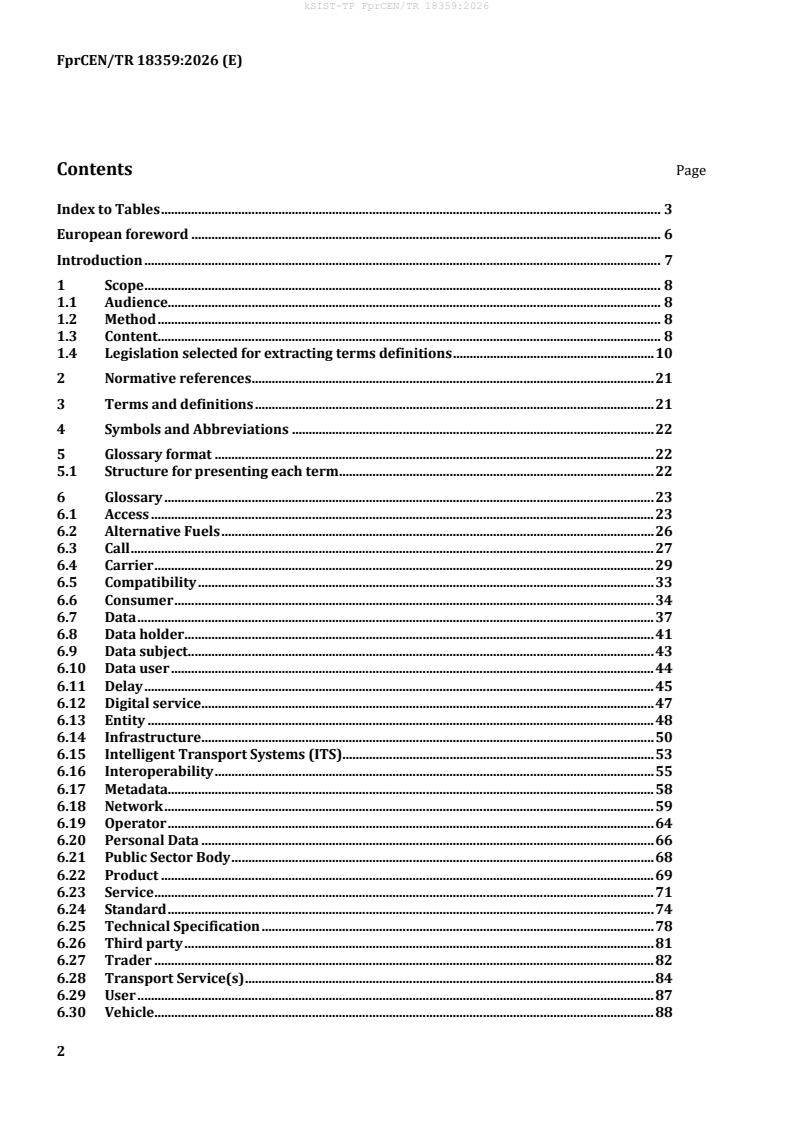
FprCEN/TR 18359:2026 (E)
Contents Page
Index to Tables . 3
European foreword . 6
Introduction . 7
1 Scope . 8
1.1 Audience . 8
1.2 Method . 8
1.3 Content . 8
1.4 Legislation selected for extracting terms definitions . 10
2 Normative references . 21
3 Terms and definitions . 21
4 Symbols and Abbreviations . 22
5 Glossary format . 22
5.1 Structure for presenting each term . 22
6 Glossary . 23
6.1 Access . 23
6.2 Alternative Fuels . 26
6.3 Call . 27
6.4 Carrier . 29
6.5 Compatibility . 33
6.6 Consumer . 34
6.7 Data . 37
6.8 Data holder . 41
6.9 Data subject . 43
6.10 Data user . 44
6.11 Delay . 45
6.12 Digital service . 47
6.13 Entity . 48
6.14 Infrastructure . 50
6.15 Intelligent Transport Systems (ITS). 53
6.16 Interoperability . 55
6.17 Metadata. 58
6.18 Network . 59
6.19 Operator . 64
6.20 Personal Data . 66
6.21 Public Sector Body . 68
6.22 Product . 69
6.23 Service . 71
6.24 Standard . 74
6.25 Technical Specification . 78
6.26 Third party . 81
6.27 Trader . 82
6.28 Transport Service(s) . 84
6.29 User . 87
6.30 Vehicle . 88
FprCEN/TR 18359:2026 (E)
Bibliography . 91
Index to Tables
Table 1 List of terms presented in the report . 8
Table 2 Legislation selected for extracting term definitions . 10
Table 3 Access Familiar name to bibliographic reference . 23
Table 4 Access related terms . 24
Table 5 Access definition source references . 25
Table 6 Alternative Fuel Familiar name to bibliographic reference . 26
Table 7 Alternative fuels definition source references. 26
Table 8 Call Familiar name to bibliographic reference . 28
Table 9 Call related terms . 28
Table 10 Call definition source references . 29
Table 11 Carrier familiar name to bibliographic reference . 29
Table 12 Carrier related terms . 30
Table 13 Carrier definition source references . 31
Table 14 Compatibility familiar name to bibliographic reference . 33
Table 15 Compatibility definition source references . 33
Table 16 Consumer familiar name to bibliographic reference . 34
Table 17 Consumer related terms . 34
Table 18 Consumer definition source references . 36
Table 19 Data familiar name to bibliographic reference . 37
Table 20 Data related terms . 37
Table 21 Data definition source references . 41
Table 22 Data holder familiar name to bibliographic reference . 42
Table 23 Data holder definition source references . 42
Table 24 Data subject familiar name to bibliographic reference . 43
Table 25 Data subject definition source references . 43
Table 26 Data user familiar name to bibliographic reference . 44
Table 27 Data user definition source references . 44
Table 28 Delay familiar name to bibliographic reference . 45
Table 29 Delay related terms . 46
Table 30 Delay definition source references . 46
Table 31 Digital service familiar name to bibliographic reference . 47
Table 32 Digital service definition source references . 47
Table 33 Entity familiar name to bibliographic reference . 48
FprCEN/TR 18359:2026 (E)
Table 34 Entity related terms . 48
Table 35 Entity definition source references . 50
Table 36 Infrastructure familiar name to bibliographic reference . 50
Table 37 Infrastructure related terms . 50
Table 38 Infrastructure definition source references . 52
Table 39 Intelligent transport systems familiar name to bibliographic reference . 53
Table 40 Intelligent transport systems related terms . 54
Table 41 Intelligent transport system definition source references . 54
Table 42 Interoperability familiar name to bibliographic reference . 55
Table 43 Interoperability related terms . 56
Table 44 Interoperability definition source references . 57
Table 45 Metadata familiar name to bibliographic reference . 58
Table 46 Metadata related terms . 58
Table 47 Metadata definition source references . 58
Table 48 Network familiar name to bibliographic reference . 59
Table 49 Network related terms . 59
Table 50 Network definition source references . 63
Table 51 Operator familiar name to bibliographic reference . 64
Table 52 Operator related terms . 64
Table 53 Operator definition source references . 66
Table 54 Personal data familiar name to bibliographic reference . 66
Table 55 Personal data related terms . 67
Table 56 Personal data definition source references . 67
Table 57 Public sector body familiar name to bibliographic reference . 68
Table 58 Public sector body definition source references . 68
Table 59 Product familiar name to bibliographic reference . 69
Table 60 Product related terms . 69
Table 61 Product definition source references. 70
Table 62 Service familiar name to bibliographic reference . 71
Table 63 Service related terms . 71
Table 64 Service definition source references . 73
Table 65 Standard familiar name to bibliographic reference . 74
Table 66 Standard related terms. 75
Table 67 Standard definition source references . 77
Table 68 Technical specification familiar name to bibliographic reference. 78
Table 69 Technical specification related terms . 78
FprCEN/TR 18359:2026 (E)
Table 70 Technical specification definition source references . 80
Table 71 Third party familiar name to bibliographic reference . 81
Table 72 Third party related terms . 81
Table 73 Third Party definition source references . 82
Table 74 Trader familiar name to bibliographic reference . 82
Table 75 Trader definition source references . 83
Table 76 Transport service(s) familiar name to bibliographic reference . 84
Table 77 Transport services definition source references . 85
Table 78 User familiar name to bibliographic reference . 87
Table 79 User related terms . 87
Table 80 User definition source references . 88
Table 81 Vehicle familiar name to bibliographic reference . 88
Table 82 Vehicle definition source references . 90
FprCEN/TR 18359:2026 (E)
European foreword
This document (FprCEN/TR 18359:2026) has been prepared by Technical Committee CEN/TC 278 WG3
“Intelligent transport systems”, the secretariat of which is held by NEN.
This document is currently submitted to the Vote on TR.
This document has been prepared under a request addressed to CEN by the European Commission to
harmonise terms and definitions used in Public Transport and in the mobility ecosystem. The Standing
Committee of the EFTA States subsequently approves these requests for its Member States.
FprCEN/TR 18359:2026 (E)
Introduction
This document presents a Common Glossary for EU legislations answering the concerns stated by the EC:
“… there is a strong need to harmonise terms and definitions used in Public Transport because various
legislations have adopted general terms and definitions which are not aligned, e.g.:
— “interoperability” has a fully different meaning in the rail Interoperability Directive 2016/797/EU and
in the ITS Directive 2010/40/EU.
— “international” is sometimes confused with “cross-border”, while some cross-border topics are not
international but “local” (it is the case for some cross-border public transport services operated under
public obligations).
— “standard” is a word associated with documents produced only by the “official” standardisation bodies
(at EU level CEN, CENELEC and ETSI), while many people use the word “standards” instead of
“specifications” for documents produced by modal platforms (e.g. OSDM for “rail” ).
[The Common Glossary] aims to harmonise such misaligned terms and definition to secure consistency and
interoperability of mobility data.”
After giving detailed consideration to this aim, it appeared clearly that the most helpful method to
promote harmonisation would be to highlight the differences between various use contexts rather than
try to produce a unique standard set of terms, which would appear as yet another standard on top of
others.
This arises from several factors, many of them practical:
— The facts of history. Many of the regulations, as noted, already have mandatory application of varying
scope, and the regulatory bodies would be most unlikely to consider it worthwhile to modify them in
line with some list of precise terms developed after the fact.
— The diversity of practices and use-cases which have been included in the Public Transport domain.
Especially because of the need for this domain to cover multi-modality and developing technologies,
and the increasing requirement for Public Transport to interact at European level with wider domains
such as Road Traffic Management, there are bound to be some deeply embedded terms which have
been used in different senses in different domains.
— The differing nature and working practices involved in the legislative, regulatory and technical
standardisation processes, and their relationship both to one another and to real-world
implementors of Public Transport services.
— The prior existence of a well-established and precise set of Conceptual Models, including terms and
definitions, in the Transmodel ecosystem. This is self-consistent and clearly defined and is being
maintained on a continuous basis. However, its use in the legislative context of the Directive
2010/40/EU (amended by Directive (EU) 2023/2661) is by “delegation”, which might do little to
decrease the possibility of other regulations themselves making use of some terms in a sense not
intended by Transmodel itself.
None of these factors, however, diminish either the importance or the urgency of promoting mutual
understanding between the different interests involved. In fact, they underline both importance and
urgency.
The Open Sales and Distribution Model (OSDM) is a rail sector specification enabling interoperable ticket sales for
trains and other modes of transport and is defined in the new UIC International Railway Solution (IRS) 90918-10
FprCEN/TR 18359:2026 (E)
1 Scope
1.1 Audience
This document provides a Glossary focused on providing practical help to the following users:
— Those drafting or interpreting legislation.
— Those seeking to interpret terms which might be used or defined in one context to apply them in
another context.
— Those needing to develop an understanding of commonly used terms which might have a specialist
meaning in contexts of which they are unaware.
— Those developing ontologies intended to cover domains which are not yet fully covered by their own
set of unambiguous definitions.
1.2 Method
This project’s methodology consisted in a first phase to investigate EU legislations which might have an
impact on the management of data used in Europe in the various transport domains.
At the end of March 2025, more than 250 legislations had been identified which could contains relevant
terms and definitions. Taking into consideration the timeframe of the OpRa+ project it was decided to
develop the comparison work from this list, from which 43 legislations (as amended as of March 2025)
have been selected to record in an Excel file the official definitions they contained. As a whole, the
definition of a total of 717 terms has been provided in an Excel file which also detailed the scope of the
selected legislations.
This Excel file has been in a second phase consolidated with the Transmodel-v6.2-Data-Dictionary into a
new file named OpRa exhaustive glossary issued on 7 May 2025 which contains 2336 definitions of terms.
Then the methodology focused on the redundancy of the terms in the legislations which highlighted from
the various sources 72 terms redundant between 2 and 6 times.
Even though only a limited number of terms are covered explicitly in this document, hopefully the
recommendations provided for the listed terms can inspire the intended Audience to use an analogous
approach when defining or selecting terms to be used when drafting legislation or developing ontologies.
This Glossary was last updated using the legislation available in March 2025. Readers need to be aware
that some regulations, standards and other referenced material are undergoing active development and
therefore the latest versions available at a later date might contain differences to these reviewed.
1.3 Content
The Glossary contains a separate section for each of the 30 selected terms. Each such section contains
sub-sections detailing the contexts the term is used in, related terms, any unifying concept, source
references to the full definitions, and usage recommendations. The following section describes this in
more detail.
Table 1 — List of terms presented in the report
List of terms presented in the report Section of the report
Access 6.1
Alternative Fuels 6.2
Call 6.3
FprCEN/TR 18359:2026 (E)
List of terms presented in the report Section of the report
Carrier 6.4
Compatibility 6.5
Consumer 6.6
Data 6.7
Data holder 6.8
Data subject 6.9
Data user 6.10
Delay 6.11
Digital service 6.12
Entity 6.13
Infrastructure 6.14
Intelligent Transport Systems (ITS) 6.15
Interoperability 6.16
Metadata 6.17
Network 6.18
Operator 6.19
Personal Data 6.20
Public Sector Body 6.21
Product 6.22
Service 6.23
Standard 6.24
Technical Specification 6.25
Third party 6.26
Trader 6.27
Transport Service(s) 6.28
User 6.29
Vehicle 6.30
FprCEN/TR 18359:2026 (E)
1.4 Legislation selected for extracting terms definitions
Table 2 — Legislation selected for extracting term definitions
Legislation reference Legislation Information on scope and/or purpose of the
(listed by date of first in short legislation
publication even when
amended afterwards)
Council Directive Safety and The Directive applies to all sectors of activity, both public
89/391/EEC on the health of and private (industrial, agricultural, commercial,
introduction of measures to workers at administrative, service, educational, cultural, leisure,
encourage improvements work etc.), except certain specific public service activities, such
in the safety and health of as the armed forces or the police, or certain specific
workers at work activities in the civil protection services.
Council Regulation (EEC) NACE Rev.1 Ensures the consistent classification of economic
3037/90 on the statistical activities across the EU as NACE Revision 1 ((NACE:
classification of economic Nomenclature statistique des ACtivités Economiques)).
activities in the European NACE, which was first introduced in 1970, defines a 4-
Community; superseded by digit classification of economic activities which is
Regulation (EC) 1893/2006 consistent with the UN classification ISIC (International
(NACE Revision 2) Standard Industrial Classification of All Economic
amended by Regulation Activities). The EEC regulation has only an historical
(EU) 2023/137 (NACE interest, since it is superseded by NACE Revision 2
Revision 2.1) applied since 2008 and by NACE Revision 2.1 applied
from 2025.
Council Directive Combined Accompanies and promotes the liberalization of
92/106/EEC on the transport combined transport operations (combining road on the
establishment of common initial or final leg of the journey and, on the other leg, rail
rules for certain types of or inland waterway or maritime services where this
combined transport of section exceeds 100 km as the crow flies within a radius
goods between Member not exceeding 150 km as the crow flies from the inland
States waterway port or seaport of loading or unloading.
Regulation (EEC) Maritime Establishes freedom to provide maritime transport
3577/92 applying the cabotage services within a Member State (maritime cabotage) by
principle of freedom to Community shipowners who have their ships registered
provide services to in, and flying the flag of a Member State, provided that
maritime transport within these ships comply with all conditions for carrying out
Member States cabotage in that Member State, including ships
registered in Euros, once that Register is approved by the
Council.
Directive 93/13/EEC on Unfair The purpose of the Directive is to approximate the laws,
unfair terms in consumer Terms regulations and administrative provisions of the Member
contracts; amended by Directive States relating to unfair terms in contracts concluded
Directive 2011/83/EU and between a seller or supplier and a consumer.
by Directive (EU) The contractual terms which reflect mandatory
2019/2161. statutory or regulatory provisions and the provisions or
principles of international conventions to which the
Member States or the Community are party, particularly
in the transport area, is not subject to the provisions of
this Directive.
FprCEN/TR 18359:2026 (E)
Legislation reference Legislation Information on scope and/or purpose of the
(listed by date of first in short legislation
publication even when
amended afterwards)
Directive 96/9/EC on the Legal This Directive concerns the legal protection of databases
legal protection of protection in any form (any collection of independent works, data
databases amended by of databases or other materials arranged in a systematic or
Directive (EU) 2019/790. methodical way and individually accessible by electronic
or other means).
This Directive applies without prejudice to Community
provisions relating to:
(a) the legal protection of computer programs;
(b) rental right, lending right and certain rights related
to copyright in the field of intellectual property,
(c) the term of protection of copyright and certain
related rights.
The directive has been amended by Directive (EU)
2019/790 on copyright and related rights in the Digital
Single Market.
Directive 96/53/EC laying Road This Directive applies to:
down for certain road vehicles (a) the dimensions of motor vehicles in categories M2
vehicles circulating within dimensions and M3 and their trailers in category O and motor
the Community the and weight vehicles in categories N2 and N3 and their trailers in
maximum authorized categories O3 and O4, as defined in Annex II to Directive
dimensions in national and 2007/46/EC;
international traffic and the (b) the weights and certain other characteristics of the
maximum authorized vehicles defined in (a) and specified in Annex I (2) to this
weights in international Directive.
traffic; amended by All the values of weights indicated in Annex I are valid as
Regulation (EU) circulation standards and thus refer to loading
2019/1242 conditions, not production standards, which will be
defined in a later Directive.
This Directive does not apply to articulated buses
comprising more than one articulated section.
It has been amended by Regulation (EU) 2019/1242
setting CO2 emission performance standards for new
heavy-duty vehicles.
Directive 98/6/EC on Consumer This Directive stipulates indication of the selling price
consumer protection in the protection and the price per unit of measurement of products
indication of the prices of offered by traders to consumers in order to improve
products offered to consumer information and to facilitate comparison of
consumers, amended by prices. It has been amended by Directive (EU)
Directive (EU) 2019/2161 2019/2161 as regards the better enforcement and
modernisation of Union consumer protection rules.
Council Decision Terrorist This Decision sets up rules on the exchange of
2005/671/JHA on the offences information and cooperation concerning terrorist
exchange of information offences between Member States and Europol. It has
and cooperation been amended by Directive (EU) 2017/541 on
concerning terrorist combating terrorism.
FprCEN/TR 18359:2026 (E)
Legislation reference Legislation Information on scope and/or purpose of the
(listed by date of first in short legislation
publication even when
amended afterwards)
offences, amended by
Directive (EU) 2017/541
Directive 2005/29/EC Unfair The purpose of this Directive is to contribute to the
concerning unfair business- Commercial proper functioning of the internal market and achieve a
to-consumer commercial Practices high level of consumer protection by approximating the
practices in the internal laws, regulations and administrative provisions of the
market amended by Member States on unfair commercial practices harming
Directive (EU) 2019/2161. consumers' economic interests. It has been amended by
Directive (EU) 2019/2161 as regards the better
enforcement and modernisation of Union consumer
protection rules.
Regulation (EC) Social This Regulation defines the rules applying to the carriage
561/2006 on the legislation by road:
harmonisation of certain relating to (a) of goods where the maximum permissible mass of
social legislation relating to road the vehicle, including any trailer, or semi-trailer, exceeds
road transport, amended transport 3,5 tonnes, or
by Regulation (EU) (b) of passengers by vehicles which are constructed or
165/2014 and by permanently adapted for carrying more than nine
Regulation (EC) persons including the driver, and are intended for that
1073/2009, and purpose;
supplemented by irrespective of the country of registration of the vehicle,
Regulation (EU) undertaken:
2022/1012. (a) exclusively within the Community; or
(b) between the Community, Switzerland and the
countries party to the Agreement on the European
Economic Area [AEEA].
It has been amended by Regulation (EU) 165/2014 on
tachographs in road transport and by Regulation (EC)
1073/2009 on common rules for access to the
international market for coach and bus services, and
supplemented by Regulation (EU) 2022/1012 with
regard to the establishment of standards detailing the
level of service and security of safe and secure parking
areas and to the procedures for their certification.
Regulation (EC) NACE The regulation changes the statistical classification of
1893/2006 establishing Revision 2 economic activities and amends the Regulation (EEC)
the statistical classification 3037/90 dealing with the correlation between NACE and
of economic activities NACE Revision 1. It has been amended by Regulation
(NACE Revision 2) and (EU) 2023/137 issuing a NACE Revision 2.1.
amending Regulation (EEC)
3037/90 as well as certain
EC Regulations on specific
statistical domains;
FprCEN/TR 18359:2026 (E)
Legislation reference Legislation Information on scope and/or purpose of the
(listed by date of first in short legislation
publication even when
amended afterwards)
amended by Regulation
(EU) 2023/137
Directive 2007/2/EC INSPIRE This Directive lays down general rules aimed at the
establishing an establishment of the Infrastructure for Spatial
Infrastructure for Spatial Information (established and operated by the Member
Information in the State) in the European Community, for the purposes of
European Community; Community environmental policies and policies or
amended by Regulation activities which might have an impact on the
(EU) 2019/1010. environment. It has been amended by Regulation (EU)
2019/1010 on the alignment of reporting obligations in
the field of legislation related to the environment.
Directive 2010/40/EU on ITS This Directive establishes a framework in support of the
the framework for the Directive coordinated and coherent deployment and use of
deployment of Intelligent Intelligent Transport Systems (ITS) within the Union, in
Transport Systems in the particular across the borders between the Member
field of road transport and States, and sets out the general conditions necessary for
for interfaces with other that purpose.
modes of transport; This Directive provides for the development of
amended by Directive (EU) specifications for actions within the priority areas
2023/2661 referred to in Article 2, as well as for the development,
where appropriate, of necessary standards.
It applies to ITS applications and services in the field of
road transport and to their interfaces with other modes
of transport without prejudice to matters concerning
national security or necessary in the interest of defence.
It has been amended by Directive (EU) 2023/2661 to
cover the availability of data and the deployment of ITS
services within the priority areas referred to in Article 2,
with, for data, the specific geographical coverage set out
in Annex III and, for ITS services, the specific
geographical coverage set out in Annex IV.
Directive 2011/83/EU on Consumer The purpose of this Directive is, through the achievement
consumer Rights amended Rights of a high level of consumer protection, to contribute to
by Directive (EU) the proper functioning of the internal market by
2015/2302. approximating certain aspects of the laws, regulations
and administrative provisions of the Member States
concerning contracts concluded between consumers and
traders.
It has been amended by Directive (EU) 2015/2302 on
package travel and linked travel arrangements.
FprCEN/TR 18359:2026 (E)
Legislation reference Legislation Information on scope and/or purpose of the
(listed by date of first in short legislation
publication even when
amended afterwards)
Regulation (EU) European This Regulation establishes rules with regard to the
1025/2012 on European standardiza cooperation between European standardisation
standardization Regulation, tion organisations [ESOs], national standardisation bodies
amended by Regulation [NSBs}, Member States and the Commission, the
(EU) 2022/2480 establishment of European standards and European
standardisation deliverables for products and for
services in support of Union legislation and policies, the
identification of ICT technical specifications eligible for
referencing, the financing of European standardisation
and stakeholder participation in European
standardisation.
It has been amended by Regulation (EU) 2022/2480 as
regards decisions of European standardisation
organisations concerning European standards and
European standardisation deliverables
Directive 2014/25/EU on Procuremen This Directive establishes rules on the procedures for
procurement by entities t Directive procurement [acquisition by means of a supply, works or
operating in the water, service contract of works, supplies or services} by
energy, transport and contracting entities with respect to contracts as well as
postal services sectors design contests (whose value exceeds some minimum
thresholds.
This Directive does not affect the freedom of Member
States to define, in conformity with Union law, what they
consider to be services of general economic interest, how
those services ought be organised and financed, in
compliance with the State aid rules, and what specific
obligations they ought to be subject to. Equally, this
Directive does not affect the decision of public
authorities whether, how and to what extent they wish
to perform public functions themselves [.].
This Directive does not affect the way in which the
Member States organise their social security systems.
The scope of this Directive does not include non-
economic services of general interest.
Directive 2014/33/EU on Lifts and This Directive applies to lifts (and their safety
the harmonisation of the safety components) permanently serving buildings and
laws of the Member States components constructions [.].
relating to lifts and safety for lifts This Directive does not apply to: [.]
components for lifts. (c) cableways, including funicular railways ; [.]
(h) lifting appliances fitted in means of transport ; [.]
(k) escalators and mechanical walkways.
FprCEN/TR 18359:2026 (E)
Legislation reference Legislation Information on scope and/or purpose of the
(listed by date of first in short legislation
publication even when
amended afterwards)
Regulation (EU) Tachograph This Regulation sets out obligations and requirements in
165/2014 on tachographs s in road relation to the construction, installation, use, testing and
in road transport, transport control of tachographs used in road transport.
amending Regulation (EC) Definitions of Regulation (EC) 561/2006 -on the
561/2006. harmonisation of certain social legislation relating to
road transport- do apply and are complemented.
Directive (EU) Codification This Directive defines several terms before stating that it
2015/1535 laying down a does not apply: […]
procedure for the provision 3. […] to rules relating to matters which are covered by
of information in the field Union legislation in the field of telecommunications
of technical regulations and services, as covered by Directive (EU) 2018/1972
of rules on Information establishing the European Electronic Communications
Society services Code;
4. […] to rules relating to matters which are covered by
Union legislation in the field of financial services (as
listed non-exhaustively in Annex II);
5. […] with the exception of Article 5(3) [Member States
shall communicate the definitive text of a technical
regulation to the Commission without delay], to rules
enacted by or for regulated markets [.]
...