


EN 17813:2023
(Main)Environmental solid matrices - Determination of halogens and sulfur by oxidative pyrohydrolytic combustion followed by ion chromatography
Environmental solid matrices - Determination of halogens and sulfur by oxidative pyrohydrolytic combustion followed by ion chromatography
This document specifies an empirical method for the simultaneous direct determination of the fluorine, chlorine, bromine, and sulfur content in environmental solid matrices by oxidative pyrohydrolytic combustion at (1 050 ± 50) °C, followed by ion chromatography. The method is applicable for the determination of concentrations ≥ 10 mg/kg of each element based on dry matter. The upper limit and exact concentration range covered depends on the blank levels of the instrumentation and the capacity of the chromatographic separation column used for determination.
NOTE 1 Simultaneous determination of iodine content is possible but currently not validated.
NOTE 2 Other detection methods can be applied if validated.
Feststoffe in der Umwelt - Bestimmung von Halogenen und Schwefel durch oxidative pyrohydrolytische Verbrennung, gefolgt von Ionenchromatographie
Dieses Dokument legt ein Konventionsverfahren für die gleichzeitige direkte Bestimmung des Gehalts an Fluor, Chlor, Brom und Schwefel in Feststoffen in der Umwelt durch oxidative pyrohydrolytische Verbrennung bei (1 050 ± 50) °C, gefolgt von Ionenchromatographie fest. Das Verfahren ist anwendbar für die Bestimmung von Konzentrationen ≥ 10 mg/kg jedes Elements, bezogen auf die Trockenmasse. Die Höchstgrenze und der exakte Konzentrationsbereich, der abgedeckt wird, hängen von den Blindwerten der Geräte und der Kapazität der für die Bestimmung verwendeten chromatographischen Trennsäule ab.
ANMERKUNG 1 Die gleichzeitige Bestimmung des Iodgehalts ist möglich, aber derzeit nicht validiert.
ANMERKUNG 2 Andere Detektionsmethoden können verwendet werden, sofern sie validiert sind.
Matrices environnementales solides - Méthode de dosage des halogènes et du soufre par combustion pyrohydrolytique oxydative suivie d’une analyse par chromatographie ionique
Le présent document spécifie une méthode empirique de dosage, direct et simultané, du fluor, du chlore, du brome et du soufre dans des matrices environnementales solides, par combustion pyrohydrolytique oxydative à une température de (1 050 ± 50) °C, suivie d’une analyse par chromatographie ionique. Cette méthode s'applique à la détermination, pour chaque élément, de concentrations supérieures ou égales à 10 mg/kg, en masse de matière sèche. La limite supérieure et la plage de concentration exacte couverte dépendent des niveaux de blanc des appareils et de la capacité de la colonne de séparation chromatographique utilisée pour le dosage.
NOTE 1 Le dosage simultané de l'iode est possible, mais non validé à l'heure actuelle.
NOTE 2 D’autres méthodes de détection peuvent être appliquées, dès lors qu’elles sont validées.
Trdni matriksi v okolju - Določanje halogenov in žvepla z ionsko kromatografijo po oksidativnem pirohidrolitskem sežigu
Ta evropski standard določa metodo za neposredno določanje skupne vsebnosti fluora, klora, broma in žvepla v trdnih matriksih v okolju. Metoda se uporablja za določanje koncentracij ≥ 10 mg/kg posameznega elementa glede na suho snov. Zgornja meja in natančno območje koncentracij sta odvisna od sistemskih slepih vrednosti instrumentov in zmogljivosti kromatografske ločevalne kolone, uporabljene za določanje.
General Information
- Status
- Published
- Publication Date
- 24-Oct-2023
- Technical Committee
- CEN/TC 444 - Environmental characterization
- Drafting Committee
- CEN/TC 444/WG 3 - Inorganic analysis
- Current Stage
- 6060 - Definitive text made available (DAV) - Publishing
- Start Date
- 25-Oct-2023
- Due Date
- 06-Dec-2022
- Completion Date
- 25-Oct-2023
- Directive
- 99/31/EC - Landfill of waste
Overview
EN 17813:2023 (CEN) specifies an empirical laboratory method for the simultaneous direct determination of fluorine, chlorine, bromine and sulfur in environmental solid matrices. The technique combines oxidative pyrohydrolytic combustion at (1 050 ± 50) °C with subsequent capture of combustion gases and ion chromatography (IC) analysis. The method is applicable for concentrations ≥ 10 mg/kg (dry matter); the upper limit depends on instrument blank levels and the chromatographic column capacity. Iodine can be determined simultaneously but is currently not validated under this standard. Other detection methods may be used if validated.
Key topics and technical requirements
- Principle: Homogenized solid sample is combusted under oxidative/pyrohydrolytic conditions; combustion products are absorbed in aqueous solution and converted to anions (fluoride, chloride, bromide, sulfate) for IC analysis.
- Temperature: Pyrohydrolysis performed at (1 050 ± 50) °C to ensure accurate fluorine recovery.
- Detection: Conductivity detector with suppressor recommended; UV detection (λ = 205 nm) is optional for bromide when improved selectivity is needed.
- Absorption chemistry:
- Oxidizing agent required in the absorber for complete conversion of sulfur to sulfate.
- Reducing agent required to capture bromine (elemental bromine can be formed during combustion).
- Interferences:
- High-melting inorganic sulfates may bias sulfur results (alternative dry combustion at ≥ 1 250 °C may be used).
- Co-eluting ions or high ionic strength can affect resolution (R < 1.3 considered interfering).
- Reagents & gases:
- High-purity inert gas (e.g., argon) and oxygen (≥ 99.9%).
- High-purity water (≥ 18 MΩ·cm) and carbonate/hydroxide eluents (sodium carbonate examples are given).
- Quality control: Use of control standards and mixed multi-anion calibration solutions; examples of organic control standards (4-halobenzoic acids, dibenzothiophene in xylene) are provided.
Applications and users
- Environmental testing laboratories performing routine or regulatory analysis of soils, sediments, sludge, wastes and other solid environmental matrices.
- Agencies and consultants involved in contaminated site assessment, waste characterization, and compliance testing.
- Instrument manufacturers and method developers validating combustion-IC workflows.
- Useful when simultaneous multi-anion determination (F, Cl, Br, S) is required with trace-level capability (≥ 10 mg/kg).
Related standards and notes
- EN 17813 references general analytical practice (sampling, calibration and QC) and cross-references methods for higher-temperature dry combustion for sulfur when needed.
- Annex A of EN 17813 provides performance characteristics; laboratories should align sampling and sample-preparation standards (e.g., ISO guidance for test portions) when implementing this method.
Keywords: EN 17813:2023, environmental solid matrices, halogens, sulfur, oxidative pyrohydrolytic combustion, ion chromatography, pyrohydrolysis, environmental analysis.

Frequently Asked Questions
EN 17813:2023 is a standard published by the European Committee for Standardization (CEN). Its full title is "Environmental solid matrices - Determination of halogens and sulfur by oxidative pyrohydrolytic combustion followed by ion chromatography". This standard covers: This document specifies an empirical method for the simultaneous direct determination of the fluorine, chlorine, bromine, and sulfur content in environmental solid matrices by oxidative pyrohydrolytic combustion at (1 050 ± 50) °C, followed by ion chromatography. The method is applicable for the determination of concentrations ≥ 10 mg/kg of each element based on dry matter. The upper limit and exact concentration range covered depends on the blank levels of the instrumentation and the capacity of the chromatographic separation column used for determination. NOTE 1 Simultaneous determination of iodine content is possible but currently not validated. NOTE 2 Other detection methods can be applied if validated.
This document specifies an empirical method for the simultaneous direct determination of the fluorine, chlorine, bromine, and sulfur content in environmental solid matrices by oxidative pyrohydrolytic combustion at (1 050 ± 50) °C, followed by ion chromatography. The method is applicable for the determination of concentrations ≥ 10 mg/kg of each element based on dry matter. The upper limit and exact concentration range covered depends on the blank levels of the instrumentation and the capacity of the chromatographic separation column used for determination. NOTE 1 Simultaneous determination of iodine content is possible but currently not validated. NOTE 2 Other detection methods can be applied if validated.
EN 17813:2023 is classified under the following ICS (International Classification for Standards) categories: 71.040.40 - Chemical analysis; 71.040.50 - Physicochemical methods of analysis. The ICS classification helps identify the subject area and facilitates finding related standards.
EN 17813:2023 is associated with the following European legislation: EU Directives/Regulations: 2000/76/EC, 99/31/EC. When a standard is cited in the Official Journal of the European Union, products manufactured in conformity with it benefit from a presumption of conformity with the essential requirements of the corresponding EU directive or regulation.
You can purchase EN 17813:2023 directly from iTeh Standards. The document is available in PDF format and is delivered instantly after payment. Add the standard to your cart and complete the secure checkout process. iTeh Standards is an authorized distributor of CEN standards.
Standards Content (Sample)
SLOVENSKI STANDARD
01-junij-2024
Trdni matriksi v okolju - Določanje halogenov in žvepla z ionsko kromatografijo po
oksidativnem pirohidrolitskem sežigu
Environmental solid matrices - Determination of halogens and sulfur by oxidative
pyrohydrolytic combustion followed by ion chromatography
Feststoffe in der Umwelt - Bestimmung von Halogenen und Schwefel durch oxidative
pyrohydrolytische Verbrennung, gefolgt von Ionenchromatographie
Matrices environnementales solides - Méthode de dosage des halogènes et du soufre
par combustion pyrohydrolytique oxydative suivie d’une analyse par chromatographie
ionique
Ta slovenski standard je istoveten z: EN 17813:2023
ICS:
71.040.40 Kemijska analiza Chemical analysis
71.040.50 Fizikalnokemijske analitske Physicochemical methods of
metode analysis
2003-01.Slovenski inštitut za standardizacijo. Razmnoževanje celote ali delov tega standarda ni dovoljeno.
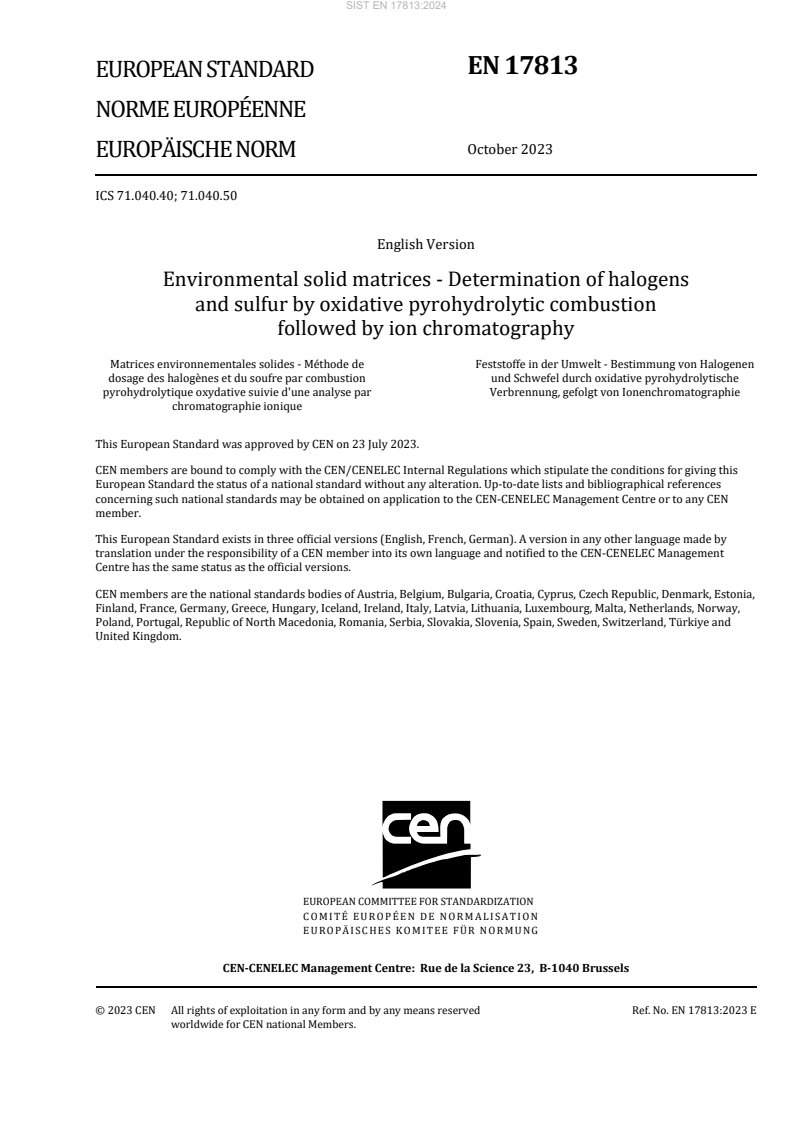
EN 17813
EUROPEAN STANDARD
NORME EUROPÉENNE
October 2023
EUROPÄISCHE NORM
ICS 71.040.40; 71.040.50
English Version
Environmental solid matrices - Determination of halogens
and sulfur by oxidative pyrohydrolytic combustion
followed by ion chromatography
Matrices environnementales solides - Méthode de Feststoffe in der Umwelt - Bestimmung von Halogenen
dosage des halogènes et du soufre par combustion und Schwefel durch oxidative pyrohydrolytische
pyrohydrolytique oxydative suivie d'une analyse par Verbrennung, gefolgt von Ionenchromatographie
chromatographie ionique
This European Standard was approved by CEN on 23 July 2023.
CEN members are bound to comply with the CEN/CENELEC Internal Regulations which stipulate the conditions for giving this
European Standard the status of a national standard without any alteration. Up-to-date lists and bibliographical references
concerning such national standards may be obtained on application to the CEN-CENELEC Management Centre or to any CEN
member.
This European Standard exists in three official versions (English, French, German). A version in any other language made by
translation under the responsibility of a CEN member into its own language and notified to the CEN-CENELEC Management
Centre has the same status as the official versions.
CEN members are the national standards bodies of Austria, Belgium, Bulgaria, Croatia, Cyprus, Czech Republic, Denmark, Estonia,
Finland, France, Germany, Greece, Hungary, Iceland, Ireland, Italy, Latvia, Lithuania, Luxembourg, Malta, Netherlands, Norway,
Poland, Portugal, Republic of North Macedonia, Romania, Serbia, Slovakia, Slovenia, Spain, Sweden, Switzerland, Türkiye and
United Kingdom.
EUROPEAN COMMITTEE FOR STANDARDIZATION
COMITÉ EUROPÉEN DE NORMALISATION
EUROPÄISCHES KOMITEE FÜR NORMUNG
CEN-CENELEC Management Centre: Rue de la Science 23, B-1040 Brussels
© 2023 CEN All rights of exploitation in any form and by any means reserved Ref. No. EN 17813:2023 E
worldwide for CEN national Members.
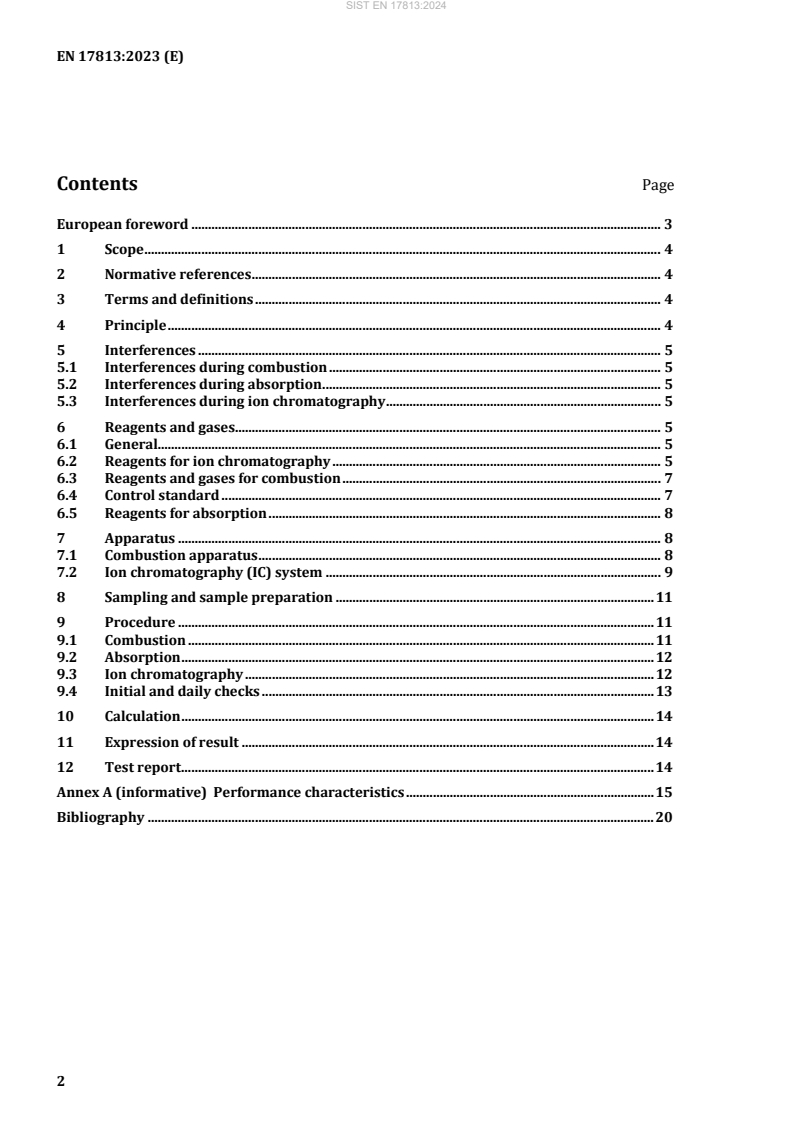
Contents Page
European foreword . 3
1 Scope . 4
2 Normative references . 4
3 Terms and definitions . 4
4 Principle . 4
5 Interferences . 5
5.1 Interferences during combustion . 5
5.2 Interferences during absorption . 5
5.3 Interferences during ion chromatography . 5
6 Reagents and gases. 5
6.1 General. 5
6.2 Reagents for ion chromatography . 5
6.3 Reagents and gases for combustion . 7
6.4 Control standard . 7
6.5 Reagents for absorption . 8
7 Apparatus . 8
7.1 Combustion apparatus . 8
7.2 Ion chromatography (IC) system . 9
8 Sampling and sample preparation . 11
9 Procedure . 11
9.1 Combustion . 11
9.2 Absorption . 12
9.3 Ion chromatography . 12
9.4 Initial and daily checks . 13
10 Calculation . 14
11 Expression of result . 14
12 Test report . 14
Annex A (informative) Performance characteristics . 15
Bibliography . 20
European foreword
This document (EN 17813:2023) has been prepared by Technical Committee CEN/TC 444
“Environmental characterization of solid matrices”, the secretariat of which is held by NEN.
This European Standard shall be given the status of a national standard, either by publication of an
identical text or by endorsement, at the latest by April 2024, and conflicting national standards shall be
withdrawn at the latest by April 2024.
Attention is drawn to the possibility that some of the elements of this document may be the subject of
patent rights. CEN shall not be held responsible for identifying any or all such patent rights.
Any feedback and questions on this document should be directed to the users’ national standards body.
A complete listing of these bodies can be found on the CEN website.
According to the CEN-CENELEC Internal Regulations, the national standards organisations of the
following countries are bound to implement this European Standard: Austria, Belgium, Bulgaria, Croatia,
Cyprus, Czech Republic, Denmark, Estonia, Finland, France, Germany, Greece, Hungary, Iceland, Ireland,
Italy, Latvia, Lithuania, Luxembourg, Malta, Netherlands, Norway, Poland, Portugal, Republic of North
Macedonia, Romania, Serbia, Slovakia, Slovenia, Spain, Sweden, Switzerland, Türkiye and the United
Kingdom.
1 Scope
This document specifies an empirical method for the simultaneous direct determination of the fluorine,
chlorine, bromine, and sulfur content in environmental solid matrices by oxidative pyrohydrolytic
combustion at (1 050 ± 50) °C, followed by ion chromatography. The method is applicable for the
determination of concentrations ≥ 10 mg/kg of each element based on dry matter. The upper limit and
exact concentration range covered depends on the blank levels of the instrumentation and the capacity
of the chromatographic separation column used for determination.
NOTE 1 Simultaneous determination of iodine content is possible but currently not validated.
NOTE 2 Other detection methods can be applied if validated.
2 Normative references
There are no normative references in this document.
3 Terms and definitions
For the purposes of this document, the following terms and definitions apply.
ISO and IEC maintain terminological databases for use in standardization at the following addresses:
— IEC Electropedia: available at https://www.electropedia.org/
— ISO Online browsing platform: available at https://www.iso.org/obp
3.1
pyrohydrolysis
high temperature chemical reaction with water
3.2
test portion
analytical portion
quantity of material, of proper size, for measurement of the concentration or other property of interest,
removed from the test sample
Note to entry 1: The test portion can be taken from the primary sample or from the laboratory sample directly if
no preparation of sample is required (e.g. with liquids), but it is usually taken from the prepared test sample.
Note to entry 2: A unit or increment of proper homogeneity, size, and fineness, needing to further preparation, can
be a test portion.
[SOURCE: EN ISO 11074:2015, definition 4.3.15]
4 Principle
The homogenized sample is combusted under oxidative conditions. For the determination of fluorine, the
combustion is performed under pyrohydrolytic conditions. The combustion gases are absorbed in an
aqueous solution. For the determination of sulfur the absorption solution contains an oxidizing agent to
ensure complete conversion to sulfate. Changes in the volume of the absorption solution are considered
for concentration calculations.
The anions of interest (bromide, chloride, fluoride, and sulfate) are separated by ion chromatography,
and detected with a conductivity detector. To reduce the total conductivity caused by the eluent a
suppressor unit (cation exchange unit) is used [4].
NOTE A UV detector is not required to carry out this analysis, but can be used for the detection of bromide, if a
higher detection selectivity is required or in case of a matrix interference observed in conductivity detection.
Bromide can be detected directly at λ = 205 nm.
NOTE Additional information is available in [3].
5 Interferences
5.1 Interferences during combustion
Pyrohydrolytic conditions during fluorine determination are required to avoid a negative bias.
Sulfur present in inorganic compounds with melting points higher than 1 050 °C (e.g. earth alkali metal
sulfates) can lead to a negative bias. In this case the determination of the sulfur content can be carried
out by dry combustion in an oxygen stream at a temperature ≥ 1 250 °C [7].
5.2 Interferences during absorption
For the determination of sulfur an oxidizing agent in the absorption solution is required to avoid a
negative bias.
For the determination of bromine a reducing agent in the absorption solution is required, as elemental
bromine can be formed during combustion, which may not be completely absorbed.
5.3 Interferences during ion chromatography
Any substance which generates a detector signal and from which the peak resolution R between the
analyte ion and that substance is less than 1,3, can cause interference. A high concentration of ions can
influence the peak resolution and the retention time of the analyte. A gradient elution can help to prevent
these kind of interferences.
6 Reagents and gases
6.1 General
Use only reagents of recognized analytical grade. The purity of water, reagents and gases shall be
confirmed. Unless otherwise specified, reagents shall be weighed to an accuracy of ± 1 % of nominal
mass. Commercially available solutions may be used. If necessary, alternative volumes and
concentrations may be prepared for the solutions described in this section.
Relevant reagents should be tested for their contribution to the blank value.
6.2 Reagents for ion chromatography
6.2.1 Eluents
Degas all water used for eluent preparation. During operation, the gas intake shall be purged, e.g. by
applying an inert gas to the eluent bottles or use of an inline degasser.
Carbonate, hydrogen carbonate, or hydroxide salts can be used to prepare eluents. Eluents can be
prepared manually, by mixing from stock solutions or electrochemically in situ. The choice of the eluent
depends on the column chosen and the detector. Follow instructions of the column manufacturer. The
selected combination of separation column and eluent shall fulfil the requirement for resolution
according to 7.2.9. The eluents may be used as long as the requirements of 7.2.9 are met. An example of a
suitable eluent is described in 6.2.3.2.
6.2.2 Water, with a resistivity of ≥ 18 MΩ cm (25 °C)
6.2.3 Sodium carbonate (anhydrous), Na CO
2 3
6.2.3.1 Sodium carbonate concentrate, c(Na CO ) = 0,09 mol/l
2 3
Dissolve 9,54 g anhydrous sodium carbonate (6.2.3) in water in a 1 000 ml volumetric flask and bring to
volume with water.
The solution is stable for six months if stored at 2 °C to 8 °C.
6.2.3.2 Sodium carbonate eluent, c(Na CO ) = 0,009 mol/l
2 3
Pipette 100 ml of sodium carbonate concentrate (6.2.3.1) into a 1 000 ml volumetric flask and bring to
volume with water.
Prepare the eluent freshly after 3 days.
6.2.4 Bromide, chloride, fluoride, and sulfate stock solutions, c = 1 000 mg/l of each anion
Single anion and mixed anion stock solutions are commercially available in sufficiently high quality.
These solutions are considered stable for several months. Alternatively, stock solutions may be prepared
manually according to Table 1.
Salts are dried appropriately and dissolved according to the weights stated in the table. For calibration,
use mixed multi component standard solutions with at least five different concentrations.
Table 1 — Weight and salt pre-treatment for stock solutions
Anion Salt Weight (g) Dry salt at
(105 ± 5) °C for at
least
Fluoride NaF 2,210 1 h
Chloride NaCl 1,648 2 h
Bromide NaBr 1,288 6 h
Sulfate Na SO 4,439 3 h
2 4
Other salts with corresponding weights and pre-treatment specifications may be used.
6.2.5 Bromide, chloride, fluoride, and sulfate standard solutions
6.2.5.1 General
Depending on the concentrations expected, prepare single or mixed calibration solutions with different
bromide, chloride, fluoride, and sulfate concentrations from the stock standard solution (6.2.4). The
example in 6.2.5.3 describes the preparation of mixed calibration solutions.
The standard solutions can be stored in e.g. polyethylene containers.
6.2.5.2 Example of a bromide, chloride, fluoride, and sulfate mixed standard solution,
c = 100 mg/l of each anion
Pipette 10 ml of each stock solution (6.2.4) into a 100 ml volumetric flask and bring to volume with water.
The solution is stable for one week if stored at 2 °C to 8 °C.
6.2.5.3 Example of bromide, chloride, fluoride, and sulfate mixed calibration solutions
Depending on the concentrations expected in the sample, use the standard solution (6.2.5.2) to prepare
e.g. 5 to 10 calibration solutions distributed as evenly as possible over the expected working range.
For example, proceed as follows for the range 1 mg/l to 10 mg/l of each anion:
Into a series of 10 ml volumetric flasks, pipette the following volumes: 100 μl, 200 μl, 300 μl, 400 μl,
500 μl, 600 μl, 700 μl, 800 μl, 900 μl, and 1 000 μl of the standard solution (6.2.5.2). Bring to volume with
water.
The concentrations of the anions in these calibration solutions are: 1 mg/l, 2 mg/l, 3 mg/l, 4 mg/l, 5 mg/l,
6 mg/l, 7 mg/l, 8 mg/l, 9 mg/l, and 10 mg/l, respectively.
Prepare the calibration solutions on the day of use.
For the assessment of any chromatographic interference by co-eluting ions it is recommended to add
further relevant anions, e.g. nitrite, nitrate or sulfite to the calibration solution.
6.3 Reagents and gases for combustion
6.3.1 Inert gas, for example argon, ≥ 99,9 % (v/v) purity
6.3.2 Oxygen, ≥ 99,9 % (v/v) purity
6.4 Control standard
6.4.1 General
Control standards are used to check the performance of the overall process. This section describes the
preparation of liquid control standards. If a suitable solid control standard or Certified Reference Material
(CRM) is available, this may be used. Standard substances, solvents and concentrations stated in this
section are suitable examples. Other substances containing the desired element and other solvents may
be used. Commercially available solutions may be used. When preparing mixed standard solutions,
standard substances of elements that are not of interest may be omitted. Mixtures may be prepared from
single element stock solutions by dilution into a common flask.
6.4.2 4-Bromobenzoic acid, C H BrO , ≥ 99 % (m/m) purity, CAS no. 586-76-5
7 5 2
6.4.3 4-Chlorobenzoic acid, C H ClO , ≥ 99 % (m/m) purity, CAS no. 74-11-3
7 5 2
6.4.4 Dibenzothiophene, C H S, ≥ 99 % (m/m) purity, CAS no. 132-65-0
12 8
6.4.5 4-Fluorobenzoic acid, C H FO , ≥ 99 % (m/m) purity, CAS no. 456-22-4
7 5 2
6.4.6 Xylene, C H , analytical grade, CAS no. 1330-20-7
8 10
6.4.7 Example of a bromine, chlorine, fluorine, and sulfur control standard solution,
c = 1 000 mg/l of each element
Weigh 251,6 mg 4-bromobenzoic acid (6.4.2), 441,0 mg 4-chlorobenzoic acid (6.4.3), 574,5 mg
dibenzothiophene (6.4.4), and 737,5 mg 4-fluorobenzoic acid (6.4.5) into a 100 ml volumetric flask. Add
xylene (6.4.6) to dissolve and bring to volume with xylene. The solution contains 1 000 mg/l of fluorine,
chlorine, bromine, and sulfur respectively.
6.4.8 Example of a bromine, chlorine, fluorine, and sulfur control standard solution,
c = 10 mg/l and 100 mg/l of each element
Pipette 1 ml and 10 ml respectively of the control standard solution (6.4.7) into separate 100 ml
volumetric flasks and fill up to mark with xylene.
6.5 Reagents for absorption
6.5.1 General
Ultrapure water is suitable as an absorption solution and recommended for the determination of fluoride.
A composition similar to that of the eluent can reduce interferences at the beginning of the
chromatogram. Hydrogen peroxide as additive acts as an oxidizing agent to convert dissolved combustion
gases to a uniform ionic species, e.g. sulfur dioxide to sulfate or elemental bromine to bromide. Sodium
methane sulfonate may be used as internal standard for determination of the final absorption solution
volume. Re
...
Die Norm EN 17813:2023 behandelt die umwelttechnische Analyse von festen Matrices und legt ein empirisches Verfahren zur gleichzeitigen Bestimmung von Halogenen und Schwefel durch oxidative pyrohydrolytische Verbrennung fest. Dieses Dokument ist besonders relevant für Fachleute, die in der Umweltanalytik tätig sind, da es eine präzise Methodik zur Bestimmung von Fluor, Chlor, Brom und Schwefel in festgelegten Umweltproben bietet. Die Stärken der Norm liegen in der hohen Temperatur von (1 050 ± 50) °C, die eine effektive und gründliche Oxidation der Proben ermöglicht. Dadurch wird sichergestellt, dass die Halogen- und Schwefelgehalte in umweltrelevanten festen Matrices präzise erfasst werden können. Die Methode gestattet die Bestimmung von Konzentrationen ab 10 mg/kg für jedes Element, was sie für eine Vielzahl von Anwendungen in der Umweltüberwachung geeignet macht. Ein bemerkenswerter Aspekt dieser Norm ist die Möglichkeit, die gleichzeitige Bestimmung des Iodgehalts zu integrieren, obwohl diese derzeit noch nicht validiert ist. Dies lässt Raum für zukünftige Entwicklungen und Validierungen, die die Anwendbarkeit der Methode weiter verbessern könnten. Zudem bietet die Norm die Flexibilität, dass alternative Detektionsmethoden angewendet werden können, sofern diese validiert sind, was die Relevanz der Norm in einem sich ständig weiterentwickelnden technologischen Umfeld erhöht. Insgesamt trägt die Norm EN 17813:2023 wesentlich zur Weiterentwicklung der analytischen Methoden in der Umweltanalytik bei und ist ein wichtiges Dokument für die präzise Bestimmung von Halogenen und Schwefel in festen Umweltmatrizen.
The standard EN 17813:2023 provides a comprehensive framework for the determination of halogens and sulfur in environmental solid matrices through an empirical method. This standard specifically outlines the procedure for simultaneous direct determination of fluorine, chlorine, bromine, and sulfur content via oxidative pyrohydrolytic combustion at a controlled temperature of (1 050 ± 50) °C, followed by ion chromatography. The precision and reliability of this method are enhanced by its applicability to samples with concentrations of at least 10 mg/kg for each element on a dry matter basis, allowing for effective analysis in diverse environmental contexts. One notable strength of EN 17813:2023 is its focus on an integrated analytical approach that combines oxidative pyrohydrolytic combustion with ion chromatography, which is a proven technique for the accurate quantification of these elements. This dual-phase methodology ensures high sensitivity and specificity in detecting halogens and sulfur, contributing to its relevance in environmental assessments and monitoring. Additionally, the standard acknowledges the possibility of determining iodine content, although it notes that this aspect is not currently validated. This openness allows for future advancements and enhancements to the standard, which could expand its applicability. Furthermore, the document emphasizes flexibility by permitting the inclusion of other validated detection methods, accommodating technological advancements in analytical techniques. In summary, EN 17813:2023 serves as a critical standard in the field of environmental analysis, providing a robust method for quantifying halogens and sulfur in solid matrices. Its precise methodology, adaptability to other detection methods, and commitment to empirical validation make it an essential reference for professionals engaged in environmental monitoring and compliance.
SIST EN 17813:2024 표준은 환경 고형 매트릭스에서 할로겐과 황의 함량을 결정하는 데 있어 매우 중요한 문서입니다. 이 표준은 산화적 피로화 연소를 통한 실험적 방법을 명시하고 있으며, 이는 1,050 ± 50 °C의 온도에서 실시됩니다. 이 방법의 강점 중 하나는 불소, 염소, 브로민 및 황과 같은 요소를 동시에 직접 결정할 수 있다는 점입니다. 이러한 동시에 측정 가능성은 분석의 효율성을 높여줍니다. 또한, 이 표준은 건조물 기준으로 각 요소의 농도를 10 mg/kg 이상 측정하는 데 적합합니다. 이는 환경 오염 모니터링 및 규제 준수를 위한 효과적인 수단이 됩니다. 더 나아가, 장비의 블랭크 수준과 크로마토그래픽 분리 컬럼의 용량에 따라 측정할 수 있는 최대 농도 범위가 달라지는 점 또한 중요한 고려 사항입니다. 본 문서에서는 요오드의 함량 또한 동시에 결정할 수 있음을 언급하지만, 현재로서는 검증되지 않았습니다. 이러한 측정이 가능한 가능성은 향후 연구와 검증을 통해 확장될 수 있습니다. 결론적으로, SIST EN 17813:2024는 환경 고형 매트릭스 내 할로겐과 황의 정량 분석을 위한 신뢰할 수 있는 지침을 제공하며, 다양한 분석 요구 사항을 충족할 수 있는 매우 유용한 표준입니다. 이 표준은 환경 과학 및 공학 분야에서의 좋은 실천을 지원하며, 관련 연구 및 산업에 큰 기여를 할 것으로 기대됩니다.
La norme EN 17813:2023, intitulée "Matrices solides environnementales - Détermination des halogènes et du soufre par combustion pyrohydrolytique oxydative suivie de la chromatographie ionique", représente un avancement significatif dans le domaine de l'analyse des matrices solides environnementales. Cette norme établit une méthode empirique pour la détermination simultanée et directe des contenus en fluor, chlore, brome et soufre par combustion pyrohydrolytique oxydative à des températures de (1 050 ± 50) °C, suivie d'une analyse par chromatographie ionique. L'un des principaux atouts de cette norme réside dans sa capacité à traiter des concentrations allant jusqu’à 10 mg/kg pour chacun des éléments mentionnés, en se basant sur la matière sèche, ce qui rend la méthode particulièrement pertinente pour les analyses environnementales où des niveaux traces sont souvent observés. De plus, le fait que la norme précise que d'autres méthodes de détection peuvent être utilisées si elles sont validées, témoigne de sa flexibilité et de sa capacité à s'adapter aux avancées technologiques. La norme met également en avant l'importance de l'instrumentation utilisée, en précisant que la limite supérieure et la plage de concentration exacte dépendent des niveaux de bruit de fond et de la capacité de la colonne chromatographique. Cela souligne le besoin de rigueur dans la réalisation des analyses et la valorisation de l'équipement à disposition des laboratoires. La possibilité d'une détermination simultanée du contenu en iode, bien que non validée à ce jour, ouvre également des perspectives intéressantes pour des travaux futurs, ce qui pourrait enrichir encore plus le champ d'application de la norme. En résumé, la norme EN 17813:2023 est une référence indispensable pour les laboratoires engagés dans l’analyse des matrices solides environnementales, offrant une méthode robuste et adaptable pour la détermination des halogènes et du soufre.
EN 17813:2023の標準は、環境固体マトリックス中のハロゲンおよび硫黄の定量に関する包括的なガイドラインを提供します。この文書は、1,050 ± 50 °Cでの酸化ピロハイドロリティック燃焼を通じて、フッ素、塩素、臭素、および硫黄の同時直接定量を行う経験的な方法を規定しています。特に、乾燥物質に基づく各元素の濃度が10 mg/kg以上であることが求められており、これにより環境マトリックスの安全性と品質管理において非常に重要な役割を果たします。 この標準の強みは、環境分析における精度の向上と、ハロゲンおよび硫黄の同時分析を可能にする点です。この方法は、特定の機器のブランクレベルとクロマトグラフィー分離カラムの能力に依存しており、これが定量可能な上限および正確な濃度範囲に影響を与えることに留意すべきです。また、現在はバリデーションが行われていないものの、ヨウ素含量の同時定量も可能である点は、この標準の柔軟性を示す要素です。 EN 17813:2023は、環境基準の遵守のために必要な分析手法を規定しているため、環境科学や化学分析の分野での関連性が高く、業界や研究機関における実用性を確保しています。さらに、他の検出方法も適用可能であり、適切にバリデーションされた場合には、分析手法の選択肢がさらに広がります。このように、EN 17813:2023は、環境固体マトリックス中のハロゲンおよび硫黄の正確で効率的な定量を実現するための重要な標準と言えるでしょう。
Questions, Comments and Discussion
Ask us and Technical Secretary will try to provide an answer. You can facilitate discussion about the standard in here.
Loading comments...