

EN 15085-1:2007
(Main)Railway applications - Welding of railway vehicles and components - Part 1: General
- Abstract
This series of standards applies to welding of metallic materials in the manufacture and maintenance of railway vehicles and their parts.
With respect to the railway environment, this series of standards defines the certification and quality requirements for the welding manufacturer to undertake new building and repair work. It then provides an essential link between performance requirements defined during design, and achieves appropriate quality welds during production and the demonstration of the required quality by inspection.
This link is achieved by defining a weld performance class during design, which is based on safety and stress factors relevant to railway operation. Quality levels of imperfections are assigned to weld performance classes to ensure a certain level of performance intended during design. Based on these weld performance classes, certification levels for production as well as inspection and testing and qualifications for welding personnel of the manufacturer are specified.
This standard deals with welding steel and aluminium alloys including castings.
NOTE The principle of this standard may also be applied for welding of other parent materials (e.g. Cu, Mg).
This part of the series provides general recommendations and definitions for welding railway vehicles and associated components. Except for specific provisions which are laid down contractually, this standard applies to all assemblies, sub-assemblies or parts welded by any welding process, either manual, partly mechanized, fully mechanized or automatic welding as defined in EN ISO 4063.
This series of standards does not deal with product qualification.
Items of equipment subject to specific regulations are not relevant to the scope of this series of standards, e.g. air reservoirs according to EN 286-3 and EN 286-4.
- Status
- Withdrawn
- Publication Date
- 23-Oct-2007
- Withdrawal Date
- 21-May-2013
- Technical Committee
- CEN/TC 256 - Railway applications
- Drafting Committee
- CEN/TC 256/WG 31 - Welding of railway vehicules and components
- Current Stage
- 9960 - Withdrawal effective - Withdrawal
- Start Date
- 22-May-2013
- Completion Date
- 22-May-2013

Relations
- Effective Date
- 18-Jan-2023
- Effective Date
- 28-Jan-2026
- Effective Date
- 28-Jan-2026
- Effective Date
- 28-Jan-2026
- Effective Date
- 28-Jan-2026
- Effective Date
- 28-Jan-2026
- Effective Date
- 28-Jan-2026
- Effective Date
- 28-Jan-2026
- Effective Date
- 28-Jan-2026
- Effective Date
- 28-Jan-2026
- Effective Date
- 28-Jan-2026
- Effective Date
- 28-Jan-2026
- Effective Date
- 28-Jan-2026
Get Certified
Connect with accredited certification bodies for this standard

DVS-ZERT GmbH
German welding certification society.
IRIS Certification (UNIFE)
International Railway Industry Standard certification.

TÜV SÜD Rail GmbH
TÜV SÜD railway certification services.
Sponsored listings
Frequently Asked Questions
EN 15085-1:2007 is a standard published by the European Committee for Standardization (CEN). Its full title is "Railway applications - Welding of railway vehicles and components - Part 1: General". This standard covers: This series of standards applies to welding of metallic materials in the manufacture and maintenance of railway vehicles and their parts. With respect to the railway environment, this series of standards defines the certification and quality requirements for the welding manufacturer to undertake new building and repair work. It then provides an essential link between performance requirements defined during design, and achieves appropriate quality welds during production and the demonstration of the required quality by inspection. This link is achieved by defining a weld performance class during design, which is based on safety and stress factors relevant to railway operation. Quality levels of imperfections are assigned to weld performance classes to ensure a certain level of performance intended during design. Based on these weld performance classes, certification levels for production as well as inspection and testing and qualifications for welding personnel of the manufacturer are specified. This standard deals with welding steel and aluminium alloys including castings. NOTE The principle of this standard may also be applied for welding of other parent materials (e.g. Cu, Mg). This part of the series provides general recommendations and definitions for welding railway vehicles and associated components. Except for specific provisions which are laid down contractually, this standard applies to all assemblies, sub-assemblies or parts welded by any welding process, either manual, partly mechanized, fully mechanized or automatic welding as defined in EN ISO 4063. This series of standards does not deal with product qualification. Items of equipment subject to specific regulations are not relevant to the scope of this series of standards, e.g. air reservoirs according to EN 286-3 and EN 286-4.
This series of standards applies to welding of metallic materials in the manufacture and maintenance of railway vehicles and their parts. With respect to the railway environment, this series of standards defines the certification and quality requirements for the welding manufacturer to undertake new building and repair work. It then provides an essential link between performance requirements defined during design, and achieves appropriate quality welds during production and the demonstration of the required quality by inspection. This link is achieved by defining a weld performance class during design, which is based on safety and stress factors relevant to railway operation. Quality levels of imperfections are assigned to weld performance classes to ensure a certain level of performance intended during design. Based on these weld performance classes, certification levels for production as well as inspection and testing and qualifications for welding personnel of the manufacturer are specified. This standard deals with welding steel and aluminium alloys including castings. NOTE The principle of this standard may also be applied for welding of other parent materials (e.g. Cu, Mg). This part of the series provides general recommendations and definitions for welding railway vehicles and associated components. Except for specific provisions which are laid down contractually, this standard applies to all assemblies, sub-assemblies or parts welded by any welding process, either manual, partly mechanized, fully mechanized or automatic welding as defined in EN ISO 4063. This series of standards does not deal with product qualification. Items of equipment subject to specific regulations are not relevant to the scope of this series of standards, e.g. air reservoirs according to EN 286-3 and EN 286-4.
EN 15085-1:2007 is classified under the following ICS (International Classification for Standards) categories: 25.160.10 - Welding processes; 45.060.01 - Railway rolling stock in general. The ICS classification helps identify the subject area and facilitates finding related standards.
EN 15085-1:2007 has the following relationships with other standards: It is inter standard links to EN 15085-1:2007+A1:2013, EN ISO 17659:2004, CEN/TR 14599:2005, EN 15085-4:2007, EN ISO 9241-171:2008, EN 15085-2:2007, EN ISO 9241-20:2009, EN ISO 11064-7:2006, EN ISO 9241-151:2008, EN ISO 11064-5:2008, EN 15085-3:2007, EN 15085-5:2007, EN ISO 14915-1:2002. Understanding these relationships helps ensure you are using the most current and applicable version of the standard.
EN 15085-1:2007 is associated with the following European legislation: EU Directives/Regulations: 93/38/EEC, 96/48/EC; Standardization Mandates: M/024, M/275. When a standard is cited in the Official Journal of the European Union, products manufactured in conformity with it benefit from a presumption of conformity with the essential requirements of the corresponding EU directive or regulation.
EN 15085-1:2007 is available in PDF format for immediate download after purchase. The document can be added to your cart and obtained through the secure checkout process. Digital delivery ensures instant access to the complete standard document.
Standards Content (Sample)
2003-01.Slovenski inštitut za standardizacijo. Razmnoževanje celote ali delov tega standarda ni dovoljeno.Railway applications - Welding of railway vehicles and components - Part 1: GeneralŽelezniške naprave - Varjenje železniških vozil in elementov - 1. del: SplošnoApplications ferroviaires - Soudage des véhicules ferroviaires et des pieces - Partie 1 : GénéralitésBahnanwendungen - Schweißen von Schienenfahrzeugen und -fahrzeugteilen - Teil 1: AllgemeinesTa slovenski standard je istoveten z:EN 15085-1:2007SIST EN 15085-1:2008en,fr,de45.060.0125.160.10ICS:SLOVENSKI
STANDARDSIST EN 15085-1:200801-april-2008
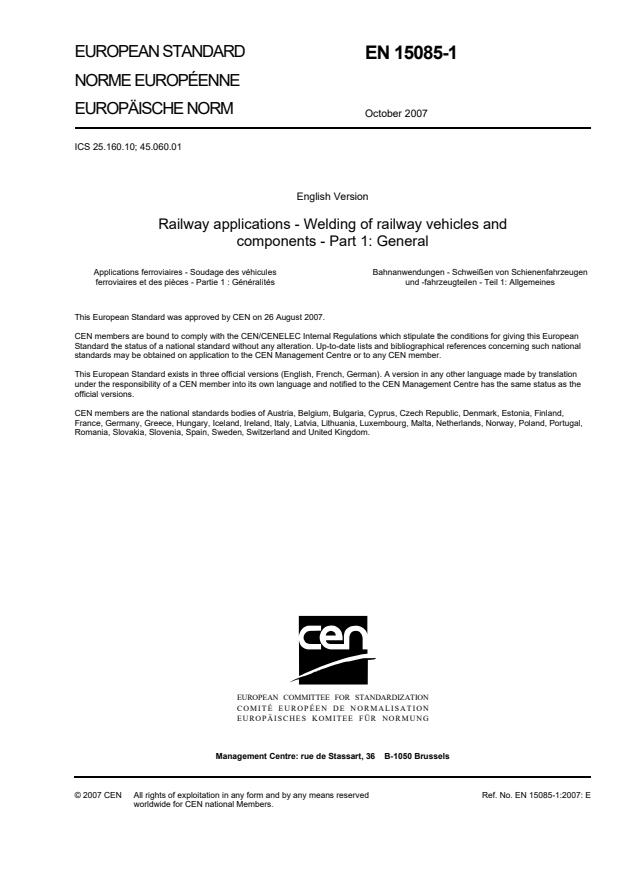
EUROPEAN STANDARDNORME EUROPÉENNEEUROPÄISCHE NORMEN 15085-1October 2007ICS 25.160.10; 45.060.01 English VersionRailway applications - Welding of railway vehicles andcomponents - Part 1: GeneralApplications ferroviaires - Soudage des véhiculesferroviaires et des pièces - Partie 1 : GénéralitésBahnanwendungen - Schweißen von Schienenfahrzeugenund -fahrzeugteilen - Teil 1: AllgemeinesThis European Standard was approved by CEN on 26 August 2007.CEN members are bound to comply with the CEN/CENELEC Internal Regulations which stipulate the conditions for giving this EuropeanStandard the status of a national standard without any alteration. Up-to-date lists and bibliographical references concerning such nationalstandards may be obtained on application to the CEN Management Centre or to any CEN member.This European Standard exists in three official versions (English, French, German). A version in any other language made by translationunder the responsibility of a CEN member into its own language and notified to the CEN Management Centre has the same status as theofficial versions.CEN members are the national standards bodies of Austria, Belgium, Bulgaria, Cyprus, Czech Republic, Denmark, Estonia, Finland,France, Germany, Greece, Hungary, Iceland, Ireland, Italy, Latvia, Lithuania, Luxembourg, Malta, Netherlands, Norway, Poland, Portugal,Romania, Slovakia, Slovenia, Spain, Sweden, Switzerland and United Kingdom.EUROPEAN COMMITTEE FOR STANDARDIZATIONCOMITÉ EUROPÉEN DE NORMALISATIONEUROPÄISCHES KOMITEE FÜR NORMUNGManagement Centre: rue de Stassart, 36
B-1050 Brussels© 2007 CENAll rights of exploitation in any form and by any means reservedworldwide for CEN national Members.Ref. No. EN 15085-1:2007: E
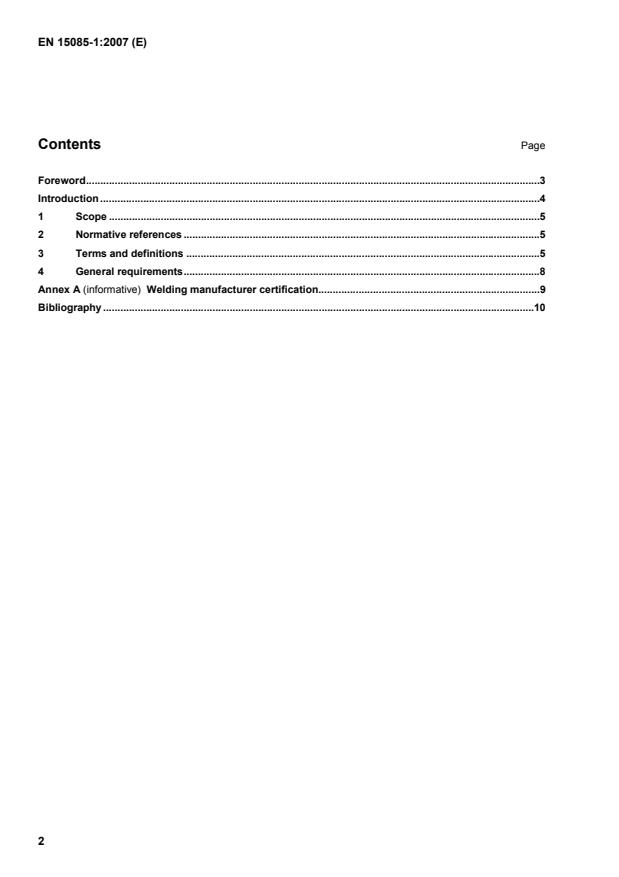
Welding manufacturer certification.9 Bibliography.10
This series of European Standards EN 15085 "Railway applications – Welding of railway vehicles and components" consists of the following parts: Part 1: General Part 2: Quality requirements and certification of welding manufacturer Part 3: Design requirements Part 4: Production requirements Part 5: Inspection, testing and documentation Attention is drawn to the possibility that some of the elements of this document may be the subject of patent rights. CEN [and/or CENELEC] shall not be held responsible for identifying any or all such patent rights. According to the CEN/CENELEC Internal Regulations, the national standards organizations of the following countries are bound to implement this European Standard: Austria, Belgium, Bulgaria, Cyprus, Czech Republic, Denmark, Estonia, Finland, France, Germany, Greece, Hungary, Iceland, Ireland, Italy, Latvia, Lithuania, Luxembourg, Malta, Netherlands, Norway, Poland, Portugal, Romania, Slovakia, Slovenia, Spain, Sweden, Switzerland and the United Kingdom.
1 Scope This series of standards applies to welding of metallic materials in the manufacture and maintenance of railway vehicles and their parts. With respect to the railway environment, this series of standards defines the certification and quality requirements for the welding manufacturer to undertake new building and repair work. It then provides an essential link between performance requirements defined during design, and achieves appropriate quality welds during production and the demonstration of the required quality by inspection. This link is achieved by defining a weld performance class during design, which is based on safety and stress factors relevant to railway operation. Quality levels of imperfections are assigned to weld performance classes to ensure a certain level of performance intended during design. Based on these weld performance classes, certification levels for production as well as inspection and testing and qualifications for welding personnel of the manufacturer are specified. This standard deals with welding steel and aluminium alloys including castings. NOTE The principle of this standard may also be applied for welding of other parent materials (e.g. Cu, Mg). This part of the series provides general recommendations and definitions for welding railway vehicles and associated components. Except for specific provisions which are laid down contractually, this standard applies to all assemblies, sub-assemblies or parts welded by any welding process, either manual, partly mechanized, fully mechanized or automatic welding as defined in EN ISO 4063. This series of standards does not deal with product qualification. Items of equipment subject to specific regulations are not relevant to the scope of this series of standards, e.g. air reservoirs according t
...