


EN 17127:2024
(Main)Outdoor hydrogen refuelling points dispensing gaseous hydrogen and incorporating filling protocols
Outdoor hydrogen refuelling points dispensing gaseous hydrogen and incorporating filling protocols
This document defines the minimum requirements to ensure the interoperability of hydrogen refuelling points, including refuelling protocols that dispense gaseous hydrogen to road vehicles (e.g. Fuel Cell Electric Vehicles) that comply with legislation applicable to such vehicles.
The safety and performance requirements for the entire hydrogen fuelling station, addressed in accordance with existing relevant European and national legislation, are not included in this document.
This document applies to hydrogen refuelling points dispensing gaseous hydrogen to vehicles compliant with UN R134 (Regulation No. 134), UN R134 or Regulation (EC) No 79/2009.
NOTE 1 Guidance on considerations for hydrogen fuelling stations is provided in ISO 19880 1:2020.
NOTE 2 Units used in this document follow SI (International System of Units).
Wasserstofftankstellen im Außenbereich zur Abgabe gasförmigen Wasserstoffs und Betankungsprotokolle umfassend
Dieses Dokument legt die Mindestanforderungen zur Sicherstellung der Interoperabilität (einschließlich der Betankungsprotokolle) von Wasserstoff-Füllanlagen, die gasförmigen Wasserstoff an Straßenfahrzeuge (z. B. Brennstoffzellenfahrzeuge) abgeben, die den für solche Fahrzeuge geltenden Rechtsvorschriften entsprechen.
Die gesamte Wasserstoff-Füllanlage (en: hydrogen refuelling station (HRS)) betreffenden Sicherheits- und Leistungsanforderungen, die durch europäische und nationale Rechtsvorschriften geregelt werden, sind nicht Gegenstand dieses Dokuments.
Dieses Dokument gilt für Wasserstoff-Füllanlagen, die gasförmigen Wasserstoff an Fahrzeuge abgeben, die der UNECE Regelung Nr. 134, Verordnung (EG) Nr. 79/2009 entsprechen.
ANMERKUNG Leitlinien für Überlegungen im Zusammenhang mit Wasserstoff-Füllanlagen werden in ISO 19880 1:2020 gegeben.
Points de ravitaillement en hydrogène en extérieur distribuant de l'hydrogène gazeux et intégrant des protocoles de remplissage
Le présent document définit les exigences minimales permettant de garantir l’interopérabilité des points de ravitaillement en hydrogène intégrant les protocoles de remplissage qui distribuent de l’hydrogène gazeux pour les véhicules routiers (par exemple, les véhicules électriques à pile à combustible) qui sont conformes à la législation applicable à ces véhicules.
Les exigences de sécurité et de performances relatives à toute la station de remplissage d’hydrogène, traitées conformément à la législation européenne et nationale, ne sont pas incluses dans le présent document.
Le présent document s’applique aux points de ravitaillement en hydrogène distribuant de l’hydrogène gazeux aux véhicules conformes à l’UN ECE R134 ou au règlement (UE) n° 79/2009.
NOTE 1 Les recommandations relatives aux considérations concernant les stations de remplissage d’hydrogène sont fournies dans l’ISO 19880 1:2020.
NOTE 2 Les unités utilisées dans le présent document sont conformes au Système international d’unités (SI).
Zunanje polnilne postaje za plinasti vodik in postopki polnjenja
Ta evropski standard bo vključeval tehnične specifikacije z enotno rešitvijo za lahka in težka cestna vozila.
Ta dokument opredeljuje minimalne zahteve za zagotavljanje interoperabilnosti javnih polnilnih postaj za vodik, vključno s postopki točenja stisnjenega (plinastega) vodika za lahka in težka vozila v skladu z veljavnimi predpisi. Zahteve glede varnosti in učinkovitosti celotne postaje za oskrbo z vodikom (HRS), obravnavane v skladu z obstoječo ustrezno evropsko ter nacionalno zakonodajo, v tem dokumentu niso vključene. OPOMBA: Napotki v zvezi z določili za postaje za oskrbo z vodikom (HRS) so navedeni v standardu ISO 19880-1.
General Information
- Status
- Published
- Publication Date
- 13-Feb-2024
- Technical Committee
- CEN/TC 268 - Cryogenic vessels
- Drafting Committee
- CEN/TC 268/WG 5 - Specific hydrogen technologies applications
- Current Stage
- 6060 - Definitive text made available (DAV) - Publishing
- Start Date
- 14-Feb-2024
- Due Date
- 14-Jan-2024
- Completion Date
- 14-Feb-2024
Relations
- Effective Date
- 18-Jan-2023
- Effective Date
- 28-Jan-2026
- Effective Date
- 28-Jan-2026
Overview
EN 17127:2024 is a CEN European Standard that defines the minimum technical requirements to ensure the interoperability of outdoor hydrogen refuelling points dispensing gaseous hydrogen. It specifies requirements for refuelling protocols (algorithms and control strategies) used to fill road vehicles - including Fuel Cell Electric Vehicles (FCEVs) - that comply with applicable vehicle regulations (e.g., UN R134, Regulation (EC) No 79/2009). The standard focuses on the dispenser and refuelling interface; overall station safety and performance remain subject to existing European and national legislation.
Key topics and requirements
- Scope and purpose
- Minimum requirements for interoperability of refuelling points and refuelling protocols.
- Applies to refuelling points for vehicles compliant with UN R134/Reg. (EC) No 79/2009.
- Dispenser characteristics
- Definitions and requirements for dispenser, dispenser cabinet, dispensing system, and dispenser fuel pressure/temperature.
- Extension for higher flow rates to support Heavy Duty Road vehicles.
- Fuel quality
- Fuel quality requirements are referenced (see EN 17124 for hydrogen product specification).
- Refuelling protocols and process control
- Requirements for fuelling protocol design and process limits for vehicle dispensing systems.
- Guidance on vehicle-to-station communications to improve safety and interoperability.
- Handling of dispenser pressure and temperature control faults, and over‑pressure protection concepts (MAWP, MOP, MFP, MDP, NWP).
- Inspection and validation
- Inspection prior to commissioning and periodic inspection.
- Minimum Site Acceptance Testing (SAT) to confirm interoperability.
- Informative annexes
- Anticipated minimum vehicle characteristics and countermeasures for unsuitable fuelling protocols.
Practical applications and who uses this standard
EN 17127:2024 is intended for:
- HRS equipment manufacturers (dispensers, nozzles, control systems) designing interoperable components.
- Station designers and integrators implementing dispenser process control and fueling algorithms.
- Vehicle OEMs ensuring vehicle refuelling systems are compatible with EU refuelling points.
- Station operators and network owners performing Site Acceptance Testing and interoperability validation.
- Regulators and conformity assessors aligning national rules with EU interoperability objectives.
Benefits: Enables seamless EU-wide hydrogen vehicle mobility, reduces incompatible refuelling events, and supports heavy duty vehicle refuelling by addressing higher flow requirements.
Related standards and references
- EN 17124 - Hydrogen fuel: product specification and quality assurance
- EN ISO 17268 - Gaseous hydrogen vehicle refuelling connection devices
- ISO 19880-1 - Guidance on hydrogen fuelling stations
- UN R134 / Regulation (EC) No 79/2009 - Vehicle hydrogen system requirements
Keywords: EN 17127:2024, hydrogen refuelling points, refuelling protocols, gaseous hydrogen, interoperability, hydrogen dispenser, fuel cell electric vehicles, hydrogen refuelling station (HRS), pressure class, NWP, MFP.

Get Certified
Connect with accredited certification bodies for this standard

DNV
DNV is an independent assurance and risk management provider.

Lloyd's Register
Lloyd's Register is a global professional services organisation specialising in engineering and technology.

ABS Quality Evaluations Inc.
American Bureau of Shipping quality certification.
Sponsored listings
Frequently Asked Questions
EN 17127:2024 is a standard published by the European Committee for Standardization (CEN). Its full title is "Outdoor hydrogen refuelling points dispensing gaseous hydrogen and incorporating filling protocols". This standard covers: This document defines the minimum requirements to ensure the interoperability of hydrogen refuelling points, including refuelling protocols that dispense gaseous hydrogen to road vehicles (e.g. Fuel Cell Electric Vehicles) that comply with legislation applicable to such vehicles. The safety and performance requirements for the entire hydrogen fuelling station, addressed in accordance with existing relevant European and national legislation, are not included in this document. This document applies to hydrogen refuelling points dispensing gaseous hydrogen to vehicles compliant with UN R134 (Regulation No. 134), UN R134 or Regulation (EC) No 79/2009. NOTE 1 Guidance on considerations for hydrogen fuelling stations is provided in ISO 19880 1:2020. NOTE 2 Units used in this document follow SI (International System of Units).
This document defines the minimum requirements to ensure the interoperability of hydrogen refuelling points, including refuelling protocols that dispense gaseous hydrogen to road vehicles (e.g. Fuel Cell Electric Vehicles) that comply with legislation applicable to such vehicles. The safety and performance requirements for the entire hydrogen fuelling station, addressed in accordance with existing relevant European and national legislation, are not included in this document. This document applies to hydrogen refuelling points dispensing gaseous hydrogen to vehicles compliant with UN R134 (Regulation No. 134), UN R134 or Regulation (EC) No 79/2009. NOTE 1 Guidance on considerations for hydrogen fuelling stations is provided in ISO 19880 1:2020. NOTE 2 Units used in this document follow SI (International System of Units).
EN 17127:2024 is classified under the following ICS (International Classification for Standards) categories: 27.075 - Hydrogen technologies; 75.200 - Petroleum products and natural gas handling equipment. The ICS classification helps identify the subject area and facilitates finding related standards.
EN 17127:2024 has the following relationships with other standards: It is inter standard links to EN 17127:2020, EN 17124:2022, EN ISO 17268-1:2025. Understanding these relationships helps ensure you are using the most current and applicable version of the standard.
EN 17127:2024 is associated with the following European legislation: EU Directives/Regulations: 2014/94/EU, 2023/1804, 2023/1804-1, 2023/1804-2; Standardization Mandates: M/581. When a standard is cited in the Official Journal of the European Union, products manufactured in conformity with it benefit from a presumption of conformity with the essential requirements of the corresponding EU directive or regulation.
EN 17127:2024 is available in PDF format for immediate download after purchase. The document can be added to your cart and obtained through the secure checkout process. Digital delivery ensures instant access to the complete standard document.
Standards Content (Sample)
SLOVENSKI STANDARD
01-maj-2024
Nadomešča:
SIST EN 17127:2021
Zunanje polnilne postaje za plinasti vodik in postopki polnjenja
Outdoor hydrogen refuelling points dispensing gaseous hydrogen and incorporating
filling protocols
Gasförmiger Wasserstoff - Betankungsanlagen - Teil 1: Allgemeine Anforderungen
Points de ravitaillement en hydrogène en extérieur distribuant de l'hydrogène gazeux et
intégrant des protocoles de remplissage
Ta slovenski standard je istoveten z: EN 17127:2024
ICS:
27.075 Tehnologija vodika Hydrogen technologies
75.200 Oprema za skladiščenje Petroleum products and
nafte, naftnih proizvodov in natural gas handling
zemeljskega plina equipment
2003-01.Slovenski inštitut za standardizacijo. Razmnoževanje celote ali delov tega standarda ni dovoljeno.
EN 17127
EUROPEAN STANDARD
NORME EUROPÉENNE
February 2024
EUROPÄISCHE NORM
ICS 27.075; 75.200 Supersedes EN 17127:2020
English Version
Outdoor hydrogen refuelling points dispensing gaseous
hydrogen and incorporating filling protocols
Points de ravitaillement en hydrogène en extérieur Gasförmiger Wasserstoff - Betankungsanlagen - Teil 1:
distribuant de l'hydrogène gazeux et intégrant des Allgemeine Anforderungen
protocoles de remplissage
This European Standard was approved by CEN on 17 December 2023.
CEN members are bound to comply with the CEN/CENELEC Internal Regulations which stipulate the conditions for giving this
European Standard the status of a national standard without any alteration. Up-to-date lists and bibliographical references
concerning such national standards may be obtained on application to the CEN-CENELEC Management Centre or to any CEN
member.
This European Standard exists in three official versions (English, French, German). A version in any other language made by
translation under the responsibility of a CEN member into its own language and notified to the CEN-CENELEC Management
Centre has the same status as the official versions.
CEN members are the national standards bodies of Austria, Belgium, Bulgaria, Croatia, Cyprus, Czech Republic, Denmark, Estonia,
Finland, France, Germany, Greece, Hungary, Iceland, Ireland, Italy, Latvia, Lithuania, Luxembourg, Malta, Netherlands, Norway,
Poland, Portugal, Republic of North Macedonia, Romania, Serbia, Slovakia, Slovenia, Spain, Sweden, Switzerland, Türkiye and
United Kingdom.
EUROPEAN COMMITTEE FOR STANDARDIZATION
COMITÉ EUROPÉEN DE NORMALISATION
EUROPÄISCHES KOMITEE FÜR NORMUNG
CEN-CENELEC Management Centre: Rue de la Science 23, B-1040 Brussels
© 2024 CEN All rights of exploitation in any form and by any means reserved Ref. No. EN 17127:2024 E
worldwide for CEN national Members.
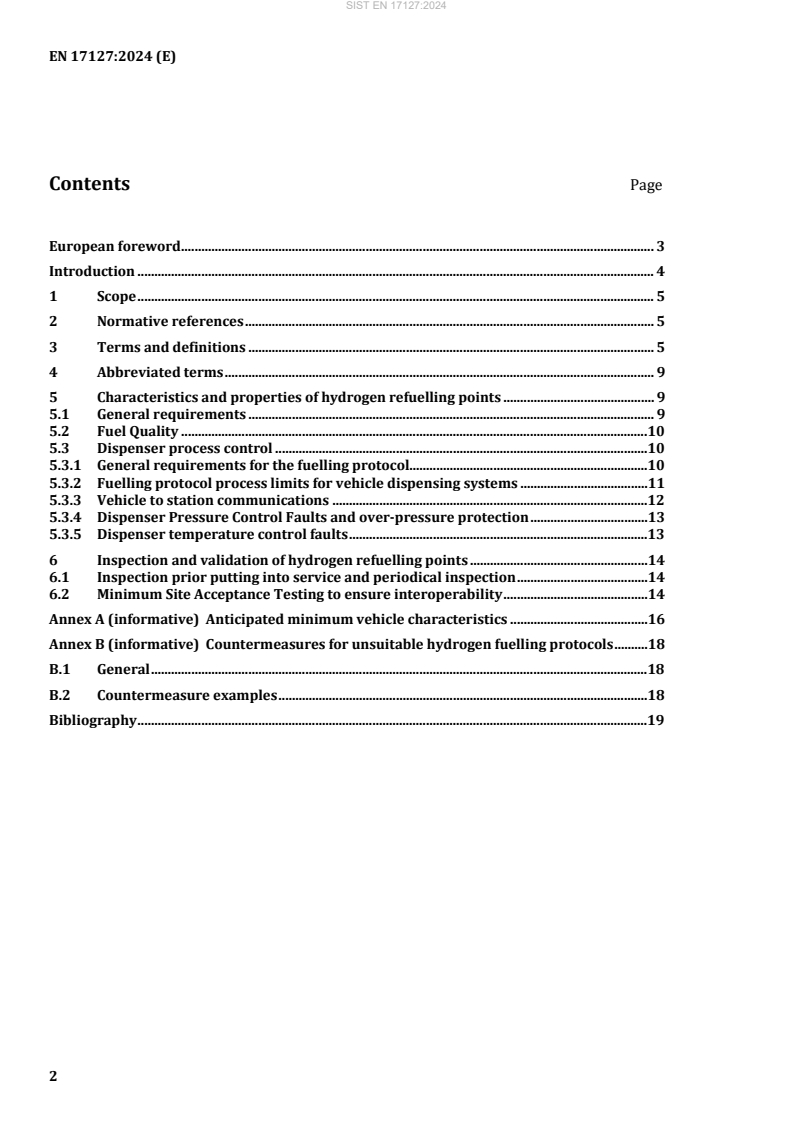
Contents Page
European foreword . 3
Introduction . 4
1 Scope . 5
2 Normative references . 5
3 Terms and definitions . 5
4 Abbreviated terms . 9
5 Characteristics and properties of hydrogen refuelling points . 9
5.1 General requirements . 9
5.2 Fuel Quality .10
5.3 Dispenser process control .10
5.3.1 General requirements for the fuelling protocol.10
5.3.2 Fuelling protocol process limits for vehicle dispensing systems .11
5.3.3 Vehicle to station communications .12
5.3.4 Dispenser Pressure Control Faults and over-pressure protection .13
5.3.5 Dispenser temperature control faults .13
6 Inspection and validation of hydrogen refuelling points .14
6.1 Inspection prior putting into service and periodical inspection .14
6.2 Minimum Site Acceptance Testing to ensure interoperability .14
Annex A (informative) Anticipated minimum vehicle characteristics .16
Annex B (informative) Countermeasures for unsuitable hydrogen fuelling protocols .18
B.1 General .18
B.2 Countermeasure examples .18
Bibliography .19
European foreword
This document (EN 17127:2024) has been prepared by Technical Committee CEN/TC 268 “Cryogenic
vessels and specific hydrogen technologies applications”, the secretariat of which is held by AFNOR.
This European Standard shall be given the status of a national standard, either by publication of an
identical text or by endorsement, at the latest by August 2024, and conflicting national standards shall be
withdrawn at the latest by August 2024.
Attention is drawn to the possibility that some of the elements of this document may be the subject of
patent rights. CEN shall not be held responsible for identifying any or all such patent rights.
This document supersedes EN 17127:2020.
The main changes compared to the previous edition are listed below:
— Improvement of the definitions;
— The general requirements of the characteristics and properties of hydrogen refuelling points have
been extended for higher flow rates needed for the refuelling of Heavy Duty Road vehicles;
— Communication is considered to improve the level of safety.
This document has been prepared under a standardization request addressed to CEN by the European
Commission. The Standing Committee of the EFTA States subsequently approves these requests for its
Member States.
Any feedback and questions on this document should be directed to the users’ national standards body.
A complete listing of these bodies can be found on the CEN website.
According to the CEN-CENELEC Internal Regulations, the national standards organisations of the
following countries are bound to implement this European Standard: Austria, Belgium, Bulgaria, Croatia,
Cyprus, Czech Republic, Denmark, Estonia, Finland, France, Germany, Greece, Hungary, Iceland, Ireland,
Italy, Latvia, Lithuania, Luxembourg, Malta, Netherlands, Norway, Poland, Portugal, Republic of North
Macedonia, Romania, Serbia, Slovakia, Slovenia, Spain, Sweden, Switzerland, Türkiye and the United
Kingdom.
Introduction
The European Commission in its standardization requests M/533 of March 12th, 2015 and M/581 of
th
March 24 , 2022, aims to ensure that technical specifications for interoperability of refuelling points are
specified in European Standards compatible with the relevant International Standards. These
specifications aim to meet the European needs, be compatible and aligned as much as possible with
relevant International Standards and as far as possible with existing refuelling infrastructure already in
place and leave room to accommodate the adopted standard to local technical, analytical and regulatory
needs. The requested European Standards aim to be technologically and commercially neutral and based
on the know-how currently in the possession of the EU industry and of the public sector on a fair,
reasonable and non-discriminatory basis.
According to the legal requirements given in the Directive 2014/94/EU and the future EU Regulation
repealing the Directive 2014/94/EU (AFIR) and M/533 and M/581, European Standards specifying only
the required specifications for ensuring the interoperability of refuelling points should be provided.
European standards and common requirements with respect to “interoperability” mean the capability of
an infrastructure to supply energy (in this document, hydrogen) that is compatible with all vehicle
technologies and allows seamless EU-wide mobility and a clear definition of fuel pressure and
temperature levels and connector designs.
The European Standardization Organizations (ESOs) should adopt European Standards in accordance
with Article 10 of Regulation (EU) No 1025/2012 of the European Parliament and of the Council, and
those standards should be based on current International Standards or ongoing international
standardization work, where applicable.
Direction from the standardization request M/533 for European Standards for hydrogen supply are to
develop European Standards containing technical solutions for interoperability with technical
specifications in regard to Article 5 and point 2 of Annex II, in particular for:
a) outdoor hydrogen refuelling points dispensing gaseous hydrogen;
b) hydrogen purity dispensed by hydrogen refuelling points;
c) fuelling algorithms and equipment of hydrogen refuelling points;
d) connectors for vehicles for the refuelling of gaseous hydrogen.
This document specifies Items a) and c).
Item b) is covered by EN 17124 and Item d) by EN ISO 17268.
This document also addresses the standardization request M/581 for a European standard supporting
an interoperable infrastructure for hydrogen supply for road transport and containing technical
specifications with a unified solution for hydrogen refuelling points dispensing compressed (gaseous)
hydrogen for heavy duty vehicles.
1 Scope
This document defines the minimum requirements to ensure the interoperability of hydrogen refuelling
points, including refuelling protocols that dispense gaseous hydrogen to road vehicles (e.g. Fuel Cell
Electric Vehicles) that comply with legislation applicable to such vehicles.
The safety and performance requirements for the entire hydrogen fuelling station, addressed in
accordance with existing relevant European and national legislation, are not included in this document.
This document applies to hydrogen refuelling points dispensing gaseous hydrogen to vehicles compliant
with UN R134 (Regulation No. 134), Regulation (EC) No 79/2009.
NOTE Guidance on considerations for hydrogen fuelling stations is provided in ISO 19880-1:2020.
2 Normative references
The following documents are referred to in the text in such a way that some or all of their content
constitutes requirements of this document. For dated references, only the edition cited applies. For
undated references, the latest edition of the referenced document (including any amendments) applies.
EN 17124, Hydrogen fuel - Product specification and quality assurance for hydrogen refuelling points
dispensing gaseous hydrogen - Proton exchange membrane (PEM) fuel cell applications for vehicles
EN ISO 17268, Gaseous hydrogen land vehicle refuelling connection devices (ISO 17268)
3 Terms and definitions
For the purposes of this document, the following terms and definitions apply.
ISO and IEC maintain terminology databases for use in standardization at the following addresses:
— IEC Electropedia: available at https://www.electropedia.org/
— ISO Online browsing platform: available at https://www.iso.org/obp
3.1
compressed hydrogen storage system
CHSS
hydrogen storage on-board vehicle
Note 1 to entry As defined in the UN R134 (Regulation No. 134)
3.2
dispenser
equipment in the dispensing system, including the dispenser cabinet(s) and support structure, that is
physically located in the fuelling area
Note 1 to entry: The hydrogen dispenser typically includes, as a minimum, one or more fuelling assemblies
consisting of a nozzle, hose and break-away coupling, required temperature and pressure instrumentation, filters,
and the user interface to conduct vehicle fuelling.
Note 2 to entry: The manufacturer of the hydrogen dispenser can elect to include additional equipment in the
dispenser, including the possibility of all equipment in the dispensing system, such as compressor, pressure storage.
3.3
dispenser cabinet
protective housing that encloses process piping and can also enclose measurement, control and ancillary
dispenser equipment
3.4
dispenser fuel pressure
pressure of the hydrogen gas supplied to the vehicle by the refuelling point
Note 1 to entry: See Annex A for discussion of pressure terminology and its application to dispensing systems.
3.5
dispenser fuel temperature
temperature of the hydrogen gas supplied to the vehicle by the refuelling point
3.6
dispensing system
hydrogen refuelling point
system downstream of the hydrogen supply system comprising all equipment necessary to carry out the
vehicle refuelling operation, through which the compressed hydrogen is supplied to the vehicle
[SOURCE: ISO 19880-1:2020]
3.7
hydrogen fuelling station
facility for the dispensing of compressed hydrogen vehicle fuel, often referred to as a hydrogen refuelling
station (HRS) or hydrogen filling station, including the supply of hydrogen compression, storage and
dispensing systems
3.8
hydrogen service level
HSL
pressure level in MPa used to characterize the hydrogen service of the dispenser based on the NWP rating
of the vehicle
Note 1 to entry: The numerical value of HSL also matches the number after the “H” in Pressure Class.
Note 2 to entry: See Annex A for application of pressure terminology to hydrogen dispenser systems and vehicles.
3.9
interoperability
capability of a hydrogen refuelling point to supply hydrogen at the fuelling station/vehicle interface that
is compatible with road vehicles and allows seamless EU-wide mobility through applying clear definitions
of connector designs, fuel quality, pressure levels, temperatures and other applicable considerations
3.10
maximum allowable working pressure
MAWP
maximum pressure permissible in a vessel or system at the temperature specified for the pressure
Note 1 to entry: The maximum allowable working pressure can also be defined as the design pressure, the
maximum allowable operating pressure, the maximum permissible working pressure, or the maximum allowable
pressure for the rating of pressure vessels and equipment manufactured in accordance with national pressure
vessel codes.
Note 2 to entry: See Annex A for application of pressure terminology to hydrogen dispenser systems and vehicles.
3.11
maximum developed pressure
MDP
highest pressure expected during fault management by the dispensing system
Note 1 to entry: Per the UN R134 (Regulation No. 134), the maximum developed pressure is 1,50 × NWP.
Note 2 to entry: The estimate of maximum developed pressure is based on “worst case” assumptions; the highest
possible setpoint for the pressure protection and maximum allowable values for setpoint accuracy and “lift” to open
the PSV for full relieving.
3.12
maximum fuelling pressure
MFP
maximum pressure applied to the vehicle high pressure hydrogen system during refuelling; 125 per cent
of the nominal working pressure
Note 1 to entry: See UN R134 (Regulation No. 134) Clause II-3.36.
Note 2 to entry: Also referred to as maximum fill pressure.
3.13
maximum operating pressure
MOP
highest pressure that is expected for a component or system during normal operation
Note 1 to entry: See Annex A for application of pressure terminology to hydrogen dispenser systems and vehicles.
3.14
nominal working pressure
NWP
pressure of a-vehicle CHSS at 100% SOC at a gas temperature of 15 °C
Note 1 to entry: See UN R134 (Regulation No. 134) Clause II-3.37.
Note 2 to entry: For road vehicles, this is typically 35 MPa or 70 MPa.
Note 3 to entry: See Annex A for application of pressure terminology to hydrogen dispenser systems and vehicles.
3.15
pressure class
non-dimensional rating of components that indicates that the components are designed to dispense
hydrogen to road vehicles at the required pressure and temperature
Note 1 to entry: The numbers following ‘H’ in the pressure class are numerically the same as the HSL, but the HSL
identifies only the level of the dispensing service, whereas the pressure class designation shows the component are
fully capable of meeting the pressure and temperature requirements for dispensing hydrogen at the indicated
service level.
Note 2 to entry: See Annex A for application of pressure terminology to hydrogen dispenser systems and vehicles.
3.16
pressure safety valve
PSV
pressure activated valve that opens at specified set point to protect a system from rupture and re-closes
when the pressure falls below the set point and which can reclose above the MOP
3.17
refuelling protocol
technical descriptions, instructions, or constructs that define how the dispensing of compressed gaseous
hydrogen to storage systems on vehicles should be conducted and that serves as the basis for defining
control strategies and algorithms for implementation in the basic process control of the dispensing
control system hardware and software
Note 1 to entry: Fuelling protocols can range from simple descriptions that can be performed in hardware to
complex programmable control functions using prescribed values, tables, and/or reduced-order models as well as
conventional process controls such as feed-forward/feedback and predictor/corrector control functions.
Note 2 to entry: A refuelling protocol can be also referred to as a refuelling algorithm.
3.18
state of charge
SOC
density ratio of hydrogen in the CHSS between the actual CHSS condition and the capacity at NWP when
the system is equilibrated at 15 °C
Note 1 to entry: SOC is expressed as a percentage and is computed based on the gas density according to Formula 1
below.
ρ PT,
( )
(1)
SOC % ×100
( )
ρ NWP,15 °C
( )
Note 2 to entry: The accuracy of the NIST formula has been quantified to be to within 0,01 % from 255 K to 1 000 K
with pressures up to 120 MPa at the time of publishing of this document.
The hydrogen densities at the two major nominal working pressures are:
— density of H at 35 MPa and 15 °C = 24,0 g/l;
— density of H at 70 MPa and 15 °C = 40,2 g/l.
Note 3 to entry: The ρ(P,T) function for hydrogen is available from the National Institute of Standards and
Technology (NIST) at https://nvlpubs.nist.gov/nistpubs/jres/113/6/V113.N06.A05.pdf.
=
3.19
target pressure
dispenser fuel pressure that the hydrogen fuelling protocol targets for the end of refuelling
3.20
verification
evaluation using subscale and full-scale tests, analyses, or a combination of tests and analyses that that a
product, service, or system complies with a regulations, requirements, specifications, or imposed
conditions
Note 1 to entry: Verification is typically conducted as part of the development process.
4 Abbreviated terms
H35 Indication for 35 MPa NWP hydrogen refuelling as defined in EN ISO 17268
H70 Indication for 70 MPa NWP hydrogen refuelling as defined in EN ISO 17268
5 Characteristics and properties of hydrogen refuelling points
5.1 General requirements
The hydrogen refuelling point shall be able to refuel hydrogen vehicles certified according to UN
Regulation 134, regulation (EU) 2019/2144 or EC 79/2009 for already approved vehicles without
compromising their specification limits.
NOTE 1 Assumptions made on the minimum characteristics of the hydrogen vehicle necessary to ensure
interoperability with the refuelling points defined in this document are outlined in Annex A.
Hydrogen refuelling points that would potentially be harmful to vehicles compliant with UN Regulation
134, regulation (EU) 2019/2144 or EC 79/2009 for already approved vehicles (for example, due to the
protocol used) shall use countermeasures to prevent unsafe refuelling from occurring.
NOTE 2 Examples of countermeasures that can be employed to prevent vehicles refuelling at refuelling points
where the protocol could be unsafe for vehicles compliant with UN R134 or Regulation (EC) No 79/2009 are
provided in Annex B.
Refuelling points shall provide hydrogen at either H35 and/or H70 (relating to an NWP in the vehicle of
35 MPa and 70 MPa respectively) via appropriately rated components.
The refuelling nozzle shall be compatible with vehicle hydrogen receptacles that comply with
EN ISO 17268.
Instructions for use of the hydrogen refuelling point by the general public shall be included on or in the
vicinity of each dispenser. The fuel (i.e. hydrogen) and pressure class shall be clearly indicated. Dispenser
operation instructions for dispensing hydrogen into a vehicle may be displayed as markings or as an
electronic display at the dispenser.
These instructions shall include prohibitions against:
— the use of adapters (e.g. 35 MPa vehicle refuelling from 70 MPa nozzle, or alternative fuel nozzles);
— the refuelling of cylinder systems (whether in a vehicle or not) that are incompatible with the fuelling
protocol employed at the refuelling point, see 5.3.
NOTE 3 EN 16942 includes information on labelling requirements for hydrogen refuelling points, and hydrogen
vehicles, in Europe.
5.2 Fuel Quality
The hydrogen quality at the nozzle shall meet the requirements of EN 17124.
To prevent hydrogen containing function-impairing impurities (i.e. particulates) that would affect the
high pressure hydrogen system of the vehicle, specifically the vehicle CHSS valves, hydrogen filters shall
be included as part of the dispenser. There shall be a filter with a capability to prevent particulates of a
maximum size of 5 µm with a minimum removal efficiency of 99 % under expected process conditions,
or alternatively a 5 µm filter. The filter shall be installed downstream of dispenser components which
could create particulates, such as a heat exchanger, flow controller, valves, etc. and be as close as possible
to the nozzle or hose breakaway device. This shall filter out the particulate concentration in the hydrogen
as per EN 17124.
All filters located at the nearest side to the nozzle shall be carefully selected by taking the robustness into
account (for example the durability limitations of powdered sintered metal filters).
EN ISO 4022, ISO 12500-1 and ISO 12500-3 provide recommended methodologies for the testing of filter
efficiencies.
5.3 Dispenser process control
5.3.1 General requirements for the fuelling protocol
In order to ensure that the refuel
...
Questions, Comments and Discussion
Ask us and Technical Secretary will try to provide an answer. You can facilitate discussion about the standard in here.
Loading comments...