

prEN 18372
(Main)Materials and articles in contact with foodstuffs — Evaluation of the suitability of metal and alloy articles in contact with foodstuffs during microwave heating
- Abstract
This document establishes a methodology framework for testing metal-made articles in contact with foodstuffs for use in domestic microwave applicators. An experimental method aiming at qualifying this class of articles is proposed. The objectives of the method are two-folds: ensuring a correct eating efficiency considering a standard microwave heating cycle and guarantying the user safety notably regarding the risk of electrical discharge.
- Status
- Not Published
- Publication Date
- 30-Mar-2027
- Technical Committee
- CEN/TC 194 - Utensils in contact with food
- Current Stage
- 4060 - Closure of enquiry - Enquiry
- Start Date
- 01-Oct-2026
- Due Date
- 11-Mar-2026
- Completion Date
- 01-Oct-2026

prEN 18372 is a draft CEN European Standard for evaluating whether metal and alloy articles can be used with foodstuffs during microwave heating. It specifies a test method for domestic microwave ovens that checks both heating efficiency and user safety, especially the risk of electrical discharge.
What does prEN 18372 specify?
prEN 18372 specifies a method for determining the suitability of metal or partially metal articles, coated or uncoated, when they are used as containers for foodstuffs or drinks during microwave heating. It applies to single-use and reusable containers used with the microwave function only, and it also sets minimum information for marking, labelling, or instructions for use.
The document is organized into clauses 1 to 10:
- scope, normative references, terms and definitions
- principle, apparatus, and test pieces
- calibration of the microwave oven
- operating procedure
- marking, labelling or instructions for use
- test report
The scope excludes microwave combination appliances, microwave ovens with impingement function, and microwave ovens with input power lower than 900 W. It also excludes models without a protective dielectric barrier, such as a missing or broken glass turntable or a damaged ceramic floor, where direct metal-to-metal contact with the oven base could occur.
What are the key requirements of prEN 18372?
Calibration and heating time
prEN 18372 requires the microwave oven to be calibrated before testing so the effective power output is known. Clause 7 uses water in a borosilicate glass beaker to determine that power, and the result is then used to calculate the theoretical heating time for the container test.
This matters in practice because the test time is based on the oven’s real heating performance, not just its nameplate rating. The oven must also be used at a power setting that provides continuous power output.
Safety testing
prEN 18372 requires safety testing in four positions inside the cavity: centred in front of the door, then centred in front of each of the three side walls. During these tests the container is filled to two-thirds of its maximum usable capacity, kept on the glass plate or lower surface in a static position, and held away from the walls by the distances stated in the method.
The test runs for three times the theoretical heating time, with a maximum of 20 minutes. If an electric arc forms, the oven is stopped immediately and the sample fails. The container also fails if its appearance changes or if it damages the oven cavity.
Performance testing
prEN 18372 requires a separate performance test to check whether the container heats food or water sufficiently. The container is filled to two-thirds of maximum usable capacity, conditioned at laboratory temperature, placed in the centre of the oven, and heated for the calculated time.
The result is the rise in water temperature. The performance test is satisfactory only if each of the three tested containers reaches a temperature rise greater than 30 % of the theoretical 55 °C rise. In practice, this screens out articles that are technically safe but too poor at transmitting microwave energy to be useful.
Marking and reporting
prEN 18372 requires consumer-facing marking, labelling, or instructions to state that the article is suitable for microwave use and to include warnings such as spark risk, one container at a time, no metal covering, and the minimum 25 mm distance from microwave walls. For reusable containers, the instructions also cover turning freedom and reheating instructions where applicable.
The test report must identify the laboratory and the containers tested, state the effective power output used, and record the results of the performance and safety tests together with the marking requirements.
What terms does prEN 18372 define?
- single-use container - a container not designed, created, or placed on the market to be refilled or reused for the same purpose.
- container - an article designed to contain and protect foodstuffs and allow handling and transport from producer to consumer or user.
- packaging - the product’s external or visible packaging.
- reusable container - a container designed to be used again without changing its original use.
- article - a metal or partially metal object, coated or uncoated, used as a container for foodstuffs or drinks during microwave heating.
Who uses prEN 18372?
prEN 18372 is used by manufacturers and suppliers of metal and alloy food-contact containers who need to assess whether a design is suitable for microwave use. It is also used by test laboratories performing suitability, safety, and heating-efficiency tests, and by quality or compliance teams preparing marking and instructions for market release.
Which standards are used with prEN 18372?
prEN 18372 cites ISO 3585:1998, Borosilicate glass 3.3 - Properties. Clause 7 uses it for the borosilicate glass beaker in the microwave oven calibration step, so the beaker material properties are part of the effective power determination.
What does the prEN 18372 document contain?
prEN 18372 contains a microwave-oven calibration method, a theoretical heating-time calculation, safety and performance test procedures, consumer information requirements, and a test report list. It includes the setup for filling the test container with water, placing it in specified positions in the cavity, and checking for electric arc, damage, and heating rise.
The document also includes the formula used to calculate effective microwave oven power and the formula used to derive the test time. Table 1 sets out the minimum marking, labelling, and instruction items for reusable and single-use containers.
Get Certified
Connect with accredited certification bodies for this standard

BSI Group
BSI (British Standards Institution) is the business standards company that helps organizations make excellence a habit.

Bureau Veritas
Bureau Veritas is a world leader in laboratory testing, inspection and certification services.

DNV
DNV is an independent assurance and risk management provider.
Sponsored listings
Frequently Asked Questions
prEN 18372 is a draft published by the European Committee for Standardization (CEN). Its full title is "Materials and articles in contact with foodstuffs — Evaluation of the suitability of metal and alloy articles in contact with foodstuffs during microwave heating". This standard covers: This document establishes a methodology framework for testing metal-made articles in contact with foodstuffs for use in domestic microwave applicators. An experimental method aiming at qualifying this class of articles is proposed. The objectives of the method are two-folds: ensuring a correct eating efficiency considering a standard microwave heating cycle and guarantying the user safety notably regarding the risk of electrical discharge.
This document establishes a methodology framework for testing metal-made articles in contact with foodstuffs for use in domestic microwave applicators. An experimental method aiming at qualifying this class of articles is proposed. The objectives of the method are two-folds: ensuring a correct eating efficiency considering a standard microwave heating cycle and guarantying the user safety notably regarding the risk of electrical discharge.
prEN 18372 is classified under the following ICS (International Classification for Standards) categories: 67.250 - Materials and articles in contact with foodstuffs; 97.040.20 - Cooking ranges, working tables, ovens and similar appliances. The ICS classification helps identify the subject area and facilitates finding related standards.
prEN 18372 is available in PDF format for immediate download after purchase. The document can be added to your cart and obtained through the secure checkout process. Digital delivery ensures instant access to the complete standard document.
Standards Content (Sample)
SLOVENSKI STANDARD
01-julij-2026
Materiali in predmeti v stiku z živili - Ocena primernosti izdelkov iz kovin in zlitin, ki
so v stiku z živili med segrevanjem v mikrovalovni pečici
Materials and articles in contact with foodstuffs - Evaluation of the suitability of metal and
alloy articles in contact with foodstuffs during microwave heating
Ta slovenski standard je istoveten z: prEN 18372
ICS:
67.250 Materiali in predmeti v stiku z Materials and articles in
živili contact with foodstuffs
2003-01.Slovenski inštitut za standardizacijo. Razmnoževanje celote ali delov tega standarda ni dovoljeno.
DRAFT
EUROPEAN STANDARD
NORME EUROPÉENNE
EUROPÄISCHE NORM
July 2026
ICS
English Version
Materials and articles in contact with foodstuffs -
Evaluation of the suitability of metal and alloy articles in
contact with foodstuffs during microwave heating
This draft European Standard is submitted to CEN members for enquiry. It has been drawn up by the Technical Committee
CEN/TC 194.
If this draft becomes a European Standard, CEN members are bound to comply with the CEN/CENELEC Internal Regulations
which stipulate the conditions for giving this European Standard the status of a national standard without any alteration.
This draft European Standard was established by CEN in three official versions (English, French, German). A version in any other
language made by translation under the responsibility of a CEN member into its own language and notified to the CEN-CENELEC
Management Centre has the same status as the official versions.
CEN members are the national standards bodies of Austria, Belgium, Bulgaria, Croatia, Cyprus, Czech Republic, Denmark, Estonia,
Finland, France, Germany, Greece, Hungary, Iceland, Ireland, Italy, Latvia, Lithuania, Luxembourg, Malta, Netherlands, Norway,
Poland, Portugal, Republic of North Macedonia, Romania, Serbia, Slovakia, Slovenia, Spain, Sweden, Switzerland, Türkiye and
United Kingdom.
Recipients of this draft are invited to submit, with their comments, notification of any relevant patent rights of which they are
aware and to provide supporting documentation.
Warning : This document is not a European Standard. It is distributed for review and comments. It is subject to change without
notice and shall not be referred to as a European Standard.
EUROPEAN COMMITTEE FOR STANDARDIZATION
COMITÉ EUROPÉEN DE NORMALISATION
EUROPÄISCHES KOMITEE FÜR NORMUNG
CEN-CENELEC Management Centre: Rue de la Science 23, B-1040 Brussels
© 2026 CEN All rights of exploitation in any form and by any means reserved Ref. No. prEN 18372:2026 E
worldwide for CEN national Members.
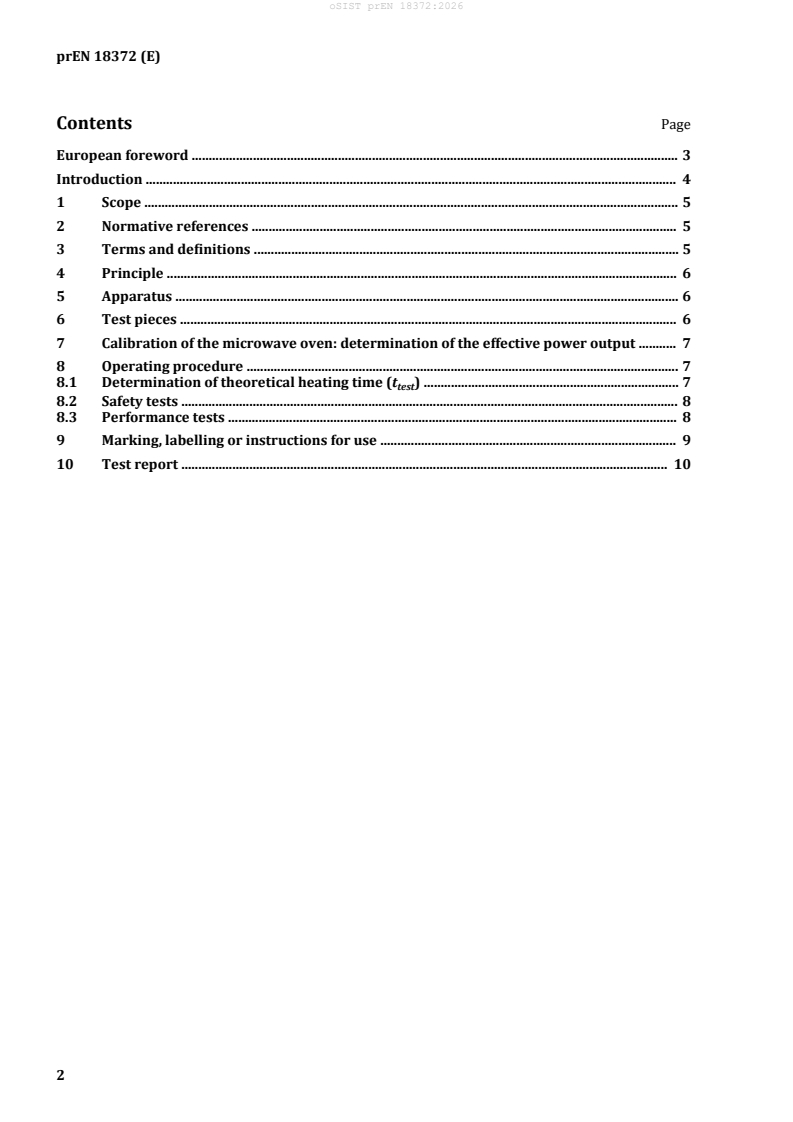
Contents Page
European foreword . 3
Introduction . 4
1 Scope . 5
2 Normative references . 5
3 Terms and definitions . 5
4 Principle . 6
5 Apparatus . 6
6 Test pieces . 6
7 Calibration of the microwave oven: determination of the effective power output . 7
8 Operating procedure . 7
8.1 Determination of theoretical heating time (t ) . 7
test
8.2 Safety tests . 8
8.3 Performance tests . 8
9 Marking, labelling or instructions for use . 9
10 Test report . 10
European foreword
This document (prEN 18372:2026) has been prepared by Technical Committee CEN/TC 194
"Utensils in contact with food", the secretariat of which is held by AFNOR.
This document is currently submitted to the CEN Enquiry.
Introduction
This document specifies a method for checking the compatibility of articles used for reheating foodstuffs
in a conventional microwave oven. The main material of these articles is iron or aluminium metal, or
alloys of these metals – for example, carbon steel or stainless steel.
The power levels in question are similar to the maximum installed power of most European microwave
ovens and representative of those required for using the articles as containers for reheating foodstuffs
or drinks.
The articles are subjected to microwave energy in various positions in the oven cavity, in order to create
the most adverse conditions for heating and for distributing and concentrating microwave energy. As
most of the articles in question are made of metal, they should be used in accordance with certain
recommendations, including keeping a minimum distance of 25 mm between the article and any oven
cavity wall while microwave energy is being emitted, to avoid the risk of triggering the formation of an
electric arc.
The aim is also to advise against articles that take an abnormally long time to reheat for the user. As all
metal walls are opaque to microwaves, microwave energy can only heat up foodstuffs or drinks if the
article is technically designed to allow sufficient microwave energy to penetrate it.
This method aims to exclude:
– articles that could damage the oven, for example, by causing an electric arc to form, even though the
article is kept at a distance of 25 mm from the oven cavity walls while microwave energy is being emitted;
this may be caused by the article's unsuitable geometry;
– articles that may be damaged by microwave heating.
The articles are tested by being heated for a period of time and at power settings of the microwave oven
that are representative of those typically expected by a user. Specifically, a reheating time of about 5-10
minutes to raise the temperature of the article’s contents by 55°C (when the article is filled to 2/3 of its
maximum capacity).
1 Scope
This document specifies a method for determining the suitability of metal or partially metal articles
(coated or uncoated) used as containers for foodstuffs or drinks during microwave heating.
It applies to containers designed to be used once or many times with the microwave function only inside
the microwave oven.
This document aims to check the safety and heating efficiency of containers exclusively under
microwave heating energy, if other kind of heating are intended to be used for this container, it is tested
by considering only the microwave energy heating.
Microwave combination appliances, microwave ovens with impingement function and microwave with
an input power lower than 900W are excluded from the tests described in the standard. Furthermore,
any model lacking a protective dielectric barrier (such as a missing/broken glass turntable or a damaged
ceramic floor) that would allow direct metal-to-metal contact between the container and the oven’s
base is strictly excluded. In all compatible models, the use of the manufacturer-provided glass plate or
integrated ceramic base is mandatory to ensure electrical insulation.
This document defines the requirements for marking and labelling or instructions for use that are
provided to consumers.
2 Normative references
The following documents are referred to in the text in such a way that some or all of their content
constitutes requirements of this document. For dated references, only the edition cited applies. For
undated references, the latest edition of the referenced document (including any amendments) applies.
ISO 3585:1998, Borosilicate glass 3.3 — Properties
3 Terms and definitions
For the purposes of this document, the following terms and definitions apply
— ISO Online browsing platform: available at http://www.iso.org/obp
— IEC Electropedia: available at http://www.electropedia.org/
3.1
single-use container
container that is not designed, created or placed on the market to be refilled or reused for the same
purpose for which it was designed
EXAMPLE Tin can
3.2
container
article designed to contain and protect foodstuffs, in a single-use or used multiple times and enable
them to be handled and transported from the producer to the consumer or user. Foodstuffs may be
eaten directly from the container
3.3
packaging
product’s external packaging or visible packaging
EXAMPLE cardboard backing
3.4
reusable container
container designed to be used again without any change in its original use
EXAMPLE reusable stainless steel container
3.5
article
metal or partially metal object (coated or uncoated) used as containers for foodstuffs or drinks during
microwave heating
4 Principle
A container is filled with water to 2/3 of its maximum cap
...