

prEN IEC 63203-302-1:2026
(Main)IEC 63203-302-1: Wearable electronic devices and technologies - Part 302-1: Materials - Test method for torsion of conductive stretchable films
- Status
- Not Published
- Publication Date
- 09-Mar-2028
- Technical Committee
- CLC/SR 124 - Wearable Electronic Devices and Technologies
- Current Stage
- 4020 - Enquiry circulated - Enquiry
- Start Date
- 02-Oct-2026
- Due Date
- 30-Jun-2026
- Completion Date
- 02-Oct-2026

prEN IEC 63203-302-1:2026 is an IEC document prepared for wearable electronic devices and technologies. It specifies a torsion test method for conductive stretchable films so users can measure how twisting affects electrical resistance and material robustness.
The document is aimed at people who need to compare film designs, check twisting performance, or report torsion test results in a repeatable way. It covers both single torsion and cyclic torsion testing, with tension-released and tension-held conditions.
What does prEN IEC 63203-302-1:2026 specify?
prEN IEC 63203-302-1:2026 specifies a test method for ribbon-shaped conductive stretchable films used in wearable electronic devices. The method measures change in electrical properties under torsion and is intended for films used on skin or attached to clothing that contacts skin, excluding e-textile types.
The document is organized into:
- Scope
- Normative references
- Terms and definitions
- Standard atmospheric conditions for test
- Test conditions
- Single torsion test
- Cyclic torsion test
What are the key requirements of prEN IEC 63203-302-1:2026?
The document defines a controlled torsion test setup, specimen preparation, electrical measurement method, and reporting content. In practice, these points determine whether two laboratories will get comparable resistance-change results from the same film.
Test environment and equipment
Clause 4 sets standard atmospheric conditions for testing unless customer and supplier agree otherwise: 25 °C ± 3 °C, 25 % RH to 85 % RH, and 86 kPa to 106 kPa. Clause 5.1 also requires equipment that can reach at least ±90° twist, accept specimens from 80 mm to 240 mm long and up to 200 mm wide, keep the specimen insulated from the machine frame, and align the twist axis with the film center. This matters because temperature, humidity, alignment, and unwanted friction can change resistance readings.
Tension-released and tension-held torsion
Clause 5.1.2 describes tension-released torsion, where the stationary side can move along the torsion axis to remove unwanted axial tension. Clause 5.1.3 describes tension-held torsion, where the stationary side is fixed so twisting occurs together with axial tension. This gives two different use cases: one for twist alone and one for twist combined with stretch.
Specimen shape and clamping
Clause 5.2 uses a rectangular or square strip made from conductive thin film on a stretchable substrate, with the exposed length between grips treated as the test length. A length-to-width ratio greater than 1 is recommended, and the specimen size is agreed between user and supplier. Clause 5.3 requires secure clamping without pre-stress, wrinkling, slacking, slip, or damage, because poor gripping can hide or create failure modes.
Resistance measurement
Clause 5.4 requires resistance measurement in a region of nearly uniform strain. The document allows 2-wire or 4-wire measurement, but requires 4-wire measurement when contact resistance or lead resistance would affect the result. It also gives a conversion from measured resistance to sheet resistance. In practice, this means the electrical setup must be stable enough that the clamp contacts do not dominate the result.
Single torsion test
Clause 6 evaluates the immediate resistance change during one torsion cycle. The procedure uses clockwise and counterclockwise twisting, return to the initial state between steps, and real-time resistance recording with at least 20 data points per cycle. Recommended torsion angles are 15°, 30°, 45°, and 90°, and recommended oscillation velocities are 10, 20, and 30 cycles per minute.
Cyclic torsion test
Clause 7 evaluates resistance change after repeated torsion over time. It uses the same test directions, angles, and velocities as the single torsion test, with recommended cycle counts of 1 000, 10 000, and 100 000. The result shows how the film behaves under repeated twisting, which is useful for durability screening and reliability assessment.
Test reports
Clauses 6.3 and 7.3 list the reporting items: test date, specimen identification, number of specimens, atmospheric conditions, torsion type, angle and velocity, time interval for recording resistance, the resistance result or degree of change, and any unusual observations or deviations. This is what makes results traceable and comparable.
What terms does prEN IEC 63203-302-1:2026 define?
- Torsion test - deformation that twists the conductive stretchable film plane by rotating both ends in opposite directions.
- Conductive stretchable film - a stretchable substrate on which a conductor layer is formed.
- Stretchable substrate - a substrate or film that returns to its original size and shape after the extending force is removed.
- Tension-released torsion test - a torsion test condition where unwanted axial tension is allowed to relax during twisting.
- Tension-held torsion test - a torsion test condition where axial tension is kept on the specimen while torsion is applied.
- Sheet resistance - the resistance value derived from the measured specimen resistance and its geometry, used to compare films independent of size.
Who uses prEN IEC 63203-302-1:2026?
prEN IEC 63203-302-1:2026 is used by wearable device manufacturers, materials engineers, test laboratories, and quality teams working on stretchable conductors. It is also useful for suppliers and buyers who need an agreed method for screening materials, checking design choices, or documenting reliability under twisting.
The document is relevant where conductors must survive movement around the wrist, arm, neck, or other body areas. It supports material selection, design guidance, and reliability modeling.
Which standards are used with prEN IEC 63203-302-1:2026?
Clause 2 names these normative references:
- IEC 63203-101-1:2021 - provides terminology for wearable electronic devices and technologies.
- IEC 62899-502-1:2017 - contributes the source definition for torsion test and is referenced for the tension-released torsion test.
- IEC 62715-6-1:2018 - provides the standard atmospheric conditions used for testing.
- IEC 62951-1:2017 - is referenced for the specimen shape used as the model for the test piece.
What does the prEN IEC 63203-302-1:2026 document contain?
The document contains five figures showing the equipment, the two torsion modes, the specimen shape, the clamping process, and the resistance-measurement setup. It also includes one equation that converts measured resistance into sheet resistance.
Its procedures define how to prepare, clamp, twist, and measure conductive stretchable films, and how to report the results for single and cyclic torsion testing. That makes it suitable for laboratory testing, comparative material evaluation, and reliability work on wearable electronics.
Get Certified
Connect with accredited certification bodies for this standard

Control Union Certifications
Global certification for agriculture and sustainability.

Hohenstein Institut
Textile testing and certification.

Bureau Veritas Bangladesh
Bureau Veritas certification services in Bangladesh.
Sponsored listings
Frequently Asked Questions
prEN IEC 63203-302-1:2026 is a draft published by CLC. Its full title is "IEC 63203-302-1: Wearable electronic devices and technologies - Part 302-1: Materials - Test method for torsion of conductive stretchable films". This standard covers: IEC 63203-302-1: Wearable electronic devices and technologies - Part 302-1: Materials - Test method for torsion of conductive stretchable films
IEC 63203-302-1: Wearable electronic devices and technologies - Part 302-1: Materials - Test method for torsion of conductive stretchable films
prEN IEC 63203-302-1:2026 is classified under the following ICS (International Classification for Standards) categories: 19.080 - Electrical and electronic testing; 59.080.80 - Smart textiles. The ICS classification helps identify the subject area and facilitates finding related standards.
prEN IEC 63203-302-1:2026 is available in PDF format for immediate download after purchase. The document can be added to your cart and obtained through the secure checkout process. Digital delivery ensures instant access to the complete standard document.
Standards Content (Sample)
SLOVENSKI STANDARD
01-november-2026
IEC 63203-302-1: Nosljive elektronske naprave in tehnologije - 302-1. del: Materiali
- Preskusna metoda za torzijo prevodnih raztegljivih folij
IEC 63203-302-1: Wearable electronic devices and technologies - Part 302-1: Materials -
Test method for torsion of conductive stretchable films
Ta slovenski standard je istoveten z: prEN IEC 63203-302-1:2026
ICS:
19.080 Električno in elektronsko Electrical and electronic
preskušanje testing
59.080.80 Inteligentne tekstilije Smart textiles
2003-01.Slovenski inštitut za standardizacijo. Razmnoževanje celote ali delov tega standarda ni dovoljeno.
124/401/CDV
COMMITTEE DRAFT FOR VOTE (CDV)
PROJECT NUMBER:
IEC 63203-302-1 ED1
DATE OF CIRCULATION: CLOSING DATE FOR VOTING:
2026-10-02 2026-12-25
SUPERSEDES DOCUMENTS:
124/372/CD, 124/400/CC
IEC TC 124 : WEARABLE ELECTRONIC DEVICES AND TECHNOLOGIES
SECRETARIAT: SECRETARY:
Korea, Republic of Mr Jae Yeong Park
OF INTEREST TO THE FOLLOWING COMMITTEES: HORIZONTAL FUNCTION(S):
ASPECTS CONCERNED:
SUBMITTED FOR CENELEC PARALLEL VOTING NOT SUBMITTED FOR CENELEC PARALLEL VOTING
Attention IEC-CENELEC parallel voting
The attention of IEC National Committees, members of
CENELEC, is drawn to the fact that this Committee Draft
for Vote (CDV) is submitted for parallel voting.
The CENELEC members are invited to vote through the
CENELEC online voting system.
This document is still under study and subject to change. It should not be used for reference purposes.
Recipients of this document are invited to submit, with their comments, notification of any relevant patent rights of
which they are aware and to provide supporting documentation.
Recipients of this document are invited to submit, with their comments, notification of any relevant “In Some
Countries” clauses to be included should this proposal proceed. Recipients are reminded that the CDV stage is
the final stage for submitting ISC clauses. (SEE AC/22/2007 OR NEW GUIDANCE DOC).
TITLE:
Wearable electronic devices and technologies - Part 302-1: Materials - Test method for torsion
of conductive stretchable films
PROPOSED STABILITY DATE: 2032
NOTE FROM TC/SC OFFICERS:
In accordance with Recommendation #9 of 124/AG 1/RM of TC 124/AG 1 meeting held on 2026 -06-12,
TC 124 agreed this project proceed to the CDV stage.
download this electronic file, to make a copy and to print out the content for the sole purpose of preparing National
Committee positions. You may not copy or "mirror" the file or printed version of the document, o r any part of it,
for any other purpose without permission in writing from IEC.
IEC CDV 63203-302-1 ED1 © IEC 2026
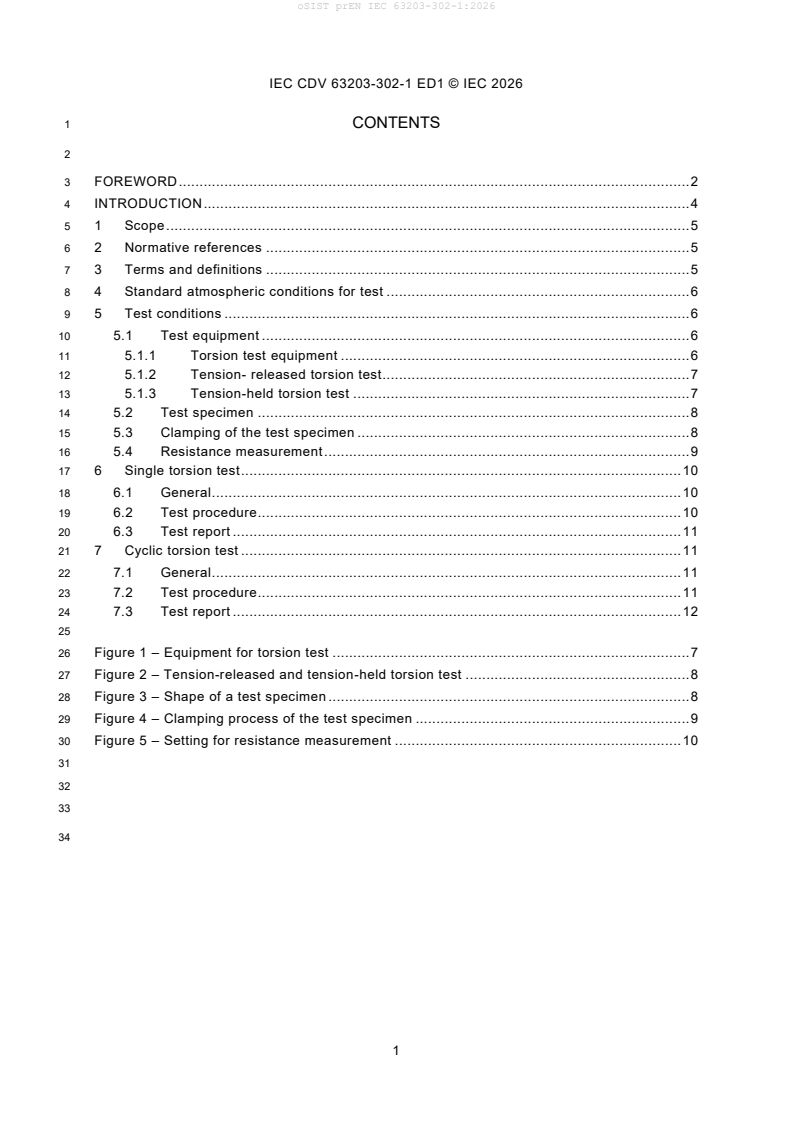
1 CONTENTS
3 FOREWORD . 2
4 INTRODUCTION . 4
5 1 Scope . 5
6 2 Normative references . 5
7 3 Terms and definitions . 5
8 4 Standard atmospheric conditions for test . 6
9 5 Test conditions . 6
10 5.1 Test equipment . 6
11 5.1.1 Torsion test equipment . 6
12 5.1.2 Tension- released torsion test. 7
13 5.1.3 Tension-held torsion test . 7
14 5.2 Test specimen . 8
15 5.3 Clamping of the test specimen . 8
16 5.4 Resistance measurement . 9
17 6 Single torsion test . 10
18 6.1 General . 10
19 6.2 Test procedure. 10
20 6.3 Test report . 11
21 7 Cyclic torsion test . 11
22 7.1 General . 11
23 7.2 Test procedure. 11
24 7.3 Test report . 12
26 Figure 1 – Equipment for torsion test . 7
27 Figure 2 – Tension-released and tension-held torsion test . 8
28 Figure 3 – Shape of a test specimen . 8
29 Figure 4 – Clamping process of the test specimen . 9
30 Figure 5 – Setting for resistance measurement . 10
IEC CDV 63203-302-1 ED1 © IEC 2026
35 INTERNATIONAL ELECTROTECHNICAL COMMISSION
36 ____________
38 WEARABLE ELECTRONIC DEVICES AND TECHNOLOGIES
40 Part 302-1: Materials - Test method for torsion of conductive stretchable
41 films
43 FOREWORD
44 1) The International Electrotechnical Commission (IEC) is a worldwide organization for standardization comprising
45 all national electrotechnical committees (IEC National Committees). The object of IEC is to promote international
46 co-operation on all questions concerning standardization in the electrical and electronic fields. To this end and
47 in addition to other activities, IEC publishes International Standards, Technical Specifications, Technical Reports,
48 Publicly Available Specifications (PAS) and Guides (hereafter referred to as "IEC Publication(s)"). Their
49 preparation is entrusted to technical committees; any IEC National Committee interested in the subject dealt with
50 may participate in this preparatory work. International, governmental and non-governmental organizations liaising
51 with the IEC also participate in this preparation. IEC collaborates closely with the International Organization for
52 Standardization (ISO) in accordance with conditions determined by agreement between the two organizations.
53 2) The formal decisions or agreements of IEC on technical matters express, as nearly as possible, an international
54 consensus of opinion on the relevant subjects since each technical committee has representation from all
55 interested IEC National Committees.
56 3) IEC Publications have the form of recommendations for international use and are accepted by IEC National
57 Committees in that sense. While all reasonable efforts are made to ensure that the technical content of IEC
58 Publications is accurate, IEC cannot be held responsible for the way in which they are used or for any
59 misinterpretation by any end user.
60 4) In order to promote international uniformity, IEC National Committees undertake to apply IEC Publications
61 transparently to the maximum extent possible in their national and regional publications. Any divergence between
62 any IEC Publication and the corresponding national or regional publication shall be clearly indicated in the latter.
63 5) IEC itself does not provide any attestation of conformity. Independent certification bodies provide conformity
64 assessment services and, in some areas, access to IEC marks of conformity. IEC is not responsible for any
65 services carried out by independent certification bodies.
66 6) All users should ensure that they have the latest edition of this publication.
67 7) No liability shall attach to IEC or its directors, employees, servants or agents including individual experts and
68 members of its technical committees and IEC National Committees for any personal injury, property damage or
69 other damage of any nature whatsoever, whether direct or indirect, or for costs (including legal fees) and
70 expenses arising out of the publication, use of, or reliance upon, this IEC Publication or any other IEC
71 Publications.
72 8) Attention is drawn to the Normative references cited in this publication. Use of the referenced publications is
73 indispensable for the correct application of this publication.
74 9) IEC draws attention to the possibility that the implementation of this document may involve the use of (a)
75 patent(s). IEC takes no position concerning the evidence, validity or applicability of any claimed patent rights in
76 respect thereof. As of the date of publication of this document, IEC had not received notice of (a) patent(s), which
77 may be required to implement this document. However, implementers are cautioned that this may not represent
78 the latest information, which may be obtained from the patent database available at https://patents.iec.ch and/or
79 www.iso.org/patents. IEC shall not be held responsible for identifying any or all such patent rights.
80 IEC 63203-302-1 has been prepared by IEC technical committee 124: Wearable electronic
81 devices and technologies. It is an International Standard.
82 The text of this International Standard is based on the following documents:
Draft Report on voting
XX/XX/FDIS XX/XX/RVD
84 Full information on the voting for its approval can be found in the report on voting indicated in
85 the above table.
86 The language used for the development of this International Standard is English.
IEC CDV 63203-302-1 ED1 © IEC 2026
87 This document was drafted in accordance with ISO/IEC Directives, Part 2, and developed in
88 accordance with ISO/IEC Directives, Part 1 and ISO/IEC Directives, IEC Supplement, available
89 at www.iec.ch/members_experts/refdocs. The main document types developed by IEC are
90 described in greater detail at www.iec.ch/publications.
91 The committee has decided that the contents of this document will remain unchanged until the
92 stability date indicated on the IEC website under webstore.iec.ch in the data related to the
93 specific document. At this date, the document will be
94 • reconfirmed,
95 • withdrawn,
96 • replaced by a revised edition, or
97 • amended.
IEC CDV 63203-302-1 ED1 © IEC 2026
100 INTRODUCTION
101 Wearable electronic devices bend naturally with the human body, but around wrists, elbows and
102 necks they twist, exposing conductive films to torsional shear that pure tensile tests cannot
103 replicate. Existing IEC 62899-202-4 rigorously measures changes in resistance under
104 incremental and cyclic stretch but its specimen geometry, loading mode and failure criteria are
105 limited to uniaxial tension and thus overlook the mixed-mode cracks, interfacial slip and local
106 buckling triggered by twist.
107 Finite-element studies show that the maximum shear strain in a twisted strip is proportional to
108 the twist angle, producing delamination at roughly half the tensile strain required in stretch tests,
109 while real-time resistance drifts reveal transient open circuits long before a two-point break
110 would be detected in tension. To fill this gap IEC 63203-302-1 introduces a dedicated torsion
111 method that grips a conductive stretchable film and rotates the ends through defined clockwise
112 and counter-clockwise angles, both with and without axial restraint, capturing the combined
113 pull-and-twist conditions seen during everyday wear.
114 Single-cycle measurements establish the immediate resistance excursion that limits signal
115 fidelity, whereas accelerated cyclic testing compresses months of arm-swing into hours to
116 predict service life. The protocol provides designers with critical torsional metrics needed to
117 properly size line widths, pitches, and encapsulation. Without these data manufacturers are
118 forced to overspecify conductors, sacrificing flexibility and comfort; with them they can certify
119 reliability confidently while maintaining the lightweight, skin-conformal form factors that define
120 next-generation wearables.
121 The value of this standard is that it provides baseline data on how the material layer withstands
122 the combined shear and tension that arise during twisting. For that reason, the test specimen
123 is designed as a wide rectangular conductive film. Using a broad film creates a continuous
124 gradient of shear, tensile and compressive stresses from the twist axis to the edges; this quickly
125 reveals intrinsic weak points such as delamination, cracking or resistance drift. The results can
126 therefore be used to material screening, design guidance and/or reliability modelling.
IEC CDV 63203-302-1 ED1 © IEC 2026
130 WEARABLE ELECTRONIC DEVICES AND TECHNOLOGIES
132 Part 302-1: Materials - Test method for torsion of conductive stretchable
133 films
137 1 Scope
138 This document specifies a test method for torsion of ribbon shaped conductive stretchable films
139 for the determination of change of electrical properties by the torsion motion and robustness as
140 the materials for the circuit pattern of wearable electronic devices using stretchable substrate.
141 In the wearable environments, tension-held and/or tension-released torsion motions of
142 wearable electronic devices are likely to happen easily during use on such as the arm, wrist
143 and neck. depending on the motion of human body. This document provides general procedures
144 for torsion test methods applicable to conductive stretchable films used in the production of
145 wearable electronic devices wearing on human skin directly or attached to clothing which
146 contact human skin, excluding e-textile types. The measurement method does not specify the
147 twisting durability as a material property, but has an aspect of practical testing conducted under
148 conditions closer to actual use.
149 2 Normative references
150 The following documents are referred to in the text in such a way that some or all of their content
151 constitutes requirements of this document. For dated references, only the edition cited applies.
152 For undated references, the latest edition of the referenced document (including any
153 amendments) applies.
154 IEC 63203-101-1:2021, Wearable electronic devices and technologies - Part 101-1:
155 Terminology
156 IEC 62899-502-1:2017, Printed electronics – Part 502-1: Quality assessment – Organic light
157 emitting diode (OLED) elements – Mechanical stress testing of OLED elements formed on
158 flexible substrates
159 IEC 62715-6-1:2018, Flexible Display Devices – Part 6-1: Mechanical test methods –
160 Deformation tests
161 IEC 62951-1:2017, Semiconductor devices - Flexible and stretchable semiconductor devices -
162 Part 1: Bending test method for conductive thin films on flexible substrates
163 3 Terms and definitions
164 For the purposes of this document, the following terms and definitions apply.
165 ISO and IEC maintain terminology databases for u
...