

ISO 14656:2026
(Main)Steel — Epoxy powder and sealing material for the coating of steel for the reinforcement of concrete
- Abstract
This document specifies requirements for epoxy powders and texturing surface treatment material for use in preparing fusion-bonded epoxy-coated steel reinforcing bar, wire and welded fabric. It also includes requirements for sealing material used to repair damaged areas and cut ends on reinforcing steel. This document defines a flexible (type A) coating and a nonflexible (type B) coating. The adhesion and moisture resistance of fusion-bonded epoxy powder coatings can be enhanced by certain formulation designs. These coating enhancements typically result in a reduction of the coating’s flexibility.
- Status
- Published
- Publication Date
- 13-Oct-2026
- Technical Committee
- ISO/TC 17/SC 16 - Steels for the reinforcement and prestressing of concrete
- Drafting Committee
- ISO/TC 17/SC 16/WG 12 - Epoxy coated reinforcement
- Current Stage
- 6060 - International Standard published
- Start Date
- 14-Oct-2026
- Completion Date
- 14-Oct-2026


ISO 14656:2026 is an International Standard from ISO for epoxy powder and sealing material used on steel for reinforcement of concrete. It specifies material requirements, coating performance tests, sealing material performance, and qualification testing for fusion-bonded epoxy-coated steel reinforcing bar, wire, and welded fabric.
What does ISO 14656:2026 specify?
ISO 14656:2026 specifies requirements for epoxy powders and texturing surface treatment material used to prepare fusion-bonded epoxy-coated steel reinforcing bar, wire, and welded fabric. It also specifies requirements for sealing material used to repair damaged areas and cut ends on reinforcing steel.
The document is organized into Scope, Normative references, Terms and definitions, Materials, Coating requirements, Sealing material requirements, Qualification testing, and Documentation. It defines two coating types - flexible type A and nonflexible type B - which matters because the test route and some acceptance criteria differ by type.
What are the key requirements of ISO 14656:2026?
ISO 14656:2026 sets out how the coating and sealing materials are to be checked for appearance, durability, adhesion, flexibility, and repair performance. In practice, it gives manufacturers and purchasers a common basis for qualifying coating systems and for documenting test results.
Material and storage requirements
Clause 4 distinguishes epoxy powder coating, texturing surface treatment material, and sealing material. The sealing material must be compatible with the coating, inert in concrete, and suitable for repairing damaged epoxy-coated areas and cut ends. For users, this means the repair material cannot be chosen independently if it is to remain part of the qualified system.
Clause 5.1 requires the coating material to appear uniform and free of lumps when stirred, and it gives storage conditions and a use-by period. That matters because coating performance can change if material is stored or handled outside the stated conditions.
Coating performance tests
Clause 5.2 checks chemical resistance in several immersion solutions, including water, salt solution, and alkaline solutions. The coating is tested on damaged bars, and the acceptance criterion is based on limited disbondment after immersion. This is the main screen for how the coating behaves around defects in aggressive concrete-like environments.
Clause 5.3 measures cathodic disbondment under applied voltage for 168 h. Clause 5.4 measures salt spray resistance for 800 h, and Clause 5.5 checks chloride permeability for 45 d using a two-compartment cell. Together these tests show whether the coating can keep adhesion and act as a barrier under electrical, corrosive, and chloride exposure.
Clause 5.6 applies only to type A coatings and evaluates bending performance on coated bars. Clause 5.7 measures abrasion resistance, with different mass-loss limits for fusion-bonded epoxy coating and composite epoxy textured coating. Clause 5.8 uses a falling weight impact test to check resistance to mechanical damage. In practice, these tests tell the buyer whether the coating is suitable for handling, transport, and installation without unacceptable damage.
Sealing material requirements
Clause 6 checks the sealing material in two ways: chemical resistance after immersion in alkaline solution and salt spray resistance in a hot, wet environment. The sealed repair areas must not blister or show rust originating from the seal or the seal interface. That is important for bars that are cut, damaged, or repaired before use.
Qualification testing and records
Clause 7 requires qualification tests to be carried out by an agency acceptable to the purchaser. It also requires submission of coating material samples, sealing material samples, test specimens, and the coating application procedures used for both test specimens and production. Clause 8 requires the laboratory to provide signed reports to the manufacturer. This creates traceable evidence that a coating system and its repair material were tested under the stated conditions.
What terms does ISO 14656:2026 define?
- Disbonding - loss of adhesion between the fusion-bonded epoxy coating and the reinforcing steel.
- Fusion-bonded epoxy coating - a powder-applied thermosetting epoxy coating fused onto a heated metallic substrate to form a continuous barrier.
- Textured coating - a coating formed by cured texturing surface treatment material.
- Composite epoxy textured coating - a coating made by applying texturing surface treatment material on top of a fusion-bonded epoxy coating.
- Sealing material - a compatible coating system used to repair damaged areas and cut ends.
- Type A coating - the flexible coating class.
- Type B coating - the nonflexible coating class.
Who uses ISO 14656:2026?
ISO 14656:2026 is used by coating manufacturers, steel reinforcement producers, fabricators, testing laboratories, and purchasers of coated reinforcing steel. It supports product qualification, incoming material review, repair-material selection, and testing of coated bars, wire, and welded fabric for concrete reinforcement.
What changed in ISO 14656:2026 from the previous edition?
ISO 14656:2026 cancels and replaces ISO 14656:1999 and is technically revised. The changes stated for this edition are:
- the scope now includes texturing surface treatment material for fusion-bonded epoxy-coated steel bar, wire, and welded fabric
- the referenced standards have updated edition numbers
- terms and definitions related to texturing surface treatment material were added
- the requirements for sealing material were modified
- requirements for appearance and storage were added
- requirements for coating thickness after curing were modified
- requirements for coating flexibility were added
- technical requirements for abrasion resistance of composite epoxy abrasive coatings were added
Which standards are used with ISO 14656:2026?
ISO 14656:2026 normatively references these standards:
- ISO 6272-1 - provides the falling weight impact test with a large-area indenter
- ISO 6272-2 - provides the falling weight impact test with a small-area indenter
- ISO 9352 - provides the Taber abrasion test method used for abrasion resistance
- ISO 14654 - provides requirements for epoxy-coated steel for the reinforcement of concrete and is used for prequalification bar preparation
What does the ISO 14656:2026 document contain?
ISO 14656:2026 contains detailed test methods for chemical resistance, cathodic disbondment, salt spray resistance, chloride permeability, flexibility, abrasion resistance, and impact resistance. It also contains the qualification testing requirements for bars, panels, free films, and repaired specimens.
The document includes Figure 1 for the cathodic disbondment test arrangement and Figure 2 for the permeability cell example. It also gives the specimen preparation steps, test temperatures, exposure times, acceptance criteria, and the reporting items needed for qualification and production support.
Relations
- Effective Date
- 15-Jun-2024
Get Certified
Connect with accredited certification bodies for this standard

DIBt (Deutsches Institut für Bautechnik)
German Institute for Building Technology.
DIN CERTCO
DIN Group product certification.
DVS-ZERT GmbH
German welding certification society.
Sponsored listings
Frequently Asked Questions
ISO 14656:2026 is a standard published by the International Organization for Standardization (ISO). Its full title is "Steel — Epoxy powder and sealing material for the coating of steel for the reinforcement of concrete". This standard covers: This document specifies requirements for epoxy powders and texturing surface treatment material for use in preparing fusion-bonded epoxy-coated steel reinforcing bar, wire and welded fabric. It also includes requirements for sealing material used to repair damaged areas and cut ends on reinforcing steel. This document defines a flexible (type A) coating and a nonflexible (type B) coating. The adhesion and moisture resistance of fusion-bonded epoxy powder coatings can be enhanced by certain formulation designs. These coating enhancements typically result in a reduction of the coating’s flexibility.
This document specifies requirements for epoxy powders and texturing surface treatment material for use in preparing fusion-bonded epoxy-coated steel reinforcing bar, wire and welded fabric. It also includes requirements for sealing material used to repair damaged areas and cut ends on reinforcing steel. This document defines a flexible (type A) coating and a nonflexible (type B) coating. The adhesion and moisture resistance of fusion-bonded epoxy powder coatings can be enhanced by certain formulation designs. These coating enhancements typically result in a reduction of the coating’s flexibility.
ISO 14656:2026 is classified under the following ICS (International Classification for Standards) categories: 25.220.99 - Other treatments and coatings; 77.140.15 - Steels for reinforcement of concrete; 91.080.40 - Concrete structures. The ICS classification helps identify the subject area and facilitates finding related standards.
ISO 14656:2026 has the following relationships with other standards: It is inter standard links to ISO 14656:1999. Understanding these relationships helps ensure you are using the most current and applicable version of the standard.
ISO 14656:2026 is available in PDF format for immediate download after purchase. The document can be added to your cart and obtained through the secure checkout process. Digital delivery ensures instant access to the complete standard document.
Standards Content (Sample)
International
Standard
ISO 14656
Second edition
Steel — Epoxy powder and sealing
2026-10
material for the coating of steel for
the reinforcement of concrete
Acier — Poudres époxy et matériau de réparation pour le
revêtement des armatures en acier pour béton
Reference number
© ISO 2026
All rights reserved.
This ISO publication is protected by copyright and is owned by ISO and/or its licensors.
The content of this ISO publication is provided under licence, not sold. Use is subject to the applicable licence terms issued by ISO,
an ISO member body, or an authorized third-party distributor.
Except as required for implementation or expressly permitted by a separate licence, no part of this ISO publication may be
reproduced, distributed, modified, used, or made available in any form or by any means – electronic or mechanical, including
photocopying, scanning, recording, or posting on internal or external digital platforms.
Any use beyond the scope of the granted rights is prohibited and may result in legal action.
ISO copyright office
CP 401 • CH-1214 Vernier, Geneva
Phone: +41 22 749 01 11
Email: copyright@iso.org
Website: www.iso.org
Published in Switzerland
ii
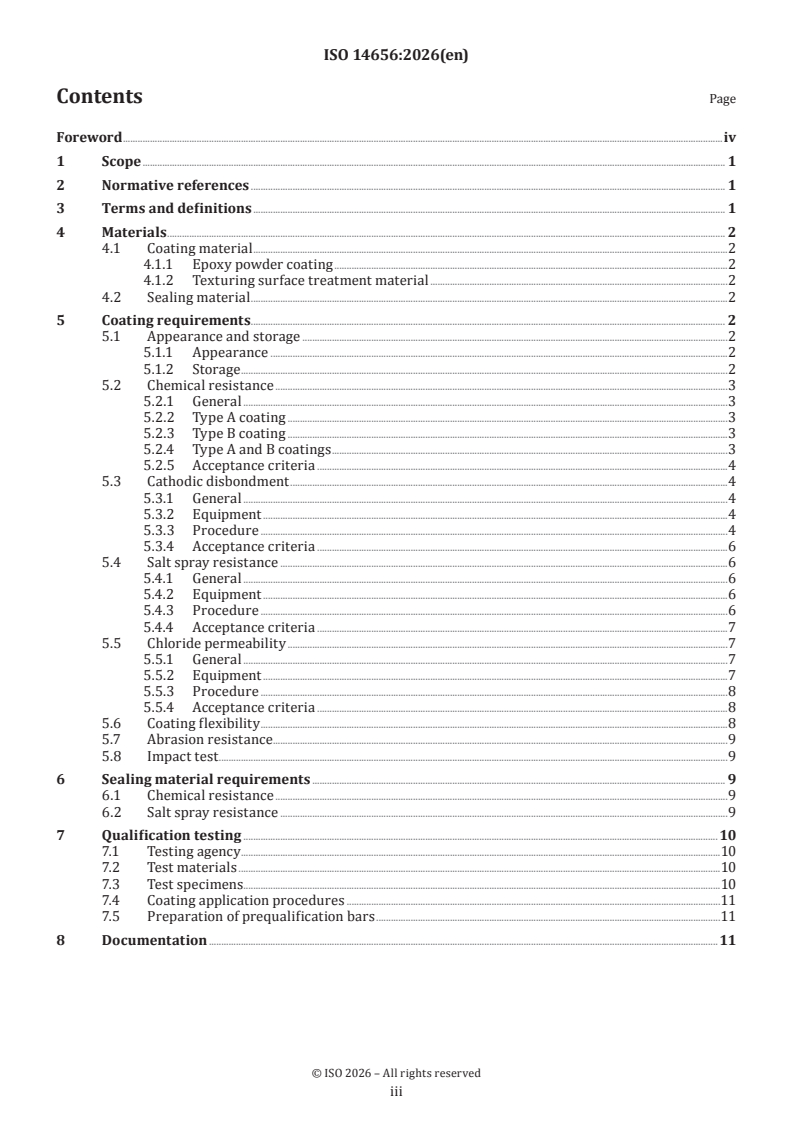
Contents Page
Foreword .iv
1 Scope . 1
2 Normative references . 1
3 Terms and definitions . 1
4 Materials . 2
4.1 Coating material .2
4.1.1 Epoxy powder coating .2
4.1.2 Texturing surface treatment material .2
4.2 Sealing material .2
5 Coating requirements . 2
5.1 Appearance and storage .2
5.1.1 Appearance .2
5.1.2 Storage .2
5.2 Chemical resistance .3
5.2.1 General .3
5.2.2 Type A coating .3
5.2.3 Type B coating .3
5.2.4 Type A and B coatings .3
5.2.5 Acceptance criteria .4
5.3 Cathodic disbondment .4
5.3.1 General .4
5.3.2 Equipment .4
5.3.3 Procedure .4
5.3.4 Acceptance criteria .6
5.4 Salt spray resistance .6
5.4.1 General .6
5.4.2 Equipment .6
5.4.3 Procedure .6
5.4.4 Acceptance criteria .7
5.5 Chloride permeability .7
5.5.1 General .7
5.5.2 Equipment .7
5.5.3 Procedure .8
5.5.4 Acceptance criteria .8
5.6 Coating flexibility .8
5.7 Abrasion resistance . . .9
5.8 Impact test .9
6 Sealing material requirements . 9
6.1 Chemical resistance .9
6.2 Salt spray resistance .9
7 Qualification testing . 10
7.1 Testing agency . . .10
7.2 Test materials .10
7.3 Test specimens.10
7.4 Coating application procedures .11
7.5 Preparation of prequalification bars .11
8 Documentation .11
iii
Foreword
ISO (the International Organization for Standardization) is a worldwide federation of national standards
bodies (ISO member bodies). The work of preparing International Standards is normally carried out through
ISO technical committees. Each member body interested in a subject for which a technical committee
has been established has the right to be represented on that committee. International organizations,
governmental and non-governmental, in liaison with ISO, also take part in the work. ISO collaborates closely
with the International Electrotechnical Commission (IEC) on all matters of electrotechnical standardization.
The procedures used to develop this document and those intended for its further maintenance are described
in the ISO/IEC Directives, Part 1. In particular, the different approval criteria needed for the different types
of ISO documents should be noted. This document was drafted in accordance with the editorial rules of the
ISO/IEC Directives, Part 2 (see www.iso.org/directives).
ISO draws attention to the possibility that the implementation of this document may involve the use of (a)
patent(s). ISO takes no position concerning the evidence, validity or applicability of any claimed patent
rights in respect thereof. As of the date of publication of this document, ISO had not received notice of (a)
patent(s) which may be required to implement this document. However, implementers are cautioned that
this may not represent the latest information, which may be obtained from the patent database available at
www.iso.org/patents. ISO shall not be held responsible for identifying any or all such patent rights.
Any trade name used in this document is information given for the convenience of users and does not
constitute an endorsement.
For an explanation of the voluntary nature of standards, the meaning of ISO specific terms and expressions
related to conformity assessment, as well as information about ISO's adherence to the World Trade
Organization (WTO) principles in the Technical Barriers to Trade (TBT), see www.iso.org/iso/foreword.html.
This document was prepared by Technical Committee ISO/TC 17, Steel, Subcommittee SC 16, Steels for the
reinforcement and prestressing of concrete.
This second edition cancels and replaces the first edition (ISO 14656:1999), which has been technically
revised.
The main changes are as follows:
— The prescribed scope of the document (texturing surface treatment material for the preparation of
fusion-bonded epoxy-coated steel bar, wire and welded fabric) has been added (see Clause 1);
— The version numbers of the referenced standards have been updated (see Clause 2);
— The terms and definitions related to texturing surface treatment material have been added (see 3.3; 3.4;
4.1.2);
— The requirements for sealing material have been modified (see 3.5; 4.2);
— The requirements for appearance and storage have been added (see 5.1);
— The requirements for coating thickness after curing have been modified (see 5.5.2.3);
— The requirements for coating flexibility have been added (see 5.6);
— The technical requirements for abrasion resistance of composite epoxy abrasive coatings have been
added (see 5.7).
Any feedback or questions on this document should be directed to the user’s national standards body. A
complete listing of these bodies can be found at www.iso.org/members.html.
iv
International Standard ISO 14656:2026(en)
Steel — Epoxy powder and sealing material for the coating of
steel for the reinforcement of concrete
1 Scope
This document specifies requirements for epoxy powders and texturing surface treatment material for
use in preparing fusion-bonded epoxy-coated steel reinforcing bar, wire and welded fabric. It also includes
requirements for sealing material used to repair damaged areas and cut ends on reinforcing steel.
This document defines a flexible (type A) coating and a nonflexible (type B) coating. The adhesion and
moisture resistance of fusion-bonded epoxy powder coatings can be enhanced by certain formulation
designs. These coating enhancements typically result in a reduction of the coating’s flexibility.
2 Normative references
The following documents are referred to in the text in such a way that some or all of their content constitutes
requirements of this document. For dated references, only the edition cited applies. For undated references,
the latest edition of the referenced document (including any amendments) applies.
ISO 6272-1, Paints and varnishes — Rapid-deformation (impact resistance) tests — Part 1: Falling weight test,
large-area indenter
ISO 6272-2, Paints and varnishes — Rapid-deformation (impact resistance) tests — Part 2: Falling weight test,
small-area indenter
ISO 9352, Plastics — Determination of resistance to wear by abrasive wheels
ISO 14654, Epoxy-coated steel for the reinforcement of concrete
3 Terms and definitions
For the purposes of this document, the following terms and definitions apply.
ISO and IEC maintain terminology databases for use in standardization at the following addresses:
— ISO Online browsing platform: available at https:// www .iso .org/ obp
— IEC Electropedia: available at https:// www .electropedia .org/
3.1
disbonding
loss of adhesion between the fusion-bonded epoxy coating and the steel reinforcing bar. wire or welded
fabric
3.2
fusion-bonded epoxy coating
coating containing pigments, thermosetting epoxy resins, crosslinking agents and other additives, which
have been applied in the form of a powder on to a clean, heated metallic substrate and fused to form a
continuous barrier
3.3
textured coating
coating formed by cured texturing surface treatment material
3.4
composite epoxy textured coating
composite coating formed by applying an additional layer of texturing surface treatment material to the
surface of a fusion-bonded epoxy coating
3.5
sealing material
coating system, formulated to be compatible with the fusion-bonded epoxy coating and textured coating,
used to repair damaged areas and cut ends
4 Materials
4.1 Coating material
4.1.1 Epoxy powder coating
Thermosetting epoxy powder coating material that can be used alone to form an epoxy coating or as base
powder in combination with texturing surface treatment material.
4.1.2 Texturing surface treatment material
The material used immediately after the fusion-bonded epoxy coating is an epoxy powder coating containing
pigment, thermosetting epoxy resin, crosslinking agent and other additives to improve the bonding strength
to concrete and increase the surface hardness of the coating.
4.2 Sealing material
The coating system, for use as sealing material, shall be compatible with the fusion-bonded epoxy coating or
composite epoxy textured coating, inert in concrete, and recommended by the epoxy powder manufacturer.
The sealing material shall be suitable for repairing damaged epoxy coating or composite epoxy textured
coating at the manufacturer or fabricator, or at the site.
5 Coating requirements
5.1 Appearance and storage
5.1.1 Appearance
When stirred with a stirring rod, the appearance of the coating material should have a uniform colour and
be free of lumps.
5.1.2 Storage
The coating material should be stored at 27 °C (80 °F) and 50 % relative humidity. It should be used up with
6 months.
If the storage temperature is lower than that of the construction site, the product is allowed to reach the site
temperature before the package is opened.
5.2 Chemical resistance
5.2.1 General
The ability of the coating to resist disbonding, blistering and corrosion in solutions that simulate potential
exposure environments shall be evaluated by immersing coated, 20 mm diameter steel reinforcing bars in
each of the following solutions:
a) deionized water;
b) an aqueous solution containing 3 % NaCl;
c) an aqueous solution containing 0,3 KOH and 0,05 N NaOH;
d) an aqueous solution containing 0,3 N KOH, 0,05 N NaOH and 3 % NaCl.
5.2.2 Type A coating
If the coating is classified as flexible, sixteen pieces of damage-free coated 20 mm diameter ribbed steel
reinforcing bar, 300 mm in length, shall be selected for testing. Also, sixteen additional coated bars shall
be bent 180°around a 100 mm diameter mandrel. The bend shall be made at a uniform rate and completed
within 5 s. The overall (developed) length of the bent coated bars shall be 300 mm. After bending, the
number of bending-induced holidays shall be determined using a 67,5 V, 80 000 Ω, wet-sponge type, direct
current holiday detector and recorded. Prior to testing, all holidays and coated bar ends shall be coated with
sealing material.
5.2.3 Type B coating
If the coating is classified as non-flexible, sixteen pieces of damage-free coated 20 mm diameter ribbed
steel reinforcing bar, 300 mm in length, shall be selected for testing. Also, sixteen additional uncoated bars
shall be bent 180° around a 100 mm diameter mandrel These bars shall then be coated according to 7.5.
The overall (developed) length of the bent, coated bars shall be 300 mm. The number of holidays shall be
determined using a 67,5 V, 80 000 Ω, wet-sponge type, direct current holiday detector and recorded. Prior to
testing, all holidays and coated bar ends shall be coated with sealing material.
5.2.4 Type A and B coatings
A 3 mm diameter hole shall be drilled through the coating of each of the thirty-two test specimens down to
the underlying steel prior to solution immersion. This hole shall be located between the transverse ribs on
the centre-line of each of the bars and at the midpoint of the bend for the bent bars.
Four straight and four bent bars shall be soaked in each solution for a period of 28 d at 55 °C ± 4 °C. The pH
of the solutions shall be checked and recorded daily and adj
...