

SIST-TP CEN/TR 16894:2015
(Main)Postal services - Quality of delivery: Reforwarding
General Information
- Abstract
This Technical Report specifies methods for measuring the quality of a re-forwarding service of domestic addressed mail that is collected, processed and delivered by postal service operators. As a European Standard or technical specification it relates to the measurement of services given to household and business customers who receive mail at their homes, their post office boxes, or at their office premises and have contracted their national Postal Operator (PO) to re-forward their mail for a defined stretch of time to an address that deviates from the one presented on the postal items that are to be delivered to them.
It is not the purpose of this standard to measure the POs performance in a way that provides direct comparison of postal service providers.
- Status
- Published
- Public Enquiry End Date
- 29-Jul-2015
- Publication Date
- 18-Oct-2015
- Technical Committee
- I13 - Imaginarni 13
- Current Stage
- 6060 - National Implementation/Publication (Adopted Project)
- Start Date
- 06-Oct-2015
- Due Date
- 11-Dec-2015
- Completion Date
- 19-Oct-2015


Overview
SIST-TP CEN/TR 16894:2015 is a European Technical Report developed by CEN/TC 331 focusing on the quality of delivery in postal re-forwarding services. This standard outlines objective measurement methods for evaluating the performance of national Postal Operators (POs) in handling re-forwarded domestic mail. The re-forwarding service involves redirecting mail from the original address to a new address specified by the customer, typically due to temporary absence or permanent relocation. SIST-TP CEN/TR 16894:2015 aims to provide postal operators across Europe with a consistent framework for assessing this service’s quality without enabling direct provider-to-provider comparisons.
Key Topics
Measuring Quality of Service (QoS) for Reforwarding: The standard defines performance indicators such as the percentage of mail correctly redirected and delivered to the new address under an active re-forwarding contract.
Service Characteristics: Re-forwarding applies to household and business customers who temporarily relocate or have a permanent address change. The service relies on updated contract information in postal databases for correct mail handling.
Test Items and Procedures: Utilizing test mail sent to real re-forwarding contracts ensures measurement reflects actual operational processes. Test letters must mimic regular mail standards in format, addressing, and franking to avoid detection by postal staff.
Sample Design and Customer Recruitment: Since re-forwarding contracts typically represent a small fraction of total mail volume, sampling test customers with valid contracts is essential. To avoid bias, test participants remain anonymous to postal staff. The monitoring period aligns with the contract duration to capture accurate service performance.
Data Recording and Reporting: Both senders and receivers of test items record mailing and delivery dates to validate results. The primary indicator is whether items are successfully delivered to the new address, considering exceptions such as late mail or items returned to sender.
Applications
Postal Operators: SIST-TP CEN/TR 16894:2015 supports postal operators in objectively monitoring and improving their re-forwarding services. It offers a standardized methodology to measure operational reliability and user experience for redirected mail.
Quality Assurance Programs: This standard can be integrated into national or internal quality assurance frameworks, ensuring that re-forwarding meets customer expectations and complies with service-level agreements.
Regulatory Compliance: National regulators and policymakers can utilize measurement methods outlined in this report to oversee postal service performance and enhance service standardization across member states.
Customer Confidence: Transparent measurement approaches help build trust among end-users, such as households and businesses, that require mail forwarding during absences or relocations.
Related Standards
CEN/TC 331 Postal Services Series: SIST-TP CEN/TR 16894:2015 complements other postal quality of service standards addressing delivery speed, accuracy, and overall mail handling.
Quality of Service (QoS) Measurement Standards: It aligns with general QoS methodologies emphasizing objective, auditable metrics and representative sampling.
International Postal Standards: While focused on European domestic services, the techniques may support compliance with broader international postal quality requirements and best practices.
SIST-TP CEN/TR 16894:2015 provides a practical, flexible, and auditable framework for measuring the quality of re-forwarding postal services, promoting consistent service evaluation and enhancement across European postal operators. By focusing on real contracts, verified addressing, and representative sampling, this standard ensures reliable insights into mail redirection performance essential for customer satisfaction and operational excellence.
Get Certified
Connect with accredited certification bodies for this standard

BSI Group
BSI (British Standards Institution) is the business standards company that helps organizations make excellence a habit.

Bureau Veritas
Bureau Veritas is a world leader in laboratory testing, inspection and certification services.

DNV
DNV is an independent assurance and risk management provider.
Sponsored listings
Frequently Asked Questions
SIST-TP CEN/TR 16894:2015 is a technical report published by the Slovenian Institute for Standardization (SIST). Its full title is "Postal services - Quality of delivery: Reforwarding". This standard covers: This Technical Report specifies methods for measuring the quality of a re-forwarding service of domestic addressed mail that is collected, processed and delivered by postal service operators. As a European Standard or technical specification it relates to the measurement of services given to household and business customers who receive mail at their homes, their post office boxes, or at their office premises and have contracted their national Postal Operator (PO) to re-forward their mail for a defined stretch of time to an address that deviates from the one presented on the postal items that are to be delivered to them. It is not the purpose of this standard to measure the POs performance in a way that provides direct comparison of postal service providers.
This Technical Report specifies methods for measuring the quality of a re-forwarding service of domestic addressed mail that is collected, processed and delivered by postal service operators. As a European Standard or technical specification it relates to the measurement of services given to household and business customers who receive mail at their homes, their post office boxes, or at their office premises and have contracted their national Postal Operator (PO) to re-forward their mail for a defined stretch of time to an address that deviates from the one presented on the postal items that are to be delivered to them. It is not the purpose of this standard to measure the POs performance in a way that provides direct comparison of postal service providers.
SIST-TP CEN/TR 16894:2015 is classified under the following ICS (International Classification for Standards) categories: 03.120.99 - Other standards related to quality; 03.240 - Postal services. The ICS classification helps identify the subject area and facilitates finding related standards.
SIST-TP CEN/TR 16894:2015 is associated with the following European legislation: EU Directives/Regulations: 97/67/EC; Standardization Mandates: M/428. When a standard is cited in the Official Journal of the European Union, products manufactured in conformity with it benefit from a presumption of conformity with the essential requirements of the corresponding EU directive or regulation.
SIST-TP CEN/TR 16894:2015 is available in PDF format for immediate download after purchase. The document can be added to your cart and obtained through the secure checkout process. Digital delivery ensures instant access to the complete standard document.
Standards Content (Sample)
SLOVENSKI STANDARD
01-november-2015
Poštne storitve - Kakovost dostave: ponovno pošiljanje
Postal services - Quality of delivery: Reforwarding
Qualität von Lieferungen: Nachsendeantrag
Services postaux - Qualité de la distribution: réexpédition
Ta slovenski standard je istoveten z: CEN/TR 16894:2015
ICS:
03.120.99 Drugi standardi v zvezi s Other standards related to
kakovostjo quality
03.240 Poštne storitve Postal services
2003-01.Slovenski inštitut za standardizacijo. Razmnoževanje celote ali delov tega standarda ni dovoljeno.
CEN/TR 16894
TECHNICAL REPORT
RAPPORT TECHNIQUE
September 2015
TECHNISCHER BERICHT
ICS 03.240
English Version
Postal services - Quality of delivery: Reforwarding
Services postaux - Qualité de la distribution: Qualität von Lieferungen: Nachsendeantrag
réexpédition
This Technical Report was approved by CEN on 8 September 2015. It has been drawn up by the Technical Committee CEN/TC
331.
CEN members are the national standards bodies of Austria, Belgium, Bulgaria, Croatia, Cyprus, Czech Republic, Denmark, Estonia,
Finland, Former Yugoslav Republic of Macedonia, France, Germany, Greece, Hungary, Iceland, Ireland, Italy, Latvia, Lithuania,
Luxembourg, Malta, Netherlands, Norway, Poland, Portugal, Romania, Slovakia, Slovenia, Spain, Sweden, Switzerland, Turkey and
United Kingdom.
EUROPEAN COMMITTEE FOR STANDARDIZATION
COMITÉ EUROPÉEN DE NORMALISATION
EUROPÄISCHES KOMITEE FÜR NORMUNG
CEN-CENELEC Management Centre: Avenue Marnix 17, B-1000 Brussels
© 2015 CEN All rights of exploitation in any form and by any means reserved Ref. No. CEN/TR 16894:2015 E
worldwide for CEN national Members.
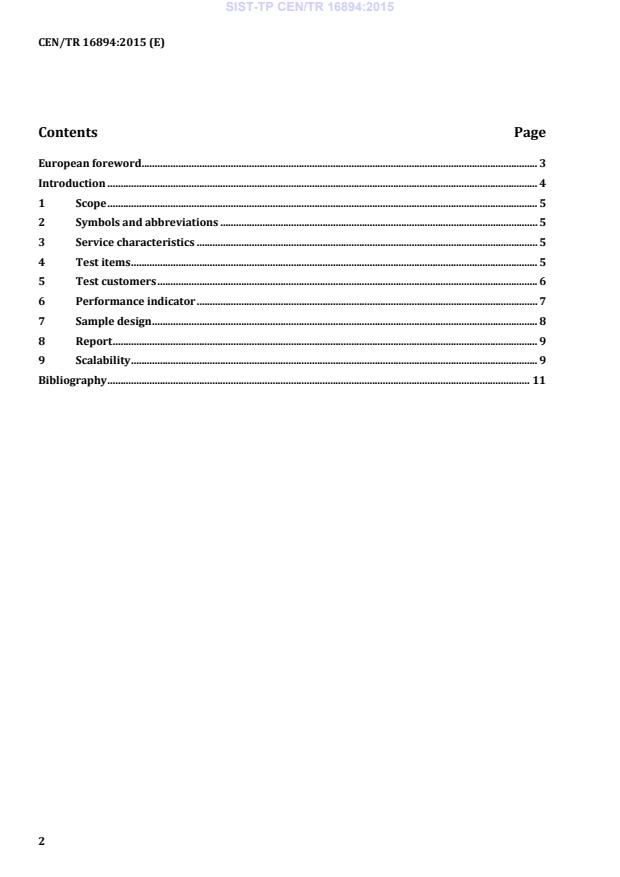
Contents Page
European foreword . 3
Introduction . 4
1 Scope . 5
2 Symbols and abbreviations . 5
3 Service characteristics . 5
4 Test items . 5
5 Test customers . 6
6 Performance indicator . 7
7 Sample design . 8
8 Report . 9
9 Scalability . 9
Bibliography . 11
European foreword
This document (CEN/TR 16894:2015) has been prepared by Technical Committee CEN/TC 331 “Postal
services”, the secretariat of which is held by NEN.
Attention is drawn to the possibility that some of the elements of this document may be the subject of
patent rights. CEN [and/or CENELEC] shall not be held responsible for identifying any or all such patent
rights.
Introduction
The European Commission emphasises the need to have common rules for the development of
community postal services and the improvement of Quality of Service (QoS).
The purpose of re-forwarding of postal items standardization is to supply all POs with a useful set of
rules how to measure the QoSin re-forwarding. A survey among operators showed that all contributing
countries provide this type of service, although with varying offers on type of mail, duration of contract,
and modes of processing. The technical recommendations on re-forwarding measurement take the
varying service levels into account and should be flexible towards any PO’s service offer.
It is essential to set the re-forwarding monitor up as an independent measurement, performed by an
independent network of senders and receivers managed by an independent supplier.
Beyond this, this document describes a best practice approach of measuring re-forwarding with a basic
design and sample. The design can be extended and refined to meet more advanced criteria of
representative sampling, e.g. in mail characteristics, geographical spread, customer type, and
differentiation of performance indicator. It is recommended to focus on the type of contract that covers
the majority of contracts, e.g. on the domestic measurement (although re-forwarding contracts are
offered as cross-border service as well), and / or on those of private households or permanent
relocation.
The measurement should be based on a defined methodology which shall be objective and be auditable
even if no audit is foreseen. The methodology and the sample design should be defined before the start
of the measurement.
1 Scope
This Technical Report specifies methods for measuring the quality of a re-forwarding service of
domestic addressed mail that is collected, processed and delivered by postal service operators. As a
European Standard or technical specification it relates to the measurement of services given to
household and business customers who receive mail at their homes, their post office boxes, or at their
office premises and have contracted their national Postal Operator (PO) to re-forward their mail for a
defined stretch of time to an address that deviates from the one presented on the postal items that are
to be delivered to them.
It is not the purpose of this standard to measure the POs performance in a way that provides direct
comparison of postal service providers.
2 Symbols and abbreviations
PO Postal Operator
QoS Quality of Service
3 Service characteristics
The re-forwarding service is characterized by the fact that a person or company asks the PO to deliver
their mail to a different address from the one that is written on the label of the postal item. This service
is used when private households, businesses or other type of organizations leave their premises
temporarily or permanently and the alternative address is not (yet) commonly known to their
correspondents.
Holidays or travels / stays away from home for health, educational or job purposes are typical examples
of temporary absence which has a predetermined end. Alternatively, re-forwarding contracts are set up
if a person, family, or business relocates permanently, i.e. move to another place of living. This type of
re-forwarding service typically runs for several months.
To measure this type of service, real re-forwarding contracts shall be used. The method to monitor the
quality of the re-forwarding service is to send the test items to a person having a re-forwarding contract
under this address. The test letters are being sent to the old/not valid address, and are considered
correctly re-forwarded if they arrive at the new / now valid address.
Without the real registration of the re-forwarding request the usual process of re-forwarding cannot be
carried out by the PO. PO employees shall be able to refer to their usual database or source of
information to identify a test item as a letter that should not be delivered to the address written on it
but to someplace else. Both addresses, the one that is written on the envelope and the one where the
item is re-forwarded to, shall be real addresses, postally correct and verified, and available in the PO’s
information system as a re-forwarding case. Only then a sorting process or postal employees are able to
correctly re-direct the item and the postman is able to deliver the item to its addressee.
4 Test items
The need for real re-forwarding contracts renders the finding of participants in the measurement rather
demanding. A sample of test customers with the comparatively rare feature of a re-forwarding contract
needs to be picked and their mail monitored for test purposes (test mail) for a certain period. The test
period should begin with the contract start date and last until the end of the contract. A defined number
of test letters is sent to this test customer and monitored during this period.
The start and end date of the contract should be considered carefully in the posting plan because a
letter posted on the last day before a contract starts might slip through the sorting, before the contract
becomes active and the re-forwarding information is available. If a letter was posted the day before the
contract terminates, it will not reach the postman until the day after the contract becomes invalid and
the re-forwarding information might get unavailable. These critical days shall be proportionately
included in the measurement.
The QoS(QoS) result Fulfilment of the re-forwarding service shall be measured by the percentage of mail
that is properly redirected and arrives at the new / temporary address (fulfilment of re-forwarding
service). The percentage of successful delivery can be calculated if one knows the total number of items
that should have been re-forwarded, and thereby find out whether any one is missing. Therefore one
has to control the number of items that are sent to the test receiver and have to be taken into account
for the monitoring result calculation, which is achieved by the use of test items. Other (real) mail items
that arrive during that period of observation are not measured.
NOTE 1 The simple approach of just reporting the real mail that was successfully re-forwarded does not give
more than an indicator whether the re-forwarding works at all. Even if it was possible to determine the number of
items gone to the wrong address (e.g. finding them at home after the end of holidays or collected by persons with
access to the old/not valid letterbox), it does not produce the number of items that might have been lost in transit,
if one is not aware they were on their way.
The test letters shall have an outward appearance that shows no obvious difference from typical regular
mail in format, weight, colour, print, and franking. The address on the envelope shall be in conformity
with typical addressing.
The address shall be written correctly and legibly. Therefore it might be useful to fabricate all items and
provide them to the sender(s) to prevent individual errors in addressing. It should be verified that the
addressing was correct and enabled the PO to deliver the letter.
The test letters’ address shall match exactly the one given in the re-forwarding contract which is
verified by most postal operators. Verifying the new address as well avoids delays in the re-forwarded
delivery.
NOTE 2 It might be possible to set up a test design that makes use of real mail between the test person with a
re-forwarding contract and one or some of his regular correspondents. As the letters under observation are
selected for the test period they are also referred to as “test items”.
5 Test customers
For setting up the test
...