

oSIST prEN IEC 61547:2026
(Main)Equipment for general lighting purposes - EMC immunity requirements
General Information
- Abstract
- Status
- Not Published
- Public Enquiry End Date
- 29-Jun-2026
- Technical Committee
- STV - Steklo, svetloba in razsvetljava v gradbeništvu
- Current Stage
- 4020 - Public enquire (PE) (Adopted Project)
- Start Date
- 14-Apr-2026
- Due Date
- 01-Sep-2026
- Completion Date
- 03-Aug-2026

Overview
oSIST prEN IEC 61547:2026, developed by CLC and the International Electrotechnical Commission (IEC), establishes electromagnetic compatibility (EMC) immunity requirements for equipment used in general lighting applications. This European standard ensures lighting products-such as lamps, luminaires, controlgear, and end-user replaceable LED modules-can operate reliably in environments with electromagnetic disturbances. By setting EMC immunity benchmarks, the standard plays a vital role in enhancing safety, performance, and interoperability in residential, commercial, and industrial lighting systems.
Key Topics
- EMC Immunity for Lighting Equipment
- Specifies test methods and performance criteria for electromagnetic immunity to disturbances such as electrostatic discharges, radio-frequency fields, power frequency magnetic fields, fast transients (bursts), voltage dips, surges, interruptions, and conducted disturbances.
- Types of Equipment Covered
- Applies to a broad range of lighting products, including lamps, LED modules, luminaires, and controlgear, as well as lighting equipment with wireless control functions.
- Excludes modules not intended for end-user replacement, certain specialized equipment, and devices specifically addressed by other EMC standards.
- Performance Assessment
- Defines three performance criteria (A, B, C) to assess the effects of disturbances on lighting equipment:
- Illuminance stability
- Reliability of control functions (on/off, dimming, color adjustment)
- Restoration and recovery requirements after disruptions
- Defines three performance criteria (A, B, C) to assess the effects of disturbances on lighting equipment:
- Testing Methods
- Details procedures and reference standards for carrying out immunity tests using consistent, repeatable approaches.
- Specifies how to apply different tests to various ports (AC/DC power, load, and signal), and addresses practical considerations for testing end-user replaceable modules and integrated lamps.
Applications
oSIST prEN IEC 61547:2026 is widely relevant in the lighting industry for ensuring EMC immunity, including:
- Manufacturers and Product Developers
- Essential for companies designing and producing lighting devices to comply with European and global EMC requirements.
- Supports market access by facilitating third-party testing, CE marking, and conformity assessment.
- Designers and System Integrators
- Assists in integrating lighting equipment into complex installations-such as office buildings, smart homes, and industrial facilities-where electromagnetic disturbances are common.
- Testing Laboratories
- Provides a uniform framework and reference test setups for accredited EMC compliance testing.
- Procurement and Compliance Teams
- Ensures product selections meet safety and reliability requirements, minimizing risk of interference with other electronic equipment.
- End Users and Facility Managers
- Enhances performance and operational stability of lighting installations, avoiding disruptions in environments sensitive to electromagnetic disturbances.
Related Standards
- IEC 61000 Series: Core reference for EMC immunity and testing methods, including:
- IEC 61000-4-2 (Electrostatic Discharge Immunity)
- IEC 61000-4-3 (Radiated RF Electromagnetic Field Immunity)
- IEC 61000-4-4 (Electrical Fast Transient/Burst)
- IEC 61000-4-5 (Surge Immunity)
- IEC 61000-4-6 (Conducted Disturbances)
- IEC 61000-4-8 (Power Frequency Magnetic Field)
- IEC 61000-4-11 (Voltage Dips and Interruptions)
- CISPR 15: Limits and methods for measuring radio disturbance characteristics in lighting equipment.
- IEC 60050-161, IEC 60050-845: Terminology for electromagnetic compatibility and lighting.
- IEC 61347-1: General requirements for lamp controlgear.
By aligning with oSIST prEN IEC 61547:2026, manufacturers and practitioners can ensure lighting equipment meets the latest EMC immunity requirements, supporting product quality, safety, and regulatory compliance across evolving lighting technologies and smart systems.
Relations
- Effective Date
- 12-Mar-2024
Get Certified
Connect with accredited certification bodies for this standard

IMQ S.p.A. (Certification)
Italian electrical product certification.

SLG Prüf- und Zertifizierungs GmbH
German testing and certification body.

UL Solutions
Global safety science company with testing, inspection and certification.
Sponsored listings
Frequently Asked Questions
oSIST prEN IEC 61547:2026 is a draft published by the Slovenian Institute for Standardization (SIST). Its full title is "Equipment for general lighting purposes - EMC immunity requirements". This standard covers: Equipment for general lighting purposes - EMC immunity requirements
Equipment for general lighting purposes - EMC immunity requirements
oSIST prEN IEC 61547:2026 is classified under the following ICS (International Classification for Standards) categories: 29.020 - Electrical engineering in general; 29.140.01 - Lamps in general; 33.100.10 - Emission; 33.100.20 - Immunity. The ICS classification helps identify the subject area and facilitates finding related standards.
oSIST prEN IEC 61547:2026 has the following relationships with other standards: It is inter standard links to SIST EN IEC 61547:2023. Understanding these relationships helps ensure you are using the most current and applicable version of the standard.
oSIST prEN IEC 61547:2026 is associated with the following European legislation: EU Directives/Regulations: 2014/30/EU; Standardization Mandates: M/552. When a standard is cited in the Official Journal of the European Union, products manufactured in conformity with it benefit from a presumption of conformity with the essential requirements of the corresponding EU directive or regulation.
oSIST prEN IEC 61547:2026 is available in PDF format for immediate download after purchase. The document can be added to your cart and obtained through the secure checkout process. Digital delivery ensures instant access to the complete standard document.
Standards Content (Sample)
SLOVENSKI STANDARD
01-junij-2026
Oprema za splošno razsvetljavo - Zahteve za odpornost proti EMC
Equipment for general lighting purposes - EMC immunity requirements
Einrichtungen für allgemeine Beleuchtungszwecke - EMV-Störfestigkeitsanforderungen
Equipements pour l'éclairage à usage général - Exigences concernant l'immunité CEM
Ta slovenski standard je istoveten z: prEN IEC 61547:2026
ICS:
29.140.01 Žarnice na splošno Lamps in general
33.100.20 Imunost Immunity
2003-01.Slovenski inštitut za standardizacijo. Razmnoževanje celote ali delov tega standarda ni dovoljeno.
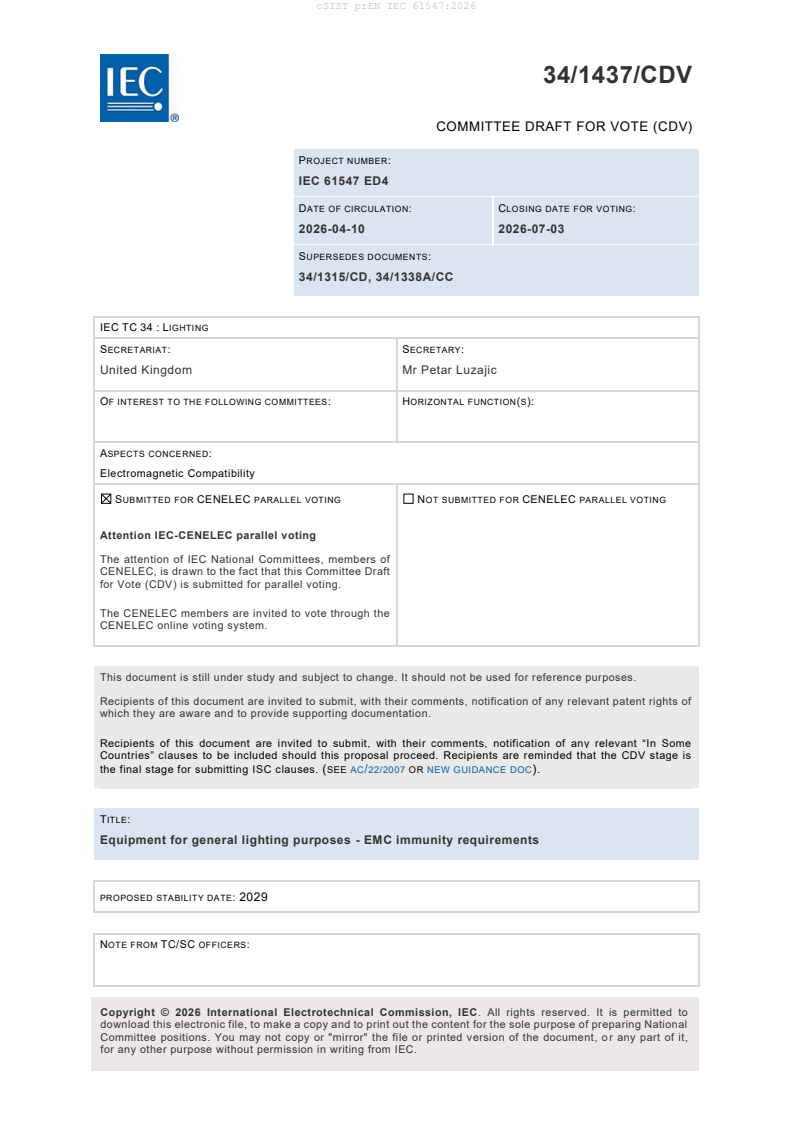
34/1437/CDV
COMMITTEE DRAFT FOR VOTE (CDV)
PROJECT NUMBER:
IEC 61547 ED4
DATE OF CIRCULATION: CLOSING DATE FOR VOTING:
2026-04-10 2026-07-03
SUPERSEDES DOCUMENTS:
34/1315/CD, 34/1338A/CC
IEC TC 34 : LIGHTING
SECRETARIAT: SECRETARY:
United Kingdom Mr Petar Luzajic
OF INTEREST TO THE FOLLOWING COMMITTEES: HORIZONTAL FUNCTION(S):
ASPECTS CONCERNED:
Electromagnetic Compatibility
SUBMITTED FOR CENELEC PARALLEL VOTING NOT SUBMITTED FOR CENELEC PARALLEL VOTING
Attention IEC-CENELEC parallel voting
The attention of IEC National Committees, members of
CENELEC, is drawn to the fact that this Committee Draft
for Vote (CDV) is submitted for parallel voting.
The CENELEC members are invited to vote through the
CENELEC online voting system.
This document is still under study and subject to change. It should not be used for reference purposes.
Recipients of this document are invited to submit, with their comments, notification of any relevant patent rights of
which they are aware and to provide supporting documentation.
Recipients of this document are invited to submit, with their comments, notification of any relevant “In Some
Countries” clauses to be included should this proposal proceed. Recipients are reminded that the CDV stage is
the final stage for submitting ISC clauses. (SEE AC/22/2007 OR NEW GUIDANCE DOC).
TITLE:
Equipment for general lighting purposes - EMC immunity requirements
PROPOSED STABILITY DATE: 2029
NOTE FROM TC/SC OFFICERS:
download this electronic file, to make a copy and to print out the content for the sole purpose of preparing National
Committee positions. You may not copy or "mirror" the file or printed version of the document, o r any part of it,
for any other purpose without permission in writing from IEC.
IEC CDV 61547 © IEC 2026
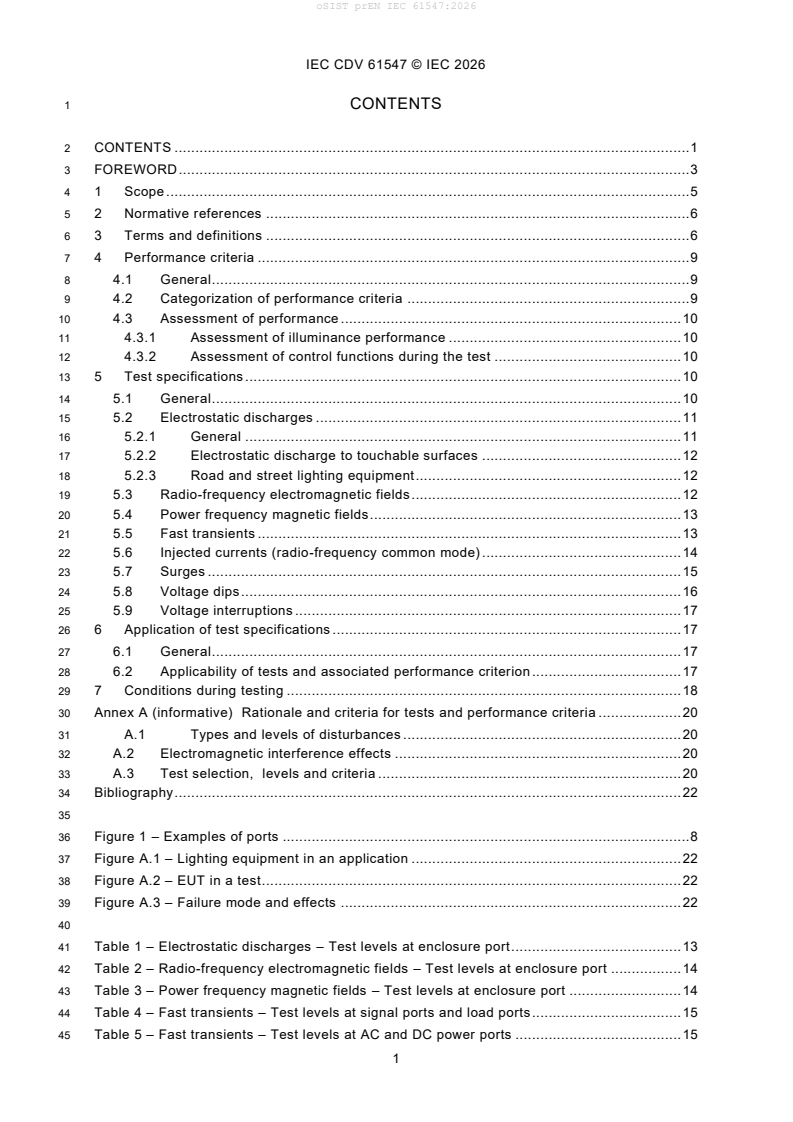
1 CONTENTS
2 CONTENTS . 1
3 FOREWORD . 3
4 1 Scope . 5
5 2 Normative references . 6
6 3 Terms and definitions . 6
7 4 Performance criteria . 9
8 4.1 General . 9
9 4.2 Categorization of performance criteria . 9
10 4.3 Assessment of performance . 10
11 4.3.1 Assessment of illuminance performance . 10
12 4.3.2 Assessment of control functions during the test . 10
13 5 Test specifications . 10
14 5.1 General . 10
15 5.2 Electrostatic discharges . 11
16 5.2.1 General . 11
17 5.2.2 Electrostatic discharge to touchable surfaces . 12
18 5.2.3 Road and street lighting equipment . 12
19 5.3 Radio-frequency electromagnetic fields . 12
20 5.4 Power frequency magnetic fields . 13
21 5.5 Fast transients . 13
22 5.6 Injected currents (radio-frequency common mode) . 14
23 5.7 Surges . 15
24 5.8 Voltage dips . 16
25 5.9 Voltage interruptions . 17
26 6 Application of test specifications . 17
27 6.1 General . 17
28 6.2 Applicability of tests and associated performance criterion . 17
29 7 Conditions during testing . 18
30 Annex A (informative) Rationale and criteria for tests and performance criteria . 20
31 A.1 Types and levels of disturbances . 20
32 A.2 Electromagnetic interference effects . 20
33 A.3 Test selection, levels and criteria . 20
34 Bibliography . 22
36 Figure 1 – Examples of ports . 8
37 Figure A.1 – Lighting equipment in an application . 22
38 Figure A.2 – EUT in a test . 22
39 Figure A.3 – Failure mode and effects . 22
41 Table 1 – Electrostatic discharges – Test levels at enclosure port . 13
42 Table 2 – Radio-frequency electromagnetic fields – Test levels at enclosure port . 14
43 Table 3 – Power frequency magnetic fields – Test levels at enclosure port . 14
44 Table 4 – Fast transients – Test levels at signal ports and load ports . 15
45 Table 5 – Fast transients – Test levels at AC and DC power ports . 15
IEC CDV 61547 © IEC 2026
46 Table 6 – Radio-frequency common mode – Test levels at signal ports and load ports. 15
47 Table 7 – Radio-frequency common mode – Test levels at DC power ports. 16
48 Table 8 – Radio-frequency common mode – Test levels at AC power ports . 16
49 Table 9 – Surges – Test levels at AC and DC power ports . 16
50 Table 10 – Surges – Test levels at signal ports . 17
51 Table 11 – Voltage dips – Test levels at AC power ports . 17
52 Table 12 – Voltage short interruptions – Test levels at AC power ports . 18
53 Table 13 – Test applicability and associated performance criterion . 19
IEC CDV 61547 © IEC 2026
56 INTERNATIONAL ELECTROTECHNICAL COMMISSION
57 ____________
59 EQUIPMENT FOR GENERAL LIGHTING PURPOSES –
60 EMC IMMUNITY REQUIREMENTS
62 FOREWORD
63 1) The International Electrotechnical Commission (IEC) is a worldwide organization for standardization comprising
64 all national electrotechnical committees (IEC National Committees). The object of IEC is to promote international
65 co-operation on all questions concerning standardization in the electrical and electronic fields. To this end and
66 in addition to other activities, IEC publishes International Standards, Technical Specifications, Technical Reports,
67 Publicly Available Specifications (PAS) and Guides (hereafter referred to as “IEC Publication(s)”). Their
68 preparation is entrusted to technical committees; any IEC National Committee interested in the subject dealt with
69 may participate in this preparatory work. International, governmental and non-governmental organizations liaising
70 with the IEC also participate in this preparation. IEC collaborates closely with the International Organization for
71 Standardization (ISO) in accordance with conditions determined by agreement between the two organizations.
72 2) The formal decisions or agreements of IEC on technical matters express, as nearly as possible, an international
73 consensus of opinion on the relevant subjects since each technical committee has representation from all
74 interested IEC National Committees.
75 3) IEC Publications have the form of recommendations for international use and are accepted by IEC National
76 Committees in that sense. While all reasonable efforts are made to ensure that the technical content of IEC
77 Publications is accurate, IEC cannot be held responsible for the way in which they are used or for any
78 misinterpretation by any end user.
79 4) In order to promote international uniformity, IEC National Committees undertake to apply IEC Publications
80 transparently to the maximum extent possible in their national and regional publications. Any divergence between
81 any IEC Publication and the corresponding national or regional publication shall be clearly indicated in the latter.
82 5) IEC itself does not provide any attestation of conformity. Independent certification bodies provide conformity
83 assessment services and, in some areas, access to IEC marks of conformity. IEC is not responsible for any
84 services carried out by independent certification bodies.
85 6) All users should ensure that they have the latest edition of this publication.
86 7) No liability shall attach to IEC or its directors, employees, servants or agents including individual experts and
87 members of its technical committees and IEC National Committees for any personal injury, property damage or
88 other damage of any nature whatsoever, whether direct or indirect, or for costs (including legal fees) and
89 expenses arising out of the publication, use of, or reliance upon, this IEC Publication or any other IEC
90 Publications.
91 8) Attention is drawn to the normative references cited in this publication. Use of the referenced publications is
92 indispensable for the correct application of this publication.
93 9) Attention is drawn to the possibility that some of the elements of this IEC Publication may be the subject of patent
94 rights. IEC shall not be held responsible for identifying any or all such patent rights.
95 International Standard IEC 61547 has been prepared by IEC technical committee 34: Lamps
96 and related equipment.
97 This fourth edition cancels and replaces the third edition, published in 2020. This edition
98 constitutes a technical revision
99 This edition includes the following significant technical changes with respect to the previous
100 edition:
101 a) The assessment of performance has been split into illuminance performance and control
102 functionality performance
103 b) The test frequency range for radio frequency electromagnetic fields has been increased to
104 6 GHz
105 c) The test level for fast transients for DC power ports has been increased
106 d) New test requirements added for load ports for the injected currents test
107 e) New test requirements added for DC power ports and signal ports for the surge test
IEC CDV 61547 © IEC 2026
108 f) New test requirements added for the voltage dips and voltage short interruption tests for AC
109 power ports
111 The text of this International Standard is based on the following documents:
DC Report
xx xx
113 Full information on the voting for the approval of this International Standard can be found in the
114 report on voting indicated in the above table.
115 This document has been drafted in accordance with the ISO/IEC Directives, Part 2.
116 This document is to be read in conjunction with the relevant basic and/or product standard(s).
117 A list of all parts in the IEC 61547 series, published under the general title Equipment for
118 general lighting purposes – EMC immunity requirements, can be found on the IEC website.
119 The committee has decided that the contents of this document will remain unchanged until the
120 stability date indicated on the IEC website under "http://webstore.iec.ch" in the data related to
121 the specific document. At this date, the document will be
122 • reconfirmed,
123 • withdrawn,
124 • replaced by a revised edition, or
125 • amended.
IMPORTANT – The 'colour inside' logo on the cover page of this publication indicates that it
contains colours which are considered to be useful for the correct understanding of its
contents. Users should therefore print this document using a colour printer.
IEC CDV 61547 © IEC 2026
129 EQUIPMENT FOR GENERAL LIGHTING PURPOSES –
130 EMC IMMUNITY REQUIREMENTS
134 1 Scope
135 This part of IEC 61547 which deals with electromagnetic immunity requirements, applies to
136 lighting equipment which is within the scope of IEC technical committee 34, including apparatus
137 such as lamps, luminaires, controlgear for electric light sources, and end-user replaceable
138 modules like non-integrated and semi-integrated LED lamps and LED modules.
139 Lighting equipment with a wireless control function are also within the scope of this document.
140 However, the test is limited to the control of the lighting function only. Radio properties like
141 frequency stability or spurious emissions are not assessed.
142 EXAMPLE Colour/light level control via a wireless interface are meant to stay intact during and after an immunity
143 test.
144 Also included in the scope of this document is lighting equipment that interfaces with systems
145 or installations other than common power supply networks.
146 Excluded from the scope of this document are:
147 – components or modules designed to be integrated into lighting equipment but not intended
148 for end-user replacement.
149 – equipment for which the electromagnetic compatibility requirements in the radio -frequency
150 range are explicitly formulated in other product immunity standards, even if they incorporate
151 a built-in lighting function.
152 NOTE 1 Examples of exclusions are:
153 – equipment with built-in lighting devices for display back lighting, scale illumination and signaling;
154 – SSL-displays;
155 – range hoods, refrigerators, freezers;
156 – photocopiers, projectors;
157 – electronic switches for fixed installations;
158 – lighting equipment for road vehicles (within the scope of CISPR 12);
159 – lighting equipment for aircraft and airfield facilities.
160 NOTE 2 Modules that are not end-user replaceable are not in the scope of this document but can be tested according
161 to this document for information purposes (for instance, of luminaire manufacturers).
162 In multi-function equipment where the lighting function operates independently from other
163 functions, the electromagnetic immunity requirements of this document apply to the lighting
164 function only.
165 The requirements of this document are based on the generic immunity standard for residential,
166 commercial and light-industrial environments IEC 61000-6-1:2016, but modified to lighting
167 engineering practice.
168 It can be expected that lighting equipment complying with the requirements of this document
169 will operate satisfactorily in other environments. In some special cases, measures can be taken
170 to provide higher immunity. In this document it is impracticable to deal with all these possibilities.
171 Such requirements can be established by contractual agreement between supplier and
172 purchaser.
IEC CDV 61547 © IEC 2026
173 This document does not cover the effects that electromagnetic disturbances have on the lifetime
174 of lighting equipment.
175 2 Normative references
176 The following documents are referred to in the text in such a way that some or all of their content
177 constitutes requirements of this document. For dated references, only the edition cited applies.
178 For undated references, the latest edition of the referenced document (including any
179 amendments) applies.
180 IEC 60050-161, International Electrotechnical Vocabulary – Part 161: Electromagnetic
181 Compatibility (available at http://www.electropedia.org)
182 IEC 60050-845, International Electrotechnical Vocabulary – Part 845: Lighting (available at
183 http://www.electropedia.org)
184 IEC 61000-4-2:2025, Electromagnetic compatibility (EMC) – Part 4-2: Testing and
185 measurement techniques – Electrostatic discharge immunity test
186 IEC 61000-4-3:2020, Electromagnetic compatibility (EMC) – Part 4-3: Testing and
187 measurement techniques – Radiated, radio frequency, electromagnetic field immunity test
189 IEC 61000-4-4:2012, Electromagnetic compatibility (EMC) – Part 4-4: Testing and
190 measurement techniques – Electrical fast transient/burst immunity test
191 IEC 61000-4-5:2014, Electromagnetic compatibility (EMC) – Part 4-5: Testing and
192 measurement techniques – Surge immunity test
193 IEC 61000-4-5:2014/AMD1:2017
194 IEC 61000-4-6:2023, Electromagnetic compatibility (EMC) – Part 4-6: Testing and
195 measurement techniques – Immunity to conducted disturbances, induced by radio-frequency
196 fields
197 IEC 61000-4-8:2009, Electromagnetic compatibility (EMC) – Part 4-8: Testing and
198 measurement techniques – Power frequency magnetic field immunity test
199 IEC 61000-4-11:2020, Electromagnetic compatibility (EMC) – Part 4-11: Testing and
200 measurement techniques – Voltage dips, short interruptions and voltage variations immunity
201 tests for equipment with input current up to 16 A per phase
202 CISPR 15:2018, Limits and methods of measurement of radio disturbance characteristics of
203 electrical lighting and similar equipment CISPR 15:2018/AMD1:2024
204 3 Terms and definitions
205 For the purposes of this document, the terms and definitions given in IEC 60050-161 and
206 IEC 60050-845 and the following apply.
207 ISO and IEC maintain terminological databases for use in standardization at the following addresses:
208 • IEC Electropedia: available at http://www.electropedia.org/
209 • ISO Online browsing platform: available at http://www.iso.org/obp
IEC CDV 61547 © IEC 2026
210 3.1
211 enclosure port
212 physical boundary of the equipment through which electromagnetic fields can radiate or
213 penetrate
214 3.2
215 AC power port
216 port at which a conductor or cable, intended to supply AC power from a mains electric power
217 network to the equipment, is connected to the equipment
218 3.3
219 DC power port
220 port at which conductor or cable, intended to supply DC power from an electric power network
221 to the equipment, is connected to the equipment
222 3.4
223 load port
224 port at which the power cable of the load is connected to the equipment
225 3.5
226 end-user replaceable module
227 electronic or electrical part which serves a specific function or functions of a lighting application,
228 which is intended for application in a luminaire or in an installation by an end-user
229 EXAMPLE Starter, controlgear, ELV lamps, control unit, LEDni lamps, LEDsi lamps.and LEDi lamps
230 Note 1 to entry: End-user replaceable modules are replaceable modules excluding non-user replaceable modules.
231 3.6
232 port
233 category of an interface of an EUT which provides a coupling path for electromagnetic
234 disturbances from the electromagnetic environment into the EUT
235 Note 1 to entry: Figure 1 shows examples of ports. The AC power port or DC power port can include the protective
236 earth conductor.
Enclosure port
AC power port
Load port Load
Network
Lighting equipment
(lighting
equipment)
DC power port
Signal port
238 Figure 1 – Examples of ports
239 3.7
240 signal port
241 port at which a signal cable is connected to the equipment
242 Note 1 to entry: The signal cable can arise from a network (e.g. DALI), a local control mechanism (e.g. sensor), or
243 an auxiliary supply for load (e.g. photocell or presence sensor).
IEC CDV 61547 © IEC 2026
244 Note 2 to entry: Signal ports are also called control ports. In this document, each reference to signal ports also
245 refers to wired control ports
247 3.8
248 road and street lighting equipment
249 lighting equipment for illuminating roads, streets, tunnels and other public outdoor areas
250 Note 1 to entry: Typical road and street lighting equipment has a minimum total height above normal ground level
251 of 2,5 m.
253 3.9
254 lighting equipment
255 equipment with a primary function of generating or regulating or distributing optical radiation or
256 a combination of these functions
257 EXAMPLE
258 • light sources and luminaires;
259 • the lighting part of multi-function equipment where one of the primary functions of this is illumination;
260 • end-user replaceable modules like non-integrated and semi-integrated LED lamps, and controlgear;
261 • integrated lamps;
262 • ultraviolet (UV) and infrared (IR) radiation equipment.
263 3.10
264 non-integrated LED lamp
265 LEDni lamp
266 LED lamp which needs a separate controlgear to operate
267 3.11
268 semi-integrated LED lamp
269 LEDsi lamp
270 LED lamp which carries the control unit of the controlgear, and is operated by the separated
271 power supply of the controlgear
272 3.12
273 Integrated LED module
274 LEDi module
275 LED module, incorporating control gear and any additional elements necessary for stable
276 operation of the light source, designed for direct connection to the supply voltage
277 [SOURCE: IEV 845-27-059]
278 3.13
279 ELV
280 extra-low voltage
281 voltage which does not exceed 50 V AC or 120 V ripple-free DC between conductors or between
282 any conductor and earth
283 [SOURCE: IEC 61347-1:2024]
284 Note 1 to entry: Ripple-free is conventionally defined as an RMS ripple voltage of not more than 10% of the DC
285 component.
286 3.14
287 integrated lamp
288 electric lamp that cannot be dismantled without being permanently damaged, incorporating
289 controlgear, and all additional elements necessary for starting and stable operation of the light
290 source, designed for direct connection of the supply voltage
IEC CDV 61547 © IEC 2026
291 Note 1 to entry: Example of integrated lamp is self-ballasted lamp.
292 3.15
293 standby mode
294
295 mode when the equipment is connected to a supply voltage with the illumination function off,
296 while capable of being activated by a trigger
297 3.16
298 EUT
299 equipment-under-test
300 lighting equipment subjected to EMC (immunity) tests.
301 Note 1 to entry: Several units which can be physically separated and connected via load ports over long distances
302 (e.g. tunnel or stadium lighting) may also be considered as a single EUT for certain tests when tested simultaneously.
303 3.17
304 electric power network
305 particular installations, substations, lines or cables for the transmission and distribution of
306 electricity
307 Note 1 to entry: The boundaries of the different parts of this network are defined by appropriate criteria, such as
308 geographical situation, ownership, voltage, etc.
309 SOURCE: IEV 601-01-02
310 4 Performance criteria
311 4.1 General
312 For the various immunity tests that apply, the performance criteria are specified in 4.2. The
313 following functions shall be assessed with consideration of the instructions for use.
314 – the illuminance of the Iuminaire or of the light source(s);
315 – the control function, for example switching on and off, light level setting, colour adjustment,
316 wireless control.
317 The functions assessed and the performance criteria for each individual test shall be noted in
318 the test report.
319 4.2 Categorization of performance criteria
320 The following three categories of performance criteria apply.
321 a) Performance criterion A
322 During the test, no visible change of the illuminance according to 4.3.1 shall be observed
323 and the control function (see 4.3.2), if any, shall operate during the test as intended. The
324 EUT shall operate as intended after the test.
325 b) Performance criterion B
326 During the test, the illuminance can change to any value. After the test, the illuminance shall
327 be restored to its initial value (see 4.3.1) within 1 minute (30 minutes for high pressure gas
328 discharge lamps). Control function need not operate during the test, but after the test, the
329 mode of the control shall be the same as before the test, provided that during the test no
330 mode changing commands were given.
331 NOTE 1 High pressure discharge lamps by their technical nature require up to 30 min to fully restore
332 the previous illuminance.
IEC CDV 61547 © IEC 2026
333 NOTE 2 In safety critical applications, for example emergency escape lighting, according to the
334 applicable standards much shorter restoration times can be required.
335 c) Performance criterion C
336 During and after the test, any change of the illuminance is allowed and the light source(s)
337 can extinguish. After the test, within 30 min, all functions shall return to normal, if necessary
338 by temporary interruption of the mains supply or operating the control function.
339 NOTE For circuit protections recovery up to 30 min can be required.
340 .
341 The application of the different performance criteria for the various types of tests and for
342 different lighting equipment are specified in Clause 6.
343 4.3 Assessment of performance
344 4.3.1 Assessment of illuminance performance
345 According to clause 4.2, the illuminance variation is checked during and after the test for
346 performance criterion A, and after the test for performance criterion B. A change of illuminance
347 shall be checked by measurement. Absolute measurement is not required, relative
348 measurements can be performed. Other photometric quanti
...