

SIST EN 17799:2024
(Main)Personal data protection requirements for processing operations
General Information
- Abstract
This document specifies baseline requirements for demonstrating processing activities compliance with the European personal data protection normative framework in accordance with EN ISO/IEC 17065. It does not however apply to products or management systems destined for processing personal data.
This document is applicable to all organizations which, as personal data controllers and/or processors, process personal data, and its objective is to provide a set of requirements enabling such organizations to conform effectively with the European personal data protection normative framework.
An organization can decide that the standard is applicable only to a specific subset of its processing activities if such a decision does not involve failure to conform with the European personal data protection normative framework.
This document also provides indications for conformity assessment with the aforementioned requirements.
- Status
- Published
- Public Enquiry End Date
- 13-Feb-2022
- Publication Date
- 22-Feb-2024
- Technical Committee
- ITC - Information technology
- Current Stage
- 6060 - National Implementation/Publication (Adopted Project)
- Start Date
- 13-Feb-2024
- Due Date
- 19-Apr-2024
- Completion Date
- 23-Feb-2024

Overview
SIST EN 17799:2024 sets out baseline requirements for organizations acting as controllers or processors of personal data to demonstrate compliance with the European personal data protection legal framework, particularly the General Data Protection Regulation (GDPR). Published by SIST, this European Standard is intended for all entities engaged in the processing of personal data, regardless of sector, size, or location within the EU. The standard details organizational and operational controls that help ensure the correct handling, processing, and protection of personal data, as required under EU law.
Implemented in the context of EN ISO/IEC 17065, SIST EN 17799:2024 is not applicable to products or management systems themselves, but rather focuses on the operational aspects of data processing. The document provides not only fundamental requirements for compliance but also guidance for conformity assessment.
Key Topics
- Understanding Roles and Responsibilities
The standard distinguishes between the obligations of data controllers and data processors and outlines the assignment of roles such as Data Protection Officers (DPOs) and data protection managers. - Defining Processing Activities
Requirements for maintaining detailed records of processing activities, identifying legal bases, and applying data minimization and retention policies are specified. - Risk Management and Impact Assessments
Organizations must conduct risk assessments and Data Protection Impact Assessments (DPIAs) to identify, analyze, and mitigate risks to the rights and freedoms of data subjects. - Operational Controls
Specific operational activities covered include issuing clear data protection notices, obtaining and managing consent, responding to data subject requests, managing personal data breaches, and ensuring regular training and awareness for all personnel involved in data processing. - Personal Data Protection by Design and By Default
Emphasizes integrating data protection measures from the earliest stages of designing data processing operations and systems.
Applications
SIST EN 17799:2024 is applicable to all organizations that process personal data, whether for customers, employees, or other stakeholders. Key applications include:
- Compliance Demonstration
Organizations seeking to prove alignment with GDPR for regulatory, business, or certification purposes can use this standard as a framework to document and verify their compliance efforts. - Internal Data Governance Programs
The standard supports continuous improvement cycles, helping organizations to maintain up-to-date policies, procedures, and technical controls relating to personal data. - Third-Party Processor Assessment
Controllers can reference the standard’s requirements when assessing or contracting processors, ensuring clear agreements and accountability. - Auditing and Certification
Facilitates structured internal and external audits by providing clear requirements and documentation guidelines, aiding organizations preparing for independent conformity assessments according to EN ISO/IEC 17065.
Related Standards
Organizations implementing SIST EN 17799:2024 often reference or integrate the following related standards for a comprehensive data protection and information security framework:
- ISO/IEC 27000 Series
Provides overarching guidance on information security management systems. - ISO/IEC 27701
Specifies requirements for privacy information management, and is often used alongside GDPR-focused standards. - ISO/IEC 29134
Guidance on privacy impact assessment methodologies. - ISO/IEC 27555/29151
Offers best practices on the protection and erasure of personally identifiable information (PII). - EN ISO/IEC 17065
Specifies requirements for bodies certifying products, processes, and services, supporting conformity assessment.
By implementing SIST EN 17799:2024, organizations demonstrate a commitment to robust personal data protection, risk management, and legal compliance, building trust with customers, partners, and regulatory authorities across Europe.
Relations
- Effective Date
- 28-Jan-2026
Get Certified
Connect with accredited certification bodies for this standard

BSI Group
BSI (British Standards Institution) is the business standards company that helps organizations make excellence a habit.

Bureau Veritas
Bureau Veritas is a world leader in laboratory testing, inspection and certification services.

DNV
DNV is an independent assurance and risk management provider.
Sponsored listings
Frequently Asked Questions
SIST EN 17799:2024 is a standard published by the Slovenian Institute for Standardization (SIST). Its full title is "Personal data protection requirements for processing operations". This standard covers: This document specifies baseline requirements for demonstrating processing activities compliance with the European personal data protection normative framework in accordance with EN ISO/IEC 17065. It does not however apply to products or management systems destined for processing personal data. This document is applicable to all organizations which, as personal data controllers and/or processors, process personal data, and its objective is to provide a set of requirements enabling such organizations to conform effectively with the European personal data protection normative framework. An organization can decide that the standard is applicable only to a specific subset of its processing activities if such a decision does not involve failure to conform with the European personal data protection normative framework. This document also provides indications for conformity assessment with the aforementioned requirements.
This document specifies baseline requirements for demonstrating processing activities compliance with the European personal data protection normative framework in accordance with EN ISO/IEC 17065. It does not however apply to products or management systems destined for processing personal data. This document is applicable to all organizations which, as personal data controllers and/or processors, process personal data, and its objective is to provide a set of requirements enabling such organizations to conform effectively with the European personal data protection normative framework. An organization can decide that the standard is applicable only to a specific subset of its processing activities if such a decision does not involve failure to conform with the European personal data protection normative framework. This document also provides indications for conformity assessment with the aforementioned requirements.
SIST EN 17799:2024 is classified under the following ICS (International Classification for Standards) categories: 03.120.20 - Product and company certification. Conformity assessment; 03.160 - Law. Administration; 35.020 - Information technology (IT) in general. The ICS classification helps identify the subject area and facilitates finding related standards.
SIST EN 17799:2024 has the following relationships with other standards: It is inter standard links to SIST-TP CEN/TR 17603-20-21:2022. Understanding these relationships helps ensure you are using the most current and applicable version of the standard.
SIST EN 17799:2024 is available in PDF format for immediate download after purchase. The document can be added to your cart and obtained through the secure checkout process. Digital delivery ensures instant access to the complete standard document.
Standards Content (Sample)
SLOVENSKI STANDARD
01-april-2024
Zahteve za varstvo osebnih podatkov za postopke obdelave
Personal data protection requirements for processing operations
Anforderungen an den Datenschutz bei Verarbeitungsvorgängen
Exigences de protection des données à caractère personnel pour les opérations de
traitement
Ta slovenski standard je istoveten z: EN 17799:2023
ICS:
03.160 Pravo. Uprava Law. Administration
35.020 Informacijska tehnika in Information technology (IT) in
tehnologija na splošno general
2003-01.Slovenski inštitut za standardizacijo. Razmnoževanje celote ali delov tega standarda ni dovoljeno.
EUROPEAN STANDARD EN 17799
NORME EUROPÉENNE
EUROPÄISCHE NORM
October 2023
ICS 03.120.20; 03.160
English version
Personal data protection requirements for processing
operations
Exigences de protection des données à caractère Anforderungen an den Datenschutz bei
personnel pour les opérations de traitement Verarbeitungsvorgängen
This European Standard was approved by CEN on 4 September 2023.
CEN and CENELEC members are bound to comply with the CEN/CENELEC Internal Regulations which stipulate the conditions for
giving this European Standard the status of a national standard without any alteration. Up-to-date lists and bibliographical
references concerning such national standards may be obtained on application to the CEN-CENELEC Management Centre or to
any CEN and CENELEC member.
This European Standard exists in three official versions (English, French, German). A version in any other language made by
translation under the responsibility of a CEN and CENELEC member into its own language and notified to the CEN-CENELEC
Management Centre has the same status as the official versions.
CEN and CENELEC members are the national standards bodies and national electrotechnical committees of Austria, Belgium,
Bulgaria, Croatia, Cyprus, Czech Republic, Denmark, Estonia, Finland, France, Germany, Greece, Hungary, Iceland, Ireland, Italy,
Latvia, Lithuania, Luxembourg, Malta, Netherlands, Norway, Poland, Portugal, Republic of North Macedonia, Romania, Serbia,
Slovakia, Slovenia, Spain, Sweden, Switzerland, Türkiye and United Kingdom.
CEN-CENELEC Management Centre:
Rue de la Science 23, B-1040 Brussels
© 2023 CEN/CENELEC All rights of exploitation in any form and by any means
Ref. No. EN 17799:2023 E
reserved worldwide for CEN national Members and for
CENELEC Members.
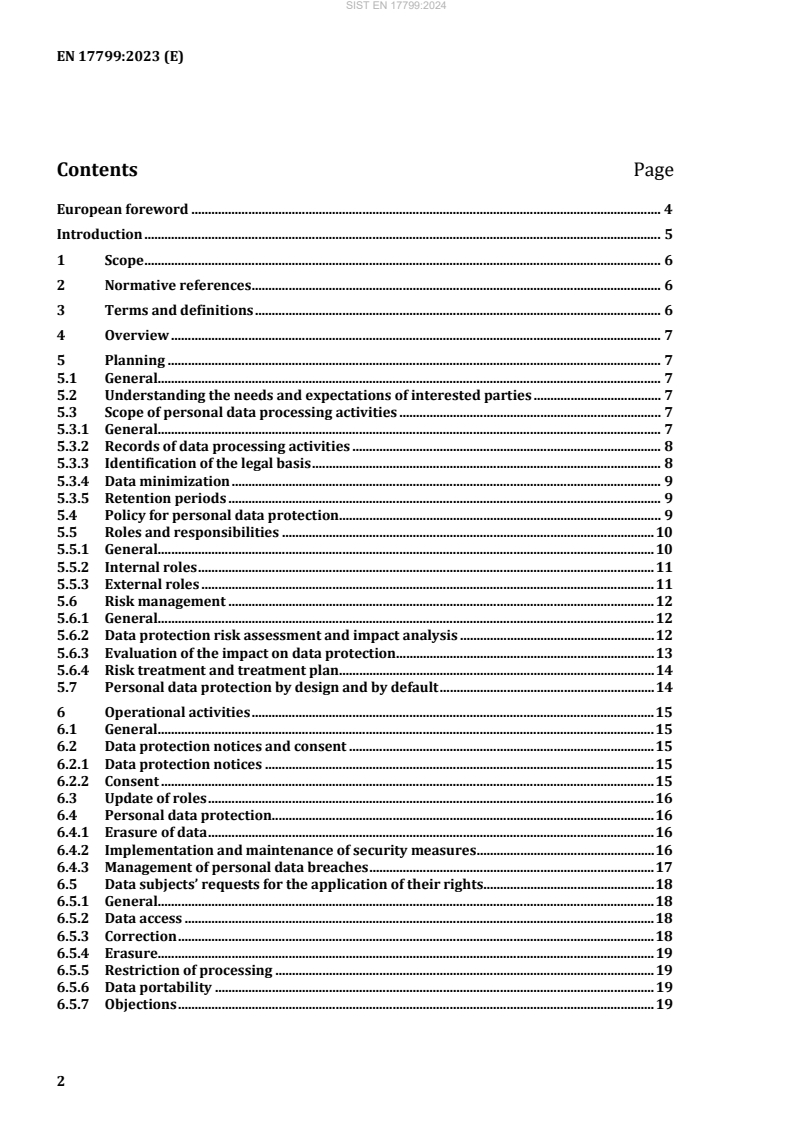
Contents Page
European foreword . 4
Introduction . 5
1 Scope . 6
2 Normative references . 6
3 Terms and definitions . 6
4 Overview . 7
5 Planning . 7
5.1 General. 7
5.2 Understanding the needs and expectations of interested parties . 7
5.3 Scope of personal data processing activities . 7
5.3.1 General. 7
5.3.2 Records of data processing activities . 8
5.3.3 Identification of the legal basis . 8
5.3.4 Data minimization . 9
5.3.5 Retention periods . 9
5.4 Policy for personal data protection . 9
5.5 Roles and responsibilities . 10
5.5.1 General. 10
5.5.2 Internal roles . 11
5.5.3 External roles . 11
5.6 Risk management . 12
5.6.1 General. 12
5.6.2 Data protection risk assessment and impact analysis . 12
5.6.3 Evaluation of the impact on data protection . 13
5.6.4 Risk treatment and treatment plan . 14
5.7 Personal data protection by design and by default . 14
6 Operational activities . 15
6.1 General. 15
6.2 Data protection notices and consent . 15
6.2.1 Data protection notices . 15
6.2.2 Consent . 15
6.3 Update of roles . 16
6.4 Personal data protection . 16
6.4.1 Erasure of data . 16
6.4.2 Implementation and maintenance of security measures . 16
6.4.3 Management of personal data breaches . 17
6.5 Data subjects’ requests for the application of their rights. 18
6.5.1 General. 18
6.5.2 Data access . 18
6.5.3 Correction . 18
6.5.4 Erasure. 19
6.5.5 Restriction of processing . 19
6.5.6 Data portability . 19
6.5.7 Objections . 19
6.5.8 Automated decisions, including profiling . 20
6.5.9 Complaints and appeals . 20
6.6 Training and awareness . 20
7 Control . 20
7.1 General . 20
7.2 Internal audits . 20
7.3 Periodical report. 21
7.4 Nonconformities and corrective actions . 22
Annex A (informative) Controllers and processors requirements mapping . 23
Bibliography . 25
European foreword
This document (EN 17799:2023) has been prepared by Technical Committee CEN/CLC/JTC 13
“Cybersecurity and Data Protection”, the secretariat of which is held by DIN.
This European Standard shall be given the status of a national standard, either by publication of an
identical text or by endorsement, at the latest by April 2024, and conflicting national standards shall be
withdrawn at the latest by April 2024.
Attention is drawn to the possibility that some of the elements of this document may be the subject of
patent rights. CEN shall not be held responsible for identifying any or all such patent rights.
Any feedback and questions on this document should be directed to the users’ national standards body.
A complete listing of these bodies can be found on the CEN website.
According to the CEN-CENELEC Internal Regulations, the national standards organisations of the
following countries are bound to implement this European Standard: Austria, Belgium, Bulgaria, Croatia,
Cyprus, Czech Republic, Denmark, Estonia, Finland, France, Germany, Greece, Hungary, Iceland, Ireland,
Italy, Latvia, Lithuania, Luxembourg, Malta, Netherlands, Norway, Poland, Portugal, Republic of North
Macedonia, Romania, Serbia, Slovakia, Slovenia, Spain, Sweden, Switzerland, Türkiye and the United
Kingdom.
Introduction
Personal data protection is regulated throughout European Union according to laws, the most important
of which is the EU Regulation 2016/679 (hereafter referred to as “Regulation” or “GDPR”). This regulates
the protection of natural persons with regard to the processing of personal data but does not
contextualise it in a set of consequential or related activities.
Moreover, the Regulation refers to the establishment of data protection certification mechanisms and of
data protection seals and marks, for the purpose of demonstrating compliance with the regulation of
processing operations by controllers and processors.
Those efforts will also provide a solid basis for GDPR conformance and alignment of the European data
protection landscape with global standards. The focus of those standards is fundamentally different since
they are aimed to a management system and not to services and processes as the current document is.
ISO/IEC 27701 has been adopted as an EN, and CEN/CLC JTC 13 is undertaking a new work item on its
“Refinements in European context”. Those efforts will also provide a solid support for GDPR conformance
and alignment of the European data protection landscape with global norms. The focus of those standards
is however fundamentally different since they are aimed at a management system and not to services and
processes as the current document.
1 Scope
This document specifies baseline requirements intended to support the data protection certification
mechanism requested by Article 42 of the GDPR to demonstrate compliance in accordance with
EN ISO/IEC 17065.
It does not however apply to products or management systems destined for processing personal data.
This document is applicable to all organizations which, as personal data controllers and/or processors,
process personal data, and its objective is to provide a set of requirements supporting such organizations
in demonstrating compliance with the EU personal data protection normative framework
This document is applicable to all of an organization’s processing activities or to a specific subset of these
if such a decision does not involve failure to conform with the EU personal data protection normative
framework.
This document also provides indications for conformity assessment with the aforementioned
requirements.
2 Normative references
The following documents are referred to in the text in such a way that some or all of their content
constitutes requirements of this document. For dated references, only the edition cited applies. For
undated references, the latest edition of the referenced document (including any amendments) applies.
ISO/IEC 27000:2020, Information technology — Security techniques — Information security management
systems — Overview and vocabulary
3 Terms and definitions
For the purposes of this document, the terms and definitions given in ISO/IEC 27000:2020 and the
following apply.
ISO and IEC maintain terminological databases for use in standardization at the following addresses:
— IEC Electropedia: available at https://www.electropedia.org/
— ISO Online browsing platform: available at https://www.iso.org/obp
3.1
impact
data protection impact
anything that has an effect on the protection of a data subject and/or group of data subjects
[SOURCE: ISO/IEC 27557]
3.2
consequence
outcome of an event affecting organizational objectives
[SOURCE: ISO/IEC 27557]
4 Overview
This document specifies baseline requirements for the processing of personal data so that an
organization, whether controller or processor, is effectively supported when demonstrating compliance
with EU and applicable national personal data protection normative framework. The separation between
controller and processor activities is based on the requirements within the aforementioned normative
framework.
This document is completed by Annex A which summarizes the applicability of the document clauses to
controllers and processors.
NOTE This document can’t provide direct coverage of all the requirements within EU and applicable national
personal data protection normative framework but is structured to contribute establishing a baseline to allow their
effective fulfilment.
5 Planning
5.1 General
This clause sets out the activities which a controller or processor shall perform, in order to carry out
processing activities aiming at the protection of personal data in a systematic and organized way. Those
activities shall be performed periodically or after relevant changes such as modifications to the applicable
legislation or corporate organization, structural changes in information technology or its characteristics.
NOTE All seven principles listed within article 5 of the Regulation are considered within this and following
chapters, inside dedicated paragraphs or spread in other.
5.2 Understanding the needs and expectations of interested parties
The controller or, where applicable and consistent with the circumstances of the data processing, the
processor shall determine:
a) all interested parties involved in personal data processing activities, including data subjects,
processors and controllers; and
b) the requirements of such interested parties related to personal data processing activities;
c) the mandatory requirements of any applicable legislation and the contractual obligations.
5.3 Scope of personal data processing activities
5.3.1 General
The controller shall determine the limits and applicability of the personal data processing, documenting:
records of data processing activities, their legal basis, the physical locations, organizational structure
(including all interested parties identified in 5.2), information systems and other relevant involved
supporting assets.
5.3.2 Records of data processing activities
The controller or processor shall, to the extent of their applicable responsibilities, identify the personal
data and their flow related to each processing and shall keep them updated in personal data processing
activity records. In particular, the controller or processor shall establish and maintain up-to-date records
of data processing activities identifying:
1) the name and contact details of the controller of the processing and, where applicable, of the joint
controller and the data protection officer;
2) the processes which use personal data;
3) the sources from which personal data originate (only applicable to controllers);
4) the categories of data subjects and personal data being processed (only applicable to controllers);
5) the categories of processing carried out on behalf of each controller (only applicable to processors);
6) the identified legal basis for the processing (see 5.3.3) (only applicable to controllers);
7) the purposes of the processing (only applicable to controllers);
8) the categories of recipients of personal data, including categories of third parties;
10) the information systems involved in the storage of personal data;
11) the general description of technical and organisational security measures used to protect personal
data (ensuring the existence of this description is not itself a security hazard);
12) any transfers of personal data to third parties, international organizations or other countries;
13) the retention period of personal data or the criteria used for determining such period and the type
of measures taken at the end of the period;
14) the physical locations where processing takes place.
NOTE This section is intended to support article 30of the Regulation.
5.3.3 Identification of the legal basis
The controller shall identify the legal basis for the processing of personal data and communicate them to
the data subjects. The controller shall document the legal basis.
NOTE 1 Article 6 of the Regulation specifies the acceptable legal basis for processing personal data.
When special categories of personal data are processed, the controller shall identify, communicate and
document the legal basis for the processing of personal data.
NOTE 2 Article 9 of the Regulation specifies the acceptable legal basis for processing special categories of
personal data.
5.3.4 Data minimization
The controller shall, for all processing, always ensure that:
a) the organization processes the minimum quantity of personal data necessary to fulfil its legitimate
purposes;
b) any other personal data which is not relevant are not gathered unless the provision of such
information is optional and only processed with the consent of the data subject;
c) new systems and processes involving processing of personal data are reviewed as early as during the
design phase in order to guarantee that the processed information is relevant, adequate and limited
to what is necessary in relation to the purposes for which they are processed;
d) any processing activity and the relevant purposes are only performed according to the data
protection notice (see 6.2.1).
5.3.5 Retention periods
Retention periods of personal data, or, where not possible, the criteria used to determine those periods,
shall be:
a) defined by the controller considering the effective need for the purposes of processing and the
periods indicated in the applicable requirements and in the purposes of the processing; and
b) declared in the relevant data protection notices.
The controller shall keep documentation regarding the justifications leading to the definition of such
periods.
NOTE ISO/IEC 27555 “Guidelines on personally Identifiable Information deletion” contains guidance on how
to select and implement retention periods
5.4 Policy for personal data protection
The controller’s or processor’s top management shall establish a policy for personal data protection
which:
a) is consistent with the purposes of the organization;
b) provides a reference framework for setting objectives for the protection of personal data;
c) includes a commitment to fulfil applicable requirements for the protection of personal data in
compliance with the present document and with the reference personal data protection normative
framework;
d) includes a commitment to continuously improve the protection of personal data;
e) is suitable for the organization and its geographical location, the architecture and connection of the
networks and IT systems and the existing policies concerning the exchange of data.
The policy for personal data protection shall:
— be documented;
— be communicated within the organization;
— be made available possibly in a summary form to all relevant interested parties, external and internal,
involved in the processing of personal data; and
— be periodically reviewed and updated if necessary.
The policy for personal data protection shall address the coverage of all processing of personal data of
data subjects (see applicable legislation for additional information).
5.5 Roles and responsibilities
5.5.1 General
The controller’s or processor’s top management shall ensure that the responsibilities and authority of the
relevant roles are assigned and communicated.
The controller’s or processor’s top management shall assign the responsibilities and authority in order
to:
a) ensure that the activities regarding the processing of personal data conform with this document and
with the personal data protection normative framework ; and
b) report the results of such activities to the top management.
Responsibilities shall be duly assigned for:
c) monitoring the compliance of the policy for personal data protection with the personal data
protection normative framework (see applicable legislation for additional information);
d) implementing the objectives for the protection of personal data, including those defined in the
practice regarding the processing of personal data set out or specified in any code of conduct
applicable to the organization;
e) managing the training program and creating awareness;
f) assigning authorizations for the processing of personal data;
g) defining and approving the following documented procedures for processing personal data:
1) gathering and processing of personal data;
2) management and communication of information regarding personal data protection;
3) processing of requests made by data subjects;
4) management of complaints;
5) management of personal data breaches;
6) management of suppliers and other third parties;
7) controls and any transfers of personal data to third parties or international organizations; and
8) monitoring of normative updates and legal developments concerning personal data protection.
5.5.2 Internal roles
5.5.2.1 Data protection manager
At least one member of the controller’s or processor’s management shall be designated as person in
charge of data protection matters for personal data processing activities within the organization to
manage compliance with the data protection requirements and best practices.
prEN 17740 defines competence requirements applicable to the profile and its main characteristics.
5.5.2.2 Data protection officer
If a controller or a processor is required to nominate a data protection officer (article 37 of the
Regulation) or decides to do so owing to specific organizational needs, it shall nominate an adequately
qualified person.
NOTE 1 The assignment of the person’s role is described in article 38 of the Regulation.
NOTE 2 The data protection officer can be internal or external to the organization which nominates it.
The contact details of the data protection officer shall be communicated to the competent supervisory
authority and included in the data protection notices (see 6.2.1).
The data protection officer, or if such figure does not exist, an adequately qualified person, shall ensure
the execution of the assigned tasks.
NOTE Data protection officer’s fundamental tasks are set out in article 39 of the Regulation.
prEN 17740 defines competence requirements applicable to the profile and its main characteristics.
5.5.2.3 Persons authorized to process personal data
Persons authorized to process personal data within a controller’s or processor’s organization shall be
made aware of their role in the processing of this personal data, and of the appropriate procedures that
they need to work within. They shall also be made aware of the consequences of of non-compliance with
the organization’s data protection policies and of not implementing these procedures.
5.5.3 External roles
5.5.3.1 Processors
Interested parties, as defined in 5.2 a), including suppliers or partners, undertaking processing on behalf
of the controller or of another processor without, however, determining the purposes and means of
processing of personal data, shall:
a) demonstrate their capacity to ensure the implementation of technical and organizational measures
which are adequate for the personal data protection (see the following paragraph) and of their
respect for the personal data protection normative framework;
b) possess a contract or other legal act with the organization (controller and processor, as the case may
be), conforming at least with the following clauses:
1) processing the personal data only on documented instructions from the controller;
2) ensuring that persons authorized to process the personal data are committed to respect data
confidentiality;
3) not engaging another processor without written authorization by the controller;
4) applying the same data protection obligations set out in the contract or other legal act to their
processors;
5) assisting the controller in ensuring compliance with the obligations on data breach notification,
communication, data protection impact assessment and prior consultation as applicable;
6) deleting or returning all the personal data to the controller after the end of the contract or legal
act unless retention is required by law;
7) making available to the controller all information necessary to demonstrate compliance with
their obligations, also allowing and contributing to audits and inspections by the controller.
NOTE Article 28 of the Regulation defines the processor’s role.
5.6 Risk management
5.6.1 General
The controller or processor shall consider the requirements set out in 5.2 and shall periodically
determine the risks and opportunities that they face in order to prevent or reduce undesired impact on
the rights and freedoms of natural persons.
5.6.2 Data protection risk assessment and impact analysis
The controller or processor shall define risk assessment and impact analysis o
...