

SIST EN 18140:2026
(Main)Sustainable and smart cities and communities - Nature-based solutions (NbSs) - Terminology and classification
General Information
- Abstract
Building on the consolidated definitions of NbS, this document establishes a terminology to support the development of an agreed vocabulary, forming the basis of the standardisation process.
- Status
- Published
- Public Enquiry End Date
- 31-Jan-2025
- Publication Date
- 16-Apr-2026
- Technical Committee
- I11 - Imaginarni 11
- Current Stage
- 6060 - National Implementation/Publication (Adopted Project)
- Start Date
- 09-Apr-2026
- Due Date
- 14-Jun-2026
- Completion Date
- 17-Apr-2026

Overview
SIST EN 18140:2026 is a European Standard developed by CEN that provides a consolidated terminology and classification framework for nature-based solutions (NbSs) in the context of sustainable and smart cities and communities. The document aims to develop and harmonize vocabulary, ensuring stakeholders across urban development, environmental management, and policy-making can communicate and implement NbSs consistently across Europe and beyond. By establishing common terms and definitions, SIST EN 18140:2026 supports effective standardization, knowledge sharing, and widespread adoption of sustainable, nature-driven initiatives for cities and communities.
Key Topics
SIST EN 18140:2026 covers critical aspects necessary for an integrated understanding of nature-based solutions in urban and community settings:
- Nature-based solutions (NbSs): Actions that protect, conserve, restore, and manage ecosystems to address society’s social, economic, and environmental challenges while promoting human wellbeing and biodiversity.
- Terminology: A comprehensive vocabulary including terms connected to NbS such as "adaptive management," "ecosystem services," "biodiversity," "green infrastructure," "resilience," and more.
- Classification: NbSs are classified based on:
- Societal challenges addressed (e.g., climate change adaptation/mitigation, disaster risk reduction)
- Intervention approach (restoration, conservation, sustainable management)
- Spatial scale (site-specific, city-wide, community-wide)
- Stakeholder involvement (local authorities, citizens, private sector)
- Related Concepts: Distinguishes NbSs from related approaches, such as nature-derived solutions and nature-inspired solutions, and includes supporting concepts like biodiversity, ecosystem-based adaptation, and hybrid infrastructure.
Applications
SIST EN 18140:2026 provides direct, practical value for multiple audiences:
- Urban planners and designers: Assist in integrating NbSs into urban development, regeneration, and smart city strategies.
- Municipalities and public authorities: Facilitate consistent policymaking and procurement for green infrastructure, blue-green networks, and climate resilience projects.
- Environmental consultants and researchers: Use standardized terminology in assessments, impact reporting, and scientific studies, enhancing credibility and comparability.
- Business and industry: Enable nature-based enterprises to align products and services with widely recognized definitions and classification, fostering sustainable business models and innovation.
- Stakeholder engagement: Clear language around NbSs supports effective community participation, cross-sector collaboration, and communication with non-technical partners.
- International alignment: The standard enhances compatibility with other global frameworks such as United Nations initiatives, EU taxonomy for sustainable activities, and IUCN guidelines.
Common practical applications include:
- Urban green spaces and parks development
- Floodplain restoration and integrated watershed management
- Climate change adaptation and mitigation planning
- Urban biodiversity and habitat enhancement
- Community-based disaster risk reduction initiatives
Related Standards
SIST EN 18140:2026 supports or complements several other standards and widely accepted frameworks for environmental protection, sustainability, and urban resilience:
- EN ISO 14050: Environmental management - Vocabulary
- EN ISO 14090: Adaptation to climate change - Principles and guidelines
- ISO 14008: Monetary valuation of ecosystem services
- ISO/DIS 13208: Principles and framework for ecosystem restoration
- UNEP and IUCN global standards on NbS: Align definitions and best practices
- EU taxonomy for sustainable activities: Provides foundation for environmental objectives and impact assessments
Conclusion
Adopting SIST EN 18140:2026 enables cities, communities, and organizations to speak a common language around nature-based solutions. This not only fosters better collaboration and innovation but also strengthens urban sustainability, climate adaptation, and community resilience. Standardized NbS terminology and classification are critical tools for building the sustainable, smart cities of the future.
Relations
- Effective Date
- 28-Jan-2026
- Effective Date
- 28-Jan-2026
- Effective Date
- 28-Jan-2026
- Effective Date
- 28-Jan-2026
- Effective Date
- 28-Jan-2026
Get Certified
Connect with accredited certification bodies for this standard

BSI Group
BSI (British Standards Institution) is the business standards company that helps organizations make excellence a habit.

Bureau Veritas
Bureau Veritas is a world leader in laboratory testing, inspection and certification services.

DNV
DNV is an independent assurance and risk management provider.
Sponsored listings
Frequently Asked Questions
SIST EN 18140:2026 is a standard published by the Slovenian Institute for Standardization (SIST). Its full title is "Sustainable and smart cities and communities - Nature-based solutions (NbSs) - Terminology and classification". This standard covers: Building on the consolidated definitions of NbS, this document establishes a terminology to support the development of an agreed vocabulary, forming the basis of the standardisation process.
Building on the consolidated definitions of NbS, this document establishes a terminology to support the development of an agreed vocabulary, forming the basis of the standardisation process.
SIST EN 18140:2026 is classified under the following ICS (International Classification for Standards) categories: 01.040.13 - Environment. Health protection. Safety (Vocabularies); 13.020.20 - Environmental economics. Sustainability. The ICS classification helps identify the subject area and facilitates finding related standards.
SIST EN 18140:2026 has the following relationships with other standards: It is inter standard links to SIST EN ISO/ASTM 52909:2023, SIST EN ISO 52909:2024, SIST EN 4800-001:2025, SIST EN 4800-005:2025, SIST EN 10225-3:2019+A1:2023. Understanding these relationships helps ensure you are using the most current and applicable version of the standard.
SIST EN 18140:2026 is available in PDF format for immediate download after purchase. The document can be added to your cart and obtained through the secure checkout process. Digital delivery ensures instant access to the complete standard document.
Standards Content (Sample)
SLOVENSKI STANDARD
01-junij-2026
Trajnostna in pametna mesta ter skupnosti - Na naravi temelječe rešitve (NbSs) -
Terminologija in razvrstitev
Sustainable and smart cities and communities - Nature-based solutions (NbSs) -
Terminology and classification
Nachhaltige und intelligente Städte und Gemeinden - Naturbasierte Lösungen (NbL) -
Terminologie und Grundsätze
Villes et communautés territoriales durables et intelligentes - Solutions fondées sur la
nature (SFN) - Vocabulaire et classification
Ta slovenski standard je istoveten z: EN 18140:2026
ICS:
01.040.13 Okolje. Varovanje zdravja. Environment. Health
Varnost (Slovarji) protection. Safety
(Vocabularies)
13.020.20 Okoljska ekonomija. Environmental economics.
Trajnostnost Sustainability
2003-01.Slovenski inštitut za standardizacijo. Razmnoževanje celote ali delov tega standarda ni dovoljeno.
EN 18140
EUROPEAN STANDARD
NORME EUROPÉENNE
April 2026
EUROPÄISCHE NORM
ICS 13.020.20
English Version
Sustainable and smart cities and communities - Nature-
based solutions (NbSs) - Terminology and classification
Villes et communautés territoriales durables et Nachhaltige und intelligente Städte und Gemeinden -
intelligentes - Solutions fondées sur la nature (SFN) - Naturbasierte Lösungen (NbL) - Terminologie und
Vocabulaire et classification Grundsätze
This European Standard was approved by CEN on 2 February 2026.
CEN members are bound to comply with the CEN/CENELEC Internal Regulations which stipulate the conditions for giving this
European Standard the status of a national standard without any alteration. Up-to-date lists and bibliographical references
concerning such national standards may be obtained on application to the CEN-CENELEC Management Centre or to any CEN
member.
This European Standard exists in three official versions (English, French, German). A version in any other language made by
translation under the responsibility of a CEN member into its own language and notified to the CEN-CENELEC Management
Centre has the same status as the official versions.
CEN members are the national standards bodies of Austria, Belgium, Bulgaria, Croatia, Cyprus, Czech Republic, Denmark, Estonia,
Finland, France, Germany, Greece, Hungary, Iceland, Ireland, Italy, Latvia, Lithuania, Luxembourg, Malta, Netherlands, Norway,
Poland, Portugal, Republic of North Macedonia, Romania, Serbia, Slovakia, Slovenia, Spain, Sweden, Switzerland, Türkiye and
United Kingdom.
EUROPEAN COMMITTEE FOR STANDARDIZATION
COMITÉ EUROPÉEN DE NORMALISATION
EUROPÄISCHES KOMITEE FÜR NORMUNG
CEN-CENELEC Management Centre: Rue de la Science 23, B-1040 Brussels
© 2026 CEN All rights of exploitation in any form and by any means reserved Ref. No. EN 18140:2026 E
worldwide for CEN national Members.
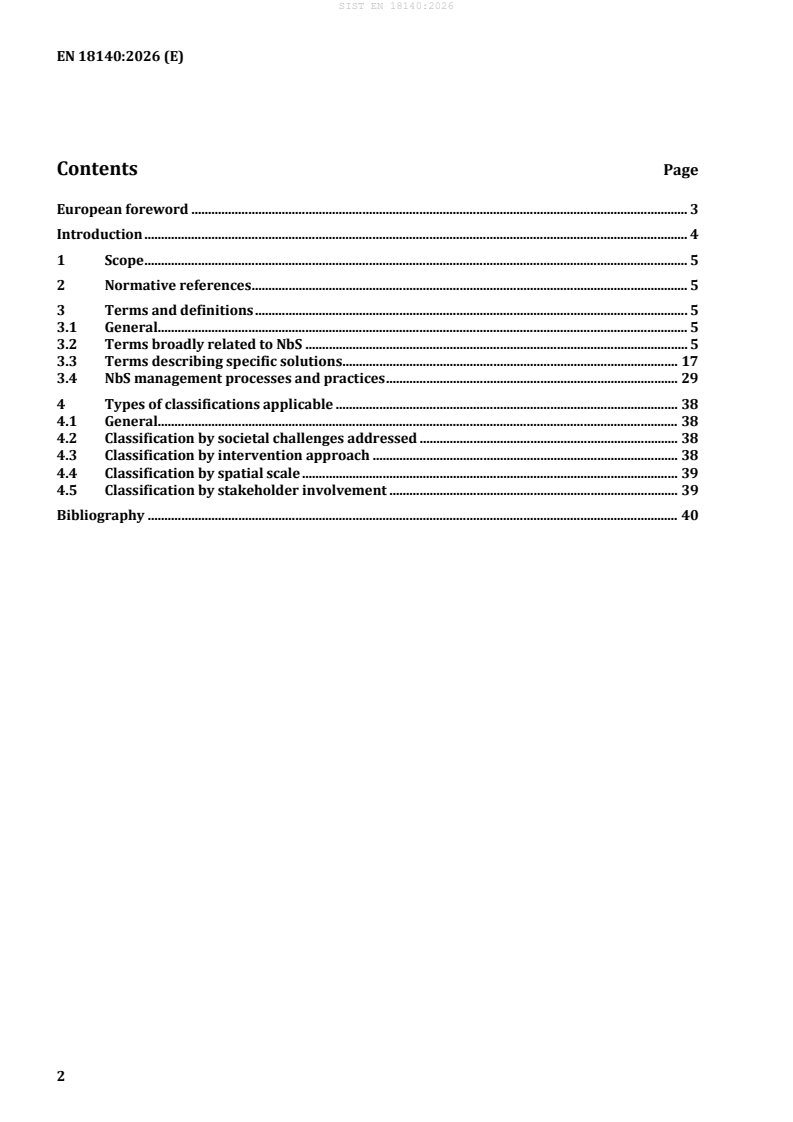
Contents Page
European foreword . 3
Introduction . 4
1 Scope . 5
2 Normative references . 5
3 Terms and definitions . 5
3.1 General. 5
3.2 Terms broadly related to NbS . 5
3.3 Terms describing specific solutions. 17
3.4 NbS management processes and practices . 29
4 Types of classifications applicable . 38
4.1 General. 38
4.2 Classification by societal challenges addressed . 38
4.3 Classification by intervention approach . 38
4.4 Classification by spatial scale . 39
4.5 Classification by stakeholder involvement . 39
Bibliography . 40
European foreword
This document (EN 18140:2026) has been prepared by Technical Committee CEN/TC 465 “Sustainable
cities and communities”, the secretariat of which is held by AFNOR.
This European Standard shall be given the status of a national standard, either by publication of an
identical text or by endorsement, at the latest by October 2026, and conflicting national standards shall
be withdrawn at the latest by October 2026.
Attention is drawn to the possibility that some of the elements of this document may be the subject of
patent rights. CEN shall not be held responsible for identifying any or all such patent rights.
Any feedback and questions on this document should be directed to the users’ national standards body.
A complete listing of these bodies can be found on the CEN website.
According to the CEN-CENELEC Internal Regulations, the national standards organisations of the
following countries are bound to implement this European Standard: Austria, Belgium, Bulgaria, Croatia,
Cyprus, Czech Republic, Denmark, Estonia, Finland, France, Germany, Greece, Hungary, Iceland, Ireland,
Italy, Latvia, Lithuania, Luxembourg, Malta, Netherlands, Norway, Poland, Portugal, Republic of North
Macedonia, Romania, Serbia, Slovakia, Slovenia, Spain, Sweden, Switzerland, Türkiye and the United
Kingdom.
Introduction
At European level the European Commission (EC) released the first document on NbS: Towards an EU
Research and Innovation policy agenda for Nature-Based Solutions and Re-Naturing Cities, in 2015. In this
document the EC identified four goals that can be addressed by nature-based solutions:
— enhancing sustainable urbanisation;
— restoring degraded ecosystems;
— developing climate change adaptation and mitigation;
— Improving risk management and resilience.
In the recent document “EU taxonomy for sustainable activities” (2021c) has considered as
environmental objectives the following categories: climate change mitigation and adaptation, the
sustainable use and protection of water and marine resources, the transition to a circular economy,
pollution prevention and control, the protection and restoration of biodiversity and ecosystems.
Evaluating the impact of NbS the “Handbook of practitioners” (2021a) reported a gap analysis in terms
of:
— lack of a widely agreed definition of Nature-based Solutions (NbS);
— lack of NbS monitoring methodology and implementation stages (longer-term evaluations to assess
NbS effects over time and guaranteeing continuity of monitoring measurements);
— measurability of intangible impacts (e.g. aesthetic enjoyment) and spillovers (impact of NbS
intervention may spread beyond the treated area or group);
— accounting for trade-offs, difficulties in communicating to non-scientific partners the need and the
challenges in a less -technical language.
The United Nation Environmental Agency with the resolution 5 provided the NbS definition that has been
adopted in the present document. This definition, reported at paragraph 3.1, is the most widely accepted
and multilaterally agreed NbS definition currently available (UNEA, 2022).
The effectiveness and credibility of NbS depend on adherence to key principles. These include, but are
not limited to:
— biodiversity net gain and ecosystem integrity;
— addressing societal challenges while enhancing nature;
— long-term sustainability and adaptive management;
— inclusive governance and social equity.
Ensuring that NbS are framed within these principles helps prevent misinterpretation and guarantees
alignment with the UNEA definition and the IUCN “Global Standard” on NbS (IUCN, 2020 a,b).
The purpose of including 3.2. Terms broadly related to NbS, is to provide context, to distinguish those
terms from NbS and to support the standardisation effectiveness. These terms are connected to NbS, but
not necessarily part of the definition, they have been chosen because of their frequent use in the context
of NbS and their presence in the document sources.
1 Scope
Building on the consolidated definitions of NbS, this document establishes a terminology to support the
development of an agreed vocabulary, forming the basis of the standardisation process.
2 Normative references
There are no normative references in this document.
3 Terms and definitions
For the purposes of this document, the following terms and definitions apply.
ISO and IEC maintain terminology databases for use in standardization at the following addresses:
— ISO Online browsing platform: available at https://www.iso.org/obp/
— IEC Electropedia: available at https://www.electropedia.org/
3.1 General
3.1.1
Nature-based solutions
NbS
actions to protect, conserve, restore, sustainably use and manage natural or modified terrestrial,
freshwater, coastal and marine ecosystems which address social, economic and environmental
challenges effectively and adaptively, while simultaneously providing human wellbeing, ecosystem
services, resilience and biodiversity benefits
[SOURCE: UNEP/EA.5/Res.5 United Nations Environment Assembly of the United Nations Environment
Program Fifth, 2022]
3.2 Terms broadly related to NbS
3.2.1
adaptive management
process of iteratively planning, implementing and modifying strategies for managing resources in the face
of uncertainty and change
Note 1 to entry: Adaptive management involves adjusting approaches in response to observations of their effects
and changes in the system brought on by resulting feedback effects and other variables.
[SOURCE: EN ISO 14090:2019, 3.3]
3.2.2
alien species
species, subspecies or lower taxon introduced outside its natural past or present distribution, including
any part, gametes, seeds, eggs, or propagules of such species that might survive and subsequently
reproduce
Note 1 to entry: This definition also applies to the terms “exotic species” and “introduced species” considered in this
standard synonymous with “alien species”.
[SOURCE: Convention on Biological Diversity (CBD) COP 6 Decision V1/23. Alien species that threaten
ecosystems, habitats or species. pp. Annex, Footnote 57 [64]
3.2.3
anthropogenic climate change
change of climate which is attributed directly or indirectly to human activity that alters the composition
of the global atmosphere and which is in addition to natural climate variability observed over comparable
time period
[SOURCE: United Nations Framework Convention on Climate Change (UNFCC),
https://unfccc.int/resource/ccsites/zimbab/conven/text/art01.htm modified: Antrhopogenic added in the
term]
3.2.4
biodiversity
variability among living organisms on the earth, including the variability within and between species, and
within and between ecosystems
[SOURCE: EN ISO 14050:2020, 3.8.22]
3.2.5
blue infrastructure
BI
strategically planned network of natural and semi-natural areas with other environmental features
designed and managed to deliver a wide range of ecosystem services such as water purification, water
retention, air quality improvement, space for recreation and climate resilience and adaptation
Note 1 to entry: This network of blue (water) spaces can improve environmental conditions and therefore citizens'
health and quality of life. It also supports a green economy, creates job opportunities and enhances biodiversity.
[SOURCE: European Commission: Energy, Climate change, Environment
https://environment.ec.europa.eu/topics/nature-and-biodiversity/green-infrastructure_en; modified: “such as
water purification, water retention, air quality improvement, space for recreation and climate resilience
and adaptation” added]
3.2.6
blue-green network
urban space development concept defining a network of existing and/or restored rivers and their valleys
(blue areas) and green areas (agricultural areas, parks, old orchards, wastelands, degraded areas and
others), as a basis for the spatial planning of cities that will provide sustainable development and
adaptation to global climate change
Note 1 to entry: The network aims to create or preserve key ‘reservoirs’ for biodiversity and to link these through
ecological corridors vital to the free movement of species. Blue-green networks can range from small-scale
endeavours to all-encompassing city plans.
3.2.7
carbon sequestration
process of capturing and storing atmospheric carbon dioxide
Note 1 to entry: It is one method of reducing the amount of carbon dioxide in the atmosphere with the goal of
reducing global climate change.
[SOURCE: U.S. Geological Survey https://www.usgs.gov/faqs/what-carbon-sequestration]
3.2.8
climate adaptation services
benefits to people from increased social ability to respond to climate change, provided by the capacity of
ecosystems to moderate and adapt to climate change and variability
[SOURCE: Cohen-Shacham, E., Walters, G., Janzen, C. and Maginnis, S. (eds.) (2016). Nature-based
Solutions to address global societal challenges. Gland, Switzerland: IUCN. xiii + 97pp.]
3.2.9
climate change
change in climate that persists for an extended period, typically decades or longer
[SOURCE: ISO 14050:2020, 3.8.3]
3.2.10
coastal erosion
gradual wearing away of material from a coast by the action of sea water
[SOURCE: ISO/DIS 13208:2024, 3.3.4]
3.2.11
cost-benefit analysis
decision tool which judges the desirability of projects by comparing their costs and benefits
3.2.12
cost-effectiveness analysis
CEA
economic evaluation method that compares the relative costs and outcomes (effects) of different
interventions without monetising benefits, often used to assess the efficiency of NbS implementation
3.2.13
cultural heritage conservation
measures taken to extend the life of cultural heritage while strengthening transmission of its significant
heritage messages and values
Note 1 to entry: In the domain of cultural property, the aim of conservation is to maintain the physical and cultural
characteristics of the object to ensure that its value is not diminished and that it will outlive our limited time span.
[SOURCE: UNESCO https://databrowser.uis.unesco.org/resources/glossary/3073]
3.2.14
cultural landscape
one of the following three main categories:
— clearly defined landscape designed and created intentionally by human beings, often built for
aesthetics reasons associated with religious or other monumental buildings and ensembles
— organically evolved landscape, developed by association with and in response to its natural
environment (a relict, or fossil, landscape or a continuing landscape is one which retains an active
social role in contemporary society)
— associative cultural landscape with powerful religious, artistic or cultural associations of the natural
element
[SOURCE: UNESCO https://whc.unesco.org/en/culturallandscape/#1, modified “by man” with “by human
beings”]
3.2.15
disaster risk
potential loss of life, injury, destroyed or damaged assets which could occur to a system, society or a
community in a specific period of time, determined probabilistically as a function of hazards, exposure,
vulnerability and capacity
[SOURCE: United Nations Office for Disaster Risk Reduction (UNDRR), 2017. The Sendai Framework
Terminology on Disaster Risk Reduction. "Disaster risk reduction". Accessed 2 April 2025.
https://www.undrr.org/terminology/disaster-risk]
3.2.16
disaster risk reduction
DRR
actions aimed at preventing new risks and reducing existing disaster risk and managing residual risk,
which contribute to strengthening resilience and therefore to the achievement of sustainable
development objectives
[SOURCE: United Nations Office for Disaster Risk Reduction (UNDRR), 2017. The Sendai Framework
Terminology on Disaster Risk Reduction. "Disaster risk reduction". Accessed 2 April 2025.
https://www.undrr.org/terminology/disaster-risk-reduction.]
3.2.17
ecohydrology
EH
understanding of relationships between hydrological and biological processes at different scales to
improve water security, enhance biodiversity and further opportunities for sustainable development by
by lessening ecological threats and maximizing greater harmony within catchment processes
[SOURCE: FAO https://agrovoc.fao.org/browse/agrovoc/en/page/c_f3c9b866]
3.2.18
ecohydrological nature-based solution
EH-NbS
action enhancing efficiency of hydrotechnical infrastructure, in agricultural and urban landscapes, for
adaptation to the ongoing climate change and enhancing catchments sustainability by creating
multidimensional potential of the WBSRC (water, biodiversity, ecosystem services for society, resilience
to climatic changes, culture and education)
Note 1 to entry: It also promotes a holistic approach by encouraging transdisciplinary sustainability science and
education; an integral part of this strategy is the implementation of EH-NbS for water quality and quantity
improvement.
3.2.19
ecological engineering
management of systems of human and environmental self-design or light management that joins human
design and environmental self-design
Note 1 to entry: The design of sustainable ecosystems that integrate human society with its environment for the
benefit of both.
[SOURCE:ISO/DIS 13208:2024, 3.1.10]
3.2.20
ecological resilience
ability of an ecosystem to absorb or recover from disturbance and stress, while maintaining its function
and structure
[SOURCE: ISO/DIS 13208:2024, 3.3.14]
3.2.21
ecosystem or ecological system
dynamic complex of plants, animals, and micro-organisms communities, and their non-living
environment interacting as a functional entity
EXAMPLE: Deserts, coral reefs, wetlands, rain forests, boreal forests, grasslands, urban parks, cultivated farmlands.
Note 1 to entry: Ecosystems can be influenced by human activity.
Note 2 to entry: Examples include heathland, quarry lakes.
[SOURCE: EN ISO 14008:2020, 3.1.6, modified, “Note 2 to entry” added]
3.2.22
ecosystem approach
strategy for the integrated management of land, water and living resources that promotes conservation
and sustainable use in an equitable way. Application of the ecosystem approach will help to reach a
balance of the three objectives of the Convention
[SOURCE: Secretariat of the Convention on Biological Diversity (2005). Handbook of the Convention on
Biological Diversity Including its Cartagena Protocol on Biosafety, 3rd edition, (Montreal, Canada), p 586]
3.2.23
ecosystem services
benefits people obtain from ecosystems
Note 1 to entry: These include provisioning services such as food and water; regulating services such as flood and
disease control; cultural services such as spiritual, recreational, and cultural benefits; and supporting services such
as nutrient cycling that maintain the conditions for life on Earth. The concept “ecosystem goods and services” is
synonymous with ecosystem services.
[SOURCE: Millennium Ecosystem Services – MEA (2005). Ecosystems and Human Well-being: Policy
Responses, Volume 3. https://www.millenniumassessment.org/documents/document.776.aspx.pdf.
Retrieved March 2025, modified: “benefits that humans obtain from ecosystems"]
3.2.24
ecosystem-based adaptation
(EbA)
managing ecosystems in a way that uses biodiversity and ecosystem services to help people adapt to the
adverse effects of climate change
[SOURCE: Convention on Biological Diversity (CBD) Technical Series No86 p7]
3.2.25
ecosystem-based management
integrated, science-based approach to the management of natural resources that aims to sustain the
health, resilience and diversity of ecosystems while allowing for sustainable use by humans of the goods
and services they provide
[SOURCE: Cohen-Shacham, E., Walters, G., Janzen, C. and Maginnis, S. (eds.) (2016). Nature-based
Solutions to address global societal challenges. Gland, Switzerland: IUCN. xiii + 97pp.
https://doi.org/10.2305/IUCN.CH.2016.13.en]
3.2.26
ecosystem-based mitigation
managing ecosystems in a way that counteracts anthropogenic climate change, in particular by reducing
emissions of greenhouse gases and enhancing removals of greenhouse gases from the atmosphere
[SOURCE: Convention on Biological Diversity (CBD) Technical Series No86 p7]
3.2.27
ecosystem maintenance
ongoing activity, applied after full recovery of an ecosystem, intended to counteract processes of
ecological degradation to sustain the attributes of an ecosystem
Note 1 to entry: Higher ongoing maintenance is likely to be required at restored sites where higher levels of threats
continue, compared to sites where threats have been controlled.
[SOURCE: International standards for the practice of ecological restoration – including principles and key
concepts http://seraustralasia.com/wheel/image/SER_International_Standards.pdf . Modified, the word
“activity” has been used instead of “activities”; the words “of an ecosystem” have been added after “full
recovery” ]
3.2.28
ecological restoration
activity or process that assists in initiating or accelerating the recovery of the health, structure, integrity,
resilience and stability of an ecosystem or habitat that has been degraded, damaged, or destroyed
Note 1 to entry: By addressing ecosystem integrity, ecological restoration can reverse the loss of species by growing
their population or reducing the population of alien invasive species.
[SOURCE: ISO/DIS 13208:2024, 3.3.17]
3.2.29
ecosystem resilience
capacity of a system to absorb disturbance and reorganize while still retaining similar function, structure,
and feedback
Note 1 to entry: In plant and animal communities, this property is highly dependent on adaptations by individual
species to disturbances or stresses experienced during the species’ evolution.
[SOURCE: International standards for the practice of ecological restoration – including principles and key
concepts, http://seraustralasia.com/wheel/image/SER_International_Standards.pdf, modified: the word
“feedback” has been used instead of the plural “feedbacks”]
3.2.30
endemic species
species for which the entire global range is strictly limited to a specified region or locality
[SOURCE: Food and Agriculture Organization of the United Nations. Reducing Emissions from
Deforestation and Forest Degradation https://www.un-redd.org/glossary/endemic-species. Modified: the
phrase “is restricted to the site, the region or the country” has been replaced by the phrase “is strictly
limited to a specified region or locality”]
3.2.31
environmental protection
prevention of unwanted changes to ecosystems and their constituent parts
[SOURCE: Hamilton, C. and Bastianoni, S. (2019). Environmental protection and ecology. Encyclopaedia
of Ecology (4), 2nd ed., 319-326.]
3.2.32
ex-situ conservation
conservation method that entails the removal of genetic material from their original habitat to grow or
maintain them in another location such as zoos or botanical gardens
[SOURCE: ISO/DIS 13208:2024, 3.3.23]
3.2.33
floodplain
area bordering a river that naturally provides space for the retention of flood and rainwater
Note 1 to entry: The potential floodplain extent is the lateral extent of a flood that has a return period of once every
100 years.
[SOURCE: Office International de l’Eau, 2013. Individual NWRM, Floodplain restoration and management,
http://nwrm.eu/measure/floodplain-restoration-and-management;
https://www.nwrm.eu/sites/default/files/nwrm_ressources/n3_-
_floodplain_restoration_and_management.pdf]
3.2.34
green infrastructure
strategically planned network of natural and semi-natural areas with other environmental features
designed and managed to deliver a wide range of ecosystem services
Note 1 to entry: It incorporates green spaces (or blue if aquatic ecosystems are concerned) and other physical
features in terrestrial (including coastal) and marine areas. On land, green infrastructure is present in rural and
urban settings.
[SOURCE: European Commission https://environment.ec.europa.eu/topics/nature-and-
biodiversity/green-infrastructure_en]
3.2.35
human health
state of complete physical, mental, and social wellbeing and not merely the absence of disease or infirmity
Note 1 to entry: The health of a whole community or population is reflected in measurements of disease incidence
and prevalence, age-specific death rates, and life expectancy. Constituents of wellbeing: The experiential aspects of
wellbeing, such as health, happiness, and freedom to be and do, and, more broadly, basic liberties. Determinants of
wellbeing: Inputs into the production of wellbeing, such as food, clothing, potable water, and access to knowledge
and information.
[SOURCE World Health Organization, https://www.who.int/about/governance/constitution]
3.2.36
human wellbeing
prosperity or quality of life
Note 1 to entry: Human wellbeing is assumed to have multiple constituents, including the basic material for a good
life, such as secure and adequate livelihoods, enough food at all times, shelter, clothing, and access to goods; health,
including feeling well and having a healthy physical environment, such as clean air and access to clean water; good
social relations, including social cohesion, mutual respect, and the ability to help others and provide for children;
security, including secure access to natural and other resources, personal safety, and security from natural and
human-made disasters; and freedom of choice and action, including the opportunity to achieve what an individual
values doing and being.
Note 2 to entry: NbS provide human wellbeing.
[SOURCE: World Health Organization, https://www.who.int/activities/promoting-well-being]
3.2.37
hybrid infrastructure
mixes the conservation and restoration of nature (including natural coastal buffers such as mangroves
and seagrasses) with conventional approaches (such as concrete dams, roads, pipes and seawalls), also
known as grey infrastructure, potentially delivering benefits for the economy, communities, and the
environment
[SOURCE: Integrating Green and Gray – Creating Next Generation Infrastructure" Report, World Bank &
World Resources Institute (WRI) and from the EU Green Infrastructure Strategy COM(2019) 236 final
https://www.conservation.org/projects/green-gray-infrastructure ]
3.2.38
invasive species or invasive alien species
species whose introduction and/or spread threaten biological diversity
[SOURCE: Convention on Biological Diversity, (CBD) COP 6 Decision V1/23. species that threaten
ecosystems, habitats or species. pp. Annex, Footnote 57 [64]]
3.2.39
in-situ conservation
conservation of ecosystems and habitats and the maintenance and recovery of viable populations of
species in their surroundings and, in the case of domesticated or cultivated species, in the surroundings
where they have developed their distinctive properties
[SOURCE: ISO/DIS 13208:2024, 3.3.28]
3.2.40
just transition
set of principles, processes and practices that aim to ensure that no people, workers, places, sectors,
countries or regions are left behind in the transition from a high-carbon to a low carbon economy and
environmentally sustainable economies and societies, can enable more ambitious climate action and
provide an impetus to attaining the Sustainable Development Goals
[SOURCE: IPCC, 2022: Annex I: Glossary [van Diemen, R., J.B.R. Matthews, V. Möller, J.S. Fuglestvedt, V.
Masson-Delmotte, C. Méndez, A. Reisinger, S. Semenov (eds)]. In IPCC, 2022: Climate Change 2022:
Mitigation of Climate Change. Contribution of Working Group III to the Sixth Assessment Report of the
Intergovernmental Panel on Climate Change [P.R. Shukla, J. Skea, R. Slade, A. Al Khourdajie, R. van Diemen,
D. McCollum, M. Pathak, S. Some, P. Vyas, R. Fradera, M. Belkacemi, A. Hasija, G. Lisboa, S. Luz, J. Malley,
(eds.)]. Cambridge University Press, Cambridge, UK and New York, NY, USA. doi:
10.1017/9781009157926.020]
3.2.41
land use change
change in the land use or management of land by humans which may lead to a change in land cover
[SOURCE: IPBES (2019), Global assessment report of the Intergovernmental Science-Policy Platform on
Biodiversity and Ecosystem Services, Brondzio, E. S., Settele, J., Daz, S., Ngo, H. T. (eds). IPBES secretariat,
Bonn, Germany. 1144 pages. ISBN: 978-3-947851-20-1]
3.2.42
land use
anthropogenic use of a piece of land for a certain purpose such as irrigated agriculture or recreation or
conservation
Note 1 to entry: Land use is influenced by, but not synonymous with, land cover.
[SOURCE: IPBES (2019), Global assessment report of the Intergovernmental Science-Policy Platform on
Biodiversity and Ecosystem Services, Brondzio, E. S., Settele, J., Daz, S., Ngo, H. T. (eds). IPBES secretariat,
Bonn, Germany. 1144 pages. ISBN: 978-3-947851-20-1]
3.2.43
marine protected area
MPA
designated area in the ocean within which human activities are regulated more stringently than
elsewhere in the marine environment
Note 1 to entry: The protection afforded by MPAs can vary widely, from minimal protection to full protection, that
is, no-take reserves. Such areas are carved out to maintain, at least to some extent, the natural environment of the
designated area for ecological, economic, cultural, social, recreational, and other reasons.
[SOURCE: Ussif R. Sumaila, Gordon R. Munro, in Encyclopaedia of Ocean Sciences (Third Edition), 2019
https://doi.org/10.1016/B978-0-12-409548-9.11376-4]
3.2.44
native species or indigenous species
fauna, flora, fungi, algae, and other microbial species that occur naturally in a given area
[SOURCE: ISO/DIS 13208:2024, 3.1.35]
3.2.45
natural capital
world’s stock of natural assets which include geology, soil, air, water and all living things
Note 1 to entry: It is from this natural capital that humans derive a wide range of services, often called ecosystem
services, which make human life possible.
[SOURCE: World Forum on Natural Capital https://www.cbd.int/business/projects/natcap.shtml]
3.2.46
nature’s contribution to people
NCP
contributions both positive and negative of living nature (diversity of organisms, ecosystems and their
associated ecological and evolutionary processes) to people’s quality of life
Note 1 to entry: The NCP concept is building on the ecosystem services (ES) concept and aims to incorporate social
sciences more inclusively into the already established economic and ecological aspects of ES, broadening its
epistemological boundaries. The NCP framework has not been designed to replace the ES framework and can be
used to complete it.
[SOURCE: Díaz, S., Pascual, U., Stenseke, M., Martín-López, B., Watson, R. T., Molnár, Z., . & Shirayama, Y.
(2018). Assessing nature's contributions to people. Science, 359(6373), 270-272.]
3.2.47
nature-positive
halt and reverse nature loss by 2030 on a 2020 baseline, and achieve full recovery by 2050
Note 1 to entry: Recognised by the Nature Positive Initiative (NPI), this term is central to global biodiversity
strategies.
[SOURCE: Nature Positive Initiative https://www.naturepositive.org/app/uploads/2024/02/The-
Definition-of-Nature-Positive.pdf]
3.2.48
nature-positive economy
economy that no longer incentivises the overexploitation of nature and instead results in increasing
levels of nature over time, operating within planetary boundaries
[SOURCE: WWF (2024). Global Roadmap for a Nature-Positive Economy.
https://wwfint.awsassets.panda.org/downloads/global-roadmap-for-a-nature-positive-economy---
october-2024.pdf]
3.2.49
nature-based enterprise
enterprise, engaged in economic activity, that uses nature sustainably as a core element of their
product/service offering. Here, nature may be engaged directly by growing, harnessing, harvesting, or
sustainably restoring natural ecosystems, and/or indirectly by contributing to the planning, delivery or
stewardship of nature-based solutions
Note 1 to entry: A nature-based enterprise must contribute positively to biodiversity and ecosystem services.
[SOURCE: European Commission: Directorate-General for Research and Innovation. (2022). The vital role
of nature-based solutions in a nature positive economy. Publications Office of the European Union.
https://data.europa.eu/doi/10.2777/307761]
3.2.50
NbS maintenance
maintenance ranging from landscaping to water engineering and civil infrastructure
Note 1 to entry: It may be undertaken by the local entity, by stakeholders through agreements or outsourced. In any
case, it should be considered in the NbS implementation financial plan, which covers the whole NbS life-cycle, from
design to construction, monitoring and end of life, with funds made available in the annual municipal budget as well
as for medium- and long-term plans. The maintenance programme should include preventive and corrective
measures for the short and long term.
3.2.51
NbS stewardship
ongoing participatory management and maintenance of NbS
Note 1 to entry: Stewardship includes the monitoring and evaluation of the nature-based solutions, which enables
the making of adaptations that ensure long-term sustainability and resilience.
3.2.52
nature-derived solution
wind, wave and solar energy, all of which are derived from nature and help to fulfil low carbon energy
needs through production methods deriving from natural sources
Note 1 to entry: Although these energy sources come from the natural world, they are not directly based on
functioning ecosystems, therefore should not be confused with nature-based solutions.
[SOURCE: International Union for Conservation of Nature - IUCN (2020b). Guidance for using the IUCN
Global Standard for Nature-based Solutions. A user-friendly framework for the verification, design and
scaling up of Nature-based Solutions. First edition. Gland, Switzerland: IUCN. ISBN: 978-2-8317-2061-6,
DOI: https://doi.org/10.2305/IUCN.CH.2020.09.en]
3.2.53
nature-inspired solution
innovative design and production of materials, structures and systems that are modelled on biological
processes and are nature-inspired
Note 1 to entry: For example, biomimicry is a practice that learns from and mimics the strategies found in nature to
solve challenges. They are not based on functioning ecosystems, therefore should not be confused with nature-
based solutions.
[SOURCE: International Union for Conservation of Nature - IUCN (2020b). Guidance for using the IUCN
Global Standard for Nature-based Solutions. A user-friendly framework for the verification, design and
scaling up of Nature-based Solutions. First edition. Gland, Switzerland: IUCN. ISBN: 978-2-8317-2061-6,
DOI: https://doi.org/10.2305/IUCN.CH.2020.09.en]
3.2.54
protected area
clearly defined geographical space, recognized, dedicated, and managed, through legal or other effective
means, to achieve the long-term conservation of nature
[SOURCE: ISO/DIS 13208:2024, 3.3.45]
3.2.55
resilience
ability of a system, community or society exposed to hazards to resist, absorb, accommodate to and
recover from the effects of a hazard in a timely and efficient manner, including through the preservation
and restoration of its essential basic structures and functions
[SOURCE: United Nations Office for Disaster Risk Reduction (UNISDR), “2009 UNISDR Terminology on
Disaster Risk Reduction”, Geneva, May 2009 (https://www.undrr.org/terminology/resilience)]
3.2.56
risk assessment
qualitative and/or quantitative scientific estimation of risks
[SOURCE: Modified from Urban Adaptation Support Tool (2.4), Covenant of Mayors for Climate & Energy,
Europe]
3.2.57
scale
measurable dimensions of phenomena or observations
Note 1 to entry: Expressed in physical units, such as meters, years, population size, or quantities moved or
exchanged. In observation, scale determines the relative fineness and coarseness of different detail and the
selectivity among patterns these data may form.
3.2.58
soil conservation
management of soil to prevent or reduce soil erosion and depletion by wind and water
Note 1 to entry: Preservation of soil against deterioration and loss by using it within its capabilities; application of
conservation practices needed for its protection and improvement.
[SOURCE: WISE Freshwater Information System for Europe,
https://water.europa.eu/freshwater/resources/glossary/soil-conservation . modified: the word “soil”
has been used instead of “land”; the word “prevent or reduce” has been used instead of “minimise”; the
sentence “depletion by wind and water” has been used instead of “water resources, and provide
sustainable benefits in the long term”]
3.2.59
stepping stones
habitat patches that are scattered throughout a landscape that facilitate dispersal among otherwise
isolated habitat areas
[SOURCE: Saura S, Bodin Ö, Fortin M-J. 2013. Stepping stones are crucial for species’ long-distance
dispersal and range expansion through habitat networks. Journal of Applied Ecology, 51(1), 171-182]
3.2.60
stakeholder
person or group who are directly or indirectly affected by a project, as well as those who may have
interests in a project and/or the ability to influence its outcome, positively or negatively
Note 1 to entry: Stakeholders can include locally affected communities or individuals and their formal and informal
representatives, national or local government authorities, politicians, religious leaders, civil society, organizations
and groups with special interests, the academic community, or other businesses. The “stake” that each of these
different individuals or groups has in a project or investment will vary.
3.2.61
sustainability
process that helps create a vibrant economy and a high quality of life, while respecting the need to sustain
natural resources and protect the environment
Note 1 to entry: It expresses the principle that future generations should live in a world that the present generation
has enjoyed but not diminished.
[SOURCE: Clough, G. W., Chameau, J.-L., Carmichael, C., 2006. “Sustainability and the University.”
https://uwosh.edu/sirt/wp-content/uploads/sites/86/2017/08/Definitions-of-Sustainability.pdf]
3.2.62
trade-off
choice that involves losing one quality or service (of an ecosystem) in return for gaining another quality
or service
Note 1 to entry: Many decisions affecting ecosystems involve trade-offs, sometimes mainly in the long term.
3.2.63
urban ecosystem
urban environment as a whole, embodying both the built infrastructure and the ecological infrastructure,
so the built environment is fully part of the urban ecosystem
Note 1 to entry: It is largely artificial ecosystem dominated by human activities including settlements, commercial
and industrial areas that have changed the structure, transformed the material cycle and partially changed the
energy conversion process.
[SOURCE: Pickett, S.T.A. “urban ecosystem”. Encyclopedia Britannica, 2015[12]]
3.2.64
urban resilience
ability of any urban system, with its inhabitants, in a changing environment, to anticipate, prepare,
respond to and absorb shocks, positively adapt and transform in the face of stresses and challenges, such
as the urban heat island effect, while facilitating inclusive and sustainable development
[SOURCE: ISO/TR 22370:2020, 3.26, modified, notes to entry deleted]
3.2.65
vulnerability assessment
qualitative analysis of climate change impacts using a matrix of the participatory process
Note 1 to entry: Indicator-based vulnerability assessments use sets of pre-defined indicators that can be both
quantitative and qualitative and can be assessed both through modelling or stakeholder consultation. It can be
combined with risk assessment.
[SOURCE: Urban Adaptation Support Tool (2.4), Covenant of Mayors for Climate & Energy, Europe,
modified: note to entry added]
3.3 Terms describing specific solutions
3.3.1
artificial reef
human-made structures that are intentionally placed on the seafloor or submerged in bodies of water to
enhance marine habitats and ecosystems
[SOURCE: https://pharosproject.eu/blog/artificial-reefs/]
3.3.2
biofilter
filter developed to collect and treat storm- and wastewater using bacteria and microorganisms
Note 1 to entry: Bacteria and microorganisms are located on a filter medium (biofilm), which often consists of sand
or granular activated carbon. The biofilm degrades nutrients and contaminants in the wastewater (influent) that is
pumped through the filter material. The term “filter,” however, can be misleading. Biofilters separate and remove
nutrients and organic carbons from storm- and wastewater through biodegradation. As a result, biofiltration
improves the quality of storm- and wastewater (e.g. the reduction of nutrients, metals, sediments) while
temporarily storing stormwater, which can help reduce peak flows.
Terms describing components that are widely accepted and used as nature-based solutions when implemented in
a manner to deliver NbS benefits.
[SOURCE: UnaLab – URBAN NATURE LABS, 2022. Nature-based Solutions. Technical Handbook
Factsheets. Stuttgart, p. 134]
3.3.3
biogenic reef
structure (concretions, encrustations, and bivalve beds originating from dead or living animals) arising
from the seafloor
Note 1 to entry: Biogenic reefs are made up of hard matter created by living organisms. The reefs are raised above
the seabed. Reefs can grow to be several metres in height and diameter, providing important habitat for a number
of species.
Note 2 to entry: The restoration of biogenic reefs, such as native shellfish reefs (oysters or other bivalve) or coral
reefs, is a NbS that provides
...