

EN 1999-1-1:2023
(Main)Eurocode 9 - Design of aluminium structures - Part 1-1: General rules
General Information
- Abstract
1.1 Scope of FprEN 1999-1-1
(1) FprEN 1999-1-1 gives basic design rules for structures made of wrought aluminium alloys and limited guidance for cast alloys (see Clause 5 and Annex C).
This document does not cover the following, unless otherwise explicitly stated in this document:
- components with material thickness less than 0,6 mm;
- welded components with material thickness less than 1,5 mm;
- connections with:
- steel bolts and pins with diameter less than 5 mm;
- aluminium bolts and pins with diameter less than 8 mm;
- rivets and thread forming screws with diameter less than 3,9 mm.
1.2 Assumptions
(1) In addition to the general assumptions of EN 1990 the following assumptions apply:
- execution complies with EN 1090-3 and EN 1090-5;
- the mechanical properties comply with the product standards listed in 5.2.2.
(2) EN 1999 is intended to be used in conjunction with:
- European Standards for construction products relevant for aluminium structures;
- EN 1090-1, Execution of steel structures and aluminium structures - Part 1: Requirements for conformity assessment of structural components;
- EN 1090-3, Execution of steel structures and aluminium structures - Part 3: Technical requirements for aluminium structures;
- EN 1090-5, Execution of steel structures and aluminium structures - Part 5: Technical requirements for cold-formed structural aluminium elements and cold-formed structures for roof, ceiling, floor and wall applications.
- Status
- Published
- Publication Date
- 21-Mar-2023
- Technical Committee
- CEN/TC 250 - Structural Eurocodes
- Drafting Committee
- CEN/TC 250/SC 9 - Eurocode 9: Design of aluminium structures
- Current Stage
- 6060 - Definitive text made available (DAV) - Publishing
- Start Date
- 22-Mar-2023
- Due Date
- 19-Mar-2022
- Completion Date
- 22-Mar-2023

Overview
EN 1999-1-1:2023 - Eurocode 9: Design of aluminium structures - Part 1-1: General rules is a key European Standard developed by CEN (European Committee for Standardization). It provides fundamental design rules and requirements for the construction of structures using wrought aluminium alloys, and limited guidelines for cast aluminium alloys. The standard elevates the safety, reliability, and consistency of aluminium structural designs across Europe, supporting engineers, architects, and construction professionals in adopting best practices.
EN 1999-1-1:2023 supersedes previous editions, updating approaches to modern materials, manufacturing methods, and regulatory compliance. Its scope is focused on structural components and does not extend to very thin materials or small connectors, unless otherwise specified.
Key Topics
EN 1999-1-1:2023 covers a comprehensive range of aspects crucial to the proper design and execution of aluminium structures:
- Material Selection: Basic requirements for the use of wrought and cast aluminium alloys, including compliance with specific product standards.
- General Design Rules: Principles for structural reliability, durability, and robustness, in alignment with EN 1990.
- Structural Analysis: Methods for global and member-level analysis, taking into account imperfection, buckling, and stability.
- Limit States: Principles of ultimate and serviceability limit states, ensuring safety under various loading scenarios.
- Connections and Joints: Guidance for the design of bolts, rivets, pins, welded joints, and alternative joining methods.
- Execution Requirements: Reference to EN 1090-3 and EN 1090-5 for execution and conformity.
- Quality and Corrosion Protection: Directions on quality assurance, corrosion, and surface protection to enhance service life.
Key exclusions are detailed, including:
- Aluminium components less than 0.6 mm thick
- Welded components thinner than 1.5 mm
- Connectors below specified minimum diameters
Additional annexes provide informative content on finite element analysis, durability, casting, analytical models, cross-sectional properties, and joining techniques.
Applications
EN 1999-1-1:2023 is applicable to a wide variety of projects in the construction and engineering sectors where aluminium is selected for its weight, strength, and corrosion resistance. Common applications include:
- Building Frameworks: Structural frameworks for commercial, industrial, and residential buildings.
- Bridges and Walkways: Lightweight, corrosion-resistant bridges and pedestrian structures.
- Facade and Roofing Systems: Design of curtain walls, facades, roofs, and ceilings using aluminium profiles.
- Transport and Infrastructure: Station canopies, transport shelters, and related infrastructure components.
- Special Structures: Exhibition halls, sports arenas, and other spaces benefiting from aluminium’s unique properties.
By following EN 1999-1-1:2023, designers and engineers ensure compliance with harmonized European regulatory requirements, facilitate cross-border construction projects, and increase the safety and longevity of aluminium structures.
Related Standards
EN 1999-1-1:2023 is intended to be used in conjunction with a range of supporting European and international standards, including:
- EN 1090-1: Execution of steel and aluminium structures - Requirements for conformity assessment.
- EN 1090-3: Technical requirements for the execution of aluminium structures.
- EN 1090-5: Technical requirements for cold-formed structural aluminium elements.
- EN 1990: Eurocode - Basis of structural design.
- Relevant product standards for mechanical properties and fabrication of aluminium alloys.
Adopting EN 1999-1-1:2023 along with these related standards ensures a holistic approach to the safe and efficient design, execution, and maintenance of modern aluminium structures.
Relations
- Effective Date
- 29-Mar-2023
- Effective Date
- 29-Mar-2023
- Replaces
EN 1999-1-1:2007 - Eurocode 9: Design of aluminium structures - Part 1-1: General structural rules - Effective Date
- 13-Nov-2019
- Effective Date
- 25-Mar-2026
- Effective Date
- 25-Mar-2026
- Refers
EN 1991-3:2026 - Eurocode 1 - Actions on structures - Part 3: Actions induced by cranes and machines - Effective Date
- 25-Mar-2026
- Effective Date
- 25-Mar-2026
- Effective Date
- 25-Mar-2026
- Effective Date
- 28-Jan-2026
- Effective Date
- 28-Jan-2026
- Effective Date
- 28-Jan-2026
- Effective Date
- 28-Jan-2026
- Effective Date
- 28-Jan-2026
- Effective Date
- 28-Jan-2026
- Effective Date
- 28-Jan-2026
Get Certified
Connect with accredited certification bodies for this standard

DIBt (Deutsches Institut für Bautechnik)
German Institute for Building Technology.
DIN CERTCO
DIN Group product certification.

Aboma Certification B.V.
Specialized in construction, metal, and transport sectors.
Sponsored listings
Frequently Asked Questions
EN 1999-1-1:2023 is a standard published by the European Committee for Standardization (CEN). Its full title is "Eurocode 9 - Design of aluminium structures - Part 1-1: General rules". This standard covers: 1.1 Scope of FprEN 1999-1-1 (1) FprEN 1999-1-1 gives basic design rules for structures made of wrought aluminium alloys and limited guidance for cast alloys (see Clause 5 and Annex C). This document does not cover the following, unless otherwise explicitly stated in this document: - components with material thickness less than 0,6 mm; - welded components with material thickness less than 1,5 mm; - connections with: - steel bolts and pins with diameter less than 5 mm; - aluminium bolts and pins with diameter less than 8 mm; - rivets and thread forming screws with diameter less than 3,9 mm. 1.2 Assumptions (1) In addition to the general assumptions of EN 1990 the following assumptions apply: - execution complies with EN 1090-3 and EN 1090-5; - the mechanical properties comply with the product standards listed in 5.2.2. (2) EN 1999 is intended to be used in conjunction with: - European Standards for construction products relevant for aluminium structures; - EN 1090-1, Execution of steel structures and aluminium structures - Part 1: Requirements for conformity assessment of structural components; - EN 1090-3, Execution of steel structures and aluminium structures - Part 3: Technical requirements for aluminium structures; - EN 1090-5, Execution of steel structures and aluminium structures - Part 5: Technical requirements for cold-formed structural aluminium elements and cold-formed structures for roof, ceiling, floor and wall applications.
1.1 Scope of FprEN 1999-1-1 (1) FprEN 1999-1-1 gives basic design rules for structures made of wrought aluminium alloys and limited guidance for cast alloys (see Clause 5 and Annex C). This document does not cover the following, unless otherwise explicitly stated in this document: - components with material thickness less than 0,6 mm; - welded components with material thickness less than 1,5 mm; - connections with: - steel bolts and pins with diameter less than 5 mm; - aluminium bolts and pins with diameter less than 8 mm; - rivets and thread forming screws with diameter less than 3,9 mm. 1.2 Assumptions (1) In addition to the general assumptions of EN 1990 the following assumptions apply: - execution complies with EN 1090-3 and EN 1090-5; - the mechanical properties comply with the product standards listed in 5.2.2. (2) EN 1999 is intended to be used in conjunction with: - European Standards for construction products relevant for aluminium structures; - EN 1090-1, Execution of steel structures and aluminium structures - Part 1: Requirements for conformity assessment of structural components; - EN 1090-3, Execution of steel structures and aluminium structures - Part 3: Technical requirements for aluminium structures; - EN 1090-5, Execution of steel structures and aluminium structures - Part 5: Technical requirements for cold-formed structural aluminium elements and cold-formed structures for roof, ceiling, floor and wall applications.
EN 1999-1-1:2023 is classified under the following ICS (International Classification for Standards) categories: 91.010.30 - Technical aspects; 91.080.17 - Aluminium structures. The ICS classification helps identify the subject area and facilitates finding related standards.
EN 1999-1-1:2023 has the following relationships with other standards: It is inter standard links to EN 1999-1-1:2007/A1:2009, EN 1999-1-1:2007/A2:2013, EN 1999-1-1:2007, EN 1991-1-4:2026, EN 1993-1-11:2026, EN 1991-3:2026, EN 1991-4:2026, EN 1991-1-8:2026, EN ISO 13918:2018, EN 14399-8:2018, EN 14399-1:2015, EN 1991-1-7:2025, EN 1993-1-11:2006, EN 1993-1-8:2024, EN 1991-1-6:2005. Understanding these relationships helps ensure you are using the most current and applicable version of the standard.
EN 1999-1-1:2023 is associated with the following European legislation: EU Directives/Regulations: 305/2011; Standardization Mandates: M/515. When a standard is cited in the Official Journal of the European Union, products manufactured in conformity with it benefit from a presumption of conformity with the essential requirements of the corresponding EU directive or regulation.
EN 1999-1-1:2023 is available in PDF format for immediate download after purchase. The document can be added to your cart and obtained through the secure checkout process. Digital delivery ensures instant access to the complete standard document.
Standards Content (Sample)
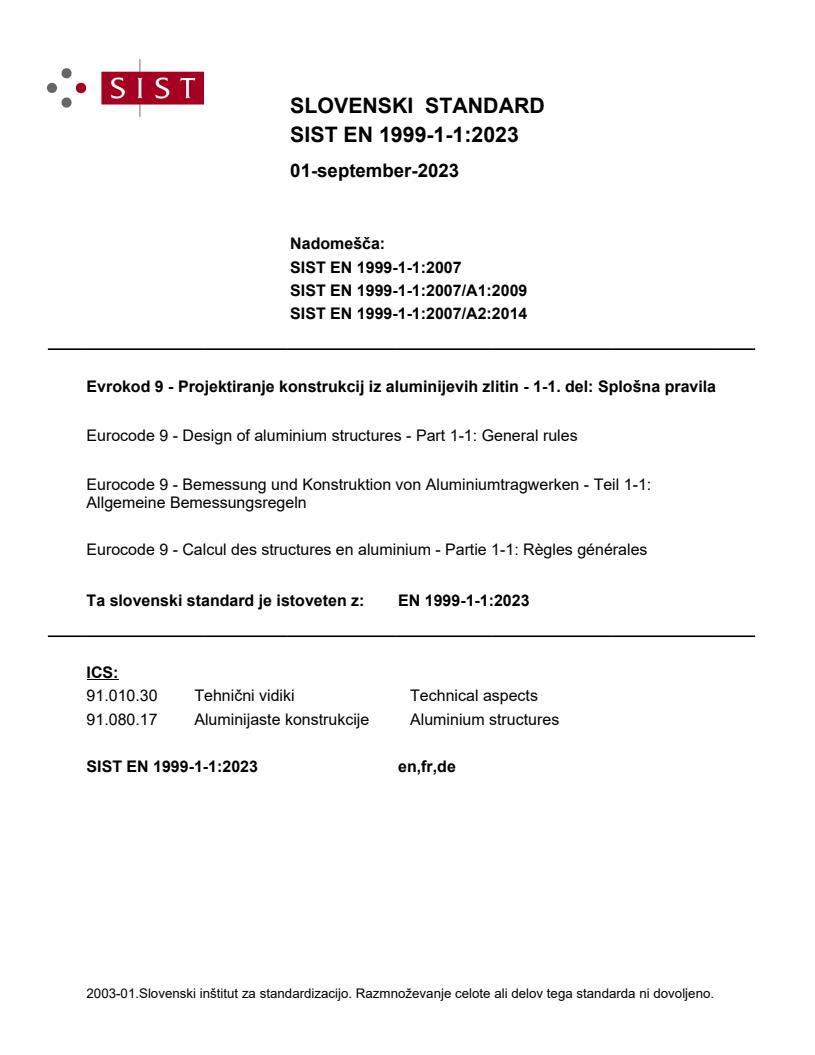
SLOVENSKI STANDARD
SIST EN 1999-1-1:2023
01-september-2023
Nadomešča:
SIST EN 1999-1-1:2007
SIST EN 1999-1-1:2007/A1:2009
SIST EN 1999-1-1:2007/A2:2014
Evrokod 9 - Projektiranje konstrukcij iz aluminijevih zlitin - 1-1. del: Splošna pravila
Eurocode 9 - Design of aluminium structures - Part 1-1: General rules
Eurocode 9 - Bemessung und Konstruktion von Aluminiumtragwerken - Teil 1-1:
Allgemeine Bemessungsregeln
Eurocode 9 - Calcul des structures en aluminium - Partie 1-1: Règles générales
Ta slovenski standard je istoveten z: EN 1999-1-1:2023
ICS:
91.010.30 Tehnični vidiki Technical aspects
91.080.17 Aluminijaste konstrukcije Aluminium structures
SIST EN 1999-1-1:2023 en,fr,de
2003-01.Slovenski inštitut za standardizacijo. Razmnoževanje celote ali delov tega standarda ni dovoljeno.
SIST EN 1999-1-1:2023
SIST EN 1999-1-1:2023
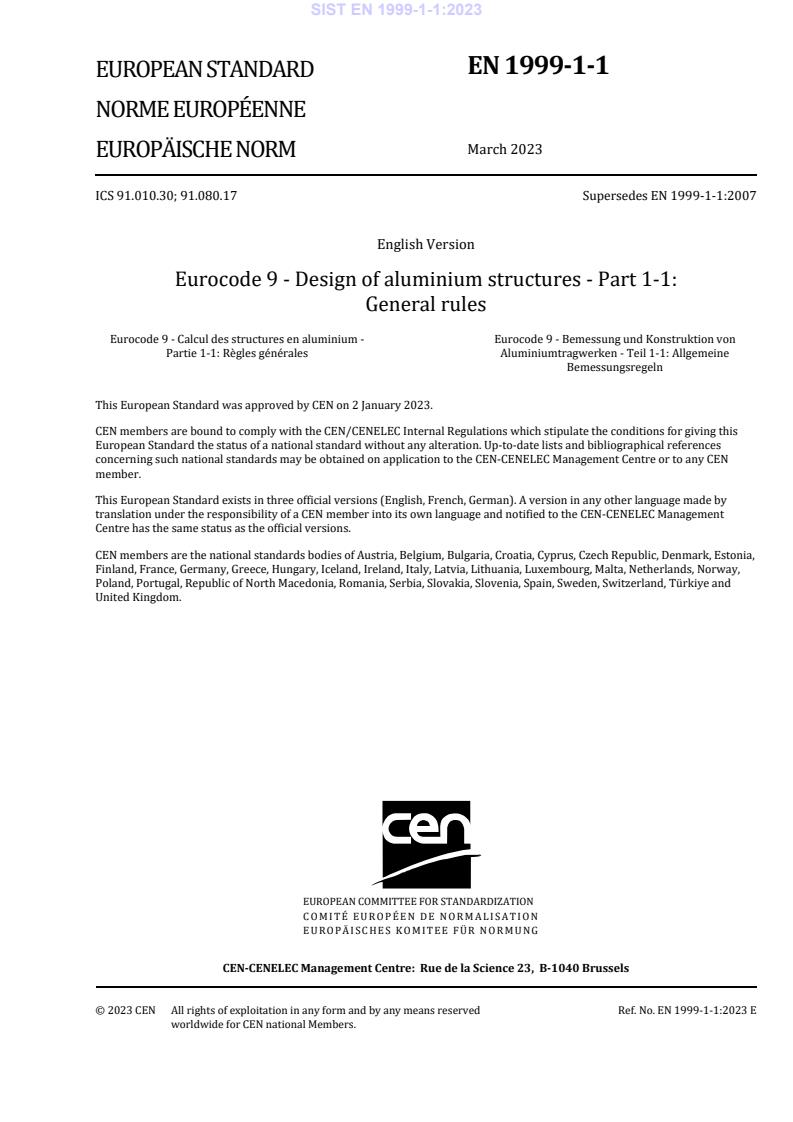
EN 1999-1-1
EUROPEAN STANDARD
NORME EUROPÉENNE
March 2023
EUROPÄISCHE NORM
ICS 91.010.30; 91.080.17 Supersedes EN 1999-1-1:2007
English Version
Eurocode 9 - Design of aluminium structures - Part 1-1:
General rules
Eurocode 9 - Calcul des structures en aluminium - Eurocode 9 - Bemessung und Konstruktion von
Partie 1-1: Règles générales Aluminiumtragwerken - Teil 1-1: Allgemeine
Bemessungsregeln
This European Standard was approved by CEN on 2 January 2023.
CEN members are bound to comply with the CEN/CENELEC Internal Regulations which stipulate the conditions for giving this
European Standard the status of a national standard without any alteration. Up-to-date lists and bibliographical references
concerning such national standards may be obtained on application to the CEN-CENELEC Management Centre or to any CEN
member.
This European Standard exists in three official versions (English, French, German). A version in any other language made by
translation under the responsibility of a CEN member into its own language and notified to the CEN-CENELEC Management
Centre has the same status as the official versions.
CEN members are the national standards bodies of Austria, Belgium, Bulgaria, Croatia, Cyprus, Czech Republic, Denmark, Estonia,
Finland, France, Germany, Greece, Hungary, Iceland, Ireland, Italy, Latvia, Lithuania, Luxembourg, Malta, Netherlands, Norway,
Poland, Portugal, Republic of North Macedonia, Romania, Serbia, Slovakia, Slovenia, Spain, Sweden, Switzerland, Türkiye and
United Kingdom.
EUROPEAN COMMITTEE FOR STANDARDIZATION
COMITÉ EUROPÉEN DE NORMALISATION
EUROPÄISCHES KOMITEE FÜR NORMUNG
CEN-CENELEC Management Centre: Rue de la Science 23, B-1040 Brussels
© 2023 CEN All rights of exploitation in any form and by any means reserved Ref. No. EN 1999-1-1:2023 E
worldwide for CEN national Members.
SIST EN 1999-1-1:2023
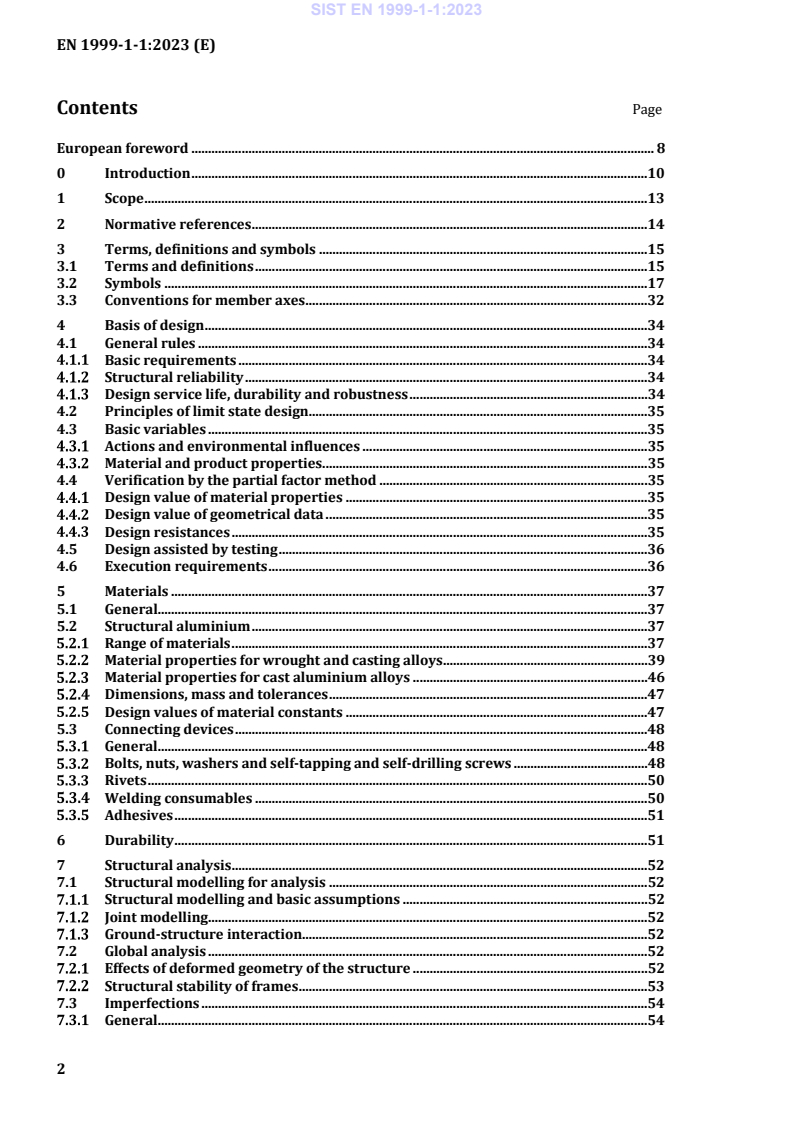
Contents Page
European foreword . 8
0 Introduction .10
1 Scope .13
2 Normative references .14
3 Terms, definitions and symbols .15
3.1 Terms and definitions .15
3.2 Symbols .17
3.3 Conventions for member axes .32
4 Basis of design .34
4.1 General rules .34
Basic requirements .34
Structural reliability .34
Design service life, durability and robustness .34
4.2 Principles of limit state design .35
4.3 Basic variables .35
Actions and environmental influences .35
Material and product properties .35
4.4 Verification by the partial factor method .35
Design value of material properties .35
Design value of geometrical data .35
Design resistances .35
4.5 Design assisted by testing .36
4.6 Execution requirements .36
5 Materials .37
5.1 General.37
5.2 Structural aluminium .37
Range of materials .37
Material properties for wrought and casting alloys .39
Material properties for cast aluminium alloys .46
Dimensions, mass and tolerances .47
Design values of material constants .47
5.3 Connecting devices .48
General.48
Bolts, nuts, washers and self-tapping and self-drilling screws .48
Rivets .50
Welding consumables .50
Adhesives .51
6 Durability .51
7 Structural analysis .52
7.1 Structural modelling for analysis .52
Structural modelling and basic assumptions .52
Joint modelling.52
Ground-structure interaction.52
7.2 Global analysis .52
Effects of deformed geometry of the structure .52
Structural stability of frames .53
7.3 Imperfections .54
General.54
SIST EN 1999-1-1:2023
Imperfections for global analysis of frames. 54
Imperfection for analysis of bracing systems . 61
Member imperfections . 63
7.4 Methods of analysis . 63
General . 63
Elastic global analysis . 64
Plastic global analysis . 64
8 Ultimate limit states for members. 64
8.1 Basis. 64
General . 64
Characteristic value of strength . 64
Partial factors . 65
Classification of cross-sections . 65
Local buckling resistance in class 4 members . 73
HAZ softening adjacent to welds . 74
8.2 Resistance of cross-sections . 77
General . 77
Section properties . 78
Tension . 79
Compression . 80
Bending moment . 81
Shear . 84
Torsion . 85
Bending and shear . 86
Bending and axial force . 87
Bending, shear and axial force . 88
Web bearing. 88
8.3 Buckling resistance of members . 89
Members in compression. 89
Members in bending . 95
Members in bending and axial compression . 98
8.4 Simplified analysis of resistance . 103
8.5 Uniform built-up members . 104
General . 104
Laced compression members . 106
Battened compression members . 108
Closely spaced built-up members . 109
8.6 Un-stiffened plates under in-plane loading . 110
General . 110
Resistance under uniform compression . 111
Resistance under in-plane moment . 112
Resistance under transverse or longitudinal stress gradient . 113
Shear resistance . 113
Resistance under out-of-plane loading . 114
Resistance under combined action . 115
8.7 Stiffened plates under in-plane loading . 116
General . 116
Stiffened plates under uniform compression . 117
Stiffened plates under in-plane moment . 119
Longitudinal stress gradient on multi-stiffened plates . 120
Multi-stiffened plate in shear . 120
Buckling load for orthotropic plates . 121
Out-of-plane loading . 124
Resistance under combined loading. 126
SIST EN 1999-1-1:2023
8.8 Plate girders. 128
General. 128
Resistance of plate girders under in-plane bending . 128
Plate girders with longitudinal web stiffeners . 129
Shear resistance . 131
Resistance to transverse forces . 136
Interaction . 140
Flange induced buckling . 141
Web stiffeners . 142
8.9 Members with corrugated webs . 143
General. 143
Bending moment resistance . 143
Shear force resistance . 144
9 Serviceability limit states . 146
9.1 General. 146
9.2 Deformations and dynamic effects for buildings . 146
10 Design of joints . 147
10.1 Basis of design . 147
Introduction . 147
Applied forces and moments . 147
Resistance of joints . 148
Design assumptions . 148
Fabrication and execution . 148
10.2 Intersections for bolted, riveted and welded joints . 149
10.3 Joints loaded in shear subject to impact, vibration and/or load reversal . 149
10.4 Classification of joints . 149
10.5 Connections made with bolts, rivets and pins . 149
Positioning of holes for bolts and rivets . 149
Deductions for fastener holes . 152
Categories of bolted connections . 155
Design resistances of bolts . 157
Design resistance of rivets . 159
Countersunk bolts and rivets . 160
Self-tapping and self-drilling screws and blind rivets . 160
Bolts in slip-resistant connections . 161
Long joints . 163
Single lap joints of flats with only one row of fasteners . 163
Fasteners through packings . 164
Pin connections . 164
Aluminium connecting devices . 166
10.6 Welded connections . 167
General. 167
Design of welded connections . 168
10.7 Design of friction stir welds . 183
10.8 Hybrid connections . 184
10.9 Special joints . 184
General. 184
Bolt-channel joints . 185
Screw grooves and screw ports . 188
10.10 Equivalent T-stub in tension . 188
General . 188
Prying Forces in typical T-Stub Stand-alone Connection . 189
General rules for resistance evaluation . 191
Geometrical limitations. 199
SIST EN 1999-1-1:2023
10.11 Column web in transverse tension and transverse compression . 199
General . 199
Column web in transverse tension . 200
Column web in transverse compression . 204
10.12 Adhesive bonded joints . 206
10.13 Other joining methods . 206
Annex A (normative) Quality requirements for execution . 207
A.1 Use of this annex . 207
A.2 Scope and field of application . 207
A.3 General . 207
A.4 Selection process for execution class . 208
A.5 Evaluation of utilization grades . 210
Annex B (informative) Finite Element Methods of analysis (FEM) . 211
B.1 Use of this Annex . 211
B.2 Scope and field of application . 211
B.3 Use of FEM for design . 211
B.4 Modelling . 212
B.5 Choice of software and documentation . 212
B.6 Use of imperfections . 212
B.7 Material properties . 214
B.8 Loads . 214
B.9 Limit state criteria . 214
B.10 Partial factors . 215
Annex C (informative) Materials selection . 218
C.1 Use of this Annex . 218
C.2 Scope and field of application . 218
C.3 General . 218
C.4 Wrought products . 218
C.5 Cast products . 222
Annex D (informative) Corrosion and surface protection . 224
D.1 Use of this Annex . 224
D.2 Scope and field of application . 224
D.3 Corrosion of aluminium under various exposure conditions . 224
D.4 Durability ratings of aluminium alloys . 226
D.5 Corrosion protection . 227
Annex E (normative) Castings . 233
E.1 Use of this Annex . 233
E.2 Scope and field of application . 233
E.3 General design provisions for castings . 233
Annex F (informative) Analytical models for stress-strain relationship . 236
F.1 Use of this Annex . 236
F.2 Scope and field of application . 236
F.3 Analytical models . 236
F.4 Approximate evaluation of ε . 244
uni,max
Annex G (informative) Geometrical properties of cross-sections. 245
G.1 Use of this Annex . 245
G.2 Scope and field of application . 245
G.3 Torsion constant I . 245
t
G.4 Torsion modulus Wt . 246
G.5 Position of shear centre S . 246
G.6 Warping constant I . 246
w
SIST EN 1999-1-1:2023
G.7 Cross-section constants for open thin-walled cross-sections . 249
G.8 Torsion constant of cross-section with closed part . 252
G.9 Shear area . 253
G.10 Plastic section modulus and interaction formula . 254
Annex H (informative) Behaviour of cross-sections beyond elastic limit . 256
H.1 Use of this Annex . 256
H.2 Scope and field of application . 256
H.3 Definition of cross-section limit states . 256
H.4 Classification of cross-sections to limit states . 257
H.5 Boundary values of ultimate axial load . 258
H.6 Boundary values of ultimate moment . 259
H.7 Ultimate resistance . 260
Annex I (informative) Lateral-torsional buckling of beams and torsional or torsional-
flexural buckling of compressed members . 261
I.1 Use of this Annex . 261
I.2 Scope and field of application . 261
I.3 Elastic critical moment and slenderness . 261
I.4 Slenderness for lateral-torsional buckling . 271
I.5 Elastic critical axial force for torsional and torsional-flexural buckling . 272
I.6 Slenderness for torsional and torsional-flexural buckling . 275
Annex J (informative) Shear lag effects in member design . 279
J.1 Use of this Annex . 279
J.2 Scope and field of application . 279
J.3 Effective width for elastic shear lag . 279
J.4 Shear lag at ultimate limit states . 283
Annex K (informative) Plastic hinge method for continuous beams . 284
K.1 Use of this Annex . 284
K.2 Scope and field of application . 284
K.3 Determination of ultimate bending moment M . 285
u
Annex L (informative) Cross-sectional ductility and rotation capacity . 287
L.1 Use of this Annex . 287
L.2 Scope and field of application . 287
L.3 Moment-curvature analysis of cross-section . 288
L.4 Evaluation of rotation capacity . 293
L.5 Empirical relations for ultimate resistance . 294
L.6 Empirical relations for rotation capacity . 295
Annex M (informative) Classification of joints . 297
M.1 Use of this Annex . 297
M.2 Scope and field of application . 297
M.3 General. 297
M.4 Fully restoring joints . 298
M.5 Partially restoring joints . 298
M.6 Classification according to rigidity . 298
M.7 Classification according to strength . 298
M.8 Classification according to ductility . 299
M.9 General design requirements for joints . 301
M.10 Requirements for framing joints . 301
Annex N (informative) The use of the component method for joints . 305
N.1 Use of this Annex . 305
N.2 Scope and field of application . 305
Annex O (informative) Screw grooves and screw ports . 306
SIST EN 1999-1-1:2023
O.1 Use of this Annex . 306
O.2 Scope and field of application . 306
O.3 Tensile resistance . 307
O.4 Shear resistance . 309
Annex P (informative) Adhesive bonded joints . 312
P.1 Use of this Annex . 312
P.2 Scope and field of application . 312
P.3 General . 312
P.4 Adhesives . 312
P.5 Design of adhesive bonded joints . 313
P.6 Tests . 315
Annex Q (informative) Determining the extent of HAZ from hardness tests . 316
Q.1 Use of this Annex . 316
Q.2 Scope and field of application . 316
Q.3 Determining the extent of HAZ from hardness tests . 316
Annex R (informative) Weld studs connected by arc stud welding with tip ignition . 318
R.1 Use of this Annex . 318
R.2 Scope and field of application . 318
R.3 Construction . 318
R.4 Design . 319
Annex S (normative) Aluminium bridges . 321
S.1 Use of this Annex . 321
S.2 Scope and field of application . 321
S.3 Terms, definitions and symbols . 321
S.4 Basis of design . 321
S.5 Materials . 322
S.6 Durability . 322
S.7 Structural Analysis . 323
S.8 Ultimate limit states . 324
S.9 Serviceability limit states . 325
S.10 Fatigue . 326
S.11 Detailing . 327
Annex T (informative) Lattice spatial roof structures . 340
T.1 Use of this Annex . 340
T.2 Scope and field of application . 340
T.3 General requirements . 340
T.4 Double layer reticulated structures. 340
T.5 Single-layer reticulated structures . 348
Annex U (informative) Composite Aluminium Concrete Beams. 356
U.1 Use of this Annex .
...