


EN 1370:2011
(Main)Founding - Examination of surface condition
Founding - Examination of surface condition
This European Standard specifies methods for the examination of surface condition (roughness and surface discontinuities) of castings.
This European Standard is applicable to all cast metals and all casting processes except die casting.
Gießereiwesen - Bewertung des Oberflächenzustandes
Diese Europäische Norm legt Verfahren zur Prüfung der Oberflächenqualität (Rauheit und Oberflächen-ungänzen) von Gussstücken fest. Diese Europäische Norm ist anwendbar für alle Gusswerkstoffe und Gießverfahren, ausgenommen Druckguss.
Fonderie - Contrôle de l'état de surface
La présente Norme européenne spécifie les méthodes de contrôle de l’état de surface (rugosité et
discontinuités de surface) des pièces moulées.
La présente Norme européenne est applicable à tous les produits moulés et à tous les procédés de moulage,
à l’exception du moulage sous pression.
Livarstvo - Preiskave hrapavosti površine
Ta standard opisuje metodo za vrednotenje hrapavosti odlitka z vizualno-otipno primerjavo. Metoda se uporablja za vse livarske postopke za vse lite materiale. Mogoče jo je uporabiti za oceno neobdelanih odlitkov ali območij odlitkov (razen odstranitve pripomočkov za ulivanje, kot so vrata, dvižne cevi in odstranitev ostankov materiala za kalup). Metoda ne omogoča ugotavljanja kakovosti odlitkov z vidnim pregledom.
General Information
- Status
- Published
- Publication Date
- 20-Dec-2011
- Withdrawal Date
- 29-Jun-2012
- Technical Committee
- CEN/TC 190 - Foundry technology
- Drafting Committee
- CEN/TC 190/WG 11 - Surface inspection
- Current Stage
- 9093 - Decision to confirm - Review Enquiry
- Start Date
- 10-Nov-2022
- Completion Date
- 23-Apr-2025
Relations
- Replaces
EN 12454:1998 - Founding - Visual examination of surface discontinuities - Steel sand castings - Effective Date
- 28-Dec-2011
- Effective Date
- 28-Dec-2011
- Effective Date
- 02-Feb-2023
Overview
EN 1370:2011 - Founding: Examination of surface condition is a CEN European Standard that specifies methods for assessing the surface condition (roughness and surface discontinuities) of castings. It applies to all cast metals and casting processes except die casting. The standard replaces earlier editions (EN 1370:1996 and EN 12454:1998) and consolidates procedures for visual-tactile comparators, dimensional classification of defects, and optional instrumented measurements.
Key Topics and Requirements
- Scope & applicability: Applies to as-cast, shot-blasted, ground or otherwise finished cast surfaces for all alloys except die-castings.
- Comparators: Uses positive replica comparators (BNIF and SCRATA sets) as the primary means to classify surface roughness and detect discontinuities. Typical comparator sizes: SCRATA ~100 × 150 mm, BNIF ~110 × 160 mm.
- Surface roughness: Visual-tactile comparison is the preferred method; roughness categories are mapped to comparator levels (examples and Ra guidance are provided in the standard). Instrumented methods (stylus contact or optical non‑contact) may be used only by prior agreement between purchaser and manufacturer.
- Surface discontinuities: Defines classification by dimensions (height/depth H and largest length L) with severity levels (VD1–VD8) and comparator-based categories for steel and iron (VC levels). Steps, laps, inclusions, porosity and similar defects are covered.
- Inspection protocol: At ordering, parties must agree on category/severity level, unacceptable discontinuities, areas to inspect, sample size, and inspection stage. Examinations must be performed by trained personnel under adequate lighting.
- Documentation: Manufacturers should record casting identification, inspector name/qualification, comparator/instrument references, designated areas/levels, and inspection results.
Applications and Who Uses It
EN 1370:2011 is used by:
- Foundries and casting manufacturers for quality control and contractual acceptance criteria
- Purchasing/specification engineers to define surface finish and allowable defects on drawings
- QA/QC inspectors and NDT technicians performing visual/tactile inspections
- Tooling and finishing departments selecting moulding, dressing or surface treatments
Practical uses include selecting appropriate moulding processes (sand, shell, lost-wax, etc.), agreeing acceptance criteria for external customers, and guiding repair/finishing actions (grinding, welding) based on defect severity.
Related Standards
- EN 1559-3 - Additional requirements for iron castings (guidance on acceptance criteria)
- EN 13018 - General principles for visual testing
- Historical standards replaced: EN 1370:1996 and EN 12454:1998
Keywords: EN 1370:2011, surface condition, surface roughness, surface discontinuities, castings inspection, visual tactile comparators, SCRATA, BNIF, founding standard.



Frequently Asked Questions
EN 1370:2011 is a standard published by the European Committee for Standardization (CEN). Its full title is "Founding - Examination of surface condition". This standard covers: This European Standard specifies methods for the examination of surface condition (roughness and surface discontinuities) of castings. This European Standard is applicable to all cast metals and all casting processes except die casting.
This European Standard specifies methods for the examination of surface condition (roughness and surface discontinuities) of castings. This European Standard is applicable to all cast metals and all casting processes except die casting.
EN 1370:2011 is classified under the following ICS (International Classification for Standards) categories: 17.040.20 - Properties of surfaces; 25.120.30 - Moulding equipment; 77.180 - Equipment for the metallurgical industry. The ICS classification helps identify the subject area and facilitates finding related standards.
EN 1370:2011 has the following relationships with other standards: It is inter standard links to EN 12454:1998, EN 1370:1996, prEN 1370. Understanding these relationships helps ensure you are using the most current and applicable version of the standard.
EN 1370:2011 is associated with the following European legislation: EU Directives/Regulations: 97/23/EC. When a standard is cited in the Official Journal of the European Union, products manufactured in conformity with it benefit from a presumption of conformity with the essential requirements of the corresponding EU directive or regulation.
You can purchase EN 1370:2011 directly from iTeh Standards. The document is available in PDF format and is delivered instantly after payment. Add the standard to your cart and complete the secure checkout process. iTeh Standards is an authorized distributor of CEN standards.
Standards Content (Sample)
2003-01.Slovenski inštitut za standardizacijo. Razmnoževanje celote ali delov tega standarda ni dovoljeno.Livarstvo - Preiskave hrapavosti površineGießereiwesen - Bestimmung der OberflächenqualitätFonderie - Contrôle de l’état de surfaceFounding - Examination of surface condition25.120.30Livarska opremaMoulding equipment17.040.20Lastnosti površinProperties of surfacesICS:Ta slovenski standard je istoveten z:EN 1370:2011SIST EN 1370:2012en,fr,de01-februar-2012SIST EN 1370:2012SLOVENSKI
STANDARDSIST EN 1370:1997SIST EN 12454:20001DGRPHãþD
EUROPEAN STANDARD NORME EUROPÉENNE EUROPÄISCHE NORM
EN 1370
December 2011 ICS 17.040.20; 77.180 Supersedes EN 12454:1998, EN 1370:1996English Version
Founding - Examination of surface condition
Fonderie - Contrôle de l'état de surface
Gießereiwesen - Bewertung des Oberflächenzustandes This European Standard was approved by CEN on 12 November 2011.
CEN members are bound to comply with the CEN/CENELEC Internal Regulations which stipulate the conditions for giving this European Standard the status of a national standard without any alteration. Up-to-date lists and bibliographical references concerning such national standards may be obtained on application to the CEN-CENELEC Management Centre or to any CEN member.
This European Standard exists in three official versions (English, French, German). A version in any other language made by translation under the responsibility of a CEN member into its own language and notified to the CEN-CENELEC Management Centre has the same status as the official versions.
CEN members are the national standards bodies of Austria, Belgium, Bulgaria, Croatia, Cyprus, Czech Republic, Denmark, Estonia, Finland, France, Germany, Greece, Hungary, Iceland, Ireland, Italy, Latvia, Lithuania, Luxembourg, Malta, Netherlands, Norway, Poland, Portugal, Romania, Slovakia, Slovenia, Spain, Sweden, Switzerland and United Kingdom.
EUROPEAN COMMITTEE FOR STANDARDIZATION
COMITÉ EUROPÉEN DE NORMALISATION EUROPÄISCHES KOMITEE FÜR NORMUNG
Management Centre:
Avenue Marnix 17,
B-1000 Brussels © 2011 CEN All rights of exploitation in any form and by any means reserved worldwide for CEN national Members. Ref. No. EN 1370:2011: ESIST EN 1370:2012
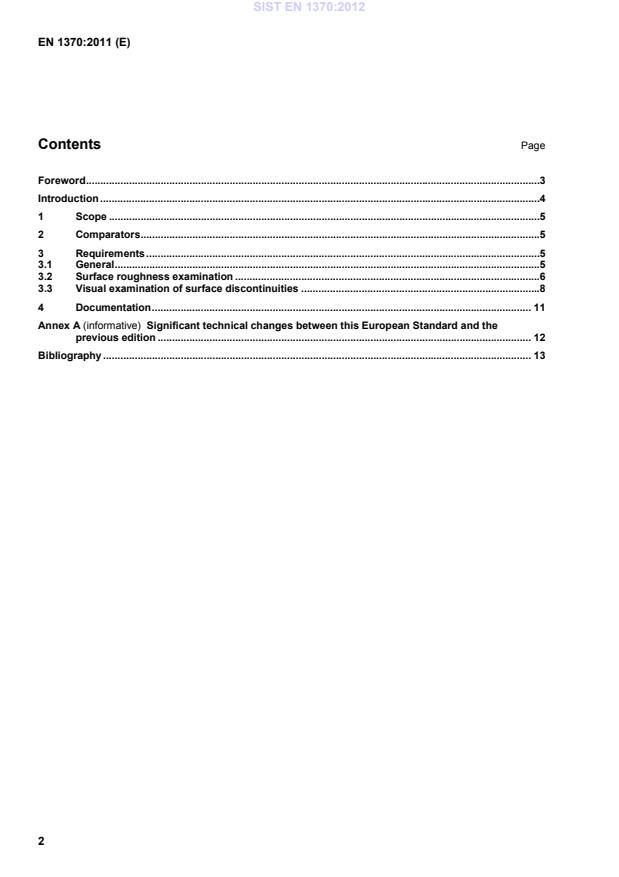
Significant technical changes between this European Standard and the previous edition . 12Bibliography . 13 SIST EN 1370:2012
1) 100 mm × 150 mm for SCRATA comparators;
110 mm × 160 mm for BNIF comparators. SIST EN 1370:2012
...
The EN 1370:2011 standard, titled "Founding - Examination of surface condition," provides critical methodologies for evaluating the surface characteristics of castings, specifically focusing on roughness and surface discontinuities. This European Standard holds significant relevance in the foundry industry as it applies universally to all cast metals and various casting processes, with the exception of die casting. One of the strengths of this standard lies in its comprehensive approach to surface condition examination. By establishing clear and consistent methods, EN 1370:2011 allows for uniform assessment across different materials and casting techniques, thereby facilitating quality assurance and enhancing the reliability of cast products. The procedures outlined in this standard are crucial for manufacturers seeking to meet rigorous industry standards and customer expectations regarding surface quality. Additionally, the inclusion of surface roughness and discontinuity evaluation ensures that foundries can adhere to specific requirements that may impact the performance and durability of cast components. This integration of surface condition analysis into standard manufacturing practices underscores the importance of meticulous quality control in the foundry sector. Overall, EN 1370:2011 stands as a vital framework guiding foundries in the assessment of surface conditions, promoting consistency and fostering advancements in casting quality. Its applicability to a wide range of casting processes solidifies its role as an essential resource for professionals within the industry.
Die EN 1370:2011 stellt einen wichtigen Standard im Bereich des Gießereiwesens dar, indem sie spezifische Methoden zur Untersuchung des Oberflächenzustands von Gussteilen definiert. Dieser Standard fokussiert sich auf die Analyse der Rauheit sowie auf Oberflächenunregelmäßigkeiten, die für die Qualität und Leistungsfähigkeit von Gussprodukten entscheidend sind. Ein herausragendes Merkmal der EN 1370:2011 ist ihre umfassende Anwendbarkeit. Sie gilt für alle Gussmetalle und deckt sämtliche Gießverfahren ab, mit Ausnahme des Druckgussverfahrens. Dadurch bietet der Standard eine breite Grundlage, um sicherzustellen, dass die Oberflächenqualität von Gussteilen in verschiedenen Herstellungsprozessen konstant auf hohem Niveau bleibt. In der heutigen Industrie, in der die Oberflächenqualität einen direkten Einfluss auf die Funktionalität und Haltbarkeit von Produkten hat, ist die Relevanz der EN 1370:2011 unverkennbar. Die Standardisierung der Prüfmethoden sorgt für einheitliche Maßstäbe und fördert die Transparenz sowie das Vertrauen in die Qualität der Gussprodukte. Die Stärken der EN 1370:2011 liegen nicht nur in den klar definierten Prüfmethoden, sondern auch in der Unterstützung der Herstellungsindustrie, die sicherstellen möchte, dass ihre Produkte den hohen Erwartungen hinsichtlich Oberflächenbeschaffenheit gerecht werden. Die Standardisierung leistet einen wertvollen Beitrag zur Qualitätskontrolle und -sicherung im Gießereiwesen.
La norme EN 1370:2011, intitulée "Founding - Examination of surface condition", établit des méthodes exhaustives pour l'examen de l'état de surface des pièces de fonderie, en se concentrant particulièrement sur la rugosité et les discontinuities de surface. Cette norme est d'une grande importance pour l'industrie de la fonderie, car elle offre un cadre standardisé permettant de garantir la qualité des surfaces des métaux coulés. L'une des forces majeures de la norme réside dans son champ d'application étendu, qui englobe tous les métaux coulés ainsi que tous les processus de fonderie, à l'exception de la fonderie sous pression. Cela permet d'assurer que les méthodes d'examen de l'état de surface sont pertinentes pour une large variété de matériaux et de techniques de fabrication, favorable à la diversité des applications industrielles. En outre, la norme EN 1370:2011 répond à un besoin croissant de contrôles de qualité rigoureux dans le secteur de la fonderie. En spécifiant des méthodes précises pour évaluer la rugosité et les anomalies de surface, elle aide les fabricants à maintenir des standards de qualité élevés et à éviter des défauts susceptibles d'affecter la performance des pièces produites. Cela renforce la crédibilité et la confiance envers les produits coulés sur le marché. En somme, la norme SIST EN 1370:2012 représente un outil indispensable pour les entreprises du secteur de la fonderie, favorisant la standardisation dans l'examen des conditions de surface et contribuant à l'amélioration continue des processus de fabrication. Sa pertinence est indiscutable pour garantir que les pièces réalisées répondent aux exigences strictes de qualité imposées par l'industrie moderne.
SIST EN 1370:2012は、鋳造品の表面状態の検査に関する重要な標準であり、特に鋳造プロセスにおける表面粗さや表面の不連続性を評価するための手法を明確に定義しています。この標準の重要な範囲は、すべての鋳造金属と鋳造プロセスに適用される点にありますが、ダイキャストプロセスを除外しています。 この標準の強みは、鋳造品の品質管理における一貫したアプローチを提供することにあります。EN 1370:2011における手法は、鋳造業界のニーズに応えるために設計されており、製品の耐久性や性能に直結する表面の状態を適切に評価することができます。鋳造物の表面条件の徹底的な検査により、不具合の早期発見が可能となり、最終製品の品質向上に寄与します。 さらに、この標準は国際的な一貫性を確保するための基準を設定するものであり、鋳造業界での標準化を推進する上で非常に重要です。鋳造品の製造において、顧客の要求や規制に対しても適合性を持つことが求められる中、適切な検査手法を提供することにより、ビジネスの信頼性と競争力を高めることができます。 EN 1370:2011は、鋳造品の表面状態の検査における信頼性の向上に大きく寄与し、この標準に準拠することで、企業は市場における優位性を確保することができます。このように、SIST EN 1370:2012は鋳造業界において活用されるべき不可欠な文書と言えるでしょう。
SIST EN 1370:2012는 주조물의 표면 상태(거칠기 및 표면 불연속성)에 대한 검사 방법을 규정하는 유럽 표준입니다. 이 기준은 모든 주철 및 모든 주조 공정에 적용되며 다이 캐스팅을 제외한 모든 주조 방법에 해당됩니다. 이러한 포괄적인 적용 범위는 주조 업계에서의 다양한 요구 사항을 충족하는 데 있어 중요한 역할을 합니다. EN 1370:2011의 강점 중 하나는 표면 상태 검사의 표준화된 절차를 제공함으로써, 주조물의 품질과 일관성을 확보하는 데 기여한다는 점입니다. 이는 특히 제품의 신뢰성과 사용성을 보장해야 하는 산업 분야에서 더욱 중요합니다. 표준화된 검사 방법은 주조물의 품질을 일관되게 평가할 수 있는 기준을 마련해 주며, 불량률을 낮추고 고객 만족도를 높이는 데 기여합니다. 또한, EN 1370:2011은 거칠기 및 표면 불연속성과 같은 구체적인 지표에 초점을 맞추고 있어, 주조물의 성능 및 내구성을 평가하는 데 중요한 기준이 됩니다. 이러한 표준은 제조업체가 생산 과정에서 발생할 수 있는 문제를 사전에 식별하고 수정할 수 있도록 돕는 가이드라인 역할을 합니다. 결론적으로, SIST EN 1370:2012는 주조물의 표면 상태를 체계적으로 검사할 수 있는 유럽 표준으로, 주조 분야의 품질 관리 및 개선에 결정적인 영향을 미칩니다. 이 표준은 제조업체가 제품의 신뢰성을 강화하고, 시장 경쟁력을 높이는 중요한 도구로 자리 잡고 있습니다.
Questions, Comments and Discussion
Ask us and Technical Secretary will try to provide an answer. You can facilitate discussion about the standard in here.
Loading comments...