

SIST-TS CLC/TS 50752:2026
(Main)Design for recycling guidelines for styerincs and polyolefins products and parts in electrical and electronic equipment, with focus on ABS, PP and PS
- Abstract
This document provides guidance on the best practices and technical solutions that manufacturers of electrical and electronic equipment (EEE) can consider during the design phase, to enable consistent and effective recycling of styrenics and polyolefins plastics composing the equipment, during the Waste of Electrical and Electronic Equipment (WEEE) management.
NOTE This Technical Specification is intended to cover electrical and electronic equipment as listed in Annex I and Annex III of Directive 2012/19/EU [6].
This document deals specifically with the following types of styrenics and polyolefins, used for parts and components of EEE:
- Acrylonitrile-Butadiene-Styrene (ABS);
- Polystyrene (PS);
- Polypropylene (PP).
NOTE The principles laid down in this document can be potentially applied to thermoplastics other than ABS, PP and PS.
- Status
- Published
- Publication Date
- 29-Sep-2026
- Technical Committee
- ITIV - Electronics assembly technology and Environmental standardization
- Current Stage
- 6060 - National Implementation/Publication (Adopted Project)
- Start Date
- 17-Sep-2026
- Due Date
- 22-Nov-2026
- Completion Date
- 30-Sep-2026
Buy Documents

SIST-TS CLC/TS 50752:2026 is the Slovenian adoption of CLC/TS 50752:2026, a CENELEC Technical Specification published by SIST. It gives guidance for designing electrical and electronic equipment so that styrenics and polyolefins - especially ABS, PP and PS - can be recycled more consistently during WEEE management.
What does SIST-TS CLC/TS 50752:2026 specify?
SIST-TS CLC/TS 50752:2026 gives design-for-recycling guidance for EEE manufacturers. It focuses on design choices made before the product becomes WEEE, so that plastic parts can be separated, sorted and recycled more effectively later.
The document is aimed at equipment covered by Directive 2012/19/EU, as noted in the scope. It concentrates on ABS, PP and PS, and it also notes that the principles can potentially help with other thermoplastics.
It does not set the detailed recycling requirements for WEEE treatment itself, such as depollution. Instead, it points designers toward the collection, logistics and treatment stages and toward other standards that cover those stages.
| Part of the document | What it covers |
|---|---|
| Clause 1 | Scope |
| Clause 2 | Normative references |
| Clause 3 | Terms, definitions and abbreviated terms |
| Clause 4 | General principles |
| Clause 5 | Design for recycling principles based on existing recycling processes |
| Clause 6 | Design for recycling principles based on possible future improvement of recycling processes |
| Bibliography | Related standards, regulations and background references |
What are the key requirements of SIST-TS CLC/TS 50752:2026?
SIST-TS CLC/TS 50752:2026 asks manufacturers to design EEE with recycling in mind from the start. The practical message is to align material choice, part design and information sharing with the way WEEE is actually collected and processed.
Design for the real recycling chain
Clause 4 says the product design should take account of the expected recycling processes, the related technologies and their limits. In practice, this means a material that is easy to mould is not automatically a good choice if it is hard to separate later.
Clause 4 also recommends considering the WEEE collection, logistics and treatment stages described in the EN 50625 series. For a designer, that means the recycling route is part of the product specification, not an afterthought.
Prefer plastics that fit sorting and recycling
Clause 5.2 says to prefer ABS, PP and PS where possible, and to limit other polymers when they would make recycling harder. The document also encourages choosing plastics with established and widely used recycling routes.
Clause 5.2.2 links design to the main separation methods used after shredding - density, electrostatic and optical sorting. The practical point is to avoid combinations that confuse these processes, such as materials with similar density, similar triboelectric behaviour, carbon black, coatings, or permanent bonds to other materials.
Keep additives and contaminants under control
Clause 5.2.3 warns that additives can reduce recyclate quality and create health or processing problems. The document gives brominated flame retardants as a clear example of why material selection matters for both recyclers and end markets.
It also points manufacturers toward forward-looking substance selection, including attention to substances of concern identified in public regulatory sources. In practice, this means checking not only today’s compliance status, but also the likely recyclability and future acceptability of the chemistry you choose.
Design parts so they can be dismantled or harvested
Clause 5.3 says parts and components should support pre-shredding removal where this makes sense. The document discourages permanent enclosed connections, painted or coated plastics, and moulding different plastics together when those choices would block separation later.
For a designer, this usually means using standard fasteners, keeping plastics easier to disassemble, and avoiding assemblies that force mixed material streams into the wrong recycling route.
Think at product level, not just part level
Clause 5.4 applies the same logic to the whole EEE. It recommends minimizing the number of plastic types used in one product and preferring ABS, PP and PS alongside other plastics with structured recycling schemes.
The clause also points to EN 45555 as a way to compare recyclability rates for existing and redesigned products. That gives teams a way to check whether a design change actually improves recyclability instead of only appearing to do so.
Plan for future recycling improvements and information exchange
Clause 6 looks ahead to improved collection, pre-shredding treatment and post-shredding sorting. It suggests designs that would work better if collection becomes more selective, if dismantling becomes more automated, or if technologies such as NIR, MIR and HSI become more widely used.
Clause 6.5 also encourages sharing information with collection, treatment and recycling operators on request and under contract. In practice, that means lists of plastic types or plastic-containing parts can help operators route material into the right recycling process more quickly.
What terms does SIST-TS CLC/TS 50752:2026 define?
SIST-TS CLC/TS 50752:2026 defines the terms it uses so readers can apply the guidance consistently.
- Design for Recycling (DfR) - design choices made to improve the recovery, sorting and recycling of materials at end of life.
- Electrical and electronic equipment (EEE) - the equipment covered by the document before it becomes waste.
- Waste electrical and electronic equipment (WEEE) - discarded EEE, including its components, subassemblies and consumables.
- Recyclability - the potential of a material or item to be recycled under the relevant standards and regulations.
- Recyclable - a characteristic of a product or component that can be diverted from waste and returned as raw material or a product.
- Post-consumer recycled material (PCR) - plastic recovered from products that have already been used and are no longer fit for their intended purpose.
- Post-industrial recycled material (PIR) - scrap or waste recovered during manufacturing before the product reaches consumers.
Who uses SIST-TS CLC/TS 50752:2026?
SIST-TS CLC/TS 50752:2026 is used by EEE manufacturers, product designers and materials engineers when they choose plastics, part architecture and joining methods. It is also useful for quality managers and sustainability teams that need to justify recyclability decisions or compare redesign options.
Treatment operators and recyclers can use it to understand what information and product features help sorting after shredding. Buyers and procurement teams can also use it when setting expectations for plastics, recycled content and disassembly-friendly product design.
Which standards are used with SIST-TS CLC/TS 50752:2026?
The document refers to several related standards and parts that support its guidance:
- EN 50625 (all parts) - collection, logistics and treatment requirements for WEEE, which frame the recycling chain considered by the document.
- EN 45554 and EN 45555 - methods for assessing repair, reuse, upgrade, recyclability and recoverability.
- EN 18064-1, EN 18064-3, EN 18064-6 and EN 18064-7 - quality recommendations and basis for specifications for recycled plastics, including general guidance and PP, PS and ABS-specific parts.
- EN 15342, EN 15345 and EN 18067 - characterization standards for PS, PP and ABS recyclates.
- EN ISO 1043-1, EN ISO 11469, EN ISO 472, EN ISO 14021, EN 15343, EN 17615 and ISO 15270 - terminology, identification, environmental claims, traceability and recycling vocabulary used by the definitions and guidance.
What does the SIST-TS CLC/TS 50752:2026 document contain?
The document contains tables comparing plastic separation methods, such as density, electrostatic and optical sorting, and it links those methods to design choices. It also includes tables for plastic materials, plastic components and parts, whole EEE design, collection, pre-shredding treatment and future sorting technologies.
Figure 1 shows the main stages from EEE design to WEEE management, and Figure 2 shows density ranges for common plastics and composites. Tables 10 and 11 describe NIR, MIR and HSI technologies and explain how their strengths and limits affect design choices.
The bibliography points to standards, regulations and studies on WEEE treatment, plastics recyclates, sorting methods and substance concerns.
Relations
- Effective Date
- 03-Feb-2026
Buy Documents
Get Certified
Connect with accredited certification bodies for this standard

IMQ S.p.A. (Certification)
Italian electrical product certification.

SLG Prüf- und Zertifizierungs GmbH
German testing and certification body.

UL Solutions
Global safety science company with testing, inspection and certification.
Sponsored listings
Frequently Asked Questions
SIST-TS CLC/TS 50752:2026 is a technical specification published by the Slovenian Institute for Standardization (SIST). Its full title is "Design for recycling guidelines for styerincs and polyolefins products and parts in electrical and electronic equipment, with focus on ABS, PP and PS". This standard covers: This document provides guidance on the best practices and technical solutions that manufacturers of electrical and electronic equipment (EEE) can consider during the design phase, to enable consistent and effective recycling of styrenics and polyolefins plastics composing the equipment, during the Waste of Electrical and Electronic Equipment (WEEE) management. NOTE This Technical Specification is intended to cover electrical and electronic equipment as listed in Annex I and Annex III of Directive 2012/19/EU [6]. This document deals specifically with the following types of styrenics and polyolefins, used for parts and components of EEE: - Acrylonitrile-Butadiene-Styrene (ABS); - Polystyrene (PS); - Polypropylene (PP). NOTE The principles laid down in this document can be potentially applied to thermoplastics other than ABS, PP and PS.
This document provides guidance on the best practices and technical solutions that manufacturers of electrical and electronic equipment (EEE) can consider during the design phase, to enable consistent and effective recycling of styrenics and polyolefins plastics composing the equipment, during the Waste of Electrical and Electronic Equipment (WEEE) management. NOTE This Technical Specification is intended to cover electrical and electronic equipment as listed in Annex I and Annex III of Directive 2012/19/EU [6]. This document deals specifically with the following types of styrenics and polyolefins, used for parts and components of EEE: - Acrylonitrile-Butadiene-Styrene (ABS); - Polystyrene (PS); - Polypropylene (PP). NOTE The principles laid down in this document can be potentially applied to thermoplastics other than ABS, PP and PS.
SIST-TS CLC/TS 50752:2026 is classified under the following ICS (International Classification for Standards) categories: 13.030.50 - Recycling; 29.100.01 - Components for electrical equipment in general; 31.220.01 - Electromechanical components in general. The ICS classification helps identify the subject area and facilitates finding related standards.
SIST-TS CLC/TS 50752:2026 has the following relationships with other standards: It is inter standard links to SIST EN ISO 80369-6:2025. Understanding these relationships helps ensure you are using the most current and applicable version of the standard.
SIST-TS CLC/TS 50752:2026 is associated with the following European legislation: Standardization Mandates: M/584. When a standard is cited in the Official Journal of the European Union, products manufactured in conformity with it benefit from a presumption of conformity with the essential requirements of the corresponding EU directive or regulation.
SIST-TS CLC/TS 50752:2026 is available in PDF format for immediate download after purchase. The document can be added to your cart and obtained through the secure checkout process. Digital delivery ensures instant access to the complete standard document.
Standards Content (Sample)
SLOVENSKI STANDARD
01-november-2026
Smernice za načrtovanje za recikliranje izdelkov in delov iz stirenskih polimerov in
poliolefinov v električni in elektronski opremi s poudarkom na ABS, PP in PS
Design for recycling guidelines for styerincs and polyolefins products and parts in
electrical and electronic equipment, with focus on ABS, PP and PS
Richtlinien für recyclinggerechtes Design für Styrol- und Polyolefinprodukte und -teile in
elektrischen und elektronischen Geräten mit Schwerpunkt auf ABS, PP und PS
Ta slovenski standard je istoveten z: CLC/TS 50752:2026
ICS:
13.030.50 Recikliranje Recycling
29.100.01 Sestavni deli za električne Components for electrical
naprave na splošno equipment in general
31.220.01 Elektromehanske Electromechanical
komponente (sestavni deli, components in general
gradniki) na splošno
2003-01.Slovenski inštitut za standardizacijo. Razmnoževanje celote ali delov tega standarda ni dovoljeno.
TECHNICAL SPECIFICATION CLC/TS 50752
SPÉCIFICATION TECHNIQUE
TECHNISCHE SPEZIFIKATION September 2026
ICS 13.030.50; 29.100.01; 31.220.01
English Version
Design for recycling guidelines for styrenics and polyolefins
products and parts in electrical and electronic equipment, with
focus on ABS, PP and PS
To be completed Richtlinien für recyclinggerechtes Design für Styrol- und
Polyolefinprodukte und -teile in elektrischen und
elektronischen Geräten mit Schwerpunkt auf ABS, PP und
PS
This Technical Specification was approved by CENELEC on 2026-05-25.
CENELEC members are required to announce the existence of this TS in the same way as for an EN and to make the TS available promptly
at national level in an appropriate form. It is permissible to keep conflicting national standards in force.
CENELEC members are the national electrotechnical committees of Austria, Belgium, Bulgaria, Croatia, Cyprus, the Czech Republic,
Denmark, Estonia, Finland, France, Germany, Greece, Hungary, Iceland, Ireland, Italy, Latvia, Lithuania, Luxembourg, Malta, the
Netherlands, Norway, Poland, Portugal, Republic of North Macedonia, Romania, Serbia, Slovakia, Slovenia, Spain, Sweden, Switzerland,
Türkiye and the United Kingdom.
European Committee for Electrotechnical Standardization
Comité Européen de Normalisation Electrotechnique
Europäisches Komitee für Elektrotechnische Normung
CEN-CENELEC Management Centre: Rue de la Science 23, B-1040 Brussels
© 2026 CENELEC All rights of exploitation in any form and by any means reserved worldwide for CENELEC Members.
Ref. No. CLC/TS 50752:2026 E
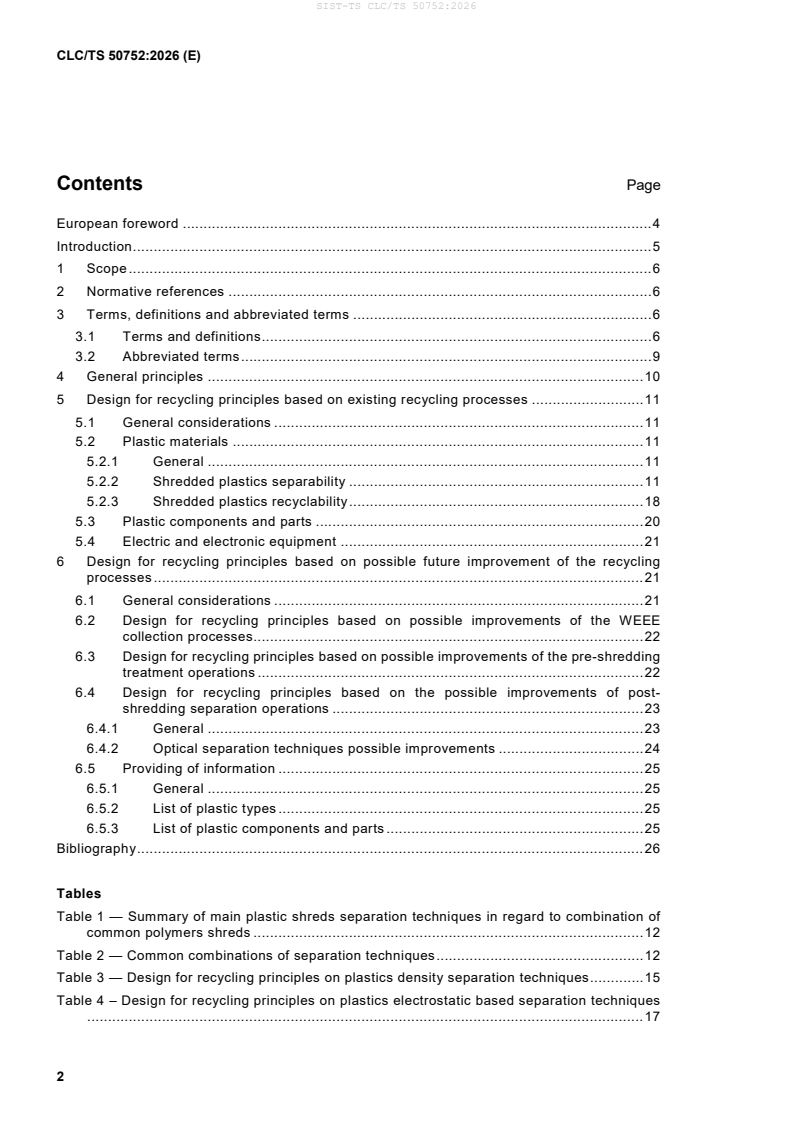
Contents Page
European foreword . 4
Introduction . 5
1 Scope . 6
2 Normative references . 6
3 Terms, definitions and abbreviated terms . 6
3.1 Terms and definitions . 6
3.2 Abbreviated terms . 9
4 General principles . 10
5 Design for recycling principles based on existing recycling processes . 11
5.1 General considerations . 11
5.2 Plastic materials . 11
5.2.1 General . 11
5.2.2 Shredded plastics separability . 11
5.2.3 Shredded plastics recyclability . 18
5.3 Plastic components and parts . 20
5.4 Electric and electronic equipment . 21
6 Design for recycling principles based on possible future improvement of the recycling
processes . 21
6.1 General considerations . 21
6.2 Design for recycling principles based on possible improvements of the WEEE
collection processes. 22
6.3 Design for recycling principles based on possible improvements of the pre-shredding
treatment operations . 22
6.4 Design for recycling principles based on the possible improvements of post-
shredding separation operations . 23
6.4.1 General . 23
6.4.2 Optical separation techniques possible improvements . 24
6.5 Providing of information . 25
6.5.1 General . 25
6.5.2 List of plastic types . 25
6.5.3 List of plastic components and parts . 25
Bibliography . 26
Tables
Table 1 — Summary of main plastic shreds separation techniques in regard to combination of
common polymers shreds . 12
Table 2 — Common combinations of separation techniques . 12
Table 3 — Design for recycling principles on plastics density separation techniques . 15
Table 4 – Design for recycling principles on plastics electrostatic based separation techniques
...................................................................................................................................... 17
Table 5 — Design for recycling principles on plastics optical separation techniques . 18
Table 6 — Design for recycling principles on plastic components and parts . 20
Table 7 — Design for recycling principles on EEE containing plastics . 21
Table 8 — Design for recycling principles based on possible improvements of the WEEE
collection processes . 22
Table 9 — Design for recycling principles based on possible improvements of the pre-shredding
treatment operations . 23
Table 10 — Advantages and limitations of NIR, MIR and HSI technologies . 24
Table 11 — Design for recycling principles on plastics NIR, MIR and HSI separation techniques
...................................................................................................................................... 24
Figures
Figure 1 — Design for Recycling principles focus stages from EEE design to WEEE
management phases . 10
Figure 2 — Density ranges for commonly used plastics and composites (solid/not foamed
plastics) compared to other materials (Source CEN/TS 18084:2025) . 14
European foreword
This document (CLC/TS 50752:2026) has been prepared by CLC/TC 111X “Environment”.
Attention is drawn to the possibility that some of the elements of this document may be the subject of patent
rights. CENELEC shall not be held responsible for identifying any or all such patent rights.
This document has been prepared under a standardization request addressed to CENELEC by the European
Commission. The Standing Committee of the EFTA States subsequently approves these requests for its
Member States.
Any feedback and questions on this document should be directed to the users’ national committee. A complete
listing of these bodies can be found on the CENELEC website.
Introduction
This document covers the Acrylonitrile-Butadiene-Styrene (ABS), Polypropylene (PP) and Polystyrene (PS)
based components and parts, used in electrical and electronic equipment (EEE) falling under the scope of the
European Directive on Waste of Electrical and Electronic Equipment (WEEE Directive) (2012/19/EU) [6].
This document aims to support the European Strategy for Plastics in a Circular Economy’s objective to improve
the economics and quality of plastics recyclates. In particular, to improve design-for-recycling of plastic products
as well as the quality of inputs to the recycling industry and create viable markets for recycled plastics.
Acknowledging this objective and based on the Standardization Request M/584 of the European Commission,
the CENELEC/TC 111X has decided to develop this document to define the design-for-recycling principles that
can promote plastics recycling of electrical and electronic equipment.
1 Scope
This document provides guidance on the best practices and technical solutions that manufacturers of electrical
and electronic equipment (EEE) can consider during the design phase, to enable consistent and effective
recycling of styrenics and polyolefins plastics composing the equipment, during the Waste of Electrical and
Electronic Equipment (WEEE) management.
NOTE This document is intended to cover electrical and electronic equipment as listed in Annex I and Annex III of
Directive 2012/19/EU [6].
This document deals specifically with the following types of styrenics and polyolefins, used for parts and
components of EEE:
— Acrylonitrile-Butadiene-Styrene (ABS);
— Polystyrene (PS);
— Polypropylene (PP).
NOTE The principles laid down in this document can be potentially applied to thermoplastics other than ABS, PP and
PS.
2 Normative references
There are no normative references in this document.
3 Terms, definitions and abbreviated terms
For the purposes of this document, the following terms and definitions apply.
ISO and IEC maintain terminology databases for use in standardization at the following addresses:
— ISO Online browsing platform: available at https://www.iso.org/obp/
— IEC Electropedia: available at https://www.electropedia.org/
3.1 Terms and definitions
3.1.1
acrylonitrile-butadiene-styrene
ABS
terpolymer made by polymerizing styrene and acrylonitrile in the presence of polybutadiene rubber
[SOURCE: EN ISO 1043-1:2011 Clause 4.1 – Table 1]
3.1.2
additive
substance which is used to process or to modify end use of plastics
Note 1 to entry: Substances are normally included in carrier matrix.
[SOURCE: EN 17615:2022, 3.4, modified - Note 2, 3 and 4 to entry have been removed]
3.1.3
commingled plastic
mixed plastic
mixture of materials or products consisting of different types of plastics
[SOURCE: EN 17615:2022, 3.58]
3.1.4
compound
formulation in the form of granulates, pellets, powder or flakes, prepared for processing into a finished
product, consisting of a polymer and all the necessary additives, such as stabilizers, plasticizers, fillers,
pigments, etc., that are required for the intended application
[SOURCE: EN ISO 472:2013, 2.222]
3.1.5
dismantling
process whereby a product is taken apart in such a way that some parts can be reused, although the product
(and the parts not intended to be reused) can no longer be reassembled and made operational
Note 1 to entry: “Parts” means any element of a product, as defined by the product's type designation [See Regulation
(EU) 2018/1139, Article 3 Definition (4)].
[SOURCE: EN 17615:2022, 3.90]
3.1.6
plastic
material which contains as an essential ingredient a polymer and which at some stage in its processing into
finished products can be shaped by flow
Note 1 to entry: Elastomeric materials, which also are shaped by flow, are not considered plastics.
Note 2 to entry: Additives or other substances may have been added and which can function as a main structural
component of final product.
[SOURCE: EN 17615:2022, 3.184, modified - removed references to other terms]
3.1.7
polymer
large molecule, synthetic or natural, characterized by the sequence of one or more types of monomer units
which are covalently bound to each other
[SOURCE: EN 17615:2022, 3.190]
3.1.8
polymer blend
alloy
two or more polymers (3.1.4) blended to create an alloy
[SOURCE: EN ISO 11469:2016, 5.1.3]
3.1.9
polypropylene
PP
plastic based on a homopolymer of propene or a copolymer of propene and other α-olefins, or a mixture of both,
in which propene is the predominant monomer
[SOURCE: EN ISO 472:2013, 2.555]
3.1.10
polystyrene
PS
plastic based homopolymer of styrene or a copolymer of styrene and other monomers, the styrene being the
predominant monomer
[SOURCE: EN ISO 472:2013, 2.576]
3.1.11
post-consumer recycled material
PCR
plastic material recovered from products that have been used by consumers or businesses and are no longer
usable for their intended purpose
Note 1 to entry: The adjective of “recyclability” is “recyclable”.
[SOURCE: EN 15343:2007, 3.6]
3.1.12
post-industrial recycled material
PIR
plastic scrap or waste recovered from manufacturing processes before the product reaches the consumer (e.g.
production off-cuts, trimmings, rejected parts)
[SOURCE: EN 15343:2007, 3.5]
3.1.13
recyclability
potential of items or materials to be recycled as defined by the relevant standards and regulations in force
Note 1 to entry: The adjective of “recyclability” is “recyclable”.
[SOURCE: EN 17615:2022, 3.208]
3.1.14
recyclable
characteristic of a product, packaging, or associated component that be diverted from the waste stream through
available processes and programmes and can be collected, processed, and return to the used in the form of
raw materials or products
[SOURCE: EN ISO 14021:2016, 7.7.1]
3.1.15
recycling of plastics
process of recovering plastic waste into products, materials or substances to be used again but excluding energy
recovery and materials intended to be used as fuels
Note 1 to entry: Recycling can be mechanical, chemical, physical or organic.
Note 2 to entry: Recycling is also defined in Directive 2008/98/EC, Article 3 (15a).
Note 3 to entry: Directive 2008/98/EC contains the following: “‘recycling’ means any recovery operation by which waste
materials are reprocessed into products, materials or substances whether for the original or other purposes. It includes the
reprocessing of organic material but does not include energy recovery and the reprocessing into materials that are to be
used as fuel or for backfilling operations”.
[SOURCE: EN 17615:2022, 3.211, modified – Added Note 3 to entry]
3.1.16
shredding
mechanical process by which waste is fragmented into irregular pieces of any dimension or shape
Note 1 to entry: Shredding usually signifies the tearing or cutting of materials that cannot be crushed by fragmentation
methods applicable to brittle materials, as typically carried out in a hammer mill.
[SOURCE: ISO 15270:2008, 3.33]
3.1.17
treatment
mesh recovery or disposal operations, including preparation prior to recovery or disposal
[SOURCE: Directive 2008/98/EC]
3.1.18
treatment facility
location where WEEE undergoes treatment
[SOURCE: EN 50625-1:2014]
3.1.19
waste electrical and electronic equipment
WEEE
electrical or electronic equipment which is waste, including all components, subassemblies and consumables
which are part of the product at the time of discarding
Note 1 to entry: A definition of waste is available in Article 3(1) of Directive 2008/98/EC [5].
[SOURCE: Directive 2012/19/EU [6], modified, mention of Article 3 of the directive removed from definition and
Note 1 to entry added]
3.2 Abbreviated terms
ABS Acrylonitrile-Butadiene-Styrene (3.1.1)
BFR Brominated Flame Retardant
DfR Design for Recycling
EEE Electrical and electronic equipment
EPDM Ethylene Propylene Diene Monomer
FTIR Fourier Transform Infra-Red
HDPE High-Density Polyethylene
NIR Near Infra-Red
PA Polyamide
PBT Polybutylene Terephthalate
PC Polycarbonate
PE Polyethylene
PET Polyethylene Terephthalate
PLA Polylactic Acid
PMMA Polymethyl Methacrylate
POM Polyoxymethylene
PP Polypropylene (3.1.10)
PS Polystyrene (3.1.9)
PVC Polyvinyl Chloride
SEBS Styrene-Ethylene-Butylene-Styrene
WEEE Waste from electrical and electronic equipment (3.1.19)
XRF X-ray Fluorescence
4 General principles
Recycling of plastics used in electric and electronic equipment (EEE) is often affected by several factors, such
as the use of different type of plastics within a product, the inability and economic constrains of the treatment
operator to easily dismantle and separate plastics from other materials. These factors could significantly impair
the recyclability of the EEE and, as consequence, the amount of plastics recycled and the relative quality of
recyclates generated.
When designing EEE, manufacturers may consider the design for recycling principles and considerations laid
down in this document. The design process of the EEE, its components, parts and materials should take in
consideration the expected recycling processes, the related technologies and limitations.
This document describes the design for recycling principles and technical solutions that may be adopted by
EEE manufacturers, in regard to the existing WEEE recycling processes and technologies. It also includes
principles and technical solutions that may further enhance the recycling of ABS, PP and PS plastics in EEE,
based on possible future improvements of the recycling processes and the related technologies.
In principle, the EEE manufacturers in the design process of the product, should consider the WEEE collection,
logistics and treatment stages described in EN 50625 series.
This document does not deal with the specific recycling requirements associated to the EEE once it becomes
WEEE, including its de-pollution, as these are already addressed in other relevant standards.
In principle, manufacturers of EEE for which dedicated collection schemes currently exist, are recommended to
consider the design for recycling principles laid down in Clause 5 and Clause 6. Manufacturers of EEE for which
dedicated collection schemes does not exist or, are recommended to consider mainly the design for recycling
principles laid down in Clause 5. Figure 1 shows which are the focus stages where the design for recycling
principles can be applied.
NOTE Despite the product categories defined by the WEEE Directive 2012/19/EU [6], not always the relative collection
schemes (collection point and products grouping) are set up and applied for each category individually. For example, often
category 5 (small equipment) and category 6 (small IT) are mixed and collected together.
It is noted that in the context of this document, recyclates and recycled plastics, always refer to post-consumer
recycled plastic materials. Post-industrial recycled plastic materials are not considered for the DfR principles
described.
Figure 1 — Design for Recycling principles focus stages from EEE design to WEEE management
phases
It is noted that for the effective application of the design for recycling principles laid down in this document,
considering the variety of polymers, additives, fillers and substances used in EEE and the differences in
collection and recycling processes and technologies available on the market; it is considered of paramount
importance the communication and exchange of information between all the parties involved in the supply chain
for the production of an EEE as well as with the treatment and recyclers associations.
5 Design for recycling principles based on existing recycling processes
5.1 General considerations
In the majority of the existing WEEE recycling processes, after having depolluted the WEEE to be recycled,
these are shredded and the resulting fractions, consisting of mixed materials, are then separated and sorted by
different automated processes.
Due to cost/effective and current technologies reasons, the WEEE pre-shredding steps are mainly intended for
the treatment of the subject WEEE, such as de-pollution operations, and other activities intended for the
preparation for shredding. The limited possibilities to dismantle a WEEE to separate parts and components by
plastic type, in combination with the high variety of plastics used within the same EEE, often results in a lower
quality of the generated plastic recyclates, due to different plastics being mixed together in the same recycling
stream. Considering this type of recycling processes, the EEE manufacturer may consider DfR principles that
focus mainly on enhancing the use of ABS, PP and PS over other polymers as well as improving the post-
shredding separation and sorting of ABS, PP and PS from other materials and plastics.
In the following subclauses are summarized the general DfR principles for EEE, based on the existing recycling
processes. It is noted that the following described DfR principles are not intended to be an exhaustive or
comprehensive list of the possible principles that can effectively enhance the recycling and generation of high
quality recyclates of ABS, PP and PS plastics used in EEE. Manufacturers during the design of EEE, should
consider the principles following described and assess if alternative and/or further principles can be applied.
5.2 Plastic materials
5.2.1 General
When selecting plastics to be used for EEE parts and components, the manufacturer should give preference to
ABS, PP and PS, limiting where possible the use of other polymers.
When selecting other plastics to be used, the manufacturer should consider the main separation and sorting
technologies used in post-shredding and therefore, choose solutions and materials that might maximize the
possibilities for these plastics to be effectively separated and sorted from ABS, PP and PS. Manufacturer should
also give preference to the use of plastics for which well established and widely applied recycling processes
exist.
5.2.2 Shredded plastics separability
5.2.2.1 General
It should be noted that separation and sorting of shredded WEEE plastic fractions, often involves the
combination of different steps and technologies to achieve separation from foreign materials such as metal,
wood, and glass, as well as the separation between the type of plastics, to meet certain quality criteria for the
different plastics recycling processes and avoid adverse effects from the recycling of mixed plastics. Table 1
summarizes the main plastic shreds separation techniques in regard to combination of common polymer shreds,
while Table 2 shows the most common combinations of separation techniques.
Table 1 — Summary of main plastic shreds separation techniques in regard to combination of
common polymers shreds
Density Triboelectric /
NIR Spectroscopy XRF (Br /Cl Raman /
[1] [2]
Plastic Pair Separation Electrostatic
[20,21,28,33] Detection) [23] FTIR [28,33]
[16] [1,2,7,31]
PP vs PE Limited Effective Effective Not effective Limited
PP vs PS Highly effective Effective Effective Not effective Limited
PP vs ABS Highly effective Effective Effective Not effective Limited
PS vs ABS Limited Effective Effective Not effective Limited
ABS vs PC-ABS Limited Effective Not effective Not effective Limited
ABS (non-BFR)
Effective Not effective Not effective Effective Not effective
vs BFR-ABS
PET vs ABS Limited Effective Effective Not effective Limited
PVC vs
Limited Not effective Limited Effective Limited
ABS/PS/PP
Keys:
[1] Bromine (Br)
[2] Chlorine (Cl)
Table 2 — Common combinations of separation techniques
Separation techniques Use case
Density separation + Near Infra-Red Bulk separation of commodity plastics like ABS, PP
and PS
Triboelectric + Electrostatic separation + Air Separation of similar-density plastics
classification
Density separation + Triboelectric + Electrostatic
separation
X-Ray Fluorescence + Near Infra-Red Removal of halogenated plastics (example ABS with
brominated flame retardants)
Magnetic + Eddy current + Near Infra-Red, or X-Ray Often used upstream for metal separation, but often
Fluorescence paired with plastic recovery
Solved-based cleaning + Spectroscopic sorting Higher-purity recovery or complex plastic blends
(either Raman sorting or Fourier Transform Infra-
Red)
In the following sections are described the main separation and sorting techniques applied for shredded WEEE
plastic fractions together with the related design for recycling principles that EEE manufacturer may consider to
enhance the generation of ABS, PP and PS recyclates.
Density separation techniques
Gravity separation, floating separation and hydrocyclone separation, are some of the techniques that allows to
separate different materials as well as different plastics, based on the relative density differences.
NOTE 1 Gravity separation is particularly effective for separating heavier metals from lighter plastics and other materials.
It is widely employed in WEEE recycling processes. Although floating separation is less commonly used in WEEE recycling
compared to gravity separation, it can be effective for separating certain materials, especially plastics, by exploiting
differences in surface properties. Hydrocyclone is not as commonly used in WEEE recycling compared to gravity separation,
but it can be employed in certain applications for fine shredded particle separation.
NOTE 2 In most commercial WEEE plastic recycling plants across Europe, two consecutive density separation (sink-
float) steps are used as part of the wet separation line. The first step uses an heavy medium (having for example ρ≈
1,08 g/cm ) to remove flame-retarded or filler-laden plastics, having all commodity plastic fractions (PP, PE, PS, ABS)
floating and going to the next step, while unwanted high-density contaminants sink. The second step uses water (ρ≈
1,00 g/cm ), split polyolefins from styrenics, having PP and PE floating while PS and ABS sinking. Only some advanced
facilities employ also a third step using additional higher heavy media (having for example ρ≈ 1,15 ~ 1,25 g/cm ) to separate
even denser engineering plastics (PA, PC, PET, POM) [27,29].
To enable proper separation and sorting of shredded plastic fragments, it is important to select materials and
polymers having different density characteristics from ABS, PP and PS. Improper separation can lead to plastic
fragments from different polymers and foreign materials to end up in the ABS, PP and PS recycling processes,
impairing the recyclability and / or quality of the generated recyclates. It should also be considered that
compounding of ABS, PP and PS with fibre glass or other additives can affect the density of the material, leading
potentially to improper separation. Figure 2 shows the different density ranges of commonly used materials.
Key
1 HDPE 15 ABS/PET blend
2 HDPE (filled) 16 PET or PBT
3 HDPE (fibre reinforced) 17 PBT (fibre reinforced)
4 PP 18 PVC (both rigid and plasticized)
5 PP (filled) 19 PLA
6 PP (fibre reinforced) 20 SEBS
7 PA 21 EPDM
8 PA (fibre reinforced) 22 wood (chipboard)
9 SMC (fibreglass) 23 wood (natural)
10 PS A common polymers and their composites
11 ABS B other polymers and their composites
12 ABS/PC blend C elastomers
13 PMMA D wood
14 PC X density
Figure 2 — Density ranges for commonly used plastics and composites (solid/not foamed plastics)
compared to other materials (Source CEN/TS 18084:2025)
Table 3 provides examples of design for recycling principles related to plastic density separation.
Table 3 — Design for recycling principles on plastics density separation techniques
Design for recycling principle Technical solutions
Density considerations per fibre glass or Select ABS, PP and PS plastics, either filled or
additives content unfilled, having density within the relative value
range, to allow proper separation with density-
Recycling of plastics with fibre glass or additive
based techniques.
contents has direct influence on the quality of the
generated recyclates. For example PP recyclates Other plastics used should have density different
from a mix of different unfilled and fibre glass filled from the common density ranges for ABS, PP
PP plastics, will have lower quality then recyclates and PS either filled or unfilled.
from a pure unfilled mix.
Since fibre glass or additives content increase the
plastic density, the density separation techniques
allow for the proper separation between filled and
unfilled fragments of the same plastic material.
For example:
ABS – 1,030 to 1,070 g/cm
10 % Glass fibre filled ABS – 1,150 to 1,200 g/cm
BFR filled ABS – 1,150 to 1,300 g/cm
PP – 0,895 to 0,905 g/cm
10 % Glass fibre filled PP – 1,050 to 1,100 g/cm
BFR filled PP – 1,150 to 1,300 g/cm
PS – 1,040 to 1,070 g/cm
10 % Glass fibre filled PS – 1,090 to 1,120 g/cm
BFR filled PS – 1,250 to 1,350 g/cm [22,26,32]
However there can be cases where during the
separation of different types of mixed plastics, the
filled plastic fragments may be improper separated
by density based techniques, for example, 10 %
Glass fibre filled PP fragments can be mixed with
unfilled ABS and PS fragments.
- ABS, PP and PS plastics when being
compounded with fibre glass or additives, should
remain in density ranges commonly expected for
those filled plastics materials, to prevent
improper mixing with unfilled plastics.
- Other plastics, either pure or compounded with
fibre glass or other additives, should have
density ranges different from those of unfilled
ABS, PP and PS, to prevent improper
separations, when foreign plastics end up mixed
with ABS, PP or PS.
Different densities polymers blend avoidance If not separable during the relevant treatment
processes or if not intended for achieving a
Plastics based on blended polymers cannot be
needed material function, the use of blended
properly separated by density based techniques,
polymers should be avoided or if not possible,
since the density will vary depending on the type of
minimized.
the blended polymers and the related blending
percentages. Possibly choose blended plastics having density
different from the common density ranges for
- ABS and PS have similar density characteristics,
ABS, PP and PS, to prevent improper separation,
therefore the separation by density techniques is
where blended plastics fragments end up mixed
not effective. Despite blended ABS-PS
with ABS, PP or PS, possibly impairing the
fragments could end up in the ABS or PS
quality of the generated recyclates.
recycling process, no significant quality
degradation is expected.
- PP blends with ABS or PS, although not
common due to poor miscibility, should be
avoided. Additives filled PP and fibre glass
reinforced PP have usually density ranges
similar to those of ABS and PS.
- Blends of ABS, PP or PS with other plastics,
should be carefully evaluated, considering the
density of the blend and therefore the likelihood
of being separated by density techniques, asl
well as, the possible effects of the blend
fragments on the generated recyclates, when
being recycled with ABS, PP or PS plastics.
Different densities plastics aggregation If not separable during the relevant treatment
avoidance processes or if not intended for achieving a
needed material function, the use of permanent
Different type of plastics that are either,
connection of different type or colour of plastics
compounded, aggregated by a medium such as
should be avoided or if not possible minimized.
glue, or welded together, cannot be properly
separated and sorted by density separation For compounded and welded plastics, possibly
techniques due to the difference in density between choose plastics having densities different from
the two plastics, possibly ending therefore, in the the common density ranges for ABS, PP and PS,
wrong recycling process. to prevent improper separation, where
aggregated plastics fragments end up mixed with
As per blended polymers, the proper density
ABS, PP or PS, possibly impairing the quality of
separation of aggregated plastics can be
the generated recyclates.
significantly affected by the different density of the
aggregated plastics. For aggregated plastics using adhesive or glue
medium, the aggregating medium should be
- For compounded and welded together plastics,
chosen in order to be either dissolvable by
the same principles for blended polymers can be
commonly using chemicals or able to lose its
applied.
adhesive properties through heating.
- Aggregated plastics by a medium may be
separable provided that the aggregating medium
can be removed. Examples include dissolution
of the adhesive medium through dedicated
chemicals, or separation though loosening of the
adhesive medium properties by heat.
5.2.2.2 Electric based separation techniques
Electric based separation techniques include electrostatic separation and eddy current separation.
Eddy current separation is a technique used in the recycling and waste management processes to separate
non-ferrous metals from non-metallic and ferrous materials. This method leverages the principles of
electromagnetic induction to achieve separation of materials. While eddy current separators are not directly
used to sort different types of plastics, they play a crucial role in ensuring the purity of plastics fragment streams,
by removing metal contaminants. After the removal of non-ferrous metals, the plastic fragments usually undergo
additional sorting processes to separate different types of plastics.
Design for recycling principles that may be considered by EEE manufacturers, in consideration to the eddy
current separation, should mainly focus on the avoidance of permanently bonding of ABS, PP and PS plastic
with metal parts, as explained in Table 5 raw “Permanently enclosed connections avoidance”.
Electrostatic separation is a technique used to separate plastic fragments based on their electrical properties.
This method leverages the different electrostatic characteristics of different types of plastics to sort between
them.
Table 4 provides example of design for recycling principles related to plastic electrostatic based separation.
Table 4 — Design for recycling principles on plastics electrostatic based separation techniques
Design for recycling principle Technical solutions
Polymers triboelectric series Select plastics having different dielectric constant
(relative permittivity) and triboelectric series ranking to
Electrostatic separation can be impaired if
enable effective electrostatic separation.
polymers having similar dielectric constant
(relative permittivity) and similar ranking on the Dielectric constant (relative permittivity) [18,22,26,32]
triboelectric series are simultaneously processed.
ABS – 2,5 to 3,5
Despite having similar dielectric constants, ABS,
PP – 2,2 to 2,3
PP and PS have different triboelectric series
PS – 2,5 to 2,7
ranking and therefore can be effectively separated
a
Triboelectric series and (charge tendency) [22,26,32]
by electrostatic based separation technique.
1- ABS (Variable – Negative or neutral charge)
Other polymers having similar dielectrics and
triboelectric series ranking as ABS, PP or PS can 2- PP (Positive charge)
easily end up in the same recycling process,
3- PS (Negative charge)
potentially impairing the quality of the generated
recyclates.
Below is reported an example of the triboelectric
series of some polymers. Charge tendencies
behaviour can anyway significantly vary
depending on the specific plastic formulation.
Positive charge tendency – PA, PC, PMMA, PET,
PP, PE, LDPE/HDPE.
Neutral charge tendency – ABS.
Negative charge tendency – PS, PVC, PTFE
[1,2,7].
Antistatic coatings and additives avoidance Avoid or, if not possible, minimize the use of antistatic
additives.
Electrostatic separation can be impaired by plastic
containing antistatic additives or covered by As alternative to antistatic coatings, it should be
antistatic coatings, Since the antistatic property of considered the use of antistatic materials overlaying
the additive or coating will nullify the primary the specific plastic part but without a permanent
function of this separation technique, leading to connection to it. Examples of permanent connections,
plastic fragments to be incorrectly separated. includes, aggregated by a medium such as glue, or
welded together.
a
The triboelectric series is a list that ranks materials based on their tendency to gain or lose electrons when they come
into contact with each other through friction. This list helps predict which materials will become positively charged and
which will become negatively charged, where materials higher in the list are more likely to lose electrons becoming
positively charged, while those lower in the list are more likely to acquire electrons becoming negatively charged.
5.2.2.3 Optical separation techniques
Optical separation techniques include Infrared (IR) transmission sorting, and visible spectrum sorting. These
techniques rely on the optical analysis of shredded plastic fractions allowing the separation and sorting based
on the molecular characteristics or colour of the material.
NOTE Due to some technology limitations, optical separation techniques are currently less used than density
separation techniques in WEEE recycling processes.
Table 5 provides example of DfR principles related to plastic optical separation.
Table 5 — Design for recycling principles on plastics optical separation techniques
Design for recycling principle Technical solutions
Carbon black limitation Alternative pigments to the carbon black includes:
Plastics containing carbon black cannot be
- Natural pigments such as charcoal or black iron
properly separated and sorted by optical
oxide.
separation techniques, ending therefore, in the
- Bio-based pigments such as biochar or vegetable-
wrong recycling processes [34,35,36].
based inks
- Synthetic pigments such as ferrosoferric oxide
(magnetite) or manganese dioxide
- Mixing pigments to achieve the desired black shade
- Other suitable material is graphene
Coatings avoidance Avoid or, if not possible, minimize the use of coated
plastics.
Plastic coatings can alter the surface properties of
the material, affecting how the light is absorbed If coated plastics are used, it should be considered
and reflected. This can result in coated materials how to ensure that coating can be effectively removed
having similar spectral properties of certain during the pre-treatment process. Some of the
plastics, leading to the misidentification and considerations may include:
separation.
- Used coating should be removable through
washing and cleaning pre-treatment operations,
before optical sorting
- For multilayered plastics, delamination processes
can separate the layers, allowing for a more
accurate identification of the base plastic
If coatings are used, select those that can provide
spectral properties different from those of ABS, PP and
PS.
Fourier Transform Infrared (FTIR) spectroscopy, X-Ray Fluorescence (XRF) spectroscopy and Raman
spectroscopy are commonly used optical separation techniques for the identification and analysis in recycling
materials. Due to the analysis time needed for the effectiveness of FTIR and Raman spectroscopy, the related
use is in most cases, limited to Quality Control and Laboratory activities.
FTIR is widely used to identify polymers based on their functional group vibrations. XRF is a widely used as fast
and non-destructive analytical technique to determine the elemental composition of polymers. Although XRF
cannot differentiate the types of plastics, it can detect inorganic elements present in additives, fillers, pigments
and flame retardants, therefore its used has been found particularly effective for the detection of brominated
(Br) and chlorinated (Cl) flame retardants as well as PVC presence, lead (Pb), cadmium (Cd) and chromium
(Cr) in pigments or stabilizers.
5.2.3 Shredded plastics recyclability
5.2.3.1 General
Recyclability of plastics is generally driven by factors such as, the presence of additives, presence of
contaminants, possibility of separating and sorting, and expected quality of recyclates. Recyclability of a plastic
can be significantly impaired by the presence of pollutants and substances that can cause health hazards during
the recycling process.
5.2.3.2 Additives considerations
Plastic additives, which are used to enhance the properties of plastics, might present significant challenges
during recycling. Additives include stabilizers, plasticizers, flame retardants, colorants, and fillers, among others.
Plastics can often contain a wide variety of additives, resulting in a complex mix that can impair the possibility
to achieve a homogenous and pure recycled material.
Additives can also act as contaminants in the recycling process, affecting the quality and properties of the
recycled plastic. Thermal and chemical degradation of additives, especially during melting and re-extrusion, can
affect the mechanical properties, colour, and stability of the recyclates. Additives in different type of plastics can
be incompatible with each other, leading
...