

oSIST prEN 18181:2026
(Main)Agricultural and forestry machinery - Combined firewood processors - Safety
General Information
- Abstract
This document specifies safety requirements and their verification for the design and construction of firewood processors, designed to
be used for making firewood. Firewood processors are combined machinery that cut and then split the wood. This document covers
machines where the cutting is done either by a chain blade or a circular saw, and splitting movement is done horizontally or near
horizontally by one or more splitting wedges. If cutting or splitting is done by other means, e.g. by guillotine blade or vertical movement
splitting, this document is not applicable. This document is not applicable for machinery, where the wood is required to be moved from
cutting to the splitting by manual handing by the operator.
This document deals with firewood processors that are designed in a way that only one operator carries out the work process, but it is
foreseeable that other operators, e.g. for loading or unloading, will work on or close to the machine.
This document deals with all significant hazards, hazardous situations and hazardous events relevant to these machines, when they
are used as intended and under the conditions foreseen by the manufacturer.
See Clause 4 for the list of significant hazards.
This document is not applicable to machines which were manufactured before the date of its publication.
This document is applicable for manually operated, semi-automatic and automatic firewood processors.
This document is applicable to the following possible integral features of the firewood processor:
- Integral outfeed conveyors
- Integral infeed conveyors
- Integral hold to run operated log lifting device
Other accessories or added features of firewood processors are not covered by this document. These could be e.g.:
- Separate conveyors or tables that are not integral parts of the machine
- Other wood lifting equipment (e.g. winch or crane)
- Other separate accessories of the machine, e.g. for cleaning the wood or packing the wood.
- Status
- Not Published
- Public Enquiry End Date
- 30-Jun-2026
- Technical Committee
- IMKG - Machinery for agriculture and forestry
- Current Stage
- 4020 - Public enquire (PE) (Adopted Project)
- Start Date
- 22-Apr-2026
- Due Date
- 09-Sep-2026
- Completion Date
- 08-Jul-2026

Overview
oSIST prEN 18181:2026: Agricultural and forestry machinery – Combined firewood processors – Safety is a draft European Standard developed by the CEN Technical Committee for Tractors and Machinery for Agriculture and Forestry (CEN/TC 144). This standard specifies comprehensive safety requirements and verification procedures for the design and construction of combined firewood processors. Firewood processors covered by this standard are machinery that both cut and split wood, where cutting is performed using a chain blade or circular saw, and splitting is performed horizontally or near-horizontally with splitting wedges. The document ensures enhanced operator safety and outlines the expected protective measures in accordance with European regulatory expectations.
Key Topics
Scope and Applicability
- Applies to manually operated, semi-automatic, and automatic firewood processors.
- Covers machines with integral infeed/outfeed conveyors and log lifting devices.
- Encompasses all significant hazards associated with intended use, foreseeable misuse, and the presence of multiple operators (such as for loading/unloading).
- Not applicable to processors with different cutting/splitting mechanisms or machines requiring manual transfer of logs between cutting and splitting.
Design and Construction Safety
- Mandates adherence to principles from EN ISO 12100 for machinery risk assessment.
- Requires robust fixed guards and guarded control panels.
- Defines control system performance levels and ergonomic requirements for operator interfaces per EN ISO 13849 and EN 894 series.
- Specifies mechanical and electrical safety, including minimum Ingress Protection (IP) ratings.
Ergonomics and Operator Protection
- Details requirements for control layout, force thresholds, and operation visibility.
- Calls for the design of platforms, guardrails, manual handling features, and vibration isolation.
- Ensures controls and indicators use standardized symbols and are accessible even when processing large logs.
Operational Features and Integrated Components
- Considers safety for integral conveyors and hold-to-run log lifting devices.
- Addresses marking, warning devices, maintenance access, lifting/transport points, and instructions for use.
Exclusions
- Does not cover separate accessories such as independent conveyors, winches, cranes, or packaging devices.
Applications
oSIST prEN 18181:2026 serves manufacturers, design engineers, and operators involved in the production and use of firewood processors for agricultural and forestry applications. The standard:
- Facilitates compliance with European safety legislation, supporting CE marking and market access.
- Guides manufacturers in risk assessment, ensuring that all significant hazards are identified and mitigated.
- Offers a benchmark for safety inspections, certification processes, and the development of operator manuals and warning signage.
- Ensures a consistent approach to safeguarding, noise management, dust emission control, and ergonomic design in machinery for processing firewood.
- Assists employers in safeguarding workers who operate, maintain, or work in proximity to firewood processing machines.
By adhering to the requirements of oSIST prEN 18181:2026, organizations can reduce workplace accidents, enhance productivity through safer machine design, and assure end-users of product reliability.
Related Standards
oSIST prEN 18181:2026 aligns with several other key European and international standards, including:
- EN ISO 12100 – General principles for machinery design, risk assessment, and risk reduction.
- EN 894 series – Ergonomics in machinery controls and display design.
- EN ISO 13849-1 – Safety-related parts of control systems design.
- EN 60204-1 – Electrical equipment safety for machinery.
- EN 15811 – Fixed guards for moving transmission parts in agricultural machinery.
- EN ISO 4254-1 – General safety requirements for agricultural machinery.
- EN ISO 14120, EN ISO 13855, EN ISO 13857 – Machine guard design and safety distances.
- EN ISO 14738 – Workstation ergonomic requirements.
- ISO 3767 series – Operator controls and display symbols.
Organizations designing, manufacturing, or importing firewood processors should ensure familiarity with all referenced standards to achieve full compliance and provide safe, reliable machinery for forestry and agricultural wood processing.
For more detailed safety requirements and verification measures, consult the full text of oSIST prEN 18181:2026 and its references.
Get Certified
Connect with accredited certification bodies for this standard

Control Union Certifications
Global certification for agriculture and sustainability.

ECOCERT
Organic and sustainability certification.

FSC International
Forest Stewardship Council certification.
Sponsored listings
Frequently Asked Questions
oSIST prEN 18181:2026 is a draft published by the Slovenian Institute for Standardization (SIST). Its full title is "Agricultural and forestry machinery - Combined firewood processors - Safety". This standard covers: This document specifies safety requirements and their verification for the design and construction of firewood processors, designed to be used for making firewood. Firewood processors are combined machinery that cut and then split the wood. This document covers machines where the cutting is done either by a chain blade or a circular saw, and splitting movement is done horizontally or near horizontally by one or more splitting wedges. If cutting or splitting is done by other means, e.g. by guillotine blade or vertical movement splitting, this document is not applicable. This document is not applicable for machinery, where the wood is required to be moved from cutting to the splitting by manual handing by the operator. This document deals with firewood processors that are designed in a way that only one operator carries out the work process, but it is foreseeable that other operators, e.g. for loading or unloading, will work on or close to the machine. This document deals with all significant hazards, hazardous situations and hazardous events relevant to these machines, when they are used as intended and under the conditions foreseen by the manufacturer. See Clause 4 for the list of significant hazards. This document is not applicable to machines which were manufactured before the date of its publication. This document is applicable for manually operated, semi-automatic and automatic firewood processors. This document is applicable to the following possible integral features of the firewood processor: - Integral outfeed conveyors - Integral infeed conveyors - Integral hold to run operated log lifting device Other accessories or added features of firewood processors are not covered by this document. These could be e.g.: - Separate conveyors or tables that are not integral parts of the machine - Other wood lifting equipment (e.g. winch or crane) - Other separate accessories of the machine, e.g. for cleaning the wood or packing the wood.
This document specifies safety requirements and their verification for the design and construction of firewood processors, designed to be used for making firewood. Firewood processors are combined machinery that cut and then split the wood. This document covers machines where the cutting is done either by a chain blade or a circular saw, and splitting movement is done horizontally or near horizontally by one or more splitting wedges. If cutting or splitting is done by other means, e.g. by guillotine blade or vertical movement splitting, this document is not applicable. This document is not applicable for machinery, where the wood is required to be moved from cutting to the splitting by manual handing by the operator. This document deals with firewood processors that are designed in a way that only one operator carries out the work process, but it is foreseeable that other operators, e.g. for loading or unloading, will work on or close to the machine. This document deals with all significant hazards, hazardous situations and hazardous events relevant to these machines, when they are used as intended and under the conditions foreseen by the manufacturer. See Clause 4 for the list of significant hazards. This document is not applicable to machines which were manufactured before the date of its publication. This document is applicable for manually operated, semi-automatic and automatic firewood processors. This document is applicable to the following possible integral features of the firewood processor: - Integral outfeed conveyors - Integral infeed conveyors - Integral hold to run operated log lifting device Other accessories or added features of firewood processors are not covered by this document. These could be e.g.: - Separate conveyors or tables that are not integral parts of the machine - Other wood lifting equipment (e.g. winch or crane) - Other separate accessories of the machine, e.g. for cleaning the wood or packing the wood.
oSIST prEN 18181:2026 is classified under the following ICS (International Classification for Standards) categories: 65.060.80 - Forestry equipment; 79.120.10 - Woodworking machines. The ICS classification helps identify the subject area and facilitates finding related standards.
oSIST prEN 18181:2026 is associated with the following European legislation: EU Directives/Regulations: 2006/42/EC, 2023/1230; Standardization Mandates: M/396, M/605. When a standard is cited in the Official Journal of the European Union, products manufactured in conformity with it benefit from a presumption of conformity with the essential requirements of the corresponding EU directive or regulation.
oSIST prEN 18181:2026 is available in PDF format for immediate download after purchase. The document can be added to your cart and obtained through the secure checkout process. Digital delivery ensures instant access to the complete standard document.
Standards Content (Sample)
SLOVENSKI STANDARD
01-junij-2026
Kmetijski in gozdarski stroji - Kombinirani stroji za obdelavo lesa - Varnost
Agricultural and forestry machinery - Combined firewood processors - Safety
Land- und Forstmaschinen - Sägespaltautomaten - Sicherheit
Machines agricoles et forestières - Machines combinées de traitement du bois de
chauffage - Sécurité
Ta slovenski standard je istoveten z: prEN 18181
ICS:
65.060.80 Gozdarska oprema Forestry equipment
79.120.10 Lesnoobdelovalni stroji Woodworking machines
2003-01.Slovenski inštitut za standardizacijo. Razmnoževanje celote ali delov tega standarda ni dovoljeno.
DRAFT
EUROPEAN STANDARD
NORME EUROPÉENNE
EUROPÄISCHE NORM
April 2026
ICS 79.120.10
English Version
Agricultural and forestry machinery - Combined firewood
processors - Safety
Machines agricoles et forestières - Machines combinées Land- und Forstmaschinen - Sägespaltautomaten -
de traitement du bois de chauffage - Sécurité Sicherheit
This draft European Standard is submitted to CEN members for enquiry. It has been drawn up by the Technical Committee
CEN/TC 144.
If this draft becomes a European Standard, CEN members are bound to comply with the CEN/CENELEC Internal Regulations
which stipulate the conditions for giving this European Standard the status of a national standard without any alteration.
This draft European Standard was established by CEN in three official versions (English, French, German). A version in any other
language made by translation under the responsibility of a CEN member into its own language and notified to the CEN-CENELEC
Management Centre has the same status as the official versions.
CEN members are the national standards bodies of Austria, Belgium, Bulgaria, Croatia, Cyprus, Czech Republic, Denmark, Estonia,
Finland, France, Germany, Greece, Hungary, Iceland, Ireland, Italy, Latvia, Lithuania, Luxembourg, Malta, Netherlands, Norway,
Poland, Portugal, Republic of North Macedonia, Romania, Serbia, Slovakia, Slovenia, Spain, Sweden, Switzerland, Türkiye and
United Kingdom.
Recipients of this draft are invited to submit, with their comments, notification of any relevant patent rights of which they are
aware and to provide supporting documentation.
Warning : This document is not a European Standard. It is distributed for review and comments. It is subject to change without
notice and shall not be referred to as a European Standard.
EUROPEAN COMMITTEE FOR STANDARDIZATION
COMITÉ EUROPÉEN DE NORMALISATION
EUROPÄISCHES KOMITEE FÜR NORMUNG
CEN-CENELEC Management Centre: Rue de la Science 23, B-1040 Brussels
© 2026 CEN All rights of exploitation in any form and by any means reserved Ref. No. prEN 18181:2026 E
worldwide for CEN national Members.
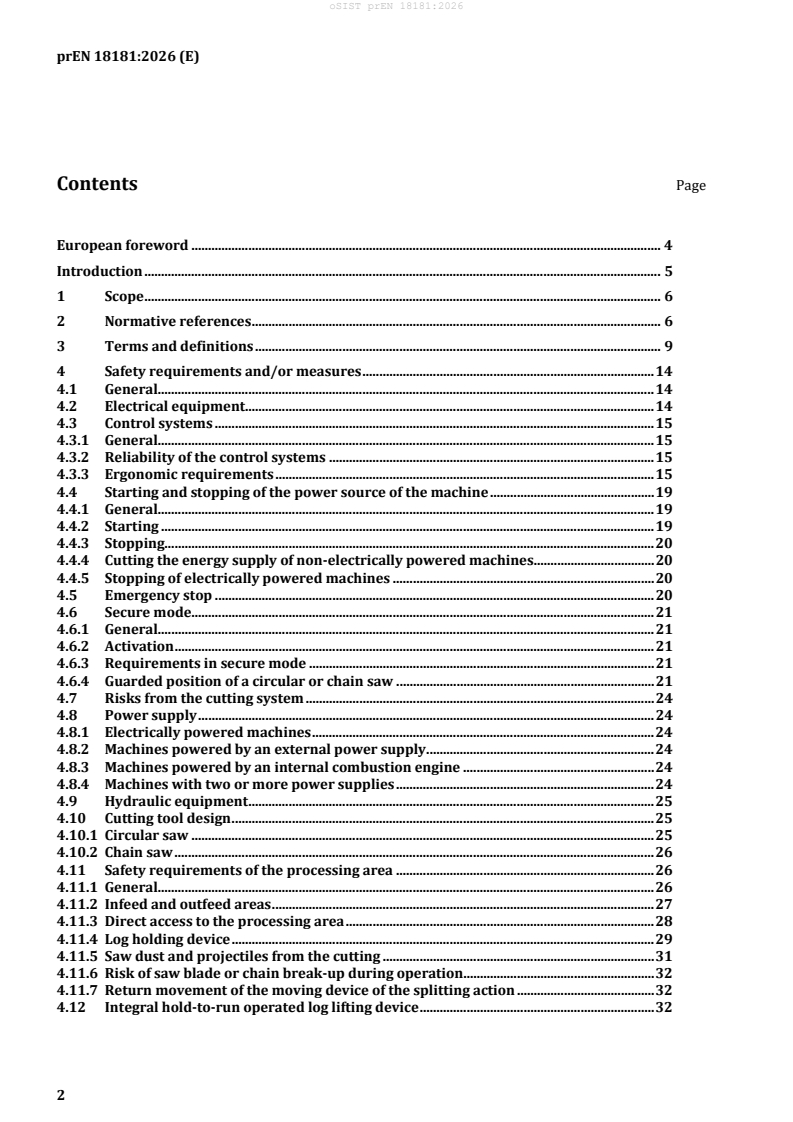
Contents Page
European foreword . 4
Introduction . 5
1 Scope . 6
2 Normative references . 6
3 Terms and definitions . 9
4 Safety requirements and/or measures . 14
4.1 General. 14
4.2 Electrical equipment. 14
4.3 Control systems . 15
4.3.1 General. 15
4.3.2 Reliability of the control systems . 15
4.3.3 Ergonomic requirements . 15
4.4 Starting and stopping of the power source of the machine . 19
4.4.1 General. 19
4.4.2 Starting . 19
4.4.3 Stopping. 20
4.4.4 Cutting the energy supply of non-electrically powered machines . 20
4.4.5 Stopping of electrically powered machines . 20
4.5 Emergency stop . 20
4.6 Secure mode. 21
4.6.1 General. 21
4.6.2 Activation . 21
4.6.3 Requirements in secure mode . 21
4.6.4 Guarded position of a circular or chain saw . 21
4.7 Risks from the cutting system . 24
4.8 Power supply . 24
4.8.1 Electrically powered machines . 24
4.8.2 Machines powered by an external power supply . 24
4.8.3 Machines powered by an internal combustion engine . 24
4.8.4 Machines with two or more power supplies . 24
4.9 Hydraulic equipment . 25
4.10 Cutting tool design . 25
4.10.1 Circular saw . 25
4.10.2 Chain saw . 26
4.11 Safety requirements of the processing area . 26
4.11.1 General. 26
4.11.2 Infeed and outfeed areas . 27
4.11.3 Direct access to the processing area . 28
4.11.4 Log holding device . 29
4.11.5 Saw dust and projectiles from the cutting . 31
4.11.6 Risk of saw blade or chain break-up during operation. 32
4.11.7 Return movement of the moving device of the splitting action . 32
4.12 Integral hold-to-run operated log lifting device . 32
4.13 Safety requirements of the integral outfeed conveyor . 32
4.14 Bluntness of edges . 33
4.15 Stability . 33
4.15.1 General . 33
4.15.2 Stability test for machines in working condition . 33
4.15.3 Stability test for machines in stored condition . 33
4.16 Emission of chips and dust from the cutting . 34
4.17 Noise . 35
4.17.1 General . 35
4.17.2 Operating conditions . 35
4.17.3 Sound power level measurement . 35
4.17.4 Emission-sound pressure level at the workplace . 35
4.17.5 Measurement uncertainties . 36
4.17.6 Reporting . 36
4.17.7 Declaration and verification . 37
4.18 Maintenance . 37
5 Verification of safety requirements . 37
6 Information for use . 38
6.1 Warning devices . 38
6.2 Marking of machine . 38
6.3 Warnings signs . 39
6.4 Instruction handbook . 39
6.4.1 General . 39
6.4.2 Other information . 39
Annex A (informative) List of significant hazards . 44
Annex B (normative) Saw spindle dimensional tolerances. 47
Annex ZA (informative) Relationship between this European Standard and the essential
requirements of Regulation (EU) 2023/1230 aimed to be covered . 48
Bibliography . 52
European foreword
This document (prEN 18181:2026) has been prepared by Technical Committee CEN/TC 144 “Tractors
and machinery for agriculture and forestry”, the secretariat of which is held by AFNOR.
This document is currently submitted to the CEN Enquiry.
This document has been prepared under a standardization request addressed to CEN by the European
Commission. The Standing Committee of the EFTA States subsequently approves these requests for its
Member States.
For relationship with EU Directive(s), see informative Annex ZA, which is an integral part of this
document.
Introduction
This document is a type-C standard as stated in EN ISO 12100.
This document is of relevance, in particular, for the following stakeholder groups representing the market
players with regard to machinery safety:
— designers, manufacturers and their authorized representatives of firewood processors;
— health and safety bodies (regulators, accident prevention organizations, market surveillance etc.).
Others can be affected by the level of machinery safety achieved with the means of the document by the
above-mentioned stakeholder groups:
— machine users/employers (small, medium and large enterprises);
— machine users/employees (e.g. trade unions, organizations for people with special needs);
— service providers, e.g. for maintenance (small, medium and large enterprises);
— consumers (in case of machinery intended for use by consumers).
The above-mentioned stakeholder groups have been given the possibility to participate at the drafting
process of this document.
The machinery concerned and the extent to which hazards, hazardous situations or hazardous events are
covered are indicated in the Scope of this document.
When requirements of this type-C standard are different from those which are stated in type-A or type-B
standards, the requirements of this type-C standard take precedence over the requirements of the other
standards for machines that have been designed and built according to the requirements of this type-C
standard.
1 Scope
This document specifies safety requirements and their verification for the design and construction of
firewood processors, designed to be used for making firewood. Firewood processors are combined
machinery that cut and then split the wood. This document covers machines where the cutting is done
either by a chain blade or a circular saw, and splitting movement is done horizontally or near horizontally
by one or more splitting wedges. If cutting or splitting is done by other means, e.g. by guillotine blade or
vertical movement splitting, this document is not applicable. This document is not applicable for
machinery, where the wood is required to be moved from cutting to the splitting by manual handling by
the operator.
This document deals with firewood processors that are designed in a way that only one operator carries
out the work process, but it is foreseeable that other operators, e.g. for loading or unloading, will work
on or close to the machine.
This document deals with all significant hazards, hazardous situations and hazardous events relevant to
these machines, when they are used as intended and under the conditions foreseen by the manufacturer.
See Annex A for the list of significant hazards.
This document is applicable for manually operated, semi-automatic and automatic firewood processors.
This document is applicable to the following possible integral features of the firewood processor:
— Integral outfeed conveyors;
— Integral infeed conveyors;
— Integral hold to run operated log lifting device.
Other accessories or added features of firewood processors are not covered by this document. These
could be e.g.:
— Separate conveyors or tables that are not integral parts of the machine;
— Other wood lifting equipment (e.g. winch or crane);
— Other separate accessories of the machine, e.g. for cleaning the wood or packing the wood.
This document is not applicable to firewood processors which were manufactured before the date of its
publication.
2 Normative references
The following referenced documents are indispensable for the application of this document. For dated
references, only the edition cited applies. For undated references, the latest edition of the referenced
document (including any amendments) applies.
EN 847-1:2017, Tools for woodworking - Safety requirements - Part 1: Milling tools, circular saw blades
EN 894-1:1997+A1:2008, Safety of machinery - Ergonomics requirements for the design of displays and
control actuators - Part 1: General principles for human interactions with displays and control actuators
EN 894-2:1997+A1:2008, Safety of machinery - Ergonomics requirements for the design of displays and
control actuators - Part 2: Displays
EN 894-3:2000+A1:2008, Safety of machinery - Ergonomics requirements for the design of displays and
control actuators - Part 3: Control actuators
EN 894-4:2010, Safety of machinery - Ergonomics requirements for the design of displays and control
actuators - Part 4: Location and arrangement of displays and control actuators
EN 15811:2014, Agricultural machinery - Fixed guards and interlocked guards with or without guard
locking for moving transmission parts (ISO/TS 28923:2012 modified)
EN 17067:2018, Forestry machinery - Safety requirements on radio remote controls
EN 60204-1:2018, Safety of machinery - Electrical equipment of machines - Part 1: General requirements
EN 60529:1991, Degrees of protection provided by enclosures (IP Code)
EN 61310-1:2008, Safety of machinery - Indication, marking and actuation - Part 1: Requirements for
visual, acoustic and tactile signals
EN 61310-2:2008, Safety of machinery - Indication, marking and actuation - Part 2: Requirements for
marking
EN ISO 14122-3:2016, Safety of machinery - Permanent means of access to machinery - Part 3: Stairs,
stepladders and guard-rails (ISO 14122-3:2016)
EN ISO 3411:2007, Earth-moving machinery - Physical dimensions of operators and minimum operator
space envelope (ISO 3411:2007)
EN ISO 3743-2:2019, Acoustics - Determination of sound power levels of noise sources using sound pressure
- Engineering methods for small, movable sources in reverberant fields - Part 2: Methods for special
reverberation test rooms (ISO 3743-2:2018)
EN ISO 3744:2010, Acoustics - Determination of sound power levels and sound energy levels of noise sources
using sound pressure - Engineering methods for an essentially free field over a reflecting plane (ISO
3744:2010)
EN ISO 4254-1:2015, Agricultural machinery - Safety - Part 1: General requirements (ISO 4254-1:2013)
EN ISO 4413:2010, Hydraulic fluid power - General rules and safety requirements for systems and their
components (ISO 4413:2010)
EN ISO 4871:2009, Acoustics - Declaration and verification of noise emission values of machinery and
equipment (ISO 4871:1996)
EN ISO 11201:2010, Acoustics - Noise emitted by machinery and equipment - Determination of emission
sound pressure levels at a work station and at other specified positions in an essentially free field over a
reflecting plane with negligible environmental corrections (ISO 11201:2010)
EN ISO 11202:2010, Acoustics - Noise emitted by machinery and equipment - Determination of emission
sound pressure levels at a work station and at other specified positions applying approximate environmental
corrections (ISO 11202:2010)
As impacted by EN 60529:1991/A1:2000, EN 60529:1991/A2:2013, EN 60529:1991/corrigendum May 1993, EN
60529:1991/AC:2016-12 and EN 60529:1991/A2:2013/AC:2019-02.
As impacted by EN ISO 4254-1:2015/A1:2021.
As impacted by EN ISO 11202:2010/A1:2021.
EN ISO 11688-1:2009, Acoustics - Recommended practice for the design of low-noise machinery and
equipment - Part 1: Planning (ISO/TR 11688-1:1995)
EN ISO 12100:2010, Safety of machinery - General principles for design - Risk assessment and risk reduction
(ISO 12100:2010)
EN ISO 13849-1:2023, Safety of machinery - Safety-related parts of control systems - Part 1: General
principles for design (ISO 13849-1:2023)
EN ISO 13850:2015, Safety of machinery - Emergency stop function - Principles for design (ISO 13850:2015)
EN ISO 13855:2024, Safety of machinery - Positioning of safeguards with respect to the approach of the
human body (ISO 13855:2024)
EN ISO 13857:2019, Safety of machinery - Safety distances to prevent hazard zones being reached by upper
and lower limbs (ISO 13857:2019)
EN ISO 14119:2025, Safety of machinery - Interlocking devices associated with guards - Principles for
design and selection (ISO 14119:2024)
EN ISO 14120:2015, Safety of machinery - Guards - General requirements for the design and construction
of fixed and movable guards (ISO 14120:2015)
EN ISO 14738:2008, Safety of machinery - Anthropometric requirements for the design of workstations at
machinery (ISO 14738:2002, including Cor 1:2003 and Cor 2:2005)
ISO 3767-1:2016, Tractors, machinery for agriculture and forestry, powered lawn and garden equipment
— Symbols for operator controls and other displays — Part 1: Common symbols
ISO 3767-2:2016, Tractors, machinery for agriculture and forestry, powered lawn and garden equipment
— Symbols for operator controls and other displays — Part 2: Symbols for agricultural tractors and
machinery
ISO 7960:1995, Airborne noise emitted by machine tools — Operating conditions for woodworking
machines
ISO 15818:2017, Earth-moving machinery — Lifting and tying-down attachment points — Performance
requirements
As impacted by ISO 3767-1:2016/Amd 1:2020.
As impacted by ISO 3767-2:2016/Amd 1:2020.
3 Terms and definitions
For the purposes of this document, the terms and definitions given in EN ISO 12100:2010 and the
following apply.
ISO and IEC maintain terminological databases for use in standardization at the following addresses:
— IEC Electropedia: available at http://www.electropedia.org/
— ISO Online browsing platform: available at http://www.iso.org/obp
3.1
firewood processor
combination of a circular saw or a chain saw to cut logs and a wedge splitting device to split the log cuts
into two or more pieces
Note 1 to entry: Moving the wood from cutting to splitting does not require touching it (i.e. with a hand).
Note 2 to entry: A basic type of a firewood processor is illustrated in Figure 1.
a)
b)
Key
A Belt conveyor (infeed table)
B Log holding device
C Chain saw
D Splitting bed
E Splitting wedge
F Interlocking movable guard
G Belt conveyor (outfeed)
H Guard for the outfeed area
Figure 1 — Example of a firewood processor with belt conveyor for feeding, chain saw and belt
conveyor for discharge (Interlocking movable guard closed and open)
3.1.1
manually operated firewood processor
firewood processor (3.1) where all movements are initiated and controlled manually by the operator, one
at a time
Note 1 to entry: This group of firewood processors can be equipped with the following features:
— a manually controlled log feed motion – possibly non-mechanical – in the feeding direction;
— a manually controlled log holding device – possibly non-mechanical;
— a manually controlled saw feed (in the cutting direction) or cutting operation – possibly non-
mechanical;
— a log transfer to the splitting bed by gravity;
— a manually triggered splitting activation;
— a manually controlled splitting wedge adjustment.
3.1.2
semiautomatic firewood processor
firewood processor (3.1) where one of its sub-functions is activated by the operator and then performed
automatically
Note 1 to entry: This group of firewood processors can be equipped with some or all of the features of manual
machines and the following:
— an automatic splitting operation (either by the adjusting of a control device or by a saw-return function
or by a cut log);
— an automatic log holding device.
Note 2 to entry: See Figure 1.
Note 3 to entry: The operator is present at all times to intervene in the event of faults of at least one semi-automatic
function.
3.1.3
automatic firewood processor
firewood processor (3.1) where the process (each of its sub-functions) is activated by the operator only
once and then performed automatically
Note 1 to entry: This group of firewood processors can be equipped with the following features:
— an automatically operated log feed to the feeding direction;
— an automatically operated log holding device;
— an automatically operated saw feed operation;
— a log transfer to the splitting bed by automatically operated devices;
— an automatic splitting operation;
— an automatically operated splitting wedge adjustment.
Note 2 to entry: For use of the firewood processor, the operator is not required to be present all the time. All
functions are fully automatic, no pro-active support for a process or human user is required.
3.2
feeding direction
direction in which the material is being fed for cutting
Note 1 to entry: Feeding direction is perpendicular to the cutting direction (3.3).
3.3
cutting direction
direction in which the material is being cut
Note 1 to entry: Cutting direction is perpendicular to the feeding direction (3.2).
Note 2 to entry: Cutting action can be achieved by moving the blade or the wood in the cutting direction.
3.4
infeed table
integral part of the machine, which supports and feeds the wood during the whole feeding and cutting
process
EXAMPLES Belt conveyor, chain conveyor, mechanical roller, feeding cylinder or feeding gripper.
3.5
integral conveyor
element of a firewood processor, which performs functions related to moving the material
Note 1 to entry: An integral conveyor cannot be removed from the machine.
Note 2 to entry: Not related to the maximum log length of the machine.
3.5.1
integral infeed conveyor
integral conveyor (3.5) which feeds the wood directly into the work process via the infeed area without
requiring manual support
3.5.2
integral outfeed conveyor
integral conveyor (3.5) which takes the wood pieces from the area after the processing area (3.16)
Note 1 to entry: An integral outfeed conveyor can also be used to restrict direct access to the splitting zone of the
machine.
3.6
secure mode
operating mode of a firewood processor (3.1) where all hazardous movement is prevented and the
machine is not dangerous to the user
Note 1 to entry: Secure mode can be activated by an operator. In a typical case, the action to activate the secure
mode is by opening a guard to access the processing area.
3.7
line of cutting
line along which the wood is being cut
Note 1 to entry: See Figure 2, key E.
3.8
movable pressure plate
moving part of the machine, which pushes the log against the splitting wedge
3.9
splitting wedge
stationary or moving tool, which causes the log to split into two or more pieces
Note 1 to entry: A stationary splitting wedge can have a height adjustment.
3.10
splitting zone
area, in which the log is being split
3.11
splitting bed
part of a horizontal wedge splitting device on which the log is placed for splitting
3.12
infeed area
area where wood is fed into the processing area
Note 1 to entry: See Figure 2.
3.13
outfeed area
area to where processed wood pieces exit after the processing area
Note 1 to entry: See Figure 2.
3.14
integral hold to run operated log lifting device
optional accessory of a firewood processor designed to lift the wood to the infeed table in order to be fed
into the processing area of the machine
3.15
log holding device
device designed to hold the wood still during the cutting operation
3.16
processing area
area where hazardous movements occur in the process of sawing and splitting (D, E, F)
Note 1 to entry: See Figure 2.
Key
A Integral hold to run operated log lifting device (see 3.14)
B Infeed table (see 3.4)
C Start of the processing area (opening of the infeed area) (see 3.16)
D Log holding device (see 3.15)
E Line of cutting (see 3.7)
F Splitting wedge (see 3.9)
G Processing area
H End of the processing area (opening of the outfeed area)
I Integral outfeed conveyor (see 3.5.2)
CE Infeed area inside the processing area
EF Splitting zone inside the processing area
FH Outfeed area inside the processing area
Figure 2 — Processing area
3.17
hold-to-run control device
control device which initiates and maintains machine functions only as long as the manual control
(actuator) is actuated
[SOURCE: EN ISO 12100:2010, 3.28.3]
4 Safety requirements and/or measures
4.1 General
Machinery shall be in accordance with the safety requirements and/or protective measures of Clause 4.
The machine shall also be marked in accordance with 6.2 and shall be provided or equipped with warning
signs in accordance with 6.3.
In addition, the machine shall be designed according to the principles of EN ISO 12100:2010 for relevant
but not significant hazards which are not dealt with by this document.
Fixings used for securing fixed guards shall be held captive either on the machine or the guard they secure
in accordance with EN ISO 14120:2015, 5.19.
4.2 Electrical equipment
The electrical equipment of electrically driven machines shall be in accordance with EN 60204-1:2018.
The degree of protection of all electrical components shall be a minimum of IP54, and IP44 for the plug
and main switch box in accordance with EN 60529:1991.
See 6.4.2 g) for the use of a portable residual current device.
4.3 Control systems
4.3.1 General
Unless otherwise specified in this document controls shall be at least category 1 in accordance with
EN ISO 13849-1:2023, 6.1.3.2.3.
Firewood processors shall have a maximum of one stationary control station.
For a remote control a separate risk assessment shall be made. The remote control shall be in accordance
with EN 17067:2018.
4.3.2 Reliability of the control systems
Safety-related functions are generally composed of an input portion (e.g. control levers, position sensors,
guards or protective devices), a logic part and an output part (e.g. a motor). These functions shall meet
the requirements of EN ISO 13849-1:2023 and performance level as follows:
a) Starting: PL = c (see 4.4.2);
b) Normal stopping: PL = c (see 4.4.3 and 4.4.4);
c) Emergency stopping: PL = c (see 4.5);
d) Interlocking movable guard stop function: PL = c;
e) Secure mode: PL = c (see 4.6);
f) Active optoelectronic protective device (AOPD) stop function: PL = d;
g) Cutting saw stop function: PL = c (see 4.7);
h) Electrical control unit for the protection of the processing area: PL = c.
4.3.3 Ergonomic requirements
4.3.3.1 General
The controls and actuators shall comply with EN 894-1:1997+A1:2008, EN 894-3:2000+A1:2008 and
EN 894-4:2010.
The machine shall be designed in accordance with EN 894-2:1997+A1:2008 to facilitate the monitoring
of the process and the detection of problems/blockages/fault by the operator.
4.3.3.2 Identification of control actuators
Control functions and movements shall be identified by symbols conforming to ISO 3767-1:2016 with
ISO 3767-1:2016/Amd 1:2020 or ISO 3767-2:2016 with ISO 3767-2:2016/Amd 1:2020, so that the
operator can determine the proper control function and movement.
Labels, signs and other informative texts or symbols shall be located on or adjacent to their associated
control actuators, in such a position that they are visible when control actuators are operated.
4.3.3.3 Movement space of control actuators
At the operator station clearance according to EN ISO 3411:2007, Table 1, Figure 5 and if applicable
Figure 4 shall be observed. For standing operators, a lateral clearance of at least 920 mm shall be
observed.
The body movements that are required to operate control actuators shall not cause discomfort for the
operator.
The space between individual control actuators shall fulfil the requirements of EN ISO 4254-1:2015, 4.5.
Additional requirements for the manual controls are:
Unless otherwise stated in this document, the manual control actuators shall be in accordance with the
requirements of EN 894-3:2000+A1:2008 and EN 894-4:2010 with respect to design and actuating
forces.
The machines shall be designed to minimize the force exerted by the operator, when using the control
actuators. The maximum force shall not exceed the requirements of EN ISO 4254-1:2015, 4.5.
Minimum control actuating forces shall be sufficient to avoid inadvertent actuation.
The force required to activate the manual control actuator hand lever shall not be greater than 55 N in
the vertical and 35 N in the horizontal direction.
The emergency stop, secure mode control and cutting saw stop control required in 4.5, 4.6 and 4.7 c) shall
be clearly visible and reachable from the operating position of the machine. The actuator shall be clearly
visible and reachable also when the machine is loaded with the maximum sized wood.
Actuators shall be designed taking into account the need for the operator to wear personal protective
equipment (e.g. gloves for protection against mechanical hazards, cold, etc.).
4.3.3.4 Operating station
The operating station shall be positioned so that operator shall be able to monitor the processing area.
NOTE The operator monitors and detects problems in the wood flow.
When the machine is standing on the ground, the height of controls (or control panel), from the ground
or from operator's platform if provided, shall be between 960 and 1190 mm (see EN 894-4:2010,
Annex A).
If the operator is required to stand against or close to the control panel, clearance zone for feet shall be
provided for the whole width of the operating position (see Figure 3):
— a ≥ 120 mm (see EN ISO 13854:2019, 4.2);
— b ≥ 210 mm (see EN ISO 14738:2008, 9.1).
Key
a height
b depth
Figure 3 — Free space for the feet
If provided, the operator platform shall:
— provide enough space for the operator to operate around infeed, processing and outfeed areas with
the following minimum dimensions (see Figure 4):
— width (w) ≥ 600 mm;
— depth (d), measured from the edge of the machine to the rear end of the platform ≥ 600 mm;
— be designed according to EN ISO 4254-1:2015, 4.7;
— isolate the operator from vibrations of the machines.
If the maximum height (h) of the platform above the ground reference plane is 400 mm (see Figure 5),
guard-rails are not mandatory. Guard-rails shall be in accordance with EN ISO 14122-3:2016.
If the operator’s platform is foldable/moveable, it shall be in accordance with EN ISO 4254-1:2015, 4.9.2
and 4.9.3, and the operating force shall not exceed 200 N as the average value when moving between the
working position and the folded position. The peak(s) shall not exceed 400 N.
If a seat is provided, it shall not impede the movement of the operator from the infeed area to the outfeed
area.
The seat may be foldable. If it is a standing-seat, it shall be in accordance with EN ISO 14738:2008,
Clause 8.
Key
d depth of the operating platform
w width of the operating platform
Figure 4 — Minimum dimensions of the operating platform (top view)
Key
h height of the platform from the ground
Figure 5 — Height of the operating platform from the ground level (side view)
4.3.3.5 Transportation and lifting points
4.3.3.5.1 General
Firewood processors shall be equipped with lifting and tying-down points that comply with and are
marked in accordance with ISO 15818:2017.
If the firewood processor has a three-point-linkage, it shall fulfil the requirements of
EN ISO 4254-1:2015, 6.2.
Safety instructions on stability during transports shall be given in the instruction handbook, see 6.4 c).
Lifting and tying-down instructions shall be made in accordance with ISO 15818:2017.
4.3.3.5.2 Ergonomic requirements for transportation
If manual transportation of the firewood processor is an option provided by the manufacturer, facilities
to enable manual transport shall be provided, e.g. sufficient handles/holding surfaces for the required
number of persons.
The forces that need to be applied in order to move the machine into the transport position and back to
the working position shall not exceed 250 N. The force shall be measured at the centre of the grip area
provided.
If the machine has components which need to be changed or moved by the operator during normal use,
e.g. a changeable wedge, the required manual force shall not exceed 250 N at any time during the process.
If forces exceeding 250 N arise or if the weight of such a component exceeds a mass of 25 kg, means shall
be foreseen for mechanical handling of this component. Handling instructions shall be given in the
instruction handbook.
If the machine has a three-point linkage, this can be considered a safe and ergonomic transport option.
4.4 Starting and stopping of the power source of the machine
4.4.1 General
A control device, for starting and stopping the power source, shall be provided within the reach of the
operator at a height between 600 and 1500 mm from the level where the operator is standing, unless
different requirements are made in this document.
4.4.2 Starting
The start of an operation shall be possible only when all relevant safety functions and/or protective
measures are in place and are operational.
Starting the power source of the machine shall not start the cutting or splitting process, or any other
hazardous movement, if the machine is in a secure mode (see 4.6.).
Suitable interlocks shall be provided to secure correct sequential starting.
The conditions to initiate a start shall be:
a) all required conditions for machine operation shall be met; and
b) all start control devices shall be in the released (off) position.
Starting of electrically driven machines shall be in accordance with EN 60204-1:2018, 9.2.3.2.
Where it is necessary to suspend safety functions and/or protective measures (for example maintenance
purposes), the control of operating mode selector shall simultaneously:
c) disable all other operating (control) modes;
d) permit operation only by the use of a hold-to-run device or by a similar control device positioned so
as to permit sight of the hazardous elements;
e) permit operation of the hazardous elements only in reduced risk conditions (e.g. reduced speed,
reduced power / force, step-by-stem operation, e.g. with a limited movement control device);
f) prevent any operation of hazardous functions by voluntary or involuntary action on the machine’s
sensors.
If these four conditions cannot be fulfilled simultaneously, the control or operating mode selector shall
activate other protective measures designed and constructed to ensure a safe intervention zone. In
addition, the operator shall be able to control operation of the parts he is working on from the adjustment
point.
4.4.3 Stopping
Every machine function shall be equipped with a stop control. Latched controls shall have a defined stable
stop position, hold to run controls shall return to their stop position once they are released. When a
control is put into the stop position or reaches its stop position, this shall stop the controlled function
immediately and lead to a safe state of the controlled device. The stop function shall have priority over
any other function except the emergency stop function.
4.4.4 Cutting the energy supply of non-electrically powered machines
Every machine shall be equipped with a device which is able to cut the energy supply from the prime
mover to the machine.
For machines powered by the power take-off of a tractor, the start and stop control of the tractor may be
regarded as the operator's controls for cutting the energy supply to the machine.
4.4.5 Stopping of electrically powered machines
Electrically driven machines shall be fitted with a stop control which, when actuated, shall disconnect
power from all the machine actuators.
The colour of the normal stop control device shall be in accordance with EN 60204-1:2018, 10.2.1 using
only the red colour for better identification.
Stop category 0 functions shall be provided as indicated by the risk assessment and the functional
requirements of the machine (see EN 60204-1:2018, 4.1).
Stop functions shall override related start functions (see EN 60204-1:2018, 9.2.3.2 and 9.2.3.3).
The reset of the stop function shall not initiate any hazardous situation.
4.5 Emergency stop
If a firewood processor is equipped with a hold to run actuator of the cutting device and has a secure
mode function, as described in 4.6, an emergency stop would not reduce the stopping time of the
hazardous movement or prevent the hazard. In such firewood processors an emergency stop is not
required.
When a machine has more than one stopping control of the power source and an emergency stop would
reduce the stopping time and/or make it simpler, an emergency stop shall be provided.
With an automatic firewood processor, where the operator of the firewood processor is not required to
stay in the operating position to complete a full process cycle, an emergency stop shall be provided within
the reach of the operator at the operating position and at a position close to the area where the material
is entering the infeed area, at a pos
...