

SIST EN 10359:2023
(Main)Laser welded tailored blanks - Technical delivery conditions
General Information
- Abstract
This document specifies the requirements for laser welded tailored blanks (LWB) made of steels for all cold or hot forming processes.
This document is applicable to all steel grades with or without metallic and/or organic coatings, having uniform or different sheet thickness, welded with or without extra material addition.
After the welding process, LWB are further processed to pressed parts by forming operations under the responsibility of the processor.
- Status
- Published
- Public Enquiry End Date
- 14-Sep-2022
- Publication Date
- 28-May-2023
- Technical Committee
- IFEK - Ferrous metals
- Current Stage
- 6060 - National Implementation/Publication (Adopted Project)
- Start Date
- 16-May-2023
- Due Date
- 21-Jul-2023
- Completion Date
- 29-May-2023

Overview
EN 10359:2023 - "Laser welded tailored blanks (LWB) - Technical delivery conditions" (CEN) defines delivery and inspection requirements for laser welded tailored blanks made of steel for all cold and hot forming processes. The standard applies to LWBs with uniform or different sheet thicknesses and steel grades, with or without metallic/organic coatings and with or without filler material. It replaces EN 10359:2015 and clarifies weld quality, testing, tolerances and heat‑treatment requirements for LWB used mainly in forming and press‑hardening processes.
Key topics and technical requirements
- Scope & applicability: LWB for cold and hot forming; coated and uncoated steels; responsibility for downstream forming lies with the processor.
- Tolerances and references: Dimensional and shape tolerances reference EN 10131, EN 10143 and ISO 2768‑1 (precision class c) for lengths, angles and symmetry.
- Weld quality and geometry: Requirements cover absence of cracks, limits on pores/inclusions, undercut and excess weld metal, and specific rules when filler wire is used. Offset of sheets is limited (example: ±1.5 mm).
- Destructive testing:
- Cup test: recommended best practice for cold‑stamped LWB; frequency minimum once per run.
- Cross‑section measurement: samples taken at least 5 mm from weld ends; coating is excluded from cross‑section measurement.
- Tensile testing: best practice for hot‑stamped LWB; specimens with weld seam centered and perpendicular to load (EN ISO 6892‑1 or equivalent). Acceptable failure modes are defined in Annex A; brittle fracture through the weld is not acceptable.
- Hardness testing: required for hot‑stamped LWB after heat treatment (EN ISO 6507‑1, ASTM E92‑16 recommended). Use HV0.5; avoid decarburized zones (measurement points ≥150 µm from surface) and average at least 9 points for WS, BM1 and BM2.
- Hardness limits: Average weld hardness shall not be lower than the softer base material average minus 30 HV0.5. Upper limits depend on base material strength (e.g., for materials with UTS < 1 200 MPa, maximum average weld hardness is 500 HV0.5; for UTS > 1 200 MPa an average exceedance up to 15% of the higher‑strength base material is permissible).
- Heat treatment: Guidelines for hot‑stamped blanks to ensure base‑material strength targets (tensile/hardness) are met.
Applications and who uses this standard
- Steel mills and strip producers specifying material and coatings for LWB manufacture.
- LWB suppliers and laser welding shops for process control, inspection and delivery conditions.
- Automotive OEMs and Tier 1/2 suppliers using tailored blanks for stamped structural parts and press‑hardening applications (PSW/master sample practices referenced).
- Stampers, quality engineers and inspection labs performing cup, tensile, hardness and cross‑section tests to verify weld integrity and formability.
Related standards
- EN 10131, EN 10143 (tolerances for flat steel products)
- ISO 2768‑1 (general tolerances)
- EN ISO 6892‑1 (tensile testing)
- EN ISO 6507‑1, ASTM E92‑16 (hardness testing)
Keywords: EN 10359:2023, laser welded tailored blanks, LWB, technical delivery conditions, weld testing, tensile testing, hardness testing, cup test, steel tailored blanks.
Relations
- Effective Date
- 25-Aug-2026
- Effective Date
- 28-Jan-2026
- Effective Date
- 28-Jan-2026
- Effective Date
- 28-Jan-2026
- Effective Date
- 19-Jan-2023
Get Certified
Connect with accredited certification bodies for this standard

DVS-ZERT GmbH
German welding certification society.

Element Materials Technology
Materials testing and product certification.
Inštitut za kovinske materiale in tehnologije
Institute of Metals and Technology. Materials testing, metallurgical analysis, NDT.
Sponsored listings
Frequently Asked Questions
SIST EN 10359:2023 is a standard published by the Slovenian Institute for Standardization (SIST). Its full title is "Laser welded tailored blanks - Technical delivery conditions". This standard covers: This document specifies the requirements for laser welded tailored blanks (LWB) made of steels for all cold or hot forming processes. This document is applicable to all steel grades with or without metallic and/or organic coatings, having uniform or different sheet thickness, welded with or without extra material addition. After the welding process, LWB are further processed to pressed parts by forming operations under the responsibility of the processor.
This document specifies the requirements for laser welded tailored blanks (LWB) made of steels for all cold or hot forming processes. This document is applicable to all steel grades with or without metallic and/or organic coatings, having uniform or different sheet thickness, welded with or without extra material addition. After the welding process, LWB are further processed to pressed parts by forming operations under the responsibility of the processor.
SIST EN 10359:2023 is classified under the following ICS (International Classification for Standards) categories: 25.160.40 - Welded joints and welds; 77.140.50 - Flat steel products and semi-products. The ICS classification helps identify the subject area and facilitates finding related standards.
SIST EN 10359:2023 has the following relationships with other standards: It is inter standard links to SIST ISO 2768-1:1999, SIST EN 12631:1999, SIST EN 10131:2006, SIST EN 10143:2006, SIST EN 10359:2015. Understanding these relationships helps ensure you are using the most current and applicable version of the standard.
SIST EN 10359:2023 is available in PDF format for immediate download after purchase. The document can be added to your cart and obtained through the secure checkout process. Digital delivery ensures instant access to the complete standard document.
Standards Content (Sample)
SLOVENSKI STANDARD
01-julij-2023
Lasersko varjeni posebej prilagojeni spoji - Tehnični dobavni pogoji
Laser welded tailored blanks - Technical delivery conditions
Laserstrahlgeschweißte Tailored Blanks aus Stahlfeinblech - Technische
Lieferbedingungen
Flans raboutés laser - Conditions techniques de livraison
Ta slovenski standard je istoveten z: EN 10359:2023
ICS:
25.160.40 Varjeni spoji in vari Welded joints and welds
77.140.50 Ploščati jekleni izdelki in Flat steel products and semi-
polizdelki products
2003-01.Slovenski inštitut za standardizacijo. Razmnoževanje celote ali delov tega standarda ni dovoljeno.
EN 10359
EUROPEAN STANDARD
NORME EUROPÉENNE
May 2023
EUROPÄISCHE NORM
ICS 77.140.50 Supersedes EN 10359:2015
English Version
Laser welded tailored blanks - Technical delivery
conditions
Flans raboutés laser - Conditions techniques de Laserstrahlgeschweißte Tailored Blanks aus
livraison Stahlfeinblech - Technische Lieferbedingungen
This European Standard was approved by CEN on 17 March 2023.
CEN members are bound to comply with the CEN/CENELEC Internal Regulations which stipulate the conditions for giving this
European Standard the status of a national standard without any alteration. Up-to-date lists and bibliographical references
concerning such national standards may be obtained on application to the CEN-CENELEC Management Centre or to any CEN
member.
This European Standard exists in three official versions (English, French, German). A version in any other language made by
translation under the responsibility of a CEN member into its own language and notified to the CEN-CENELEC Management
Centre has the same status as the official versions.
CEN members are the national standards bodies of Austria, Belgium, Bulgaria, Croatia, Cyprus, Czech Republic, Denmark, Estonia,
Finland, France, Germany, Greece, Hungary, Iceland, Ireland, Italy, Latvia, Lithuania, Luxembourg, Malta, Netherlands, Norway,
Poland, Portugal, Republic of North Macedonia, Romania, Serbia, Slovakia, Slovenia, Spain, Sweden, Switzerland, Türkiye and
United Kingdom.
EUROPEAN COMMITTEE FOR STANDARDIZATION
COMITÉ EUROPÉEN DE NORMALISATION
EUROPÄISCHES KOMITEE FÜR NORMUNG
CEN-CENELEC Management Centre: Rue de la Science 23, B-1040 Brussels
© 2023 CEN All rights of exploitation in any form and by any means reserved Ref. No. EN 10359:2023 E
worldwide for CEN national Members.
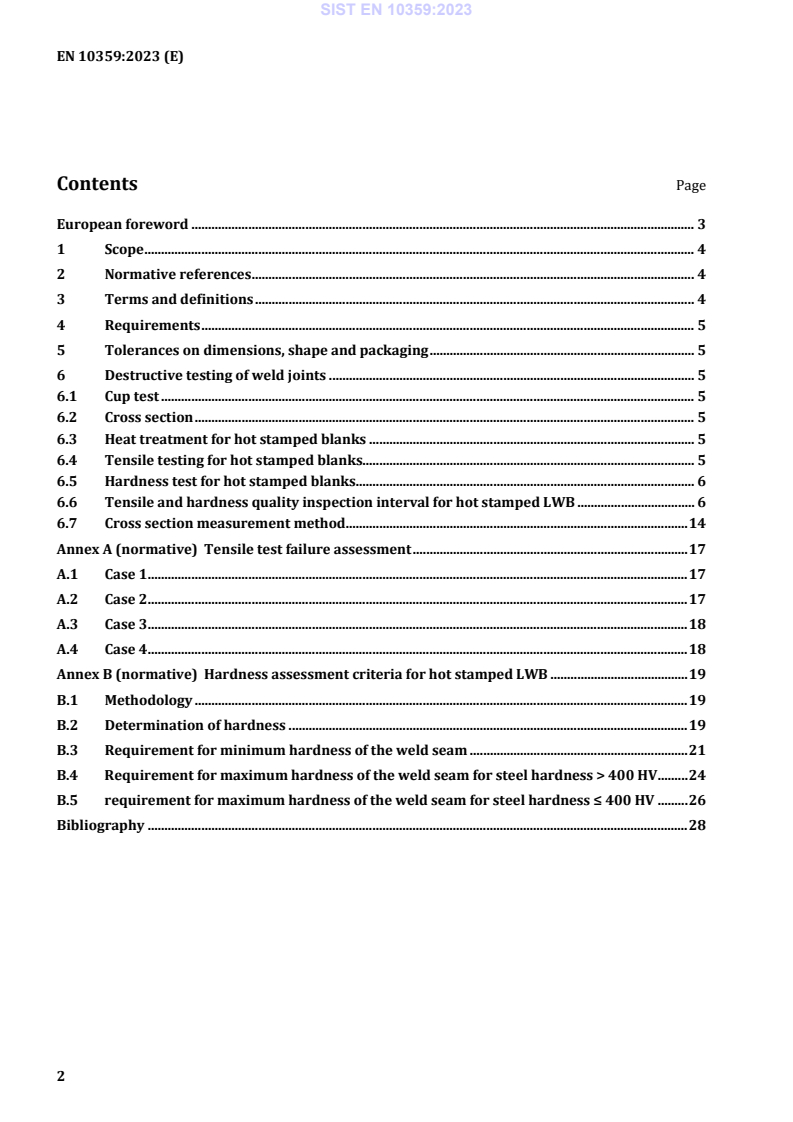
Contents Page
European foreword . 3
1 Scope . 4
2 Normative references . 4
3 Terms and definitions . 4
4 Requirements . 5
5 Tolerances on dimensions, shape and packaging . 5
6 Destructive testing of weld joints . 5
6.1 Cup test . 5
6.2 Cross section . 5
6.3 Heat treatment for hot stamped blanks . 5
6.4 Tensile testing for hot stamped blanks. 5
6.5 Hardness test for hot stamped blanks. 6
6.6 Tensile and hardness quality inspection interval for hot stamped LWB . 6
6.7 Cross section measurement method . 14
Annex A (normative) Tensile test failure assessment . 17
A.1 Case 1 . 17
A.2 Case 2 . 17
A.3 Case 3 . 18
A.4 Case 4 . 18
Annex B (normative) Hardness assessment criteria for hot stamped LWB . 19
B.1 Methodology . 19
B.2 Determination of hardness . 19
B.3 Requirement for minimum hardness of the weld seam . 21
B.4 Requirement for maximum hardness of the weld seam for steel hardness > 400 HV . 24
B.5 requirement for maximum hardness of the weld seam for steel hardness ≤ 400 HV . 26
Bibliography . 28
European foreword
This document (EN 10359:2023) has been prepared by Technical Committee CEN/TC 459 “ECISS -
European Committee for Iron and Steel Standardization” , the secretariat of which is held by AFNOR.
This European Standard shall be given the status of a national standard, either by publication of an
identical text or by endorsement, at the latest by November 2023 and conflicting national standards shall
be withdrawn at the latest by November 2023.
Attention is drawn to the possibility that some of the elements of this document may be the subject of
patent rights. CEN shall not be held responsible for identifying any or all such patent rights.
This document supersedes EN 10359:2015.
In comparison with the previous edition, the following technical modifications have been made:
— addition of three definitions;
— modification of the convexity requirement when filler wire is added for cold stamped LWB;
— addition of a requirement in the case of hot stamped LWB:
— modification of the convexity requirement;
— heat treatment guidelines;
— modification of the destructive testing requirement (tensile test and hardness test);
— modification of the cross-section measurement method: exclusion of coating;
— definition of the weld cross section measurement method;
— suppression of the weld sagging defect as being redundant with other existing defects.
Any feedback and questions on this document should be directed to the users’ national standards body.
A complete listing of these bodies can be found on the CEN website.
According to the CEN-CENELEC Internal Regulations, the national standards organizations of the
following countries are bound to implement this European Standard: Austria, Belgium, Bulgaria, Croatia,
Cyprus, Czech Republic, Denmark, Estonia, Finland, France, Germany, Greece, Hungary, Iceland, Ireland,
Italy, Latvia, Lithuania, Luxembourg, Malta, Netherlands, Norway, Poland, Portugal, Republic of North
Macedonia, Romania, Serbia, Slovakia, Slovenia, Spain, Sweden, Switzerland, Türkiye and the United
Kingdom.
1 Through its sub-committee SC 9 “Coated and uncoated flat products to be used for cold forming” (secretariat:
AFNOR).
1 Scope
This document specifies the requirements for laser welded tailored blanks (LWB) made of steels for all
cold or hot forming processes.
This document is applicable to all steel grades with or without metallic and/or organic coatings, having
uniform or different sheet thickness, welded with or without extra material addition.
After the welding process, LWB are further processed to pressed parts by forming operations under the
responsibility of the processor.
2 Normative references
The following documents are referred to in the text in such a way that some or all of their content
constitutes requirements of this document. For dated references, only the edition cited applies. For
undated references, the latest edition of the referenced document (including any amendments) applies.
EN 10131, Cold rolled uncoated and zinc or zinc-nickel electrolytically coated low carbon and high yield
strength steel flat products for cold forming — Tolerances on dimensions and shape
EN 10143, Continuously hot-dip coated steel sheet and strip — Tolerances on dimensions and shape
ISO 2768-1, General tolerances — Part 1: Tolerances for linear and angular dimensions without individual
tolerance indications
3 Terms and definitions
For the purposes of this document, the following terms and definitions apply.
ISO and IEC maintain terminology databases for use in standardization at the following addresses:
— ISO Online browsing platform: available at https://www.iso.org/obp
— IEC Electropedia: available at https://www.electropedia.org/
3.1
laser welded tailored blanks
LWB
laser welded metal sheets of uniform and/or different thickness and/or uniform or different steel grades,
both with and without surface coating
3.2
part submission warrant
PSW
technical report used in the automotive industry when submitting a new car part to a car part
manufacturer for approval as part of a production car part approval process
Note 1 to entry: The part manufacturer can be a carmaker or a subcontracting company delivering car parts to the
carmaker.
3.3
supplier
manufacturer of LWB
3.4
customer
purchaser of LWB
4 Requirements
As far as the properties of the components are concerned, the general rules of engineering apply. The
suitability of LWB for the processes of the customer shall be guaranteed in case of appropriate execution
of the welding seam, suitable positioning of the weld seam in the part to be formed and appropriate lay
out of sheet thicknesses and steel grades taking into consideration the requirements of known further
processing steps. The criteria laid down in Table 1 have proved to be a practical basis for ordering and
shall be applied. Additional specific deviations can be permitted and shall be agreed upon at the time of
ordering.
5 Tolerances on dimensions, shape and packaging
Regarding tolerances on dimensions and shape, the agreements of EN 10131 and EN 10143 shall apply
for cold rolled and surface coated wide coils, cut to length sheets and slit coils, which are used for the
manufacturing of LWB.
The relevant tolerance classes for width, flatness and thickness shall be agreed upon between producer
of LWB, steel producer and customer.
For the general tolerances regarding lengths, angles, coaxiality and symmetry, the precision class c
according to ISO 2768-1 shall apply.
If not all edges of the blank were cut, the definition of the dimension shall be according to EN 10143 and
EN 10131 also.
Specific requirements and other beyond that valid special customer agreement shall be agreed upon
between producer of LWB /steel producer and customer.
Packaging requirements for LWB are specified in Figure 6.
6 Destructive testing of weld joints
6.1 Cup test
Destructive testing of the weld joints with cup test is considered as best practice procedure for cold
stamped blanks.
The evaluation of weld quality shall be done in accordance with the Figures 3, 4 and 5.
Frequency of the cup test is minimum once a run.
6.2 Cross section
Samples shall be taken minimum 5 mm from both ends of welds. For measurements, Figure 7 and
Figure 8 apply.
Additional criteria for press hardening steel LWB, ferritic and intermetallic phases are acceptable as long
as they have no negative influence on the weld strength measured with the tensile test.
6.3 Heat treatment for hot stamped blanks
Heat treatment shall be conducted to have base material meeting minimal and maximal customer
strength requirements measured either with tensile or hardness testing.
6.4 Tensile testing for hot stamped blanks
Destructive testing of weld joints with tensile testing is considered as a best practice procedure for hot
stamped blanks.
This test shall be carried out after heat treatment. The tensile test samples are taken across the seam.
The shape of the tensile specimen may be in accordance with EN ISO 6892-1 or the relevant JIS or ASTM
standard. Another shape may also be agreed between supplier and customer.
The weld seam shall be positioned in the middle of the specimen and perpendicular to the applied load.
Ultimate tensile strength of the specimens shall exceed base material minimum tensile strength of the
weaker substrate.
The tensile test result can be considered as good if one of the three following failure modes occurs:
— fracture occurs in base material not affecting at all the weld seam (see case 1 in Annex A);
— the crack starts at the notch base of the weld seam and continues in the base material (see case 2 in
Annex A);
— in the case of same gauge and same thickness, a ductile fracture occurs in the weld provided the
minimum strength, the hardness and the weld geometry meet the requirements of this document
(see case 3 in Annex A).
The tensile test is not good if a brittle fracture perpendicular to the load occurs (see case 4 in Annex A).
6.5 Hardness test for hot stamped blanks
The hardening process shall be carried out as specified in 6.3.
The hardness test should be carried out in accordance with EN ISO 6507-1, ASTM E92-16 or another
equivalent standard. HV 0,5 is recommended as the best compromise to have enough measurements in
the weld seam and not too high dispersion (see Figure B.1).
The hardness shall not be measured in the decarburized area (see Figures B.2 and B.3). Therefore,
hardness measurement points shall have a minimum distance from the surface of at least 150 μm.
Due to the scattering of hardness values an average value from at least 9 measurement points in the weld
seam (WS), the base material 1 (BM1) and the base material 2 (BM2) shall be determined (see Figure B.2).
Minimum hardness value of the weld seam
The average hardness of the weld shall not drop below average softer material hardness value minus
30 HV 0,5.
See Figures B.4 and B.5.
Maximum hardness value of the weld seam
— Higher strength material with ultimate tensile strength higher than 1 200 MPa. Exceeding the
maximum value of higher strength base material by 15 % is permissible in average. See Figure B.6.
— higher strength material with ultimate tensile strength below 1 200 MPa. The maximum average
value is set to 500 HV 0,5. See Figure B.7.
6.6 Tensile and hardness quality inspection interval for hot stamped LWB
The quality inspection interval requirements on the weld seam are specified in Table 1, column
“Frequency”.
Table 1 — Requirements
Dimensions, surface
Criterion Figures Assessment Frequency
Shape inspection — Tolerances for linear and angular —
(Tolerance) dimensions without individual
tolerance indications according to
ISO 2768-1, class c,
EN 10143, EN 10131 or customer
specification.
Shape inspection — Master sample (initial sample): Initial parts or master
(Method of Reference points should be agreed sample for PSW.
measurement) with the customer. Production:
Production sample each
measuring of the influential
run.
dimensions.
Flatness of the entire Deviation h guaranteed acc. to Initial parts or master
Figure 1 a)
blank EN 10131 and EN 10143. sample for PSW.
Furthermore, the “processability”
Production samples each
criterion shall apply. Tighter
run. Visual.
specification should be agreed
between customer and supplier.
Burr of the entire — Customer specification. Production samples each
LWB run. Visual.
Surface quality of — According to relevant technical Production samples each
LWB delivery conditions for flat run. Visual.
products.
Oiling of LWB — The entire blank shall be free from Initial parts or master
corrosion products. Oil type and sample for PSW.
amount of oil at time of steel strip
Visual each run.
production acc. to customer
specification. More than 1,5 g/m is
not state of the art due to process
ability.
Offset of sheets maximal offset ± 1,5 mm Initial parts or master
Figure 1 b)
sample for PSW.
Production sample one
each run.
Requirements on weld seam
Cracks / Pores / — Pores, inclusions: Maximum size of Additional minimum one
Inclusions / Craters / imperfection ≤ 0,3 x t destructive test (cross
Lack of fusion section) once a year.
Pore nests: f ≤ 0,7 %.
No cracks, craters or lack of fusion
...