

EN IEC 55012:2025
(Main)Vehicles, boats and devices with internal combustion engines or traction batteries - Radio disturbance characteristics - Limits and methods of measurement for the protection of off-board receivers
General Information
- Abstract
- Status
- Published
- Publication Date
- 18-Sep-2025
- Technical Committee
- CLC/TC 210 - Electromagnetic Compatibility (EMC)
- Current Stage
- 6060 - Document made available - Publishing
- Start Date
- 19-Sep-2025
- Due Date
- 30-May-2025
- Completion Date
- 19-Sep-2025

Overview
EN IEC 55012:2025 (CISPR 12:2025) is the European adoption of the international standard that defines radio disturbance characteristics, limits and measurement methods for vehicles, boats and devices powered by internal combustion engines or traction batteries. It replaces EN 55012:2007 and provides the criteria and test procedures to protect off‑board receivers from radiated electromagnetic interference (EMI). The standard was approved by CENELEC in 2025 and is published in English, French and German.
Key Topics
- Scope and alignment: Identical to CISPR 12:2025; applies to vehicles, boats and ICE/traction-battery‑powered devices where off‑board receiver protection is required.
- Limits of radiated disturbance: Defines limit curves and detector types used for compliance assessment (peak, quasi‑peak and average detectors).
- Measurement methods: Detailed procedures for radiated emission testing, including required measuring receivers, antenna types and calibration references.
- Test site requirements: Specifications for outdoor test sites (OTS) and alternative sites, antenna placement and test geometry.
- Test setups & conditions: Procedures for vehicles in normal operation and charging mode, vehicle/boat/device conditioning, dry vs. wet conditions, and grouping rules for different product types.
- Measurement uncertainty: Guidance on instrumentation uncertainty and sources of error for reliable test results.
- Normative and informative annexes: Includes procedures for alternative emission limits, measurement of ignition noise suppressors, attenuation tests for high‑voltage ignition systems, applicability flowcharts, and DC charging/artificial network definitions (AMN, AAN, DC‑charging‑AN).
Applications
- Automotive and marine OEMs: Use the standard to design and validate vehicles and boats to meet EMI limits protecting radio services.
- Electric vehicle (EV) and charging-system designers: Apply measurement methods for vehicles with traction batteries and for evaluating charging‑related emissions.
- Component suppliers: Test engines, ignition suppression devices, inverters and charging interfaces against CISPR‑based limits.
- EMC test laboratories & certification bodies: Perform standardized radiated emission tests for regulatory compliance and product certification.
- Regulators and procurement teams: Reference the standard when setting acceptance criteria for products deployed near radio receivers.
Related Standards
EN IEC 55012:2025 references and aligns with several measurement and equipment standards, for example:
- CISPR 16 (measurement apparatus and test sites)
- IEC 61851‑1 (EV conductive charging systems)
- EN IEC 55014‑1, EN IEC 55025 and other EMC test standards
Keywords: EN IEC 55012:2025, CISPR 12:2025, vehicle EMI, radiated disturbance, off‑board receivers, EMC testing, internal combustion engines, traction batteries.
Relations
- Effective Date
- 20-Feb-2024
- Effective Date
- 20-Feb-2024
- Effective Date
- 03-Feb-2026
- Effective Date
- 03-Feb-2026
- Effective Date
- 03-Feb-2026
- Effective Date
- 03-Feb-2026
- Effective Date
- 03-Feb-2026
- Effective Date
- 03-Feb-2026
- Effective Date
- 03-Feb-2026
- Effective Date
- 03-Feb-2026
- Refers
EN IEC 61851-1:2019 - Electric vehicle conductive charging system - Part 1: General requirements - Effective Date
- 03-Feb-2026
- Effective Date
- 03-Feb-2026
- Effective Date
- 03-Feb-2026
- Effective Date
- 03-Feb-2026
- Effective Date
- 03-Feb-2026
Get Certified
Connect with accredited certification bodies for this standard

DNV
DNV is an independent assurance and risk management provider.

Lloyd's Register
Lloyd's Register is a global professional services organisation specialising in engineering and technology.
DNV Energy Systems
Energy and renewable energy certification.
Sponsored listings
Frequently Asked Questions
EN IEC 55012:2025 is a standard published by CLC. Its full title is "Vehicles, boats and devices with internal combustion engines or traction batteries - Radio disturbance characteristics - Limits and methods of measurement for the protection of off-board receivers". This standard covers: Vehicles, boats and devices with internal combustion engines or traction batteries - Radio disturbance characteristics - Limits and methods of measurement for the protection of off-board receivers
Vehicles, boats and devices with internal combustion engines or traction batteries - Radio disturbance characteristics - Limits and methods of measurement for the protection of off-board receivers
EN IEC 55012:2025 is classified under the following ICS (International Classification for Standards) categories: 27.020 - Internal combustion engines; 33.100.10 - Emission. The ICS classification helps identify the subject area and facilitates finding related standards.
EN IEC 55012:2025 has the following relationships with other standards: It is inter standard links to EN 55012:2007, EN 55012:2007/A1:2009, EN 55016-1-2:2014/A1:2018, EN 55016-1-3:2006/A2:2020, EN IEC 55016-1-4:2019/A1:2020, EN 55016-2-1:2014/A1:2017, EN 55016-1-6:2015, EN 55016-1-3:2006, EN 55016-1-6:2015/A2:2022, EN 55016-1-6:2015/A1:2017, EN IEC 61851-1:2019, EN 55016-1-3:2006/A1:2016, EN IEC 55016-1-1:2019, EN 55016-1-2:2014, EN IEC 55016-1-4:2019. Understanding these relationships helps ensure you are using the most current and applicable version of the standard.
EN IEC 55012:2025 is associated with the following European legislation: EU Directives/Regulations: 2014/30/EU. When a standard is cited in the Official Journal of the European Union, products manufactured in conformity with it benefit from a presumption of conformity with the essential requirements of the corresponding EU directive or regulation.
EN IEC 55012:2025 is available in PDF format for immediate download after purchase. The document can be added to your cart and obtained through the secure checkout process. Digital delivery ensures instant access to the complete standard document.
Standards Content (Sample)
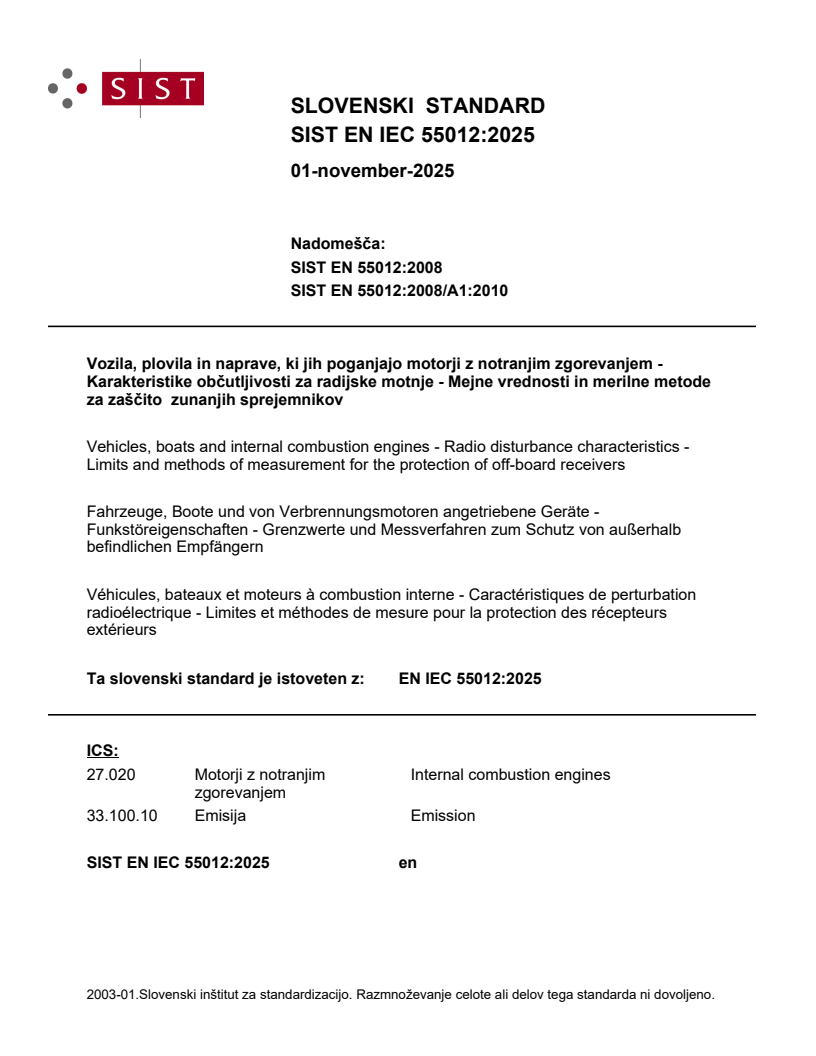
SLOVENSKI STANDARD
01-november-2025
Nadomešča:
SIST EN 55012:2008
SIST EN 55012:2008/A1:2010
Vozila, plovila in naprave, ki jih poganjajo motorji z notranjim zgorevanjem -
Karakteristike občutljivosti za radijske motnje - Mejne vrednosti in merilne metode
za zaščito zunanjih sprejemnikov
Vehicles, boats and internal combustion engines - Radio disturbance characteristics -
Limits and methods of measurement for the protection of off-board receivers
Fahrzeuge, Boote und von Verbrennungsmotoren angetriebene Geräte -
Funkstöreigenschaften - Grenzwerte und Messverfahren zum Schutz von außerhalb
befindlichen Empfängern
Véhicules, bateaux et moteurs à combustion interne - Caractéristiques de perturbation
radioélectrique - Limites et méthodes de mesure pour la protection des récepteurs
extérieurs
Ta slovenski standard je istoveten z: EN IEC 55012:2025
ICS:
27.020 Motorji z notranjim Internal combustion engines
zgorevanjem
33.100.10 Emisija Emission
2003-01.Slovenski inštitut za standardizacijo. Razmnoževanje celote ali delov tega standarda ni dovoljeno.
EUROPEAN STANDARD EN IEC 55012
NORME EUROPÉENNE
EUROPÄISCHE NORM September 2025
ICS 27.020; 33.100.10 Supersedes EN 55012:2007; EN 55012:2007/A1:2009
English Version
Vehicles, boats and devices with internal combustion engines or
traction batteries - Radio disturbance characteristics - Limits and
methods of measurement for the protection of off-board
receivers
(CISPR 12:2025)
Véhicules, bateaux et engins à moteurs à combustion Fahrzeuge, Boote und Geräte mit Verbrennungsmotoren
interne ou batteries de traction - Caractéristiques de oder Antriebsbatterien - Funkstöreigenschaften -
perturbation radioélectrique - Limites et méthodes de Grenzwerte und Messverfahren zum Schutz von außerhalb
mesure pour la protection des récepteurs extérieurs befindlichen Empfängern
(CISPR 12:2025) (CISPR 12:2025)
This European Standard was approved by CENELEC on 2025-08-22. CENELEC members are bound to comply with the CEN/CENELEC
Internal Regulations which stipulate the conditions for giving this European Standard the status of a national standard without any alteration.
Up-to-date lists and bibliographical references concerning such national standards may be obtained on application to the CEN-CENELEC
Management Centre or to any CENELEC member.
This European Standard exists in three official versions (English, French, German). A version in any other language made by translation
under the responsibility of a CENELEC member into its own language and notified to the CEN-CENELEC Management Centre has the
same status as the official versions.
CENELEC members are the national electrotechnical committees of Austria, Belgium, Bulgaria, Croatia, Cyprus, the Czech Republic,
Denmark, Estonia, Finland, France, Germany, Greece, Hungary, Iceland, Ireland, Italy, Latvia, Lithuania, Luxembourg, Malta, the
Netherlands, Norway, Poland, Portugal, Republic of North Macedonia, Romania, Serbia, Slovakia, Slovenia, Spain, Sweden, Switzerland,
Türkiye and the United Kingdom.
European Committee for Electrotechnical Standardization
Comité Européen de Normalisation Electrotechnique
Europäisches Komitee für Elektrotechnische Normung
CEN-CENELEC Management Centre: Rue de la Science 23, B-1040 Brussels
© 2025 CENELEC All rights of exploitation in any form and by any means reserved worldwide for CENELEC Members.
Ref. No. EN IEC 55012:2025 E
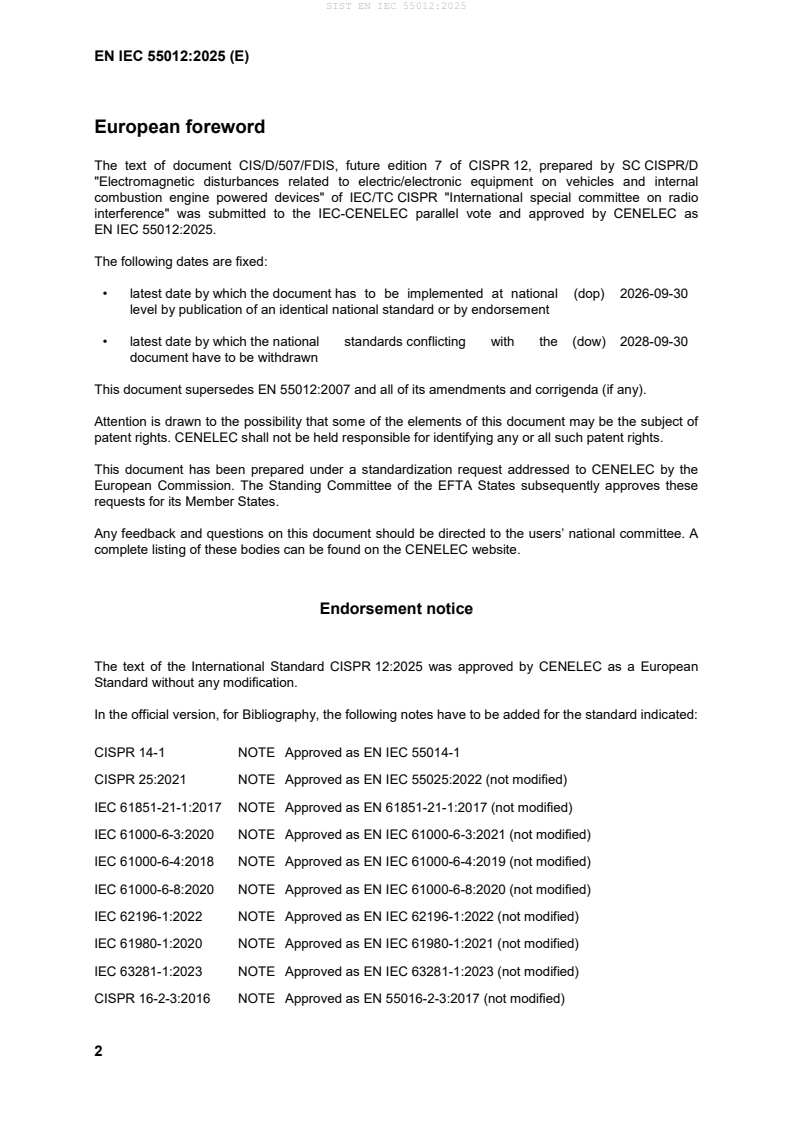
European foreword
The text of document CIS/D/507/FDIS, future edition 7 of CISPR 12, prepared by SC CISPR/D
"Electromagnetic disturbances related to electric/electronic equipment on vehicles and internal
combustion engine powered devices" of IEC/TC CISPR "International special committee on radio
interference" was submitted to the IEC-CENELEC parallel vote and approved by CENELEC as
The following dates are fixed:
• latest date by which the document has to be implemented at national (dop) 2026-09-30
level by publication of an identical national standard or by endorsement
• latest date by which the national standards conflicting with the (dow) 2028-09-30
document have to be withdrawn
This document supersedes EN 55012:2007 and all of its amendments and corrigenda (if any).
Attention is drawn to the possibility that some of the elements of this document may be the subject of
patent rights. CENELEC shall not be held responsible for identifying any or all such patent rights.
This document has been prepared under a standardization request addressed to CENELEC by the
European Commission. The Standing Committee of the EFTA States subsequently approves these
requests for its Member States.
Any feedback and questions on this document should be directed to the users’ national committee. A
complete listing of these bodies can be found on the CENELEC website.
Endorsement notice
The text of the International Standard CISPR 12:2025 was approved by CENELEC as a European
Standard without any modification.
In the official version, for Bibliography, the following notes have to be added for the standard indicated:
CISPR 14-1 NOTE Approved as EN IEC 55014-1
CISPR 25:2021 NOTE Approved as EN IEC 55025:2022 (not modified)
IEC 61851-21-1:2017 NOTE Approved as EN 61851-21-1:2017 (not modified)
IEC 61000-6-3:2020 NOTE Approved as EN IEC 61000-6-3:2021 (not modified)
IEC 61000-6-4:2018 NOTE Approved as EN IEC 61000-6-4:2019 (not modified)
IEC 61000-6-8:2020 NOTE Approved as EN IEC 61000-6-8:2020 (not modified)
IEC 62196-1:2022 NOTE Approved as EN IEC 62196-1:2022 (not modified)
IEC 61980-1:2020 NOTE Approved as EN IEC 61980-1:2021 (not modified)
IEC 63281-1:2023 NOTE Approved as EN IEC 63281-1:2023 (not modified)
CISPR 16-2-3:2016 NOTE Approved as EN 55016-2-3:2017 (not modified)
CISPR 11 NOTE Approved as EN IEC 55011
CISPR 16-4-2:2011 NOTE Approved as EN 55016-4-2:2011 (not modified)
CISPR 12:2007 NOTE Approved as EN 55012:2007 (not modified)
Annex ZA
(normative)
Normative references to international publications
with their corresponding European publications
The following documents are referred to in the text in such a way that some or all of their content
constitutes requirements of this document. For dated references, only the edition cited applies. For
undated references, the latest edition of the referenced document (including any amendments)
applies.
NOTE 1 Where an International Publication has been modified by common modifications, indicated by (mod),
the relevant EN/HD applies.
NOTE 2 Up-to-date information on the latest versions of the European Standards listed in this annex is
available here: www.cencenelec.eu.
Publication Year Title EN/HD Year
IEC 61851-1 2017 Electric vehicle conductive charging system - EN IEC 61851-1 2019
Part 1: General requirements
CISPR 16-1-1 2019 Specification for radio disturbance and EN IEC 55016-1-1 2019
immunity measuring apparatus and methods
- Part 1-1: Radio disturbance and immunity
measuring apparatus - Measuring apparatus
CISPR 16-1-2 2014 Specification for radio disturbance and EN 55016-1-2 2014
immunity measuring apparatus and methods
- Part 1-2: Radio disturbance and immunity
measuring apparatus - Coupling devices for
conducted disturbance measurements
+ A1 2017 + A1 2018
CISPR 16-1-3 2004 Specification for radio disturbance and EN 55016-1-3 2006
immunity measuring apparatus and methods
- Part 1-3: Radio disturbance and immunity
measuring apparatus - Ancillary equipment -
Disturbance power
+ A1 2016 + A1 2016
+ A2 2020 + A2 2020
CISPR 16-1-4 2019 Specification for radio disturbance and EN IEC 55016-1-4 2019
immunity measuring apparatus and methods
- Part 1-4: Radio disturbance and immunity
measuring apparatus - Antennas and test
sites for radiated disturbance measurements
+ A1 2020 + A1 2020
+ A2 2023 + A2 2023
CISPR 16-1-6 2014 Specification for radio disturbance and EN 55016-1-6 2015
immunity measuring apparatus and methods
- Part 1-6: Radio disturbance and immunity
measuring apparatus - EMC antenna
calibration
+ A1 2017 + A1 2017
Publication Year Title EN/HD Year
+ A2 2022 + A2 2022
CISPR 16-2-1 2014 Specification for radio disturbance and EN 55016-2-1 2014
immunity measuring apparatus and methods
- Part 2-1: Methods of measurement of
disturbances and immunity - Conducted
disturbance measurements
+ A1 2017 + A1 2017
ANSI C63.5 2017 American National Standard for - -
Electromagnetic Compatibility - Radiated
Emission Measurements in Electromagnetic
Interference (EMI) Control - Calibration and
Qualification of Antennas (9 kHz to 40 GHz)
+ Corrigendum 1 2018 - -
CISPR 12 ®
Edition 7.0 2025-07
INTERNATIONAL
STANDARD
INTERNATIONAL SPECIAL COMMITTEE ON RADIO INTERFERENCE
Vehicles, boats and devices with internal combustion engines or traction
batteries – Radio disturbance characteristics – Limits and methods of
measurement for the protection of off-board receivers
ICS 27.020; 33.100.10 ISBN 978-2-8327-0553-7
CISPR 12:2025-07(en)
CISPR 12:2025 © IEC 2025
CONTENTS
FOREWORD. 6
INTRODUCTION . 8
1 Scope . 9
2 Normative references . 10
3 Terms, definitions and abbreviated terms . 11
3.1 Terms and definitions . 11
3.2 Abbreviated terms . 17
4 Limits of radiated disturbance . 18
4.1 General . 18
4.2 Group definitions . 18
4.3 Determination of conformance of the vehicle, boat and device with the limits . 18
4.4 Peak and quasi-peak detector limits . 19
4.5 Average detector limit . 21
5 Methods of measurement . 22
5.1 Measuring instruments . 22
5.1.1 Measuring receiver . 22
5.1.2 Antenna types . 23
5.2 Measurement instrumentation uncertainty . 24
5.3 Measuring site requirements . 24
5.3.1 General . 24
5.3.2 Outdoor test site (OTS) requirements . 24
5.3.3 Alternative test site requirements . 27
5.4 Test setup for measurement . 27
5.4.1 Antenna requirements . 27
5.4.2 Test setup for vehicle in charging mode . 32
5.5 Test object conditions . 42
5.5.1 General . 42
5.5.2 Vehicles and boats . 42
5.5.3 Devices . 44
5.6 Data collection . 44
6 Methods of checking for compliance with CISPR requirements . 45
6.1 General . 45
6.2 Application of limit curves . 45
6.2.1 Measurements under dry conditions . 45
6.2.2 Measurements under wet conditions . 45
Annex A (normative) Procedure to determine an alternative emission limit for
measurements . 46
Annex B (informative) Measurement of the insertion loss of ignition noise suppressors . 47
B.1 Overview . 47
B.1.1 General . 47
B.1.2 CISPR box method (50/75 Ω laboratory method) . 47
B.1.3 Field comparison method . 47
B.2 Comparison of test methods . 47
B.2.1 CISPR box method . 47
B.2.2 Field comparison method . 47
CISPR 12:2025 © IEC 2025
B.3 CISPR box method (50/75 Ω laboratory method of measurement of insertion
loss of ignition noise suppressors) . 48
B.3.1 General conditions and limitations of measurement . 48
B.3.2 Test procedure . 48
B.3.3 Test box construction . 48
B.3.4 Results . 48
Annex C (informative) Methods of measurement to determine the attenuation
characteristics of ignition noise suppressors for high voltage ignition systems . 52
C.1 General . 52
C.2 Recommended requirements for ignition noise suppressors . 52
C.3 Test set-up . 52
C.4 Test procedure . 53
C.5 Measuring spark-plugs without suppression elements . 57
C.6 Test setup examples . 57
C.6.1 General . 57
C.6.2 Connection of a right-angle spark-plug ignition noise suppressor . 57
C.6.3 Connection of a distributor rotor . 58
C.6.4 Connection of distributor caps with integrated ignition noise
suppressors . 59
C.6.5 Connection of resistive ignition cables . 59
Annex D (informative) Applicability of CISPR 12 . 61
D.1 Flow chart . 61
D.2 Example products that are in the scope of CISPR 12 . 63
D.2.1 General . 63
D.2.2 Vehicles . 63
D.2.3 Boats and boat ICE(s) and EM(s) . 63
D.2.4 Devices . 64
D.3 Grouping . 64
Annex E (normative) Direct current charging artificial networks (DC-charging-AN),
artificial mains networks (AMN) and asymmetric artificial networks (AAN) . 67
E.1 General . 67
E.2 Direct current charging artificial networks (DC-charging-AN) . 67
E.3 Artificial mains networks (AMN) . 69
E.4 Asymmetric artificial network (AAN) . 69
E.4.1 General . 69
E.4.2 Signal and control port with symmetric lines . 69
E.4.3 Signal and control port with PLC (technology) on control pilot line . 70
E.4.4 Signal and control port with control pilot line . 71
Annex F (informative) Measurement instrumentation uncertainty . 73
F.1 General . 73
F.2 Uncertainty sources . 73
F.3 Measurand . 75
F.4 Input quantities to be considered . 75
Annex G (informative) Uncertainty budgets for radiated disturbance measurements of
electric field strength . 78
G.1 General . 78
G.2 Typical CISPR 12 uncertainty budgets . 78
G.3 Receiver’s frequency step . 81
Annex H (informative) Justification for the limits for an electric vehicle . 83
CISPR 12:2025 © IEC 2025
H.1 General . 83
H.2 Background . 83
H.3 Consideration on the effect of radio receivers . 83
H.4 Calculation of limits . 84
H.4.1 General . 84
H.4.2 Electric vehicles in a driven mode . 84
H.4.3 Electric vehicles in a charging mode . 85
H.5 Conclusion . 87
Annex I (informative) Items under consideration . 88
I.1 General . 88
I.2 Frequency range . 88
I.2.1 General considerations . 88
I.2.2 Testing between 1 GHz to 6 GHz . 88
I.3 Correlation between OTS, ALSE and OATS measurements . 88
I.4 Calibration of antennas . 88
I.5 Charging mode for boats . 88
I.6 Necessity for the use of artificial networks in the test setups . 88
I.7 Electric vehicle limits . 88
I.7.1 Charging . 88
I.7.2 Driven mode . 88
I.8 Dynamic test modes . 89
Bibliography . 90
Figure 1 – Method of determination of conformance . 19
Figure 2 – Quasi-peak limits at 10 m antenna distance . 20
Figure 3 – Peak limits at 10 m antenna distance . 21
Figure 4 – Average limits at 10 m antenna distance . 21
Figure 5 – Measuring site (OTS) for vehicles, boats and devices. 25
Figure 6 – Measuring site (OTS) for boats . 26
Figure 7 – Antenna height to measure emissions – Elevation view (vertical polarization
shown) . 28
Figure 8 – Antenna distance to measure emissions – Plan view (horizontal polarization
shown) . 29
Figure 9 – Antenna position for N = 1 (one antenna position to be used) – Horizontal
polarization shown . 31
Figure 10 – Example antenna positions for N = 2 (multiple antenna positions to be
used) – Horizontal polarization shown . 31
Figure 11 – Example of test setup for vehicle with vehicle inlet located on vehicle side
(charging mode 1 or 2, AC powered, without communication) . 34
Figure 12 – Example of test setup for vehicle with vehicle inlet located front or rear of
vehicle (charging mode 1 or 2, AC powered, without communication) . 35
Figure 13 – Example of test setup for vehicle with vehicle inlet located on vehicle side
(charging mode 3 or mode 4, AC/DC powered, with communication) . 38
Figure 14 – Example of test setup for vehicle with vehicle inlet located front or rear of
vehicle (charging mode 3 or mode 4, AC/DC powered, with communication) . 39
Figure 15 – Example of test setup for vehicle in charging mode through wireless power
transfer . 41
Figure A.1 – Calculation of the resulting gain reduction X . 46
dB
CISPR 12:2025 © IEC 2025
Figure B.1 – Test circuit . 49
Figure B.2 – General arrangement of the test box . 49
Figure B.3 – Details of the test box lid . 50
Figure B.4 – Details of the test box . 50
Figure B.5 – Straight spark-plug ignition noise suppressor (screened or unscreened) . 50
Figure B.6 – Right-angle spark-plug ignition noise suppressor (screened or
unscreened) . 50
Figure B.7 – Noise suppression spark-plug . 51
Figure B.8 – Resistive distributor brush . 51
Figure B.9 – Noise suppressor in distributor cap . 51
Figure B.10 – Noise suppression distributor rotor . 51
Figure B.11 – Noise suppression ignition cable (resistive or reactive). 51
Figure C.1 – Test set-up, side view . 54
Figure C.2 – Test set-up, top view . 55
Figure C.3 – Pressure chamber with ventilation . 56
Figure C.4 – Top view of the set-up of a right-angle ignition noise suppressor for
distributors . 57
Figure C.5 – Location of high voltage ignition components . 58
Figure C.6 – Top view of the test set-up for distributor rotors . 59
Figure C.7 – Side view of the test set-up for ready-to-use resistive ignition cables . 60
Figure D.1 – Flowchart for the applicability of CISPR 12 . 62
Figure E.1 – Example of 5 µH / 50 Ω DC-charging-AN schematic . 67
Figure E.2 – Characteristics of the DC-charging-AN impedance . 68
Figure E.3 – Example of an AAN for signal and control port with symmetric lines (e.g.
CAN) . 70
Figure E.4 – Example of AAN circuit for signal and control port with PLC (technology)
on control pilot . 71
Figure E.5 – Example of AAN circuit for pilot line . 72
Figure F.1 – Typical sources of measurement instrumentation uncertainty . 74
Figure G.1 – Example of measurement for frequency step uncertainty evaluation for
120 kHz bandwidth . 82
Figure H.1 – Histogram – Peak to quasi-peak delta, EV driving mode . 85
Figure H.2 – Histogram – Peak to quasi-peak delta, vehicle in AC or DC charging
mode . 86
Figure H.3 – Degradation to 12 dB SINAD (LO-VHF) from Mode 3 charging vs. CW
noise . 87
Table 1 – Detection limits . 18
Table 2 – Quasi-peak limits at 10 m antenna distance . 20
Table 3 – Peak limits at 10 m antenna distance . 20
Table 4 – Spectrum analyser parameters . 23
Table 5 – Scanning receiver parameters . 23
Table 6 – ICE operating speeds . 43
Table C.1 – Limits . 52
CISPR 12:2025 © IEC 2025
Table D.1 – Examples of products in the scope of CISPR 12 with their assignment to
the groups . 65
Table E.1 – Magnitude of the DC-charging-AN impedance Z . 68
PB
Table F.1 – Input quantities to be considered for radiated disturbance measurements . 75
Table G.1 – Typical uncertainty budget – 3 m/10 m distance – Biconical antenna . 78
Table G.2 – Typical uncertainty budget – 3 m/10 m distance – Log-periodic antenna . 80
CISPR 12:2025 © IEC 2025
INTERNATIONAL ELECTROTECHNICAL COMMISSION
INTERNATIONAL SPECIAL COMMITTEE ON RADIO INTERFERENCE
____________
Vehicles, boats and devices with internal combustion engines or traction
batteries - Radio disturbance characteristics - Limits and methods of
measurement for the protection of off-board receivers
FOREWORD
1) The International Electrotechnical Commission (IEC) is a worldwide organization for standardization comprising
all national electrotechnical committees (IEC National Committees). The object of IEC is to promote international
co-operation on all questions concerning standardization in the electrical and electronic fields. To this end and
in addition to other activities, IEC publishes International Standards, Technical Specifications, Technical Reports,
Publicly Available Specifications (PAS) and Guides (hereafter referred to as “IEC Publication(s)”). Their
preparation is entrusted to technical committees; any IEC National Committee interested in the subject dealt with
may participate in this preparatory work. International, governmental and non-governmental organizations liaising
with the IEC also participate in this preparation. IEC collaborates closely with the International Organization for
Standardization (ISO) in accordance with conditions determined by agreement between the two organizations.
2) The formal decisions or agreements of IEC on technical matters express, as nearly as possible, an international
consensus of opinion on the relevant subjects since each technical committee has representation from all
interested IEC National Committees.
3) IEC Publications have the form of recommendations for international use and are accepted by IEC National
Committees in that sense. While all reasonable efforts are made to ensure that the technical content of IEC
Publications is accurate, IEC cannot be held responsible for the way in which they are used or for any
misinterpretation by any end user.
4) In order to promote international uniformity, IEC National Committees undertake to apply IEC Publications
transparently to the maximum extent possible in their national and regional publications. Any divergence between
any IEC Publication and the corresponding national or regional publication shall be clearly indicated in the latter.
5) IEC itself does not provide any attestation of conformity. Independent certification bodies provide conformity
assessment services and, in some areas, access to IEC marks of conformity. IEC is not responsible for any
services carried out by independent certification bodies.
6) All users should ensure that they have the latest edition of this publication.
7) No liability shall attach to IEC or its directors, employees, servants or agents including individual experts and
members of its technical committees and IEC National Committees for any personal injury, property damage or
other damage of any nature whatsoever, whether direct or indirect, or for costs (including legal fees) and
expenses arising out of the publication, use of, or reliance upon, this IEC Publication or any other IEC
Publications.
8) Attention is drawn to the Normative references cited in this publication. Use of the referenced publications is
indispensable for the correct application of this publication.
9) IEC draws attention to the possibility that the implementation of this document may involve the use of (a)
patent(s). IEC takes no position concerning the evidence, validity or applicability of any claimed patent rights in
respect thereof. As of the date of publication of this document, IEC had not received notice of (a) patent(s), which
may be required to implement this document. However, implementers are cautioned that this may not represent
the latest information, which may be obtained from the patent database available at https://patents.iec.ch. IEC
shall not be held responsible for identifying any or all such patent rights.
International Standard CISPR 12 has been prepared by CISPR subcommittee D:
Electromagnetic disturbances related to electric/electronic equipment on vehicles and internal
combustion engine powered devices.
This seventh edition cancels and replaces the sixth edition published in 2007 and its
Amendment 1 (2009). This edition constitutes a technical revision.
CISPR 12:2025 © IEC 2025
This edition includes the following significant technical changes with respect to the previous
edition:
a) test setups and requirements for electric vehicles and hybrid electric vehicles in charging
mode were added,
b) antenna positions relative to the vehicle were defined,
c) some statements dealing with series surveillance and type approval were deleted,
d) annexes for measurement instrumentation uncertainty were added,
e) the vehicles, boats and devices subject to this document are separated into three groups
with corresponding limits applied accordingly,
f) an annex describing networks to be used for the charging mode was added,
g) an annex describing justification for the limits of an electric vehicle was added, and
h) general improvements were made.
The text of this International Standard is based on the following documents:
Draft Report on voting
CIS/D/507/FDIS CIS/D/509/RVD
Full information on the voting for its approval can be found in the report on voting indicated in
the above table.
The language used for the development of this International Standard is English.
This document was drafted in accordance with ISO/IEC Directives, Part 2, and developed in
accordance with ISO/IEC Directives, Part 1 and ISO/IEC Directives, IEC Supplement, available
at www.iec.ch/members_experts/refdocs. The main document types developed by IEC are
described in greater detail at www.iec.ch/publications.
The committee has decided that the contents of this document will remain unchanged until the
stability date indicated on the IEC website under webstore.iec.ch in the data related to the
specific document. At this date, the document will be
• reconfirmed,
• withdrawn, or
• revised.
CISPR 12:2025 © IEC 2025
INTRODUCTION
There is a specific need for standards to define acceptable radio frequency performances of all
electrical and electronic products. CISPR 12 has been developed to serve the vehicles, boats,
devices with internal combustion engines and related industries with test methods and limits
that provide satisfactory protection for radio reception.
CISPR 12 has been used for many years as a regulatory requirement in numerous countries,
to provide protection for radio receivers at a 10 m distance. It has been effective in protecting
the radio environment outside the vehicle.
CISPR 12:2025 © IEC 2025
1 Scope
The limits in this document are designed to provide protection in the frequency range of 30 MHz
to 1 000 MHz for off-board receivers. Compliance with this document does not guarantee
adequate protection for receivers nearer than 10 m to the vehicle, boat or device.
This document applies to the emission of electromagnetic energy that can cause interference
to radio reception and which is emitted from:
1) vehicles propelled by an internal combustion engine (ICE), electrical means or both (see
3.1.34);
2) boats propelled by an ICE, electrical means or both (see 3.1.4). Boats are tested in the
same manner as vehicles except where they have unique characteristics as explicitly stated
in this document;
3) devices equipped with ICE (see 3.1.9). In the case of hybrid devices (e.g. equipped with
both ICE and traction batteries), only the ICE mode is included in this document;
4) inboard and outboard boat engines and motors [i.e. equipped with ICE, electric motor (EM),
or both], when marketed independently.
See Annex D for a flow chart and a list of examples to help determine the applicability of
CISPR 12.
This document does not apply to aircraft, household appliances, medical devices, traction
systems (railway engine or locomotive, streetcar or tram and electric trolley bus), vehicle,
boat and device off-board chargers or to incomplete vehicles, boats and devices. In the case of
a dual-mode trolley bus (e.g. propelled by power from either AC/DC mains or an ICE), the ICE
propulsion system is included, but the EM propulsion portion of the vehicle is excluded from
this document. In addition, domestic helper robots, such as household cleaning robots, hotel
service robots and personal safety robots are also excluded from the scope of this document.
NOTE 1 Other than inboard or outboard boat engines and motors that are marketed independently, this document
does not apply to components or incomplete products, such as an ICE, an incomplete vehicle or boat that has not
yet been fitted with an ICE or EM, or spare parts. This document only applies to the final product, which is equipped
with all applicable parts and components to be able to function as intended.
NOTE 2 Appliances without ICE for typical housekeeping and service functions in the household and similar
environment are covered by the requirements of CISPR 14-1[1].
NOTE 3 Protection of receivers used on board the same vehicle as the disturbance source(s) are covered by
CISPR 25[2].
This document does not prescribe measurement methods or limits for conducted disturbances,
for the charging mode of operation, where the (electric or hybrid) vehicle or boat is connected
to power mains, either directly (i.e. plug-in vehicle or boat) or indirectly (i.e. wireless power
charging). The user is referred to appropriate IEC and CISPR standards, which define
measurement techniques and limits for this condition.
NOTE 4 See IEC 61851-21-1[3] for road vehicles and IEC 61000-6-3[4], IEC 61000-6-4[5] and IEC 61000-6-8[6] for
other types of vehicles or boats.
The emission requirements in this document are not applicable to the intentional transmissions
from a radio transmitter, as defined by the ITU-R, including its spurious emissions.
Equipment that is covered by other CISPR product and product family emission standards are
excluded from the scope of this document, except where they include ICE(s). In the latter case,
the equipment complies with this document in all modes of operation where the ICE(s) is(are)
active.
CISPR 12:2025 © IEC 2025
NOTE 5 The other CISPR product or product family emission standard can also apply to the equipment for those
modes of operation where the ICE(s) is (are) not active. In case the ICE(s) is (are) always in operation, the other
CISPR product or product family emission standard can still apply, for verifying the emissions from the other
components and circuitry of the equipment.
Annex B and Annex C contain methods to evaluate the disturbance characteristics of high
voltage ignition systems.
Annex H contains a justification for the limits for an electric vehicle.
Annex I lists work being considered for future revisions.
2 Normative references
The following documents are referred to in the text in such a way that some or all of their content
constitutes requirements of this document. For dated references, only the edition cited applies.
For undated references, the latest edition of the referenced document (including any
amendments) applies.
IEC 61851-1:2017, Electric vehicle conductive charging system - Part 1: General requirements
CISPR 16-1-1:2019, Specification for radio disturbance and immunity measuring apparatus and
methods - Part 1-1: Radio disturbance and immunity measuring apparatus - Measuring
apparatus
CISPR 16-1-2:2014, Specification for radio disturbance and immunity measuring apparatus and
methods - Part 1-2: Radio disturbance and immunity measurement apparatus - Coupling
devices for conducted disturbance measurements
CISPR 16-1-2:2014/AMD1:2017
CISPR 16-1-3:2004, Specification for radio disturbance and immunity measuring apparatus and
methods - Part 1-3: Radio disturbance and immunity measuring apparatus - Ancillary equipment
- Disturbance power
CISPR 16-1-3:2004/AMD1:2016
CISPR 16-1-3:2004/AMD2:2020
CISPR 16-1-4:2019, Specification for radio disturbance and immunity measuring apparatus and
methods - Part 1-4: Radio disturbance and immunity measuring apparatus - Antennas and test
sites for radiated disturbance measurements
CISPR 16-1-4:2019/AMD1:2020
CISPR 16-1-4:2019/AMD2:2023
CISPR 16-1-6:2014, Specification for radio disturbance and immunity measuring apparatus and
methods - Part 1-6: Ra
...