

EN 13160-1:2016
(Main)Leak detection systems - Part 1: General Principles
General Information
- Abstract
This European Standard specifies the general principles for leak detection systems for use with double-skin tanks, single-skin tanks and pipework designed for water polluting fluids.
- Status
- Published
- Publication Date
- 05-Jul-2016
- Withdrawal Date
- 29-Apr-2018
- Technical Committee
- CEN/TC 393 - Equipment for storage tanks and for service stations
- Drafting Committee
- CEN/TC 393/WG 2 - Leak detecting devices for tanks and pipes
- Current Stage
- 9092 - Decision on results of review/2YR ENQ - revise - Review Enquiry
- Start Date
- 13-Oct-2022
- Completion Date
- 30-Sep-2026


Overview
EN 13160-1:2016 - “Leak detection systems - Part 1: General principles” is a CEN European Standard that establishes the general principles, terminology and basic requirements for leak detection systems used with double-skin and single-skin tanks, underground or above-ground tanks, and associated pipework designed for water-polluting fluids. It defines system classes, functional expectations (alarm, testability, restart after power loss), and high-level safety and electromagnetic requirements applicable across the EN 13160 series.
Key Topics
- Scope and definitions
- Covers leak detection for tanks, interstitial spaces, leak detection linings/jackets, monitoring wells and related components.
- Defines key terms such as interstitial space, pressure/vacuum leak detectors, liquid/vapour sensors, tank gauge leak detection (static/dynamic/statistical).
- Classes of leak detection systems (I–V)
- Class I: pressure/vacuum systems that detect leaks before product reaches the environment (highest containment).
- Class II: liquid monitoring for interstitial space (may allow release to environment).
- Class III: sensors detect leaks below liquid level-product may reach environment.
- Class IV: tank-gauge based detection (dynamic/static/statistical) for changes in stored volume; includes sub-classes for pipework and static systems.
- Class V: monitoring-well based systems (product will enter environment before detection).
- Functional requirements
- Visual and audible alarms for all leak and malfunction conditions.
- Systems must be testable and able to simulate leak conditions.
- Disconnection or cable faults shall trigger alarms; power interruptions must allow automatic resumption on restore.
- Design to prevent accidental disconnection; plug/socket allowed only if interruption causes alarm.
- Safety and environmental protection
- Where explosive atmospheres are possible, components must be explosion-protected and assessed per EN ISO 80079-36 and related standards.
- Electromagnetic compatibility (EMC) and electrical safety requirements apply to non-hazardous and hazardous area equipment.
- Installation and maintenance
- Components should be suitable for intended temperature/atmospheric ranges and used per manufacturer instructions.
Applications
- Protective specification for: fuel storage terminals, service stations, environmental monitoring around tanks, chemical storage facilities, tank manufacturers, system integrators, and inspection/test bodies.
- Useful for designing, installing, certifying and maintaining leak detection for systems handling water-polluting liquids to reduce environmental risk and comply with national adoption of CEN standards.
Related Standards
EN 13160-1 is Part 1 of a 7-part series (Parts 2–7 cover pressure/vacuum kits, liquid systems, sensor systems, tank gauges, monitoring wells, interstitial spaces/linings). Normative references include:
- EN 60079 series (explosive atmospheres)
- EN 61000 series (EMC)
- EN 61010-1 / EN 60950-1 (electrical safety)
- EN ISO 80079-36 (non-electrical equipment for explosive atmospheres)
Keywords: EN 13160-1, leak detection systems, tank leak detection, double-skin tanks, interstitial space, tank monitoring, EMC, explosion protection, pipework leak detection.
Relations
- Effective Date
- 13-Jul-2016
- Effective Date
- 02-Jun-2026
- Effective Date
- 09-Feb-2026
- Effective Date
- 09-Feb-2026
- Effective Date
- 09-Feb-2026
- Effective Date
- 09-Feb-2026
- Effective Date
- 09-Feb-2026
- Effective Date
- 09-Feb-2026
- Effective Date
- 09-Feb-2026
- Effective Date
- 09-Feb-2026
- Effective Date
- 09-Feb-2026
- Effective Date
- 28-Jan-2026
- Effective Date
- 28-Jan-2026
- Effective Date
- 28-Jan-2026
- Effective Date
- 28-Jan-2026
Get Certified
Connect with accredited certification bodies for this standard

IMQ S.p.A. (Certification)
Italian electrical product certification.

SLG Prüf- und Zertifizierungs GmbH
German testing and certification body.

UL Solutions
Global safety science company with testing, inspection and certification.
Sponsored listings
Frequently Asked Questions
EN 13160-1:2016 is a standard published by the European Committee for Standardization (CEN). Its full title is "Leak detection systems - Part 1: General Principles". This standard covers: This European Standard specifies the general principles for leak detection systems for use with double-skin tanks, single-skin tanks and pipework designed for water polluting fluids.
This European Standard specifies the general principles for leak detection systems for use with double-skin tanks, single-skin tanks and pipework designed for water polluting fluids.
EN 13160-1:2016 is classified under the following ICS (International Classification for Standards) categories: 23.020.01 - Fluid storage devices in general; 23.040.99 - Other pipeline components; 29.040.99 - Other insulating fluids; 29.260.20 - Electrical apparatus for explosive atmospheres. The ICS classification helps identify the subject area and facilitates finding related standards.
EN 13160-1:2016 has the following relationships with other standards: It is inter standard links to EN 13160-1:2003, EN IEC 61000-6-3:2026, EN 61340-4-1:2004, EN IEC 60079-26:2024, EN IEC 62368-1:2024, EN IEC 61000-6-4:2019, EN IEC 61000-6-1:2019, EN IEC 61000-6-2:2019, EN IEC 61000-6-3:2021, EN IEC 60079-0:2018, EN 61010-1:2010, EN ISO 80079-36:2016, EN 13160-7:2016, EN 13160-4:2016+A1:2024, EN 13341:2005+A1:2011. Understanding these relationships helps ensure you are using the most current and applicable version of the standard.
EN 13160-1:2016 is associated with the following European legislation: EU Directives/Regulations: 305/2011, 89/106/EEC; Standardization Mandates: M/131. When a standard is cited in the Official Journal of the European Union, products manufactured in conformity with it benefit from a presumption of conformity with the essential requirements of the corresponding EU directive or regulation.
EN 13160-1:2016 is available in PDF format for immediate download after purchase. The document can be added to your cart and obtained through the secure checkout process. Digital delivery ensures instant access to the complete standard document.
Standards Content (Sample)
2003-01.Slovenski inštitut za standardizacijo. Razmnoževanje celote ali delov tega standarda ni dovoljeno.Leckanzeigesysteme - Teil 1: Allgemeine GrundsätzeSystèmes de détection de fuites - Partie 1 : Principes générauxLeak detection systems - Part 1: General principles23.020.01Fluid storage devices in generalICS:Ta slovenski standard je istoveten z:EN 13160-1:2016SIST EN 13160-1:2016en,fr,de01-november-2016SIST EN 13160-1:2016SLOVENSKI
STANDARDSIST EN 13160-1:20031DGRPHãþD
EUROPEAN STANDARD NORME EUROPÉENNE EUROPÄISCHE NORM
EN 13160-1
July
t r s x ICS
t uä r t rä r sâ
t uä r v rä { {â
t {ä t x rä t r Supersedes EN
s u s x ræ sã t r r uEnglish Version
Leak detection systems æ Part
sã General Principles Systèmes de détection de fuites æ Partie
sã Principes généraux
Leckanzeigesysteme æ Teil
sã Allgemeine Grundsätze This European Standard was approved by CEN on
z April
t r s xä
egulations which stipulate the conditions for giving this European Standard the status of a national standard without any alterationä Upætoædate lists and bibliographical references concerning such national standards may be obtained on application to the CENæCENELEC Management Centre or to any CEN memberä
translation under the responsibility of a CEN member into its own language and notified to the CENæCENELEC Management Centre has the same status as the official versionsä
CEN members are the national standards bodies of Austriaá Belgiumá Bulgariaá Croatiaá Cyprusá Czech Republicá Denmarká Estoniaá Finlandá Former Yugoslav Republic of Macedoniaá Franceá Germanyá Greeceá Hungaryá Icelandá Irelandá Italyá Latviaá Lithuaniaá Luxembourgá Maltaá Netherlandsá Norwayá Polandá Portugalá Romaniaá Slovakiaá Sloveniaá Spainá Swedená Switzerlandá Turkey andUnited Kingdomä
EUROPEAN COMMITTEE FOR STANDARDIZATION COMITÉ EUROPÉEN DE NORMALISATION EUROPÄISCHES KOMITEE FÜR NORMUNG
CEN-CENELEC Management Centre:
Avenue Marnix 17,
B-1000 Brussels
t r s x CEN All rights of exploitation in any form and by any means reserved worldwide for CEN national Membersä Refä Noä EN
s u s x ræ sã t r s x ESIST EN 13160-1:2016
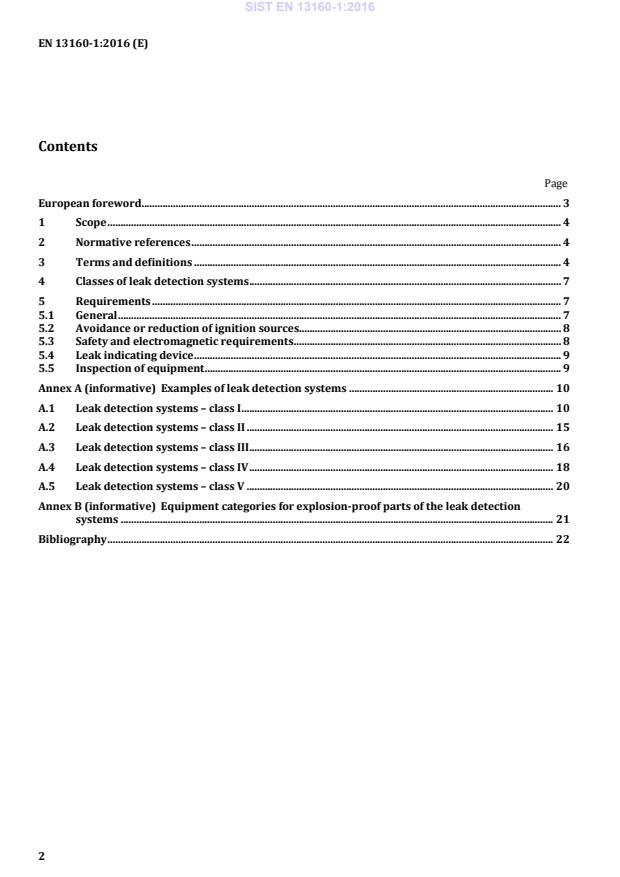
Examples of leak detection systems . 10 A.1 Leak detection systems – class I . 10 A.2 Leak detection systems – class II . 15 A.3 Leak detection systems – class III . 16 A.4 Leak detection systems – class IV . 18 A.5 Leak detection systems – class V . 20 Annex B (informative)
Equipment categories for explosion-proof parts of the leak detection systems . 21 Bibliography . 22
...