

kSIST FprEN 14532-1:2026
(Main)Welding consumables - Test methods and quality requirements - Part 1: Primary methods and assessment of consumables for steel, nickel and nickel alloys
- Abstract
This document specifies the type qualification tests, test methods, the amount of testing and the requirements for the qualification of welding consumables for steel, nickel and nickel alloys intended for all fields of application.
This document specifies a wide range of tests, which are appropriate for the majority of applications. When supplementary tests are required (see EN 14532 2), these are carried out at any time without the need to repeat the type qualification tests.
NOTE Additional information is given in Annex O.
- Status
- Not Published
- Public Enquiry End Date
- 02-Jul-2026
- Technical Committee
- VAR - Welding
- Current Stage
- 5020 - Formal vote (FV) (Adopted Project)
- Start Date
- 23-Nov-2026
- Due Date
- 11-Jan-2027

kSIST FprEN 14532-1:2026 is the Slovenian draft adoption of prEN 14532-1:2026 from CEN for welding consumables. It specifies type qualification tests, test methods, the amount of testing, and the qualification requirements for consumables for steel, nickel and nickel alloys used in all fields of application. The document is meant for manufacturers, suppliers, examiners and examination bodies that need a common technical basis to qualify a consumable and state its permitted range of use.
What does kSIST FprEN 14532-1:2026 specify?
kSIST FprEN 14532-1:2026 sets the framework for qualifying welding consumables by testing the product itself, the deposited all-weld metal, and welded joints. It also tells the user how the document is organized, how qualification is documented, and how the qualified range is defined.
The document is arranged in Clauses 1 to 14, covering scope, normative references, terms, assessment procedures, type qualification, test methods, retests, range of qualification, reporting, certification, extension, modification, transfer and prolongation. The annexes provide the detailed tables, forms and guidance used by those clauses.
| Annex | What it covers |
|---|---|
| A | Overview of type qualification tests |
| B | Solid product composition limits |
| C | All-weld metal chemical composition limits for covered and tubular cored electrodes |
| D | All-weld metal requirements for steel, nickel and nickel alloys |
| E | Calculation of delta ferrite |
| F | Range of qualification for steels |
| G | Butt weld thickness limits |
| H | Technical requirements for welded joints |
| I | Number of test pieces in a type qualification test |
| J | Suggested qualification test report |
| K | Type qualification certificate |
| L | Transfer of qualification application |
| M | Transfer of qualification declaration of identity |
| N | Prolongation of qualification tests |
| O | Qualification under supervision of an examiner or examination body |
| P | Material group lists according to EN ISO 15608:2025 |
| Q | Example constituents for coating or fluxes |
What are the key requirements of kSIST FprEN 14532-1:2026?
kSIST FprEN 14532-1:2026 makes qualification a controlled process, not just a test result. The most important points are the witnessed testing, the required documentation, the test methods for all-weld metal and welded joints, and the way the qualified range is limited.
Clause 4 requires product testing and welding/testing of the specimens to be witnessed by an examiner or an examination body. The product label must show that the required tests were passed. In practice, this gives third-party traceability and reduces disputes about whether a consumable was really qualified.
Clause 5.1 says compliance is shown by a type qualification test plus ongoing control to keep quality consistent. The type qualification test consists of product testing, all-weld metal testing and welded-joint testing. This matters because approval depends on both product properties and weld performance.
Clause 5.2 sets the information that must be documented, including the scope of qualification, brand and product name, standard designation, composition limits, major constituents of the covering, flux or filling material, and requested ferrite or hydrogen data. In practice, the certificate and report have to describe exactly what was tested.
Clause 5.3 requires product sampling at the applicant’s premises and checks on dimensions, physical condition and marking. Chemical composition of solid wire and strip must meet the product specification and the limits in Annex B, and shielding gas identification follows EN ISO 14175. This ensures the tested product matches the product placed on the market.
Clause 6.1 defines the all-weld metal test route. It sets the preparation method, the welding process conditions, the allowed test-piece selection, and the required tests such as tensile, impact, chemical analysis, ferrite content and, when required, hydrogen content. The practical result is that the consumable is checked as a deposited metal, not only as a raw product.
Clause 6.2 defines welded-joint testing. It covers parent metal selection, joint type, specimen preparation, welding position, current and polarity, shielding gas, non-destructive testing, tensile tests, bend tests, macro examination, hardness, impact testing and hot cracking tests where applicable. This matters because many consumables must work in real joint conditions, not only in all-weld metal.
Clauses 7 and 8 control failures and the scope of approval. Retests are allowed under defined conditions, and the qualification range is limited by parent metals, heat treatment, combinations with auxiliary materials, welding positions, current and polarity, root weldability, diameter range, temperature limits, undermatching strength and material thickness. In practice, the certificate only supports the exact family of use that was proven by the tests.
Clauses 9 to 14 cover reporting, certificates, extension, modification, transfer and prolongation of qualification. These clauses are what make the result usable in commerce and quality systems, because they define how the qualification is recorded, extended when needed, transferred to another trade name, and kept current over time.
What terms does kSIST FprEN 14532-1:2026 define?
auxiliary material - A material that does not affect the weld’s chemical composition or mechanical properties and is not incorporated into the weld, such as a temporary backing strip.
classification - The process used to verify that a product designation matches the relevant consumable standard.
qualified welding consumable - A welding consumable that complies with the requirements of this document.
manufacturer - The organization that produces and packages welding consumables.
supplier - An organization that sells welding consumables under its own brand name and sources them from a manufacturer that meets this document.
lot - The defined production quantity used by the manufacturer’s quality system or by ISO 14344.
applicant - The organization that manufactures or supplies the welding consumable and applies for qualification.
Who uses kSIST FprEN 14532-1:2026?
Manufacturers of welding consumables use kSIST FprEN 14532-1:2026 to design qualification tests, document product limits, and issue type qualification reports and certificates. Suppliers use it when they market an existing consumable under their own name or need to maintain a qualified range.
Examiners and examination bodies use it to witness testing, verify marking, review reports and issue certificates. Quality managers, welding engineers and buyers use it to check whether a consumable is qualified for the parent metals, positions, processes, current, polarity, thickness range and heat treatment conditions required by their work.
The document is relevant in welding consumables for steel, nickel and nickel alloys, especially where product qualification, traceability and formal certificate control are part of procurement or compliance work.
What changed in kSIST FprEN 14532-1:2026 from the previous edition?
kSIST FprEN 14532-1:2026 will supersede EN 14532-1:2004.
Which standards are used with kSIST FprEN 14532-1:2026?
kSIST FprEN 14532-1:2026 relies on several groups of standards:
Qualification and quality system references - EN 14532-2 provides supplementary methods and conformity assessment, EN 12074 covers manufacture, supply and distribution requirements, EN ISO 9001 is used in the prolongation procedure, and ISO 14344 is used for lot definition.
Product marking and inspection documents - EN ISO 544 and EN ISO 14174 control product and packaging marking, while EN 10204 supports inspection documents for test material.
Test-piece preparation and welding set-up - EN ISO 15792-1, -2 and -3 define test piece preparation, EN ISO 6847 supports chemical analysis sample preparation, EN ISO 4063 gives process numbers, EN ISO 6947 gives welding positions, EN 1011-1 gives welding guidance, and EN ISO 17663 covers heat treatment.
Test methods and acceptance - EN ISO 4136, 5173, 5178, 148-1, 17637, 17636-1, 17636-2, 17639, 9015-1, 9016, 10675-1, 17641-2, 3690, 8249, 5817 and 14175 support the mechanical, metallurgical, non-destructive and gas-related checks used in the qualification.
Classification and product family standards - The document cites the relevant consumable classification standards for steel, nickel and nickel alloys, including EN ISO 14341, 2560, 14171, 18275, 17632, 14174, 3580, 3581, 636, 21952, 17634, 14343, 17633, 16834, 18276, 20378, 14172 and 18274.
Material grouping - EN ISO 15608:2025 provides the steel and nickel alloy group system used to define qualification ranges and test selection.
What does the kSIST FprEN 14532-1:2026 document contain?
kSIST FprEN 14532-1:2026 contains the full qualification workflow from planning and sampling through testing, reporting and certification. It also includes detailed annexes for composition limits, ferrite calculation, material grouping, thickness limits and the number of test pieces.
The annexes provide the practical tools for implementation: an overview of the test programme, report and certificate templates, transfer forms, prolongation tests, and an optional supervised qualification route. Annex E gives the delta ferrite calculation approach, Annex P lists the EN ISO 15608:2025 material groups, and Annex Q gives an example of coating or flux constituents.
Relations
- Effective Date
- 01-Jun-2026
Get Certified
Connect with accredited certification bodies for this standard

DVS-ZERT GmbH
German welding certification society.

Element Materials Technology
Materials testing and product certification.

Inštitut za kovinske materiale in tehnologije
Institute of Metals and Technology. Materials testing, metallurgical analysis, NDT.
Sponsored listings
Frequently Asked Questions
kSIST FprEN 14532-1:2026 is a draft published by the Slovenian Institute for Standardization (SIST). Its full title is "Welding consumables - Test methods and quality requirements - Part 1: Primary methods and assessment of consumables for steel, nickel and nickel alloys". This standard covers: This document specifies the type qualification tests, test methods, the amount of testing and the requirements for the qualification of welding consumables for steel, nickel and nickel alloys intended for all fields of application. This document specifies a wide range of tests, which are appropriate for the majority of applications. When supplementary tests are required (see EN 14532 2), these are carried out at any time without the need to repeat the type qualification tests. NOTE Additional information is given in Annex O.
This document specifies the type qualification tests, test methods, the amount of testing and the requirements for the qualification of welding consumables for steel, nickel and nickel alloys intended for all fields of application. This document specifies a wide range of tests, which are appropriate for the majority of applications. When supplementary tests are required (see EN 14532 2), these are carried out at any time without the need to repeat the type qualification tests. NOTE Additional information is given in Annex O.
kSIST FprEN 14532-1:2026 is classified under the following ICS (International Classification for Standards) categories: 25.160.20 - Welding consumables; 77.080.20 - Steels; 77.120.40 - Nickel, chromium and their alloys. The ICS classification helps identify the subject area and facilitates finding related standards.
kSIST FprEN 14532-1:2026 has the following relationships with other standards: It is inter standard links to SIST EN 14532-1:2005. Understanding these relationships helps ensure you are using the most current and applicable version of the standard.
kSIST FprEN 14532-1:2026 is available in PDF format for immediate download after purchase. The document can be added to your cart and obtained through the secure checkout process. Digital delivery ensures instant access to the complete standard document.
Standards Content (Sample)
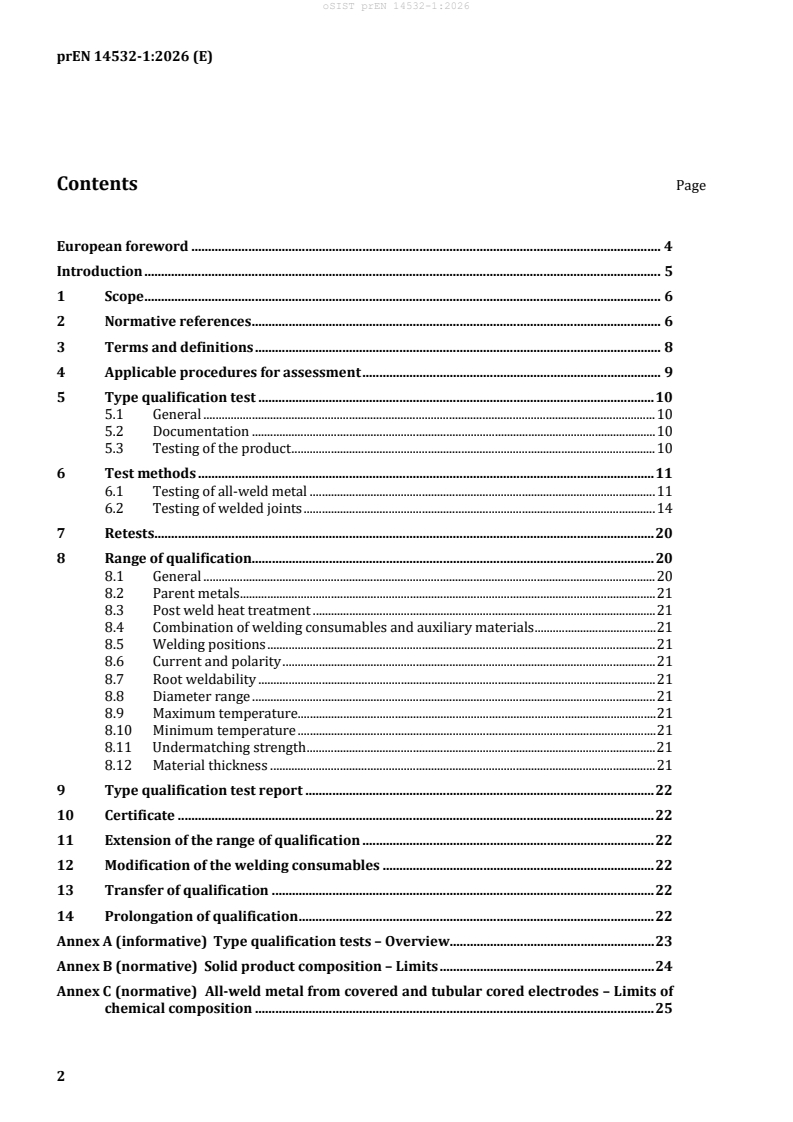
Contents
- Introduction
- 1 Scope
- 2 Normative references
- 3 Terms and definitions
- 3.1 auxiliary material
- 3.2 classification
- 3.3 qualified welding consumable
- 3.4 manufacturer
- 3.5 supplier
- 3.6 lot
- 3.7 applicant
- 4 Applicable procedures for assessment
- 5 Type qualification test
- 5.1 General
- 5.2 Documentation
- 5.3 Testing of the product
- 6 Test methods
- 6.1 Testing of all-weld metal
- 6.2 Testing of welded joints
- 7 Retests
- 8 Range of qualification
- 8.1 General
- 8.2 Parent metals
- 8.3 Post weld heat treatment
- 8.4 Combination of welding consumables and auxiliary materials
- 8.5 Welding positions
- 8.6 Current and polarity
- 8.7 Root weldability
- 8.8 Diameter range
- 8.9 Maximum temperature
- 8.10 Minimum temperature
- 8.11 Undermatching strength
- 8.12 Material thickness
- 9 Type qualification test report
- 10 Certificate
- 11 Extension of the range of qualification
- 12 Modification of the welding consumables
- 13 Transfer of qualification
- 14 Prolongation of qualification
- Annex A
- 1 All-weld metal: 5.3 and 6.1 Classification of product in accordance
- 2 Welded joint: 5.3 and 6.2 Part of qualification when required by
- Annex B
- Annex C
- Annex D
- Annex E
- Annex F
- Annex G
- Annex H
- Annex I
- 1 Test 1: 25 mm thickness, PA position, largest and smallest diameters on one joint, d.c.+
- 2 Test 2: less than 25 mm thickness, PF position, recommended diameter, d.c. –
- 3 Test 3: less than 25 mm thickness, PG position, recommended diameter, d.c. –
- 4 Test 4: less than 25 mm thickness, PE position, recommended diameter, d.c. –
- Annex J
- Annex K
- Annex L
- Annex M
- Annex N
- Annex O
- Annex P
- 1 Steels with a specified minimum yield strength ReH ≤ 460 N/mm and with analysis
- 1.1 Steels with a specified minimum yield strength ReH ≤ 275 N/mm
- 1.2 Steels with a specified minimum yield strength 275 N/mm < R ≤ 360 N/mm
- 1.3 Normalized fine grain steels with a specified minimum yield strength
- 1.4 Steels with improved atmospheric corrosion resistance whose analysis may exceed
- 2 Thermomechanically treated fine grain steels and cast steels with a specified
- 2.1 Thermomechanically treated fine grain steels and cast steels with a specified
- 2.2 Thermomechanically treated fine grain steels and cast steels with a specified
- 3 Quenched and tempered steels and precipitation hardened steels except stainless
- 3.1 Quenched and tempered steels with a specified minimum yield strength
- 3.2 Quenched and tempered steels with a specified minimum yield strength
- 3.3 Precipitation hardened steels except stainless steels
- 4 Low vanadium alloyed Cr-Mo-(Ni) steels with Mo ≤ 0,7 % and V ≤ 0,1 %
- 4.1 Steels with Cr ≤ 0,3 % and Ni ≤ 0,7 %
- 4.2 Steels with Cr ≤ 0,7 % and Ni ≤ 1,5 %
- 5 Cr-Mo steels free of vanadium with C ≤ 0,35 %
- 5.1 Steels with 0,75 % ≤ Cr ≤ 1,5 % and Mo ≤ 0,7 %
- 5.2 Steels with 1,5 % < Cr ≤ 3,5 % and 0,7 % < Mo ≤ 1,2 %
- 5.3 Steels with 3,5 % < Cr ≤ 7,0 % and 0,4 % < Mo ≤ 0,7 %
Introduction
This document proposes harmonized verification test conditions for the qualification of welding consumables.
The extent of the tests to be carried out is determined by the competent entity in accordance with market requirements.
It should be noted that tests in accordance with this document are made in a way which is not necessarily representative of a real welded structure.
The requirements for the qualification of welding consumable manufacturers, suppliers and distributors are given in EN 12074.
NOTE A competent entity can include a manufacturer or supplier.
oSIST prEN 14532-1:2026 prEN 14532-1:2026 (E)
1 Scope
This document specifies the type qualification tests, test methods, the amount of testing and the requirements for the qualification of welding consumables for steel, nickel and nickel alloys intended for all fields of application.
This document describes a wide range of tests, which are appropriate for the majority of applications. When supplementary tests are required (see EN 14532-2), these are carried out at any time without the need to repeat the type qualification tests.
NOTE Additional information is given in Annex O.
2 Normative references
The following documents are referred to in the text in such a way that some or all of their content constitutes requirements of this document. For dated references, only the edition cited applies. For undated references, the latest edition of the referenced document (including any amendments) applies. EN 1011-1, Welding - Recommendations for welding of metallic materials - Part 1: General guidance for arc welding EN 10204, Metallic products - Types of inspection documents EN ISO 14175, Welding consumables - Gases and gas mixtures for fusion welding and allied processes (ISO 14175) EN ISO 14341, Welding consumables - Wire electrodes and weld deposits for gas shielded metal arc welding of non alloy and fine grain steels - Classification (ISO 14341) EN ISO 2560, Welding consumables - Covered electrodes for manual metal arc welding of non-alloy and fine grain steels - Classification (ISO 2560) EN ISO 14171, Welding consumables - Solid wire electrodes, tubular cored electrodes and electrode/flux combinations for submerged arc welding of non alloy and fine grain steels - Classification (ISO 14171) EN ISO 18275, Welding consumables - Covered electrodes for manual metal arc welding of high-strength steels - Classification (ISO 18275) EN ISO 17632, Welding consumables - Tubular cored electrodes for gas shielded and non-gas shielded metal arc welding of non-alloy and fine grain steels - Classification (ISO 17632) EN ISO 14174, Welding consumables - Fluxes for submerged arc welding and electroslag welding - Classification (ISO 14174) EN ISO 9016, Destructive tests on welds in metallic materials - Impact tests - Test specimen location, notch orientation and examination (ISO 9016) EN ISO 5178, Destructive tests on welds in metallic materials - Longitudinal tensile test on weld metal in fusion welded joints (ISO 5178) EN ISO 4136, Destructive tests on welds in metallic materials - Transverse tensile test (ISO 4136) EN ISO 5173, Destructive tests on welds in metallic materials - Bend tests (ISO 5173) EN ISO 17637, Non-destructive testing of welds - Visual testing of fusion-welded joints (ISO 17637)
oSIST prEN 14532-1:2026 prEN 14532-1:2026 (E) EN ISO 9015-1, Destructive tests on welds in metallic materials - Hardness testing - Part 1: Hardness test on arc welded joints (ISO 9015-1) EN ISO 17639, Destructive tests on welds in metallic materials - Macroscopic and microscopic examination of welds (ISO 17639) EN ISO 17636-1, Non-destructive testing of welds - Radiographic testing - Part 1: X- and gamma-ray techniques with film (ISO 17636-1) EN ISO 17636-2, Non-destructive testing of welds - Radiographic testing - Part 2: X- and gamma-ray techniques with digital detectors (ISO 17636-2) EN ISO 15792-1, Welding consumables - Test methods - Part 1: Preparation of all-weld metal test pieces and specimens in steel, nickel and nickel alloys (ISO 15792-1) EN ISO 15792-2, Welding consumables - Test methods - Part 2: Preparation of single-run and two-run technique test pieces and specimens in steel (ISO 15792-2) EN ISO 15792-3, Welding consumables - Test methods - Part 3: Classification testing of positional capacity and root penetration of welding consumables in a fillet weld (ISO 15792-3) EN ISO 3580, Welding consumables - Covered electrodes for manual metal arc welding of creep-resisting steels - Classification (ISO 3580) EN ISO 3581, Welding consumables - Covered electrodes for manual metal arc welding of stainless and heatresisting steels - Classification (ISO 3581) EN ISO 636, Welding consumables - Rods, wires and deposits for tungsten inert gas welding of non-alloy and fine-grain steels - Classification (ISO 636) EN ISO 148-1, Metallic materials - Charpy pendulum impact test - Part 1: Test method (ISO 148-1) EN ISO 21952, Welding consumables - Wire electrodes, wires, rods and deposits for gas shielded arc welding of creep-resisting steels - Classification (ISO 21952) EN ISO 17634, Welding consumables - Tubular cored electrodes for gas shielded metal arc welding of creepresisting steels - Classification (ISO 17634) EN ISO 14343, Welding consumables - Wire electrodes, strip electrodes, wires and rods for arc welding of stainless and heat resisting steels - Classification (ISO 14343) EN ISO 17633, Welding consumables - Tubular cored electrodes and rods for gas shielded and non-gas shielded metal arc welding of stainless and heat-resisting steels - Classification (ISO 17633) EN ISO 10675-1, Non-destructive testing of welds - Acceptance levels for radiographic testing - Part 1: Steel, nickel, titanium and their alloys (ISO 10675-1) EN ISO 16834, Welding consumables - Wire electrodes, wires, rods and deposits for gas shielded arc welding of high strength steels - Classification (ISO 16834) EN ISO 18276, Welding consumables - Tubular cored electrodes for gas-shielded and non-gas-shielded metal arc welding of high strength steels - Classification (ISO 18276)
oSIST prEN 14532-1:2026 prEN 14532-1:2026 (E) EN ISO 20378, Welding consumables - Rods for gas welding of non-alloy and creep-resisting steels - Classification (ISO 20378) EN ISO 544, Welding consumables - Technical delivery conditions for filler materials and fluxes - Type of product, dimensions, tolerances and markings (ISO 544) EN ISO 3690, Welding and allied processes - Determination of hydrogen content in arc weld metal (ISO 3690) EN ISO 4063, Welding, brazing, soldering and cutting - Nomenclature of processes and reference numbers (ISO 4063) EN ISO 5817, Welding - Fusion-welded joints in steel, nickel, titanium and their alloys (beam welding excluded) - Quality levels for imperfections (ISO 5817) EN ISO 6947, Welding and allied processes - Welding positions (ISO 6947) EN ISO 8249, Welding - Determination of Ferrite Number (FN) in austenitic and duplex ferritic-austenitic
Cr-Ni stainless steel weld metals (ISO 8249) EN ISO 14172, Welding consumables - Covered electrodes for manual metal arc welding of nickel and nickel alloys - Classification (ISO 14172) EN ISO 17641-2, Destructive tests on welds in metallic materials - Hot cracking tests for weldments - Arc welding processes - Part 2: Self-restraint tests (ISO 17641-2) EN ISO 17663, Welding - Quality requirements for heat treatment in connection with welding and allied processes (ISO 17663) EN ISO 18274, Welding consumables - Solid wire electrodes, solid strip electrodes, solid wires and solid rods for fusion welding of nickel and nickel alloys - Classification (ISO 18274) EN ISO 15608:2025, Welding - Grouping system for metallic materials (ISO 15608:2025) ISO 14344, Welding consumables — Procurement of filler materials and fluxes
3 Terms and definitions
For the purposes of this document, the following terms and definitions apply. ISO and IEC maintain terminology databases for use in standardization at the following addresses:
- ISO Online browsing platform: available at https://www.iso.org/obp/
- IEC Electropedia: available at https://www.electropedia.org/
3.1 auxiliary material
material, which is not designed to influence the chemical composition and the mechanical properties of the weld and is not incorporated in the weld, e.g. temporary backing strips
In this document “austenitic-ferritic” is used instead of “ferritic-austenitic”.
oSIST prEN 14532-1:2026 prEN 14532-1:2026 (E)
3.2 classification
process that is carried out on the product to verify the designation according to the appropriate consumable standard
3.3 qualified welding consumable
welding consumable complying with the requirements of this document Note 1 to entry: Additional information is given in Annex O.
3.4 manufacturer
organization that produces and packages welding consumables EXAMPLE 1 A manufacturer purchases a semi-finished product with his own specification. For example: a wire rod with a diameter of 5,5 mm and reduces it in several processing steps to a final diameter of 1,2 mm. EXAMPLE 2 A manufacturer creates a recipe for the production of a rod electrode. He buys the core wire readydrawn from another manufacturer, coats the core wire, manufactures and assembles the electrodes. EXAMPLE 3 A manufacturer purchases a welding filler metal with its own specification in the final diameter and rewinds it or straighten and identifies it (for TIG rods).
3.5 supplier
organization supplying welding consumables under their own brand name and obtained them from a manufacturer that fulfils the requirements of this document Note 1 to entry: Both, the manufacturer and the supplier, have to take full responsibility for the quality of the product.
3.6 lot
quantity of welding consumables defined as the manufacturer’s standard lot in his quality assurance manual or as defined in ISO 14344
3.7 applicant
type of organisation defined in this document manufacturing or suppling welding consumable
4 Applicable procedures for assessment
The procedures for assessment are described below. Tests and evaluation for the qualification of welding consumables are given in Clauses 5 to 9.
The product testing as well as all welding and testing of the test pieces shall be witnessed by an examiner or an examining body.
The product label shall provide an indication that the product has successfully passed the required tests. NOTE Additional information is given in Annex O.
oSIST prEN 14532-1:2026 prEN 14532-1:2026 (E)
5 Type qualification test
5.1 General
The compliance of a welding consumable with this document shall be demonstrated by a type qualification test and ongoing control to ensure consistent quality. The type qualification test (see Annex A) shall consist of:
- testing of the product (see 5.3);
- testing of all-weld metal (see 6.1);
- testing of welded joints (see 6.2).
5.2 Documentation
The following product information shall be documented:
- scope of qualification;
- whether qualification is for butt welds and fillet welds or only for fillet welds;
- brand and product name;
- European Standard designation;
- manufacturer's limits of chemical composition of the product or the all-weld metal; these shall not exceed the values given in Annexes B and C, respectively;
- description of the covering, flux or filling material in terms of those major constituents which define the characteristics of the consumable (e.g. oxides, carbonates, fluorides and metals);
- limits of mechanical properties of the all-weld metal in the as welded condition and/or, if applicable, in post weld heat treated conditions;
- ferrite content (if requested);
- hydrogen content (if requested).
5.3 Testing of the product
5.3.1 Testing to demonstrate applicability
The range of testing shall be defined to demonstrate applicability in such a way that the mechanical properties of the all-weld metal are in accordance with the minimum requirements of this document. The range of qualification shall be subdivided with relevant information as follows:
- parent metals;
- heat treatment;
- any restriction on material thickness;
- highest and lowest test temperature;
oSIST prEN 14532-1:2026 prEN 14532-1:2026 (E) - type of current and polarity; - root weldability (without backing or sealing run); - welding positions; - applicability for single-run and/or multi-run techniques; - other specific product information (e.g. shielding gas or flux).
5.3.2 Sampling for verification of product physical characteristics
All welding consumables for type qualification tests shall be sampled at the applicant’s premises. The sizes and dimensions of welding consumables involved in the type qualification test shall be examined in accordance with EN ISO 544 or EN ISO 14174 for fluxes. In addition other characteristics of the product shall be examined where applicable, e.g. the colour, physical condition and marking.
5.3.3 Chemical composition of the product
The chemical composition of the solid wire and/or strip welding consumable shall meet the requirements of the product specification and the limits given in Annex B.
The constituent materials of the consumables shall be documented. NOTE In the Annex Q, an example is given of constituent materials. It is possible to include detailed values or a range.
For the purpose of qualifying a welding consumable, the identification of shielding gas shall be in accordance with EN ISO 14175.
5.3.4 Marking of products
The marking of the product and the packaging shall be in accordance with EN ISO 544 and for fluxes with EN ISO 14174. When other markings replacing the product name are used, such markings shall be unique and unambiguous and are entered into the qualification certificate.
6 Test methods
6.1 Testing of all-weld metal
6.1.1 General
All-weld metal test pieces shall be prepared in accordance with EN ISO 15792-1; Test piece form 1.3. Allweld metal test pieces are not prepared for welding consumables intended for the following welding processes:
- electrogas welding (process 73 according to EN ISO 4063);
- electroslag welding (process 72 according to EN ISO 4063);
- overlay welding;
- single and two run welding, where qualification is not required for multi run welding;
- oxy-fuel gas-welding (process 31 according to EN ISO 4063).
oSIST prEN 14532-1:2026 prEN 14532-1:2026 (E)
6.1.2 Type and number of test pieces and diameters of welding consumables to be tested
The type of test piece is given in the corresponding welding consumable standard. The number of test pieces depends on the type and diameter of the welding consumable as shown in Table 1. Table 1 — Number of all weld metal test pieces and diameters of welding consumable to be tested Number of all-weld metal test Type of welding consumable Diameter of welding consumable pieces a covered electrodes 1 4,0 mm 1 maximum to be qualified
rods for tungsten inert gas 1 2,4 mm b welding wire electrodes for gas-shielded 1 maximum to be qualified b metal arc welding b tubular cored electrodes 1 maximum to be qualified flux-wire combinations for 1 4,0 mm wire electrodes or d submerged arc welding maximum to be qualified Powders 1 45 µm to 180 µm free-flowable?
a Where 4,0 mm diameter has not been manufactured, the closest diameter to 4,0 mm shall be used. b For each shielding gas or gas group for which qualification is required a separate all-weld metal test piece shall be prepared.
Where 2,4 mm diameter has not been manufactured, the closest diameter to 2,4 mm shall be used. Rods qualifies solid wires for TIG welding.
d The used wires for flux-wire-combinations may be either solid wires or tubular cored wires.
6.1.3 Welding conditions
Welding conditions for the preparation of test pieces shall be selected in accordance with the relevant consumable classification standard, where applicable, or as recommended (for example as provided in a technical data sheet). Regarding covered electrodes; diameters not covered by the consumable classification standard shall be welded with 70 % to 90 % of the maximum welding current recommended by the applicant. Furthermore, the number of layers shall be adjusted to common welding practice as recommended (for example as provided in a technical data sheet). When qualification is for both direct current (d.c.) and alternating current (a.c.) operation then testing shall be carried out using alternating current (a.c.).
When qualification is for d.c. operation with both polarities then the polarity recommended (for example as provided in a technical data sheet) shall be used.
The welding shall be performed in the flat position.
Preheating shall be applied where it is prescribed in the relevant European Standard or material specifications for the material and material thickness in question. An interpass temperature between 150 °C and 200 °C shall be maintained; if different interpass temperatures are intended by the applicant and used for the welding shall this be given clearly in the qualification test report and in the qualification certificate.
Post weld heat treatment shall be in accordance with the relevant classification standard.
oSIST prEN 14532-1:2026 prEN 14532-1:2026 (E) When qualification is for submerged arc welding, the testing shall be carried out by using d.c. positive, or on a.c. when the flux is specially designed for a.c. When the flux is tested on d.c., a.c. can be included in the qualification if the applicant can provide positive results from internal tests (see EN 10204). It is recommended that the welding heat input used for welding is to be recorded and included in the qualification test report (see Annex J).
6.1.4 Testing conditions, test specimen type, number of test specimens and requirements
6.1.4.1 General
In addition to the requirements listed below those from the product standard classification according to the product standard shall be complied with.
If the applicant classifies a welding consumable with symbol Z, he shall specify the requirements for the consumable prior to the tests.
6.1.4.2 Tensile tests
The all-weld metal tensile test specimens of ferritic welding consumables may be exposed to a temperature not exceeding 250 °C for a period not exceeding 16 h for hydrogen removal prior to testing, alternatively a temperature not exceeding 105 °C for a time not to exceed 48 h may be used. Two tensile test specimens of 10 mm diameter in accordance with EN ISO 5178 shall be prepared. For all weld metal, the test should be carried out in accordance with EN ISO 5178 at room temperature and the tensile strength, lower yield strength or proof strength, elongation after fracture (A ) and reduction of
area shall be determined.
For all groups of welding consumables the 0,2 % proof strength shall be determined, except in the case of consumables for non alloy and fine grain steels when the lower yield strength shall be determined. All results shall meet the requirements of the relevant consumable standard.
6.1.4.3 Impact tests
Charpy V test specimens shall be prepared in accordance with EN ISO 15792-1 and tested in accordance with EN ISO 148-1 (radius of the hammer fin 2 mm, KV2). Tests to be carried out at temperatures other than room temperature shall be held at the test temperature for a minimum of 10 min prior to testing. For all materials the test temperature shall be the lowest temperature proposed by the applicant. One set of three impact test specimens shall be tested at each required temperature in each heat treatment condition.
The average value from Charpy V specimens in each set shall not be lower than the minimum value of impact energy according to Annex D. For parent metal groups 1 to 5 only one individual value may be lower than 47 J but higher than 32 joules.
...