

SIST ISO 18091:2019
Quality management systems - Guidelines for the application of ISO 9001 in local government
General Information
- Abstract
This International Standard specifies requirements for a quality management system when an organization:
a) needs to demonstrate its ability to consistently provide products and services that meet customer and applicable statutory and regulatory requirements, and
b) aims to enhance customer satisfaction through the effective application of the system, including processes for improvement of the system and the assurance of conformity to customer and applicable statutory and regulatory requirements.
All the requirements of this International Standard are generic and are intended to be applicable to any organization, regardless of its type or size, or the products and services it provides.
NOTE 1 In this International Standard, the terms "product" or "service" only apply to products and services intended for, or required by, a customer.
NOTE 2 Statutory and regulatory requirements can be expressed as legal requirements.
This document gives guidelines for local governments on understanding and implementing a quality management system that meets the requirements of ISO 9001:2015, in order to meet the needs and expectations of their customers/citizens and all other relevant interested parties by consistently providing them with products and services.
It promotes implementing a quality management system in a responsible and accountable manner, through the application of ISO 9001 on a comprehensive basis. These guidelines do not add, change or modify the requirements of ISO 9001.
It is applicable to all local government processes at all levels (i.e. strategical, tactical-managerial and operational) in order to constitute a comprehensive quality management system that focuses on the local government achieving its objectives. The comprehensive character of this system is essential to ensure that all the areas of the local government have a specified level of reliability (i.e. effectiveness of the processes).
Annex A, as a starting point for users of this document, gives a diagnostic methodology for local governments to evaluate the scope and maturity of their processes and products and services. Annex B gives the processes necessary to provide reliable products and services to customers/citizens.
- Status
- Published
- Public Enquiry End Date
- 02-May-2018
- Publication Date
- 09-Sep-2019
- Technical Committee
- VZK - Quality management and quality assurance
- Current Stage
- 6060 - National Implementation/Publication (Adopted Project)
- Start Date
- 27-Aug-2019
- Due Date
- 01-Nov-2019
- Completion Date
- 10-Sep-2019
Buy Documents




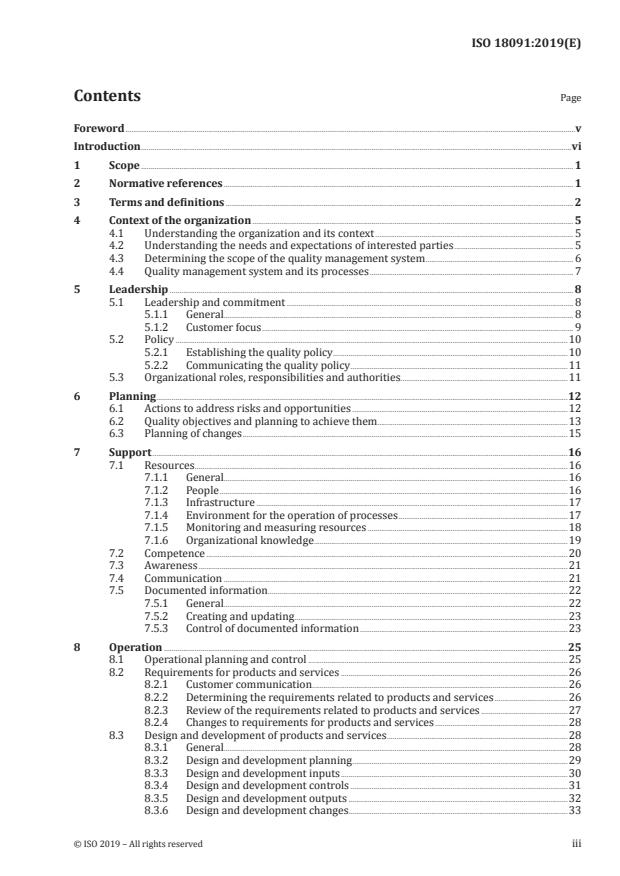
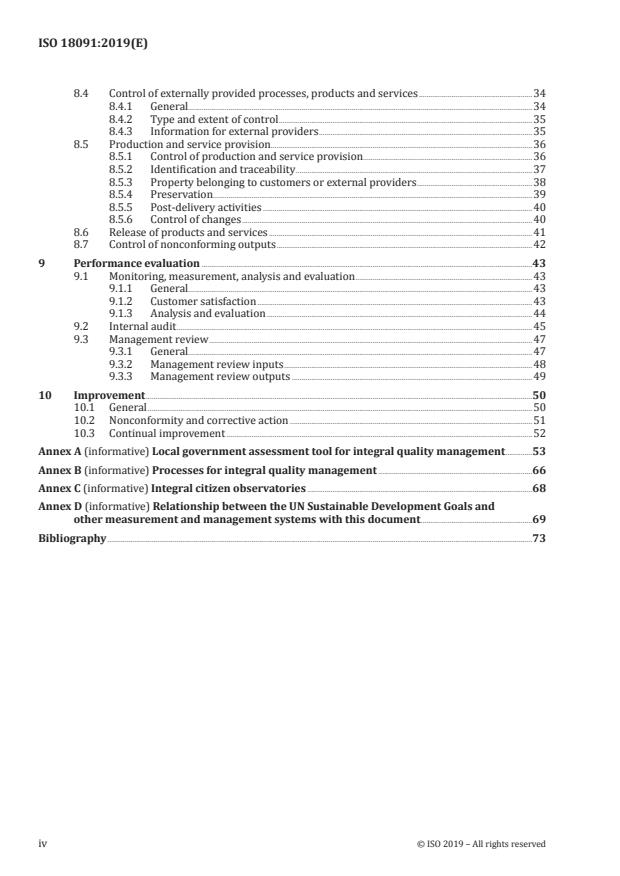
ISO 18091:2019 - Quality management systems -- Guidelines for the application of ISO 9001 in local government

ISO 18091:2019 - Quality management systems — Guidelines for the application of ISO 9001 in local government/25/2019

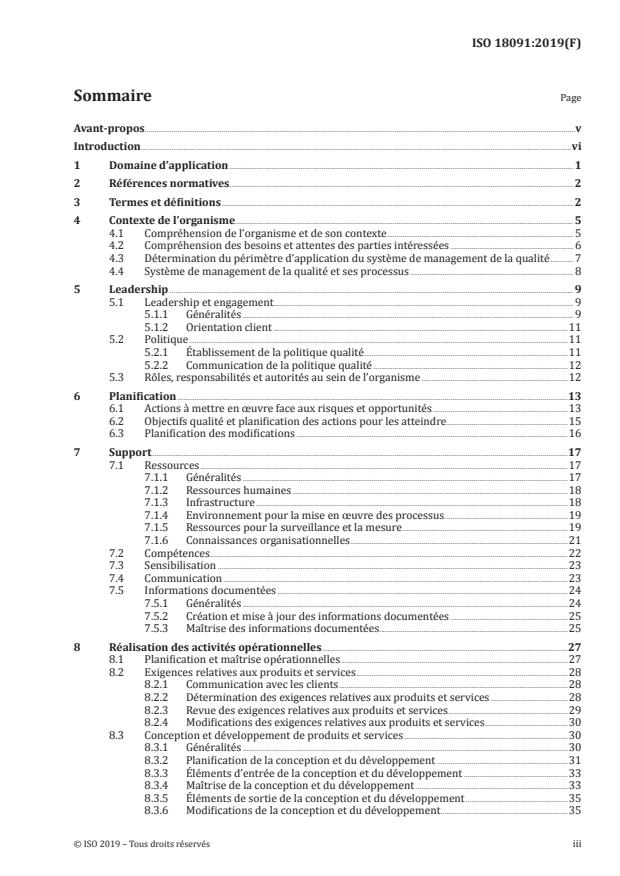
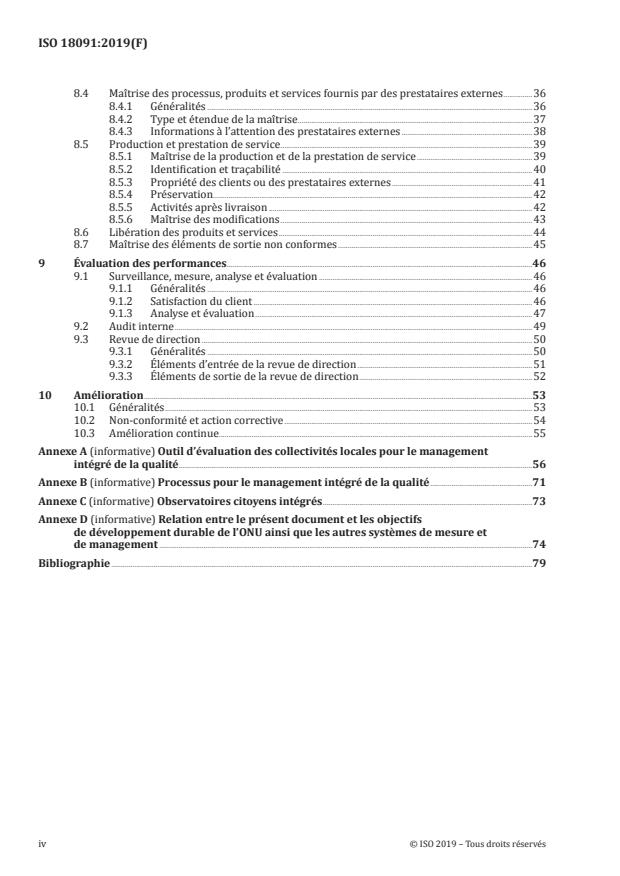
ISO 18091:2019 - Systemes de management de la qualité -- Lignes directrices pour l'application de l'ISO 9001 a la collectivité locale
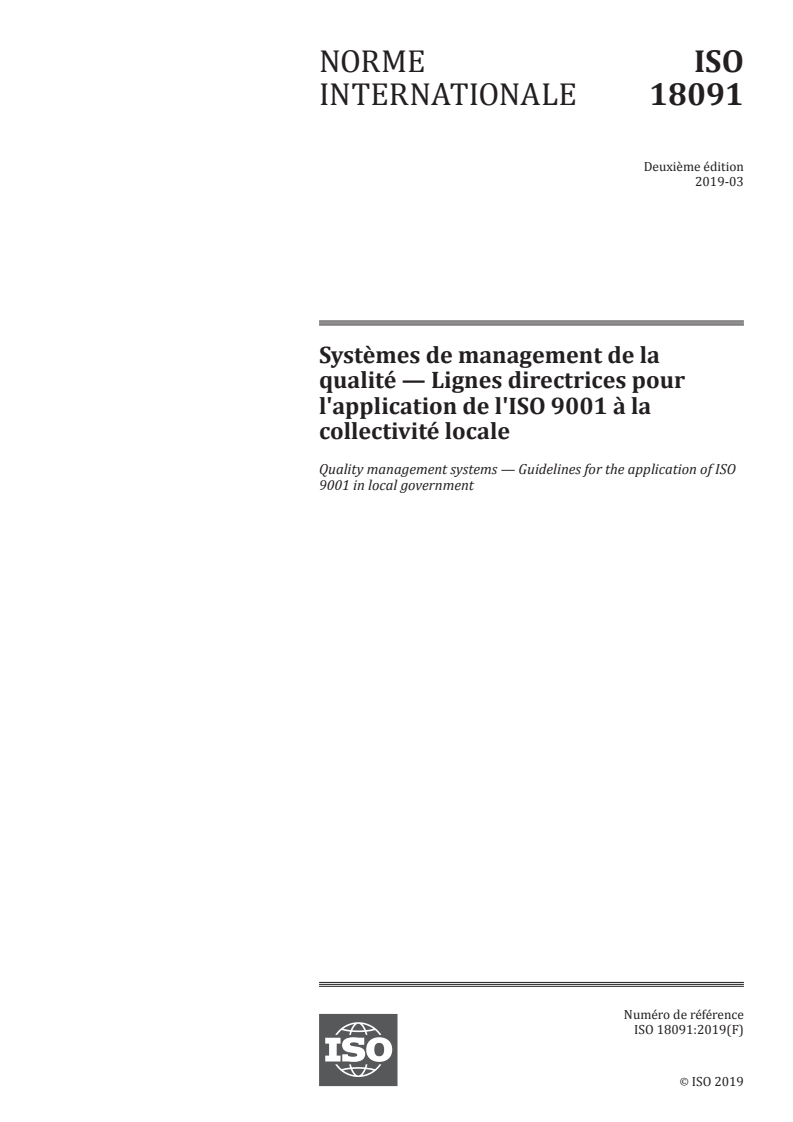

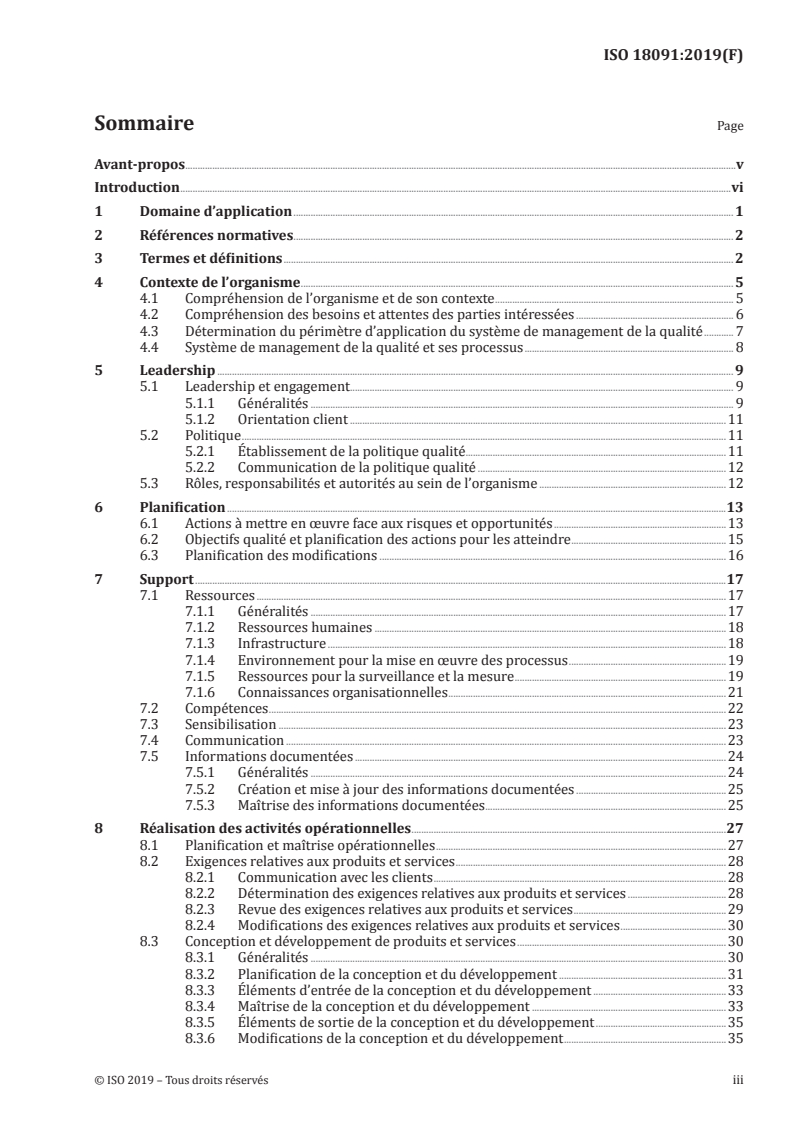
ISO 18091:2019 - Systèmes de management de la qualité — Lignes directrices pour l'application de l'ISO 9001 à la collectivité locale/25/2019


ISO 18091:2019 - Quality management systems -- Guidelines for the application of ISO 9001 in local government

ISO 18091:2019 - Quality management systems — Guidelines for the application of ISO 9001 in local government/17/2019
Overview
SIST ISO 18091:2019 - Quality management systems: Guidelines for the application of ISO 9001 in local government provides practical guidance for applying ISO 9001:2015 principles in municipal and other local government settings. It helps local authorities design and operate a comprehensive quality management system (QMS) that consistently delivers products and services meeting customer (citizen) needs and applicable statutory and regulatory requirements. This second edition (2019) updates the guidance to align with the ISO high-level structure and adds tools such as a diagnostic methodology and links to the UN Sustainable Development Goals.
Key topics and technical requirements
The standard clarifies how ISO 9001 requirements apply across local government functions without changing ISO 9001 itself. Core topics include:
- Context of the organization (clause 4): understanding local government environment, stakeholders and scope of the QMS.
- Leadership and commitment (clause 5): policy, roles, responsibilities and customer (citizen) focus.
- Planning (clause 6): risk-based thinking, quality objectives and change planning.
- Support (clause 7): resources, competence, documented information and organizational knowledge.
- Operation (clause 8): planning and control of services, requirements for products and services, design/development of services, external provider management, preservation and post‑delivery activities.
- Performance evaluation (clause 9): monitoring, customer satisfaction measurement, internal audit and management review.
- Improvement (clause 10): nonconformity, corrective action and continual improvement.
Informative annexes provide practical tools:
- Annex A: diagnostic methodology to assess scope and maturity of processes.
- Annex B: catalogue of processes needed for reliable service delivery.
- Annex C: citizen observatory examples.
- Annex D: relationship to the UN Sustainable Development Goals.
Practical applications and who should use it
SIST ISO 18091:2019 is intended for:
- Municipalities, city councils and local authorities implementing or improving an ISO 9001-based QMS.
- Quality managers, senior leaders and department heads seeking to align public services with ISO 9001 requirements.
- Auditors, consultants and policy advisors working on public sector quality, compliance and performance measurement. Practical uses include improving citizen satisfaction, assuring compliance with legal requirements, standardizing processes across strategic, tactical and operational levels, and enabling evidence-based management and continual improvement.
Related standards
- ISO 9001:2015 - Quality management systems - Requirements (primary normative reference).
- Guidance prepared by ISO/TC 176 (Quality management and quality assurance).
Keywords: SIST ISO 18091:2019, ISO 9001, local government, quality management system, citizen satisfaction, statutory and regulatory requirements, QMS implementation.
Relations
- Effective Date
- 01-Oct-2019
Buy Documents
ISO 18091:2019 - Quality management systems -- Guidelines for the application of ISO 9001 in local government
ISO 18091:2019 - Quality management systems — Guidelines for the application of ISO 9001 in local government/25/2019
ISO 18091:2019 - Systemes de management de la qualité -- Lignes directrices pour l'application de l'ISO 9001 a la collectivité locale
ISO 18091:2019 - Systèmes de management de la qualité — Lignes directrices pour l'application de l'ISO 9001 à la collectivité locale/25/2019
ISO 18091:2019 - Quality management systems -- Guidelines for the application of ISO 9001 in local government
ISO 18091:2019 - Quality management systems — Guidelines for the application of ISO 9001 in local government/17/2019
Get Certified
Connect with accredited certification bodies for this standard

BSI Group
BSI (British Standards Institution) is the business standards company that helps organizations make excellence a habit.

Bureau Veritas
Bureau Veritas is a world leader in laboratory testing, inspection and certification services.

DNV
DNV is an independent assurance and risk management provider.
Sponsored listings
Frequently Asked Questions
SIST ISO 18091:2019 is a standard published by the Slovenian Institute for Standardization (SIST). Its full title is "Quality management systems - Guidelines for the application of ISO 9001 in local government". This standard covers: This International Standard specifies requirements for a quality management system when an organization: a) needs to demonstrate its ability to consistently provide products and services that meet customer and applicable statutory and regulatory requirements, and b) aims to enhance customer satisfaction through the effective application of the system, including processes for improvement of the system and the assurance of conformity to customer and applicable statutory and regulatory requirements. All the requirements of this International Standard are generic and are intended to be applicable to any organization, regardless of its type or size, or the products and services it provides. NOTE 1 In this International Standard, the terms "product" or "service" only apply to products and services intended for, or required by, a customer. NOTE 2 Statutory and regulatory requirements can be expressed as legal requirements. This document gives guidelines for local governments on understanding and implementing a quality management system that meets the requirements of ISO 9001:2015, in order to meet the needs and expectations of their customers/citizens and all other relevant interested parties by consistently providing them with products and services. It promotes implementing a quality management system in a responsible and accountable manner, through the application of ISO 9001 on a comprehensive basis. These guidelines do not add, change or modify the requirements of ISO 9001. It is applicable to all local government processes at all levels (i.e. strategical, tactical-managerial and operational) in order to constitute a comprehensive quality management system that focuses on the local government achieving its objectives. The comprehensive character of this system is essential to ensure that all the areas of the local government have a specified level of reliability (i.e. effectiveness of the processes). Annex A, as a starting point for users of this document, gives a diagnostic methodology for local governments to evaluate the scope and maturity of their processes and products and services. Annex B gives the processes necessary to provide reliable products and services to customers/citizens.
This International Standard specifies requirements for a quality management system when an organization: a) needs to demonstrate its ability to consistently provide products and services that meet customer and applicable statutory and regulatory requirements, and b) aims to enhance customer satisfaction through the effective application of the system, including processes for improvement of the system and the assurance of conformity to customer and applicable statutory and regulatory requirements. All the requirements of this International Standard are generic and are intended to be applicable to any organization, regardless of its type or size, or the products and services it provides. NOTE 1 In this International Standard, the terms "product" or "service" only apply to products and services intended for, or required by, a customer. NOTE 2 Statutory and regulatory requirements can be expressed as legal requirements. This document gives guidelines for local governments on understanding and implementing a quality management system that meets the requirements of ISO 9001:2015, in order to meet the needs and expectations of their customers/citizens and all other relevant interested parties by consistently providing them with products and services. It promotes implementing a quality management system in a responsible and accountable manner, through the application of ISO 9001 on a comprehensive basis. These guidelines do not add, change or modify the requirements of ISO 9001. It is applicable to all local government processes at all levels (i.e. strategical, tactical-managerial and operational) in order to constitute a comprehensive quality management system that focuses on the local government achieving its objectives. The comprehensive character of this system is essential to ensure that all the areas of the local government have a specified level of reliability (i.e. effectiveness of the processes). Annex A, as a starting point for users of this document, gives a diagnostic methodology for local governments to evaluate the scope and maturity of their processes and products and services. Annex B gives the processes necessary to provide reliable products and services to customers/citizens.
SIST ISO 18091:2019 is classified under the following ICS (International Classification for Standards) categories: 03.100.70 - Management systems; 03.120.10 - Quality management and quality assurance; 03.160 - Law. Administration. The ICS classification helps identify the subject area and facilitates finding related standards.
SIST ISO 18091:2019 has the following relationships with other standards: It is inter standard links to SIST ISO 18091:2014. Understanding these relationships helps ensure you are using the most current and applicable version of the standard.
SIST ISO 18091:2019 is available in PDF format for immediate download after purchase. The document can be added to your cart and obtained through the secure checkout process. Digital delivery ensures instant access to the complete standard document.
Standards Content (Sample)
SLOVENSKI STANDARD
01-oktober-2019
Nadomešča:
SIST ISO 18091:2014
Sistemi vodenja kakovosti - Smernice za uporabo standarda ISO 9001 v lokalni
oblasti
Quality management systems - Guidelines for the application of ISO 9001 in local
government
Systèmes de management de la qualité - Lignes directrices pour l'application de l'ISO
9001 à la collectivité locale
Ta slovenski standard je istoveten z: ISO 18091:2019
ICS:
03.100.70 Sistemi vodenja Management systems
03.120.10 Vodenje in zagotavljanje Quality management and
kakovosti quality assurance
03.160 Pravo. Uprava Law. Administration
2003-01.Slovenski inštitut za standardizacijo. Razmnoževanje celote ali delov tega standarda ni dovoljeno.
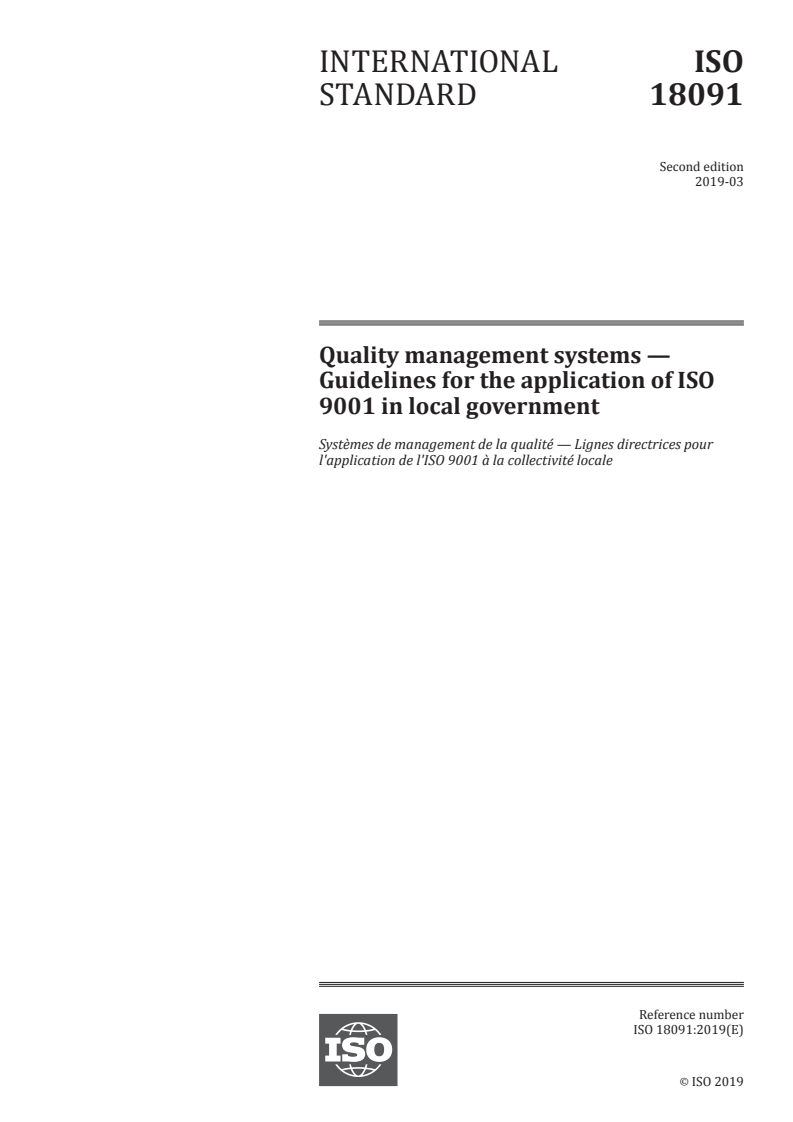
INTERNATIONAL ISO
STANDARD 18091
Second edition
2019-03
Quality management systems —
Guidelines for the application of ISO
9001 in local government
Systèmes de management de la qualité — Lignes directrices pour
l'application de l'ISO 9001 à la collectivité locale
Reference number
©
ISO 2019
© ISO 2019
All rights reserved. Unless otherwise specified, or required in the context of its implementation, no part of this publication may
be reproduced or utilized otherwise in any form or by any means, electronic or mechanical, including photocopying, or posting
on the internet or an intranet, without prior written permission. Permission can be requested from either ISO at the address
below or ISO’s member body in the country of the requester.
ISO copyright office
CP 401 • Ch. de Blandonnet 8
CH-1214 Vernier, Geneva
Phone: +41 22 749 01 11
Fax: +41 22 749 09 47
Email: copyright@iso.org
Website: www.iso.org
Published in Switzerland
ii © ISO 2019 – All rights reserved
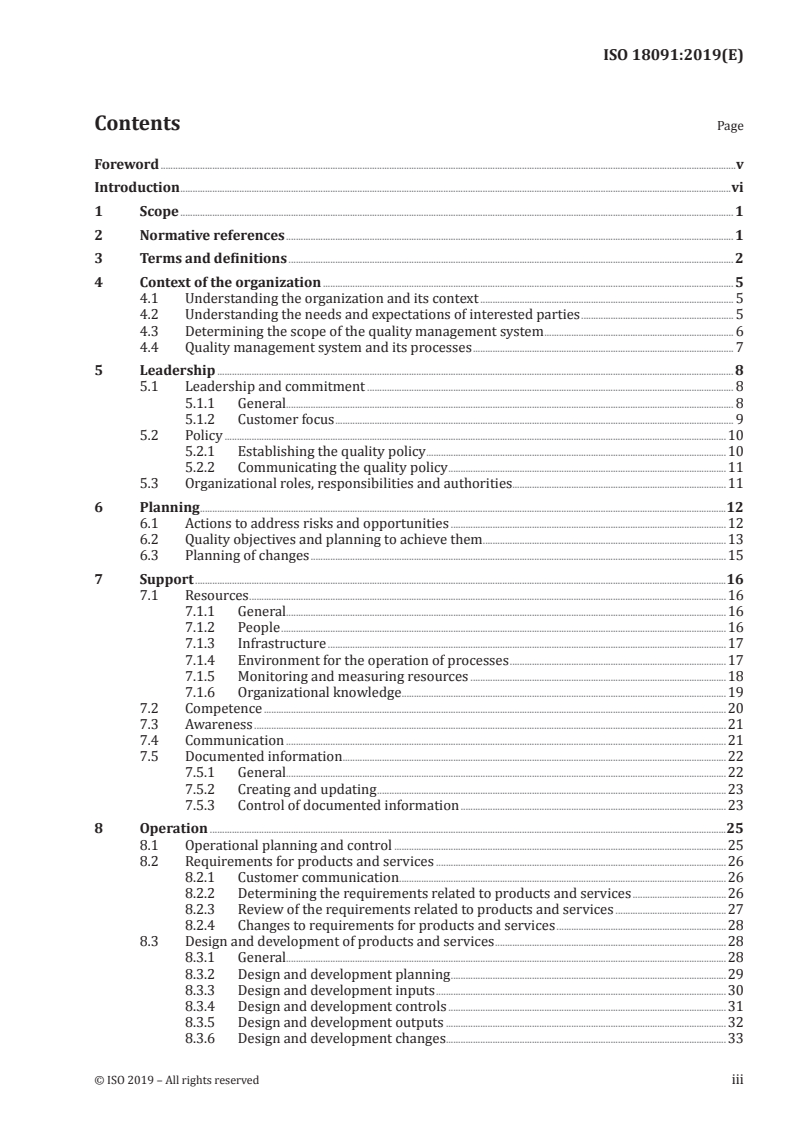
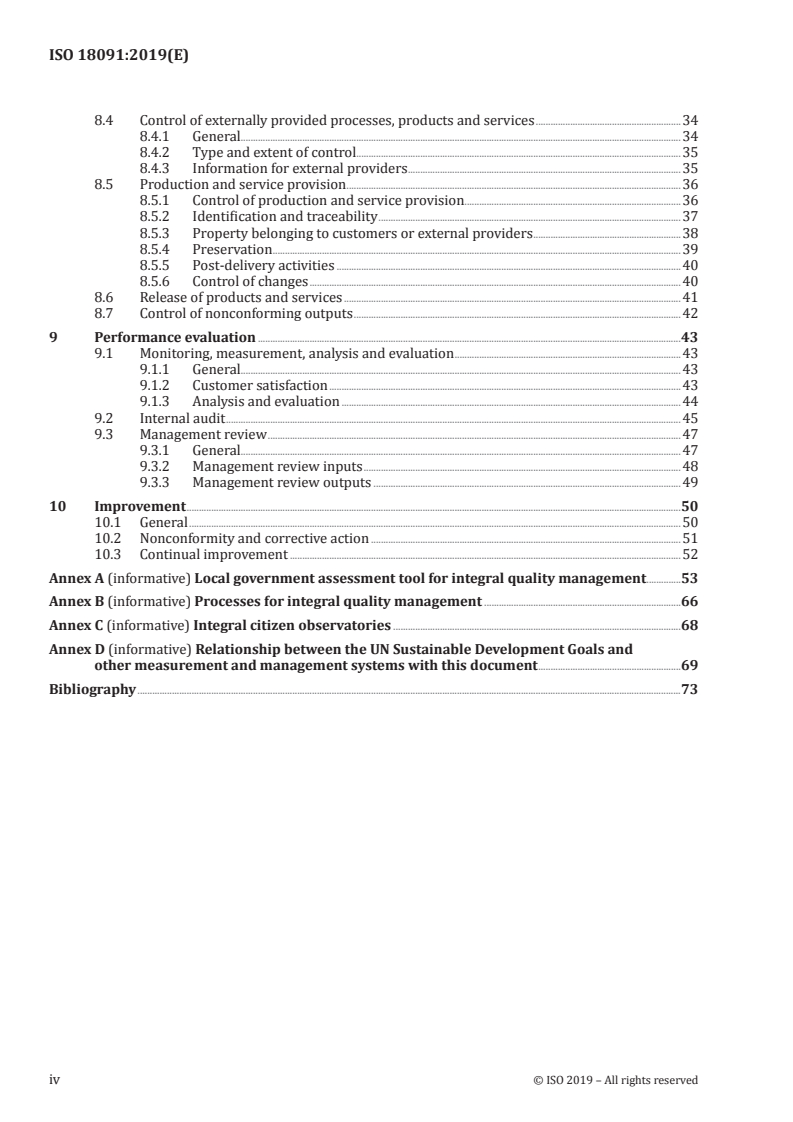
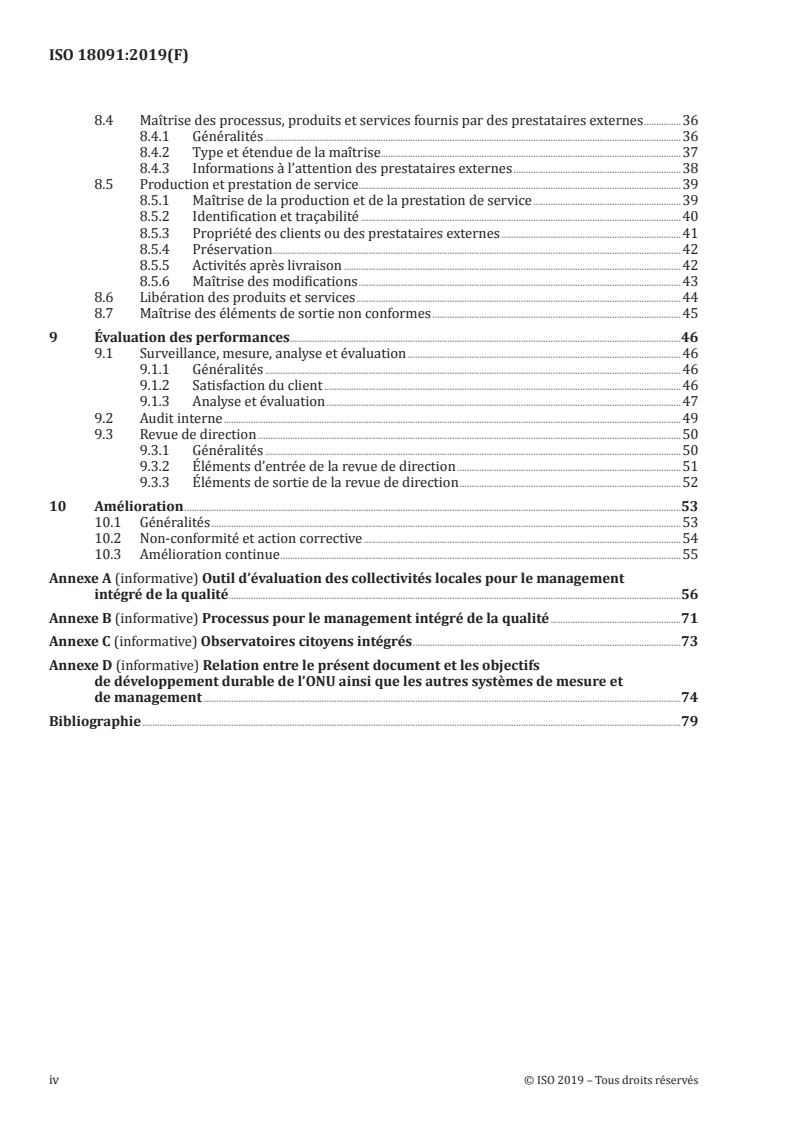
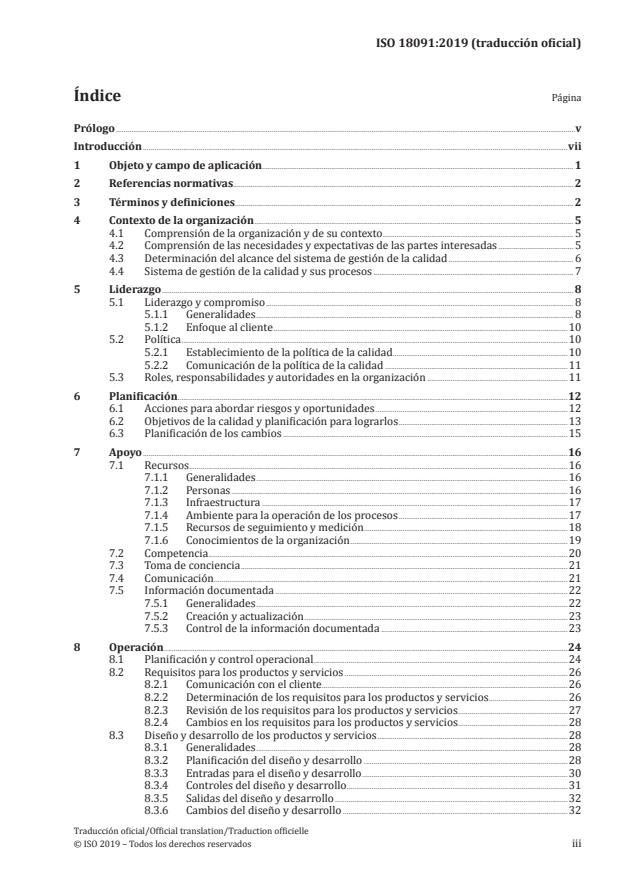
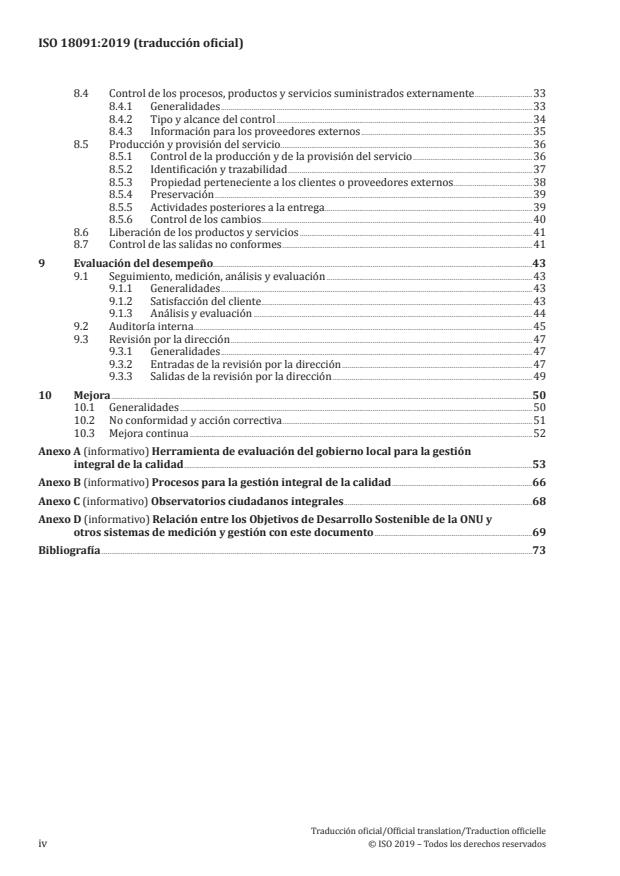
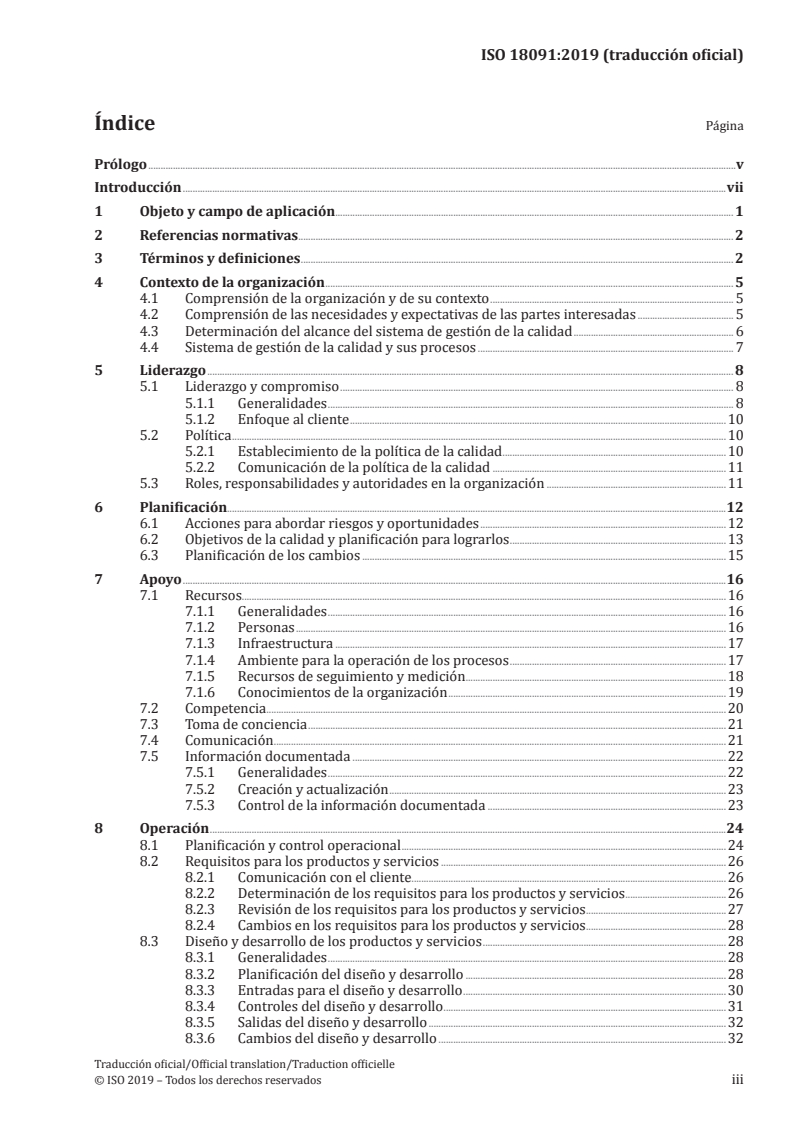
Contents Page
Foreword .v
Introduction .vi
1 Scope . 1
2 Normative references . 1
3 Terms and definitions . 2
4 Context of the organization . 5
4.1 Understanding the organization and its context . 5
4.2 Understanding the needs and expectations of interested parties . 5
4.3 Determining the scope of the quality management system . 6
4.4 Quality management system and its processes . 7
5 Leadership . 8
5.1 Leadership and commitment . 8
5.1.1 General. 8
5.1.2 Customer focus . 9
5.2 Policy .10
5.2.1 Establishing the quality policy .10
5.2.2 Communicating the quality policy .11
5.3 Organizational roles, responsibilities and authorities.11
6 Planning .12
6.1 Actions to address risks and opportunities .12
6.2 Quality objectives and planning to achieve them .13
6.3 Planning of changes .15
7 Support .16
7.1 Resources .16
7.1.1 General.16
7.1.2 People .16
7.1.3 Infrastructure .17
7.1.4 Environment for the operation of processes .17
7.1.5 Monitoring and measuring resources .18
7.1.6 Organizational knowledge .19
7.2 Competence .20
7.3 Awareness .21
7.4 Communication .21
7.5 Documented information .22
7.5.1 General.22
7.5.2 Creating and updating .23
7.5.3 Control of documented information .23
8 Operation .25
8.1 Operational planning and control .25
8.2 Requirements for products and services .26
8.2.1 Customer communication .26
8.2.2 Determining the requirements related to products and services .26
8.2.3 Review of the requirements related to products and services .27
8.2.4 Changes to requirements for products and services .28
8.3 Design and development of products and services .28
8.3.1 General.28
8.3.2 Design and development planning .29
8.3.3 Design and development inputs .30
8.3.4 Design and development controls .31
8.3.5 Design and development outputs .32
8.3.6 Design and development changes . .33
8.4 Control of externally provided processes, products and services .34
8.4.1 General.34
8.4.2 Type and extent of control .35
8.4.3 Information for external providers .35
8.5 Production and service provision .36
8.5.1 Control of production and service provision .36
8.5.2 Identification and traceability .37
8.5.3 Property belonging to customers or external providers .38
8.5.4 Preservation .39
8.5.5 Post-delivery activities .40
8.5.6 Control of changes .40
8.6 Release of products and services .41
8.7 Control of nonconforming outputs .42
9 Performance evaluation .43
9.1 Monitoring, measurement, analysis and evaluation .43
9.1.1 General.43
9.1.2 Customer satisfaction .43
9.1.3 Analysis and evaluation .44
9.2 Internal audit .45
9.3 Management review .47
9.3.1 General.47
9.3.2 Management review inputs .48
9.3.3 Management review outputs .49
10 Improvement .50
10.1 General .50
10.2 Nonconformity and corrective action .51
10.3 Continual improvement .52
Annex A (informative) Local government assessment tool for integral quality management .53
Annex B (informative) Processes for integral quality management .66
Annex C (informative) Integral citizen observatories .68
Annex D (informative) Relationship between the UN Sustainable Development Goals and
other measurement and management systems with this document .69
Bibliography .73
iv © ISO 2019 – All rights reserved
Foreword
ISO (the International Organization for Standardization) is a worldwide federation of national standards
bodies (ISO member bodies). The work of preparing International Standards is normally carried out
through ISO technical committees. Each member body interested in a subject for which a technical
committee has been established has the right to be represented on that committee. International
organizations, governmental and non-governmental, in liaison with ISO, also take part in the work.
ISO collaborates closely with the International Electrotechnical Commission (IEC) on all matters of
electrotechnical standardization.
The procedures used to develop this document and those intended for its further maintenance are
described in the ISO/IEC Directives, Part 1. In particular, the different approval criteria needed for the
different types of ISO documents should be noted. This document was drafted in accordance with the
editorial rules of the ISO/IEC Directives, Part 2 (see www .iso .org/directives).
Attention is drawn to the possibility that some of the elements of this document may be the subject of
patent rights. ISO shall not be held responsible for identifying any or all such patent rights. Details of
any patent rights identified during the development of the document will be in the Introduction and/or
on the ISO list of patent declarations received (see www .iso .org/patents).
Any trade name used in this document is information given for the convenience of users and does not
constitute an endorsement.
For an explanation of the voluntary nature of standards, the meaning of ISO specific terms and
expressions related to conformity assessment, as well as information about ISO's adherence to the
World Trade Organization (WTO) principles in the Technical Barriers to Trade (TBT) see www .iso
.org/iso/foreword .html.
This document was prepared by Technical Committee ISO/TC 176, Quality management and quality
assurance.
This second edition cancels and replaces the first edition (ISO 18091:2014), which has been technically
revised. The main changes compared with the previous edition are:
— the guidelines for ISO 9001:2015 have been updated;
— the structure has been changed to the ISO high level structure for management system standards;
— Annexes A and B have been switched;
— Annex A has been updated, including adding references to the United Nations Sustainable
Development Goals;
— a description of citizen observatories has been added in a new Annex C;
— an example how to use this document with other local government assessment systems has been
added in a new Annex D.
Any feedback or questions on this document should be directed to the user’s national standards body. A
complete listing of these bodies can be found at www .iso .org/members .html.
Introduction
0.1 General
One of the great challenges that societies face today is the need to develop and maintain citizens’
confidence in their governments and their institutions. In meeting this challenge, local governments
have a mission to enable the development of a socially responsible and sustainable local community.
Achieving and maintaining a high-level of quality in how local governments operate can result in
sustainable economic prosperity and social development at local levels. This includes interacting with
national and regional policies in coherent, consistent and compatible ways.
Citizens expect local government to provide high-quality public products and services such as safety and
security, well-maintained roads, public transportation, efficient processing of documents, transparency
and accessibility of public information, health, education and infrastructure, among others. Citizens
want local government to represent them and to protect or enhance their way of life.
It is possible to build stronger, more reliable and effective public policy networks at national, regional
and international levels if local governments adopt quality management systems with the aim to
improve their public products and services.
Improving the performance of local government can stimulate the whole system of government to
provide better results overall. Applying a coherent approach across government can help to create
reliable and sustainable governments at local, regional and national levels.
This document provides guidelines for local governments on understanding and implementing a quality
management system that meets the requirements of ISO 9001:2015 and the needs and expectations of
their citizens and other relevant interested parties.
A principle of this document is to help to make politically viable what is technically essential in local
governments and their territories (see Annex A). This can be achieved by establishing links between
government, citizens and governors (from the bottom to the top, see Annex C) and by facing the needs
of the customers/citizens in an integral manner (see Annex B).
Annex A gives a diagnostic model that can be used as a starting point for implementing a comprehensive
quality management system for reliable local government. The International Foundation for Reliable
Local Governments (FIDEGOC) has the rights of these principles and share them for use in this
document. Annex B provides information about typical local government processes. Annex C describes
the creation of an integral citizen observatory that uses this document as a tool for citizen participation
and for accountability of local government. Annex D describes how this document can help to translate
different assessment systems, contents or subject matters, e.g. the United Nations Sustainable
Development Goals (UN SDGs), into the indicators of public policy networks found in the diagnostic
model given in Annex A.
The relative stages of implementing the quality management system and the role of this document are
shown in Figure 1.
vi © ISO 2019 – All rights reserved
Figure 1 — Diagram showing the role of this document
In this document, the text reproduced from ISO 9001:2015 is placed in boxes to distinguish it from
guidance given for each clause.
NOTE 1 Local governments seeking to improve themselves could consider the use of an excellence model to
further develop the maturity of the organization and the level of its performance. Well-known excellence models
include the European model for quality management (EFQM), the Malcolm Baldrige model for excellence in
United States, The Deming Prize in Japan, and a number of national excellence award models used in different
countries or regions. These excellence models aim to improve the satisfaction of all relevant interested parties
and the sustainable development of the organization. Further information about these excellence models is
available from the websites of the organizations representing the models.
NOTE 2 More examples of how the annexes can be used can be found at www .iso18091 .org.
ISO 9001:2015, Quality management systems — Requirements
Introduction
0.1 General
The adoption of a quality management system is a strategic decision for an organization that can help
to improve its overall performance and provide a sound basis for sustainable development initiatives.
The potential benefits to an organization of implementing a quality management system based on this
International Standard are:
a) the ability to consistently provide products and services that meet customer and applicable
statutory and regulatory requirements;
b) facilitating opportunities to enhance customer satisfaction;
c) addressing risks and opportunities associated with its context and objectives;
d) the ability to demonstrate conformity to specified quality management system requirements.
This International Standard can be used by internal and external parties.
It is not the intent of this International Standard to imply the need for:
— uniformity in the structure of different quality management systems;
— alignment of documentation to the clause structure of this International Standard;
— the use of the specific terminology of this International Standard within the organization.
The quality management system requirements specified in this International Standard are complemen-
tary to requirements for products and services.
This International Standard employs the process approach, which incorporates the Plan-Do-Check-Act
(PDCA) cycle and risk-based thinking.
The process approach enables an organization to plan its processes and their interactions.
The PDCA cycle enables an organization to ensure that its processes are adequately resourced and
managed, and that opportunities for improvement are determined and acted on.
Risk-based thinking enables an organization to determine the factors that could cause its processes and
its quality management system to deviate from the planned results, to put in place preventive controls
to minimize negative effects and to make maximum use of opportunities as they arise.
Consistently meeting requirements and addressing future needs and expectations poses a challenge
for organizations in an increasingly dynamic and complex environment. To achieve this objective, the
organization might find it necessary to adopt various forms of improvement in addition to correction
and continual improvement, such as breakthrough change, innovation and re-organization.
In this International Standard, the following verbal forms are used:
— “shall” indicates a requirement;
— “should” indicates a recommendation;
— “may” indicates a permission;
— “can” indicates a possibility or a capability.
Information marked as “NOTE” is for guidance in understanding or clarifying the associated requirement.
The guidelines in this document are intended to help local governments relate the concepts of quality
management, as described in ISO 9000, ISO 9001, ISO 9004 and associated standards, with the practice
and terminology commonly deployed in the context of local government.
NOTE 3 The use of the terms and definitions presented in these guidelines can vary according to the culture,
practices and customs of each location and region in which the local government is located.
It is expected that a development plan or work programme in the short- or medium-term is received,
understood and applied by the public servants and representatives of local government. However, the
plan or programme itself does not ensure that the needs and expectations of the local community will
be covered, as the processes needed for the effective implementation of such plans or programmes
could be deficient or non-existent. To counter this problem, this document has been developed to help
local governments to implement an effective quality management system.
Any quality management system will be influenced by the different policies, objectives, diverse
work methods, resource availability and administrative practices that are specific for the context.
Therefore, it can be expected that the details of each quality management system will vary in each
local government. A detailed method of implementation of the quality management system is not what
is important. What matters is that the quality management system yields effective, consistent and
reliable results. It is important that the quality management system is as simple as possible in order to
function properly, and that it is sufficiently understandable to meet the policies and quality objectives
of the particular local government.
It is not intended that conformity to ISO 9001 be regarded as a final objective. Once a local government
has achieved a level that allows it to provide consistent and conforming products and services to the
local community, it is important that it looks beyond conformance to requirements, and that it considers
using ISO 9004 and/or other excellence models to improve its overall effectiveness and efficiency.
According to ISO 9000, for an organization to be successful, it needs to be guided and controlled in a
systematic and transparent way. This is particularly true for local government, where transparency
and accountability to its customers/citizens are vital to gain their trust and confidence. Sustainable
success will only result from the implementation of a comprehensive quality management system that
addresses the needs and expectations of all interested parties.
viii © ISO 2019 – All rights reserved
It is, therefore, important that the quality management system of a reliable and successful local
government covers all activities and processes that can affect its ability to satisfy the requirements
of its customers/citizens, the statutory and regulatory requirements and compliance commitments
applicable to the products and services, and the local government’s own requirements, as well as all
other relevant interested parties, such as regional or national governments.
0.2 Quality management principles
ISO 9001:2015, Quality management systems — Requirements
0.2 Quality management principles
This International Standard is based on the quality management principles described in ISO 9000. The
descriptions include a statement of each principle, a rationale of why the principle is important for the
organization, some examples of benefits associated with the principle and examples of typical actions
to improve the organization’s performance when applying the principle.
The quality management principles are:
— customer focus;
— leadership;
— engagement of people;
— process approach;
— improvement;
— evidence-based decision making;
— relationship management.
This document supports the application to local government of the seven quality management principles
from ISO 9000.
The relevance of the seven quality management principles to local government are as follows.
— Customer/citizen focus: Local government exists to serve its customers, i.e. its citizens. Therefore,
the needs and expectations of citizens should be of priority in the plans and programmes of the local
government.
— Leadership: Top management is the head of local government and should create a vision and provide
direction to all concerned (e.g. public servants and volunteers) to achieve goals and targets that
meet the needs and expectations of the customers/citizens.
— Engagement of people: All people should be involved in local government processes, including
voluntary participation and citizens taking part in the activities of local government. Engaged
people are fully committed and emotionally attached to the organization, its goals and objectives.
They work enthusiastically and take pride in their work. This principle envisages ensuring a high
level of motivation on an ongoing basis.
— Process approach: The logical framework and the approach to results in a local government should
be based on processes that describe elements such as its vision and long-term plans, and even the
daily activities of local government areas.
— Improvement: It is essential for local government to maintain its performance and search for new
opportunities to improve its processes and enhance the satisfaction of its customers/citizens.
— Evidence-based decision making: Use of evidence and data analysis should provide the base for
improving the quality management system and its processes.
— Relationship management: Local government should pay attention to how it relates to customers/
citizens, external providers and partners, and to its horizontal and vertical relationships.
0.3 Process approach
0.3.1 General
ISO 9001:2015, Quality management systems — Requirements
0.3 Process approach
0.3.1 General
This International Standard promotes the adoption of a process approach when developing, implement-
ing and improving the effectiveness of a quality management system, to enhance customer satisfaction
by meeting customer requirements. Specific requirements considered essential to the adoption of a
process approach are included in 4.4.
Understanding and managing interrelated processes as a system contributes to the organization’s ef-
fectiveness and efficiency in achieving its intended results. This approach enables the organization to
control the interrelationships and interdependencies among the processes of the system, so that the
overall performance of the organization can be enhanced.
The process approach involves the systematic definition and management of processes, and their
interactions, so as to achieve the intended results in accordance with the quality policy and strategic
direction of the organization. Management of the processes and the system as a whole can be achieved
using the PDCA cycle (see 0.3.2) with an overall focus on risk-based thinking (see 0.3.3) aimed at taking
advantage of opportunities and preventing undesirable results.
The application of the process approach in a quality management system enables:
a) understanding and consistency in meeting requirements;
b) the consideration of processes in terms of added value;
c) the achievement of effective process performance;
d) improvement of processes based on evaluation of data and information.
Figure 1 gives a schematic representation of any process and shows the interaction of its elements. The
monitoring and measuring check points, which are necessary for control, are specific to each process
and will vary depending on the related risks.
Figure 1 — Schematic representation of the elements of a single process
For local governments to be able to adopt a process approach, it is important to recognize the different
types of processes that are needed to provide reliable products and service to customers/citizens,
as well as their management capacity to produce the desired outputs. These include processes for
management of the organization, operational processes and support processes (see Annex B). The
processes needed to provide the local government’s products and service are the core of the operational
processes.
x © ISO 2019 – All rights reserved
Typical examples of local government processes are:
— strategic management processes to determine the local government’s role in the socio-economic
environment;
— provision of products and services to customers/citizens;
— improvement of quality management system processes;
— transparent internal and external communication processes.
For each process, the local government should identify the following.
— Who is the customer? (Who receives the output from the process?) This might be an internal
customer, within another area of the same local government, or an external customer such as a
citizen who is receiving a product or service.
— What are the main inputs to the process? (For example, information, legal requirements, national
and/or regional government policies, materials, energy, human and financial resources.)
— What are the desired outputs? (For example, what are the characteristics of the product/service to
be provided?)
— What controls and indicators are needed to verify the process performance and/or results?
— What is the interaction with other local government processes? (Outputs from one process typically
form inputs into other processes.)
— What controls are necessary to have transparency?
0.3.2 Plan-Do-Check-Act cycle
ISO 9001:2015, Quality management systems — Requirements
0.3.2 Plan-Do-Check-Act cycle
The PDCA cycle can be applied to all processes and to the quality management system as a whole. Fig-
ure 2 illustrates how Clauses 4 to 10 can be grouped in relation to the PDCA cycle.
NOTE Numbers in brackets refer to the clauses in this International Standard.
Figure 2 — Representation of the structure of this International Standard in the PDCA cycle
The PDCA cycle can be briefly described as follows:
— Plan: establish the objectives of the system and its processes, and the resources needed to deliver
results in accordance with customers’ requirements and the organization’s policies, and identify
and address risks and opportunities;
— Do: implement what was planned;
— Check: monitor and (where applicable) measure processes and the resulting products and services
against policies, objectives, requirements and planned activities, and report the results;
— Act: take actions to improve performance, as necessary.
The PDCA cycle enables the top management of the local government to develop a systematic method
of assessing the external and internal environment and to implement the necessary processes for the
improvement of the products and services provided to its customers/citizens. The PDCA cycle can be
initiated at any stage, but usually a local government that implements a quality management system for
the first time or is in the process of upgrading its system can initiate the process by assessing its current
performance (the Check stage) using the requirements of Clause 9, “Performance evaluation”. The results
of performance evaluation are fed into the PDCA cycle’s Act stage (see Clause 10, “Improvement”) where
xii © ISO 2019 – All rights reserved
the local government initiates the necessary actions to address the opportunities for improvement
identified at the Check stage.
At the Plan stage of the PDCA cycle, the local authority not only plans the actions agreed at the previous
stage, but, most importantly, it develops, by assessing the needs and expectations of its customers/
citizens and its other relevant interested parties, the necessary objectives, targets and actions to
address the risks and opportunities identified as per Clause 6, “Planning”. At the PDCA cycle’s Do stage,
the objectives and actions planned are communicated throughout the local government. New processes
or changes to existing processes are implemented to ensure that agreed objectives are met.
The local government should use the PDCA cycle, with its overall focus on risk-based thinking, to design
its quality management system, its processes and their interactions, in order to identify each of the
necessary activities to maintain its quality level, to achieve continual improvement, to take advantage
of opportunities and to prevent undesirable results. The local government should make short-, medium-
and long-term plans using the PDCA cycle.
0.3.3 Risk-based thinking
ISO 9001:2015, Quality management systems — Requirements
0.3.3 Risk-based thinking
Risk-based thinking (see Clause A.4) is essential for achieving an effective quality management system.
The concept of risk-based thinking has been implicit in previous editions of this International Standard
including, for example, carrying out preventive action to eliminate potential nonconformities, analysing
any nonconformities that do occur, and taking action to prevent recurrence that is appropriate for the
effects of the nonconformity.
To conform to the requirements of this International Standard, an organization needs to plan and imple-
ment actions to address risks and opportunities. Addressing both risks and opportunities establishes
a basis for increasing the effectiveness of the quality management system, achieving improved results
and preventing negative effects.
Opportunities can arise as a result of a situation favourable to achieving an intended result, for ex-
ample, a set of circumstances that allow the organization to attract customers, develop new products
and services, reduce waste or improve productivity. Actions to address opportunities can also include
consideration of associated risks. Risk is the effect of uncertainty and any such uncertainty can have
positive or negative effects. A positive deviation arising from a risk can provide an opportunity, but not
all positive effects of risk result in opportunities.
In local government, any changes in the operational environment, such as changes in policies,
regulations and the expectations of relevant interested parties, can be a source of uncertainty and can
lead to a deviation of performance.
Risk-based thinking is not new and can be inherent in the way the local government already
operates. This document recommends that the identification of risks and opportunities is performed
systematically and as part of an integral process.
The local government should address the risks and opportunities associated with its processes, for
example, the provision of products and services and the performance of the quality management
system. At the same time, risk and opportunities will be identified as a result of the strategic direction
of the local government’s role in the socio-economic environment.
One of the most recurring risks in a local government is not being able to access the resources offered
by other levels of government. One way to mitigate this risk is to identify alternative forms of financing.
Openness to citizen participation through integral citizen observatories (ICOs) can be an opportunity
to develop the organization of local government and to improve its products, services and processes.
However, it could also constitute a risk if citizen participation, instead of promoting the improvement of
products and activities, becomes the institutionalization of complaints.
0.4 Relationship with other management system standards
ISO 9001:2015, Quality management systems — Requirements
0.4 Relationship with other management system standards
This International Standard applies the framework developed by ISO to improve alignment among its
International Standards for management systems (see Clause A.1).
This International Standard enables an organization to use the process approach, coupled with the PDCA
cycle and risk-based thinking, to align or integrate its quality management system with the requirements
of other management system standards.
This International Standard relates to ISO 9000 and ISO 9004 as follows:
— ISO 9000 Quality management systems — Fundamentals and vocabulary provides essential
background for the proper understanding and implementation of this International Standard;
— ISO 9004 Managing for the sustained success of an organization — A quality management approach
provides guidance for organizations that choose to progress beyond the requirements of this
International Standard.
Annex B provides details of other International Standards on quality management and quality manage-
ment systems that have been developed by ISO/TC 176.
This International Standard does not include requirements specific to other management systems,
such as those for environmental management, occupational health and safety management, or financial
management.
Sector-specific quality management system standards based on the requirements of this International
Standard have been developed for a number of
...
INTERNATIONAL ISO
STANDARD 18091
Second edition
2019-03
Quality management systems —
Guidelines for the application of ISO
9001 in local government
Systèmes de management de la qualité — Lignes directrices pour
l'application de l'ISO 9001 à la collectivité locale
Reference number
©
ISO 2019
© ISO 2019
All rights reserved. Unless otherwise specified, or required in the context of its implementation, no part of this publication may
be reproduced or utilized otherwise in any form or by any means, electronic or mechanical, including photocopying, or posting
on the internet or an intranet, without prior written permission. Permission can be requested from either ISO at the address
below or ISO’s member body in the country of the requester.
ISO copyright office
CP 401 • Ch. de Blandonnet 8
CH-1214 Vernier, Geneva
Phone: +41 22 749 01 11
Fax: +41 22 749 09 47
Email: copyright@iso.org
Website: www.iso.org
Published in Switzerland
ii © ISO 2019 – All rights reserved
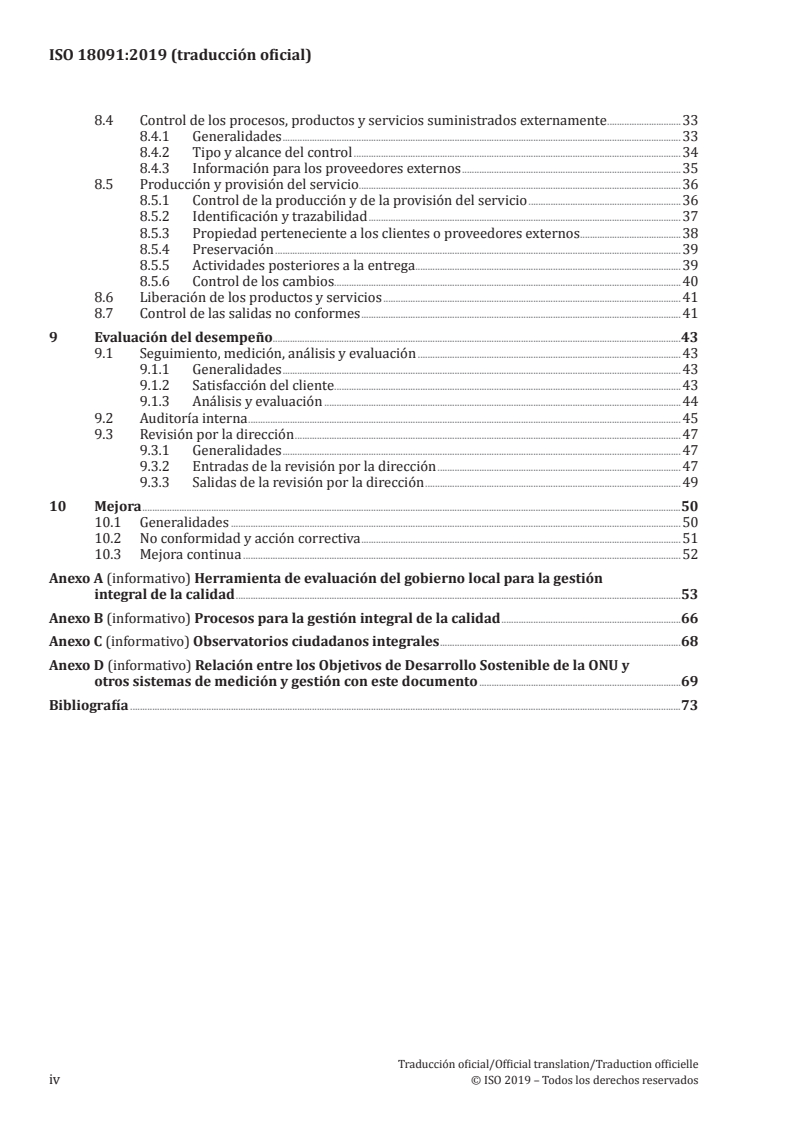
Contents Page
Foreword .v
Introduction .vi
1 Scope . 1
2 Normative references . 1
3 Terms and definitions . 2
4 Context of the organization . 5
4.1 Understanding the organization and its context . 5
4.2 Understanding the needs and expectations of interested parties . 5
4.3 Determining the scope of the quality management system . 6
4.4 Quality management system and its processes . 7
5 Leadership . 8
5.1 Leadership and commitment . 8
5.1.1 General. 8
5.1.2 Customer focus . 9
5.2 Policy .10
5.2.1 Establishing the quality policy .10
5.2.2 Communicating the quality policy .11
5.3 Organizational roles, responsibilities and authorities.11
6 Planning .12
6.1 Actions to address risks and opportunities .12
6.2 Quality objectives and planning to achieve them .13
6.3 Planning of changes .15
7 Support .16
7.1 Resources .16
7.1.1 General.16
7.1.2 People .16
7.1.3 Infrastructure .17
7.1.4 Environment for the operation of processes .17
7.1.5 Monitoring and measuring resources .18
7.1.6 Organizational knowledge .19
7.2 Competence .20
7.3 Awareness .21
7.4 Communication .21
7.5 Documented information .22
7.5.1 General.22
7.5.2 Creating and updating .23
7.5.3 Control of documented information .23
8 Operation .25
8.1 Operational planning and control .25
8.2 Requirements for products and services .26
8.2.1 Customer communication .26
8.2.2 Determining the requirements related to products and services .26
8.2.3 Review of the requirements related to products and services .27
8.2.4 Changes to requirements for products and services .28
8.3 Design and development of products and services .28
8.3.1 General.28
8.3.2 Design and development planning .29
8.3.3 Design and development inputs .30
8.3.4 Design and development controls .31
8.3.5 Design and development outputs .32
8.3.6 Design and development changes . .33
8.4 Control of externally provided processes, products and services .34
8.4.1 General.34
8.4.2 Type and extent of control .35
8.4.3 Information for external providers .35
8.5 Production and service provision .36
8.5.1 Control of production and service provision .36
8.5.2 Identification and traceability .37
8.5.3 Property belonging to customers or external providers .38
8.5.4 Preservation .39
8.5.5 Post-delivery activities .40
8.5.6 Control of changes .40
8.6 Release of products and services .41
8.7 Control of nonconforming outputs .42
9 Performance evaluation .43
9.1 Monitoring, measurement, analysis and evaluation .43
9.1.1 General.43
9.1.2 Customer satisfaction .43
9.1.3 Analysis and evaluation .44
9.2 Internal audit .45
9.3 Management review .47
9.3.1 General.47
9.3.2 Management review inputs .48
9.3.3 Management review outputs .49
10 Improvement .50
10.1 General .50
10.2 Nonconformity and corrective action .51
10.3 Continual improvement .52
Annex A (informative) Local government assessment tool for integral quality management .53
Annex B (informative) Processes for integral quality management .66
Annex C (informative) Integral citizen observatories .68
Annex D (informative) Relationship between the UN Sustainable Development Goals and
other measurement and management systems with this document .69
Bibliography .73
iv © ISO 2019 – All rights reserved
Foreword
ISO (the International Organization for Standardization) is a worldwide federation of national standards
bodies (ISO member bodies). The work of preparing International Standards is normally carried out
through ISO technical committees. Each member body interested in a subject for which a technical
committee has been established has the right to be represented on that committee. International
organizations, governmental and non-governmental, in liaison with ISO, also take part in the work.
ISO collaborates closely with the International Electrotechnical Commission (IEC) on all matters of
electrotechnical standardization.
The procedures used to develop this document and those intended for its further maintenance are
described in the ISO/IEC Directives, Part 1. In particular, the different approval criteria needed for the
different types of ISO documents should be noted. This document was drafted in accordance with the
editorial rules of the ISO/IEC Directives, Part 2 (see www .iso .org/directives).
Attention is drawn to the possibility that some of the elements of this document may be the subject of
patent rights. ISO shall not be held responsible for identifying any or all such patent rights. Details of
any patent rights identified during the development of the document will be in the Introduction and/or
on the ISO list of patent declarations received (see www .iso .org/patents).
Any trade name used in this document is information given for the convenience of users and does not
constitute an endorsement.
For an explanation of the voluntary nature of standards, the meaning of ISO specific terms and
expressions related to conformity assessment, as well as information about ISO's adherence to the
World Trade Organization (WTO) principles in the Technical Barriers to Trade (TBT) see www .iso
.org/iso/foreword .html.
This document was prepared by Technical Committee ISO/TC 176, Quality management and quality
assurance.
This second edition cancels and replaces the first edition (ISO 18091:2014), which has been technically
revised. The main changes compared with the previous edition are:
— the guidelines for ISO 9001:2015 have been updated;
— the structure has been changed to the ISO high level structure for management system standards;
— Annexes A and B have been switched;
— Annex A has been updated, including adding references to the United Nations Sustainable
Development Goals;
— a description of citizen observatories has been added in a new Annex C;
— an example how to use this document with other local government assessment systems has been
added in a new Annex D.
Any feedback or questions on this document should be directed to the user’s national standards body. A
complete listing of these bodies can be found at www .iso .org/members .html.
Introduction
0.1 General
One of the great challenges that societies face today is the need to develop and maintain citizens’
confidence in their governments and their institutions. In meeting this challenge, local governments
have a mission to enable the development of a socially responsible and sustainable local community.
Achieving and maintaining a high-level of quality in how local governments operate can result in
sustainable economic prosperity and social development at local levels. This includes interacting with
national and regional policies in coherent, consistent and compatible ways.
Citizens expect local government to provide high-quality public products and services such as safety and
security, well-maintained roads, public transportation, efficient processing of documents, transparency
and accessibility of public information, health, education and infrastructure, among others. Citizens
want local government to represent them and to protect or enhance their way of life.
It is possible to build stronger, more reliable and effective public policy networks at national, regional
and international levels if local governments adopt quality management systems with the aim to
improve their public products and services.
Improving the performance of local government can stimulate the whole system of government to
provide better results overall. Applying a coherent approach across government can help to create
reliable and sustainable governments at local, regional and national levels.
This document provides guidelines for local governments on understanding and implementing a quality
management system that meets the requirements of ISO 9001:2015 and the needs and expectations of
their citizens and other relevant interested parties.
A principle of this document is to help to make politically viable what is technically essential in local
governments and their territories (see Annex A). This can be achieved by establishing links between
government, citizens and governors (from the bottom to the top, see Annex C) and by facing the needs
of the customers/citizens in an integral manner (see Annex B).
Annex A gives a diagnostic model that can be used as a starting point for implementing a comprehensive
quality management system for reliable local government. The International Foundation for Reliable
Local Governments (FIDEGOC) has the rights of these principles and share them for use in this
document. Annex B provides information about typical local government processes. Annex C describes
the creation of an integral citizen observatory that uses this document as a tool for citizen participation
and for accountability of local government. Annex D describes how this document can help to translate
different assessment systems, contents or subject matters, e.g. the United Nations Sustainable
Development Goals (UN SDGs), into the indicators of public policy networks found in the diagnostic
model given in Annex A.
The relative stages of implementing the quality management system and the role of this document are
shown in Figure 1.
vi © ISO 2019 – All rights reserved
Figure 1 — Diagram showing the role of this document
In this document, the text reproduced from ISO 9001:2015 is placed in boxes to distinguish it from
guidance given for each clause.
NOTE 1 Local governments seeking to improve themselves could consider the use of an excellence model to
further develop the maturity of the organization and the level of its performance. Well-known excellence models
include the European model for quality management (EFQM), the Malcolm Baldrige model for excellence in
United States, The Deming Prize in Japan, and a number of national excellence award models used in different
countries or regions. These excellence models aim to improve the satisfaction of all relevant interested parties
and the sustainable development of the organization. Further information about these excellence models is
available from the websites of the organizations representing the models.
NOTE 2 More examples of how the annexes can be used can be found at www .iso18091 .org.
ISO 9001:2015, Quality management systems — Requirements
Introduction
0.1 General
The adoption of a quality management system is a strategic decision for an organization that can help
to improve its overall performance and provide a sound basis for sustainable development initiatives.
The potential benefits to an organization of implementing a quality management system based on this
International Standard are:
a) the ability to consistently provide products and services that meet customer and applicable
statutory and regulatory requirements;
b) facilitating opportunities to enhance customer satisfaction;
c) addressing risks and opportunities associated with its context and objectives;
d) the ability to demonstrate conformity to specified quality management system requirements.
This International Standard can be used by internal and external parties.
It is not the intent of this International Standard to imply the need for:
— uniformity in the structure of different quality management systems;
— alignment of documentation to the clause structure of this International Standard;
— the use of the specific terminology of this International Standard within the organization.
The quality management system requirements specified in this International Standard are complemen-
tary to requirements for products and services.
This International Standard employs the process approach, which incorporates the Plan-Do-Check-Act
(PDCA) cycle and risk-based thinking.
The process approach enables an organization to plan its processes and their interactions.
The PDCA cycle enables an organization to ensure that its processes are adequately resourced and
managed, and that opportunities for improvement are determined and acted on.
Risk-based thinking enables an organization to determine the factors that could cause its processes and
its quality management system to deviate from the planned results, to put in place preventive controls
to minimize negative effects and to make maximum use of opportunities as they arise.
Consistently meeting requirements and addressing future needs and expectations poses a challenge
for organizations in an increasingly dynamic and complex environment. To achieve this objective, the
organization might find it necessary to adopt various forms of improvement in addition to correction
and continual improvement, such as breakthrough change, innovation and re-organization.
In this International Standard, the following verbal forms are used:
— “shall” indicates a requirement;
— “should” indicates a recommendation;
— “may” indicates a permission;
— “can” indicates a possibility or a capability.
Information marked as “NOTE” is for guidance in understanding or clarifying the associated requirement.
The guidelines in this document are intended to help local governments relate the concepts of quality
management, as described in ISO 9000, ISO 9001, ISO 9004 and associated standards, with the practice
and terminology commonly deployed in the context of local government.
NOTE 3 The use of the terms and definitions presented in these guidelines can vary according to the culture,
practices and customs of each location and region in which the local government is located.
It is expected that a development plan or work programme in the short- or medium-term is received,
understood and applied by the public servants and representatives of local government. However, the
plan or programme itself does not ensure that the needs and expectations of the local community will
be covered, as the processes needed for the effective implementation of such plans or programmes
could be deficient or non-existent. To counter this problem, this document has been developed to help
local governments to implement an effective quality management system.
Any quality management system will be influenced by the different policies, objectives, diverse
work methods, resource availability and administrative practices that are specific for the context.
Therefore, it can be expected that the details of each quality management system will vary in each
local government. A detailed method of implementation of the quality management system is not what
is important. What matters is that the quality management system yields effective, consistent and
reliable results. It is important that the quality management system is as simple as possible in order to
function properly, and that it is sufficiently understandable to meet the policies and quality objectives
of the particular local government.
It is not intended that conformity to ISO 9001 be regarded as a final objective. Once a local government
has achieved a level that allows it to provide consistent and conforming products and services to the
local community, it is important that it looks beyond conformance to requirements, and that it considers
using ISO 9004 and/or other excellence models to improve its overall effectiveness and efficiency.
According to ISO 9000, for an organization to be successful, it needs to be guided and controlled in a
systematic and transparent way. This is particularly true for local government, where transparency
and accountability to its customers/citizens are vital to gain their trust and confidence. Sustainable
success will only result from the implementation of a comprehensive quality management system that
addresses the needs and expectations of all interested parties.
viii © ISO 2019 – All rights reserved
It is, therefore, important that the quality management system of a reliable and successful local
government covers all activities and processes that can affect its ability to satisfy the requirements
of its customers/citizens, the statutory and regulatory requirements and compliance commitments
applicable to the products and services, and the local government’s own requirements, as well as all
other relevant interested parties, such as regional or national governments.
0.2 Quality management principles
ISO 9001:2015, Quality management systems — Requirements
0.2 Quality management principles
This International Standard is based on the quality management principles described in ISO 9000. The
descriptions include a statement of each principle, a rationale of why the principle is important for the
organization, some examples of benefits associated with the principle and examples of typical actions
to improve the organization’s performance when applying the principle.
The quality management principles are:
— customer focus;
— leadership;
— engagement of people;
— process approach;
— improvement;
— evidence-based decision making;
— relationship management.
This document supports the application to local government of the seven quality management principles
from ISO 9000.
The relevance of the seven quality management principles to local government are as follows.
— Customer/citizen focus: Local government exists to serve its customers, i.e. its citizens. Therefore,
the needs and expectations of citizens should be of priority in the plans and programmes of the local
government.
— Leadership: Top management is the head of local government and should create a vision and provide
direction to all concerned (e.g. public servants and volunteers) to achieve goals and targets that
meet the needs and expectations of the customers/citizens.
— Engagement of people: All people should be involved in local government processes, including
voluntary participation and citizens taking part in the activities of local government. Engaged
people are fully committed and emotionally attached to the organization, its goals and objectives.
They work enthusiastically and take pride in their work. This principle envisages ensuring a high
level of motivation on an ongoing basis.
— Process approach: The logical framework and the approach to results in a local government should
be based on processes that describe elements such as its vision and long-term plans, and even the
daily activities of local government areas.
— Improvement: It is essential for local government to maintain its performance and search for new
opportunities to improve its processes and enhance the satisfaction of its customers/citizens.
— Evidence-based decision making: Use of evidence and data analysis should provide the base for
improving the quality management system and its processes.
— Relationship management: Local government should pay attention to how it relates to customers/
citizens, external providers and partners, and to its horizontal and vertical relationships.
0.3 Process approach
0.3.1 General
ISO 9001:2015, Quality management systems — Requirements
0.3 Process approach
0.3.1 General
This International Standard promotes the adoption of a process approach when developing, implement-
ing and improving the effectiveness of a quality management system, to enhance customer satisfaction
by meeting customer requirements. Specific requirements considered essential to the adoption of a
process approach are included in 4.4.
Understanding and managing interrelated processes as a system contributes to the organization’s ef-
fectiveness and efficiency in achieving its intended results. This approach enables the organization to
control the interrelationships and interdependencies among the processes of the system, so that the
overall performance of the organization can be enhanced.
The process approach involves the systematic definition and management of processes, and their
interactions, so as to achieve the intended results in accordance with the quality policy and strategic
direction of the organization. Management of the processes and the system as a whole can be achieved
using the PDCA cycle (see 0.3.2) with an overall focus on risk-based thinking (see 0.3.3) aimed at taking
advantage of opportunities and preventing undesirable results.
The application of the process approach in a quality management system enables:
a) understanding and consistency in meeting requirements;
b) the consideration of processes in terms of added value;
c) the achievement of effective process performance;
d) improvement of processes based on evaluation of data and information.
Figure 1 gives a schematic representation of any process and shows the interaction of its elements. The
monitoring and measuring check points, which are necessary for control, are specific to each process
and will vary depending on the related risks.
Figure 1 — Schematic representation of the elements of a single process
For local governments to be able to adopt a process approach, it is important to recognize the different
types of processes that are needed to provide reliable products and service to customers/citizens,
as well as their management capacity to produce the desired outputs. These include processes for
management of the organization, operational processes and support processes (see Annex B). The
processes needed to provide the local government’s products and service are the core of the operational
processes.
x © ISO 2019 – All rights reserved
Typical examples of local government processes are:
— strategic management processes to determine the local government’s role in the socio-economic
environment;
— provision of products and services to customers/citizens;
— improvement of quality management system processes;
— transparent internal and external communication processes.
For each process, the local government should identify the following.
— Who is the customer? (Who receives the output from the process?) This might be an internal
customer, within another area of the same local government, or an external customer such as a
citizen who is receiving a product or service.
— What are the main inputs to the process? (For example, information, legal requirements, national
and/or regional government policies, materials, energy, human and financial resources.)
— What are the desired outputs? (For example, what are the characteristics of the product/service to
be provided?)
— What controls and indicators are needed to verify the process performance and/or results?
— What is the interaction with other local government processes? (Outputs from one process typically
form inputs into other processes.)
— What controls are necessary to have transparency?
0.3.2 Plan-Do-Check-Act cycle
ISO 9001:2015, Quality management systems — Requirements
0.3.2 Plan-Do-Check-Act cycle
The PDCA cycle can be applied to all processes and to the quality management system as a whole. Fig-
ure 2 illustrates how Clauses 4 to 10 can be grouped in relation to the PDCA cycle.
NOTE Numbers in brackets refer to the clauses in this International Standard.
Figure 2 — Representation of the structure of this International Standard in the PDCA cycle
The PDCA cycle can be briefly described as follows:
— Plan: establish the objectives of the system and its processes, and the resources needed to deliver
results in accordance with customers’ requirements and the organization’s policies, and identify
and address risks and opportunities;
— Do: implement what was planned;
— Check: monitor and (where applicable) measure processes and the resulting products and services
against policies, objectives, requirements and planned activities, and report the results;
— Act: take actions to improve performance, as necessary.
The PDCA cycle enables the top management of the local government to develop a systematic method
of assessing the external and internal environment and to implement the necessary processes for the
improvement of the products and services provided to its customers/citizens. The PDCA cycle can be
initiated at any stage, but usually a local government that implements a quality management system for
the first time or is in the process of upgrading its system can initiate the process by assessing its current
performance (the Check stage) using the requirements of Clause 9, “Performance evaluation”. The results
of performance evaluation are fed into the PDCA cycle’s Act stage (see Clause 10, “Improvement”) where
xii © ISO 2019 – All rights reserved
the local government initiates the necessary actions to address the opportunities for improvement
identified at the Check stage.
At the Plan stage of the PDCA cycle, the local authority not only plans the actions agreed at the previous
stage, but, most importantly, it develops, by assessing the needs and expectations of its customers/
citizens and its other relevant interested parties, the necessary objectives, targets and actions to
address the risks and opportunities identified as per Clause 6, “Planning”. At the PDCA cycle’s Do stage,
the objectives and actions planned are communicated throughout the local government. New processes
or changes to existing processes are implemented to ensure that agreed objectives are met.
The local government should use the PDCA cycle, with its overall focus on risk-based thinking, to design
its quality management system, its processes and their interactions, in order to identify each of the
necessary activities to maintain its quality level, to achieve continual improvement, to take advantage
of opportunities and to prevent undesirable results. The local government should make short-, medium-
and long-term plans using the PDCA cycle.
0.3.3 Risk-based thinking
ISO 9001:2015, Quality management systems — Requirements
0.3.3 Risk-based thinking
Risk-based thinking (see Clause A.4) is essential for achieving an effective quality management system.
The concept of risk-based thinking has been implicit in previous editions of this International Standard
including, for example, carrying out preventive action to eliminate potential nonconformities, analysing
any nonconformities that do occur, and taking action to prevent recurrence that is appropriate for the
effects of the nonconformity.
To conform to the requirements of this International Standard, an organization needs to plan and imple-
ment actions to address risks and opportunities. Addressing both risks and opportunities establishes
a basis for increasing the effectiveness of the quality management system, achieving improved results
and preventing negative effects.
Opportunities can arise as a result of a situation favourable to achieving an intended result, for ex-
ample, a set of circumstances that allow the organization to attract customers, develop new products
and services, reduce waste or improve productivity. Actions to address opportunities can also include
consideration of associated risks. Risk is the effect of uncertainty and any such uncertainty can have
positive or negative effects. A positive deviation arising from a risk can provide an opportunity, but not
all positive effects of risk result in opportunities.
In local government, any changes in the operational environment, such as changes in policies,
regulations and the expectations of relevant interested parties, can be a source of uncertainty and can
lead to a deviation of performance.
Risk-based thinking is not new and can be inherent in the way the local government already
operates. This document recommends that the identification of risks and opportunities is performed
systematically and as part of an integral process.
The local government should address the risks and opportunities associated with its processes, for
example, the provision of products and services and the performance of the quality management
system. At the same time, risk and opportunities will be identified as a result of the strategic direction
of the local government’s role in the socio-economic environment.
One of the most recurring risks in a local government is not being able to access the resources offered
by other levels of government. One way to mitigate this risk is to identify alternative forms of financing.
Openness to citizen participation through integral citizen observatories (ICOs) can be an opportunity
to develop the organization of local government and to improve its products, services and processes.
However, it could also constitute a risk if citizen participation, instead of promoting the improvement of
products and activities, becomes the institutionalization of complaints.
0.4 Relationship with other management system standards
ISO 9001:2015, Quality management systems — Requirements
0.4 Relationship with other management system standards
This International Standard applies the framework developed by ISO to improve alignment among its
International Standards for management systems (see Clause A.1).
This International Standard enables an organization to use the process approach, coupled with the PDCA
cycle and risk-based thinking, to align or integrate its quality management system with the requirements
of other management system standards.
This International Standard relates to ISO 9000 and ISO 9004 as follows:
— ISO 9000 Quality management systems — Fundamentals and vocabulary provides essential
background for the proper understanding and implementation of this International Standard;
— ISO 9004 Managing for the sustained success of an organization — A quality management approach
provides guidance for organizations that choose to progress beyond the requirements of this
International Standard.
Annex B provides details of other International Standards on quality management and quality manage-
ment systems that have been developed by ISO/TC 176.
This International Standard does not include requirements specific to other management systems,
such as those for environmental management, occupational health and safety management, or financial
management.
Sector-specific quality management system standards based on the requirements of this International
Standard have been developed for a number of sectors. Some of these standards specify additional quality
management system requirements, while others are limited to providing guidance to the application of
this International Standard within the particular sector.
A matrix showing the correlation between the clauses of this edition of this International Standard
and the previous edition (ISO 9001:2008) can be found on the ISO/TC 176/SC 2 open access website at:
www .iso .org/tc176/sc02/public.
To ensure the quality of the products and services it provides, the quality management system of the
local government should address some aspects related to other management systems, such as anti-
bribery, the environment, health and safety, and risk management. This guidance document follows
the structure of ISO 9001 and therefore follows the high level structure (HLS) for all ISO management
system standards (MSS). The HLS facilitates the integration of different standards, which will enable
local governments to develop an integrated management system (IMS).
xiv © ISO 2019 – All rights reserved
INTERNATIONAL STANDARD ISO 18091:2019(E
...
INTERNATIONAL ISO
STANDARD 18091
Second edition
2019-03
Quality management systems —
Guidelines for the application of ISO
9001 in local government
Systèmes de management de la qualité — Lignes directrices pour
l'application de l'ISO 9001 à la collectivité locale
Reference number
©
ISO 2019
© ISO 2019
All rights reserved. Unless otherwise specified, or required in the context of its implementation, no part of this publication may
be reproduced or utilized otherwise in any form or by any means, electronic or mechanical, including photocopying, or posting
on the internet or an intranet, without prior written permission. Permission can be requested from either ISO at the address
below or ISO’s member body in the country of the requester.
ISO copyright office
CP 401 • Ch. de Blandonnet 8
CH-1214 Vernier, Geneva
Phone: +41 22 749 01 11
Fax: +41 22 749 09 47
Email: copyright@iso.org
Website: www.iso.org
Published in Switzerland
ii © ISO 2019 – All rights reserved
Contents Page
Foreword .v
Introduction .vi
1 Scope . 1
2 Normative references . 1
3 Terms and definitions . 2
4 Context of the organization . 5
4.1 Understanding the organization and its context . 5
4.2 Understanding the needs and expectations of interested parties . 5
4.3 Determining the scope of the quality management system . 6
4.4 Quality management system and its processes . 7
5 Leadership . 8
5.1 Leadership and commitment . 8
5.1.1 General. 8
5.1.2 Customer focus . 9
5.2 Policy .10
5.2.1 Establishing the quality policy .10
5.2.2 Communicating the quality policy .11
5.3 Organizational roles, responsibilities and authorities.11
6 Planning .12
6.1 Actions to address risks and opportunities .12
6.2 Quality objectives and planning to achieve them .13
6.3 Planning of changes .15
7 Support .16
7.1 Resources .16
7.1.1 General.16
7.1.2 People .16
7.1.3 Infrastructure .17
7.1.4 Environment for the operation of processes .17
7.1.5 Monitoring and measuring resources .18
7.1.6 Organizational knowledge .19
7.2 Competence .20
7.3 Awareness .21
7.4 Communication .21
7.5 Documented information .22
7.5.1 General.22
7.5.2 Creating and updating .23
7.5.3 Control of documented information .23
8 Operation .25
8.1 Operational planning and control .25
8.2 Requirements for products and services .26
8.2.1 Customer communication .26
8.2.2 Determining the requirements related to products and services .26
8.2.3 Review of the requirements related to products and services .27
8.2.4 Changes to requirements for products and services .28
8.3 Design and development of products and services .28
8.3.1 General.28
8.3.2 Design and development planning .29
8.3.3 Design and development inputs .30
8.3.4 Design and development controls .31
8.3.5 Design and development outputs .32
8.3.6 Design and development changes . .33
8.4 Control of externally provided processes, products and services .34
8.4.1 General.34
8.4.2 Type and extent of control .35
8.4.3 Information for external providers .35
8.5 Production and service provision .36
8.5.1 Control of production and service provision .36
8.5.2 Identification and traceability .37
8.5.3 Property belonging to customers or external providers .38
8.5.4 Preservation .39
8.5.5 Post-delivery activities .40
8.5.6 Control of changes .40
8.6 Release of products and services .41
8.7 Control of nonconforming outputs .42
9 Performance evaluation .43
9.1 Monitoring, measurement, analysis and evaluation .43
9.1.1 General.43
9.1.2 Customer satisfaction .43
9.1.3 Analysis and evaluation .44
9.2 Internal audit .45
9.3 Management review .47
9.3.1 General.47
9.3.2 Management review inputs .48
9.3.3 Management review outputs .49
10 Improvement .50
10.1 General .50
10.2 Nonconformity and corrective action .51
10.3 Continual improvement .52
Annex A (informative) Local government assessment tool for integral quality management .53
Annex B (informative) Processes for integral quality management .66
Annex C (informative) Integral citizen observatories .68
Annex D (informative) Relationship between the UN Sustainable Development Goals and
other measurement and management systems with this document .69
Bibliography .73
iv © ISO 2019 – All rights reserved
Foreword
ISO (the International Organization for Standardization) is a worldwide federation of national standards
bodies (ISO member bodies). The work of preparing International Standards is normally carried out
through ISO technical committees. Each member body interested in a subject for which a technical
committee has been established has the right to be represented on that committee. International
organizations, governmental and non-governmental, in liaison with ISO, also take part in the work.
ISO collaborates closely with the International Electrotechnical Commission (IEC) on all matters of
electrotechnical standardization.
The procedures used to develop this document and those intended for its further maintenance are
described in the ISO/IEC Directives, Part 1. In particular, the different approval criteria needed for the
different types of ISO documents should be noted. This document was drafted in accordance with the
editorial rules of the ISO/IEC Directives, Part 2 (see www .iso .org/directives).
Attention is drawn to the possibility that some of the elements of this document may be the subject of
patent rights. ISO shall not be held responsible for identifying any or all such patent rights. Details of
any patent rights identified during the development of the document will be in the Introduction and/or
on the ISO list of patent declarations received (see www .iso .org/patents).
Any trade name used in this document is information given for the convenience of users and does not
constitute an endorsement.
For an explanation of the voluntary nature of standards, the meaning of ISO specific terms and
expressions related to conformity assessment, as well as information about ISO's adherence to the
World Trade Organization (WTO) principles in the Technical Barriers to Trade (TBT) see www .iso
.org/iso/foreword .html.
This document was prepared by Technical Committee ISO/TC 176, Quality management and quality
assurance.
This second edition cancels and replaces the first edition (ISO 18091:2014), which has been technically
revised. The main changes compared with the previous edition are:
— the guidelines for ISO 9001:2015 have been updated;
— the structure has been changed to the ISO high level structure for management system standards;
— Annexes A and B have been switched;
— Annex A has been updated, including adding references to the United Nations Sustainable
Development Goals;
— a description of citizen observatories has been added in a new Annex C;
— an example how to use this document with other local government assessment systems has been
added in a new Annex D.
Any feedback or questions on this document should be directed to the user’s national standards body. A
complete listing of these bodies can be found at www .iso .org/members .html.
Introduction
0.1 General
One of the great challenges that societies face today is the need to develop and maintain citizens’
confidence in their governments and their institutions. In meeting this challenge, local governments
have a mission to enable the development of a socially responsible and sustainable local community.
Achieving and maintaining a high-level of quality in how local governments operate can result in
sustainable economic prosperity and social development at local levels. This includes interacting with
national and regional policies in coherent, consistent and compatible ways.
Citizens expect local government to provide high-quality public products and services such as safety and
security, well-maintained roads, public transportation, efficient processing of documents, transparency
and accessibility of public information, health, education and infrastructure, among others. Citizens
want local government to represent them and to protect or enhance their way of life.
It is possible to build stronger, more reliable and effective public policy networks at national, regional
and international levels if local governments adopt quality management systems with the aim to
improve their public products and services.
Improving the performance of local government can stimulate the whole system of government to
provide better results overall. Applying a coherent approach across government can help to create
reliable and sustainable governments at local, regional and national levels.
This document provides guidelines for local governments on understanding and implementing a quality
management system that meets the requirements of ISO 9001:2015 and the needs and expectations of
their citizens and other relevant interested parties.
A principle of this document is to help to make politically viable what is technically essential in local
governments and their territories (see Annex A). This can be achieved by establishing links between
government, citizens and governors (from the bottom to the top, see Annex C) and by facing the needs
of the customers/citizens in an integral manner (see Annex B).
Annex A gives a diagnostic model that can be used as a starting point for implementing a comprehensive
quality management system for reliable local government. The International Foundation for Reliable
Local Governments (FIDEGOC) has the rights of these principles and share them for use in this
document. Annex B provides information about typical local government processes. Annex C describes
the creation of an integral citizen observatory that uses this document as a tool for citizen participation
and for accountability of local government. Annex D describes how this document can help to translate
different assessment systems, contents or subject matters, e.g. the United Nations Sustainable
Development Goals (UN SDGs), into the indicators of public policy networks found in the diagnostic
model given in Annex A.
The relative stages of implementing the quality management system and the role of this document are
shown in Figure 1.
vi © ISO 2019 – All rights reserved
Figure 1 — Diagram showing the role of this document
In this document, the text reproduced from ISO 9001:2015 is placed in boxes to distinguish it from
guidance given for each clause.
NOTE 1 Local governments seeking to improve themselves could consider the use of an excellence model to
further develop the maturity of the organization and the level of its performance. Well-known excellence models
include the European model for quality management (EFQM), the Malcolm Baldrige model for excellence in
United States, The Deming Prize in Japan, and a number of national excellence award models used in different
countries or regions. These excellence models aim to improve the satisfaction of all relevant interested parties
and the sustainable development of the organization. Further information about these excellence models is
available from the websites of the organizations representing the models.
NOTE 2 More examples of how the annexes can be used can be found at www .iso18091 .org.
ISO 9001:2015, Quality management systems — Requirements
Introduction
0.1 General
The adoption of a quality management system is a strategic decision for an organization that can help
to improve its overall performance and provide a sound basis for sustainable development initiatives.
The potential benefits to an organization of implementing a quality management system based on this
International Standard are:
a) the ability to consistently provide products and services that meet customer and applicable
statutory and regulatory requirements;
b) facilitating opportunities to enhance customer satisfaction;
c) addressing risks and opportunities associated with its context and objectives;
d) the ability to demonstrate conformity to specified quality management system requirements.
This International Standard can be used by internal and external parties.
It is not the intent of this International Standard to imply the need for:
— uniformity in the structure of different quality management systems;
— alignment of documentation to the clause structure of this International Standard;
— the use of the specific terminology of this International Standard within the organization.
The quality management system requirements specified in this International Standard are complemen-
tary to requirements for products and services.
This International Standard employs the process approach, which incorporates the Plan-Do-Check-Act
(PDCA) cycle and risk-based thinking.
The process approach enables an organization to plan its processes and their interactions.
The PDCA cycle enables an organization to ensure that its processes are adequately resourced and
managed, and that opportunities for improvement are determined and acted on.
Risk-based thinking enables an organization to determine the factors that could cause its processes and
its quality management system to deviate from the planned results, to put in place preventive controls
to minimize negative effects and to make maximum use of opportunities as they arise.
Consistently meeting requirements and addressing future needs and expectations poses a challenge
for organizations in an increasingly dynamic and complex environment. To achieve this objective, the
organization might find it necessary to adopt various forms of improvement in addition to correction
and continual improvement, such as breakthrough change, innovation and re-organization.
In this International Standard, the following verbal forms are used:
— “shall” indicates a requirement;
— “should” indicates a recommendation;
— “may” indicates a permission;
— “can” indicates a possibility or a capability.
Information marked as “NOTE” is for guidance in understanding or clarifying the associated requirement.
The guidelines in this document are intended to help local governments relate the concepts of quality
management, as described in ISO 9000, ISO 9001, ISO 9004 and associated standards, with the practice
and terminology commonly deployed in the context of local government.
NOTE 3 The use of the terms and definitions presented in these guidelines can vary according to the culture,
practices and customs of each location and region in which the local government is located.
It is expected that a development plan or work programme in the short- or medium-term is received,
understood and applied by the public servants and representatives of local government. However, the
plan or programme itself does not ensure that the needs and expectations of the local community will
be covered, as the processes needed for the effective implementation of such plans or programmes
could be deficient or non-existent. To counter this problem, this document has been developed to help
local governments to implement an effective quality management system.
Any quality management system will be influenced by the different policies, objectives, diverse
work methods, resource availability and administrative practices that are specific for the context.
Therefore, it can be expected that the details of each quality management system will vary in each
local government. A detailed method of implementation of the quality management system is not what
is important. What matters is that the quality management system yields effective, consistent and
reliable results. It is important that the quality management system is as simple as possible in order to
function properly, and that it is sufficiently understandable to meet the policies and quality objectives
of the particular local government.
It is not intended that conformity to ISO 9001 be regarded as a final objective. Once a local government
has achieved a level that allows it to provide consistent and conforming products and services to the
local community, it is important that it looks beyond conformance to requirements, and that it considers
using ISO 9004 and/or other excellence models to improve its overall effectiveness and efficiency.
According to ISO 9000, for an organization to be successful, it needs to be guided and controlled in a
systematic and transparent way. This is particularly true for local government, where transparency
and accountability to its customers/citizens are vital to gain their trust and confidence. Sustainable
success will only result from the implementation of a comprehensive quality management system that
addresses the needs and expectations of all interested parties.
viii © ISO 2019 – All rights reserved
It is, therefore, important that the quality management system of a reliable and successful local
government covers all activities and processes that can affect its ability to satisfy the requirements
of its customers/citizens, the statutory and regulatory requirements and compliance commitments
applicable to the products and services, and the local government’s own requirements, as well as all
other relevant interested parties, such as regional or national governments.
0.2 Quality management principles
ISO 9001:2015, Quality management systems — Requirements
0.2 Quality management principles
This International Standard is based on the quality management principles described in ISO 9000. The
descriptions include a statement of each principle, a rationale of why the principle is important for the
organization, some examples of benefits associated with the principle and examples of typical actions
to improve the organization’s performance when applying the principle.
The quality management principles are:
— customer focus;
— leadership;
— engagement of people;
— process approach;
— improvement;
— evidence-based decision making;
— relationship management.
This document supports the application to local government of the seven quality management principles
from ISO 9000.
The relevance of the seven quality management principles to local government are as follows.
— Customer/citizen focus: Local government exists to serve its customers, i.e. its citizens. Therefore,
the needs and expectations of citizens should be of priority in the plans and programmes of the local
government.
— Leadership: Top management is the head of local government and should create a vision and provide
direction to all concerned (e.g. public servants and volunteers) to achieve goals and targets that
meet the needs and expectations of the customers/citizens.
— Engagement of people: All people should be involved in local government processes, including
voluntary participation and citizens taking part in the activities of local government. Engaged
people are fully committed and emotionally attached to the organization, its goals and objectives.
They work enthusiastically and take pride in their work. This principle envisages ensuring a high
level of motivation on an ongoing basis.
— Process approach: The logical framework and the approach to results in a local government should
be based on processes that describe elements such as its vision and long-term plans, and even the
daily activities of local government areas.
— Improvement: It is essential for local government to maintain its performance and search for new
opportunities to improve its processes and enhance the satisfaction of its customers/citizens.
— Evidence-based decision making: Use of evidence and data analysis should provide the base for
improving the quality management system and its processes.
— Relationship management: Local government should pay attention to how it relates to customers/
citizens, external providers and partners, and to its horizontal and vertical relationships.
0.3 Process approach
0.3.1 General
ISO 9001:2015, Quality management systems — Requirements
0.3 Process approach
0.3.1 General
This International Standard promotes the adoption of a process approach when developing, implement-
ing and improving the effectiveness of a quality management system, to enhance customer satisfaction
by meeting customer requirements. Specific requirements considered essential to the adoption of a
process approach are included in 4.4.
Understanding and managing interrelated processes as a system contributes to the organization’s ef-
fectiveness and efficiency in achieving its intended results. This approach enables the organization to
control the interrelationships and interdependencies among the processes of the system, so that the
overall performance of the organization can be enhanced.
The process approach involves the systematic definition and management of processes, and their
interactions, so as to achieve the intended results in accordance with the quality policy and strategic
direction of the organization. Management of the processes and the system as a whole can be achieved
using the PDCA cycle (see 0.3.2) with an overall focus on risk-based thinking (see 0.3.3) aimed at taking
advantage of opportunities and preventing undesirable results.
The application of the process approach in a quality management system enables:
a) understanding and consistency in meeting requirements;
b) the consideration of processes in terms of added value;
c) the achievement of effective process performance;
d) improvement of processes based on evaluation of data and information.
Figure 1 gives a schematic representation of any process and shows the interaction of its elements. The
monitoring and measuring check points, which are necessary for control, are specific to each process
and will vary depending on the related risks.
Figure 1 — Schematic representation of the elements of a single process
For local governments to be able to adopt a process approach, it is important to recognize the different
types of processes that are needed to provide reliable products and service to customers/citizens,
as well as their management capacity to produce the desired outputs. These include processes for
management of the organization, operational processes and support processes (see Annex B). The
processes needed to provide the local government’s products and service are the core of the operational
processes.
x © ISO 2019 – All rights reserved
Typical examples of local government processes are:
— strategic management processes to determine the local government’s role in the socio-economic
environment;
— provision of products and services to customers/citizens;
— improvement of quality management system processes;
— transparent internal and external communication processes.
For each process, the local government should identify the following.
— Who is the customer? (Who receives the output from the process?) This might be an internal
customer, within another area of the same local government, or an external customer such as a
citizen who is receiving a product or service.
— What are the main inputs to the process? (For example, information, legal requirements, national
and/or regional government policies, materials, energy, human and financial resources.)
— What are the desired outputs? (For example, what are the characteristics of the product/service to
be provided?)
— What controls and indicators are needed to verify the process performance and/or results?
— What is the interaction with other local government processes? (Outputs from one process typically
form inputs into other processes.)
— What controls are necessary to have transparency?
0.3.2 Plan-Do-Check-Act cycle
ISO 9001:2015, Quality management systems — Requirements
0.3.2 Plan-Do-Check-Act cycle
The PDCA cycle can be applied to all processes and to the quality management system as a whole. Fig-
ure 2 illustrates how Clauses 4 to 10 can be grouped in relation to the PDCA cycle.
NOTE Numbers in brackets refer to the clauses in this International Standard.
Figure 2 — Representation of the structure of this International Standard in the PDCA cycle
The PDCA cycle can be briefly described as follows:
— Plan: establish the objectives of the system and its processes, and the resources needed to deliver
results in accordance with customers’ requirements and the organization’s policies, and identify
and address risks and opportunities;
— Do: implement what was planned;
— Check: monitor and (where applicable) measure processes and the resulting products and services
against policies, objectives, requirements and planned activities, and report the results;
— Act: take actions to improve performance, as necessary.
The PDCA cycle enables the top management of the local government to develop a systematic method
of assessing the external and internal environment and to implement the necessary processes for the
improvement of the products and services provided to its customers/citizens. The PDCA cycle can be
initiated at any stage, but usually a local government that implements a quality management system for
the first time or is in the process of upgrading its system can initiate the process by assessing its current
performance (the Check stage) using the requirements of Clause 9, “Performance evaluation”. The results
of performance evaluation are fed into the PDCA cycle’s Act stage (see Clause 10, “Improvement”) where
xii © ISO 2019 – All rights reserved
the local government initiates the necessary actions to address the opportunities for improvement
identified at the Check stage.
At the Plan stage of the PDCA cycle, the local authority not only plans the actions agreed at the previous
stage, but, most importantly, it develops, by assessing the needs and expectations of its customers/
citizens and its other relevant interested parties, the necessary objectives, targets and actions to
address the risks and opportunities identified as per Clause 6, “Planning”. At the PDCA cycle’s Do stage,
the objectives and actions planned are communicated throughout the local government. New processes
or changes to existing processes are implemented to ensure that agreed objectives are met.
The local government should use the PDCA cycle, with its overall focus on risk-based thinking, to design
its quality management system, its processes and their interactions, in order to identify each of the
necessary activities to maintain its quality level, to achieve continual improvement, to take advantage
of opportunities and to prevent undesirable results. The local government should make short-, medium-
and long-term plans using the PDCA cycle.
0.3.3 Risk-based thinking
ISO 9001:2015, Quality management systems — Requirements
0.3.3 Risk-based thinking
Risk-based thinking (see Clause A.4) is essential for achieving an effective quality management system.
The concept of risk-based thinking has been implicit in previous editions of this International Standard
including, for example, carrying out preventive action to eliminate potential nonconformities, analysing
any nonconformities that do occur, and taking action to prevent recurrence that is appropriate for the
effects of the nonconformity.
To conform to the requirements of this International Standard, an organization needs to plan and imple-
ment actions to address risks and opportunities. Addressing both risks and opportunities establishes
a basis for increasing the effectiveness of the quality management system, achieving improved results
and preventing negative effects.
Opportunities can arise as a result of a situation favourable to achieving an intended result, for ex-
ample, a set of circumstances that allow the organization to attract customers, develop new products
and services, reduce waste or improve productivity. Actions to address opportunities can also include
consideration of associated risks. Risk is the effect of uncertainty and any such uncertainty can have
positive or negative effects. A positive deviation arising from a risk can provide an opportunity, but not
all positive effects of risk result in opportunities.
In local government, any changes in the operational environment, such as changes in policies,
regulations and the expectations of relevant interested parties, can be a source of uncertainty and can
lead to a deviation of performance.
Risk-based thinking is not new and can be inherent in the way the local government already
operates. This document recommends that the identification of risks and opportunities is performed
systematically and as part of an integral process.
The local government should address the risks and opportunities associated with its processes, for
example, the provision of products and services and the performance of the quality management
system. At the same time, risk and opportunities will be identified as a result of the strategic direction
of the local government’s role in the socio-economic environment.
One of the most recurring risks in a local government is not being able to access the resources offered
by other levels of government. One way to mitigate this risk is to identify alternative forms of financing.
Openness to citizen participation through integral citizen observatories (ICOs) can be an opportunity
to develop the organization of local government and to improve its products, services and processes.
However, it could also constitute a risk if citizen participation, instead of promoting the improvement of
products and activities, becomes the institutionalization of complaints.
0.4 Relationship with other management system standards
ISO 9001:2015, Quality management systems — Requirements
0.4 Relationship with other management system standards
This International Standard applies the framework developed by ISO to improve alignment among its
International Standards for management systems (see Clause A.1).
This International Standard enables an organization to use the process approach, coupled with the PDCA
cycle and risk-based thinking, to align or integrate its quality management system with the requirements
of other management system standards.
This International Standard relates to ISO 9000 and ISO 9004 as follows:
— ISO 9000 Quality management systems — Fundamentals and vocabulary provides essential
background for the proper understanding and implementation of this International Standard;
— ISO 9004 Managing for the sustained success of an organization — A quality management approach
provides guidance for organizations that choose to progress beyond the requirements of this
International Standard.
Annex B provides details of other International Standards on quality management and quality manage-
ment systems that have been developed by ISO/TC 176.
This International Standard does not include requirements specific to other management systems,
such as those for environmental management, occupational health and safety management, or financial
management.
Sector-specific quality management system standards based on the requirements of this International
Standard have been developed for a number of sectors. Some of these standards specify additional quality
management system requirements, while others are limited to providing guidance to the application of
this International Standard within the particular sector.
A matrix showing the correlation between the clauses of this edition of this International Standard
and the previous edition (ISO 9001:2008) can be found on the ISO/TC 176/SC 2 open access website at:
www .iso .org/tc176/sc02/public.
To ensure the quality of the products and services it provides, the quality management system of the
local government should address some aspects related to other management systems, such as anti-
bribery, the environment, health and safety, and risk management. This guidance document follows
the structure of ISO 9001 and therefore follows the high level structure (HLS) for all ISO management
system standards (MSS). The HLS facilitates the integration of different standards, which will enable
local governments to develop an integrated management system (IMS).
xiv © ISO 2019 – All rights reserved
INTERNATIONAL STANDARD ISO 18091:2019(E
...
NORME ISO
INTERNATIONALE 18091
Deuxième édition
2019-03
Systèmes de management de la
qualité — Lignes directrices pour
l'application de l'ISO 9001 à la
collectivité locale
Quality management systems — Guidelines for the application of ISO
9001 in local government
Numéro de référence
©
ISO 2019
DOCUMENT PROTÉGÉ PAR COPYRIGHT
© ISO 2019
Tous droits réservés. Sauf prescription différente ou nécessité dans le contexte de sa mise en œuvre, aucune partie de cette
publication ne peut être reproduite ni utilisée sous quelque forme que ce soit et par aucun procédé, électronique ou mécanique,
y compris la photocopie, ou la diffusion sur l’internet ou sur un intranet, sans autorisation écrite préalable. Une autorisation peut
être demandée à l’ISO à l’adresse ci-après ou au comité membre de l’ISO dans le pays du demandeur.
ISO copyright office
Case postale 401 • Ch. de Blandonnet 8
CH-1214 Vernier, Genève
Tél.: +41 22 749 01 11
Fax: +41 22 749 09 47
E-mail: copyright@iso.org
Web: www.iso.org
Publié en Suisse
ii © ISO 2019 – Tous droits réservés
Sommaire Page
Avant-propos .v
Introduction .vi
1 Domaine d’application . 1
2 Références normatives . 2
3 Termes et définitions . 2
4 Contexte de l’organisme . 5
4.1 Compréhension de l’organisme et de son contexte . 5
4.2 Compréhension des besoins et attentes des parties intéressées . 6
4.3 Détermination du périmètre d’application du système de management de la qualité . 7
4.4 Système de management de la qualité et ses processus . 8
5 Leadership . 9
5.1 Leadership et engagement. 9
5.1.1 Généralités . 9
5.1.2 Orientation client .11
5.2 Politique .11
5.2.1 Établissement de la politique qualité .11
5.2.2 Communication de la politique qualité .12
5.3 Rôles, responsabilités et autorités au sein de l’organisme .12
6 Planification .13
6.1 Actions à mettre en œuvre face aux risques et opportunités .13
6.2 Objectifs qualité et planification des actions pour les atteindre .15
6.3 Planification des modifications .16
7 Support .17
7.1 Ressources .17
7.1.1 Généralités .17
7.1.2 Ressources humaines .18
7.1.3 Infrastructure .18
7.1.4 Environnement pour la mise en œuvre des processus .19
7.1.5 Ressources pour la surveillance et la mesure .19
7.1.6 Connaissances organisationnelles .21
7.2 Compétences .22
7.3 Sensibilisation .23
7.4 Communication .23
7.5 Informations documentées .24
7.5.1 Généralités .24
7.5.2 Création et mise à jour des informations documentées .25
7.5.3 Maîtrise des informations documentées .25
8 Réalisation des activités opérationnelles .27
8.1 Planification et maîtrise opérationnelles .27
8.2 Exigences relatives aux produits et services .28
8.2.1 Communication avec les clients .28
8.2.2 Détermination des exigences relatives aux produits et services .28
8.2.3 Revue des exigences relatives aux produits et services .29
8.2.4 Modifications des exigences relatives aux produits et services .30
8.3 Conception et développement de produits et services .30
8.3.1 Généralités .30
8.3.2 Planification de la conception et du développement .31
8.3.3 Éléments d’entrée de la conception et du développement .33
8.3.4 Maîtrise de la conception et du développement .33
8.3.5 Éléments de sortie de la conception et du développement .35
8.3.6 Modifications de la conception et du développement .35
8.4 Maîtrise des processus, produits et services fournis par des prestataires externes .36
8.4.1 Généralités .36
8.4.2 Type et étendue de la maîtrise .37
8.4.3 Informations à l’attention des prestataires externes .38
8.5 Production et prestation de service .39
8.5.1 Maîtrise de la production et de la prestation de service .39
8.5.2 Identification et traçabilité .40
8.5.3 Propriété des clients ou des prestataires externes .41
8.5.4 Préservation .42
8.5.5 Activités après livraison .42
8.5.6 Maîtrise des modifications .43
8.6 Libération des produits et services .44
8.7 Maîtrise des éléments de sortie non conformes .45
9 Évaluation des performances .46
9.1 Surveillance, mesure, analyse et évaluation .46
9.1.1 Généralités .46
9.1.2 Satisfaction du client .46
9.1.3 Analyse et évaluation .47
9.2 Audit interne .49
9.3 Revue de direction .50
9.3.1 Généralités .50
9.3.2 Éléments d’entrée de la revue de direction .51
9.3.3 Éléments de sortie de la revue de direction .52
10 Amélioration .53
10.1 Généralités .53
10.2 Non-conformité et action corrective .54
10.3 Amélioration continue .55
Annexe A (informative) Outil d’évaluation des collectivités locales pour le management
intégré de la qualité.56
Annexe B (informative) Processus pour le management intégré de la qualité .71
Annexe C (informative) Observatoires citoyens intégrés .73
Annexe D (informative) Relation entre le présent document et les objectifs
de développement durable de l’ONU ainsi que les autres systèmes de mesure et
de management .74
Bibliographie .79
iv © ISO 2019 – Tous droits réservés
Avant-propos
L'ISO (Organisation internationale de normalisation) est une fédération mondiale d'organismes
nationaux de normalisation (comités membres de l'ISO). L'élaboration des Normes internationales est
en général confiée aux comités techniques de l'ISO. Chaque comité membre intéressé par une étude
a le droit de faire partie du comité technique créé à cet effet. Les organisations internationales,
gouvernementales et non gouvernementales, en liaison avec l'ISO participent également aux travaux.
L'ISO collabore étroitement avec la Commission électrotechnique internationale (IEC) en ce qui
concerne la normalisation électrotechnique.
Les procédures utilisées pour élaborer le présent document et celles destinées à sa mise à jour sont
décrites dans les Directives ISO/IEC, Partie 1. Il convient, en particulier, de prendre note des différents
critères d'approbation requis pour les différents types de documents ISO. Le présent document a été
rédigé conformément aux règles de rédaction données dans les Directives ISO/IEC, Partie 2 (voir www
.iso .org/directives).
L'attention est attirée sur le fait que certains des éléments du présent document peuvent faire l'objet de
droits de propriété intellectuelle ou de droits analogues. L'ISO ne saurait être tenue pour responsable
de ne pas avoir identifié de tels droits de propriété et averti de leur existence. Les détails concernant
les références aux droits de propriété intellectuelle ou autres droits analogues identifiés lors de
l'élaboration du document sont indiqués dans l'Introduction et/ou dans la liste des déclarations de
brevets reçues par l'ISO (voir www .iso .org/brevets).
Les appellations commerciales éventuellement mentionnées dans le présent document sont données
pour information, par souci de commodité, à l’intention des utilisateurs et ne sauraient constituer un
engagement.
Pour une explication de la nature volontaire des normes, la signification des termes et expressions
spécifiques de l'ISO liés à l'évaluation de la conformité, ou pour toute information au sujet de l'adhésion
de l'ISO aux principes de l’Organisation mondiale du commerce (OMC) concernant les obstacles
techniques au commerce (OTC), voir www .iso .org/avant -propos.
Le présent document a été élaboré par le comité technique ISO/TC 176, Management et assurance de la
qualité.
Cette deuxième édition annule et remplace la première édition (ISO 18091:2014), qui a fait l’objet d’une
révision technique. Les principales modifications par rapport à l’édition précédente sont les suivantes:
— les lignes directrices de l’ISO 9001:2015 ont été mises à jour;
— la structure a été modifiée pour suivre la structure-cadre de l’ISO qui régit les normes de systèmes
de management;
— les Annexes A et B ont été interverties;
— l’Annexe A a été mise à jour, notamment en ajoutant des références aux Objectifs de Développement
Durable des Nations Unies;
— une description des observatoires citoyens a été ajoutée dans une nouvelle Annexe C;
— un exemple d’utilisation du présent document avec d’autres systèmes d’évaluation des collectivités
locales a été ajouté dans une nouvelle Annexe D.
Il convient que l’utilisateur adresse tout retour d’information ou toute question concernant le présent
document à l’organisme national de normalisation de son pays. Une liste exhaustive desdits organismes
se trouve à l’adresse www .iso .org/fr/members .html.
Introduction
0.1 Généralités
L’un des plus grands défis que connaissent les sociétés à l’heure actuelle est la nécessité d’accroître et
de conserver la confiance des citoyens dans leurs collectivités et leurs institutions. Pour répondre à ce
défi, les collectivités locales ont pour mission de permettre le développement d’une communauté locale
socialement responsable et durable.
Atteindre et maintenir un haut niveau de qualité dans la manière de fonctionner des collectivités locales
peut mener à une prospérité économique et un progrès social durables au niveau local. Cela inclut une
interaction avec les politiques nationales et régionales de manière cohérente, homogène et compatible.
Les citoyens attendent de la collectivité locale qu’elle fournisse des produits et services publics de
haute qualité, tels que la sûreté et la sécurité, l’entretien des routes, les transports publics, le traitement
efficace des documents, la transparence et l’accessibilité des informations publiques, la santé, l’éducation
et des infrastructures, entre autres. Les citoyens veulent que la collectivité locale les représente et
protège ou améliore leur mode de vie.
Il est possible de bâtir des réseaux de politiques publiques plus forts, plus fiables et plus efficaces
aux niveaux national, régional et international si les collectivités locales adoptent des systèmes de
management de la qualité dans le but d’améliorer leurs produits et services publics.
L’amélioration des performances d’une collectivité locale peut inciter l’ensemble du système de la
collectivité à fournir globalement de meilleurs résultats. L’application d’une approche cohérente au sein
de la collectivité peut contribuer à créer des collectivités fiables et durables aux niveaux local, régional
et national.
Le présent document fournit des lignes directrices aux collectivités locales pour leur permettre de
comprendre et de mettre en œuvre un système de management de la qualité conforme aux exigences de
l’ISO 9001:2015 et répondant aux besoins et attentes de leurs citoyens et des autres parties intéressées
pertinentes.
L’un des principes du présent document est de contribuer à rendre politiquement viable ce qui est
techniquement indispensable dans les collectivités locales et leurs territoires (voir Annexe A). Cela
peut se faire en tissant des liens entre la collectivité, les citoyens et les gouvernants (depuis la base
jusqu’au sommet, voir Annexe C) et en répondant aux besoins des clients/citoyens de manière intégrée
(voir Annexe B).
L’Annexe A donne un modèle de diagnostic pouvant servir de point de départ à la mise en œuvre
d’un système complet de management de la qualité pour assurer la fiabilité de la collectivité locale.
La Fondation internationale pour des collectivités locales fiables (FIDEGOC) détient les droits de ces
principes et les partage pour permettre leur utilisation dans le présent document. L’Annexe B donne
des informations sur les processus propres aux collectivités locales. L’Annexe C décrit la création d’un
observatoire citoyen intégré qui utilise le présent document comme outil pour la participation citoyenne
et la définition des responsabilités de la collectivité locale. L’Annexe D décrit comment le présent
document peut aider à traduire différents systèmes d’évaluation, contenus ou sujets, par exemple les
Objectifs de Développement Durable (ODD) des Nations Unies (ONU), en indicateurs de réseaux de
politiques publiques figurant dans le modèle de diagnostic présenté à l’Annexe A.
Les différentes étapes de mise en œuvre du système de management de la qualité et le rôle du présent
document sont illustrés à la Figure 1.
vi © ISO 2019 – Tous droits réservés
Figure 1 — Schéma montrant le rôle du présent document
Dans le présent document, le texte extrait de l’ISO 9001:2015 est présenté dans des encadrés pour le
distinguer des recommandations données pour chaque article.
NOTE 1 Les collectivités locales cherchant à s’améliorer pourraient envisager l’utilisation d’un modèle
d’excellence pour développer davantage la maturité de l’organisme et son niveau de performance. Des modèles
d’excellence bien connus incluent le modèle européen de management de la qualité (EFQM), le modèle d’excellence
Malcolm Baldrige aux États-Unis, le prix Deming au Japon, et un certain nombre de modèles de prix d’excellence
nationaux utilisés dans différents pays ou régions. Ces modèles d’excellence visent à améliorer la satisfaction de
toutes les parties intéressées pertinentes ainsi que le développement durable de l’organisme. Plus d’informations
sur ces modèles d’excellence sont disponibles sur les sites Web des organismes représentant les différents
modèles.
NOTE 2 D’autres exemples de la manière dont les annexes peuvent être utilisées sont donnés sur www
.iso18091 .org.
ISO 9001:2015, Systèmes de management de la qualité — Exigences
Introduction
0.1 Généralités
L’adoption d’un système de management de la qualité relève d’une décision stratégique de l’organisme
qui peut l’aider à améliorer ses performances globales et fournir une base solide à des initiatives per-
mettant d’assurer sa pérennité.
En mettant en œuvre un système de management de la qualité fondé sur la présente Norme internatio-
nale, les avantages potentiels pour un organisme sont les suivants:
a) aptitude à fournir en permanence des produits et des services conformes aux exigences du client
et aux exigences légales et réglementaires applicables;
b) plus grandes opportunités d’amélioration de la satisfaction du client;
c) prise en compte des risques et opportunités associés au contexte et aux objectifs de l’organisme;
d) aptitude à démontrer la conformité aux exigences spécifiées du système de management de la
qualité.
La présente Norme internationale peut être utilisée aussi bien par l’organisme en interne que par des
parties externes.
La présente Norme internationale ne vise pas à imposer:
— une uniformité de structure des différents systèmes de management de la qualité;
— un alignement de la documentation pour se conformer à la structure de la présente Norme
internationale;
— l’utilisation au sein de l’organisme de la terminologie spécifique à la présente Norme internationale.
Les exigences en matière de système de management de la qualité spécifiées dans la présente Norme
internationale sont complémentaires aux exigences relatives aux produits et services.
La présente Norme internationale emploie l’approche processus, qui intègre le cycle PDCA («Plan-Do-
Check-Act») et une approche par les risques.
L’approche processus permet à un organisme de planifier ses processus et leurs interactions.
Le cycle PDCA permet à un organisme de s’assurer que ses processus sont dotés de ressources adéquates
et gérés de manière appropriée et que les opportunités d’amélioration sont déterminées et mises en œuvre.
L’approche par les risques permet à un organisme de déterminer les facteurs susceptibles de provoquer
un écart de ses processus et de son système de management de la qualité par rapport aux résultats
attendus, de mettre en place une maîtrise préventive afin de limiter les effets négatifs et d’exploiter au
mieux les opportunités lorsqu’elles se présentent.
Dans un environnement de plus en plus dynamique et complexe, satisfaire en permanence aux exi-
gences et prendre en compte les besoins et attentes futurs représentent un défi pour les organismes.
Pour atteindre cet objectif, l’organisme peut juger nécessaire d’adopter diverses formes d’amélioration
en complément d’une correction et d’une amélioration continue, telles que le changement par rupture,
l’innovation et la réorganisation.
Dans la présente Norme internationale, les formes verbales suivantes sont utilisées:
— «doit» indique une exigence;
— «il convient de» indique une recommandation;
— «peut» («may» en anglais) indique parfois une autorisation;
— ou encore («can» en anglais) une possibilité ou une capacité.
Les informations sous forme de «NOTE» sont fournies pour clarifier l’exigence associée ou en faciliter
la compréhension.
Les lignes directrices du présent document sont destinées à aider les collectivités locales à faire le lien
entre les concepts de management de la qualité, tels que décrits dans l’ISO 9000, l’ISO 9001, l’ISO 9004
et les normes associées, et les pratiques et la terminologie communément employées dans le contexte
des collectivités locales.
NOTE 3 L’utilisation des termes et définitions présentés dans ces lignes directrices peut varier selon la culture,
les pratiques et les usages de chaque lieu et région dans lesquels se trouve la collectivité locale.
Il est attendu qu’un plan de développement ou un programme de travail à court ou moyen terme soit
reçu, compris et appliqué par les agents publics et les représentants de la collectivité locale. Toutefois,
le plan ou le programme lui-même ne garantit pas que les besoins et attentes de la communauté locale
soient couverts, car les processus nécessaires à la mise en œuvre efficace de tels plans ou programmes
peuvent être déficients ou inexistants. Pour remédier à ce problème, le présent document a été élaboré
afin d’aider les collectivités locales à mettre en œuvre un système de management de la qualité efficace.
Tout système de management de la qualité sera influencé par les différents objectifs et politiques, les
diverses méthodes de travail, la disponibilité des ressources et les pratiques administratives qui sont
propres au contexte donné. Par conséquent, on peut s’attendre à ce que les détails de chaque système
de management de la qualité varient d’une collectivité locale à l’autre. L’important n’est pas de détailler
une méthode de mise en œuvre du système de management de la qualité. Ce qui importe, c’est que le
système de management de la qualité donne des résultats efficaces, cohérents et fiables. Il est important
que le système de management de la qualité soit aussi simple que possible pour pouvoir fonctionner
viii © ISO 2019 – Tous droits réservés
correctement, et qu’il soit suffisamment compréhensible pour répondre aux politiques et aux objectifs
de qualité de la collectivité locale concernée.
Il n’est pas prévu de considérer la conformité à l’ISO 9001 comme un objectif final. Une fois qu’une
collectivité locale a atteint un niveau qui lui permet de fournir à la communauté locale des produits
et services conformes et homogènes, il est important qu’elle se projette au-delà de la conformité aux
exigences, et qu’elle envisage d’utiliser l’ISO 9004 et/ou d’autres modèles d’excellence pour améliorer
son efficacité et son efficience globales.
Conformément à l’ISO 9000, pour qu’un organisme réussisse, il doit être guidé et contrôlé de façon
systématique et transparente. Cela est particulièrement vrai pour une collectivité locale, où la
transparence et la redevabilité vis-à-vis de ses clients/citoyens sont vitales pour gagner leur confiance.
Un succès durable ne résultera que de la mise en œuvre d’un système complet de management de la
qualité qui réponde aux besoins et attentes de toutes les parties intéressées.
Il est donc important que le système de management de la qualité d’une collectivité locale fiable et
florissante couvre les activités et processus pouvant influer sur sa capacité à satisfaire les exigences
de ses clients/citoyens, les exigences légales et réglementaires et les engagements de conformité
applicables aux produits et services, et les propres exigences de la collectivité locale, ainsi que toutes
les autres parties intéressées pertinentes, telles que les collectivités régionales ou nationales.
0.2 Principes de management de la qualité
ISO 9001:2015, Systèmes de management de la qualité — Exigences
0.2 Principes de management de la qualité
La présente Norme internationale est fondée sur les principes de management de la qualité décrits dans
l’ISO 9000. Les descriptions comprennent un énoncé de chaque principe, les raisons pour lesquelles le
principe est important pour l’organisme, des exemples de bénéfices associés au principe et des exemples
d’actions types visant à améliorer les performances de l’organisme lorsqu’il applique le principe.
Les principes de management de la qualité sont les suivants:
— orientation client;
— leadership;
— implication du personnel;
— approche processus;
— amélioration;
— prise de décision fondée sur des preuves;
— management des relations avec les parties intéressées.
Le présent document soutient l’application aux collectivités locales des sept principes de management
de la qualité de l’ISO 9000.
La pertinence des sept principes de management de la qualité pour les collectivités locales se caractérise
comme suit.
— Orientation client/citoyen: La collectivité locale existe pour servir ses clients, c’est-à-dire ses
citoyens. Par conséquent, il convient que les besoins et attentes des citoyens soient prioritaires dans
les plans et les programmes de la collectivité locale.
— Leadership: La direction est à la tête de la collectivité locale et il convient qu’elle définisse une vision
et fournisse une orientation à toutes les personnes concernées (par exemple les agents publics et les
bénévoles) afin d’atteindre les objectifs et les cibles répondant aux besoins et attentes des clients/
citoyens.
— Implication du personnel: Il convient que tout le monde soit impliqué dans les processus de la
collectivité locale, y compris par une participation volontaire et par la participation des citoyens
aux activités de la collectivité locale. Les personnes impliquées montrent un engagement total
et un attachement affectif vis-à-vis de l’organisme, ses buts et objectifs. Elles travaillent avec
enthousiasme et sont fières de leur travail. Ce principe entend assurer en permanence d’un haut
niveau de motivation.
— Approche processus: Il convient que le cadre logique et l’approche des résultats dans une collectivité
locale reposent sur des processus qui décrivent des éléments tels que sa vision et ses plans à long
terme, et même les activités quotidiennes des secteurs de la collectivité locale.
— Amélioration: Il est essentiel pour la collectivité locale de maintenir ses performances et de
rechercher de nouvelles opportunités d’améliorer ses processus et d’accroître la satisfaction de ses
clients/citoyens.
— Prise de décision fondée sur des preuves: Il convient que le recours à des preuves et l’analyse de
données servent de base pour améliorer le système de management de la qualité et ses processus.
— Management des relations avec les parties intéressées: Il convient que la collectivité locale prête
attention à sa manière d’entretenir des rapports avec les clients/citoyens, les prestataires externes
et partenaires, ainsi qu’à ses relations horizontales et verticales.
x © ISO 2019 – Tous droits réservés
0.3 Approche processus
0.3.1 Généralités
ISO 9001:2015, Systèmes de management de la qualité — Exigences
0.3 Approche processus
0.3.1 Généralités
La présente Norme internationale promeut l’adoption d’une approche processus lors du développement,
de la mise en œuvre et de l’amélioration de l’efficacité d’un système de management de la qualité, afin
d’accroître la satisfaction des clients par le respect de leurs exigences. Des exigences spécifiques jugées
essentielles pour l’adoption d’une approche processus sont incluses en 4.4.
Comprendre et piloter des processus en interaction comme un système contribue à l’efficacité et l’efficience
de l’organisme par l’atteinte des résultats prévus. Cette approche permet à l’organisme de maîtriser les
interactions et interdépendances entre les processus du système de telle sorte que les performances
globales de l’organisme puissent être améliorées.
L’approche processus s’appuie sur une identification systématique et un management des processus et
de leurs interactions de manière à obtenir les résultats prévus conformément à la politique qualité et à
l’orientation stratégique de l’organisme. Le management des processus et du système dans son ensemble
peut être réalisé en appliquant le cycle PDCA (voir 0.3.2), en lui intégrant globalement une approche
s’appuyant sur les risques (voir 0.3.3) visant à tirer profit des opportunités et à prévenir et limiter les
résultats indésirables.
L’application de l’approche processus dans le cadre d’un système de management de la qualité permet:
a) la compréhension et la satisfaction en permanence des exigences;
b) la prise en compte des processus en termes de valeur ajoutée;
c) l’obtention d’une performance effective des processus;
d) l’amélioration des processus sur la base d’une évaluation de données et d’informations.
La Figure 1 est une représentation schématique de tout processus et montre l’interaction entre ses
éléments. Les points de surveillance et de mesure, qui sont nécessaires à la maîtrise, sont spécifiques à
chaque processus et varieront selon les risques associés.
Figure 1 — Représentation schématique des éléments d’un processus
Pour que les collectivités locales puissent adopter une approche processus, il est important d’identifier
les différents types de processus qui sont nécessaires pour fournir des produits et services fiables aux
clients/citoyens, ainsi que leur capacité en matière de management à produire les éléments de sortie
souhaités. Cela inclut les processus de management de l’organisme, les processus opérationnels et les
processus de support (voir Annexe B). Les processus nécessaires pour fournir les produits et services
de la collectivité locale forment l’essentiel des processus opérationnels.
Exemples types de processus des collectivités locales:
— processus de management stratégique pour déterminer le rôle de la collectivité locale dans
l’environnement socio-économique;
— fourniture des produits et services aux clients/citoyens;
— amélioration des processus du système de management de la qualité;
— processus de communication transparente interne et externe.
Pour chaque processus, il convient que la collectivité locale identifie les éléments suivants.
— Qui est le client? (Qui reçoit l’élément de sortie du processus?) Il peut s’agir d’un client interne, dans
un autre secteur de la même collectivité locale, ou d’un client externe tel qu’un citoyen qui reçoit un
produit ou un service;
— Quels sont les principaux éléments d’entrée du processus? (Par exemple, informations, exigences
légales, politiques de gouvernance nationale et/ou régionale, matériaux, énergie, ressources
humaines et financières.);
— Quels sont les éléments de sortie souhaités? (Par exemple, quelles sont les caractéristiques du
produit/service à fournir?);
— Quels moyens de contrôle et indicateurs sont nécessaires pour vérifier les performances et/ou
résultats du processus?
— Quelles sont les interactions avec les autres processus de la collectivité locale? (Les éléments de
sortie d’un processus constituent généralement les éléments d’entrée d’autres processus.);
— Quels moyens de contrôle sont nécessaires pour assurer la transparence?
xii © ISO 2019 – Tous droits réservés
0.3.2 Cycle PDCA
ISO 9001:2015, Systèmes de management de la qualité — Exigences
0.3.2 Cycle PDCA
Le cycle PDCA peut s’appliquer à tous les processus et au système de management de la qualité dans
son ensemble. La Figure 2 illustre la façon dont les Articles 4 à 10 peuvent être regroupés par rapport
au cycle PDCA.
NOTE Les nombres entre parenthèses font référence aux articles de la présente Norme internationale.
Figure 2 — Représentation de la structure de la présente Norme internationale dans
le cycle PDCA
Le cycle PDCA peut être décrit succinctement comme suit:
— Planifier: établir les objectifs du système, ses processus ainsi que les ressources nécessaires pour
fournir des résultats correspondant aux exigences des clients et aux politiques de l’organisme, et
identifier et traiter les risques et opportunités;
— Réaliser: mettre en œuvre ce qui a été planifié;
— Vérifier: surveiller et (le cas échéant) mesurer les processus et les produits et services obtenus par
rapport aux politiques, objectifs, exigences et activités planifiées, et rendre compte des résultats;
— Agir: entreprendre les actions pour améliorer les performances, en tant que de besoin.
Le cycle PDCA permet à la direction de la collectivité locale de développer une méthode systématique
d’évaluation de l’environnement externe et interne et de mettre en œuvre les processus nécessaires
pour améliorer les produits et services fournis à ses clients/citoyens. Le cycle PDCA peut être initié
à n’importe quel stade, mais en général une collectivité locale qui met en œuvre un système de
management de la qualité pour la première fois ou qui est en cours d’amélioration de son système peut
initier le processus en évaluant ses performances actuelles (stade Vérifier) à l’aide des exigences de
l’Article 9, «Évaluation des performances». Les résultats de l’évaluation des performances sont pris en
compte au stade Agir du cycle PDCA (voir Article 10, «Amélioration»), où la collectivité locale lance les
actions nécessaires pour traiter les opportunités d’amélioration identifiées au stade Vérifier.
Au stade Planifier du cycle PDCA, l’autorité locale non seulement planifie les actions décidées au stade
précédent mais, plus important, elle élabore, en évaluant les besoins et attentes de ses clients/citoyens
et des autres parties intéressées pertinentes, les objectifs, cibles et actions nécessaires pour traiter
les risques et opportunités identifiés conformément à l’Article 6, «Planification». Au stade Réaliser du
cycle PDCA, les objectifs et les actions planifiées sont communiqués au sein de la collectivité locale. De
nouveaux processus ou une modification des processus existants sont mis en œuvre pour s’assurer que
les objectifs définis sont atteints.
Il convient que la collectivité locale applique le cycle PDCA, en lui intégrant globalement une approche
s’appuyant sur les risques, pour concevoir son système de management de la qualité, ses processus
et leurs interactions, afin d’identifier chacune des activités nécessaires pour maintenir son niveau de
qualité, pour parvenir à l’amélioration continue, pour tirer profit des opportunités et pour prévenir
les résultats indésirables. Il convient que la collectivité locale élabore des plans à court, moyen et long
terme en utilisant le cycle PDCA.
0.3.3 Approche par les risques
ISO 9001:2015, Systèmes de management de la qualité — Exigences
0.3.3 Approche par les risques
L’approche par les risques (voir Article A.4) est essentielle à l’obtention d’un système de management de la
qualité efficace. Le concept d’approche par les risques qui comprend, par exemple, la mise en œuvre d’une
action préventive pour éliminer des non-conformités potentielles, l’analyse de toute non-conformité se
produisant et la mise en œuvre des actions appropriées adaptées aux effets de la non-conformité visant à
éviter sa réapparition, était implicite dans les éditions précédentes de la présente Norme internationale.
Pour se conformer aux exigences de la présente Norme internationale, un organisme doit planifier et
mettre en œuvre des actions face aux risques et opportunités. La prise en compte à la fois des risques
et des opportunités sert de base pour améliorer l’efficacité du système de management de la qualité,
obtenir de meilleurs résultats et prévenir les effets négatifs.
Des opportunités peuvent naître d’une situation favorable à l’obtention d’un résultat attendu, par exemple
un ensemble de circonstances permettant à l’organisme d’attirer des clients, de développer de nouveaux
produits et services, de réduire les rebuts ou d’améliorer la productivité. Les actions à mettre en œuvre
face aux opportunités peuvent également inclure la prise en compte des risques associés. Le risque est
l’effet de l’incertitude et une telle incertitude peut avoir des effets positifs ou négatifs. Un écart positif
engendré par un risque peut offrir une opportunité, mais les effets positifs d’un risque ne se traduisent
pas tous par des opportunités.
Au sein de la collectivité locale, tout changement dans l’environnement opérationnel, tel qu’une
modification des politiques, de la réglementation et des attentes des parties intéressées pertinentes,
peut constituer une source d’incertitude et entraîner un écart de performance.
L’approche par les risques n’est pas nouvelle et peut être inhérente à la manière dont la collectivité locale
fonctionne déjà. Le présent document recommande que l’identification des risques et opportunités soit
réalisée de façon systématique et dans le cadre d’un processus intégré.
Il convient que la collectivité locale prenne en compte les risques et opportunités associés à ses
processus,
...
NORME ISO
INTERNATIONALE 18091
Deuxième édition
2019-03
Systèmes de management de la
qualité — Lignes directrices pour
l'application de l'ISO 9001 à la
collectivité locale
Quality management systems — Guidelines for the application of ISO
9001 in local government
Numéro de référence
©
ISO 2019
DOCUMENT PROTÉGÉ PAR COPYRIGHT
© ISO 2019
Tous droits réservés. Sauf prescription différente ou nécessité dans le contexte de sa mise en œuvre, aucune partie de cette
publication ne peut être reproduite ni utilisée sous quelque forme que ce soit et par aucun procédé, électronique ou mécanique,
y compris la photocopie, ou la diffusion sur l’internet ou sur un intranet, sans autorisation écrite préalable. Une autorisation peut
être demandée à l’ISO à l’adresse ci-après ou au comité membre de l’ISO dans le pays du demandeur.
ISO copyright office
Case postale 401 • Ch. de Blandonnet 8
CH-1214 Vernier, Genève
Tél.: +41 22 749 01 11
Fax: +41 22 749 09 47
E-mail: copyright@iso.org
Web: www.iso.org
Publié en Suisse
ii © ISO 2019 – Tous droits réservés
Sommaire Page
Avant-propos .v
Introduction .vi
1 Domaine d’application . 1
2 Références normatives . 2
3 Termes et définitions . 2
4 Contexte de l’organisme . 5
4.1 Compréhension de l’organisme et de son contexte . 5
4.2 Compréhension des besoins et attentes des parties intéressées . 6
4.3 Détermination du périmètre d’application du système de management de la qualité . 7
4.4 Système de management de la qualité et ses processus . 8
5 Leadership . 9
5.1 Leadership et engagement. 9
5.1.1 Généralités . 9
5.1.2 Orientation client .11
5.2 Politique .11
5.2.1 Établissement de la politique qualité .11
5.2.2 Communication de la politique qualité .12
5.3 Rôles, responsabilités et autorités au sein de l’organisme .12
6 Planification .13
6.1 Actions à mettre en œuvre face aux risques et opportunités .13
6.2 Objectifs qualité et planification des actions pour les atteindre .15
6.3 Planification des modifications .16
7 Support .17
7.1 Ressources .17
7.1.1 Généralités .17
7.1.2 Ressources humaines .18
7.1.3 Infrastructure .18
7.1.4 Environnement pour la mise en œuvre des processus .19
7.1.5 Ressources pour la surveillance et la mesure .19
7.1.6 Connaissances organisationnelles .21
7.2 Compétences .22
7.3 Sensibilisation .23
7.4 Communication .23
7.5 Informations documentées .24
7.5.1 Généralités .24
7.5.2 Création et mise à jour des informations documentées .25
7.5.3 Maîtrise des informations documentées .25
8 Réalisation des activités opérationnelles .27
8.1 Planification et maîtrise opérationnelles .27
8.2 Exigences relatives aux produits et services .28
8.2.1 Communication avec les clients .28
8.2.2 Détermination des exigences relatives aux produits et services .28
8.2.3 Revue des exigences relatives aux produits et services .29
8.2.4 Modifications des exigences relatives aux produits et services .30
8.3 Conception et développement de produits et services .30
8.3.1 Généralités .30
8.3.2 Planification de la conception et du développement .31
8.3.3 Éléments d’entrée de la conception et du développement .33
8.3.4 Maîtrise de la conception et du développement .33
8.3.5 Éléments de sortie de la conception et du développement .35
8.3.6 Modifications de la conception et du développement .35
8.4 Maîtrise des processus, produits et services fournis par des prestataires externes .36
8.4.1 Généralités .36
8.4.2 Type et étendue de la maîtrise .37
8.4.3 Informations à l’attention des prestataires externes .38
8.5 Production et prestation de service .39
8.5.1 Maîtrise de la production et de la prestation de service .39
8.5.2 Identification et traçabilité .40
8.5.3 Propriété des clients ou des prestataires externes .41
8.5.4 Préservation .42
8.5.5 Activités après livraison .42
8.5.6 Maîtrise des modifications .43
8.6 Libération des produits et services .44
8.7 Maîtrise des éléments de sortie non conformes .45
9 Évaluation des performances .46
9.1 Surveillance, mesure, analyse et évaluation .46
9.1.1 Généralités .46
9.1.2 Satisfaction du client .46
9.1.3 Analyse et évaluation .47
9.2 Audit interne .49
9.3 Revue de direction .50
9.3.1 Généralités .50
9.3.2 Éléments d’entrée de la revue de direction .51
9.3.3 Éléments de sortie de la revue de direction .52
10 Amélioration .53
10.1 Généralités .53
10.2 Non-conformité et action corrective .54
10.3 Amélioration continue .55
Annexe A (informative) Outil d’évaluation des collectivités locales pour le management
intégré de la qualité.56
Annexe B (informative) Processus pour le management intégré de la qualité .71
Annexe C (informative) Observatoires citoyens intégrés .73
Annexe D (informative) Relation entre le présent document et les objectifs
de développement durable de l’ONU ainsi que les autres systèmes de mesure et
de management .74
Bibliographie .79
iv © ISO 2019 – Tous droits réservés
Avant-propos
L'ISO (Organisation internationale de normalisation) est une fédération mondiale d'organismes
nationaux de normalisation (comités membres de l'ISO). L'élaboration des Normes internationales est
en général confiée aux comités techniques de l'ISO. Chaque comité membre intéressé par une étude
a le droit de faire partie du comité technique créé à cet effet. Les organisations internationales,
gouvernementales et non gouvernementales, en liaison avec l'ISO participent également aux travaux.
L'ISO collabore étroitement avec la Commission électrotechnique internationale (IEC) en ce qui
concerne la normalisation électrotechnique.
Les procédures utilisées pour élaborer le présent document et celles destinées à sa mise à jour sont
décrites dans les Directives ISO/IEC, Partie 1. Il convient, en particulier, de prendre note des différents
critères d'approbation requis pour les différents types de documents ISO. Le présent document a été
rédigé conformément aux règles de rédaction données dans les Directives ISO/IEC, Partie 2 (voir www
.iso .org/directives).
L'attention est attirée sur le fait que certains des éléments du présent document peuvent faire l'objet de
droits de propriété intellectuelle ou de droits analogues. L'ISO ne saurait être tenue pour responsable
de ne pas avoir identifié de tels droits de propriété et averti de leur existence. Les détails concernant
les références aux droits de propriété intellectuelle ou autres droits analogues identifiés lors de
l'élaboration du document sont indiqués dans l'Introduction et/ou dans la liste des déclarations de
brevets reçues par l'ISO (voir www .iso .org/brevets).
Les appellations commerciales éventuellement mentionnées dans le présent document sont données
pour information, par souci de commodité, à l’intention des utilisateurs et ne sauraient constituer un
engagement.
Pour une explication de la nature volontaire des normes, la signification des termes et expressions
spécifiques de l'ISO liés à l'évaluation de la conformité, ou pour toute information au sujet de l'adhésion
de l'ISO aux principes de l’Organisation mondiale du commerce (OMC) concernant les obstacles
techniques au commerce (OTC), voir www .iso .org/avant -propos.
Le présent document a été élaboré par le comité technique ISO/TC 176, Management et assurance de la
qualité.
Cette deuxième édition annule et remplace la première édition (ISO 18091:2014), qui a fait l’objet d’une
révision technique. Les principales modifications par rapport à l’édition précédente sont les suivantes:
— les lignes directrices de l’ISO 9001:2015 ont été mises à jour;
— la structure a été modifiée pour suivre la structure-cadre de l’ISO qui régit les normes de systèmes
de management;
— les Annexes A et B ont été interverties;
— l’Annexe A a été mise à jour, notamment en ajoutant des références aux Objectifs de Développement
Durable des Nations Unies;
— une description des observatoires citoyens a été ajoutée dans une nouvelle Annexe C;
— un exemple d’utilisation du présent document avec d’autres systèmes d’évaluation des collectivités
locales a été ajouté dans une nouvelle Annexe D.
Il convient que l’utilisateur adresse tout retour d’information ou toute question concernant le présent
document à l’organisme national de normalisation de son pays. Une liste exhaustive desdits organismes
se trouve à l’adresse www .iso .org/fr/members .html.
Introduction
0.1 Généralités
L’un des plus grands défis que connaissent les sociétés à l’heure actuelle est la nécessité d’accroître et
de conserver la confiance des citoyens dans leurs collectivités et leurs institutions. Pour répondre à ce
défi, les collectivités locales ont pour mission de permettre le développement d’une communauté locale
socialement responsable et durable.
Atteindre et maintenir un haut niveau de qualité dans la manière de fonctionner des collectivités locales
peut mener à une prospérité économique et un progrès social durables au niveau local. Cela inclut une
interaction avec les politiques nationales et régionales de manière cohérente, homogène et compatible.
Les citoyens attendent de la collectivité locale qu’elle fournisse des produits et services publics de
haute qualité, tels que la sûreté et la sécurité, l’entretien des routes, les transports publics, le traitement
efficace des documents, la transparence et l’accessibilité des informations publiques, la santé, l’éducation
et des infrastructures, entre autres. Les citoyens veulent que la collectivité locale les représente et
protège ou améliore leur mode de vie.
Il est possible de bâtir des réseaux de politiques publiques plus forts, plus fiables et plus efficaces
aux niveaux national, régional et international si les collectivités locales adoptent des systèmes de
management de la qualité dans le but d’améliorer leurs produits et services publics.
L’amélioration des performances d’une collectivité locale peut inciter l’ensemble du système de la
collectivité à fournir globalement de meilleurs résultats. L’application d’une approche cohérente au sein
de la collectivité peut contribuer à créer des collectivités fiables et durables aux niveaux local, régional
et national.
Le présent document fournit des lignes directrices aux collectivités locales pour leur permettre de
comprendre et de mettre en œuvre un système de management de la qualité conforme aux exigences de
l’ISO 9001:2015 et répondant aux besoins et attentes de leurs citoyens et des autres parties intéressées
pertinentes.
L’un des principes du présent document est de contribuer à rendre politiquement viable ce qui est
techniquement indispensable dans les collectivités locales et leurs territoires (voir Annexe A). Cela
peut se faire en tissant des liens entre la collectivité, les citoyens et les gouvernants (depuis la base
jusqu’au sommet, voir Annexe C) et en répondant aux besoins des clients/citoyens de manière intégrée
(voir Annexe B).
L’Annexe A donne un modèle de diagnostic pouvant servir de point de départ à la mise en œuvre
d’un système complet de management de la qualité pour assurer la fiabilité de la collectivité locale.
La Fondation internationale pour des collectivités locales fiables (FIDEGOC) détient les droits de ces
principes et les partage pour permettre leur utilisation dans le présent document. L’Annexe B donne
des informations sur les processus propres aux collectivités locales. L’Annexe C décrit la création d’un
observatoire citoyen intégré qui utilise le présent document comme outil pour la participation citoyenne
et la définition des responsabilités de la collectivité locale. L’Annexe D décrit comment le présent
document peut aider à traduire différents systèmes d’évaluation, contenus ou sujets, par exemple les
Objectifs de Développement Durable (ODD) des Nations Unies (ONU), en indicateurs de réseaux de
politiques publiques figurant dans le modèle de diagnostic présenté à l’Annexe A.
Les différentes étapes de mise en œuvre du système de management de la qualité et le rôle du présent
document sont illustrés à la Figure 1.
vi © ISO 2019 – Tous droits réservés
Figure 1 — Schéma montrant le rôle du présent document
Dans le présent document, le texte extrait de l’ISO 9001:2015 est présenté dans des encadrés pour le
distinguer des recommandations données pour chaque article.
NOTE 1 Les collectivités locales cherchant à s’améliorer pourraient envisager l’utilisation d’un modèle
d’excellence pour développer davantage la maturité de l’organisme et son niveau de performance. Des modèles
d’excellence bien connus incluent le modèle européen de management de la qualité (EFQM), le modèle d’excellence
Malcolm Baldrige aux États-Unis, le prix Deming au Japon, et un certain nombre de modèles de prix d’excellence
nationaux utilisés dans différents pays ou régions. Ces modèles d’excellence visent à améliorer la satisfaction de
toutes les parties intéressées pertinentes ainsi que le développement durable de l’organisme. Plus d’informations
sur ces modèles d’excellence sont disponibles sur les sites Web des organismes représentant les différents
modèles.
NOTE 2 D’autres exemples de la manière dont les annexes peuvent être utilisées sont donnés sur www
.iso18091 .org.
ISO 9001:2015, Systèmes de management de la qualité — Exigences
Introduction
0.1 Généralités
L’adoption d’un système de management de la qualité relève d’une décision stratégique de l’organisme
qui peut l’aider à améliorer ses performances globales et fournir une base solide à des initiatives per-
mettant d’assurer sa pérennité.
En mettant en œuvre un système de management de la qualité fondé sur la présente Norme internatio-
nale, les avantages potentiels pour un organisme sont les suivants:
a) aptitude à fournir en permanence des produits et des services conformes aux exigences du client
et aux exigences légales et réglementaires applicables;
b) plus grandes opportunités d’amélioration de la satisfaction du client;
c) prise en compte des risques et opportunités associés au contexte et aux objectifs de l’organisme;
d) aptitude à démontrer la conformité aux exigences spécifiées du système de management de la
qualité.
La présente Norme internationale peut être utilisée aussi bien par l’organisme en interne que par des
parties externes.
La présente Norme internationale ne vise pas à imposer:
— une uniformité de structure des différents systèmes de management de la qualité;
— un alignement de la documentation pour se conformer à la structure de la présente Norme
internationale;
— l’utilisation au sein de l’organisme de la terminologie spécifique à la présente Norme internationale.
Les exigences en matière de système de management de la qualité spécifiées dans la présente Norme
internationale sont complémentaires aux exigences relatives aux produits et services.
La présente Norme internationale emploie l’approche processus, qui intègre le cycle PDCA («Plan-Do-
Check-Act») et une approche par les risques.
L’approche processus permet à un organisme de planifier ses processus et leurs interactions.
Le cycle PDCA permet à un organisme de s’assurer que ses processus sont dotés de ressources adéquates
et gérés de manière appropriée et que les opportunités d’amélioration sont déterminées et mises en œuvre.
L’approche par les risques permet à un organisme de déterminer les facteurs susceptibles de provoquer
un écart de ses processus et de son système de management de la qualité par rapport aux résultats
attendus, de mettre en place une maîtrise préventive afin de limiter les effets négatifs et d’exploiter au
mieux les opportunités lorsqu’elles se présentent.
Dans un environnement de plus en plus dynamique et complexe, satisfaire en permanence aux exi-
gences et prendre en compte les besoins et attentes futurs représentent un défi pour les organismes.
Pour atteindre cet objectif, l’organisme peut juger nécessaire d’adopter diverses formes d’amélioration
en complément d’une correction et d’une amélioration continue, telles que le changement par rupture,
l’innovation et la réorganisation.
Dans la présente Norme internationale, les formes verbales suivantes sont utilisées:
— «doit» indique une exigence;
— «il convient de» indique une recommandation;
— «peut» («may» en anglais) indique parfois une autorisation;
— ou encore («can» en anglais) une possibilité ou une capacité.
Les informations sous forme de «NOTE» sont fournies pour clarifier l’exigence associée ou en faciliter
la compréhension.
Les lignes directrices du présent document sont destinées à aider les collectivités locales à faire le lien
entre les concepts de management de la qualité, tels que décrits dans l’ISO 9000, l’ISO 9001, l’ISO 9004
et les normes associées, et les pratiques et la terminologie communément employées dans le contexte
des collectivités locales.
NOTE 3 L’utilisation des termes et définitions présentés dans ces lignes directrices peut varier selon la culture,
les pratiques et les usages de chaque lieu et région dans lesquels se trouve la collectivité locale.
Il est attendu qu’un plan de développement ou un programme de travail à court ou moyen terme soit
reçu, compris et appliqué par les agents publics et les représentants de la collectivité locale. Toutefois,
le plan ou le programme lui-même ne garantit pas que les besoins et attentes de la communauté locale
soient couverts, car les processus nécessaires à la mise en œuvre efficace de tels plans ou programmes
peuvent être déficients ou inexistants. Pour remédier à ce problème, le présent document a été élaboré
afin d’aider les collectivités locales à mettre en œuvre un système de management de la qualité efficace.
Tout système de management de la qualité sera influencé par les différents objectifs et politiques, les
diverses méthodes de travail, la disponibilité des ressources et les pratiques administratives qui sont
propres au contexte donné. Par conséquent, on peut s’attendre à ce que les détails de chaque système
de management de la qualité varient d’une collectivité locale à l’autre. L’important n’est pas de détailler
une méthode de mise en œuvre du système de management de la qualité. Ce qui importe, c’est que le
système de management de la qualité donne des résultats efficaces, cohérents et fiables. Il est important
que le système de management de la qualité soit aussi simple que possible pour pouvoir fonctionner
viii © ISO 2019 – Tous droits réservés
correctement, et qu’il soit suffisamment compréhensible pour répondre aux politiques et aux objectifs
de qualité de la collectivité locale concernée.
Il n’est pas prévu de considérer la conformité à l’ISO 9001 comme un objectif final. Une fois qu’une
collectivité locale a atteint un niveau qui lui permet de fournir à la communauté locale des produits
et services conformes et homogènes, il est important qu’elle se projette au-delà de la conformité aux
exigences, et qu’elle envisage d’utiliser l’ISO 9004 et/ou d’autres modèles d’excellence pour améliorer
son efficacité et son efficience globales.
Conformément à l’ISO 9000, pour qu’un organisme réussisse, il doit être guidé et contrôlé de façon
systématique et transparente. Cela est particulièrement vrai pour une collectivité locale, où la
transparence et la redevabilité vis-à-vis de ses clients/citoyens sont vitales pour gagner leur confiance.
Un succès durable ne résultera que de la mise en œuvre d’un système complet de management de la
qualité qui réponde aux besoins et attentes de toutes les parties intéressées.
Il est donc important que le système de management de la qualité d’une collectivité locale fiable et
florissante couvre les activités et processus pouvant influer sur sa capacité à satisfaire les exigences
de ses clients/citoyens, les exigences légales et réglementaires et les engagements de conformité
applicables aux produits et services, et les propres exigences de la collectivité locale, ainsi que toutes
les autres parties intéressées pertinentes, telles que les collectivités régionales ou nationales.
0.2 Principes de management de la qualité
ISO 9001:2015, Systèmes de management de la qualité — Exigences
0.2 Principes de management de la qualité
La présente Norme internationale est fondée sur les principes de management de la qualité décrits dans
l’ISO 9000. Les descriptions comprennent un énoncé de chaque principe, les raisons pour lesquelles le
principe est important pour l’organisme, des exemples de bénéfices associés au principe et des exemples
d’actions types visant à améliorer les performances de l’organisme lorsqu’il applique le principe.
Les principes de management de la qualité sont les suivants:
— orientation client;
— leadership;
— implication du personnel;
— approche processus;
— amélioration;
— prise de décision fondée sur des preuves;
— management des relations avec les parties intéressées.
Le présent document soutient l’application aux collectivités locales des sept principes de management
de la qualité de l’ISO 9000.
La pertinence des sept principes de management de la qualité pour les collectivités locales se caractérise
comme suit.
— Orientation client/citoyen: La collectivité locale existe pour servir ses clients, c’est-à-dire ses
citoyens. Par conséquent, il convient que les besoins et attentes des citoyens soient prioritaires dans
les plans et les programmes de la collectivité locale.
— Leadership: La direction est à la tête de la collectivité locale et il convient qu’elle définisse une vision
et fournisse une orientation à toutes les personnes concernées (par exemple les agents publics et les
bénévoles) afin d’atteindre les objectifs et les cibles répondant aux besoins et attentes des clients/
citoyens.
— Implication du personnel: Il convient que tout le monde soit impliqué dans les processus de la
collectivité locale, y compris par une participation volontaire et par la participation des citoyens
aux activités de la collectivité locale. Les personnes impliquées montrent un engagement total
et un attachement affectif vis-à-vis de l’organisme, ses buts et objectifs. Elles travaillent avec
enthousiasme et sont fières de leur travail. Ce principe entend assurer en permanence d’un haut
niveau de motivation.
— Approche processus: Il convient que le cadre logique et l’approche des résultats dans une collectivité
locale reposent sur des processus qui décrivent des éléments tels que sa vision et ses plans à long
terme, et même les activités quotidiennes des secteurs de la collectivité locale.
— Amélioration: Il est essentiel pour la collectivité locale de maintenir ses performances et de
rechercher de nouvelles opportunités d’améliorer ses processus et d’accroître la satisfaction de ses
clients/citoyens.
— Prise de décision fondée sur des preuves: Il convient que le recours à des preuves et l’analyse de
données servent de base pour améliorer le système de management de la qualité et ses processus.
— Management des relations avec les parties intéressées: Il convient que la collectivité locale prête
attention à sa manière d’entretenir des rapports avec les clients/citoyens, les prestataires externes
et partenaires, ainsi qu’à ses relations horizontales et verticales.
x © ISO 2019 – Tous droits réservés
0.3 Approche processus
0.3.1 Généralités
ISO 9001:2015, Systèmes de management de la qualité — Exigences
0.3 Approche processus
0.3.1 Généralités
La présente Norme internationale promeut l’adoption d’une approche processus lors du développement,
de la mise en œuvre et de l’amélioration de l’efficacité d’un système de management de la qualité, afin
d’accroître la satisfaction des clients par le respect de leurs exigences. Des exigences spécifiques jugées
essentielles pour l’adoption d’une approche processus sont incluses en 4.4.
Comprendre et piloter des processus en interaction comme un système contribue à l’efficacité et l’efficience
de l’organisme par l’atteinte des résultats prévus. Cette approche permet à l’organisme de maîtriser les
interactions et interdépendances entre les processus du système de telle sorte que les performances
globales de l’organisme puissent être améliorées.
L’approche processus s’appuie sur une identification systématique et un management des processus et
de leurs interactions de manière à obtenir les résultats prévus conformément à la politique qualité et à
l’orientation stratégique de l’organisme. Le management des processus et du système dans son ensemble
peut être réalisé en appliquant le cycle PDCA (voir 0.3.2), en lui intégrant globalement une approche
s’appuyant sur les risques (voir 0.3.3) visant à tirer profit des opportunités et à prévenir et limiter les
résultats indésirables.
L’application de l’approche processus dans le cadre d’un système de management de la qualité permet:
a) la compréhension et la satisfaction en permanence des exigences;
b) la prise en compte des processus en termes de valeur ajoutée;
c) l’obtention d’une performance effective des processus;
d) l’amélioration des processus sur la base d’une évaluation de données et d’informations.
La Figure 1 est une représentation schématique de tout processus et montre l’interaction entre ses
éléments. Les points de surveillance et de mesure, qui sont nécessaires à la maîtrise, sont spécifiques à
chaque processus et varieront selon les risques associés.
Figure 1 — Représentation schématique des éléments d’un processus
Pour que les collectivités locales puissent adopter une approche processus, il est important d’identifier
les différents types de processus qui sont nécessaires pour fournir des produits et services fiables aux
clients/citoyens, ainsi que leur capacité en matière de management à produire les éléments de sortie
souhaités. Cela inclut les processus de management de l’organisme, les processus opérationnels et les
processus de support (voir Annexe B). Les processus nécessaires pour fournir les produits et services
de la collectivité locale forment l’essentiel des processus opérationnels.
Exemples types de processus des collectivités locales:
— processus de management stratégique pour déterminer le rôle de la collectivité locale dans
l’environnement socio-économique;
— fourniture des produits et services aux clients/citoyens;
— amélioration des processus du système de management de la qualité;
— processus de communication transparente interne et externe.
Pour chaque processus, il convient que la collectivité locale identifie les éléments suivants.
— Qui est le client? (Qui reçoit l’élément de sortie du processus?) Il peut s’agir d’un client interne, dans
un autre secteur de la même collectivité locale, ou d’un client externe tel qu’un citoyen qui reçoit un
produit ou un service;
— Quels sont les principaux éléments d’entrée du processus? (Par exemple, informations, exigences
légales, politiques de gouvernance nationale et/ou régionale, matériaux, énergie, ressources
humaines et financières.);
— Quels sont les éléments de sortie souhaités? (Par exemple, quelles sont les caractéristiques du
produit/service à fournir?);
— Quels moyens de contrôle et indicateurs sont nécessaires pour vérifier les performances et/ou
résultats du processus?
— Quelles sont les interactions avec les autres processus de la collectivité locale? (Les éléments de
sortie d’un processus constituent généralement les éléments d’entrée d’autres processus.);
— Quels moyens de contrôle sont nécessaires pour assurer la transparence?
xii © ISO 2019 – Tous droits réservés
0.3.2 Cycle PDCA
ISO 9001:2015, Systèmes de management de la qualité — Exigences
0.3.2 Cycle PDCA
Le cycle PDCA peut s’appliquer à tous les processus et au système de management de la qualité dans
son ensemble. La Figure 2 illustre la façon dont les Articles 4 à 10 peuvent être regroupés par rapport
au cycle PDCA.
NOTE Les nombres entre parenthèses font référence aux articles de la présente Norme internationale.
Figure 2 — Représentation de la structure de la présente Norme internationale dans
le cycle PDCA
Le cycle PDCA peut être décrit succinctement comme suit:
— Planifier: établir les objectifs du système, ses processus ainsi que les ressources nécessaires pour
fournir des résultats correspondant aux exigences des clients et aux politiques de l’organisme, et
identifier et traiter les risques et opportunités;
— Réaliser: mettre en œuvre ce qui a été planifié;
— Vérifier: surveiller et (le cas échéant) mesurer les processus et les produits et services obtenus par
rapport aux politiques, objectifs, exigences et activités planifiées, et rendre compte des résultats;
— Agir: entreprendre les actions pour améliorer les performances, en tant que de besoin.
Le cycle PDCA permet à la direction de la collectivité locale de développer une méthode systématique
d’évaluation de l’environnement externe et interne et de mettre en œuvre les processus nécessaires
pour améliorer les produits et services fournis à ses clients/citoyens. Le cycle PDCA peut être initié
à n’importe quel stade, mais en général une collectivité locale qui met en œuvre un système de
management de la qualité pour la première fois ou qui est en cours d’amélioration de son système peut
initier le processus en évaluant ses performances actuelles (stade Vérifier) à l’aide des exigences de
l’Article 9, «Évaluation des performances». Les résultats de l’évaluation des performances sont pris en
compte au stade Agir du cycle PDCA (voir Article 10, «Amélioration»), où la collectivité locale lance les
actions nécessaires pour traiter les opportunités d’amélioration identifiées au stade Vérifier.
Au stade Planifier du cycle PDCA, l’autorité locale non seulement planifie les actions décidées au stade
précédent mais, plus important, elle élabore, en évaluant les besoins et attentes de ses clients/citoyens
et des autres parties intéressées pertinentes, les objectifs, cibles et actions nécessaires pour traiter
les risques et opportunités identifiés conformément à l’Article 6, «Planification». Au stade Réaliser du
cycle PDCA, les objectifs et les actions planifiées sont communiqués au sein de la collectivité locale. De
nouveaux processus ou une modification des processus existants sont mis en œuvre pour s’assurer que
les objectifs définis sont atteints.
Il convient que la collectivité locale applique le cycle PDCA, en lui intégrant globalement une approche
s’appuyant sur les risques, pour concevoir son système de management de la qualité, ses processus
et leurs interactions, afin d’identifier chacune des activités nécessaires pour maintenir son niveau de
qualité, pour parvenir à l’amélioration continue, pour tirer profit des opportunités et pour prévenir
les résultats indésirables. Il convient que la collectivité locale élabore des plans à court, moyen et long
terme en utilisant le cycle PDCA.
0.3.3 Approche par les risques
ISO 9001:2015, Systèmes de management de la qualité — Exigences
0.3.3 Approche par les risques
L’approche par les risques (voir Article A.4) est essentielle à l’obtention d’un système de management de la
qualité efficace. Le concept d’approche par les risques qui comprend, par exemple, la mise en œuvre d’une
action préventive pour éliminer des non-conformités potentielles, l’analyse de toute non-conformité se
produisant et la mise en œuvre des actions appropriées adaptées aux effets de la non-conformité visant à
éviter sa réapparition, était implicite dans les éditions précédentes de la présente Norme internationale.
Pour se conformer aux exigences de la présente Norme internationale, un organisme doit planifier et
mettre en œuvre des actions face aux risques et opportunités. La prise en compte à la fois des risques
et des opportunités sert de base pour améliorer l’efficacité du système de management de la qualité,
obtenir de meilleurs résultats et prévenir les effets négatifs.
Des opportunités peuvent naître d’une situation favorable à l’obtention d’un résultat attendu, par exemple
un ensemble de circonstances permettant à l’organisme d’attirer des clients, de développer de nouveaux
produits et services, de réduire les rebuts ou d’améliorer la productivité. Les actions à mettre en œuvre
face aux opportunités peuvent également inclure la prise en compte des risques associés. Le risque est
l’effet de l’incertitude et une telle incertitude peut avoir des effets positifs ou négatifs. Un écart positif
engendré par un risque peut offrir une opportunité, mais les effets positifs d’un risque ne se traduisent
pas tous par des opportunités.
Au sein de la collectivité locale, tout changement dans l’environnement opérationnel, tel qu’une
modification des politiques, de la réglementation et des attentes des parties intéressées pertinentes,
peut constituer une source d’incertitude et entraîner un écart de performance.
L’approche par les risques n’est pas nouvelle et peut être inhérente à la manière dont la collectivité locale
fonctionne déjà. Le présent document recommande que l’identification des risques et opportunités soit
réalisée de façon systématique et dans le cadre d’un processus intégré.
Il convient que la collectivité locale prenne en compte les risques et opportunités associés à ses
processus,
...
NORMA ISO
INTERNACIONAL 18091
Segunda edición
Traducción oficial
2019-03
Official translation
Traduction officielle
Sistemas de gestión de la calidad —
Directrices para la aplicación de la
Norma ISO 9001 en el gobierno local
Quality management systems — Guidelines for the application of ISO
9001 in local government
Systèmes de management de la qualité — Lignes directrices pour
l'application de l'ISO 9001 à la collectivité locale
Publicado por la Secretaría Central de ISO en Ginebra, Suiza, como
traducción oficial en español avalada por el Grupo de Trabajo Spanish
Translation Task Force (STTF), que ha certificado la conformidad en
relación con las versiones inglesa y francesa.
Número de referencia
©
ISO 2019
DOCUMENTO PROTEGIDO POR COPYRIGHT
© ISO 2019
Reservados los derechos de reproducción. Salvo prescripción diferente, o requerido en el contexto de su implementación, no podrá
reproducirse ni utilizarse ninguna parte de esta publicación bajo ninguna forma y por ningún medio, electrónico o mecánico,
incluidos el fotocopiado, o la publicación en Internet o una Intranet, sin la autorización previa por escrito. La autorización puede
solicitarse a ISO en la siguiente dirección o al organismo miembro de ISO en el país solicitante.
ISO copyright office
CP 401 • Ch. de Blandonnet 8
CH-1214 Vernier, Ginebra, Suiza
Phone: +41 22 749 01 11
Fax: +41 22 749 09 47
Email: copyright@iso.org
Website: www.iso.org
Publicada en Suiza
Versión española publicada en 2019
Traducción oficial/Official translation/Traduction officielle
ii © ISO 2019 – Todos los derechos reservados
Índice Página
Prólogo .v
Introducción .vii
1 Objeto y campo de aplicación. 1
2 Referencias normativas . 2
3 Términos y definiciones . 2
4 Contexto de la organización . 5
4.1 Comprensión de la organización y de su contexto . 5
4.2 Comprensión de las necesidades y expectativas de las partes interesadas . 5
4.3 Determinación del alcance del sistema de gestión de la calidad . 6
4.4 Sistema de gestión de la calidad y sus procesos . 7
5 Liderazgo . 8
5.1 Liderazgo y compromiso . 8
5.1.1 Generalidades . 8
5.1.2 Enfoque al cliente .10
5.2 Política .10
5.2.1 Establecimiento de la política de la calidad .10
5.2.2 Comunicación de la política de la calidad .11
5.3 Roles, responsabilidades y autoridades en la organización .11
6 Planificación.12
6.1 Acciones para abordar riesgos y oportunidades .12
6.2 Objetivos de la calidad y planificación para lograrlos .13
6.3 Planificación de los cambios .15
7 Apoyo .16
7.1 Recursos.16
7.1.1 Generalidades .16
7.1.2 Personas .16
7.1.3 Infraestructura .17
7.1.4 Ambiente para la operación de los procesos .17
7.1.5 Recursos de seguimiento y medición .18
7.1.6 Conocimientos de la organización .19
7.2 Competencia .20
7.3 Toma de conciencia .21
7.4 Comunicación .21
7.5 Información documentada .22
7.5.1 Generalidades .22
7.5.2 Creación y actualización .23
7.5.3 Control de la información documentada .23
8 Operación .24
8.1 Planificación y control operacional .24
8.2 Requisitos para los productos y servicios .26
8.2.1 Comunicación con el cliente.26
8.2.2 Determinación de los requisitos para los productos y servicios .26
8.2.3 Revisión de los requisitos para los productos y servicios .27
8.2.4 Cambios en los requisitos para los productos y servicios .28
8.3 Diseño y desarrollo de los productos y servicios .28
8.3.1 Generalidades .28
8.3.2 Planificación del diseño y desarrollo .28
8.3.3 Entradas para el diseño y desarrollo .30
8.3.4 Controles del diseño y desarrollo .31
8.3.5 Salidas del diseño y desarrollo .32
8.3.6 Cambios del diseño y desarrollo .32
Traducción oficial/Official translation/Traduction officielle
8.4 Control de los procesos, productos y servicios suministrados externamente .33
8.4.1 Generalidades .33
8.4.2 Tipo y alcance del control .34
8.4.3 Información para los proveedores externos .35
8.5 Producción y provisión del servicio.36
8.5.1 Control de la producción y de la provisión del servicio .36
8.5.2 Identificación y trazabilidad .37
8.5.3 Propiedad perteneciente a los clientes o proveedores externos .38
8.5.4 Preservación .39
8.5.5 Actividades posteriores a la entrega .39
8.5.6 Control de los cambios.40
8.6 Liberación de los productos y servicios .41
8.7 Control de las salidas no conformes .41
9 Evaluación del desempeño.43
9.1 Seguimiento, medición, análisis y evaluación .43
9.1.1 Generalidades .43
9.1.2 Satisfacción del cliente .43
9.1.3 Análisis y evaluación .44
9.2 Auditoría interna .45
9.3 Revisión por la dirección .47
9.3.1 Generalidades .47
9.3.2 Entradas de la revisión por la dirección .47
9.3.3 Salidas de la revisión por la dirección .49
10 Mejora .50
10.1 Generalidades .50
10.2 No conformidad y acción correctiva .51
10.3 Mejora continua .52
Anexo A (informativo) Herramienta de evaluación del gobierno local para la gestión
integral de la calidad .53
Anexo B (informativo) Procesos para la gestión integral de la calidad .66
Anexo C (informativo) Observatorios ciudadanos integrales .68
Anexo D (informativo) Relación entre los Objetivos de Desarrollo Sostenible de la ONU y
otros sistemas de medición y gestión con este documento .69
Bibliografía .73
Traducción oficial/Official translation/Traduction officielle
iv © ISO 2019 – Todos los derechos reservados
Prólogo
ISO (Organización Internacional de Normalización) es una federación mundial de organismos
nacionales de normalización (organismos miembros de ISO). El trabajo de elaboración de las Normas
Internacionales se lleva a cabo normalmente a través de los comités técnicos de ISO. Cada organismo
miembro interesado en una materia para la cual se haya establecido un comité técnico, tiene el derecho
de estar representado en dicho comité. Las organizaciones internacionales, gubernamentales y no
gubernamentales, vinculadas con ISO, también participan en el trabajo. ISO colabora estrechamente
con la Comisión Electrotécnica Internacional (IEC) en todos los temas de normalización electrotécnica.
En la Parte 1 de las Directivas ISO/IEC se describen los procedimientos utilizados para desarrollar este
documento y aquellos previstos para su mantenimiento posterior. En particular debería tomarse nota
de los diferentes criterios de aprobación necesarios para los distintos tipos de documentos ISO. Este
documento ha sido redactado de acuerdo con las reglas editoriales de la Parte 2 de las Directivas ISO/
IEC (véase www .iso .org/directives).
Se llama la atención sobre la posibilidad de que algunos de los elementos de este documento puedan
estar sujetos a derechos de patente. ISO no asume la responsabilidad por la identificación de alguno
o todos los derechos de patente. Los detalles sobre cualquier derecho de patente identificado durante
el desarrollo de este documento se indicarán en la Introducción y/o en la lista ISO de declaraciones de
patente recibidas (véase www .iso .org/patents).
Cualquier nombre comercial utilizado en este documento es información que se proporciona para
comodidad del usuario y no constituye una recomendación.
Para una explicación de la naturaleza voluntaria de las normas, el significado de los términos específicos
de ISO y las expresiones relacionadas con la evaluación de la conformidad, así como la información
acerca de la adhesión de ISO a los principios de la Organización Mundial del Comercio (OMC) respecto a
los Obstáculos Técnicos al Comercio (OTC), véase www .iso .org/iso/foreword .html.
Este documento ha sido elaborado por el Comité Técnico ISO/TC 176, Gestión y aseguramiento de la
calidad.
Esta segunda edición anula y sustituye a la primera edición (ISO 18091:2014) que ha sido revisada
técnicamente. Los cambios principales en comparación con la edición previa son los siguientes:
— se han actualizado las directrices para la Norma ISO 9001:2015;
— la estructura se ha cambiado a la estructura de alto nivel de ISO para los estándares del sistema de
gestión;
— los anexos A y B se han intercambiado;
— se ha actualizado el Anexo A, incluyendo la adición de referencias a los Objetivos de Desarrollo
Sostenible de las Naciones Unidas;
— se ha agregado una descripción de observatorios ciudadanos en un nuevo Anexo C;
— se ha agregado un ejemplo de cómo usar este documento con otros sistemas de evaluación del
gobierno local en un nuevo Anexo D.
Cualquier comentario o pregunta sobre este documento deberían dirigirse al organismo nacional de
normalización del usuario. En www .iso .org/members .html se puede encontrar un listado completo de
estos organismos.
Traducción oficial/Official translation/Traduction officielle
Prólogo de la versión en español
Este documento ha sido traducido por el Grupo de Trabajo Spanish Translation Task Force (STTF) del
Comité Técnico ISO/TC 176, Gestión y aseguramiento de la calidad, en el que participan representantes
de los organismos nacionales de normalización y representantes del sector empresarial de los
siguientes países:
Argentina, Bolivia, Brasil, Chile, Colombia, Costa Rica, Cuba, Ecuador, España, Estados Unidos de
América, Honduras, México, Panamá, Perú y Uruguay.
Igualmente, en el citado Grupo de Trabajo participan representantes de COPANT (Comisión
Panamericana de Normas Técnicas) e INLAC (Instituto Latinoamericano de la Calidad).
Esta traducción es parte del resultado del trabajo que el Grupo ISO/TC 176/STTF, viene desarrollando
desde su creación en el año 1999 para lograr la unificación de la terminología en lengua española en el
ámbito de la gestión de la calidad.
Traducción oficial/Official translation/Traduction officielle
vi © ISO 2019 – Todos los derechos reservados
Introducción
0.1 Generalidades
Uno de los grandes desafíos que enfrentan las sociedades hoy en día es la necesidad de desarrollar
y mantener la confianza de los ciudadanos en sus gobiernos y en sus instituciones. Al enfrentar
este desafío, los gobiernos locales tienen la misión de permitir el desarrollo de una comunidad local
socialmente responsable y sostenible.
Lograr y mantener un alto nivel de calidad en la forma en que operan los gobiernos locales puede
resultar en una prosperidad económica sostenible y en el desarrollo social a nivel local. Esto incluye
interactuar con las políticas nacionales y regionales de manera coherente, consistente y compatible.
Los ciudadanos esperan que el gobierno local proporcione productos y servicios públicos de alta
calidad tales como seguridad y protección, caminos con buen mantenimiento, transporte público,
procesamiento eficiente de documentos, transparencia y accesibilidad a la información pública, salud,
educación e infraestructura, entre otros. Los ciudadanos quieren que el gobierno local los represente y
proteja o mejore su forma de vida.
Es posible construir redes de políticas públicas más fuertes, más confiables y efectivas a nivel nacional,
regional e internacional si los gobiernos locales adoptan sistemas de gestión de calidad con el objetivo
de mejorar sus productos y servicios públicos.
Mejorar el desempeño del gobierno local puede estimular todo el sistema de gobierno para proporcionar
mejores resultados en general. La aplicación de un enfoque coherente en todo el gobierno puede ayudar
a crear gobiernos confiables y sostenibles a nivel local, regional y nacional.
Este documento proporciona directrices para que los gobiernos locales entiendan e implementen
un sistema de gestión de la calidad que cumpla con los requisitos de la Norma ISO 9001:2015; y las
necesidades y expectativas de sus ciudadanos y otras partes interesadas pertinentes.
Un principio de este documento es ayudar a hacer políticamente viable lo que es técnicamente
indispensable en los gobiernos locales y sus territorios (véase el Anexo A). Esto se puede lograr
estableciendo vínculos entre el gobierno, los ciudadanos y los gobernadores (de abajo a arriba, véase el
Anexo C) y enfrentar las necesidades de los clientes/ciudadanos de manera integral (véase el Anexo B).
El Anexo A proporciona un modelo de diagnóstico que puede utilizarse como punto de partida para
implementar un sistema integral de gestión de calidad para un gobierno local confiable. La Fundación
Internacional para el Desarrollo de Gobiernos Confiables (FIDEGOC) tiene los derechos de estos
principios y los comparte para su uso en este documento. El Anexo B proporciona información sobre
los procesos típicos de gobierno local. El Anexo C describe la creación de un observatorio ciudadano
integral que utiliza este documento como una herramienta para la participación ciudadana y para la
rendición de cuentas del gobierno local. El Anexo D describe cómo este documento puede ayudar a
traducir diferentes sistemas de evaluación, contenidos o temas, por ejemplo, los Objetivos de Desarrollo
Sostenible de las Naciones Unidas (ODS de la ONU), dentro de los indicadores de la red de políticas
públicas que se encuentran en el modelo de diagnóstico proporcionado en el Anexo A.
Las etapas relativas de la implementación del sistema de gestión de la calidad y la función de este
documento se muestran en la Figura 1.
Traducción oficial/Official translation/Traduction officielle
Figura 1 — Diagrama que muestra el rol de este documento
En este documento, el texto reproducido de la Norma ISO 9001:2015 se coloca en recuadros para
distinguirlo de las directrices proporcionadas para cada capítulo.
NOTA 1 Los gobiernos locales en la búsqueda de la mejora, podrían considerar el uso de un modelo de
excelencia para desarrollar aún más la madurez de la organización y el nivel de su desempeño. Los modelos de
excelencia más conocidos son: el modelo europeo para la gestión de la calidad (EFQM), el modelo de Malcolm
Baldrige por excelencia en los Estados Unidos, el Premio Deming en Japón y una serie de modelos de premios a la
excelencia nacional utilizados en diferentes países o regiones. Estos modelos de excelencia tienen como objetivo
mejorar la satisfacción de todas las partes interesadas pertinentes y el desarrollo sostenible de la organización.
Más información sobre estos modelos de excelencia está disponible en los sitios web de las organizaciones que
representan a los modelos.
NOTA 2 Se pueden encontrar más ejemplos de cómo se pueden usar los anexos en www .iso18091 .org.
ISO 9001:2015, Sistemas de gestión de la calidad — Requisitos
Introducción
0.1 Generalidades
La adopción de un sistema de gestión de la calidad es una decisión estratégica para una organización
que le puede ayudar a mejorar su desempeño global y proporcionar una base sólida para las iniciativas
de desarrollo sostenible.
Los beneficios potenciales para una organización de implementar un sistema de gestión de la calidad
basado en esta Norma Internacional son:
a) la capacidad para proporcionar regularmente los productos y servicios que satisfagan los
requisitos del cliente y los legales y reglamentarios aplicables;
b) facilitar oportunidades de aumentar la satisfacción del cliente;
c) abordar los riesgos y oportunidades asociadas con su contexto y objetivos;
d) la capacidad de demostrar la conformidad con requisitos del sistema de gestión de la calidad
especificados.
Traducción oficial/Official translation/Traduction officielle
viii © ISO 2019 – Todos los derechos reservados
Esta Norma Internacional puede ser utilizada por partes internas y externas.
No es la intención de esta Norma Internacional presuponer la necesidad de:
— uniformidad en la estructura de los distintos sistemas de gestión de la calidad;
— alineación de la documentación a la estructura de los capítulos de esta Norma Internacional;
— utilización de la terminología específica de esta Norma Internacional dentro de la organización.
Los requisitos del sistema de gestión de la calidad especificados en esta Norma Internacional son com-
plementarios a los requisitos para los productos y servicios.
Esta Norma Internacional emplea el enfoque a procesos, que incorpora el ciclo Planificar–Hacer–Veri-
ficar–Actuar (PHVA) y el pensamiento basado en riesgos.
El enfoque a procesos permite a una organización planificar sus procesos y sus interacciones.
El ciclo PHVA permite a una organización asegurarse de que sus procesos cuenten con recursos y se
gestionen adecuadamente, y que las oportunidades de mejora se determinen y se actúe en consecuencia.
El pensamiento basado en riesgos permite a una organización determinar los factores que podrían
causar que sus procesos y su sistema de gestión de la calidad se desvíen de los resultados planificados,
para poner en marcha controles preventivos para minimizar los efectos negativos y maximizar el uso
de las oportunidades a medida que surjan (véase el capítulo A.4).
El cumplimiento permanente de los requisitos y la consideración constante de las necesidades y expec-
tativas futuras, representa un desafío para las organizaciones en un entorno cada vez más dinámico
y complejo. Para lograr estos objetivos, la organización podría considerar necesario adoptar diversas
formas de mejora además de la corrección y la mejora continua, tales como el cambio abrupto, la inno-
vación y la reorganización.
En esta Norma Internacional, se utilizan las siguientes formas verbales:
— “debe” indica un requisito;
— “debería” indica una recomendación;
— “puede” indica un permiso, una posibilidad o una capacidad.
La información identificada como “NOTA” se presenta a modo de orientación para la comprensión o
clarificación del requisito correspondiente.
Las directrices en este documento tienen como objetivo ayudar a los gobiernos locales a relacionar los
conceptos de gestión de la calidad, como se describe en las Normas ISO 9000, ISO 9001, ISO 9004 y
las Normas asociadas con la práctica y la terminología comúnmente implementada en el contexto del
gobierno local.
NOTA 3 El uso de los términos y definiciones presentados en estas directrices puede variar de acuerdo con la
cultura, las prácticas y las costumbres de cada ubicación y región en la que se encuentra el gobierno local.
Se espera que los funcionarios públicos y representantes del gobierno local reciban, comprendan y
apliquen un plan de desarrollo o un programa de trabajo a corto o mediano plazo. Sin embargo, el plan
o programa en sí no garantiza que las necesidades y expectativas de la comunidad local serán cubiertas,
ya que los procesos necesarios para la implementación efectiva de dichos planes o programas podrían
ser deficientes o inexistentes. Para contrarrestar este problema, este documento se ha desarrollado
para ayudar a los gobiernos locales a implementar un sistema de gestión de calidad efectivo.
Cualquier sistema de gestión de la calidad estará influenciado por las diferentes políticas, objetivos,
diversos métodos de trabajo, disponibilidad de recursos y prácticas administrativas que son específicas
para el contexto. Por lo tanto, se puede esperar que los detalles de cada sistema de gestión de la
calidad varíen en cada gobierno local. Un método detallado de implementación del sistema de gestión
de la calidad no es lo importante. Lo importante es que el sistema de gestión de la calidad produzca
resultados eficaces, coherentes y confiables. Es importante que el sistema de gestión de la calidad sea
lo más simple posible para funcionar correctamente y que sea lo suficientemente comprensible para
cumplir con las políticas y los objetivos de calidad del gobierno local en particular.
Traducción oficial/Official translation/Traduction officielle
No se pretende que la conformidad con la Norma ISO 9001 se considere un objetivo final. Una vez que
un gobierno local ha alcanzado un nivel que le permita proporcionar productos y servicios consistentes
y conformes a la comunidad local, es importante que mire más allá de la conformidad con los requisitos,
y considere utilizar la Norma ISO 9004 y/u otros modelos de excelencia para mejorar su eficacia y
eficiencia en general.
De acuerdo con la Norma ISO 9000, para que una organización tenga éxito, necesita ser guiada y
controlada de manera sistemática y transparente. Esto es particularmente cierto para el gobierno local,
donde la transparencia y la rendición de cuentas a sus clientes/ciudadanos son vitales para ganar su
confianza. El éxito sostenible solo será el resultado de la implementación de un sistema de gestión de
calidad integral que aborde las necesidades y expectativas de todas las partes interesadas.
Por lo tanto, es importante que el sistema de gestión de la calidad de un gobierno local confiable y
exitoso cubra todas las actividades y procesos que puedan afectar su capacidad para satisfacer los
requisitos de sus clientes/ciudadanos, los requisitos legales y reglamentarios y el cumplimiento de los
compromisos aplicables a los productos y servicios, y los propios requisitos del gobierno local, así como
todas las demás partes interesadas pertinentes, como son los gobiernos regionales o nacionales.
0.2 Principios de la gestión de la calidad
ISO 9001:2015, Sistemas de gestión de la calidad — Requisitos
0.2 Principios de la gestión de la calidad
Esta Norma Internacional se basa en los principios de la gestión de la calidad descritos en la Norma
ISO 9000. Las descripciones incluyen una declaración de cada principio, una base racional de por qué el
principio es importante para la organización, algunos ejemplos de los beneficios asociados con el prin-
cipio y ejemplos de acciones típicas para mejorar el desempeño de la organización cuando se aplique el
principio.
Los principios de la gestión de la calidad son:
— enfoque al cliente;
— liderazgo;
— compromiso de las personas;
— enfoque a procesos;
— mejora;
— toma de decisiones basadas en la evidencia;
— gestión de las relaciones.
Este documento apoya la aplicación al gobierno local de los siete principios de gestión de calidad de la
Norma ISO 9000.
La pertinencia de los siete principios de gestión de la calidad para el gobierno local es la siguiente.
— Enfoque al cliente/ciudadano: El gobierno local existe para servir a sus clientes, es decir, a sus
ciudadanos. Por lo tanto, las necesidades y expectativas de los ciudadanos deberían ser prioritarias
en los planes y programas del gobierno local.
— Liderazgo: La alta dirección es el jefe del gobierno local y debería crear una visión y proporcionar
orientación a todos los involucrados (por ejemplo, empleados públicos y voluntarios) para lograr los
objetivos y metas que satisfagan las necesidades y expectativas de los clientes/ciudadanos.
— Compromiso de las personas: Todas las personas deberían involucrarse en los procesos del gobierno
local, incluida la participación voluntaria y los ciudadanos que participan en las actividades del
gobierno local. Las personas comprometidas están totalmente involucradas y emocionalmente
unidas a la organización, sus metas y objetivos. Trabajan con entusiasmo y se enorgullecen de su
trabajo. Este principio prevé garantizar un alto nivel de motivación de forma continua.
Traducción oficial/Official translation/Traduction officielle
x © ISO 2019 – Todos los derechos reservados
— Enfoque a procesos: El marco lógico y el enfoque de los resultados en un gobierno local deberían
basarse en procesos que describan elementos como su visión y planes a largo plazo, e incluso las
actividades diarias de las áreas del gobierno local.
— Mejora: Es esencial para el gobierno local mantener su desempeño y buscar nuevas oportunidades
para mejorar sus procesos y mejorar la satisfacción de sus clientes/ciudadanos.
— Toma de decisiones basada en la evidencia: El uso de evidencias y análisis de datos debería
proporcionar la base para mejorar el sistema de gestión de la calidad y sus procesos.
— Gestión de las relaciones: El gobierno local debería prestar atención a cómo se relaciona con los
clientes/ciudadanos, proveedores externos y socios, y con sus relaciones horizontales y verticales.
0.3 Enfoque a procesos
0.3.1 Generalidades
ISO 9001:2015, Sistemas de gestión de la calidad — Requisitos
0.3 Enfoque a procesos
0.3.1 Generalidades
Esta Norma Internacional promueve la adopción de un enfoque a procesos al desarrollar, implemen-
tar y mejorar la eficacia de un sistema de gestión de la calidad, para aumentar la satisfacción del clien-
te mediante el cumplimiento de los requisitos del cliente. En el apartado 4.4 se incluyen requisitos
específicos considerados esenciales para la adopción de un enfoque a procesos.
La comprensión y gestión de los procesos interrelacionados como un sistema contribuye a la eficacia
y eficiencia de la organización en el logro de sus resultados previstos. Este enfoque permite a la or-
ganización controlar las interrelaciones e interdependencias entre los procesos del sistema, de modo
que se pueda mejorar el desempeño global de la organización.
El enfoque a procesos implica la definición y gestión sistemática de los procesos y sus interacciones,
con el fin de alcanzar los resultados previstos de acuerdo con la política de calidad y la dirección
estratégica de la organización. La gestión de los procesos y el sistema en su conjunto puede alcan-
zarse utilizando el ciclo PHVA (véase 0.3.2) con un enfoque global de pensamiento basado en riesgos
(véase 0.3.3) dirigido a aprovechar las oportunidades y prevenir resultados no deseados.
La aplicación del enfoque a procesos en un sistema de gestión de la calidad permite:
a) la comprensión y la coherencia en el cumplimiento de los requisitos;
b) la consideración de los procesos en términos de valor agregado;
c) el logro del desempeño eficaz del proceso;
d) la mejora de los procesos con base en la evaluación de los datos y la información.
La Figura 1 proporciona una representación esquemática de cualquier proceso y muestra la interac-
ción de sus elementos. Los puntos de control del seguimiento y la medición, que son necesarios para
el control, son específicos para cada proceso y variarán dependiendo de los riesgos relacionados.
Traducción oficial/Official translation/Traduction officielle
Figura 1 — Representación esquemática de los elementos de un proceso
Para que los gobiernos locales puedan adoptar un enfoque a procesos, es importante reconocer los
diferentes tipos de procesos que se necesitan para proporcionar productos y servicios confiables a los
clientes/ciudadanos, así como su capacidad de gestión para producir los resultados deseados. Estos
incluyen procesos para la gestión de la organización, procesos operativos y procesos de soporte (véase
el Anexo B). Los procesos necesarios para proporcionar los productos y servicios del gobierno local son
el núcleo de los procesos operativos.
Ejemplos de procesos típicos del gobierno local son:
— procesos de gestión estratégica para determinar el papel del gobierno local en el entorno
socioeconómico;
— provisión de productos y servicios a sus clientes/ciudadanos;
— mejora de los procesos del sistema de gestión de la calidad;
— procesos de comunicación internos y externos transparentes.
Para cada proceso, el gobierno local debería identificar lo siguiente.
— ¿Quién es el cliente? (¿Quién recibe los resultados del proceso?). Esto podría ser un cliente interno
dentro de otra área del mismo gobierno local, o un cliente externo como un ciudadano que está
recibiendo un producto o servicio.
— ¿Cuáles son las principales entradas para el proceso? (Por ejemplo, información, requisitos legales,
políticas gubernamentales nacionales y/o regionales, materiales, energía, recursos humanos y
financieros)
— ¿Cuáles son los resultados deseados? (Por ejemplo, ¿cuáles son las características del producto/
servicio que se proporcionará?)
— ¿Qué controles e indicadores se necesitan para verificar el desempeño del proceso y/o de los
resultados?
— ¿Cuál es la interacción con otros procesos del gobierno local? (Las salidas de un proceso generalmente
forman entradas en otros procesos.)
— ¿Qué controles son necesarios para tener transparencia?
Traducción oficial/Official translation/Traduction officielle
xii © ISO 2019 – Todos los derechos reservados
0.3.2 Ciclo Planificar-Hacer-Verificar-Actuar
ISO 9001:2015, Sistemas de gestión de la calidad — Requisitos
0.3.2 Ciclo Planificar-Hacer-Verificar-Actuar
El ciclo PHVA puede aplicarse a todos los procesos y al sistema de gestión de la calidad como un todo. La
Figura 2 ilustra cómo los Capítulos 4 a 10 pueden agruparse en relación con el ciclo PHVA.
NOTA Los números entre paréntesis hacen referencia a los capítulos de esta Norma Internacional.
Figura 2 — Representación de la estructura de esta Norma Internacional con el ciclo PHVA
El ciclo PHVA puede describirse brevemente como sigue:
— Planificar: establecer los objetivos del sistema y sus procesos, y los recursos necesarios para
generar y proporcionar resultados de acuerdo con los requisitos del cliente y las políticas de la
organización, e identificar y abordar los riesgos y las oportunidades;
— Hacer: implementar lo planificado;
— Verificar: realizar el seguimiento y (cuando sea aplicable) la medición de los procesos y los productos
y servicios resultantes respecto a las políticas, los objetivos, los requisitos y las actividades
planificadas, e informar sobre los resultados;
— Actuar: tomar acciones para mejorar el desempeño, cuando sea necesario.
El ciclo PHVA permite a la alta dirección del gobierno local desarrollar un método sistemático para
evaluar el entorno externo e interno e implementar los procesos necesarios para la mejora de los
productos y servicios proporcionados a sus clientes/ciudadanos. El ciclo PHVA puede iniciarse en
cualquier etapa, pero generalmente, un gobierno local que implementa un sistema de gestión de la
calidad por primera vez o está en proceso de actualizar su sistema puede iniciar el proceso evaluando
su desempeño actual (la etapa de Verificación) usando los requisitos del Capítulo 9, "Evaluación del
desempeño". Los resultados de la evaluación de desempeño se incorporan a la etapa Actuar del ciclo
Traducción oficial/Official translation/Traduction officielle
PHVA (véase el Capítulo 10, “Mejora”) donde el gobierno local inicia las acciones necesarias para abordar
las oportunidades de mejora identificadas en la etapa de Verificación.
En la etapa Planificar del ciclo PHVA, la autoridad local no solo planifica las acciones acordadas
en la etapa anterior, sino que, lo que es más importante, se desarrolla al valorar las necesidades y
expectativas de sus clientes/ciudadanos y de sus otras partes interesadas pertinentes, los objetivos,
metas y acciones necesarios para abordar los riesgos y oportunidades identificados según el Capítulo 6,
“Planificación”. En la etapa Hacer del ciclo PHVA, los objetivos y las acciones planificadas se comunican
a través del gobierno local. Se implementan nuevos procesos o cambios en los procesos existentes para
garantizar que se cumplan los objetivos acordados.
El gobierno local debería utilizar el ciclo PHVA, con su enfoque general en el pensamiento basado en
el riesgo para diseñar su sistema de gestión de la calidad, sus procesos y sus interacciones, a fin de
identificar cada una de las actividades necesarias para mantener su nivel de calidad, para lograr una
mejora continua, para aprovechar las oportunidades y evitar resultados indeseables. El gobierno local
debería hacer planes a corto, mediano y largo plazo utilizando el ciclo PHVA.
0.3.3 Pensamiento basado en riesgos
ISO 9001:2015, Sistemas de gestión de la calidad — Requisitos
0.3.3 Pensamiento basado en riesgos
El pensamiento basado en riesgos (véase el Capítulo A.4) es esencial para lograr un sistema de gestión
de la calidad eficaz. El concepto de pensamiento basado en riesgos ha estado implícito en ediciones an-
teriores de esta Norma Internacional, incluyendo, por ejemplo, llevar a cabo acciones preventivas para
eliminar no conformidades potenciales, analizar cualquier no conformidad que ocurra, y tomar acciones
que sean apropiadas para los efectos de la no conformidad para prevenir su recurrencia.
Para ser conforme con los requisitos de esta Norma Internacional, una organización necesita planificar
e implementar acciones para abordar los riesgos y las oportunidades. Abordar tanto los riesgos como
las oportunidades establece una base para aumentar la eficacia del sistema de gestión de la calidad,
alca
...
NORMA ISO
INTERNACIONAL 18091
Segunda edición
Traducción oficial
2019-03
Official translation
Traduction officielle
Sistemas de gestión de la calidad —
Directrices para la aplicación de la
Norma ISO 9001 en el gobierno local
Quality management systems — Guidelines for the application of ISO
9001 in local government
Systèmes de management de la qualité — Lignes directrices pour
l'application de l'ISO 9001 à la collectivité locale
Publicado por la Secretaría Central de ISO en Ginebra, Suiza, como
traducción oficial en español avalada por el Grupo de Trabajo Spanish
Translation Task Force (STTF), que ha certificado la conformidad en
relación con las versiones inglesa y francesa.
Número de referencia
©
ISO 2019
DOCUMENTO PROTEGIDO POR COPYRIGHT
© ISO 2019
Reservados los derechos de reproducción. Salvo prescripción diferente, o requerido en el contexto de su implementación, no podrá
reproducirse ni utilizarse ninguna parte de esta publicación bajo ninguna forma y por ningún medio, electrónico o mecánico,
incluidos el fotocopiado, o la publicación en Internet o una Intranet, sin la autorización previa por escrito. La autorización puede
solicitarse a ISO en la siguiente dirección o al organismo miembro de ISO en el país solicitante.
ISO copyright office
CP 401 • Ch. de Blandonnet 8
CH-1214 Vernier, Ginebra, Suiza
Phone: +41 22 749 01 11
Fax: +41 22 749 09 47
Email: copyright@iso.org
Website: www.iso.org
Publicada en Suiza
Versión española publicada en 2019
Traducción oficial/Official translation/Traduction officielle
ii © ISO 2019 – Todos los derechos reservados
Índice Página
Prólogo .v
Introducción .vii
1 Objeto y campo de aplicación. 1
2 Referencias normativas . 2
3 Términos y definiciones . 2
4 Contexto de la organización . 5
4.1 Comprensión de la organización y de su contexto . 5
4.2 Comprensión de las necesidades y expectativas de las partes interesadas . 5
4.3 Determinación del alcance del sistema de gestión de la calidad . 6
4.4 Sistema de gestión de la calidad y sus procesos . 7
5 Liderazgo . 8
5.1 Liderazgo y compromiso . 8
5.1.1 Generalidades . 8
5.1.2 Enfoque al cliente .10
5.2 Política .10
5.2.1 Establecimiento de la política de la calidad .10
5.2.2 Comunicación de la política de la calidad .11
5.3 Roles, responsabilidades y autoridades en la organización .11
6 Planificación.12
6.1 Acciones para abordar riesgos y oportunidades .12
6.2 Objetivos de la calidad y planificación para lograrlos .13
6.3 Planificación de los cambios .15
7 Apoyo .16
7.1 Recursos.16
7.1.1 Generalidades .16
7.1.2 Personas .16
7.1.3 Infraestructura .17
7.1.4 Ambiente para la operación de los procesos .17
7.1.5 Recursos de seguimiento y medición .18
7.1.6 Conocimientos de la organización .19
7.2 Competencia .20
7.3 Toma de conciencia .21
7.4 Comunicación .21
7.5 Información documentada .22
7.5.1 Generalidades .22
7.5.2 Creación y actualización .23
7.5.3 Control de la información documentada .23
8 Operación .24
8.1 Planificación y control operacional .24
8.2 Requisitos para los productos y servicios .26
8.2.1 Comunicación con el cliente.26
8.2.2 Determinación de los requisitos para los productos y servicios .26
8.2.3 Revisión de los requisitos para los productos y servicios .27
8.2.4 Cambios en los requisitos para los productos y servicios .28
8.3 Diseño y desarrollo de los productos y servicios .28
8.3.1 Generalidades .28
8.3.2 Planificación del diseño y desarrollo .28
8.3.3 Entradas para el diseño y desarrollo .30
8.3.4 Controles del diseño y desarrollo .31
8.3.5 Salidas del diseño y desarrollo .32
8.3.6 Cambios del diseño y desarrollo .32
Traducción oficial/Official translation/Traduction officielle
8.4 Control de los procesos, productos y servicios suministrados externamente .33
8.4.1 Generalidades .33
8.4.2 Tipo y alcance del control .34
8.4.3 Información para los proveedores externos .35
8.5 Producción y provisión del servicio.36
8.5.1 Control de la producción y de la provisión del servicio .36
8.5.2 Identificación y trazabilidad .37
8.5.3 Propiedad perteneciente a los clientes o proveedores externos .38
8.5.4 Preservación .39
8.5.5 Actividades posteriores a la entrega .39
8.5.6 Control de los cambios.40
8.6 Liberación de los productos y servicios .41
8.7 Control de las salidas no conformes .41
9 Evaluación del desempeño.43
9.1 Seguimiento, medición, análisis y evaluación .43
9.1.1 Generalidades .43
9.1.2 Satisfacción del cliente .43
9.1.3 Análisis y evaluación .44
9.2 Auditoría interna .45
9.3 Revisión por la dirección .47
9.3.1 Generalidades .47
9.3.2 Entradas de la revisión por la dirección .47
9.3.3 Salidas de la revisión por la dirección .49
10 Mejora .50
10.1 Generalidades .50
10.2 No conformidad y acción correctiva .51
10.3 Mejora continua .52
Anexo A (informativo) Herramienta de evaluación del gobierno local para la gestión
integral de la calidad .53
Anexo B (informativo) Procesos para la gestión integral de la calidad .66
Anexo C (informativo) Observatorios ciudadanos integrales .68
Anexo D (informativo) Relación entre los Objetivos de Desarrollo Sostenible de la ONU y
otros sistemas de medición y gestión con este documento .69
Bibliografía .73
Traducción oficial/Official translation/Traduction officielle
iv © ISO 2019 – Todos los derechos reservados
Prólogo
ISO (Organización Internacional de Normalización) es una federación mundial de organismos
nacionales de normalización (organismos miembros de ISO). El trabajo de elaboración de las Normas
Internacionales se lleva a cabo normalmente a través de los comités técnicos de ISO. Cada organismo
miembro interesado en una materia para la cual se haya establecido un comité técnico, tiene el derecho
de estar representado en dicho comité. Las organizaciones internacionales, gubernamentales y no
gubernamentales, vinculadas con ISO, también participan en el trabajo. ISO colabora estrechamente
con la Comisión Electrotécnica Internacional (IEC) en todos los temas de normalización electrotécnica.
En la Parte 1 de las Directivas ISO/IEC se describen los procedimientos utilizados para desarrollar este
documento y aquellos previstos para su mantenimiento posterior. En particular debería tomarse nota
de los diferentes criterios de aprobación necesarios para los distintos tipos de documentos ISO. Este
documento ha sido redactado de acuerdo con las reglas editoriales de la Parte 2 de las Directivas ISO/
IEC (véase www .iso .org/directives).
Se llama la atención sobre la posibilidad de que algunos de los elementos de este documento puedan
estar sujetos a derechos de patente. ISO no asume la responsabilidad por la identificación de alguno
o todos los derechos de patente. Los detalles sobre cualquier derecho de patente identificado durante
el desarrollo de este documento se indicarán en la Introducción y/o en la lista ISO de declaraciones de
patente recibidas (véase www .iso .org/patents).
Cualquier nombre comercial utilizado en este documento es información que se proporciona para
comodidad del usuario y no constituye una recomendación.
Para una explicación de la naturaleza voluntaria de las normas, el significado de los términos específicos
de ISO y las expresiones relacionadas con la evaluación de la conformidad, así como la información
acerca de la adhesión de ISO a los principios de la Organización Mundial del Comercio (OMC) respecto a
los Obstáculos Técnicos al Comercio (OTC), véase www .iso .org/iso/foreword .html.
Este documento ha sido elaborado por el Comité Técnico ISO/TC 176, Gestión y aseguramiento de la
calidad.
Esta segunda edición anula y sustituye a la primera edición (ISO 18091:2014) que ha sido revisada
técnicamente. Los cambios principales en comparación con la edición previa son los siguientes:
— se han actualizado las directrices para la Norma ISO 9001:2015;
— la estructura se ha cambiado a la estructura de alto nivel de ISO para los estándares del sistema de
gestión;
— los anexos A y B se han intercambiado;
— se ha actualizado el Anexo A, incluyendo la adición de referencias a los Objetivos de Desarrollo
Sostenible de las Naciones Unidas;
— se ha agregado una descripción de observatorios ciudadanos en un nuevo Anexo C;
— se ha agregado un ejemplo de cómo usar este documento con otros sistemas de evaluación del
gobierno local en un nuevo Anexo D.
Cualquier comentario o pregunta sobre este documento deberían dirigirse al organismo nacional de
normalización del usuario. En www .iso .org/members .html se puede encontrar un listado completo de
estos organismos.
Traducción oficial/Official translation/Traduction officielle
Prólogo de la versión en español
Este documento ha sido traducido por el Grupo de Trabajo Spanish Translation Task Force (STTF) del
Comité Técnico ISO/TC 176, Gestión y aseguramiento de la calidad, en el que participan representantes
de los organismos nacionales de normalización y representantes del sector empresarial de los
siguientes países:
Argentina, Bolivia, Brasil, Chile, Colombia, Costa Rica, Cuba, Ecuador, España, Estados Unidos de
América, Honduras, México, Panamá, Perú y Uruguay.
Igualmente, en el citado Grupo de Trabajo participan representantes de COPANT (Comisión
Panamericana de Normas Técnicas) e INLAC (Instituto Latinoamericano de la Calidad).
Esta traducción es parte del resultado del trabajo que el Grupo ISO/TC 176/STTF, viene desarrollando
desde su creación en el año 1999 para lograr la unificación de la terminología en lengua española en el
ámbito de la gestión de la calidad.
Traducción oficial/Official translation/Traduction officielle
vi © ISO 2019 – Todos los derechos reservados
Introducción
0.1 Generalidades
Uno de los grandes desafíos que enfrentan las sociedades hoy en día es la necesidad de desarrollar
y mantener la confianza de los ciudadanos en sus gobiernos y en sus instituciones. Al enfrentar
este desafío, los gobiernos locales tienen la misión de permitir el desarrollo de una comunidad local
socialmente responsable y sostenible.
Lograr y mantener un alto nivel de calidad en la forma en que operan los gobiernos locales puede
resultar en una prosperidad económica sostenible y en el desarrollo social a nivel local. Esto incluye
interactuar con las políticas nacionales y regionales de manera coherente, consistente y compatible.
Los ciudadanos esperan que el gobierno local proporcione productos y servicios públicos de alta
calidad tales como seguridad y protección, caminos con buen mantenimiento, transporte público,
procesamiento eficiente de documentos, transparencia y accesibilidad a la información pública, salud,
educación e infraestructura, entre otros. Los ciudadanos quieren que el gobierno local los represente y
proteja o mejore su forma de vida.
Es posible construir redes de políticas públicas más fuertes, más confiables y efectivas a nivel nacional,
regional e internacional si los gobiernos locales adoptan sistemas de gestión de calidad con el objetivo
de mejorar sus productos y servicios públicos.
Mejorar el desempeño del gobierno local puede estimular todo el sistema de gobierno para proporcionar
mejores resultados en general. La aplicación de un enfoque coherente en todo el gobierno puede ayudar
a crear gobiernos confiables y sostenibles a nivel local, regional y nacional.
Este documento proporciona directrices para que los gobiernos locales entiendan e implementen
un sistema de gestión de la calidad que cumpla con los requisitos de la Norma ISO 9001:2015; y las
necesidades y expectativas de sus ciudadanos y otras partes interesadas pertinentes.
Un principio de este documento es ayudar a hacer políticamente viable lo que es técnicamente
indispensable en los gobiernos locales y sus territorios (véase el Anexo A). Esto se puede lograr
estableciendo vínculos entre el gobierno, los ciudadanos y los gobernadores (de abajo a arriba, véase el
Anexo C) y enfrentar las necesidades de los clientes/ciudadanos de manera integral (véase el Anexo B).
El Anexo A proporciona un modelo de diagnóstico que puede utilizarse como punto de partida para
implementar un sistema integral de gestión de calidad para un gobierno local confiable. La Fundación
Internacional para el Desarrollo de Gobiernos Confiables (FIDEGOC) tiene los derechos de estos
principios y los comparte para su uso en este documento. El Anexo B proporciona información sobre
los procesos típicos de gobierno local. El Anexo C describe la creación de un observatorio ciudadano
integral que utiliza este documento como una herramienta para la participación ciudadana y para la
rendición de cuentas del gobierno local. El Anexo D describe cómo este documento puede ayudar a
traducir diferentes sistemas de evaluación, contenidos o temas, por ejemplo, los Objetivos de Desarrollo
Sostenible de las Naciones Unidas (ODS de la ONU), dentro de los indicadores de la red de políticas
públicas que se encuentran en el modelo de diagnóstico proporcionado en el Anexo A.
Las etapas relativas de la implementación del sistema de gestión de la calidad y la función de este
documento se muestran en la Figura 1.
Traducción oficial/Official translation/Traduction officielle
Figura 1 — Diagrama que muestra el rol de este documento
En este documento, el texto reproducido de la Norma ISO 9001:2015 se coloca en recuadros para
distinguirlo de las directrices proporcionadas para cada capítulo.
NOTA 1 Los gobiernos locales en la búsqueda de la mejora, podrían considerar el uso de un modelo de
excelencia para desarrollar aún más la madurez de la organización y el nivel de su desempeño. Los modelos de
excelencia más conocidos son: el modelo europeo para la gestión de la calidad (EFQM), el modelo de Malcolm
Baldrige por excelencia en los Estados Unidos, el Premio Deming en Japón y una serie de modelos de premios a la
excelencia nacional utilizados en diferentes países o regiones. Estos modelos de excelencia tienen como objetivo
mejorar la satisfacción de todas las partes interesadas pertinentes y el desarrollo sostenible de la organización.
Más información sobre estos modelos de excelencia está disponible en los sitios web de las organizaciones que
representan a los modelos.
NOTA 2 Se pueden encontrar más ejemplos de cómo se pueden usar los anexos en www .iso18091 .org.
ISO 9001:2015, Sistemas de gestión de la calidad — Requisitos
Introducción
0.1 Generalidades
La adopción de un sistema de gestión de la calidad es una decisión estratégica para una organización
que le puede ayudar a mejorar su desempeño global y proporcionar una base sólida para las iniciativas
de desarrollo sostenible.
Los beneficios potenciales para una organización de implementar un sistema de gestión de la calidad
basado en esta Norma Internacional son:
a) la capacidad para proporcionar regularmente los productos y servicios que satisfagan los
requisitos del cliente y los legales y reglamentarios aplicables;
b) facilitar oportunidades de aumentar la satisfacción del cliente;
c) abordar los riesgos y oportunidades asociadas con su contexto y objetivos;
d) la capacidad de demostrar la conformidad con requisitos del sistema de gestión de la calidad
especificados.
Traducción oficial/Official translation/Traduction officielle
viii © ISO 2019 – Todos los derechos reservados
Esta Norma Internacional puede ser utilizada por partes internas y externas.
No es la intención de esta Norma Internacional presuponer la necesidad de:
— uniformidad en la estructura de los distintos sistemas de gestión de la calidad;
— alineación de la documentación a la estructura de los capítulos de esta Norma Internacional;
— utilización de la terminología específica de esta Norma Internacional dentro de la organización.
Los requisitos del sistema de gestión de la calidad especificados en esta Norma Internacional son com-
plementarios a los requisitos para los productos y servicios.
Esta Norma Internacional emplea el enfoque a procesos, que incorpora el ciclo Planificar–Hacer–Veri-
ficar–Actuar (PHVA) y el pensamiento basado en riesgos.
El enfoque a procesos permite a una organización planificar sus procesos y sus interacciones.
El ciclo PHVA permite a una organización asegurarse de que sus procesos cuenten con recursos y se
gestionen adecuadamente, y que las oportunidades de mejora se determinen y se actúe en consecuencia.
El pensamiento basado en riesgos permite a una organización determinar los factores que podrían
causar que sus procesos y su sistema de gestión de la calidad se desvíen de los resultados planificados,
para poner en marcha controles preventivos para minimizar los efectos negativos y maximizar el uso
de las oportunidades a medida que surjan (véase el capítulo A.4).
El cumplimiento permanente de los requisitos y la consideración constante de las necesidades y expec-
tativas futuras, representa un desafío para las organizaciones en un entorno cada vez más dinámico
y complejo. Para lograr estos objetivos, la organización podría considerar necesario adoptar diversas
formas de mejora además de la corrección y la mejora continua, tales como el cambio abrupto, la inno-
vación y la reorganización.
En esta Norma Internacional, se utilizan las siguientes formas verbales:
— “debe” indica un requisito;
— “debería” indica una recomendación;
— “puede” indica un permiso, una posibilidad o una capacidad.
La información identificada como “NOTA” se presenta a modo de orientación para la comprensión o
clarificación del requisito correspondiente.
Las directrices en este documento tienen como objetivo ayudar a los gobiernos locales a relacionar los
conceptos de gestión de la calidad, como se describe en las Normas ISO 9000, ISO 9001, ISO 9004 y
las Normas asociadas con la práctica y la terminología comúnmente implementada en el contexto del
gobierno local.
NOTA 3 El uso de los términos y definiciones presentados en estas directrices puede variar de acuerdo con la
cultura, las prácticas y las costumbres de cada ubicación y región en la que se encuentra el gobierno local.
Se espera que los funcionarios públicos y representantes del gobierno local reciban, comprendan y
apliquen un plan de desarrollo o un programa de trabajo a corto o mediano plazo. Sin embargo, el plan
o programa en sí no garantiza que las necesidades y expectativas de la comunidad local serán cubiertas,
ya que los procesos necesarios para la implementación efectiva de dichos planes o programas podrían
ser deficientes o inexistentes. Para contrarrestar este problema, este documento se ha desarrollado
para ayudar a los gobiernos locales a implementar un sistema de gestión de calidad efectivo.
Cualquier sistema de gestión de la calidad estará influenciado por las diferentes políticas, objetivos,
diversos métodos de trabajo, disponibilidad de recursos y prácticas administrativas que son específicas
para el contexto. Por lo tanto, se puede esperar que los detalles de cada sistema de gestión de la
calidad varíen en cada gobierno local. Un método detallado de implementación del sistema de gestión
de la calidad no es lo importante. Lo importante es que el sistema de gestión de la calidad produzca
resultados eficaces, coherentes y confiables. Es importante que el sistema de gestión de la calidad sea
lo más simple posible para funcionar correctamente y que sea lo suficientemente comprensible para
cumplir con las políticas y los objetivos de calidad del gobierno local en particular.
Traducción oficial/Official translation/Traduction officielle
No se pretende que la conformidad con la Norma ISO 9001 se considere un objetivo final. Una vez que
un gobierno local ha alcanzado un nivel que le permita proporcionar productos y servicios consistentes
y conformes a la comunidad local, es importante que mire más allá de la conformidad con los requisitos,
y considere utilizar la Norma ISO 9004 y/u otros modelos de excelencia para mejorar su eficacia y
eficiencia en general.
De acuerdo con la Norma ISO 9000, para que una organización tenga éxito, necesita ser guiada y
controlada de manera sistemática y transparente. Esto es particularmente cierto para el gobierno local,
donde la transparencia y la rendición de cuentas a sus clientes/ciudadanos son vitales para ganar su
confianza. El éxito sostenible solo será el resultado de la implementación de un sistema de gestión de
calidad integral que aborde las necesidades y expectativas de todas las partes interesadas.
Por lo tanto, es importante que el sistema de gestión de la calidad de un gobierno local confiable y
exitoso cubra todas las actividades y procesos que puedan afectar su capacidad para satisfacer los
requisitos de sus clientes/ciudadanos, los requisitos legales y reglamentarios y el cumplimiento de los
compromisos aplicables a los productos y servicios, y los propios requisitos del gobierno local, así como
todas las demás partes interesadas pertinentes, como son los gobiernos regionales o nacionales.
0.2 Principios de la gestión de la calidad
ISO 9001:2015, Sistemas de gestión de la calidad — Requisitos
0.2 Principios de la gestión de la calidad
Esta Norma Internacional se basa en los principios de la gestión de la calidad descritos en la Norma
ISO 9000. Las descripciones incluyen una declaración de cada principio, una base racional de por qué el
principio es importante para la organización, algunos ejemplos de los beneficios asociados con el prin-
cipio y ejemplos de acciones típicas para mejorar el desempeño de la organización cuando se aplique el
principio.
Los principios de la gestión de la calidad son:
— enfoque al cliente;
— liderazgo;
— compromiso de las personas;
— enfoque a procesos;
— mejora;
— toma de decisiones basadas en la evidencia;
— gestión de las relaciones.
Este documento apoya la aplicación al gobierno local de los siete principios de gestión de calidad de la
Norma ISO 9000.
La pertinencia de los siete principios de gestión de la calidad para el gobierno local es la siguiente.
— Enfoque al cliente/ciudadano: El gobierno local existe para servir a sus clientes, es decir, a sus
ciudadanos. Por lo tanto, las necesidades y expectativas de los ciudadanos deberían ser prioritarias
en los planes y programas del gobierno local.
— Liderazgo: La alta dirección es el jefe del gobierno local y debería crear una visión y proporcionar
orientación a todos los involucrados (por ejemplo, empleados públicos y voluntarios) para lograr los
objetivos y metas que satisfagan las necesidades y expectativas de los clientes/ciudadanos.
— Compromiso de las personas: Todas las personas deberían involucrarse en los procesos del gobierno
local, incluida la participación voluntaria y los ciudadanos que participan en las actividades del
gobierno local. Las personas comprometidas están totalmente involucradas y emocionalmente
unidas a la organización, sus metas y objetivos. Trabajan con entusiasmo y se enorgullecen de su
trabajo. Este principio prevé garantizar un alto nivel de motivación de forma continua.
Traducción oficial/Official translation/Traduction officielle
x © ISO 2019 – Todos los derechos reservados
— Enfoque a procesos: El marco lógico y el enfoque de los resultados en un gobierno local deberían
basarse en procesos que describan elementos como su visión y planes a largo plazo, e incluso las
actividades diarias de las áreas del gobierno local.
— Mejora: Es esencial para el gobierno local mantener su desempeño y buscar nuevas oportunidades
para mejorar sus procesos y mejorar la satisfacción de sus clientes/ciudadanos.
— Toma de decisiones basada en la evidencia: El uso de evidencias y análisis de datos debería
proporcionar la base para mejorar el sistema de gestión de la calidad y sus procesos.
— Gestión de las relaciones: El gobierno local debería prestar atención a cómo se relaciona con los
clientes/ciudadanos, proveedores externos y socios, y con sus relaciones horizontales y verticales.
0.3 Enfoque a procesos
0.3.1 Generalidades
ISO 9001:2015, Sistemas de gestión de la calidad — Requisitos
0.3 Enfoque a procesos
0.3.1 Generalidades
Esta Norma Internacional promueve la adopción de un enfoque a procesos al desarrollar, implemen-
tar y mejorar la eficacia de un sistema de gestión de la calidad, para aumentar la satisfacción del clien-
te mediante el cumplimiento de los requisitos del cliente. En el apartado 4.4 se incluyen requisitos
específicos considerados esenciales para la adopción de un enfoque a procesos.
La comprensión y gestión de los procesos interrelacionados como un sistema contribuye a la eficacia
y eficiencia de la organización en el logro de sus resultados previstos. Este enfoque permite a la or-
ganización controlar las interrelaciones e interdependencias entre los procesos del sistema, de modo
que se pueda mejorar el desempeño global de la organización.
El enfoque a procesos implica la definición y gestión sistemática de los procesos y sus interacciones,
con el fin de alcanzar los resultados previstos de acuerdo con la política de calidad y la dirección
estratégica de la organización. La gestión de los procesos y el sistema en su conjunto puede alcan-
zarse utilizando el ciclo PHVA (véase 0.3.2) con un enfoque global de pensamiento basado en riesgos
(véase 0.3.3) dirigido a aprovechar las oportunidades y prevenir resultados no deseados.
La aplicación del enfoque a procesos en un sistema de gestión de la calidad permite:
a) la comprensión y la coherencia en el cumplimiento de los requisitos;
b) la consideración de los procesos en términos de valor agregado;
c) el logro del desempeño eficaz del proceso;
d) la mejora de los procesos con base en la evaluación de los datos y la información.
La Figura 1 proporciona una representación esquemática de cualquier proceso y muestra la interac-
ción de sus elementos. Los puntos de control del seguimiento y la medición, que son necesarios para
el control, son específicos para cada proceso y variarán dependiendo de los riesgos relacionados.
Traducción oficial/Official translation/Traduction officielle
Figura 1 — Representación esquemática de los elementos de un proceso
Para que los gobiernos locales puedan adoptar un enfoque a procesos, es importante reconocer los
diferentes tipos de procesos que se necesitan para proporcionar productos y servicios confiables a los
clientes/ciudadanos, así como su capacidad de gestión para producir los resultados deseados. Estos
incluyen procesos para la gestión de la organización, procesos operativos y procesos de soporte (véase
el Anexo B). Los procesos necesarios para proporcionar los productos y servicios del gobierno local son
el núcleo de los procesos operativos.
Ejemplos de procesos típicos del gobierno local son:
— procesos de gestión estratégica para determinar el papel del gobierno local en el entorno
socioeconómico;
— provisión de productos y servicios a sus clientes/ciudadanos;
— mejora de los procesos del sistema de gestión de la calidad;
— procesos de comunicación internos y externos transparentes.
Para cada proceso, el gobierno local debería identificar lo siguiente.
— ¿Quién es el cliente? (¿Quién recibe los resultados del proceso?). Esto podría ser un cliente interno
dentro de otra área del mismo gobierno local, o un cliente externo como un ciudadano que está
recibiendo un producto o servicio.
— ¿Cuáles son las principales entradas para el proceso? (Por ejemplo, información, requisitos legales,
políticas gubernamentales nacionales y/o regionales, materiales, energía, recursos humanos y
financieros)
— ¿Cuáles son los resultados deseados? (Por ejemplo, ¿cuáles son las características del producto/
servicio que se proporcionará?)
— ¿Qué controles e indicadores se necesitan para verificar el desempeño del proceso y/o de los
resultados?
— ¿Cuál es la interacción con otros procesos del gobierno local? (Las salidas de un proceso generalmente
forman entradas en otros procesos.)
— ¿Qué controles son necesarios para tener transparencia?
Traducción oficial/Official translation/Traduction officielle
xii © ISO 2019 – Todos los derechos reservados
0.3.2 Ciclo Planificar-Hacer-Verificar-Actuar
ISO 9001:2015, Sistemas de gestión de la calidad — Requisitos
0.3.2 Ciclo Planificar-Hacer-Verificar-Actuar
El ciclo PHVA puede aplicarse a todos los procesos y al sistema de gestión de la calidad como un todo. La
Figura 2 ilustra cómo los Capítulos 4 a 10 pueden agruparse en relación con el ciclo PHVA.
NOTA Los números entre paréntesis hacen referencia a los capítulos de esta Norma Internacional.
Figura 2 — Representación de la estructura de esta Norma Internacional con el ciclo PHVA
El ciclo PHVA puede describirse brevemente como sigue:
— Planificar: establecer los objetivos del sistema y sus procesos, y los recursos necesarios para
generar y proporcionar resultados de acuerdo con los requisitos del cliente y las políticas de la
organización, e identificar y abordar los riesgos y las oportunidades;
— Hacer: implementar lo planificado;
— Verificar: realizar el seguimiento y (cuando sea aplicable) la medición de los procesos y los productos
y servicios resultantes respecto a las políticas, los objetivos, los requisitos y las actividades
planificadas, e informar sobre los resultados;
— Actuar: tomar acciones para mejorar el desempeño, cuando sea necesario.
El ciclo PHVA permite a la alta dirección del gobierno local desarrollar un método sistemático para
evaluar el entorno externo e interno e implementar los procesos necesarios para la mejora de los
productos y servicios proporcionados a sus clientes/ciudadanos. El ciclo PHVA puede iniciarse en
cualquier etapa, pero generalmente, un gobierno local que implementa un sistema de gestión de la
calidad por primera vez o está en proceso de actualizar su sistema puede iniciar el proceso evaluando
su desempeño actual (la etapa de Verificación) usando los requisitos del Capítulo 9, "Evaluación del
desempeño". Los resultados de la evaluación de desempeño se incorporan a la etapa Actuar del ciclo
Traducción oficial/Official translation/Traduction officielle
PHVA (véase el Capítulo 10, “Mejora”) donde el gobierno local inicia las acciones necesarias para abordar
las oportunidades de mejora identificadas en la etapa de Verificación.
En la etapa Planificar del ciclo PHVA, la autoridad local no solo planifica las acciones acordadas
en la etapa anterior, sino que, lo que es más importante, se desarrolla al valorar las necesidades y
expectativas de sus clientes/ciudadanos y de sus otras partes interesadas pertinentes, los objetivos,
metas y acciones necesarios para abordar los riesgos y oportunidades identificados según el Capítulo 6,
“Planificación”. En la etapa Hacer del ciclo PHVA, los objetivos y las acciones planificadas se comunican
a través del gobierno local. Se implementan nuevos procesos o cambios en los procesos existentes para
garantizar que se cumplan los objetivos acordados.
El gobierno local debería utilizar el ciclo PHVA, con su enfoque general en el pensamiento basado en
el riesgo para diseñar su sistema de gestión de la calidad, sus procesos y sus interacciones, a fin de
identificar cada una de las actividades necesarias para mantener su nivel de calidad, para lograr una
mejora continua, para aprovechar las oportunidades y evitar resultados indeseables. El gobierno local
debería hacer planes a corto, mediano y largo plazo utilizando el ciclo PHVA.
0.3.3 Pensamiento basado en riesgos
ISO 9001:2015, Sistemas de gestión de la calidad — Requisitos
0.3.3 Pensamiento basado en riesgos
El pensamiento basado en riesgos (véase el Capítulo A.4) es esencial para lograr un sistema de gestión
de la calidad eficaz. El concepto de pensamiento basado en riesgos ha estado implícito en ediciones an-
teriores de esta Norma Internacional, incluyendo, por ejemplo, llevar a cabo acciones preventivas para
eliminar no conformidades potenciales, analizar cualquier no conformidad que ocurra, y tomar acciones
que sean apropiadas para los efectos de la no conformidad para prevenir su recurrencia.
Para ser conforme con los requisitos de esta Norma Internacional, una organización necesita planificar
e implementar acciones para abordar los riesgos y las oportunidades. Abordar tanto los riesgos como
las oportunidades establece una base para aumentar la eficacia del sistema de gestión de la calidad,
alca
...