

oSIST prEN IEC 60598-2-3:2026
(Main)Luminaires - Part 2-3: Particular requirements - Luminaires for road and street lighting
- Status
- Not Published
- Public Enquiry End Date
- 19-Nov-2026
- Technical Committee
- STV - Steklo, svetloba in razsvetljava v gradbeništvu
- Current Stage
- 4020 - Public enquire (PE) (Adopted Project)
- Start Date
- 08-Sep-2026
- Due Date
- 26-Jan-2027
oSIST prEN IEC 60598-2-3:2026 is a SIST-published Slovenian standard identical to prEN IEC 60598-2-3:2026. It specifies particular requirements for luminaires for road and street lighting, tunnel lighting, and column-integrated luminaires, for use with electric light sources on supply voltages up to 1 000 V. Designers, manufacturers, test laboratories, certification bodies, and buyers use it to judge whether these luminaires meet the product and test requirements for public outdoor lighting.
What does oSIST prEN IEC 60598-2-3:2026 specify?
oSIST prEN IEC 60598-2-3:2026 covers luminaires for road, street and other public outdoor lighting applications, tunnel lighting, and column-integrated luminaires with a minimum total height above normal ground level of 2,5 m. It is meant to be used together with IEC 60598-1, and the Part 1 text applies with the additions, modifications, and replacements given here.
The document is organized as clauses 1 to 17, followed by Annex AAA and Annex AAB. Additional subclauses start at 101, and the supplementary annexes are used for special test information and retest guidance.
| Annex | What it covers |
|---|---|
| AAA | Informative method for drag coefficient measurement |
| AAB | Normative schedule of amended clauses that may require retesting |
What are the key requirements of oSIST prEN IEC 60598-2-3:2026?
Installation information and marking
Clause 6 requires installation instructions to give the information needed to mount and use the luminaire correctly. That includes operating position, fixing and adjustment, mass, dimensions, wind-exposed area where relevant, suitable suspension-wire sizes, connection-compartment space, tightening torque, the mounting height relevant to glass-particle protection, and whether the luminaire is suitable for tunnel lighting.
That matters in practice because these luminaires are often specified before the site is fully built. A buyer or installer needs the mounting limits and support details to avoid ordering a unit that cannot be fixed safely or maintained easily.
Construction, moisture protection, and support
Clause 7 sets the construction rules for outdoor use and gives special treatment to tunnel lighting and column-integrated luminaires. The document also uses ingress protection (IP) requirements to separate normal outdoor moisture protection from the more demanding cases.
Luminaires for suspension on span wires need clamping devices that hold the luminaire without damaging the wire. Attachments must suit the luminaire mass and resist wind and vibration, and parts fixed with fewer than two fixing devices need extra protection against falling if one fixing fails. In practice, this is about keeping the luminaire attached and safe above roads, sidewalks, and public spaces.
Wind load and structural safety
For mast-arm or post-top luminaires, Clause 7.104 requires a static load test on the most critical projected surface. The test is based on the luminaire shape, its projected area, and a drag coefficient, and the acceptance check looks for visible failure, excessive permanent deformation, or rotation at the attachment point.
Annex AAA gives an informative method for measuring drag coefficient in a wind tunnel. This is useful when a manufacturer wants to justify a measured coefficient instead of relying on the default value used in the test.
Glass covers and impact protection
Clause 7.106 treats glass covers as a safety item, not just a design feature. Depending on the intended mounting height and the lighting application, a glass cover may need to fracture into small pieces, resist high impact, or retain fragments if it breaks. Tunnel-lighting luminaires are treated more strictly.
The document also gives a fragment-count method and an impact test route using IEC 62262, IEC/TR 62696, and the hammer-test methods of IEC 60068-2-75. In practice, this means the glass choice affects both the design and the certification evidence, and the luminaire instructions must declare the protection method used.
Column-integrated luminaires
Clauses 7.107 to 7.110 focus on column-integrated luminaires. The connection compartment must have enough space for terminals, protective devices, cable looping, and any connection box, and its fixing means must resist corrosion. The door is treated as a protected access point for authorized persons, and the door opening is impact tested to confirm that locking and IP protection remain intact.
The cable entry slot and cable path must be large enough and free from sharp edges or burrs that could damage cables. Clause 7.108 also points designers to ISO standards, or to regional or national standards where those are used, for structural design and load verification.
Wiring, earthing, and terminals
Clause 8 requires cord anchorage when the cable weight would otherwise strain the terminal connections. The test severity depends on mounting height and cable mass, so high-mounted luminaires can face a tougher test condition.
Clause 9 requires the fixed part of the earthing terminal to stay properly located when the clamping part is moved. Clause 16 requires supply terminals to accept conductors of at least 1 mm². For a reader, the point is simple: cable entry, earthing, and terminal design are part of the product safety case, not afterthoughts.
Thermal and test sequencing
Part 1 still covers protection against electric shock, resistance to dust and moisture, insulation, creepage and clearances, heat, fire, and tracking. Clause 14 adds a temperature allowance for outdoor air movement during thermal tests and sets thermal limits for glass covers. Clause 4 also states that previously assessed products do not need full type testing again if the review is limited to the amended clauses listed in Annex AAB.
What terms does oSIST prEN IEC 60598-2-3:2026 define?
- Span wire - the wire between main supports that carries the mass of the complete installation, including luminaires and cables.
- Suspension wire - the wire attached to the span wire that carries the mass of the luminaire.
- Stay wire - a tensioned wire between main supports that limits lateral and rotary movement of suspended luminaires.
- Column-integrated luminaire - a lighting system in which the luminaire is integrated into a lighting column fixed in the ground.
- Lighting column - the support for one or more luminaires, made from one or more parts such as a post, extension piece, and, if needed, a bracket.
- Nominal height - the distance used to define the height of a column-integrated luminaire relative to the intended ground level or flange plate.
- Tunnel luminaire - a luminaire for tunnel lighting that is mounted directly on, or on frames fixed to, the tunnel wall or ceiling.
Who uses oSIST prEN IEC 60598-2-3:2026?
This standard is used by manufacturers and design teams making road, street, tunnel, and column-integrated luminaires. It is also used by test laboratories and certification bodies that check static strength, glass safety, wiring, earthing, moisture protection, and thermal behavior.
Road authorities, municipalities, utilities, and procurement teams use it when specifying outdoor lighting products. Installers and maintenance teams use the installation instructions for mounting height, fixing torque, support details, and cable routing.
What changed in oSIST prEN IEC 60598-2-3:2026 from the previous edition?
This edition replaces the third edition published in 2002 and amendment 1 published in 2011. It is described as a technical revision and a structural update aligned with IEC 60598-1.
The stated changes are:
- clause numbers and structure aligned with IEC 60598-1
- more detailed glass breakage tests added
- modified requirements for high impact glass
- subclause 7.106.3 placed in Annex AAB because it is considered more onerous than the previous edition
Which standards are used with oSIST prEN IEC 60598-2-3:2026?
| Standard | What it contributes |
|---|---|
| IEC 60598-1:2024 | Base requirements and tests for luminaires; this part is used with it |
| IEC 60068-2-75 | Hammer-test methods used for impact testing |
| IEC 62262:2002 and IEC 62262:2002/AMD1:2021 | IK code impact protection classification |
| IEC/TR 62696 | Guidance on applying the IK code to luminaires |
| ISO 4354:2009 | Basis for the drag coefficient measurement method in Annex AAA |
| ISO standards, or regional/national standards such as EN 40, JIL 1003, ANSI C136 | Structural design and load verification for column-integrated luminaires where available |
What does the oSIST prEN IEC 60598-2-3:2026 document contain?
The document contains a static wind-force test for mast-arm and post-top luminaires, including a load method shown in Figure 1 and a drag-coefficient basis. It also contains glass-cover test procedures with fragment counting and impact testing, supported by Figures 2 and 3.
Table 1 in Clause 8 gives cord-anchorage pull and torque test levels for different mounting and cable-mass cases. Annex AAA explains a wind-tunnel method for drag coefficient measurement, and Annex AAB lists the amended clause that may trigger retesting when a product is moved from the previous edition to this one.
Relations
- Effective Date
- 23-Apr-2024
- Effective Date
- 23-Apr-2024
Get Certified
Connect with accredited certification bodies for this standard

IMQ S.p.A. (Certification)
Italian electrical product certification.

SLG Prüf- und Zertifizierungs GmbH
German testing and certification body.

UL Solutions
Global safety science company with testing, inspection and certification.
Sponsored listings
Frequently Asked Questions
oSIST prEN IEC 60598-2-3:2026 is a draft published by the Slovenian Institute for Standardization (SIST). Its full title is "Luminaires - Part 2-3: Particular requirements - Luminaires for road and street lighting". This standard covers: Luminaires - Part 2-3: Particular requirements - Luminaires for road and street lighting
Luminaires - Part 2-3: Particular requirements - Luminaires for road and street lighting
oSIST prEN IEC 60598-2-3:2026 is classified under the following ICS (International Classification for Standards) categories: 29.140.40 - Luminaires; 93.080.30 - Road equipment and installations. The ICS classification helps identify the subject area and facilitates finding related standards.
oSIST prEN IEC 60598-2-3:2026 has the following relationships with other standards: It is inter standard links to SIST EN 60598-2-3:2004/A1:2011, SIST EN 60598-2-3:2004. Understanding these relationships helps ensure you are using the most current and applicable version of the standard.
oSIST prEN IEC 60598-2-3:2026 is associated with the following European legislation: EU Directives/Regulations: 2014/35/EU; Standardization Mandates: M/511. When a standard is cited in the Official Journal of the European Union, products manufactured in conformity with it benefit from a presumption of conformity with the essential requirements of the corresponding EU directive or regulation.
oSIST prEN IEC 60598-2-3:2026 is available in PDF format for immediate download after purchase. The document can be added to your cart and obtained through the secure checkout process. Digital delivery ensures instant access to the complete standard document.
Standards Content (Sample)
SLOVENSKI STANDARD
01-november-2026
Svetilke - 2-3. del: Posebne zahteve - Svetilke za cestno in ulično razsvetljavo
Luminaires - Part 2-3: Particular requirements - Luminaires for road and street lighting
Leuchten - Teil 2-3: Besondere Anforderungen - Leuchten für Straßen- und
Wegebeleuchtung
Luminaires - Partie 2-3: Règles particulières - Luminaires d'éclairage public
Ta slovenski standard je istoveten z: prEN IEC 60598-2-3:2026
ICS:
29.140.40 Svetila Luminaires
93.080.30 Cestna oprema in pomožne Road equipment and
naprave installations
2003-01.Slovenski inštitut za standardizacijo. Razmnoževanje celote ali delov tega standarda ni dovoljeno.
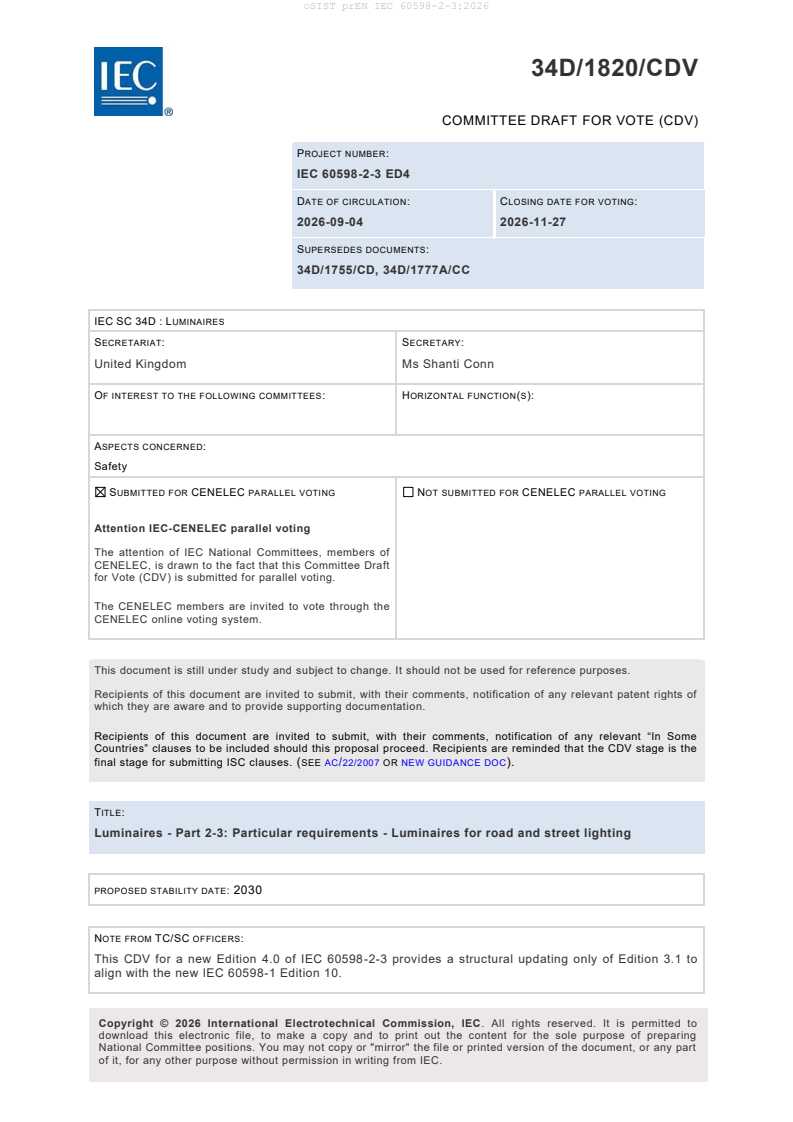
34D/1820/CDV
COMMITTEE DRAFT FOR VOTE (CDV)
PROJECT NUMBER:
IEC 60598-2-3 ED4
DATE OF CIRCULATION: CLOSING DATE FOR VOTING:
2026-09-04 2026-11-27
SUPERSEDES DOCUMENTS:
34D/1755/CD, 34D/1777A/CC
IEC SC 34D : LUMINAIRES
SECRETARIAT: SECRETARY:
United Kingdom Ms Shanti Conn
OF INTEREST TO THE FOLLOWING COMMITTEES: HORIZONTAL FUNCTION(S):
ASPECTS CONCERNED:
Safety
SUBMITTED FOR CENELEC PARALLEL VOTING NOT SUBMITTED FOR CENELEC PARALLEL VOTING
Attention IEC-CENELEC parallel voting
The attention of IEC National Committees, members of
CENELEC, is drawn to the fact that this Committee Draft
for Vote (CDV) is submitted for parallel voting.
The CENELEC members are invited to vote through the
CENELEC online voting system.
This document is still under study and subject to change. It should not be used for reference purposes.
Recipients of this document are invited to submit, with their comments, notification of any relevant patent rights of
which they are aware and to provide supporting documentation.
Recipients of this document are invited to submit, with their comments, notification of any relevant “In Some
Countries” clauses to be included should this proposal proceed. Recipients are reminded that the CDV stage is the
final stage for submitting ISC clauses. (SEE AC/22/2007 OR NEW GUIDANCE DOC).
TITLE:
Luminaires - Part 2-3: Particular requirements - Luminaires for road and street lighting
PROPOSED STABILITY DATE: 2030
NOTE FROM TC/SC OFFICERS:
This CDV for a new Edition 4.0 of IEC 60598-2-3 provides a structural updating only of Edition 3.1 to
align with the new IEC 60598-1 Edition 10.
download this electronic file, to make a copy and to print out the content for the sole purpose of preparing
National Committee positions. You may not copy or "mirror" the file or printed version of the document, or any part
of it, for any other purpose without permission in writing from IEC.
IEC CDV 60598-2-3 © IEC 2026
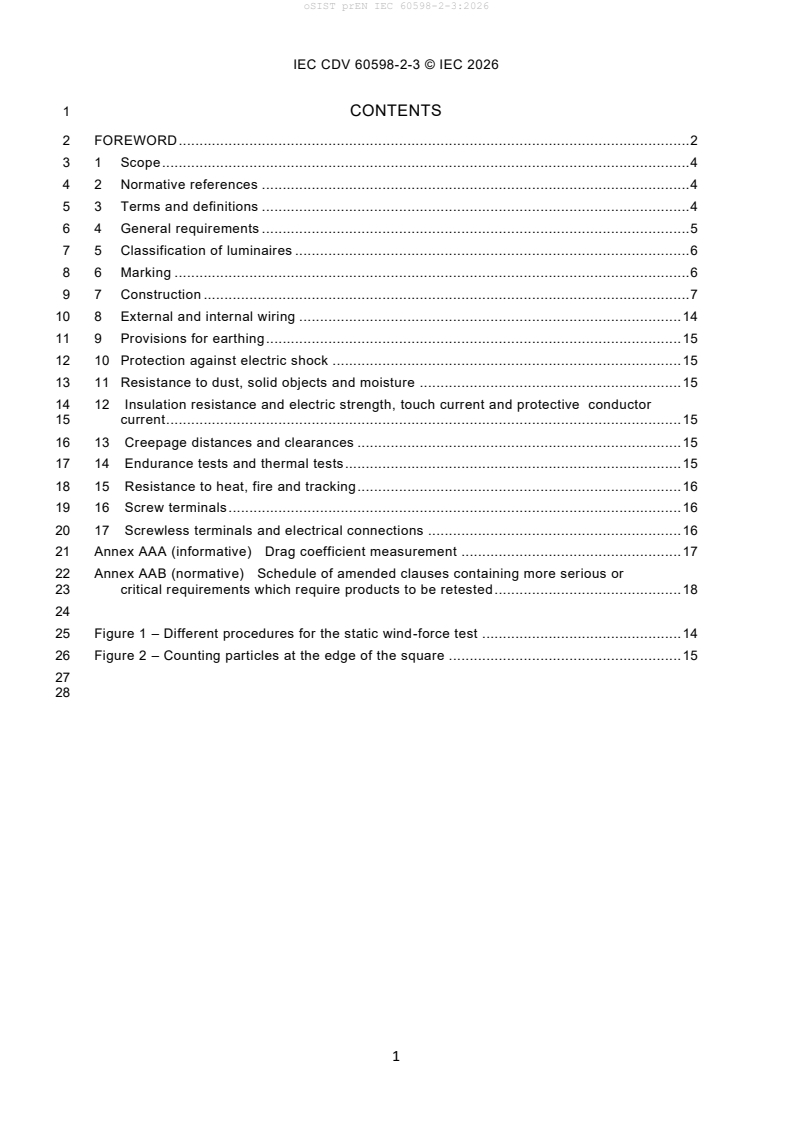
1 CONTENTS
2 FOREWORD . 2
3 1 Scope . 4
4 2 Normative references . 4
5 3 Terms and definitions . 4
6 4 General requirements . 5
7 5 Classification of luminaires . 6
8 6 Marking . 6
9 7 Construction . 7
10 8 External and internal wiring . 14
11 9 Provisions for earthing . 15
12 10 Protection against electric shock . 15
13 11 Resistance to dust, solid objects and moisture . 15
14 12 Insulation resistance and electric strength, touch current and protective conductor
15 current . 15
16 13 Creepage distances and clearances . 15
17 14 Endurance tests and thermal tests . 15
18 15 Resistance to heat, fire and tracking . 16
19 16 Screw terminals . 16
20 17 Screwless terminals and electrical connections . 16
21 Annex AAA (informative) Drag coefficient measurement . 17
22 Annex AAB (normative) Schedule of amended clauses containing more serious or
23 critical requirements which require products to be retested . 18
25 Figure 1 – Different procedures for the static wind-force test . 14
26 Figure 2 – Counting particles at the edge of the square . 15
IEC CDV 60598-2-3 © IEC 2026
29 INTERNATIONAL ELECTROTECHNICAL COMMISSION
30 ____________
32 LUMINAIRES –
34 Part 2-3: Particular requirements –
35 Luminaires for road and street lighting
39 FOREWORD
40 1) The International Electrotechnical Commission (IEC) is a worldwide organization for standardization comprising
41 all national electrotechnical committees (IEC National Committees). The object of IEC is to promote
42 international co-operation on all questions concerning standardization in the electrical and electronic fields. To
43 this end and in addition to other activities, IEC publishes International Standards, Technical Specifications,
44 Technical Reports, Publicly Available Specifications (PAS) and Guides (hereafter referred to as "IEC
45 Publication(s)"). Their preparation is entrusted to technical committees; any IEC National Committee interested
46 in the subject dealt with may participate in this preparatory work. International, governmental and non -
47 governmental organizations liaising with the IEC also participate in this preparation. IEC collaborates closely
48 with the International Organization for Standardization (ISO) in accordance with conditions determined by
49 agreement between the two organizations.
50 2) The formal decisions or agreements of IEC on technical matters express, as nearly as possible, an international
51 consensus of opinion on the relevant subjects since each technical committee has representation from all
52 interested IEC National Committees.
53 3) IEC Publications have the form of recommendations for international use and are accepted by IEC National
54 Committees in that sense. While all reasonable efforts are made to ensure that the technical content of IEC
55 Publications is accurate, IEC cannot be held responsible for the way in which they are used or for any
56 misinterpretation by any end user.
57 4) In order to promote international uniformity, IEC National Committees undertake to apply IEC Publications
58 transparently to the maximum extent possible in their national and regional publications. Any divergence
59 between any IEC Publication and the corresponding national or regional publication shall be clearly indicated in
60 the latter.
61 5) IEC itself does not provide any attestation of conformity. Independent certification bodies provide conformity
62 assessment services and, in some areas, access to IEC marks of conformity. IEC is not responsible for any
63 services carried out by independent certification bodies.
64 6) All users should ensure that they have the latest edition of this publication.
65 7) No liability shall attach to IEC or its directors, employees, servants or agents including individual experts and
66 members of its technical committees and IEC National Committees for any personal injury, property damage or
67 other damage of any nature whatsoever, whether direct or indirect, or for costs (including legal fees) and
68 expenses arising out of the publication, use of, or reliance upon, this IEC Publication or any other IEC
69 Publications.
70 8) Attention is drawn to the Normative references cited in this publication. Use of the referenced publications is
71 indispensable for the correct application of this publication.
72 9) IEC draws attention to the possibility that the implementation of this document may involve the use of (a)
73 patent(s). IEC [takes no position concerning the evidence, validity or applicability of any claimed patent rights
74 in respect thereof. As of the date of publication of this document, IEC had not received notice of (a) patent(s),
75 which may be required to implement this document. However, implementers are cautioned that this may not
76 represent the latest information, which may be obtained from the patent database available at
77 https://patents.iec.ch. IEC shall not be held responsible for identifying any or all such patent rights.
79 IEC 60598-2-3 has been prepared by subcommittee 34D: Luminaires, of IEC technical
80 committee 34: Lighting. It is an International Standard.
81 This fourth edition cancels and replaces the third edition published in 2002 and amendment
82 one published in 2011. This edition constitutes a technical revision.
83 This edition includes the following significant technical changes with respect to the previous
84 edition:
85 a) the clause numbers and structure have been aligned with those of IEC 60598-1.
86 b) more detailed glass breakage tests have been added.
IEC CDV 60598-2-3 © IEC 2026
87 c) requirements for high impact glass has been modified. Subclause 7.106.3 is now listed in
88 Annex AAB being considered more onerous compared with the last edition.
89 The text of this International Standard is based on the following documents:
Draft Report on voting
XX/XX/FDIS XX/XX/RVD
91 Full information on the voting for its approval can be found in the report on voting indicated in
92 the above table.
93 The language used for the development of this International Standard is English.
94 This document was drafted in accordance with ISO/IEC Directives, Part 2, and developed in
95 accordance with ISO/IEC Directives, Part 1 and ISO/IEC Directives, IEC Supplement, and the
96 ISO/IEC Directives, JTC 1 Supplement available at www.iec.ch/members_experts/refdocs.
97 The main document types developed by IEC are described in greater detail at
98 www.iec.ch/publications.
99 This Part 2-3 is to be used in conjunction with the latest edition of IEC 60598-1 and its
100 amendment(s). It was established on the basis of the tenth edition (2024) of that standard.
102 NOTE When “Part 1” is mentioned in this document, it refers to IEC 60598 -1.
104 Where this document states "addition", "modification" or "replacement", the relevant text of
105 Part 1 is to be adapted accordingly.
107 Subclauses, additional to those in Part 1 are numbered starting from 101; supplementary
108 annexes are entitled AAA, AAB, etc.
110 A list of all parts in the IEC 60598 series, published under the general title Luminaires can be
111 found on the IEC website.
113 The committee has decided that the contents of this document will remain unchanged until the
114 stability date indicated on the IEC website under webstore.iec.ch in the data related to the
115 specific document. At this date, the document will be
116 • reconfirmed,
117 • withdrawn,
118 • replaced by a revised edition, or
119 • amended.
IEC CDV 60598-2-3 © IEC 2026
122 LUMINAIRES –
124 Part 2-3: Particular requirements –
125 Luminaires for road and street lighting
129 1 Scope
130 This part of IEC 60598 specifies requirements for:
131 − luminaires for road, street lighting and other public outdoor lighting applications;
132 − tunnel lighting;
133 − column-integrated luminaires with a minimum total height above normal ground level of
134 2,5 m;
135 and for use with electric light sources on supply voltages not exceeding 1 000 V.
136 NOTE Where the term “luminaire” is used within this document it means luminaire(s) for road and street lighting.
138 2 Normative references
139 This clause of Part 1 applies with the following additions:
140 IEC 60068-2-75, Environmental testing – Part 2-75: Tests – Test Eh: Hammer tests
141 IEC 60598-1:2024, Luminaires - Part 1: General requirements and tests
142 IEC 62262: 2002, Degrees of protection provided by enclosures for electrical equipment
143 against external mechanical impacts (IK code)
144 IEC 62262:2002/AMD1:2021
145 IEC/TR 62696, Luminaires – Application of the IK code IEC62262
146 3 Terms and definitions
147 For the purposes of this document, the terms and definitions given in Part 1 applies with the
148 following additions:
149 ISO and IEC maintain terminology databases for use in standardization at the following
150 addresses:
151 • IEC Electropedia: available at https://www.electropedia.org/
152 • ISO Online browsing platform: available at https://www.iso.org/obp3.101
153 3.101
154 span wire
155 wire between main supports which carries the mass of the complete installation.
156 NOTE This can include several luminaires, supply cables and a stay wire.
157 3.102
158 suspension wire
159 wire attached to the span wire and carrying the mass of the luminaire
IEC CDV 60598-2-3 © IEC 2026
160 3.103
161 stay wire
162 tensioned wire between main supports to limit lateral and rotary movement of the suspended
163 luminaires
164 3.104
165 column-integrated luminaire
166 lighting system formed with a luminaire integrated in a lighting column fixed in the ground
167 3.105
168 lighting column
169 support intended to hold one or more luminaires, consisting of one or more parts in the form
170 of a post, possibly an extension piece, and if necessary, a bracket.
171 Note 1 to entry: It does not include columns for catenary lighting
172 3.106
173 nominal height
174 < of a column-integrated luminaire >
175 distance between the centre line of the point of entry of the external part and the intended
176 ground level, for column-integrated luminaires planted in the ground, or the bottom of the
177 flange plate, for column-integrated luminaires with a flange plate
178 3.107
179 door opening
180 < of a column-integrated luminaire >
181 opening in the column of a column-integrated luminaire for access to electrical equipment
182 3.108
183 cable entry slot
184 < of a column integrated luminaire >
185 opening in the part of a column-integrated luminaire below ground for the cable entry
186 3.109
187 connection box
188 < of a column integrated luminaire >
189 box containing terminal blocks for protecting devices and allowing the connection of a column-
190 integrated luminaire to the mains and the looping of supply cables
191 3.110
192 tunnel luminaire
193 luminaire for lighting tunnels which is mounted direct or on frames to the wall or ceiling of the
194 tunnel
196 4 General requirements
197 This Clause of Part 1 applies with the following additions:
198 4.101 General
199 For assessment of luminaires already assessed in accordance with the previous edition of this
200 document, full type testing is not necessary, and the product and the previous test results are
201 reviewed only against any amended clauses listed in Annex AAB.
202 In order to facilitate testing, and due to the dimensions of the sample it is, for column-
203 integrated luminaires, permitted to make use of the appropriate parts of the luminaire only .
204 4.102 Sequence of clauses
IEC CDV 60598-2-3 © IEC 2026
206 The clauses according to this document shall be applied in the following order:
208 5 Classification of luminaires
209 6 Marking
210 7 Construction
211 13 Creepage distances and clearances
212 9 Provisions for earthing
213 16 Screw terminals
214 17 Screwless terminals and electrical connections
215 8 External and internal wiring
216 10 Protection against electric shock
217 14 Endurance tests and thermal tests
218 11 Resistance to dust, solid objects and moisture
219 12 Insulation resistance and electric strength, touch current and protective conductor
220 current
221 15 Resistance to heat, fire and tracking
223 For luminaires with an IP classification greater than IP20 the tests of Clauses 14 and 11 of
224 Part 1 shall be carried out in the following order:
226 14.3 Endurance test
227 11.2 General conditions and tests for IP classification
228 14.4 Thermal test (normal operation);
229 14.5 Thermal test (abnormal operation);
230 14.6 Thermal test (failed windings in controlgear);
231 14.7 Thermal test in regard to fault conditions in controlgear or electronic devices
232 incorporated in thermoplastic luminaires
233 11.3 Humidity test
235 5 Classification of luminaires
236 This Clause of Part 1 applies.
237 NOTE Luminaires are normally suitable for one or more of the following modes of installation:
238 a) on a pipe (bracket) or the like;
239 b) on a mast (column) arm;
240 c) on a post top;
241 d) on span or suspension wires;
242 e) on a wall.
243 6 Marking
244 This Clause of Part 1 applies with the following additions:
245 6.101 The following information shall be in the installation instructions provided with the
246 luminaire:
247 a) operating position, adjustment and modes of fixing;
248 b) mass of the luminaire;
249 c) overall dimensions;
250 d) if the mounting height for normal operation is more than 8 m above ground level, the
251 maximum projected area subjected to wind force, S in m (see 7.104);
252 e) the range of cross-sectional areas of suspension wires suitable for the luminaire, if
253 applicable;
254 f) suitability for use indoors use (see 14.101);
IEC CDV 60598-2-3 © IEC 2026
255 g) dimensions of the compartment in which the connection box is placed;
256 h) the torque setting in newton metres to be applied to any bolts or screws which f ix the
257 luminaire to its support;
258 i) maximum mounting height relevant to the protection against the falling of glass particles.
259 j) suitability for tunnel lighting.
260 6.102 For adjustable lampholders or optical parts related to 7.105, suitable reference marks
261 shall be provided.
262 7 Construction
263 This Clause of Part 1 applies with the following additions:
264 7.101 General
265 All luminaires shall have protection against ingress of moisture of at least IPX3, except for
266 tunnel-lighting luminaires and translucent covers of column-integrated luminaires, for which
267 IPX5 is required.
268 For column-integrated luminaires, door opening included, the IP classification shall be as
269 follows:
270 1) parts below 2,5 m: at least IP3X
271 2) parts above 2,5 m:
272 • when the external part is open-sided, the IP classification of the translucent cover
273 shall be at least 5X;
274 • for all other parts, the IP classification shall be at least IP2X
275 7.102 Suspension on span wires
276 Luminaires for suspension on span wires shall be fitted with
...